Introduction
There is a consensus that ambidexterity can be seen as a special type of dynamic capability since it is the ability to pursue different or even conflicting goals simultaneously (O'Reilly & Tushman, Reference O'Reilly and Tushman2008; Vahlne & Ivarsson, Reference Vahlne and Ivarsson2014; Vahlne & Jonsson, Reference Vahlne and Jonsson2017). Studies such as Evers and Andersson (Reference Evers and Andersson2021) have found that, rather than trying to pursue simultaneous ambidexterity, firms may dynamically increase the levels of both exploration and exploitation by oscillating between exploration and exploitation (sequential ambidexterity). Thereby firms can enhance long-term performance. However, others disagree, for example Swift (Reference Swift2016, p. 1688) who argues that there is a ‘perilous leap between exploration and exploitation’. In particular, in a catch-up context, latecomers with both technological and market disadvantages can develop organizational learning through sequential ambidexterity and eventually catch-up with leading firms in the industry (Hobday, Reference Hobday1995; Prange, Reference Prange2012). Therefore, sequential rather than simultaneous ambidexterity is likely to benefit latecomer firms with limited resources and knowledge seeking to build dynamic technological capability.
While the value of sequential ambidexterity has been recognized, there is little research at firm level on how it is developed as a dynamic capability. A dynamic capability can be seen as a set of resources and routines that permit the firm to sense opportunities and threats, and reconfigure assets to seize opportunities over time (O'Reilly & Tushman, Reference O'Reilly and Tushman2008). If demonstrated successfully in multiple periods, sequential ambidexterity can be seen as a dynamic capability. However, the micro-foundation mechanisms of sequential ambidexterity as a dynamic capability in the context of latecomer catch-up firms have not been analysed in any depth. Recently, the dynamic capabilities’ literature has applied a micro-foundation approach to link explanatory mechanisms at the micro-level to macro-level processes and outcomes (Hallberg & Felin, Reference Hallberg and Felin2020). In the context of dynamic capabilities, a micro-foundation approach involves unpacking the processes by which dynamic capabilities are created, expressed, and transformed within organizations. Teece (Reference Teece2007) divided dynamic capability into the capabilities to sense, seize, and reconfigure. Based on this viewpoint, O'Reilly and Tushman (Reference O'Reilly and Tushman2013) argued that ambidexterity is the ability of the organization to sense and seize new opportunities through simultaneous exploration and exploitation. However, they did not analyse the micro-foundation of sequential ambidexterity as a specific dynamic capability. This differs from absorptive capacity (Lewin, Massini, & Peeters, Reference Lewin, Massini and Peeters2011) or alliance capability (Eisenhardt & Martin, Reference Eisenhardt and Martin2000) as a dynamic capability, especially in the catch-up context of latecomer firms. Therefore, the research question of this paper is: ‘how can sequential ambidexterity be developed as a specific dynamic capability in latecomer firms’ catch-up process?’.
The primary objective of this paper is thus to investigate the micro-foundations of sequential ambidexterity as a specific dynamic capability for latecomer firms in a catch-up context. There is a clear inherent tension between pursuit of exploration and exploitation, whether pursued simultaneously at an overall level (contextual ambidexterity), simultaneously through organizationally separated units within a firm (structural ambidexterity) or via temporal shifting between exploration and exploitation (sequential ambidexterity) (Birkinshaw, Zimmermann, & Raisch, Reference Birkinshaw, Zimmermann and Raisch2016; Chou, Yang, & Chiu, Reference Chou, Yang and Chiu2018). Analysis of the micro-foundations of sequential ambidexterity will help managers to understand this internal tension and develop a dynamic capability over time. Felin, Foss, Heimeriks, and Madsen (Reference Felin, Foss, Heimeriks and Madsen2012) and Galvin, Rice, and Liao (Reference Galvin, Rice and Liao2014) argue that an analysis of micro-foundations needs to consider both initial conditions and evolutionary processes. Based on this analysis, this paper develops a conceptual model of how a dynamic capability of sequential ambidexterity can be created from a micro-foundations perspective. It is based on a longitudinal case study of a Chinese company, Ningbo Cixing Company Limited, referred to as ‘Cixing’. Cixing was founded in 1988 and has become a leading firm in the global knitting machinery industry. Between 1988 and 2020, a period of 32 years, Cixing achieved a remarkable catch-up with global industry leaders, reflecting the company vision of ‘Weaving a bright future’. Through an evolutionary lens, this paper analyses how the top management of Cixing developed a dynamic capability through four key micro-foundations: (1) senior management cognition of the external environment; leading to (2) organizational learning through rhythmical shifts between explorative learning and exploitative learning; combined with (3) effective organization structure design and (4) process reconfiguration. Together these four micro-foundations eventually led to development of a dynamic capability of sequential ambidexterity. This analysis of the firm's evolutionary journey of technological catch-up not only adds to the understanding of dynamic capability and ambidexterity in a catch-up context, but also enhances our understanding of the micro-foundations required for successful sequential ambidexterity. By analysing the dynamic alignment of organization arrangements, this in-depth case study analysis provides critical insights into how latecomer firms can successfully catch-up with global leaders through sequential ambidexterity.
Literature review
In this section, three bodies of related literature are briefly reviewed as well as their connections: ambidexterity, dynamic capabilities, and technological catch-up.
Ambidexterity
Dynamic capability has been defined as a firm's ‘ability to integrate, build, and reconfigure internal and external competencies to address rapidly changing environments’ (Teece, Pisano, & Shuen, Reference Teece, Pisano and Shuen1997, p. 516). Organizational ambidexterity (sequential, simultaneous, or contextual) is reflected in a complex set of decisions and routines that enable the organization to sense and seize new opportunities through the reallocation of organizational assets (O'Reilly & Tushman, Reference O'Reilly and Tushman2013). As Nosella, Cantarello, and Filippini (Reference Nosella, Cantarello and Filippini2012) noted, the nature of ambidexterity is a capability. Felin et al. (Reference Felin, Foss, Heimeriks and Madsen2012) identified three primary categories of micro-level components underlying routines and capabilities: individuals, structure, and processes. The literature related to these three categories is reviewed briefly below.
The first category is senior managers' cognition, in particular sensing and seizing opportunities. Individual-level elements, such as characteristics and cognitions, are important building blocks for understanding collective phenomena such as dynamic capabilities (Felin et al., Reference Felin, Foss, Heimeriks and Madsen2012; Ren, Fan, Huang, & Li, Reference Ren, Fan, Huang and Li2021). Based on the micro-cognitive perspective, dynamic capability consists not only of dimensions such as resource integration and reconfiguration, but also of the cognitive dimension such as perception of the environment (Helfat & Peteraf, Reference Helfat and Peteraf2015; Hodgkinson & Healey, Reference Hodgkinson and Healey2011; Lamberg & Tikkanen, Reference Lamberg and Tikkanen2006). Cognitive capacity is a critical component of the construct of dynamic capability (Barreto, Reference Barreto2010). Scholars have examined how individual firms perceive themselves within industries and how demographic characteristics of top management teams lead to different cognitive orientations (Finkelstein & Hambrick, Reference Finkelstein and Hambrick1996). Ossenbrink, Hoppmann, and Hoffmann (Reference Ossenbrink, Hoppmann and Hoffmann2019) found evidence that differences in managers' perceptions of industry environment led to their firms' approaches to simultaneous ambidexterity. As a major component of a firm's dynamic capability, senior managers' cognition constitutes a constraint on the firm's search for precedents and innovation (Gavetti & Levinthal, Reference Gavetti and Levinthal2000; Helfat & Martin, Reference Helfat and Martin2015; Lamberg & Tikkanen, Reference Lamberg and Tikkanen2006). It therefore determines whether the firm can effectively reconfigure its resources and capacity to fit changes in the environment (Gavetti, Reference Gavetti2005). For instance, in the case of Polaroid, although the firm had gained technical capabilities in digital imaging, the lack of managerial cognition meant that the firm was unsuccessful in entering the new market and eventually lost its competitive advantage (Tripsas & Gavetti, Reference Tripsas and Gavetti2000). Therefore, senior managers' perception and grasp of opportunities is of critical importance to maintaining dynamic capability (Ossenbrink, Hoppmann, & Hoffmann, Reference Ossenbrink, Hoppmann and Hoffmann2019; Zahra, Sapienza, & Davidsson, Reference Zahra, Sapienza and Davidsson2006). However, the cognitive role of senior managers in attending to the contradictory demands of exploration and exploitation remains less clear.
The second category is organization structure design. Different organizational forms are associated with different strategies and environmental condition is one of the foundational insights from organizational research. For example, Duncan (Reference Duncan, Killman, Pondy and Sleven1976) suggested that organizations achieved ambidexterity in a sequential fashion by shifting structures over time. Firms should change their structure to adapt to environmental and technological change (O'Reilly & Tushman, Reference O'Reilly and Tushman2013; Peng & Wu, Reference Peng and Wu2013). Therefore, different structures are required for exploitation and exploration. Studies also relate different forms of organizational structure to the micro-foundations of routines and capabilities. A large body of work considers how differences in the design of organizational structures may affect routines and capabilities (Felin et al., Reference Felin, Foss, Heimeriks and Madsen2012). However, there is a need for more insights into how a senior team designs the organizational structures for sequential ambidexterity and to assist latecomer firms to achieve catch-up over time.
The third category is process reconfiguration. Key ingredients of dynamic capabilities include organizational processes directed towards learning and innovation (O'Reilly & Tushman, Reference O'Reilly and Tushman2013). In exploring how print newspapers adjusted to digital media, Gilbert (Reference Gilbert2005) proposed two distinct forms of inertia: resource rigidity (failure to change resource investment patterns) and routine rigidity (failure to change organizational processes that use those resources). Gilbert (Reference Gilbert2005) found that the problem was not the allocation of sufficient resources but the failure of the organization to change the processes necessary to use these resources effectively. A related stream of research examines the role of technologies in shaping organizational outcomes. Edmondson, Bohmer, and Pisano (Reference Edmondson, Bohmer and Pisano2001) showed that implementation of new technologies critically depends on the team learning process. These studies indicate that process reconfiguration is an important precondition for adjustment to new technology environments.
In summary, these three categories of senior managers' cognition, organization structure design and process reconfiguration are potential micro-foundation categories. While these three categories are clear, the interaction between them and with learning orientation (exploitation or exploration) is not clear. Also, their relative importance in development of a dynamic capability based on sequential ambidexterity is unclear.
Sequential ambidexterity in a technological catch-up context
Sequential ambidexterity refers to organizations oscillating over time between exploitation and exploration (Boumgarden, Nickerson, & Zenger, Reference Boumgarden, Nickerson and Zenger2012). O'Reilly and Tushman (Reference O'Reilly and Tushman2013) argued that sequential ambidexterity may be more useful for smaller firms that lack the resources required for pursuing simultaneous ambidexterity. Latecomer firms in the technological catch-up process usually have limited resources, capabilities and knowledge relative to leading firms (Hobday, Reference Hobday1995), hence sequential ambidexterity may be more beneficial and actionable.
The research on sequential ambidexterity links to changes in technology paradigms. A change in the technology paradigm is usually reflected in the embedding of certain technology breakthroughs in a long-term incremental evolution (Tushman & Anderson, Reference Tushman and Anderson1986). At the beginning of a technology S-shaped curve, firms in a specific industry expend tremendous effort and investments to acquire a new technology or develop a new, mainstream paradigm: the exploration phase. Subsequently, utilization of the innovation results in dramatic improvements in productivity and efficiency: the exploitation phase. In an S-shaped curve, the joining of the end of the existing technology paradigm and the beginning of the new technology paradigm marks the transition period between the two technology paradigms. During this period, a new phase of exploration will be launched. Therefore, the S-shaped technology curve can be viewed as sequential phases of exploration and exploitation. This is shown in Figure 1.
Exploitation, exploration, and S-shaped technology curves.

In the view of Lee and Malerba (Reference Lee and Malerba2017), a shift in technology paradigms destroys leaders' advantages that are attached to the old paradigm in a revolutionary way and opens a rare ‘window of opportunity’ for latecomer firms. This window enables firms to use their cognitive ability strategically and adopt measures to respond to the window of opportunity, thereby advancing their dynamic capability from a low level to intermediate and high levels. Gupta, Smith, and Shalley (Reference Gupta, Smith and Shalley2006) maintain that when an independent organizational unit pursues sequential ambidexterity, it should systematically shift its focus between exploration and exploitation. This continuous shift involves many changes, including the formal organizational structure, conventions, day-to-day activities, decision-making procedures, reward and punishment mechanisms, control mechanisms, and resource allocation. At a deeper level, the shift may require developing conflict management mechanisms, maintaining effective interpersonal relations, and developing rules governing the exploration–exploitation shift. Research on BMW by Birkinshaw, Zimmermann, and Raisch (Reference Birkinshaw, Zimmermann and Raisch2016) finds that in developing sequential ambidexterity, BMW implemented a variety of measures, including determining long-term strategic positioning, maintaining strategic consistency, setting a common identity, developing a formal network, and adopting work shifts. These measures facilitated the shift from exploration to exploitation through appropriate arrangements of human resources.
Although there is some relevant research, the micro-foundation mechanism of sequential ambidexterity in relation to the S-shaped technology curve has not been articulated coherently. Existing research only examines the shift from exploration to exploitation from a single perspective – either the firm's external environment or its internal factors. It rarely discusses the evolution process of sequential ambidexterity from a holistic perspective that integrates both internal and external factors (O'Reilly & Tushman, Reference O'Reilly and Tushman2013). Furthermore, as managing sequential ambidexterity involves the temporal switching (Chou, Yang, & Chiu, Reference Chou, Yang and Chiu2018), an evolutionary lens can provide insights into how firms' managers build sequential ambidexterity during the catch-up process.
Methodology
A case study methodology has been used in several ambidexterity studies (Boumgarden, Nickerson, & Zenger, Reference Boumgarden, Nickerson and Zenger2012; Foss & Kirkegaard, Reference Foss and Kirkegaard2020; Peng, Zheng, Collinson, Wu, & Wu, Reference Peng, Zheng, Collinson, Wu and Wu2020; Sun, Zhu, Sun, Müller, & Yu, Reference Sun, Zhu, Sun, Müller and Yu2020) to capture the complexities of ambidexterity and help ground the phenomenon in reality. A case study is also considered appropriate to answer ‘how’ and ‘why’ question (Yin, Reference Yin2018). In addition, a single-case study is a good fit for the scenario in which a longitudinal comparison is required for a representative firm (Siggelkow, Reference Siggelkow2007). Given that the research question of this paper is how sequential ambidexterity can be developed as a specific dynamic capability during catch-up by latecomer firms, a longitudinal single firm case study was used.
Research setting
The case selected for this study was based on the potential to develop theory. Cixing was chosen given: (1) three generations of technology transition within the period of the case study; (2) the apparent development of dynamic capability in catch-up by a latecomer firm; (3) clear sequential ambidexterity in the firm's strategy and operations with repeated periods of both exploration and exploitation; and (4) a sufficiently long history providing data over many years.
First, the knitting machinery industry to which Cixing belongs has experienced multiple technology paradigm shifts. Cixing's main product is flat knitting machines, which form a significant part of the textile mechanical equipment manufacturing industry. From a global technological evolution perspective, flat knitting machines have three generations of technology: the hand flat knitting machine, the computerized flat knitting machine, and the full-forming flat knitting machine. That has meant that the technological, market, and competitive conditions of the industry have been subject to continuous change.
Second, Hoskisson, Eden, Lau, and Wright (Reference Hoskisson, Eden, Lau and Wright2000) noted that the significance of dynamic capabilities is more prominent in the study of latecomer firms from emerging economies. Emerging economies, such as China, are experiencing an even more profound transformation than advanced economies, which results in significant market fluctuations and technology uncertainty (Dong, Yu, & Zhang, Reference Dong, Yu and Zhang2016; Hoskisson et al., Reference Hoskisson, Eden, Lau and Wright2000). China offers a rich context to test dynamic capability because its complex, fast-changing nature makes it critical for firms to evolve in order to survive and prosper in the country as well as in international markets (Zhou & Li, Reference Zhou and Li2012). In other words, it is essential for Chinese firms to develop their dynamic capability to achieve and sustain superior performance over time in a changing business environment of economic transformation and rapid industrial upgrading, expansion of domestic consumption, and growth of international markets (Dong, Yu, & Zhang, Reference Dong, Yu and Zhang2016).
Third, Cixing demonstrates a history of repeatedly shifting attention from exploration (e.g., developing entirely new products and services) to exploitation (e.g., improving existing products and operational processes) and back. In Cixing's history of over 30 years, continuous learning and innovation have enabled the firm to catch-up with leading international firms in the field of changing flat knitting machines. Cixing was founded in 1998, and its original product was hand flat knitting machines. In 2003, it entered the computerized flat knitting machine market. By 2010, its modified computerized flat knitting machines had the highest sales volume of such machines throughout the world. In 2019, Cixing successfully developed an industry-leading product: the full-forming flat knitting machine. Four rounds of innovation have enabled Cixing to continuously develop competitive advantage, reflecting enhancement in the firm's dynamic capability.
Fourth, the long period required by Cixing to catch-up with industry leaders with multiple rounds of new technology, provided sufficient data for an in-depth longitudinal study of a firm. Data included not only good access to key people and facilities within the firm, but also to historical records on the company.
Data collection
This paper follows the requirement for case studies that data be retrieved from diversified sources. Data were collected from multiple sources to allow data triangulation and to increase the accuracy of the research results (Gehman, Glaser, & Eisenhardt, Reference Gehman, Glaser, Eisenhardt, Gioia, Langley and Corley2017; Yin, Reference Yin2018). The main sources were as follows.
Semi-structured interviews
Multiple in-depth interviews were conducted with eight different firm managers, including the chief executive officer (CEO) who was also the founder, chief technical officer (CTO), chief marketing officer and five department managers. Following Corley and Gioia (Reference Corley and Gioia2004), the first author conducted all interviews to maintain consistency. Interviews were audio recorded and transcribed verbatim into text. Table 1 gives an overview of the interviews.
Overview of firm interviews

Documentation
Documents were collected from Cixing's official website, annual reports, and financial statements, the Wind database, China Academic Journals full-text database, and China Intellectual Property Bureau patent application data. In total, 95 files were collected including new articles, web pages, annual reports & IPO filings, internal magazines, and executive speeches. Table 2 gives quantitative details of documentation data according to different stages of development of the company.
Quantitative details of documentation

Observation
Direct, non-participant observation was conducted by visiting exhibitions and workshops to gather potentially insightful data. The structure and performance of machines was understood through on-site observation of equipment and questioning. The production, assembly, and debugging processes of parts and machine were understood through factory visits.
Triangulation was performed with the data obtained from interviews, documentation, and observation, to provide more reliable interpretations of the research topic (Yin, Reference Yin2018). While sources of information for the ‘first transition’ were limited, that for the rest of Cixing's history was more plentiful, enabling validation between contemporary documents and interviews.
Data analysis
First, key events were identified to build the case study history. For example, Cixing began R&D for computerized flat knitting machines in 2003; in 2006, it serialized its products; and in 2015, the firm started R&D for a full-forming flat knitting machine. Subsequently, the temporal bracketing approach was employed to divide the process into four catch-up phases: exploitation of mature technologies, exploration of new technologies, improvement to new technologies, and exploration of industry-leading technologies.
Second, the inductive theme approach proposed by Gioia, Corley, and Hamilton (Reference Gioia, Corley and Hamilton2013) was followed. Based on the case history description, a list of first-order codes was created. These first-order codes were grouped into distinct categories, most of which mapped to concepts previously found in the literature. Only when coding of the two authors involved was consistent would an item be included in the data set. When the authors' opinions differed regarding the coding of an item, they would discuss whether the item should be included in the data set or be deleted.
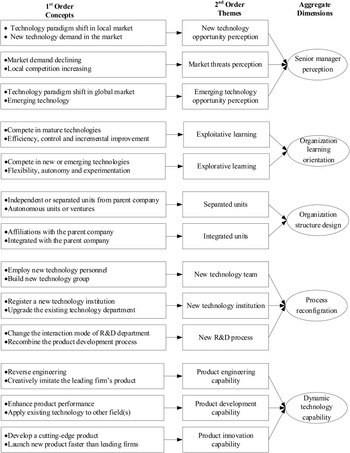
Senior manager cognition refers to firms' senior managers identifying a window of opportunity resulting from their perception of shifts in technology paradigms or of market change (Gilbert, Reference Gilbert2005; Lee & Malerba, Reference Lee and Malerba2017). Perceptions were divided into three categories: new technology opportunity perceptions, emerging technology opportunity perceptions, and market threat perceptions.
Following the view of Zollo and Winter (Reference Zollo and Winter2002) that dynamic capabilities arise from learning, exploitative, and explorative learning were used as the categories of learning orientation. Statements such as ‘compete in mature technologies’, ‘efficiency, control, and incremental improvement’, ‘develop new products or upgrade existing products within the existing technology paradigm’ were grouped under the theoretical category of ‘exploitative learning’. Similarly, statements such as ‘compete in new technologies’, ‘flexibility, autonomy, and experimentation’, ‘develop new products within the new technology paradigm’ were grouped under the theoretical category ‘explorative learning’ (March, Reference March1991).
Organization structure design was divided into two approaches: separated units or integrated units (O'Reilly & Tushman, Reference O'Reilly and Tushman2013). Organizational structures can be designed as separated (e.g., in exploration where business units or new ventures are weakly connected to each other) or integrated (e.g., in exploitation where business units are closely interconnected).
Process reconfiguration refers to the capability to optimize resource allocation processes to cope with obstructions in technological catch-up. For this purpose, the focus was on the R&D process, given the concern for technological capability building. ‘New technology team’, ‘New technology institution’, ‘New R&D process’ were the emerging categories (Christensen, Reference Christensen2013).
Dynamic technology capability was divided into three categories from a product perspective: product engineering capability, product development capability, and product innovation capability (Kim, Reference Kim1998). We use the statements of the novelty of new products to judge the levels of technology capability (Guo, Zhang, Dodgson, Gann, & Cai, Reference Guo, Zhang, Dodgson, Gann and Cai2019; Peng et al., Reference Peng, Zheng, Collinson, Wu and Wu2020).
These second-order theoretical categories were clustered into aggregate dimensions. Five aggregate dimensions were identified based on the data and the literature review: (1) senior manager cognition, (2) organization learning orientation, (3) organization structure design, (4) process reconfiguration, and (5) dynamic technology capability. Figure 2 shows an overview of the data structure.
Data structure.

An iterative approach was used to achieve an eventual match between theory, constructs, and evidence (Gioia, Corley, & Hamilton, Reference Gioia, Corley and Hamilton2013). Through continuous comparisons between the evidence and the theories, similar constructs and the connection between different pieces of evidence were identified. Working tables and figures were employed in the analysis to gradually clarify the theoretical models that emerged (Miles & Huberman, Reference Miles and Huberman1984).
Findings
This section analyses the detailed process of Cixing's technological catch-up highlighting the connection between theory and evidence from the case study. The inquiry focused on the following themes: (1) senior managers' cognition of industry environment change; (2) Cixing's organizational learning orientations; (3) organization structure, especially that targeting internal capability development, including the R&D process; and (4) dynamic technology capability that emerged as a result of catch-up.
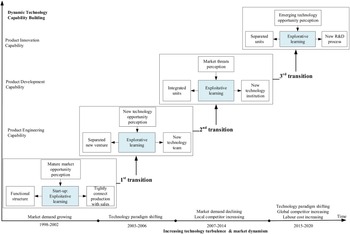
Four distinct phases of ambidexterity were identified with three associated strategic transitions. These were from exploitation during phase 1 (start-up, 1988–2002) through the first transition to exploration during phase 2 (2003–2006), through a second transition to exploitation during phase 3 (2007–2014), and then the third transition to exploration during phase 4 (2015–2020). Analysis of Cixing demonstrated a clear oscillation between exploitation and exploration in each of the three transitions, demonstrating a pattern of sequential ambidexterity over the entire catch-up period. In parallel, the number of patents that Cixing applied for increased annually, the degree of innovation in the firm's products kept growing, and the technological gap between Cixing and international leading firms was reduced. During the three strategic transitions when Cixing completed its technological catch-up, the firm's dynamic capability evolved from product engineering to product development and then to product innovation. Figure 3 shows this roadmap of Cixing sequential ambidexterity formation as it adapted to the changing environment across four phases.
Dynamic technology capability and sequential ambidexterity building in Cixing.

Start-up (1988–2002): exploitative learning
Cixing was founded in 1988 by Pingfan Sun in Taizhou, Zhejiang province, to focus on the manufacturing and sale of hand flat knitting machines. This type of knitting machine was supported by mature technologies and had a very low barrier to market entry. Information about this technology was public, and the technology was relatively easy to understand. Without significant technological advantages, Cixing capitalized on this relatively stable technology with relative low prices and rapid after-sales service, capturing the majority market share in Taizhou, one of the knitwear production and sales centres in China. As the founder stated in his interview, ‘Every machine was strictly inspected before it left the factory. If a machine was sold in the morning, by evening we would have finished installation and tests for the customer. As a result, customers were lining up. Through word of mouth, we gained an excellent reputation’.
During this phase, Cixing did not have a separate R&D department, and input from technology development was limited. Resources were mainly allocated to the production, sales, and after-sales departments. There was not even an official R&D team, though the founder himself was an excellent hand flat knitting machine technician. He led several production staff members who focused on improving existing products. For example, he introduced electric control components into the hand flat knitting machine to improve the production efficiency. Overall, there was a focus on exploitative learning at a basic level of technology development. Rapid growth in Chinese textile production, which averaged 19% a year from 1988 to 1995 (calculated from China Textile University, 1999, Table 1.1-1), drove demand for knitting equipment.
In this initial start-up phase, senior managers' cognition was focused on a rapidly growing domestic market satisfied by generic hand knitting machines combined with good service. Organizational learning was essentially exploitative, centred around incremental improvement plus service speed and quality, with processes configured around sales and support for relatively simple knitwear machinery.
First transition (2003–2006): from exploitation to exploration
After 2000, with increased demand for high-quality textile products in the domestic market and rising labour costs, computerized flat knitting machines were increasingly sought after in the market. Chinese textile producers and equipment manufacturers lagged behind international leaders who were increasingly embedding automation in market-leading equipment. This enabled advanced country manufacturers to compete in higher value segments despite rapid growth in lower value segments averaging 26% a year in the same period (calculated from China Textile University, 1999, Table 1.2-1). Keenly sensing this change of technology paradigm in the domestic market, in 2003 Pingfan Sun returned to his hometown to found a new venture. This was a separate venture from the existing production of hand flat knitting machines, specializing in R&D and manufacturing of computerized flat knitting machines. For Cixing, this was a completely new technology and was explorative learning in nature. To this end, Cixing formed a dedicated R&D team, and the firm prioritized R&D when it came to resource allocation. The founder invested substantial resources into the R&D for the computerized flat knitting machine.
The computerized flat knitting machine required what were then industry-leading technologies. Internationally leading firms were unwilling to transfer the technology, and domestic firms could only learn about the technology through independent R&D. Domestic firms in East China had acquired part of the technology through independent R&D. As well as Cixing, these included Jinlong Machinery Co. Ltd. in Changshu, Yuefa Machinery Co. Ltd. in Shaoxing, and Feihu Textile Co. Ltd in Zhuji. These firms provided more sources to obtain the necessary technology and learning opportunities that helped with Cixing's R&D and supply of parts for the new generation of machinery as well as with the assembly of the entire machine. As stated by the founder, ‘From 2003 to 2004, the supply of parts was non-existent. I had a Lexus, and drove 80,000 kilometres in one year to look for suppliers’.
In 2004, with the R&D team's continuous efforts through trial and error, 2 years of hard work enabled Cixing to successfully develop the first ‘Cixing-brand’ computerized flat knitting machine: the GE2-45S. However, due to the instability of the control system, the equipment required further improvement. Cixing commissioned the development of an electrical control system from the Hangzhou Embroidery Machine Factory, which was successful. From 2005 this system replaced the original control system that Cixing had purchased. Additionally, Cixing's own R&D team successfully improved the roller device and created a high-position roller. As a result, Cixing launched its upgraded flat knitting machine: the GE2-52S. In 2006, Cixing adopted a new electrical control system and rolled out multiple products, including the GE3-56S. Nevertheless, the R&D team still had a weak capacity and was lightweight. Data coding for this phase is provided in Table 3.
Illustrative quotes on the first transition (2003–2006)

In this phase, there is a clear shift in management perceptions from growth with existing technology to development of new technology machinery. They perceived that high value machinery demanded this new technology, and that international companies were improving their products substantially. Meanwhile, other domestic knitwear manufacturers were upgrading their technology, making Cixing less competitive. The organizational learning mode shifted from exploitative to explorative. The organization structure separated R&D from production, as well as creating a new venture focused on computerized knitting machinery. Processes were reconfigured such as those for technology search from specialist suppliers, rather than use of generic technology. While the development of Cixing's capability was clear, it was not yet at a stage where sequential ambidexterity could be seen as a dynamic capability.
Second transition (2007–2014): from exploration to exploitation
Through its previous efforts, Cixing had developed the basic capability to design and manufacture computerized flat knitting machines and to provide after-sales service. The life cycle of flat knitting machinery was on average 10 years as a capital investment for knitwear producers. After domestic knitwear producers gradually replaced their hand flat knitting machinery, Cixing's executives expected that market demand would decline around 2012. In addition, with technology diffusion of computerized flat knitting machinery to local firms, the competition would be fiercer than before.
To respond to the new market threats, Cixing's senior management decided to further improve the new generation machines' performance through more incremental innovation. In 2007, the R&D team began developing a new rising bottom board technology and replaced the pulling device on the flat knitting machine with the rising bottom board device. As a result, the machine's efficiency improved, yarn waste was reduced, and the upgraded product line was renamed from the S series to the C series. To further enhance the firm's brand reputation and improve its capability in independent R&D, in 2010 Cixing successfully acquired the third largest global manufacturer of computerized flat knitting machines: Steiger of Switzerland. As a result of the acquisition, Cixing obtained the industry-leading applique technology for flat knitting machines. As stated by the CTO in the interview, ‘Steiger's applique efficiency was 20%–30% ahead of its peers. Not only could it produce patterns in many styles, but it was also functionally very stable’.
Building on its continuous improvements in technology, in 2010 Cixing developed the HP-type high-speed computerized flat knitting machine. Afterwards, Cixing collaborated with the manufacturers of the control system for flat knitting machines to simplify the servo motor functions. Consequently, they developed a servo motor that was designed specifically for computerized flat knitting machines and rolled out the second-generation HP2-52C machine.
During this period, the applications of computerized flat knitting machinery continuously expanded, and a modified computerized flat knitting machine for making vamps (knitted socks) was developed. In 2012, Stoll of Germany developed the first all-in-one vamp machine, which created the product using 3D technology in one step without a subsequent sewing process. In the same year, Cixing began tracking this technology and in 2015 it founded the Research Institute of Vamps in Jinjiang, Fujian province. The firm explored the technology with sample designs, materials, and knitting, successfully developing and marketing its first vamp machine in 2015. Cixing became the second firm after Stoll that possessed this technology.
By the end of 2011, Cixing's R&D had grown into a heavyweight team, with the over 500 technology staff, comprising 14% of the total employees. Investment in R&D had also been boosted. During the 2010–2014 period, average annual R&D spending accounted for 4.9% of total sales revenue. An independent R&D system that consisted of dual platforms based in China and abroad was established. Data coding for this phase is shown in Table 4.
Illustrative quotes on the second transition (2007–2014)

In this stage, Cixing's senior management cognition of computerized knitting machinery shifted from exploratory to exploitative, emphasizing technology development inside Cixing to reach international levels. Organizational learning was focused on continuously upgrading and expanding the capability of computerized knitting machinery to a level that was internationally competitive in quality combined with price leadership. The organization structure again changed away from being essentially domestic to emphasize the international integration between Cixing and Steiger. This aimed to share technology internally across geographies, and was combined with new R&D process configuration. While the main trend was a shift back towards exploitative development, elements of sequential ambidexterity as a dynamic capability can be seen in this transition.
Third transition (2015–2020): from exploitation to exploration
With the rise of 3D printing and artificial intelligence, leading international firms, such as Shima and Stoll, began researching full-forming computerized flat knitting machines in the first decade of the 21st century. Around 2010, this technology had evolved into the new direction of flat knitting machines and was perceived by senior management as a new trend in China that would avoid the need to relocate production to lower cost labour areas. As the Technology Department Manager stated in the interview, ‘The traditional sweater knitting technique required many skilled and specialized workers at subsequent sewing steps, and this procedure was mechanical and repetitive. It was increasingly difficult, however, to hire sufficiently skilled workers. The full-forming flat knitting machine solved this problem’.
Full-forming flat knitting machines were an industry-leading technology, controlled by Shima of Japan and Stoll of Germany. In 2015, to seize the opportunity created by the transition from computerized flat knitting machines to full-forming flat knitting machines, Cixing transformed its Steiger subsidiary into an independent overseas R&D division and tasked it with R&D for full-forming flat knitting machines. Domestic R&D centres regularly communicated with the Steiger Division. For example, on each Friday, the Steiger Division held a video conference with the Technology Director to report R&D progress and discuss any issues. After a sample machine was successfully developed, the Swiss R&D team came to the headquarters in China for testing and guided the production department in the scale production of new products. In 2017, Cixing's R&D centre developed a new R&D process. Previously, staff members specialized in the development of a specific machine model. Under the new process, they specialized in the development of a specific part, with the parts compatible with different flat knitting machine models. Finally, the parts developed by different engineers were assembled to form a new machine model. The new process helped to bring together experience in the R&D process and made performance evaluations easier. Therefore, this process promoted more product innovation.
After 3 years of technological exploration, in 2017, Cixing developed the TAURUS full-forming flat knitting machine. By 2018, testing of the sample machine was basically complete, and it was released to the market in 2019. This machine represented a variety of innovations. For example, mechanically, the machine employed an open head and a new compound needle. In terms of software, a 3D mould simulation plate-making system was pre-installed on the machine. During this phase, Cixing's R&D staff was maintained at approximately 500 people, and the Steiger Division had 20 R&D staff. The proportion of R&D expenditure relative to total sales revenue was increased to 6.8%, and the R&D function remained as a heavyweight team. Data coding for this phase is shown in Table 5.
Illustrative quotes on the third transition (2015–2020)

In this phase, Cixing shifted again from an exploitative orientation towards exploration in relation to the new generation of full-forming flat knitting machine. Senior managers' perception was that the firm needed to develop technology that was at the leading edge of the global knitting machinery industry. Organizational learning was exploratory in focus, developing the R&D capability for full-forming flat knitting machines and the ability to translate this smoothly into production. Organization structure was again changed to align with this revised strategy and new processes configured, for example in R&D and in collaboration across international boundaries within Cixing. Overall, it is apparent that not only has sequential ambidexterity been pursued, but also that the ability to shift between exploratory and exploitative orientations has become a dynamic capability of the firm.
Discussion
This research has important theoretical and managerial implications. Theoretically, utilizing a longitudinal case study approach to trace a firm's sequential ambidexterity from an evolutionary perspective contributes to research on dynamic capability and to ambidexterity theories. Practically, Cixing's strategic transitions and sequential ambidexterity capability building practices provide important managerial insights for latecomers aiming to catch-up with industry leaders.
Theoretical implications
Micro-foundations of sequential ambidexterity as a specific dynamic capability
First, this research makes an important contribution to the ambidexterity literature by identifying micro-foundation mechanisms in a catch-up context where the latecomer firm became a leading global firm in its industry. While existing research generally maintains that learning (Eisenhardt & Martin, Reference Eisenhardt and Martin2000) and cognition (Danneels, Reference Danneels2011; Helfat & Peteraf, Reference Helfat and Peteraf2015; Tripsas & Gavetti, Reference Tripsas and Gavetti2000) are the factors that influence the formation and development of dynamic capabilities or ambidexterity, the more detailed micro-foundation mechanisms are unclear. Dong, Yu, and Zhang (Reference Dong, Yu and Zhang2016) provide a case study of a successful Chinese sportswear company. However it focused on knowledge management and the company itself has not become a global leader. Therefore, although sequential ambidexterity is recognized as an important form of firms' dynamic capability (O'Reilly & Tushman, Reference O'Reilly and Tushman2008), previous research is not fine-grained enough to provide the underlying linkage between sequential ambidexterity and developing dynamic capability, especially when looking at international success.
Based on the case study of Cixing, this paper has shown that the development of sequential ambidexterity at the micro-level is a dynamic process of aligning four micro-foundations within the firm: cognition based on senior managers' perceptions of technology and markets, organizational learning orientation, organization structure, and reconfiguration of key processes. The firm that evolves best within a dynamic environment requires a combination of accurate cognition, appropriate strategy and implementation with organization structure and process at the operational level aligned with firm learning orientations. In addition, the case shows that, in explorative learning, structural separation can overcome resource rigidity, and process reconfiguration can eliminate routine rigidity (Gilbert, Reference Gilbert2005).
The research demonstrates the importance of coherent alignment of the firm based on the identified market and technology opportunities and/or threats. O'Reilly and Tushman (Reference O'Reilly and Tushman2008) argued that only if management is consciously able to orchestrate firm assets and resources in a repeatable way can ambidexterity becomes a dynamic capability. This was clearly demonstrated in Cixing's three strategic transitions which were stages of building a dynamic capability of sequential ambidexterity. In line with Felin et al. (Reference Felin, Foss, Heimeriks and Madsen2012), the three key dimensions identified were the overall strategic orientation towards organizational learning, organization structure design, and process reconfiguration. At each stage, while the approaches to these three dimensions were different, they were aligned to meet the challenges and opportunities identified through senior managers' cognition. From the microevolution perspective, this research demonstrates how Cixing adapted to its dynamic environment over time by scrutinizing the alignment between senior team cognition, organizational strategies, organizational structure, and processes within the firm. Different cognition and organizational strategies influenced the foci of structure and processes. As a result, at each stage, the firm developed technological capability which gave it a knowledge and experience base on which it could build to renew strategies for the next transformation.
Value of sequential ambidexterity in catch-up
A second theoretical contribution of this research is that it develops a clearer understanding of how sequential ambidexterity can be of benefit in latecomer firms' catch-up. Contrary to Peng and Wu's (Reference Peng and Wu2013) and Peng et al.'s (Reference Peng, Zheng, Collinson, Wu and Wu2020) studies that focus on simultaneous ambidexterity, this study focuses on sequential ambidexterity. According to O'Reilly and Tushman (Reference O'Reilly and Tushman2013), the different ways of achieving ambidexterity may be more or less useful, contingent on the nature of the technology and market faced by firm. In the Peng and Wu's (Reference Peng and Wu2013) research, as the plastic injection machine market is so wide across different downstream industry segments, the firm could operate in different segments through separate units with different strategies, that is, through simultaneous ambidexterity. While showing that ambidexterity is critical for latecomer firms' upgrading, Peng and Wu (Reference Peng and Wu2013) focus only on simultaneous or structural ambidexterity across different organization units, not sequential ambidexterity. However, the flat knitting machine market is narrower and the main customers are knitted sweater manufacturers, so it would be very difficult to implement simultaneous ambidexterity. Peng and Wu (Reference Peng and Wu2013) also stressed the significance of tie diversity which was not critical in this case, though it was a contributor to technological development, for example in the first transition stage.
The other main research on ambidexterity as a dynamic capability is Vahlne and Jonsson's (Reference Vahlne and Jonsson2017) research, which had a different focus in that it studied leading multinational enterprises IKEA and AB Volvo to examine simultaneous processes of exploration and exploitation in the context of globalization. In contrast, this paper focuses on latecomer firms with limited resources and capabilities in a catch-up context. Analysing ambidexterity as a dynamic capability in this different context, this study has found that sequential ambidexterity is a viable strategy for catch-up and establishing a leading international position, even if simultaneous ambidexterity is desirable for industry-leading firms with richer resources and broader competencies. From these different studies, it appears that three contingent dimensions in determining the optimal approach to ambidexterity are: (i) industry leading versus catch-up firms, (ii) the scale of the firm, and (iii) the diversity of the downstream market.
Managerial implications
By investigating the growth and successful catch-up of Cixing, this research provides valuable managerial insights for latecomer firms.
Critical role of senior managers' cognition
First, from the evolution of Cixing's dynamic technology capability, there is strong support for the view that dynamic capabilities are both demonstrated and created through the cognition and subsequent decisions of senior managers. During such an evolution, the senior team's cognition of environmental changes plays an important role in directing the firm into a virtuous cycle (Burgelman, Reference Burgelman2002). An accurate perception of environmental change by senior managers helps a firm to understand the need to reallocate resources, and then to reconfigure organizational skills and assets to permit the firm to focus on exploiting existing competencies and/or to develop new ones in response to market opportunities and threats (O'Reilly & Tushman, Reference O'Reilly and Tushman2008). Therefore, senior managers of latecomer firms need to pay acute attention to both technology development trends and market opportunities, and to adapt rapidly to the environment (Ferreira, Serra, & Reis, Reference Ferreira, Serra and Reis2011). Cixing's senior managers' cognition of the technology and market environment was critical to catch-up, recognizing the changes which were emerging even when the firm had competitive advantage under current market conditions. Timing was critical, especially in recognizing when a shift in technology paradigms was a window of opportunity for a latecomer firm to catch-up with global leaders and differentiate from similar local competitors.
Need for organizational alignment
Second, this case study also demonstrates that building dynamic capabilities requires a holistic view that calls for all elements of an organization to be in alignment (Teece, Reference Teece2018). While senior managers' cognition is necessary for the firm to develop its dynamic capability, this is not sufficient by itself. Cixing's firm level dynamic capability building was based not only on its senior management perception of the environment, but also on changing the orientation of organization learning by allocating appropriate resources, combined with designing new structures and reconfiguring processes (Dong, Yu, & Zhang, Reference Dong, Yu and Zhang2016). Aligned structure and processes support exploitation or exploration in latecomer firms' technological capability development.
Specifically, when a window of opportunity is open, firms need to concentrate their focus and resources on exploration. During the ensuing exploitation period, firms will shift to carrying out activities for exploiting the technologies. Therefore, senior managers should not only develop their cognitive capacity to accurately perceive complex technologies and markets, critically interpreting information about the external environment, but also develop their ability to select and establish the appropriate structure and processes aligned with the targeted technologies and markets.
Limitations and future research directions
While this paper has demonstrated the process of building sequential ambidexterity as a dynamic capability as well as the need for alignment of senior managers' cognition, organizational learning orientation, structure, and processes, a single case study cannot address all questions regarding dynamic capability and sequential ambidexterity.
First, this is a case study of a distinctively successful firm in a competitive industry. Many other firms in the knitting machinery industry were in a similar position to Cixing in its first decade of operation but none have developed to become one of the top firms in the global industry. A limitation and opportunity for further research is therefore a wider study of firms in this industry to identify the factors differentiating firms in terms of their level of success in catch-up.
Second, there may be industry-specific factors that had a significant influence on the opportunities for catch-up. In knitting machinery, the shift of offshoring garment production to China in the 1980s meant that there was high local growth in demand at the early stages of Cixing's development which gave it the advantage of being closer than international competitors to customers in the largest world market. Hence further research could focus on catch-up in different industry contexts and dynamics.
Conclusion
As a key factor in technological catch-up for latecomer firms, sequential ambidexterity has been shown to be a valuable dynamic capability. However, the specific development process of this capability has been unclear. Through a case study of a Chinese firm's technological catch-up, this paper reveals how sequential ambidexterity became a latecomer firm's dynamic capability. The research finds that dynamic alignment of senior managers' cognition of the changing industry environment, the choice of exploratory and exploitative organizational learning, organization structure design, and process reconfiguration (especially of R&D) are the micro-foundations for latecomer firms to develop ambidexterity and dynamic capability. The evolutionary trajectory of sequential ambidexterity development that Cixing has experienced has valuable implications for latecomer firms' catch-up in an increasingly turbulent, dynamic, and competitive business environment.
Financial support
This work was supported by the National Natural Science Foundation of China (grant numbers 72172068, 71772097).
Xinmin Peng is a professor in the School of Business at Ningbo University, China. He received his PhD from Zhejiang University in 2009. His research interests are geared towards the technology innovation and strategy management for latecomer firms, as well as ambidexterity in organization learning and innovation. He has edited/co-authored several books and authored/co-authored over 60 papers as book chapters, refereed journal articles, and conference papers in these areas.