Optimal reading and spelling development depend on phonological awareness, which is the ability to identify and manipulate phonological units (syllables, onset-rimes, phonemes) in spoken language (Caravolas, Hulme, & Snowling, Reference Caravolas, Hulme and Snowling2001; Ehri, Reference Ehri, Perfetti, Rieben and Fayol1997; Goswami & Bryant, Reference Goswami and Bryant1990; Liberman, Shankweiler, Fischer, & Carter, Reference Liberman, Shankweiler, Fischer and Carter1974; McBride-Chang, Reference McBride-Chang1995; Rayner, Foorman, Perfetti, Pesetsky, & Seidenberg, Reference Rayner, Foorman, Perfetti, Pesetsky and Seidenberg2001; Wagner & Torgesen, Reference Wagner and Torgesen1987). However, the development of phonological awareness, which mediates children's transcoding between speech and writing, depends, in turn, on aural linguistic experience (Caravolas & Bruck, Reference Caravolas and Bruck1993; Chaney, Reference Chaney1998; Maclean, Bryant, & Bradley, Reference Maclean, Bryant and Bradley1987). Thus, a child's phonological lexicon, or long-term store of phonological representations in their spoken language, in tandem with phonological awareness, establishes the foundation for decoding print to speech during oral reading (Mann & Foy, Reference Mann and Foy2003) and encoding speech to print during spelling (Rickard Liow & Lau, Reference Rickard Liow and Lau2006).
In many unilingual and bilingual settings, adult speakers are diglossic, and use two phonological representations: a standard and a nonstandard (colloquial) form, for a single lexical entry. Typically the nonstandard form is used at home and the standard form is reserved for formal interactions and written communication. Before they enter kindergarten, children from diglossic families are mostly exposed to the colloquial form, so the influence of home language on literacy development is of pedagogical and theoretical interest. This study shows how a comparison of the spelling errors made by diglossic and nondiglossic Malay-speaking children can elucidate models of the cognitive processing and inform classroom practice. Looking at data on children's early spellings of shallow orthographies is especially informative because the mappings between phonology and orthography are less ambiguous than those for English.
Most children find spelling in English is a much more demanding task than reading, yet beginners often try and use letter–sound knowledge, for example, eyes as “ISE,” liked as “LIKT,” kitten as “KITN” (Read, Reference Read1986). If young children make these phonologically plausible encodings before they are taught conventional orthographic units, then they must be relying on speech-based representations (Treiman, Reference Treiman1993). Later, spelling and reading skills tend to be based on a mix of strategies (see Rittle-Johnson & Siegler, Reference Rittle-Johnson and Siegel1999). These strategies change over time (Cataldo & Ellis, Reference Cataldo and Ellis1988), and they depend on orthography–phonology consistency (Caravolas, Reference Caravolas2004; Cheung, Chen, Lai, Wong, & Hills, Reference Cheung, Chen, Lai, Wong and Hills2001; Cook & Bassetti, Reference Cook and Bassetti2005; Durgunoglu & Oney, Reference Durgunoglu and Oney1999; Harris & Hatano, 1999; Perfetti, Rieben, & Fayol, Reference Perfetti, Perfetti, Rieben and Fayol1997; Rickard Liow & Tng, Reference Rickard Liow, Tng, McBride-Chang and Chen2003), classroom teaching methods (Wimmer & Hummer, Reference Wimmer and Hummer1990; Ziegler & Goswami, Reference Ziegler and Goswami2005), print exposure (Brown & Loosemore, Reference Brown, Loosemore, Leong and Joshi1995; Kemp & Bryant, Reference Kemp and Bryant2003), and whether or not the child is learning two languages (Bialystok, Reference Bialystok2001; Bruck, Genesee, & Caravolas, Reference Bruck, Genesee, Caravolas and Blachman1997; Cook & Basetti, 2005; Rickard Liow & Lau, Reference Rickard Liow and Lau2006).
The interplay between these factors and phonological processing is often difficult to unravel once an English-speaking child enters school. This is because teaching methods for literacy skills (whole-word, whole-language, or phonics) can mask underlying cognitive–linguistic processes. However, preschoolers’ emergent spellings in an orthography with unambiguous mappings to phonology could provide unequivocal data on the use of speech-based representations. Rumi, which is widely used in South East Asia for Malay, is one such orthography, and adult speakers of Malay in Singapore and Malaysia are usually diglossic. Unlike English, Malay has syllable timing, short vowel sounds, and very few consonant clusters (Mintz, Reference Mintz1992); and there are no homophones or homophonous letters in the Rumi script. This transparency between the spoken and written forms means that Malay literacy programs emphasise phonological processing (Rickard Liow & Lee, Reference Rickard Liow and Lee2004; Rickard Liow & Poon, Reference Rickard Liow and Poon1998), and reading skills are relatively easy to acquire (cf. Ellis & Hooper, Reference Ellis and Hooper2001; Wimmer & Goswami, Reference Wimmer and Goswami1994; Ziegler & Goswami, Reference Ziegler and Goswami2005). However, the children of parents who are diglossic will be exposed to colloquial Malay almost exclusively, and will therefore develop phonological representations based on the nonstandard pronunciation used at home. If early attempts at writing are based on speech, exposure to nonstandard phonological constructions should influence the kind of spelling errors made by preschoolers. Thus, we predicted that diglossic children's invented spellings of Malay words, dictated with standard phonology, should be consistent with nonstandard phonology used at home if they rely on a speech-based redintegration.
The term redintegration has been used widely in research on memory development (e.g., Gathercole, Pickering, Hall, & Peaker, Reference Gathercole, Pickering, Hall and Peaker2001; Turner, Henry, Smith, & Brown, Reference Turner, Henry, Smith and Brown2004), and is relevant to children's reading ability (Roodenrys & Stokes, Reference Roodenrhys and Stokes2001). It refers to the restoration of the whole of something from fragments using long-term representations to support short-term recall (Hulme, Maughan, & Brown, Reference Hulme, Maughan and Brown1991). We reasoned that if diglossic children rely on their own long-term speech-based representations of words when they are starting to spell, the errors they make for target words dictated using standard pronunciation should show evidence of lexical redintegration from nonstandard phonology. The auditorily presented target word will decay from short-term memory before kindergarten children can finish writing out the letters. To complete their spellings, the children draw upon their own long-term representations (redintegration) and their phonology–orthography mappings for the target will then be consistent with nonstandard pronunciation because this is the form they speak.
The main impetus for our investigation were the questions raised by Treiman, Goswami, Tincoff, and Leevers’ (Reference Treiman, Goswami, Tincoff and Leevers1997) report of dialect effects in native English-speaking school children (chronological age 6 years, 0 months [6;0] to 8;10, with spelling ages ranging from 6;0 to 7;6). Treiman et al. (Reference Treiman, Goswami, Tincoff and Leevers1997) found subtle differences in the writing errors made by matched groups of children from the United States (Detroit) where the dialect is rhotic (/r/ can occur after a vowel in the rime of a syllable) and those made by children attending a school in the United Kingdom (Cambridge) where the dialect is nonrhotic: American children spelled words like hurt with an /r/ as “HRT,” whereas the British children omitted the /r/ and were more likely to spell the same word as “HUT.” Of importance, the observed differences were more marked for low-ability spellers, suggesting continued overreliance on speech-based representations well after school entry.
Although Treiman et al.'s (Reference Reece and Treiman1997) comparison of British and American school children demonstrated that beginners are sensitive to relatively small phonological units, it is not clear whether there were also differences in teaching methods and/or print exposure between the two groups. Moreover, the spellings of the children could have been based on the adult speech during the testing session, rather than the linguistic experience of the child. This is because Treiman et al.'s (Reference Reece and Treiman1997) target words for spelling were dictated by different experimenters, each with the same dialect as the children they tested. In a more recent study of dialect effects in American college students, Treiman (Reference Treiman2004) compared the final consonant spellings of /t/ versus /d/ of African American Vernacular (AAVE) speakers of English with those of white speakers of English, and this time both groups were asked to spell from dictation in both dialects. The results showed that both AAVE and White speakers made more <d> for <t> errors when dictated to by the AAVE speaker. Despite considerable exposure to print, like the weaker spellers in Treiman et al.'s (Reference Reece and Treiman1997) study, these adults continue to rely (too) heavily on phonological processing. Treiman's (Reference Treiman2004) target words were rated as reasonably familiar by participants so what still seems to be missing is a comparison of errors made on words versus nonwords. A lexicality effect (difference between words and nonwords) in terms of the number and/or nature of errors would clarify the role of lexical–phonological representations in spelling.
To resolve the ambiguity about whose speech is encoded by young children, and whether emergent spellings of words reflect lexical phonological representations, we developed lists of high-familiarity Malay words that have nonstandard as well as standard phonological constructions, and a set of control nonwords. Both sets of stimuli were then dictated with same standard pronunciation by the same adult speaker in a two-part study comparing the performance of preschool children from Singapore and Jakarta.
The entire ethnic Malay population in Singapore (approximately 15% of total) is extremely diglossic: standard Malay (SM) is used for reading, writing, and formal settings such as school, but nonstandard Malay (NSM) is used at home. Young children spend most of their time at home with parents and older siblings. This means they are usually exposed to NSM much more than SM from birth until they start kindergarten at age 5 years. The nonstandard form of Malay used in Singapore evolved along the Malacca Straits, between West Malaysia and Sumatra, as an interethnic language to facilitate trade with India and Arabic countries in the West, and China in the East. As in other diglossic communities, the disparity between the nonstandard form and the standard form extends to grammar, vocabulary, and phonology but only the differences in vowel sounds are relevant for this study.
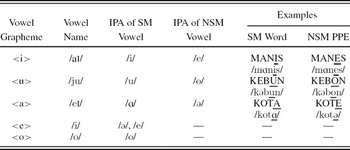
These vowel sound differences are of three kinds: /i/ to /e/ and /u/ to /o/, which occurs in all <i> and <u> vowels occupying the final closed position (e.g., manis “sweet” and kebun “garden”), and /ɑ/ to /ə/, which occurs in all <a> vowels occupying the final open position (e.g., kota “town”). These changes occur in all Malay words with the exception of English loan words in the Malay lexicon (e.g., tema “theme”). See Table 1 and Mintz (Reference Mintz1992) for more details. This means that the pronunciation for manis changes from /mɑnis/ to /mɑnes/ and so the phonologically plausible (but incorrect) spelling would be manes. Similarly, kebun changes from /kəbun/ to /kəbon/ and incorrectly spelt as kebon, and kota changes from /kotɑ/ to /kotə/ and incorrectly spelt as kote.
Contrastive vowel patterns for standard and nonstandard Malay and related phonologically plausible errors in spelling

Both forms of spoken Malay are syllable timed, so these differences are not attributable to stress patterns. Most children would have some exposure to SM if they watch Malay television channels or listen to stories read at home, but they would use NSM almost exclusively in their own conversations with friends and family members. We verified that Singaporean preschoolers tend to use NSM phonology for high frequency words by administering tests of picture naming and oral reading.
The preschoolers living in neighboring Indonesia provide a good comparison for investigating the influence of aural linguistic experience on literacy. In Jakarta, ethnic Malays form the majority (approximately 90%), and SM (called Bahasa Indonesia) is the only official language. There are some lexical and syntactic differences between the SM used in Singapore and Indonesia, stemming from earlier British and Dutch colonization, but both populations use the same Rumi orthography, and the majority of words overlap semantically. The main difference lies in the phonology: NSM is not useful in Jakarta, and so diglossic pronunciation is uncommon even at home. This means that if beginner spellers are using their own speech-based lexical redintegration to support spelling, the children in Singapore will be more likely to make errors that are phonologically plausible for the nonstandard form of Malay (e.g., vowel substitutions for manis, kebun, and kota) than the SM-speaking children in Indonesia. Importantly, these errors should occur even when target words are dictated by the same adult in SM, and they should be infrequent (or absent) for nonwords because these will be less influenced by prior linguistic experience.
Before describing how these hypotheses were tested, a synopsis of literacy instruction for Rumi orthography is appropriate. Most children start learning to read and spell when they enter kindergarten in their fifth year. Teachers usually introduce the five vowels and their sounds with SM phonology, and then the 20 consonants (<x> is not used in Malay). After brief exposure to all the letters in the alphabet, syllable phonology for a range of consonant–vowel (CV) pairs is taught. Children are encouraged to spell and sound out (chant) CV syllables in the classroom, for example, “K, A, /kɑ/. . .”; “D, A, /dɑ/. . .” before combining them into high frequency words, for example, “B, A, /bɑ/, C, A, /cɑ/, /bɑcɑ/. . .” baca (read).
Malay-speaking children seem to acquire reading and spelling skills readily (see Rickard Liow & Lee, 2004, on Malaysian pupils; Winskel & Widjaja, Reference Winskel and Widjaja2007, on Indonesian) and phonological awareness transfers to English even though some correspondences are different (Rickard Liow & Poon, Reference Rickard Liow and Poon1998, on Indonesian pupils). However, the phonology–orthography relationship for the Singapore children from diglossic families is less transparent (especially for the second vowel) because they have been regularly exposed to NSM pronunciation, for example, kota /kotɑ/→kote /kotə/. Anecdotally, teachers in Singapore have reported that pupils’ spellings are adversely affected by home language, and so we expected to find spelling errors that would be phonologically plausible for the nonstandard form of Malay. However, two other explanations needed to be ruled out before specific vowel substitutions could be attributed to phonological representations and early linguistic experience.
First, it might be the case that some children make use of letter names when they do not know individual letter sounds. Treiman (Reference Treiman1994) argued that letter names provide a bridging function in writing for English-speaking children who have not developed sufficient phonemic awareness (see also Reece & Treiman, Reference Reece and Treiman2001; Treiman & Tincoff, Reference Treiman and Tincoff1997). Thus, invented spellings should show <e> for <i> substitutions because the name for letter <e> is pronounced as /i/. Fortunately, it is possible to differentiate letter–name substitutions (LNS) from NSM vowel transcriptions by examining the vowel position. For words that have <i> as the first vowel (e.g., jimat “save”) or the final opened vowel (e.g., saji “serve food”), <e> for <i> errors must be LNS errors. This is because NSM transcriptions can only be made on the final closed vowel in words (e.g., petir “lightning”).
A second possible explanation for the expected vowel substitutions is the influence of English phonology, for example, <o> is pronounced as /u/ in English but not in Malay. In Singapore, Malay-speaking children usually acquire English as a second language in school, but do learn some English words when they are in kindergarten. This means that code mixing, rather than exposure to NSM at home, could be an explanation for kebun being spelled as kebon, and so forth. As with LNS errors, nonstandard vowel transcriptions can be differentiated from the influence of English phoneme–grapheme correspondences by examining the vowel position: for words with <u> as the first vowel (e.g., rumah “house”) or the final opened vowel (e.g., baju “clothes”), <o> for <u> substitutions must be English phoneme–grapheme substitutions rather than NSM substitutions that are made only to the final closed vowel in words (e.g., telur “egg”).
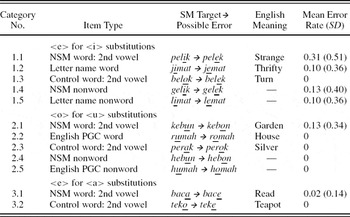
Bearing in mind these two alternative explanations to nonstandard pronunciation at home as the major influence on phonological processing, we designed Malay word and matched nonword spelling tasks suitable for young children in Singapore and Jakarta (see Table 2 for details). In Study 1 we tested whether words dictated in SM to diglossic Singapore preschoolers do result in vowel substitutions that are consistent with NSM phonology rather than letter–name substitutions or English phoneme–grapheme correspondences. For Study 2 we employed three additional oral tasks to confirm that Singaporean children do use NSM phonology when speaking more than children from Jakarta. We then matched the two groups for overall spelling abilities, to show unambiguously that phonological memory representations are influenced by exposure to nonstandard phonology, and these, in turn, affect emergent spellings of diglossic children.
Error coding system and data for Singapore children from diglossic families

STUDY 1: DIGLOSSIC MALAY-SPEAKING CHILDREN'S WORD VERSUS NONWORD SPELLINGS
Word and nonword spelling tests were developed. Both tests comprised items that might elicit NSM second vowel transcriptions (<e> for <i>, <o> for <u>, and <e> for <a>), LNS, and English phoneme–grapheme correspondences (PGCs; see Table 2) to assess whether any vowel errors are related to linguistic experience at home. Putting together the expected lexicality and vowel position effects, two predictions were made for Singaporean children from diglossic families: (H1) They will make significantly more errors involving substitutions of the second vowel in the experimental NSM words than in the matched control words, and (H2) there will be a Lexicality (word vs. nonword) × Item-Type interaction, consistent with support from redintegration, such that more substitutions will be made for the second vowel of NSM words than those made for the first vowel of (potential) LNS words and English PGC words, and there will be an effect of lexicality for NSM targets, such that more vowel transcription errors will be made for words than nonwords, with no effect of lexicality for either LNS or English PGCs targets.
Method
Participants. A total of 52 kindergarten children (M = 6.54 years, SD = 0.27) from two Singapore kindergartens took part with parental consent. There were 8 boys and 44 girls, and all participants reported Malay as the language spoken most at home.
Design. The dependent variable was the mean number of vowel substitution errors. The prediction that diglossic children do make NSM vowel substitution errors (H1) was tested using a within-participants design with type of word (experimental NSM words vs. control non-NSM words) as the independent variable. The prediction (H2) that vowel substitutions (<e> for <i> and <o> for <u>) are specific to words, and not attributable to LNS or English phoneme–grapheme substitutions (EPGS), was tested using a 2 (lexicality: word vs. nonword) × 4 (item-type: <e> for <i> NSM, <o> for <u> NSM, LNS, and EPGS) within-participants design.
Materials. The Word Spelling Test comprised 51 high-frequency Malay words (see Appendix A) taken from the Dewan Pustaka database for primary education textbooks. For Singaporeans, 32 of these items can be classified as experimental: 19 (<e> for <i> [×7], <o> for <u> [×6] and <e> for <a> [×6]) words usually pronounced with NSM phonology that might elicit nonstandard vowel substitutions in spelling, seven words likely to elicit LNS, and a further six words that might elicit EPGS. The remaining 19 control words were matched to the NSM words for vowel position, number of syllables (exact phonotactic structure of syllables could not be matched because they would yield words of the LNS and EPGS type), and frequency. The 51 words were divided into two sets and recorded onto cassette tapes in random order by a female native Malay speaker. She was blind to the purpose of the experiment but was instructed to use SM pronunciation throughout. Each item was spoken three times within 30 s: <item no> 5 s <target word> 5 s <context sentence containing target word> 5 s <target word>. The answer sheets had numbered empty boxes and two practice trials were given before each testing session began. The Nonword Spelling Test was designed to show the difference between <e> for <i> and <o> for <u> NSM errors from LNS and EPGS errors, respectively (nonwords should yield errors of LNS and EPGS type but not NSM type). Thus, 26 items were derived from a single consonant change to corresponding LNS, EPGS, as well as <e> for <i> and <o> for <u> NSM words in the spelling test were included, for example, Pelik (word) →gelik (nonword) (see Appendix A). This design ensured that the nonword spelling test had the same potential as the word spelling test to elicit NSM, LNS, and EPGS vowel substitutions (see Table 2). The nonword spelling test was recorded and presented in the same way and same time frame as the word spelling test except that the context sentence was replaced by “Cuba eja <nonword>,” which means “Please try to spell <nonword>.”
Procedure. All participants completed the word and nonword spelling tests over three classroom sessions, each lasting less than 30 min. The order of the two halves of the word spelling test was counterbalanced across the first two sessions and the nonword spelling test was administered in the third session for all pupils. All instructions were given in SM pronunciation and help was given for the practice trials only. The children were reassured that the spelling test results would not be graded for use by the kindergarten.
Results and discussion
Responses for the word and nonword tests were first scored for correct responses (whole word spelt correctly) and then coded for errors. Incorrect responses were coded as “vowel substitution errors” only if the whole word had been spelt correctly except for an <e> for <i> (e.g., pelik →pelek), <o> for <u> (e.g., kebun →kebon) or <e> for <a> (e.g., baca →bace) substitution of the second vowel of the corresponding NSM words, control words and nonwords, or an <e> for <i> (e.g., jimat →jemat) or <o> for <u> (e.g., r umah →r omah) substitution of the first vowel of LNS and EPS words and nonwords. Summary data and the coding system are shown in Table 2.
The mean number of correct spellings was 30.85 (SD = 9.78) for words (max = 51) and 11.67 (SD = 5.64) for nonwords (max = 26). The diglossic Malay children performed significantly better (proportion correct) on a 26-item subset of words (M = 0.59, SD = 0.21) than on the matched nonword list (M = 0.45, SD = 0.22), t (51) = 7.74, p = .001, d = .675. No errors were made for categories 1.3, 2.3, and 3.2 (controls for NSM words), 2.2 (EPGS words), 2.4 (<o> for <u> NSM nonwords), and 2.5 (EPGS nonwords).
NSM versus control items (H1). A series of paired sample t tests were used to check that the vowel substitutions made by diglossic children to the second vowel are indeed NSM vowel substitutions and not random vowel substitutions. There were significantly more <e> for <i> substitutions to the second vowel of the NSM words than random <e> substitutions to the second vowel of control words, Categories 1.1 versus 1.3, t (51) = 4.38, p = .001, η2 = .274, and significantly more <o> for <u> substitutions to the second vowel of NSM words than random <o> substitutions to the second vowel of control words, Categories 2.1 versus 2.3, t (51) = 2.82, p = .007, η2 = .135. However, <e> for <a> substitutions to the second vowel of NSM words did not differ significantly from random <e> substitutions to the second vowel of control words, Categories 3.1 versus 3.2, t (51) = 1, ns. Thus, the data supported the prediction (H1) that diglossic Singaporean children do make <e> for <i> and <o> for <u> vowel substitutions consistent with the NSM phonology they use at home.
NSM words of the <e> for <a> type are of CVCV phonotactic structure. The lack of <e> for <a> vowel errors is probably because of the early teaching of CVCV words compared to other phonotactic structures, that is, there is a greater likelihood that graphemic representations of CVCV words had already supplanted the internal phonological representation. Furthermore, with the acquisition of graphemic representation of CVCV words, children probably realize that the final consonant plus <e> is not legal in Rumi orthography. This is consistent with the finding that young children are sensitive to statistical properties of the orthography from an early stage (Caravolas, Kessler, Hulme, & Snowling, Reference Caravolas, Kessler, Hulme and Snowling2005), and for Malay-speaking children, CVCV words are learned first. Further analyses were conducted to rule out the two alternative explanations for the <e> for <i> and <o> for <u> substitutions.
Lexicality effects, LNS, and EPGS vowel substitutions (H2). A 2 × 4 within-participants analysis of variance (ANOVA) showed a significant Lexicality × Item-Type interaction, F (3, 153) = 2.62, p = .05, η2 = .049, as well as a main effect of lexicality, F (1, 51) = 7.16, p = .01, η2 = .123, and item type, F (3, 153) = 8.61, p = .0001, η2 = .144. Five planned comparisons (Categories 1.1 vs. 1.4, 2.1 vs. 2.4, 1.2 vs. 1.5, 1.1 vs. 1.2, and 2.1 vs. 2.1) were made using paired samples t tests to test for simple main effects, with the alpha level corrected using the Bonferroni adjustment to .05/5 = .01.
There was no simple main effect of lexicality for the <e> for <i> NSM item-type (Categories 1.1 vs. 1.4) by participants, t (51) = 2.021, p = .049, after correction for Type 1 errors. However, as predicted, there was a simple main effect of lexicality for the <o> for <u> NSM item-type (Categories 2.1 vs. 2.4) by t (51) = 2.817, p = .007, η2 = .135, although not by items after correction, t (10) = 2.15, p = .057. Post hoc analyses revealed that most of the NSM errors for nonwords involved the target cetir. A frequency count of CVCVC words in the Dewan Bahasa dan Pustaka word list showed that second vowel <i> words are of highest frequency, so <e> for <i> nonwords may have more orthographic neighbors and be more wordlike, hence, more susceptible to NSM errors. Thus, diglossic Singaporean children do make more nonstandard vowel substitutions for NSM words than nonwords, but the effect may be reduced for nonwords which are more wordlike.Footnote 1
There was no simple main effect of lexicality for LNS words (Categories 1.2 vs. 1.5) by participants subjects, t (51) < 1, or items, t (51) < 1, that is, there were the same number <e> for <i> substitutions to the first vowel of LNS words and LNS nonwords, and no simple main effects analysis was carried out for lexicality at the EPGS level (Categories 2.2 vs. 2.5) because there were no errors of this type. However, a simple main effect of word type (<e> for <i> NSM vs. LNS) at the word level was found (Categories 1.1 vs. 1.2) by participants, t (51) = 2.521, p = .01, η2 = .111, although not by items, t (12) = 1.556, p = .146. Diglossic Singaporean children made more <e> for <i> vowel substitutions to NSM words than LNS words, but this depends on the target words. A simple main effect of word type (<o> for <u> NSM vs. EPGS) at the word level was also found (Categories 2.1 vs. 2.2) by participants, t (51) = 2.817, p = .007, η2 = .135, and was borderline by items, t (10) = 2.15, p = .057. There is evidence that diglossic Singaporean children made more <o> for <u> vowel substitutions to NSM words than EPGS words.
The results of Study 1 established that Singaporean children do make <e> for <i> and <o> for <u> NSM vowel substitutions that are not attributable to either LNS or English phoneme–grapheme (EPGS) substitutions. The data show that <o> for <u> NSM errors were made when diglossic children invent the spelling of familiar words, rather than nonwords. This, in addition to taking into account the single most frequent NSM nonword error in <e> for <i> nonwords involved a highly wordlike nonword, as well as the fact that there is a lexical effect of NSM errors when the two NSM subtypes (<e> for <i> and <o> for <u>) are combined, the data suggest that NSM errors are made to words and wordlike nonwords. A lexically supported repair process (redintegration) seems to be operating. When an adult dictates familiar words in SM, the diglossic Singapore children appear to encode using their own phonological representations. Their encoding results in enhanced performance for words compared to matched nonwords, but also phonologically plausible transcriptions of NSM (i.e., the vowel substitutions).
STUDY 2: EMERGENT SPELLINGS OF DIGLOSSIC VERSUS NONDIGLOSSIC CHILDREN
The results from Study 1 confirmed that particular vowel spelling errors made by diglossic kindergarten children in Singapore are consistent with the NSM phonological representation of their own speech. The aim of Study 2 was to compare the errors made by diglossic children with those from a matched group of nondiglossic Indonesian children from Jakarta to check that vowel substitutions are a result of linguistic experience rather than poor encoding skills. First, three oral tasks (word reading, nonword reading, and picture naming) were developed and administered to children in both locations to verify that the use of NSM phonology is greater among Singapore children. Having established that the Indonesian children were not diglossic, a Location × Lexicality interaction was tested (H3). In Study 1, NSM vowel substitutions were made only to lexical entries (i.e., words but not nonwords), so planned comparisons were expected to reveal that Singaporean children do make more NSM spelling errors than Jakarta children for words, but not for nonwords.
Method
Participants. The same 52 participants for Study 1 comprised the Singapore sample, although only a subset of 37 pupils (see later) could be matched to the Jakarta group for spelling ability. The pool of participants from Jakarta comprised 41 Malay second-year kindergarten students (17 boys, 24 girls; mean age = 5.58 years, SD = 0.29). All the Jakarta participants reported Bahasa Indonesia as the language spoken most at home.
Design. The use of nonstandard phonology by the two groups was assessed using the word reading, nonword reading, and oral picture-naming tests. The design was between participants with location (Singapore vs. Jakarta) as the independent variable and number of NSM pronunciations as the dependent variable. To confirm that NSM vowel errors in the two spelling tasks were specific to lexical entries, and thus made only by the Singaporean children (H3), a 2 (Location: Singapore vs. Jakarta) × 2 (Lexicality: word vs. nonword) mixed design was employed, with NSM vowel substitutions as the dependent variable.
Materials and procedure. The Oral Word Reading Test comprised the 19 high-frequency experimental NSM Malay words used in the spelling test (i.e., those with potential <e> for <i>, <o> for <u>, and <e> for <a> NSM pronunciations). Similarly, the oral Nonword Reading Test comprised the 13 items from the nonword spelling test (i.e., those with potential for <e> for <i> and <o> for <u> NSM pronunciations; see Appendix A for the list of items). For the word and nonword reading tests, items were arranged in random order on a printed list and the children's responses were digitally recorded for subsequent analysis. The Picture-Naming Test comprised 25 items from the IPNP Database (International Picture Naming Project, 2004), with three categories of words included in the test design: those with potential <e> for <i>, <o> for <u>, and <e> for <a> NSM pronunciations during oral picture naming. These pictures were selected from an original set of 45 NSM items after 100% name agreement was obtained from Singaporean (n = 22) and Indonesian (n = 15) undergraduates. Each picture was printed out in 3.5-in. squares and pasted on a single dark blue cardboard square. After three practice trials, the children were asked to name each picture and responses were digitally recorded.
The Word Spelling and Nonword Spelling Tests given to the Indonesian children were identical to those in Study 1 and were administered in the same way across three sessions. At the design stage for the spelling tests, words were chosen only if they were common to Bahasa Melayu and Bahasa Indonesia by checking against a dictionary (Ikram, Saleh, Mutiara, Augusdin, & Rukmi, Reference Ikram, Saleh, Mutiara, Augusdin and Rukmi1985) and consulting native speakers. The native speakers also confirmed that the pronunciation used in the audio recordings matched Bahasa Indonesia phonology, and that the context sentences used made sense in the Jakarta context. In both locations, the three oral tasks were administered to individuals in the third session after the nonword spelling test.
Results and discussion
Two subgroups of children, one from each location, were matched for overall ability on the Word Spelling Test (N = 51 items; Singapore, M = 38.59, SD = 4.91; Jakarta, M = 41.24, SD = 8.16), t (72) = 1.69, p = .095. This left 37 children in each group: 7 boys, 30 girls from Singapore, 15 boys, 22 girls from Jakarta.
Oral tasks for diglossia assessment. Voice recordings from the three oral tasks were scored by two native speakers of Malay who were blind to the purpose of the experiment and the participant's location. The two raters were given examples and instructed to code for correct responses (regardless of standard or nonstandard phonology), incorrect responses, omitted responses, and whether the pronunciation was in SM or NSM. They achieved 100% interrater agreement for all categories.
The data for each of the oral tasks were then analyzed using separate independent t tests. As expected, for the Oral Word Reading Test, the Singapore children (M = 5.22, SD = 3.24) made significantly more NSM pronunciations than those from Jakarta (M = 2.32, SD = 1.75), t (72) = 4.78, p = .0001, d = .97, even though the number of correct responses in both groups was equivalent (N = 19 items; Singapore, M = 17.35, SD = 1.57; Jakarta, M = 17.81, SD = 1.52), t (72) = 1.728, ns. Similarly, for the Oral Nonword Reading Test, the Singapore children (M = 3.19, SD = 2.79) made significantly more NSM pronunciations than those from Jakarta (M = 1.81, SD = 1.46), t (72) = 2.66, p = .01, d = .59, even though the number of correct responses in both groups was equivalent (max. 13; Singapore, M = 11.73, SD = 1.39; Jakarta, M = 11.84; SD = 1.42), t (72) < 1. Finally, for the Picture-Naming Test, the Singapore group (M = 6.54, SD = 1.71) made significantly more NSM pronunciations than the Jakarta group (M = 1.97, SD = 1.24), t (72) = 13.17, p = .0001, d = 1.67, and again overall performance was equivalent in terms of correct responses (N = 25; Singapore, M = 8.16, SD = 1.36; Jakarta, M = 8.92, SD = 0.86), t (72) < 1.Footnote 2
Word and nonword spelling tests. Having established that the kindergarten children living in Singapore do use NSM phonology significantly more than their peers in Jakarta, vowel substitutions for the spelling tests were compared. Correct responses and vowel substitution errors were coded using the system described in Study 1 (see Table 2). Given the low number of <e> for <a> NSM substitutions found in Study 1, and the fact that participants from Jakarta did not make such errors, only <e> for <i> and <o> for <u> NSM words and nonwords were used for the main analyses in Study 2. The <e> for <i> and <o> for <u> NSM substitutions in words and nonwords were combined to form two measures: Word NSM substitutions and Nonword NSM substitutions, respectively.
A 2 × 2 mixed ANOVA showed a significant Location (Singapore vs. Jakarta) × Lexicality (words vs. nonwords) interaction, F (1, 72) = 4.84, p = .031, η2 = .063, a significant main effect of location, F (1, 72) = 16.134, p = .0001, η2 = .183, such that diglossic Singaporeans made more NSM vowel substitutions (M = 0.62, SD = 0.83) than the nondiglossic children from Jakarta (M = 0.05, SD = 0.23), and also a significant main effect of lexicality, F (1, 72) = 9, p = .004, η2 = .111, with more NSM vowel substitutions made to words (M = 0.27, SD = 0.56) than nonwords (M = 0.07, SD = 0.3).Footnote 3 Two planned comparisons were made using paired samples t tests to test for simple main effects, with the alpha level corrected using the Bonferroni adjustment to .05/2 = .025.
As predicted, diglossic children from Singapore made more NSM vowel substitutions for words than children from Jakarta, with a simple main effect significant by participants, t (72) = 3.608, p = .001, d = .85; Singapore, M = 0.49, SD = 0.69; Jakarta, M = 0.05, SD = 0.23, as well as by items, t (25) = 2.559, p = .017, η2 = .208. Furthermore, diglossic children from Singapore did not make more NSM vowel substitutions for nonwords than children from Jakarta participants: Singapore, M = 0.14, SD = 0.42; Jakarta, M = 0, SD = 0, t (72) = 1.96, ns. These results provide solid evidence that children's early spellings of words are based on the pronunciation they and their parents use at home.
GENERAL DISCUSSION
Young children who have had limited exposure to print can invent phonologically plausible spellings by transcribing speech. From Treiman et al.'s (Reference Reece and Treiman1997) comparison of American and British primary school children, it is not clear whether their spelling attempts were based on the phonology of the adult narrator's phonology during the testing session, or compiled from their own phonological representations. From the two experiments reported here, it is now clear that diglossic children base their spellings on their own nonlexical phonological representations because they make phonologically plausible errors for the nonstandard form even when the target words are dictated by an adult using the standard form. This finding represents an important step toward a more complete understanding of how early linguistic experience influences the development of phonological representations, and hence literacy skills.
For Rumi Malay orthography, unlike English, the sound:print relationship is very transparent for the standard pronunciation. However, the phonology of the second vowel changes when some Malay words are spoken with nonstandard pronunciation. We exploited this difference in the pronunciation by diglossic (Singapore) and nondiglossic (Jakarta) families, and compared the nature and number of vowel substitutions made on word and nonword spelling tests by 6-year-old preschoolers. When the words were dictated by the same adult SM speaker to two groups who were matched for spelling proficiency, only the children from diglossic families encoded the vowels so that they were consistent with nonstandard pronunciation. The position of these vowel errors suggests they were not attributable to the use of letter names, or to English code mixing, and equivalent substitutions were very rare for the matched set of nonwords for which redintegration is less likely to occur.
Learning to spell vowels is particularly difficult in English (Stage & Wagner, Reference Stage and Wagner1992; Treiman, Reference Treiman1993), and definitive empirical studies would be complex. This fine-grained analysis of young children's vowel substitutions in Rumi, a shallow alphabetic orthography with short vowels, provides unusually clear evidence that early linguistic experience, such as exposure to nonstandard phonology, influences spelling skills. Target words spoken in SM by an adult were recognized by the diglossic and nondiglossic children, and both groups appear to have used activated stored lexical representations of phonology to reconstruct plausible spellings. A process of redintegration (see Gathercole, Reference Gathercole2006) would be necessary during a spelling task because auditory input decays rapidly (about 2 s) and volitional rehearsal is uncommon before the age of 7 years (Gathercole & Hitch, Reference Gathercole, Hitch, Collins, Gathercole, Conway and Morris1993). For the nondiglossic children, lexically based reconstruction results in a correct spelling because Rumi is so shallow for SM pronunciation. For the diglossic children, the same redintegration process is more error prone because their phonological representations are based on the NSM pronunciation they have learned at home, and hence, the observed vowel substitutions.
Because redintegration (or lexically supported repair) is based on the child's store of known phonological representations, vowel substitutions for matched nonwords were rare. When they did occur (only cetir) it is possible that the children were making an approximation to a phonologically close lexical entry (petir). Repetition accuracy is also associated with the wordlikeness of a nonword (Gathercole, Willis, & Baddeley, Reference Gathercole, Willis and Baddeley1991), and although our nonwords were very wordlike (substitution of a single phoneme), it seems that spellers of transparent Rumi rarely need to make analogies with words. Once diglossic (and dialect-speaking) children are exposed to print regularly, and have had more exposure to standard phonology in the school, their spelling performance would be expected to show steady improvement. However, for high-frequency words, the phonological representations of the nonstandard form are well established and likely to remain strong for diglossic children because they will be regularly used in all informal settings. Moreover, if speech input and output buffers are linked neurologically, as Jacquemot and Scott (Reference Jacquemot and Scott2006) have claimed, the nonstandard form will be reinforced more often than the standard form through speech production as well as compre-hension.
The impact of code differences, arising from parental diglossia and dialect variations, on literacy has been underexplored in all languages, yet it seems that early exposure to a particular phonological form does influence cognitive–linguistic processing. This investigation of children's phonological representations, evidenced by their early attempts at writing in a shallow orthography, revealed vowel spellings that are consistent with the pronunciation they use and hear at home, whether this is standard or NSM. For speakers of SM in Indonesia, reliance on speech-based processing for spelling enhances performance because there is only one phonological form for each word, and the orthography is very shallow. For children from diglossic Malay-speaking families in Singapore, exposure to nonstandard phono-logy during vocabulary acquisition results in subtle deviations in the phonological memory representations needed for literacy in the standard form. This finding has pedagogical implications because early experience of nonstandard pronunciation at home is also commonplace in bilingual as well as diglossic communities. Messbauer and De Jong (Reference Messbauer and De Jong2006) and others have argued that dyslexic children have impairments in the long-term representation of the phonological features of words. Diglossic children do not have impairments as such but their phonological representations of the nonstandard form will be much stronger than those for the standard form before they enter school.
The kinds of errors we observed for Rumi Malay probably reflect a temporary transition phase for pupils learning languages that have transparent phonology–orthography mappings. For more opaque orthographies such as English, phonologically plausible errors may endure in adulthood, cf. Treiman's (Reference Treiman2004) AAVE college students. Despite the strong support for teaching methods based on phonological awareness, optimal spelling development for diglossic and dialect-speaking children may depend on learning particular subsets of word-specific representations (Kreiner & Gough, Reference Kreiner and Gough1990), whether or not the orthography is shallow like Malay, or relatively deep like English.
APPENDIX A
WORDS AND NONWORDS USED FOR THE SPELLING TASKS
<e> for <i> substitutions
1.1 NSM words, second vowel: pelik, naik, petir, cair, main, hasil, laris
1.2 Letter name words: jimat, tiap, biar, tiang, biji, saji, ikan
1.3 Control words, second vowel: belok, petak, kasar, lebar, dewan, belot, bebas
1.4 NSM nonwords: gelik, raik, cetir, kair, hain, fasil, faris
1.5 Letter name nonwords: limat, kiap, miar, giang, liji, faji, ikaf
<o> for <u> substitutions
2.1 NSM words, second vowel: jauh, kebun, pukul, kaum, lurus, hukum
2.2 English phoneme–grapheme words: rumah, luar, buat, kurap, urat, ucap
2.3 Control words, second vowel: perak, tanah, sawah, tebar, tekad, cakap
2.4 NSM nonwords: kauh, hebun, cukul, lukum, raum, curus
2.5 English phoneme–grapheme nonwords: humah, guar, ruat, murap, urak, ucam
<e> for <a> substitutions
3.1 NSM words, second vowel: baca, bela, desa, dewa, mana, raya
3.2 Control words, second vowel: teko, tema, akar, arah, agar, ajar
Note that <e> for <a> NSM words are CVCV structure and tend to have <a> for the second vowel. This constraint meant that there were few CVCV words available in the database to use as controls. Letter and syllable length were controlled for to make up for the difference in phonotactic structures. Tema is an English loan word that means “theme.” It is not subjected to the typical vowel changes in NSM and could be used as a control word.
ACKNOWLEDGMENTS
We are indebted to the kindergarten children and teachers in Singapore and Jakarta for their warm welcome; to Maswati bte Mahoed, Madam Zinatuddar Fuad, and their friends for support with data collection; and to Sue Gathercole for her insightful comments on redintegration.