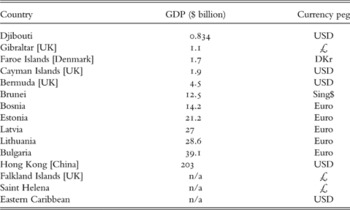
During the 1990s there was considerable enthusiasm for currency boards, particularly for small open economies, until the collapse of the Argentine system in 2001–2 and the subsequent decline of the USD.Footnote 2 Since then, currency boards have been used mainly by colonies and by Eastern European countries seeking to dispel the shadow of chaotic monetary episodes by operating currency boards pegged to the Euro. Table 1 shows that Hong Kong Special Administrative Region (SAR) is now by far the largest economy to operate a currency board and no longer conforms either to the colonial rationale or to the regime change rationale for a currency board.Footnote 3 This system has recently become more controversial because of the intensified economic integration with the mainland, the decline of the USD on world markets and the appreciation of the Chinese Renminbi (RMB) against the HKD since it adopted a flexible basket peg in July 2005.Footnote 4 Several authors who have noted the relatively poor performance of Hong Kong compared to Singapore have recommended a monitored band system similar to Singapore, although this advice came before the RMB regime was changed.Footnote 5 In this context, it is timely to reconsider why Hong Kong abandoned the currency board under similar circumstances when their anchor currency was depreciating on world markets, the RMB was appreciating against the HKD and the international monetary system appeared on the brink of disarray.
Economies operating currency board or quasi-currency board systems, december 2007

Source: Countries identified by Kurt Schuler, http://users.erols.com/kurrency/intro.htm
Note: Schuler excludes Latvia. GDP from CIA Yearbook and relates to 2007 except Gibraltar, Faroe Islands 2005 and Cayman Islands, Bermuda 2004 purchasing power parity.
In its purist form, a currency board offers a cheap and automatic monetary mechanism whereby notes are passively issued and redeemed against foreign exchange at a fixed exchange rate. The narrow money supply is thus determined by the inflow and outflow of foreign exchange in response to the balance of payments and the government is unable to exercise monetary discretion. Hong Kong's system was originally introduced in 1935 along the pattern of the British colonial monetary system of currency boards with funds managed in London by the Crown Agents for the Colonies, pegged to sterling and holding at least 100 per cent sterling reserves. From the 1950s all colonial currency boards were legally entitled to invest their resources in local assets, usually up to 30 per cent of total currency reserves, on the basis that this part of the currency issue was unlikely ever to be presented for redemption.Footnote 6 By the 1960s, the Hong Kong Exchange Fund aimed to keep at least 105 per cent nominal cover, but we shall see that the Fund's investment strategy meant that 70 per cent of its assets were illiquid, implying an expectation that only 30 per cent of liabilities were likely to be presented for redemption – this proved a costly mistake. Previous studies assumed that the excess over 105 per cent cover for liabilities was routinely transferred to government accounts.Footnote 7 This was not the case – a transfer to the Development Loan Fund took place only once, in 1964, although the financial secretary claimed that assets in the Exchange Fund were earmarked for this purpose. The Fund's assets were all in sterling, held in London by the Crown Agents, and its liabilities were denominated in HKD. This currency mismatch did not pose a risk until the £/HKD exchange rate came under threat in 1967.
When increasing the local supply of currency, the note-issuing banks (HSBC, Chartered Bank [now Standard Chartered] and Mercantile Bank) credited the Hong Kong Exchange Fund's account in London with sterling and the financial secretary issued in return HKD-denominated certificates of indebtedness (CoI) to the value of these sterling deposits at the pegged exchange rate. The banks were then entitled to issue this value of HKD notes. CoI could be redeemed through the Exchange Fund at the cost of a slight exchange margin when the banks wanted to withdraw notes from circulation. HSBC issued about 90 per cent of notes. The Fund invested the sterling through the Crown Agents in London and received the interest, using it to pay for the costs of printing, transport, cancellation etc. of the excess note issue for HSBC and Chartered but not for Mercantile Bank. One final aspect is the unusual governance of the Exchange Fund through the Exchange Fund Advisory Committee (EFAC), comprised of the financial secretary (chair), the accountant general (member and secretary) and representatives from each of the note-issuing banks, with no outside participants. The accounts and proceedings were strictly confidential and not reported to the Legislative Council (LegCo) or the Executive Council (ExecCo). EFAC routinely reviewed and accepted the Annual Report and Balance Sheet of the Fund, advised on investment strategy and during the late 1960s was instrumental in amending the operations of the Fund.
When sterling was floated against the USD and other currencies in June 1972, Hong Kong was faced with the choice of whether to maintain the peg to sterling and float against most currencies, to float independently, or to peg to another currency. The decision was made to peg to the USD and at the same time to alter the operation of the Exchange Fund so that it accepted HKD balances rather than sterling as backing for the note issue. Note-issuing banks credited special deposit accounts ear-marked for the Exchange Fund and received the equivalent value of certificates of indebtedness against which they issued notes. Overnight, this marked the end of the formal currency board rules that require foreign currency backing for the note issue.Footnote 8 By transferring the assets of the Exchange Fund from London to the Hong Kong banking system, this innovation changed the nature of the monetary system fundamentally. When the HKD floated free of its pegged rate in November 1974, the government was left with no mechanism to control monetary expansion. Several scholars have recently been critical of the abandonment of the strict currency board rules in July 1972 when certificates of indebtedness were allowed to be issued against HKD balances rather than foreign exchange.Footnote 9 They interpret this important change as an unintentional response to immediate events, taken without a full understanding of the underlying consequences for monetary stability when there was no central bank and no mechanism to control money and credit expansion. This article examines this decision in its longer-term policy context and argues that it was the culmination of a series of alterations to the operation of the Exchange Fund during the collapse of the international monetary system from 1967 onwards. The main argument is that the Hong Kong government's response to the crumbling of the international monetary system was to make the Exchange Fund operate as much more than a currency board well before 1972. In particular, it was used to provide forward cover for commercial banks, but this proved especially costly in the volatile environment of the end of the global pegged exchange rate system, so that in 1973 the cover for currency issue fell from 117 to 82 per cent.
I
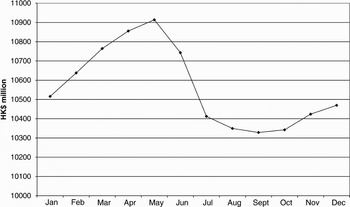
Breaking the currency board rule of issuing notes only against foreign exchange was first considered five years before it was actually done. During the May 1967 political disturbances in Hong Kong, the note issue had to be expanded dramatically in response to a run on banks.Footnote 10 At the same time the Bank of China demanded to buy large sums of sterling and this led the HSBC to identify a looming shortage of sterling to meet these two demands. The issue of notes against HKD balances was considered as a way to avoid the danger of a monetary contraction and to counteract the sterling shortage. This was not in the end required, but the expansionary impact of an HKD-backed note issue was clearly understood by J. J. Cowperthwaite as financial secretary.
Hong Kong M2 in 1967 (monthly)

The HSBC made a range of suggestions to government in early June 1967, including issuing notes without 100 per cent sterling backing, or issuing them for ‘free’ against the Exchange Fund's surplus reserves. This memorandum was sent by the Hong Kong government to the Colonial Office in London where Cowperthwaite was due to arrive on 7 June. Back home, the Hong Kong government suggested that HSBC pledge its own UK government securities rather than sterling cash against CoI but this was quickly rejected. The chairman, F. J. Knightly, replied ‘our securities were part of the bank's reserves as a whole and were not available to meet a crisis inflation of the Note Issue. I have always thought there was a trap attached to this Note Issue role of ours.’Footnote 11 In London, Cowperthwaite suggested to the Bank of England that it would be legal for HSBC to pledge HKD balances as backing for new note issue. This would merely require an administrative decision from Cowperthwaite that he would be willing to make. Haslam of the Bank of England suggested that HSBC should take up this solution and both George Stewart of the London office and Northcote (Chartered Bank) favoured this outcome if the situation worsened.Footnote 12 Stewart also reported to his Hong Kong office that the Crown Agents were willing to lend part of the increase in the liquid sterling funds that arose from the increased note issue back to the HSBC and Chartered Banks.Footnote 13 It is not clear if this was done, but it clearly would mark a departure from the monetary orthodoxy of the currency board if this did occur.
Instead of these more radical departures, at the end of June the Hong Kong government deposited £10 m on seven-day deposit with the HSBC, thus increasing HSBC's London sterling holdings from £42 m to £52 m to allow them to increase the note issue or ‘feed’ the Bank of China if necessary.Footnote 14 In the end, the crisis was short-lived and currency returned to the banks so that the note issue was successfully reduced as confidence returned. Nevertheless, this episode does establish that the issue of CoI against HKD balances was considered in the context of avoiding a monetary contraction. Although the details of the discussions are not available, it seems most likely that the expansionary implications were understood at the time. This episode also established that this practice would fall within the existing Exchange Fund Ordinance, requiring only an administrative decision by the financial secretary (taken ultimately in July 1972). The authorities did not take this step because the monetary contraction ceased and a change of policy was not in the end required.
II
On 18 November 1967 sterling was devalued by 14.3 per cent, placing considerable pressure on Hong Kong to determine its response. Initially, the Executive Council agreed that the HKD should follow sterling. This outcome was described by Holmer, a Bank of England official who was present at the meeting, as ‘a struggle between the banking group and some officials, and the Chinese members who were particularly concerned with the prospects of rising costs….The decision to go with sterling was nevertheless reached within three-quarters of an hour after my withdrawing from the Council room. The banking view seemed very quickly to prevail.’Footnote 15 A few days later, as public pressure increased over rises in the cost of living, Holmer reported that ‘the administration had cold feet’ and on 23 November Cowperthwaite announced a revaluation of 10 per cent against the pound (from HKD16 to HKD14.5), amounting to a devaluation of 5.7 per cent against the USD. At the same time, he privately asked for Bank of England support in arranging (but not paying for) compensation to banks for initially making the ‘wrong decision’, although Holmer remarked that ‘to embark on a policy of compensation without knowing the dimensions of the problem with any precision seems to me to invite embarrassment’. At this point Hong Kong's total sterling assets were about £400 m including outstanding sterling export contracts, so the devaluation created an immediate loss of about £56 m.Footnote 16
Since banks stood to lose on the HKD value of their sterling assets from the revaluation, Cowperthwaite offered the HSBC and Chartered compensation out of the reserves of the Exchange Fund. In LegCo on 29 November Cowperthwaite made public his offer of a guarantee through the Fund for movements in the HKD/£ rate in 1966 (this was news to P. A. Graham, manager at the Chartered Bank, who first heard of the financial secretary's intentions in the South China Morning Post).Footnote 17 The HSBC recorded an oral undertaking by Cowperthwaite made in October 1966, when the USD value of sterling was under pressure.Footnote 18 The rationale for compensation was initially restricted to the note-issuing banks who had, ‘by convention’, an obligation to buy and sell sterling on demand within a narrow range of exchange rates. Compensation was not so easy to justify for other exchange banks except that exchange control prevented them holding large liquid assets in any foreign currency other than sterling. Unauthorised banks had no such claim. Cowperthwaite summarised that ‘the principle it is proposed to apply is that net losses be met only in respect of those transactions on which it was impossible for the banking system to cover its position; and not in respect of those where cover could be obtained from customer or otherwise even if this was not the general custom’.Footnote 19
Of the total compensation eventually paid to authorised banks in 1968 (£10.4 m) the HSBC received the lion's share (£5.7 m or HKD82.8 m).Footnote 20 In addition, HSBC's London Office compensation was £240,625 (equivalent to HKD3.5 m) paid on 2 December 1968.Footnote 21 Hang Seng Bank (owned by HSBC) was particularly insistent on receiving compensation because it had unwisely built up its sterling balances in London just prior to the devaluation for commercial purposes and to take advantage of high interest rates there.Footnote 22 After much lobbying, late in 1968 Cowperthwaite agreed that the Fund should compensate six unauthorised banks' losses to a total of £196,971, paid in early 1969.Footnote 23 The HKD value of the Exchange Fund's assets fell by the equivalent of £13 m in 1967 and then total compensation to banks amounted to £10.6 m over the next two years, resulting in a total cost of £23.6 m or 16.5 per cent of total assets in 1968.
In March 1968, as the international monetary system was rocked by the Gold Pool Crisis, the HSBC's overbought position in sterling was accumulating quickly and they wrote to Cowperthwaite seeking cover if the HKD/£ rate increased again. In response, Cowperthwaite offered to use the borrowing powers of the Fund (then HKD30 m) to engage in a forward swap to provide cover. The Fund would borrow HKD from HSBC; HSBC would then sell an equivalent amount of sterling to the Fund with a repurchase contract set at the prevailing exchange rate. The Fund would pay interest on this borrowing at the interbank rate.Footnote 24 This met with a favourable response at HSBC, but it is not known whether the deal was implemented. What is important, however, is that this initiated the use of the financial secretary's borrowing powers through the Exchange Fund to offer forward cover to banks. The correspondence at this time referred on both sides to the HSBCs responsibilities as a ‘quasi-central bank’ for Hong Kong to protect the HKD/£ exchange rate.
The Fund's compensation agreement for banks counteracted the deflationary impact of revaluation of the HKD and established that the Exchange Fund was responsible for the effects of exchange rate variation on banks, although not yet for direct intervention in the exchange market. As the international monetary system crumbled, this responsibility became more acute and more costly.
III
In the months after the devaluation, the Hong Kong government lobbied successfully to be the only sterling area member to receive any form of future exchange guarantee for their sterling holdings.Footnote 25 The rationale from the British point of view was not only the statutory requirement for the colony to hold sterling assets, but also the very large volume of sterling held by private banks, which Cowperthwaite threatened would be dumped on the market if there was no cover for official assets. In May 1968 the British Treasury agreed to issue £100 m − £150 m worth of seven-year non-negotiable HKD bonds in exchange for 50 per cent of Hong Kong's sterling assets, effectively covering the HKD value of this proportion of Hong Kong's sterling reserves in the event of a depreciation of sterling against the HKD. As part of the agreement, the Hong Kong government agreed not to revalue the HKD unilaterally, so the scheme only protected Hong Kong from a general realignment of sterling's parity similar to the 1967 devaluation. Executive Council members accepted this proposal only very reluctantly since they wanted a USD guarantee.
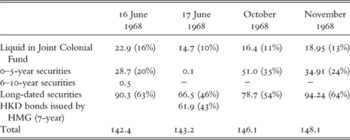
On 17 June the Exchange Fund spent £61.875 m to buy HKD900 m worth of the bonds, transforming the nature of their assets. The impact on the Exchange Fund was to break the guidelines set by EFAC in June 1966 for the investments of the Fund; which were that assets to the value of the CoI should be invested 10 per cent in the Joint Colonial Fund (liquid), 20 per cent in securities up to five years' maturity and 70 per cent in long-dated securities chosen to maximise yield. In addition, the proceeds of all new CoI should be held liquid for three months. The first £5 m of any surplus assets should be liquid, the next £10 m invested in securities up to five years and the rest in long-dated securities. Liquid assets were thus held outside the domestic banking system in the Joint Colonial Fund managed by the Crown Agents in London, and 70 per cent of the assets were illiquid. In April 1967 EFAC further agreed that the Crown Agents be instructed that all investments should be in British securities (i.e. British government or local and public authorities) and none in other Commonwealth stock.Footnote 26
In the Fund's accounts, the new HKD bonds were treated as liquid assets, although they were qualitatively different from liquid assets in the Joint Colonial Fund. The bonds could be liquidated by the Exchange Fund for ‘reasons of liquidity’ without consulting with London, but otherwise they could only be sold after mutual agreement with the British government. Any bonds prematurely redeemed also earned a punitive interest rate of about 1 per cent below the National Loan Fund rate in the first three years, falling to 0.375 per cent below this rate once the full term was reached in seven years. The HKD bond purchase overwhelmed the Exchange Fund's accounts, completely liquidating the Fund's holding of short-term securities, replacing one-third of long-dated securities as well as reducing the liquid assets in the Joint Colonial Fund. The Crown Agents were asked to sell the shorter end of the longer-term securities to minimise losses on yields, but it was estimated that with the National Loan Fund rate at 7 3/8 per cent, the cost in loss of interest of taking up £100 m of the bonds would be about £400,000 p.a. on the yield to redemption of the current investments.Footnote 27 Importantly for the next stage in the Exchange Fund's innovation, in order to take up the issue the Exchange Fund ordinance was revised to increase the borrowing power of the Fund from HKD30 m to HKD1500 m. Table 2 shows that the HKD Bonds made up over 43 per cent of the Exchange Fund's total assets in June 1968. On 25 September 1968 the HKD bonds were redeemed without interest penalty when a new sterling agreement came into force and the proceeds (£63.1 m) were reinvested in sterling securities by the Crown Agents on behalf of the Fund.Footnote 28
Exchange Fund investments 1968 (£ million, % in parentheses)

Source: Exchange Fund investments, memo for EFAC meeting 28 October 1968. HSBC Group Archive, Chairman's files, Box 2.19.
Although short-lived, the London HKD bond scheme had an important effect on the evolution of the Exchange Fund. Because of the low market value of long-dated securities, these were no longer very liquid and it was noted in EFAC that selling them to buy HKD bonds would result in losses.Footnote 29 In mid June 1968, Cowperthwaite proposed a scheme to allow the Exchange Fund to take over short-term sterling assets from note-issuing banks to buy the bonds. He suggested that HSBC and Chartered should supply the Fund with sterling to a total of about £40 m shared 5 to 1 by each bank respectively. In return, the Fund would issue non-negotiable one-year HKD bonds at 7.06 per cent interest p.a. that would be freely convertible into certificates of indebtedness to back any necessary expansion of the note issue (i.e. the Fund would forego its exchange margin).Footnote 30 The HSBC share was £33 m and the Chartered was to take up the other £7 m. The banks agreed these terms at the end of June and HSBC proposed to take up £22 m of the Fund bonds by 25 July.Footnote 31 By this time, however, London had new proposals for all sterling asset holders that replaced the London HKD Bonds and the scheme was not implemented.Footnote 32 Nevertheless, this strategy was soon offered to all banks as a way to take their sterling assets into the USD/£ guarantee on official sterling assets offered by London in July.
IV
The subsequent Sterling Agreement between Hong Kong and the UK was one of 34 similar agreements negotiated in the summer of 1968 in which signatories agreed to keep a minimum proportion of their reserve in sterling (MSP) in return for an exchange guarantee of the USD value of 90 per cent of their official government-held sterling reserves. These guarantees in turn were backed by a line of credit of USD2bn provided by G10 central banks through the Bank for International Settlements (the Basle Agreement). Hong Kong's MSP was set at 99 per cent, the highest of any signatory. Their situation was complicated, however, by the lack of a central bank, which meant that some of the sterling held privately in Hong Kong was actually held for official purposes. This pertained particularly to the sterling holdings of note-issuing banks which were obliged to buy sterling in the market to keep the official exchange rate stable, and to keep liquid balances in sterling to buy CoI if the note issue had to be increased – as in the May 1967 crisis. When the Sterling Agreement was negotiated, Cowperthwaite confirmed with the Secretary of State for the Colonies that ‘there would be no objection to local arrangements being made to enable private bank funds to be taken into official reserves’.Footnote 33
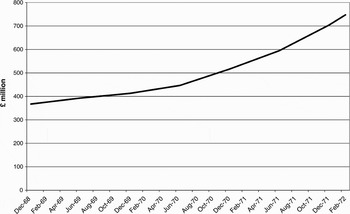
From November 1968, Hong Kong was the largest single official holder of sterling, which made it a major beneficiary from the London USD guarantee. In December 1971 Hong Kong held £703.6 m of official sterling, Australia £637.2 m and Kuwait £334.8 m. Figure 2 shows how official reserves increased quickly in the early 1970s as the Hong Kong economy boomed.
Hong Kong official sterling reserves, December 1968–February 1972Source: TNA T312/3114.

V
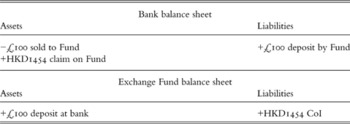
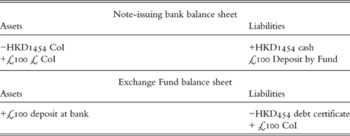
Because the banks' sterling assets could only be included under the London guarantee if they were transformed into deposits of the Exchange Fund, bringing the sterling holdings of banks into the £/USD guarantee required swaps of £ for HKD between the Exchange Fund and these banks. A scheme was put to the Exchange Fund Advisory Committee at its meeting at the end of October 1968 to be offered to all authorised and unauthorised banks. The Fund borrowed HKD from the banks in return for a non-negotiable, non-interest-bearing debt certificate (CoI). The Fund used the HKD cash to buy an equivalent amount of the banks' sterling assets, which would then be re-deposited with the banks on account of the Fund. In this way, banks swapped their sterling assets for an HKD-denominated claim on the Fund and the Fund acquired the sterling assets of the banks while leaving them on deposit for the banks to use as they wished. The intention was that the banks would treat the sterling liability as if it were still a sterling asset. To confirm this, the Fund was originally not allowed to initiate redemption of sterling deposits until the facility expired on 24 September 1973. This was subsequently changed to one months' notice but Cowperthwaite promised that ‘the likelihood of this ever being done is very remote’.Footnote 34 The banks, however, could buy or redeem the HKD CoI at any time. In addition, the note-issuing banks could exchange their HKD CoI for sterling CoI whenever the note issue was expanded and vice versa without further exchange cost. The sterling CoI would then be a liability of the Fund, and the matching asset would be the sterling on deposit with the note-issuing bank. The balance sheet implications are suggested in Tables 3 and 4.
Issue of HKD CoI to banks

Exchanging HKD CoI for £ CoI

Predictably, the banking members of the EFAC generally welcomed the proposal, although they objected to the cost of the cover, which included an exchange margin for the Fund on the redemption of the HKD certificates of 1/8 penny plus 1/8 per cent p.a. interest to be paid on the Fund's sterling deposits at the banks.Footnote 35 It was also agreed that cover for head office funds of Hong Kong based banks should be negotiated between the Fund and the bank. The banking members of EFAC also wanted the Fund to provide more general forward cover facilities for commercial transactions.Footnote 36 The deal agreed for the London office of HSBC was that the Exchange Fund would take over £25 m of their sterling along the lines of the Hong Kong scheme but it would be only 90 per cent guaranteed (equal to the London government guarantee). The HSBC London branch duly opened a deposit account for the Fund to re-deposit the sterling.Footnote 37
In early December 1968, the financial secretary explained to the Secretary of State for the Colonies that in order to bring commercial banks' sterling assets into the British government exchange guarantee ‘our intention is that Exchange Fund borrow HKD from banks, purchase their eligible sterling assets therewith and re-deposit in sterling with banks. There would be strict provisions to ensure that banks were at all times firm holders of underlying sterling assets of type eligible for guarantee in amount of at least exchange fund sterling deposits with them.’Footnote 38 The scheme required increasing the Exchange Fund's statutory borrowing limit above HKD2bn, and it was raised to HKD3bn on 20 December.
The scheme was finally offered to the Exchange Banks' Association at the end of January 1969 and implemented in March with slightly more generous terms after protests at EFAC. Cowperthwaite insisted that because of the gap between the 100 per cent guarantee offered to banks by the Fund and the 90 per cent guarantee offered by the UK, there should be a charge to recognise the risk borne by the Fund. The Fund charged an exchange margin of 1/16d on issue of the HKD debt certificates payable by banks to the Fund in sterling. The debt certificates would be interest free. The banks would also pay 3/32 per cent p.a. interest on Exchange Fund sterling deposits with banks, payable semi-annually in sterling. The agreement was to last until 24 September 1973 when the UK sterling agreement was due to expire. If the £/HKD rate changed more than 1 per cent for 30 continuous days, the Fund was liable to pay compensation within 60 days thereafter. With respect to the sterling deposits, J. G. Paterson, the Hong Kong Banking Commissioner, confirmed to Chartered Bank that ‘the assets placed at the disposal of the Exchange Fund will continue to be regarded as the property of your bank’ and would be guaranteed by the Exchange Fund.Footnote 39
Before the scheme was even offered to the local banks (or described to London) the Exchange Fund was forced to activate it to provide forward cover during a sterling exchange crisis in November 1968. The Fund took over £177 m of sterling assets from the three note-issuing banks plus the Bank of East Asia. By 21 November the HSBC held £126 m on deposit for account of the Exchange Fund against non-interest-bearing HKD certificates of indebtedness for HK$1.8b; and Chartered held a further £11 m in deposits on the same terms. The agreement at this point allowed the position to be reversed in two months' time without charge.Footnote 40 The Governor Sir David Trench alerted the Foreign Office that without this swap of HKD for sterling, these banks might have refused to continue to buy sterling in the market to keep the rate fixed. Trench explained that
This action was necessary not only for Hong Kong's protection but also to prevent a situation arising where there was no official buyer of sterling (a role played by the note-issuing banks) and it went to a substantial discount. The note-issuing banks had to absorb large quantities of sterling, mostly from other banks and the Bank of China stopped buying temporarily. The note-issuing banks could not be expected to carry on without protection and we could give it them only in this way. As it was they had to assume substantial forward risks in respect of export contracts. Because of this arrangement it was possible to keep the HKD/£ market open throughout the crisis. The arrangement has been kept confidential.Footnote 41
This operation required the Fund to exceed its statutory borrowing limit, which had to be ratified retrospectively by London, causing some consternation in the Treasury.
The Exchange Fund guarantee scheme was finally launched on 1 March 1969, when the Fund borrowed over £190 m from the banks and then a further £15 m over the next three months, bringing the total by the end of May to £205 m. Altogether, 33 banks participated including foreign banks and four unauthorised banks, although 88 per cent was held by note-issuing banks and their subsidiaries (HSBC, Chartered and Hang Seng Bank).Footnote 42 No Communist banks took part. London worried that there was no limit to the amount of sterling the Fund could borrow from the banks and that there was no control on foreigners transferring sterling to Hong Kong banks to take advantage of the guarantee. They tried to get Cowperthwaite to set an upper limit, a request he dismissed as ‘arbitrary use of the Secretary of State's powers’.Footnote 43 Setting an upper limit could bring into question the convertibility of HKD to sterling since the commercial banks' access to the scheme was vital to their continued participation in the sterling market. As in November, the scheme was justified because otherwise banks would stop buying sterling at the official rate, ‘which would have incalculable effects in the colony on confidence in sterling’. By 16 May the Fund's borrowing had reached HKD2992 m out of its limit of HKD3bn and Cowperthwaite asked for the limit to be increased to HKD3.5 or HKD4bn.Footnote 44 London refused and the stage was set for confrontation. In the meantime, the scheme was continued by transferring just over £2 m of the Fund's revenue reserves from HK dollar bank accounts into sterling.Footnote 45
With no recourse to the Exchange Fund swap to cover their sterling holdings, on 20 May 1969 HSBC suspended further forward purchases of sterling against export contracts and Cowperthwaite advised London that other banks would probably follow because ‘they are no longer prepared to take the exchange risk involved’.Footnote 46 Peterson and Cowperthwaite set off for London for talks at the end of May to resolve the impasse, holding meetings at the Treasury described by Cowperthwaite to the EFAC as ‘a rather extraordinary affair’. In the end, the British were persuaded that the increase in sterling assets was due mainly to an export boom rather than capital inflow to take advantage of the guarantee, but that there was no way to make sure that all the sterling in the scheme was from Hong Kong residents. They agreed to lift the borrowing limit for the Fund, but the negotiations for how much commercial bank sterling the Fund would be able to swap for HKD with the commercial banks, which banks would participate, and what would happen to the sterling assets so acquired, lasted until March 1970.
The final agreement was that 40 per cent of the sterling acquired from the three largest participating banks (HSBC, Chartered and Hang Seng Bank) would be put on deposit in London for the account of the Fund.Footnote 47 In this way the UK felt more confident that the sterling was legitimately on official account but it did not limit the banks' use of this sterling since it was merely deposited with the banks' London offices. EFAC accepted the British proposal to earmark funds in London, although the minutes of the meeting of 9 June report that ‘some doubt was, however, expressed that so simple and seemingly pointless a manoeuvre could be all that was really demanded’. Philip Haddon-Cave later referred to it as an ‘Alice in Wonderland exercise’.Footnote 48 By the end of March, HSBC had earmarked £50 m at their London office for account of the Exchange Fund.Footnote 49
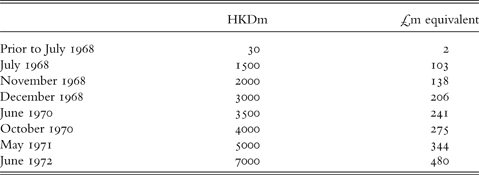
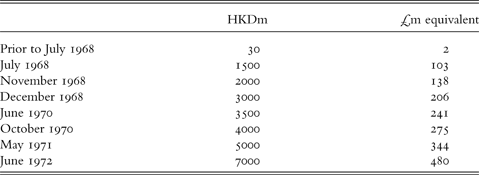
One of the implications of the new scheme was the need to increase the borrowing powers of the Exchange Fund dramatically. In May 1970 ExecCo was asked to approve an increase from HKD3b to HKD3.5b which was agreed in June. In August 1970 the Governor wrote to London to change the Exchange Fund Ordinance to allow LegCo to grant increases in borrowing powers to the Fund on advice of Financial Secretary and still with the approval of the Secretary of State for the Colonies.Footnote 50 Approval was finally granted in March 1971. On 1 September 1970 they asked for a further increase from HKD3500 m to HKD4000 m (£277 m). Table 5 shows the growth in the Fund's borrowing powers.
Financial secretary's borrowing limit for Exchange Fund
London allowed Hong Kong to diversify its total reserves from 99 to 89 per cent sterling from September 1971 but they did not take up this opportunity before sterling floated downward in June 1972. By the end of July the ratio had fallen to 97.3 per cent, to 96.9 per cent by the end of August and 96.8 per cent by the end of September.Footnote 51 As part of a general review of investment policy, on 22 May 1972 (i.e. a month before sterling floated) the EFAC agreed to recommend that the Fund should be able to invest in ‘foreign currencies and foreign government bonds, foreign government guaranteed bonds, and bonds issued by foreign organisations similar to UK local authorities’ and the approval of the Secretary of State was sought.Footnote 52 The Exchange Fund Ordinance already allowed the purchase of foreign currency other than sterling and this was undertaken before the Secretary of State's approval to buy non-sterling securities was granted.Footnote 53 In the end, because of the high interest obtainable in London the EFAC decided not to buy any non-sterling securities during 1972 or 1973 although they did switch some cash assets. We will see below that the illiquidity of the long-term assets inhibited diversification.
One last wrinkle to the story is that the Smithsonian Agreement of December 1971 revalued sterling against the USD to USD2.60/£ from USD2.40/£ but the London guarantee threshold was not changed, effectively making it inoperable until sterling had depreciated at least 8 per cent rather than the 1 per cent indicated under the initial terms. This exposed the Hong Kong government to a further liability since their guarantee was in terms of the current HKD/£ rate. Mike Sandberg, as a member of EFAC, asked that the Governor should raise this issue with London.Footnote 54 But the possibility of adjusting the guarantee threshold was quickly dismissed in London despite the claims of several other central banks that this violated the spirit if not the letter of the sterling agreements.Footnote 55 This had important effects on Hong Kong because it reduced the government's cover for their HKD guarantee of banks' sterling holdings.
VI
On 6 July 1972, two weeks after sterling floated on 23 June, the Hong Kong government decided to switch their exchange rate peg from sterling to the USD. This was greeted with equanimity in London, no doubt because diversification of their reserves was still limited by agreement to 11 per cent.Footnote 56 The HSBC had not been approached for advice in advance and was critical of the decision. The Hong Kong manager, M. G. R. Sandberg, told Haddon-Cave that
cutting ourselves off from sterling, however tempting it might seem to set the HKD up as an independent currency instead of merely an adjunct of sterling which it has always been, was taking a risk when practically all our reserves are in sterling. Secondly, with the almost total lack of exchange control regulations here speculation against the HKD (whether as an over or an undervalued currency) could be a Gnome of Zurich's dream and a Financial Secretary's nightmare.Footnote 57
Sandberg believed Haddon-Cave had chosen the USD rate of HKD5.65 with margins of HKD5.77 and HKD5.52 ‘arbitrarily’ and that it was too high, especially when the government had no USD to intervene when required. The local USD market was not big enough to provide enough dollars so sterling would have to be sold in London for the funds to intervene in the exchange market.
Major interventions in the HKD exchange market by the Exchange Fund 1972–3 (−sales/+ purchases)

Source: Exchange Fund report on the accounts for 1972. HSBC, Chairman's files, 1459/Box 2.19. Exchange Fund report on the accounts for 1973. TNA FCO40/521. These major interventions were in addition to ‘smoothing operations [that] were from time to time conducted in conjunction with the Exchange Fund's bankers’.
On 10 February 1973 the USD was devalued by 10 per cent and the Executive Council met on 14 February to decide that the HKD should retain its gold parity and be revalued by 11.1 per cent against the USD. In March 1973 there was a further global run on the USD and, from this time, most European currencies and the Yen floated against the USD (the Yen had floated in February 1973). The HKD/USD came under increasing pressure in May, but by July the Fund was purchasing USD back from the market to keep the HKD at its upper band. By the end of 1973 the Fund had about 60 per cent of its call money in USD compared with about 50 per cent in 1972, and 35 per cent of its fixed deposits in USD compared with 18 per cent in 1972. Still, only 15 per cent of total assets were denominated in USD, leaving 74 per cent in sterling.
Changing the anchor currency did not precipitate a major shift in the currency denomination of the Exchange Fund's assets because the market value of sterling securities was very low in 1972 and diversification would have entailed substantial losses. The strategy of investing 70 per cent of the Fund's assets in long-dated securities proved costly as London interest rates rose and the gilt market fell. In 1968 the depreciation of HMG assets amounted to £8.5 m and in 1969 to £6.3 m. From the end of 1971 to the end of 1973 the Financial Times government securities index fell from 80.32 to 61.05 so that by the end of 1973 the nominal value of the longer-term portion of the reserves was £225.2 m but the market value was just £133.2 m.Footnote 58 Nevertheless, when the market seemed relatively strong at the start of 1973, £20 m of gilts were sold to generate the funds for the compensation payments due later in the year.
At the same time as sterling floated, the sterling area system was disbanded. This meant that authorised banks were no longer excluded from holding positions in currencies other than sterling, which undermined the rationale for the government to cover banks' sterling holdings.Footnote 59 It also appears to have released HSBC from its obligation to use its own resources to defend the exchange rate. As soon as the new peg was announced, a line was drawn on outstanding HKD debt certificates so that there was no increase and no redemption, but banks were required to keep paying interest on their Fund sterling deposits.Footnote 60 Any future compensation would be paid on 100 per cent of the banks' sterling holdings as of 6 July even if they reduced them in the meantime. At this point, total debt certificates outstanding were at the maximum level in terms of the Exchange Fund borrowing limit of HKD6999 m. Predictably, the decision to freeze the HKD certificates was greeted with indignation by the banks and this was soon to be compounded by delays over compensation.Footnote 61
Sterling quickly fell below the 1 per cent threshold against the HKD on 6 July and payments under the guarantee came due to be paid on 5 October 1972, but the government tried to delay settlement. Based on a disputed reading of the terms of the agreement that referred to compensation in relation to ‘the new parity’, Haddon-Cave stated that compensation would only be paid after a pegged rate between the HKD and sterling was restored.Footnote 62 The British asserted their intention to return to a fixed parity within six months, in time for their entry to the EEC at the start of 1973, so the Hong Kong government proposed to await this new parity to re-establish the HKD/£ rate. HSBC responded that the government was in breach of contract and several weeks of wrangling ensued.Footnote 63 In August 1972, HSBC was secretly able to negotiate a release of up to £30 m of their HKD certificates at the prevailing exchange rate to allow them to intervene in the foreign exchange market to stabilise the USD/HKD rate and to supply the Bank of China with sterling.Footnote 64 The Exchange Fund paid compensation to HSBC on the released certificates and the corresponding sterling deposits were cancelled. The limit was adjusted to £35 m in November 1972 and by the end of the year, HSBC had taken out £56.6 m, of which £24 m was in December alone. Up to the end of November this cost the Exchange Fund £2.843 m in compensation to HSBC for depreciated sterling.Footnote 65 Meanwhile, on 25 October 1972 the £/USD rate fell below the London guarantee threshold and the clock started to tick on the 30-day deadline after which London would have to pay compensation.
Despite receiving some compensation for their sterling assets, at the end of October 1972 HSBC announced that they would diversify their reserves (which amounted to about £300 m) by £10-15 m per month starting in January 1973. The Hong Kong government feared that this would pull overall reserves into a breach of the Sterling Agreement, thus making them ineligible for the UK guarantee that they relied on to compensate their domestic banks.Footnote 66 In November Governor McLehose wrote to London setting out his predicament. Under its own scheme the Hong Kong government guaranteed the HKD value of 100 per cent of the banks' sterling assets. But the Hong Kong government could only claim compensation from the UK if the rate fell below US$2.40 and then only for 90 per cent of the value of official sterling assets. Since revaluation of sterling against the USD at the end of 1971 and then floating of the pound from June 1972, for every 1 per cent that sterling floated down the HKD value of the colony's sterling balances fell by HKD12 m, and when sterling was between USD2.60 and 2.40 this fell entirely out of HK government funds since no compensation was payable from London until the sterling rate fell below USD2.40. The gap between the two guarantee schemes was therefore building up a substantial future liability for the government. For this reason, abandoning the sterling peg made it even more vital that Hong Kong should negotiate a favourable new sterling agreement with the UK, or be allowed to reduce its MSP to 75 per cent to allow banks to diversify and reduce their claim on the Hong Kong government.Footnote 67
The solution reached after financial secretary Haddon-Cave came to negotiate in London in November was that Hong Kong banks could sell £100 m of sterling over five months with a limit of £3 m per day and £6 m per week. Haddon-Cave decided to restrict the diversification to the HSBC because of its large note-issuing burden and because it held more sterling than all the other banks put together. Chartered Bank was reported to be content with this arrangement.Footnote 68 The scheme superseded the secret agreement for the Fund to redeem the HSBC's HKD certificates, accelerating the redemption considerably to an upper limit of £100 m rather than £35 m.Footnote 69 As it turned out, the Bank of China's demand for sterling used up £90 m of HSBCs sterling reserves and there was no diversification into other currencies.Footnote 70
As soon as the HKD guarantee level was breached in July, Haddon-Cave considered making compensation payments in sterling but he quickly rejected this solution since it would place a large burden on the Exchange Fund, introducing an exchange risk since the compensation from London would not be paid for some months. Meanwhile, the value of the Fund's sterling deposits at the banks fell below the value of the HKD certificates against which they were issued. The solution was to change the value of existing HKD certificates to reflect the new prevailing exchange rates. In addition, the Exchange Fund issued a new series of HKD debt certificates ‘in respect of the amount by which the value of the existing certificates is reduced’. These were separate from those held as the counterpart of sterling deposit receipts and bore interest at 5 per cent p.a. payable by the Fund in HKD. In essence, the Exchange Fund issued new HKD CoIs as an initial adjustment claim on the Fund to be exchanged at the prevailing exchange rate once a new parity was set.Footnote 71 The impact was again to offset the contractionary impact of the appreciation of the HKD on the money supply. The HSBC and Chartered both objected to the scheme, insisting that they were entitled to compensation payments in sterling dated from 5 October. While reluctantly accepting the new HKD certificates, they tried to get the interest paid from 5 October rather than 1 January as proposed by Haddon-Cave, and at the London market rate rather than the proposed 5 per cent.Footnote 72
The new activities undertaken by the Exchange Fund led to calls in London for the Hong Kong government to begin to sell Treasury bills to the banks instead of borrowing their HKD to buy up their sterling assets. This was rejected by Haddon-Cave as it had been by his predecessor, John Cowperthwaite. The Hong Kong government had no borrowing requirements at this time and no interest in creating a local Treasury bill or money market.Footnote 73 In his proposal to the Executive Council in January 1969 to set up the Exchange Fund guarantee, Cowperthwaite had dismissed issuing Treasury bills to take over the banks' assets partly on the basis of ‘the problem of setting interest rates, and so interfering with the internal interest structure in Hong Kong’. The government wanted no role in setting interest rates. In addition, Cowperthwaite wanted to let the banks continue to manage the underlying sterling assets.Footnote 74 He thus did not want the contractionary impact of sales of government paper. More fundamentally, Cowperthwaite and Haddon-Cave resisted issuing Treasury bills because this would encourage public expectations about government spending that would be difficult to resist if there was an easy way to raise short-term debt.Footnote 75
VII
When the peg to sterling was abandoned, it no longer made sense to continue to issue certificates of indebtedness against sterling since the HKD/£ exchange rate was no longer stable. In fact, however, the Exchange Fund went even further and no longer required the deposit of any foreign exchange, thus breaking the strict currency board rules. Note-issuing banks were allowed to pledge HKD balances to the Exchange Fund to back new issues. Ghose and Greenwood explain the accumulation of HKD balances as a way for the Fund to have resources to intervene in the foreign exchange market to protect the exchange rate of the HKD to the USD. The HSBC was no longer the buyer of last resort as it had been under the sterling exchange rate peg and the Fund began to intervene in the market directly (although unsuccessfully according to Greenwood because they operated through the banking system).Footnote 76
From July 1972 all CoI were issued and redeemed against specified HKD accounts by the note-issuing banks. Up until this point, increases in note issue were covered by a payment of sterling from the issuing banks' London office to the Hong Kong government and, likewise, when a reduction happened, sterling was received by HSBC in London from the government. As W. Purves described to G. M. Sayer, ‘subsequent to the HKD being pegged to the USD we have credited a special Hong Kong Government No 5 Account with HKD to cover any increase in our unauthorised note issue and have debited this account in respect of any reduction’. The new assets of the Fund created after July 1972 thereby moved from the Crown Agents' accounts in London to the note-issuing banks' balance sheets in Hong Kong. This is the fundamental mistake of which Greenwood, Latter and Goodstadt are critical, but the evidence presented here has shown that a large amount of the Fund's assets had been deposited with the banking system from November 1968 onwards.
For the year as a whole, in 1972 a total of HKD1.631bn of certificates of indebtedness was issued, of which 39 per cent were against HKD balances. A total of HKD1.222bn of certificates of indebtedness was redeemed, of which 38 per cent were settled in HKD.Footnote 77 HSBC noted that for the year 1972 the net increase in HSBC notes backed by certificates of indebtedness against HKD balances was HKD140 m as against the total CoI outstanding of HKD3058 m. In the first half of 1973, the net increase by HSBC was a further HKD122.7 m.Footnote 78 HSBC paid interest of 3 per cent p.a. to the government on this special account and surpluses were sometimes transferred by the government to call or fixed deposits on which higher interest was paid. Purves also noted that ‘government appear to have passed some if not all of their exchange rate support operations through the special account and appear to have purchased foreign exchange from a number of non-note issuing banks in the Colony’.
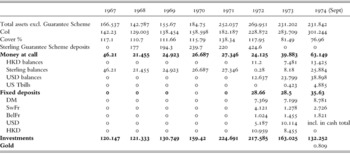
While the net increase in HKD-backed CoI was quite modest, the Fund's new policy raised a challenge almost immediately when certificates needed to be redeemed, but the Exchange Fund did not own any HKD balances so the government had to provide a temporary advance to the Fund.Footnote 79 As a result, the Exchange Fund for the first time opened HKD bank accounts even before any HKD certificates of indebtedness had to be issued. By the end of the year, the Fund had accumulated £11.2 m in HKD balances at call plus a further £11 m on three- to six-month deposit. This represented just under half of all money at call and almost 40 per cent of all non-sterling fixed deposits. A further impact of the switch to accepting HKD balances was that the liquid portion of the Fund's assets increased sharply because of the increase in HKD bank accounts (although this was also due to EFAC's decision not to buy foreign currency securities, having got permission to do so).
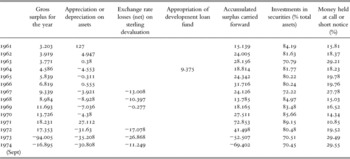
Table 7 shows some key features of the Exchange Fund's balance sheet, which shows the large size of the Sterling Guarantee Scheme compared to the assets of the Fund. A second striking feature is that the cover for the currency issue fell below 100 per cent in 1973 and 1974. A very limited amount of diversification began in 1972 for liquid assets only. Finally, the Fund accumulated £16 m worth of HKD deposits in the first six months of the new regime after July 1972, but the following year, these assets were run down to £13.4 m suggesting that the HKD received from banks in exchange for CoI were invested in foreign exchange.
Hong Kong Exchange Fund accounts

Source: 1967-8 TNA FCO59/443, 1968–69 TNA FCO59/554, 1971–2 HSBC Group Archive, Chairman's files Box 2.19, 1972–3 TNA FCO40/521, September 1974 HSBC Asia-Pacific Archive, HK 0018 N Exchange fund balance sheets, 1947–71. Sterling Guarantee Scheme: the end 1971 figure is February 1972.
Through to 1975, sterling investments still dominated; a week before the HKD was floated in November 1975 Sayer of HSBC urged the financial secretary to diversify out of sterling despite the losses that would be taken on the gilt portfolio, remarking that ‘the existing exposure is commercially unacceptable’.Footnote 80
Table 8 shows how the losses were accumulated in the early 1970s due to the appreciation of HKD liabilities against sterling and the depreciation in the market value of sterling investments. Also evident is the illiquid nature of the investment portfolio, which was still 70 per cent invested in securities by 1973, and a full 62 per cent of total assets was invested in maximum yield assets that were losing market value fast.
Key features of the Hong Kong Exchange Fund accounts, 1961–74

Note: Valuation of assets in column 2 includes gains and losses on sales and redemptions as well as market valuation.
Sources: Exchange Fund report of accounts for 1972. HSBC Group Archive, Chairman's papers, 1459/Box 2.19. Data for 1973 from TNA FCO40/521, for September 1974 HSBC Asia-Pacific Archive HK0018–Exchange fund balance sheets, 1947–71.
It is clear from this new data that the collapse of the international monetary system posed a huge burden on the operation of the Exchange Fund because it took over exchange rate risk from the banking system.
VIII
In December 1972, Haddon-Cave reported to LegCo that the liability of the Exchange Fund under the guarantee scheme was about £43 m, less £9 m due from London under the sterling exchange guarantee. Against this, the Exchange Fund had earned about £1 m from the cost charged for the HKD cover.Footnote 81 This turned out to be a substantial underestimate. From end May to 6 July 1972, Hong Kong's sterling reserves rose by £97 m to a total of about £900 m, of which a substantial proportion according to Haddon-Cave was due to the demand for forward cover by banks.Footnote 82 The lowest level of the Fund's special sterling deposits in 1972 was in February, when deposits were about £311 m. As sterling fell, banks rushed to buy HKD CoI and the financial secretary gained approval to increase the Fund's borrowing limit from HKD6000 m to HKD7000 m on the day sterling floated on 23 June. By 6 July, when the scheme was frozen, the Fund had the maximum HKD6999 m in HKD CoI outstanding, equivalent to deposits of £481 m.Footnote 83 The delay in making a decision about the exchange rate regime for Hong Kong thus increased the Exchange Fund's liability considerably.
The Exchange Fund guarantee expired on 24 September 1973, when compensation became due. Over the life of the scheme the Exchange Fund had earned £3.5 m in interest and exchange margins, i.e. the ‘cost’ of the cover to the banks. Total payments by the Fund (including the interest on the new certificates issued in January 1973) amounted to £71.4 m so the net cost to the Fund was £67.9 m. The London guarantee generated revenue for the Fund of £13.4 m in terms of compensation for losses of the £/USD exchange rate during October–November 1972, which covered part of the payments under the Exchange Fund guarantee but still left a burden of £54.5 m on total assets of £270 m at the end of 1972. The HSBC's arrangement to redeem some of the HKD CoI from January 1973 resulted in a reduction of £200.4 m before 24 September 1973, costing the Fund £29.5 m in compensation on withdrawals made at an average rate of HKD12.81/£. The early withdrawal of close to half of the total sterling on deposit cost the Fund some money in interest and exchange. The rate used to wind up the scheme in September was HKD12.395 = £1 on the balance outstanding of £38.2 m. Most banks (all but three) chose to be paid in HKD rather than sterling and this forced the Fund to buy HKD from the government's general account.
An important implication for the Hong Kong government's guarantee was that it pushed the reserve backing for the note issue well below 100 per cent in 1973. In 1971 the cover was 138 per cent, falling to 117 per cent in 1972, but was only 81.49 per cent at the end of 1973. This was kept highly secret to avoid rocking public confidence in the HKD, described by Haddon-Cave as ‘about the most closely guarded secret in Hong Kong’ because if it became known that the cover had fallen below 100 per cent ‘this could have a disastrous effect on public confidence’. At the time, Haddon-Cave expected that the 100 per cent cover would not be restored for another four to five years. He decided not to transfer government funds to the Exchange Fund to make up the shortfall since this could be detected by the public in the annual budget, but fiscal reserves were earmarked against the shortfall and this reduced the amount available for development projects.Footnote 84 At the time, Governor MacLehose and Haddon-Cave were in conflict over MacLehose's desire for greater development spending and Haddon-Cave's conservatism. There was a precedent for a shortfall in cover. In 1941 cover was almost 115 per cent but it had fallen to 96.6 per cent in 1946 due to the decision to honour the wartime duress note issue.Footnote 85 In 1953 the financial secretary declared that the assets of the Exchange Fund once again equalled the value of the CoI.Footnote 86
The compensation payments for 1973, combined with losses on the sales of assets and depreciation of gilts resulted in an unprecedented loss for that year of £94 m and a deficit carried forward to 1974 of £52.5 m. The Fund would have been able to generate a small surplus to cover the depreciation on assets and losses on exchange because of the substantial surplus of £41.5 m brought forward from 1972, but the burden of the compensation payments created the deficit. The following year offered no relief (despite another £5.7 m received under the London guarantee) as the market value of assets continued to fall and the sterling value of the Fund's HKD liabilities appreciated so that the cover had fallen below 77 per cent by September.
IX
The Exchange Fund underwent a profound transformation during the collapse of the global fixed exchange rate system. Starting in 1967, the financial secretary and the note-issuing banks began to devise ways for the Exchange Fund to increase the range of its activities based on close cooperation between the financial secretary and the note-issuing banks, both within the Exchange Fund Advisory Committee and outside it. At the heart of these innovations was the system's reliance on the HSBC to protect the pegged exchange rate to sterling. As sterling weakened, the HSBC threatened to stop supporting the rate unless it was offered forward cover. The mechanism for this was to bring the sterling assets of the banking system into the Exchange Fund not by selling Treasury bills but through sales of HKD-denominated non-negotiable bonds. The proceeds were re-deposited with the banks and the banks were reassured that they could treat the sterling as if it were still an owned asset of the bank, now with a guaranteed HKD value. To the extent that the HKD bonds were used to back the issue of new currency notes (which was allowed under the scheme) the backing for the note issue was shifted from sterling assets held by the Crown Agents in London to sterling deposits at Hong Kong banks. This change in 1968 marked a move away from the operation of an orthodox currency board much earlier than the innovation of 1972 when special HKD accounts were used to cover note issue. Currency boards rarely operate on completely orthodox terms as the temptation to intervene is often too great to resist. This was recognised when Hong Kong returned to a currency board system in 1983 when it was determined that the Exchange Fund ‘shall be used for such purposes as the Financial Secretary thinks fit affecting, either directly or indirectly the exchange value of the currency of Hong Kong and for other purposes incidental thereto’. In the 1960s when the duties of the Fund were more closely circumscribed to ‘regulating the exchange value of the currency of Hong Kong’, the government and the banks clearly saw the Exchange Fund also as a resource to moderate the impact of fluctuating exchange rates on banks' assets, not as an automatic mechanism but through deliberate intervention. The outcome was that the assets of the Fund were recycled through the banking system and there were increased risks to the reserves of the Fund. Given the illiquid nature of the Fund's reserves this proved a particularly costly strategy.