Introduction
As a consequence of demographic changes, in form of aging populations worldwide and improved health and social care, the prevalence of chronic life-limiting illnesses such as cardiovascular diseases and cancer is increasing (EIU, 2015; Fitzmaurice et al., Reference Fitzmaurice, Dicker and Pain2015). Accordingly, the number of patients suffering from distressing symptoms that could be alleviated by palliative care (PC) also increases proportionally.
In 2013, access to PC was designated a human right (Radbruch et al., Reference Radbruch, De Lima and Lohmann2013) as advocated by the European Association for Palliative Care (EAPC), the International Association for Hospice and Palliative Care (IAHPC), the Worldwide Palliative Care Alliance (WPCA), and Human Rights Watch (HRW). In 2014, the World Health Organization published a resolution at the 67th session of the World Health Assembly stating that access to PC is an exclusive part of “the right to the enjoyment of the highest attainable standard of health and well-being” (WHO, 2014). Consequently, governments are requested to actively support the implementation of PC through adopting healthcare policies, ensuring access to essential medication, integrating PC into all levels of the healthcare system, and setting up adequate training for healthcare workers. In Europe, the EAPC promotes PC education and related research in multiple European countries (Elsner et al., Reference Elsner, Centeno and Ellershaw2016), stating that PC education has been developing rapidly in multiple countries over the last years (Ilse et al., Reference Ilse, Alt-Epping and Kiesewetter2015; Walker et al., Reference Walker, Gibbins and Barclay2016).
China is home to one-fifth of the world's population and faces a rapidly aging demographic (Lynch et al., Reference Lynch, Connor and Clark2013; EIU, 2015). It is ranked a country of preliminary integration of PC by the WPCA (Lynch et al., Reference Lynch, Connor and Clark2013), a rank that includes countries where a variety of PC providers and types of services are in development and an awareness of health professionals of PC and supporting educational measures exists. Still, PC has not yet been fully integrated into mainstream service provision. The ratio of hospice–palliative care services to population in China equates as 1:8.5 million, compared with e.g., 1:49,000 in Germany or 1:48,000 in the United States (Lynch et al., Reference Lynch, Connor and Clark2013). The Quality of Death Index 2015 ranks China 71st of 80 ranked countries. PC in China is described as slowly developing and barely accessible outside the approximately 400 specialized cancer hospitals, with curative approaches still predominating healthcare (EIU, 2015).
Description of the condition
PC education for medical students and qualified physicians is crucial to ensure wider, nationwide access for patients to PC. As PC education is a standard component of general medical education in countries ranked high in The Quality of Death Index 2015 (United Kingdom, Germany, and United States), it seems reasonable to suggest that a transfer of existing approaches to skills and knowledge development could support the PC educational development in low ranked countries. As such, this review is part of a larger project aiming to get a deeper insight into the status of PC education in China. The long-term objective to which this study itself is only a very first step would be contributing to the provision of adequate international support.
Until now, there has only been one systematic review conducted that takes into account PC education in China (Wang et al., Reference Wang, Molassiotis and Chung2018). This review aims to depict the current status over several domains related to PC, rather than giving an overview in terms of structure, content, or effects of PC education.
Objectives
To determine the status of both under- and postgraduate PC education in Mainland China through examining
1. Medical students’ and physicians’ perception, knowledge, and skills in PC and
2. Educational interventions and programs in PC in any under- or postgraduate context.
Methods
Search methods for the identification of studies
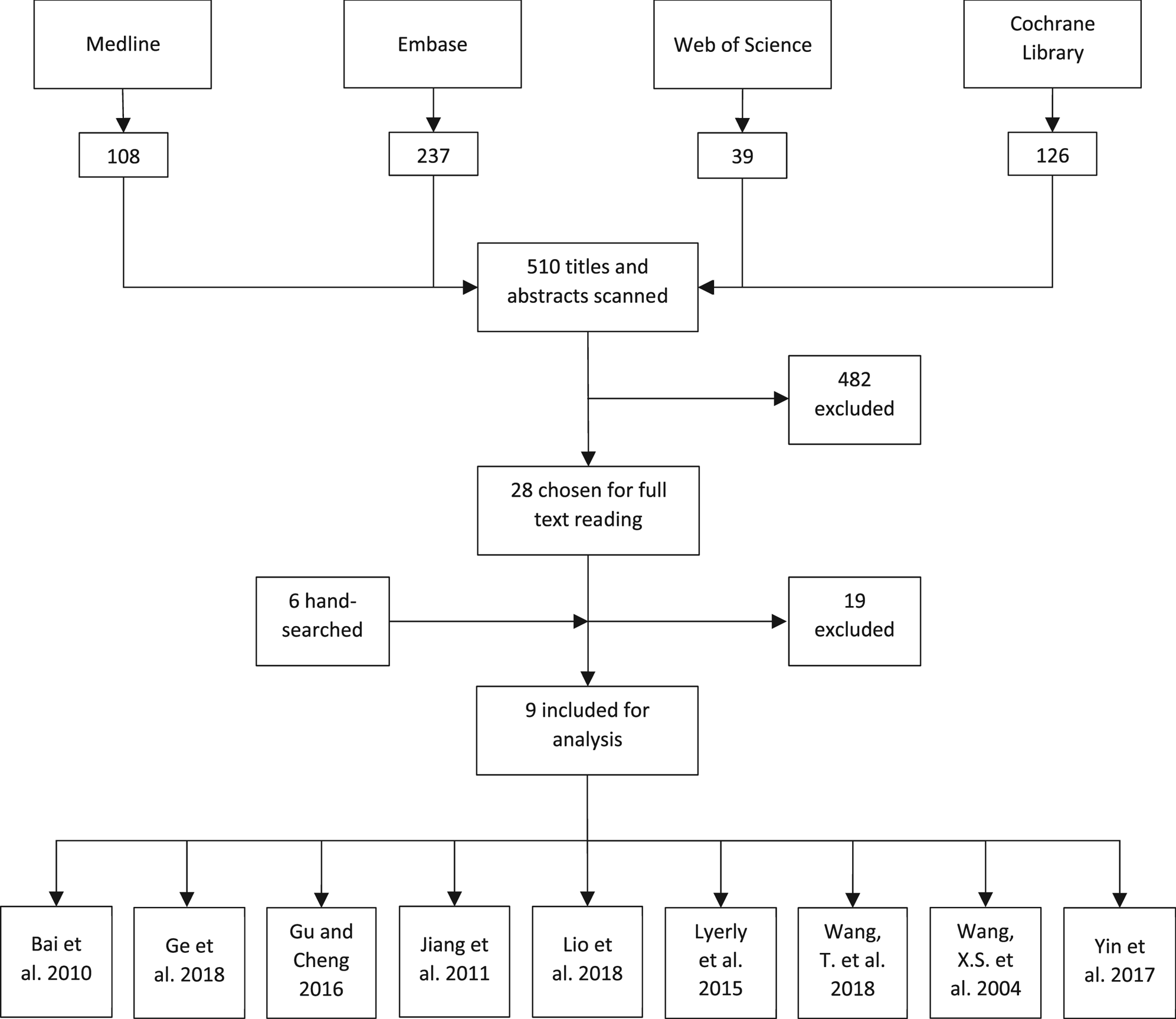
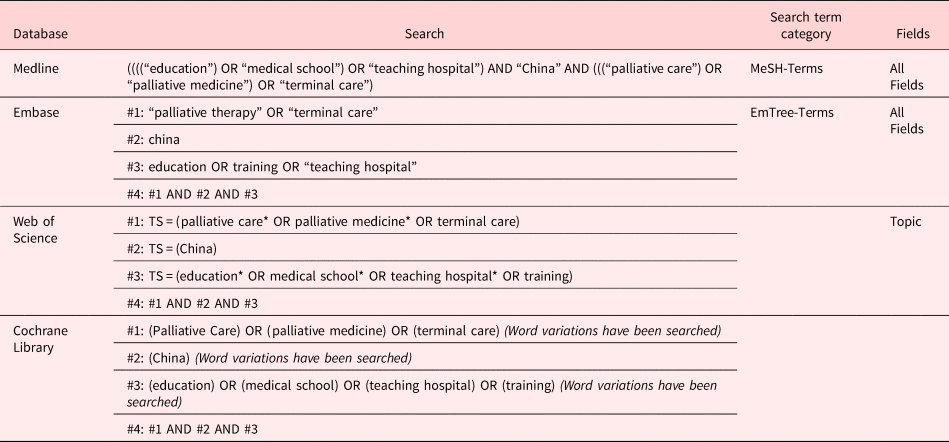
For this review, the databases Medline, Embase, Web of Science, and the Cochrane Library were searched in September 2018. Search terms used can be found in Table 1, and search history details are depicted in Figure 1. No filter was used. All references of selected articles were reviewed, yet some were not found within the databases used. Due to the low number of studies matching our inclusion criteria, we additionally searched the grey literature databases OPEN GREY and NTIS.
Search history.

Search details

All titles and abstracts were scanned, and potentially relevant publications were read full text. The inclusion process adhered to the following criteria:
Inclusion criteria
• All study types with clear study design;
• Presenting own study data or referring to data of underlying studies with clear study design;
• Having medical students or physicians as participants;
• Conducted in Mainland China (structure of medical education in other regions can deviate);
• Containing relevant data matching one of the two categories: “perception, knowledge or skills related to palliative care or palliative care education” or “educational interventions dealing with palliative care conducted in an under- or postgraduate context”; and
• Published after 2000.
Exclusion criteria
• Duplications,
• Articles or reviews depicting collected information without referring to underlying studies,
• Protocols,
• Published before 2000, and
• Full text not accessible through the databases used.
Data collection and analysis
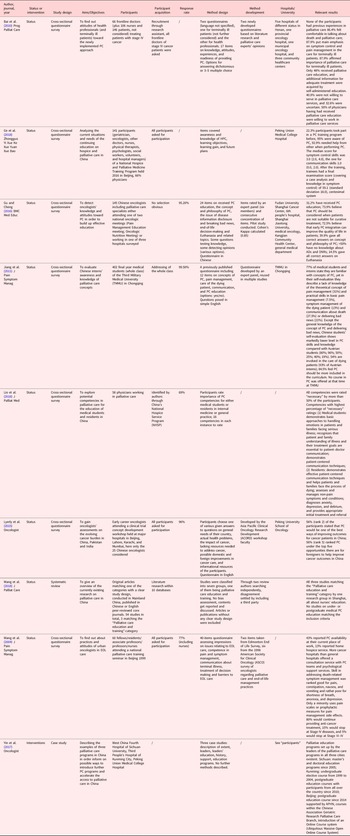
As this review was conducted by one single author, the selection of studies could not be assisted or assessed in collaboration with a second member of staff. The data extraction form can be found in Table 2. We analyzed the status of PC education considering the two categories displayed in the inclusion criteria.
Data extraction form

Assessment of risk of bias in included studies
As there is no standardized, valid tool to assess risk of bias in descriptive, cross-sectional studies (the study type of most studies included), bias assessment was conducted analogous to the Cochrane Collaboration's tool for assessing risk of bias, as described in the Cochrane Handbook for Systematic Reviews of Interventions 5.1.0. (Higgins and Green, Reference Higgins and Green2011); it was originally built to assess randomized controlled trials, so we changed the biases judged to biases relevant as follows:
• Selection bias
• Information bias
• Other bias
Results
Originally, 28 abstracts were considered for inclusion. After full text reading, 19 publications were excluded, and 9 publications could be included: 7 descriptive cross-sectional surveys, 1 systematic review, and 1 letter to the editor. The letter to the editor was included even though no full article was published because it reported a study conducted with clear design and presented own study data relevant to the topic of this review. Unfortunately, full text of the publication of Ge et al. (Reference Ge, Qu and Ning2018) could not be accessed, as the journal website and DOI indicated in our databases did not work. Still, the abstract's information was included. The search of grey literature databases revealed no additional findings.
Description of studies
Potentially relevant studies were divided into two subgroups: studies (n = 8) that examined the educational status of a target population in PC (Wang et al., Reference Wang, Di and Reyes-Gibby2004, Reference Wang, Molassiotis and Chung2018; Bai et al., Reference Bai, Zhang and Lu2010; Jiang et al., Reference Jiang, Liao and Hao2011; Lyerly et al., Reference Lyerly, Fawzy and Aziz2015; Gu and Cheng, Reference Gu and Cheng2016; Ge et al., Reference Ge, Qu and Ning2018; Lio et al., Reference Lio, Ning and Wu2018) and studies (n = 1) that examined educational interventions covering PC (Yin et al., Reference Yin, Li and Ma2017). Details on the study design, samples, sample generation, response rates, methods, and method development can be found in the data extraction form in Table 2.
Bias assessment
A graphical summary on the risk of bias of all included studies is depicted in Table 3.
Bias assessment

Selection bias
Several studies included are at risk of selection bias, for example through possibly unrepresentative samples (Wang et al., Reference Wang, Di and Reyes-Gibby2004; Jiang et al., Reference Jiang, Liao and Hao2011; Lyerly et al., Reference Lyerly, Fawzy and Aziz2015; Ge et al., Reference Ge, Qu and Ning2018) or strict inclusion criteria (Wang et al., Reference Wang, Molassiotis and Chung2018). The risk of selection bias in these studies appears to be high. In two of the publications, the risk of selection bias remains unclear due to insufficient information on sampling methods (Bai et al., Reference Bai, Zhang and Lu2010; Lio et al., Reference Lio, Ning and Wu2018). Gu and Cheng (Reference Gu and Cheng2016) provide clear information on their high-quality sample generation. The risk of selection bias seems to be low.
Information bias
In the included study of Wang et al. (Reference Wang, Di and Reyes-Gibby2004), information on the questionnaire used is insufficient and the validation incomplete. Therefore, the risk of information bias appears to be high. In several of the included studies, the risk of information bias remains unclear due to missing information on language, validation process, and item generation of questionnaires or on other data generation (Bai et al., Reference Bai, Zhang and Lu2010; Yin et al., Reference Yin, Li and Ma2017; Ge et al., Reference Ge, Qu and Ning2018; Lio et al., Reference Lio, Ning and Wu2018). Four of nine included studies provide enough information to judge the risk of information bias as low (Jiang et al., Reference Jiang, Liao and Hao2011; Lyerly et al., Reference Lyerly, Fawzy and Aziz2015; Gu and Cheng, Reference Gu and Cheng2016; Wang et al., Reference Wang, Molassiotis and Chung2018) establish validity for their review through two review authors searching independently numerous databases, including Chinese ones. The risk of information bias seems low.
Other potential sources of bias
As mentioned above, detailed information on the methodology of Lio et al. (Reference Lio, Ning and Wu2018) and Ge et al. (Reference Ge, Qu and Ning2018) is missing. Other potential sources of bias cannot be estimated, and the risk remains unclear.
Findings
Finding I: palliative care education is lacking in both under- and postgraduate medical education, only a few programs exist
Both medical students and working physicians stated in various studies that PC education in China is missing or insufficient. For example, Jiang et al. (Reference Jiang, Liao and Hao2011) reported that 84.5% of the medical students surveyed felt PC should be included more in the curriculum. Only 31.2% of Chinese oncologists and 48% of physicians treating stage IV cancer patients in general have received any PC education (Bai et al., Reference Bai, Zhang and Lu2010; Gu and Cheng, Reference Gu and Cheng2016).
Only a few education programs on PC are identified by research. Three programs get reported in the case studies by Yin et al. (Reference Yin, Li and Ma2017) taking place in Sichuan, Kunming, and Beijing. At the Sichuan University, masters and doctoral education programs began in 2005. In Kunming, there existed an elective undergraduate course from 1999 to 2004, and in 2010 postgraduate education courses were started. Finally, in Beijing, a postgraduate education course began in 2014, supported by the Asia Pacific Hospice palliative care Network (APHN), with over 100 students progressing on this program. Within the Chinese Association Geriatric Research Palliative Care Branch, PC training has been intensified and an Online Course System has been introduced (Ubiquitous Massive Open Online Course system) to reach more students and healthcare providers (Yin et al., Reference Yin, Li and Ma2017). Educational programs build the setting for two included cross-sectional surveys. Wang et al. (Reference Wang, Di and Reyes-Gibby2004) surveyed participants of a national PC training seminar held in Beijing in 1999, and the study conducted by Ge et al. (Reference Ge, Qu and Ning2018) took place at a National Hospice and Palliative Medicine Training Program held in Beijing 2016 by Peking Union Medical College Hospital.
Finding II: palliative care as a concept is well known, although detailed knowledge and practical skills are less developed
In four of our included studies, we find indications that there exists a common idea of PC as a concept among medical students and physicians. Yet, more detailed knowledge or practical skills are less evident.
For example, 77% of Chinese medical students and interns state that they are familiar with concepts of PC, yet in their self-evaluation, only a small proportion report knowledge of the theoretical concept of pain management (31%) and practical skills in basic pain management (7.5%), symptom management of the dying patient (13%), communication about death (27.5%), and delivering bad news (21%) (Jiang et al., Reference Jiang, Liao and Hao2011). At the time of survey, no educational PC course was offered. Both Chinese and Austrian students feel similarly familiar with the concepts of PC, and knowledge on how to deliver bad news is equally low (Pohl et al., Reference Pohl, Marosi and Dieckmann2008; Jiang et al., Reference Jiang, Liao and Hao2011). Yet, Chinese students’ self-evaluation shows markedly lower level in all other PC skills and knowledge compared with Austrian students (in order of the categories outlined above: 80%, 96%, 50%, 25%, 40%, and 19%). Only 54% of Chinese interns reported being involved in the care of dying patients at all, compared with 93% involvement of Austrian interns (Pohl et al., Reference Pohl, Marosi and Dieckmann2008; Jiang et al., Reference Jiang, Liao and Hao2011).
Among Chinese physicians, the situation is similar. For example, 95% of healthcare professionals (among them 66% physicians) attending a Hospice and Palliative medicine training program in Beijing were aware of PC, still 92.9% of them needed help from others when taking care of palliative patients (Ge et al., Reference Ge, Qu and Ning2018). Only 39.9% of Chinese oncologists gave all correct answers on questions covering the concept and philosophy of PC in the survey of Gu and Cheng (Reference Gu and Cheng2016). More than 50% had no knowledge about advance directives (ADs) and do not resuscitate (DNRs), 14.5% gave all correct answers on a field called euthanasia, dealing with physician-assisted death. Wang et al. (Reference Wang, Di and Reyes-Gibby2004) show that clinicians (67% physicians) who attended a national PC training seminar in 1999 felt quite confident in managing death-related symptoms like pain, constipation, nausea, and vomiting. Yet, they evaluated as insufficient in skills addressing other symptoms like shortness of breath, anorexia, or depression. Interestingly, only a minority would have used a pain scale or start prophylactic measures for pain management side effects.
Finding III: Chinese physicians consider palliative care an important field to be developed in cancer care
Of those surveyed, 73.9% of Chinese oncologists believed that PC should be considered when patients are not suitable for curative treatment, and 72.5% believed that early PC integration can improve quality of life in patients (Gu and Cheng, Reference Gu and Cheng2016). 87.9% of physicians treating stage IV cancer patients affirm the importance of PC (Bai et al., Reference Bai, Zhang and Lu2010). 56% of early career Chinese oncologists stated that PC would be one of the best ways of improving outcomes for cancer patients in China. Another 56% ranked PC under the top five opportunities for foreigners to help improve cancer outcomes in China (Lyerly et al., Reference Lyerly, Fawzy and Aziz2015).
Finding IV: the majority of healthcare professionals are not willing to work in palliative care services
Even though 87.9% of doctors treating stage IV cancer patients in Henan considered PC an important specialty, 40.9% were not willing to practice within a PC service, with another one-third of healthcare professionals doubtful (Bai et al., Reference Bai, Zhang and Lu2010). Health professionals having received education in PC were significantly more willing to work in PC services (P < 0.01) (Bai et al., Reference Bai, Zhang and Lu2010).
Finding V: communication should be a key focus in palliative care education, especially when an undergraduate
As presented by Lio et al. (Reference Lio, Ning and Wu2018), Chinese physicians most frequently rated the following three PC competencies for medical students as “necessary” for graduation:
• Demonstrates basic approaches to handling emotions in patients and families facing serious illness (88%);
• Recognizes that patient and family understanding of illness and their treatment goals are essential to patient–doctor communication (85%);
• Demonstrates patient-centered communication techniques (83%).
The competencies rated most frequently necessary for residents for graduation, extended to four (as both competencies on the 3rd rank have the same percentage of voting), were as follows:
– Demonstrates effective patient-centered communication techniques and helps patients and families face the process of dying (90%);
– Assesses and manages non-pain symptoms and conditions (90%);
– Diagnoses anxiety, depression, and delirium, and provides appropriate initial treatment and referral (88%);
– Provides basic palliative care, recognizes difficult cases, and consults palliative care specialist (88%).
Finding VI: there is no highly qualified research on under- or postgraduate palliative care education in Mainland China
No study examining academic PC education in Mainland China matched the inclusion criteria within the review conducted by Wang et al. (Reference Wang, Molassiotis and Chung2018): having a clear study design and being published in peer-reviewed Chinese or English core journal. The authors draw the conclusion that more structured research evaluation of current PC education and training programs need to be developed.
Discussion
Summary
Chinese medical students and physicians think that PC education in China is lacking and should be more integrated in medical education, only a few programs exist so far. PC is considered an important field to be developed in cancer care by Chinese physicians. Students and physicians have knowledge on the broad concept of PC, but further knowledge or practical skills are missing. Most physicians treating terminally ill patients would not work in PC services, but those who had received PC education were significantly more willing to do so. Concerning the content of PC education, Chinese physicians emphasize the role of communication skills, particularly in the undergraduate context, and high-quality research in the field is lacking.
Other reviews on the topic
There is already one review existing that takes PC education into account, included in the systematic review by Wang et al. (Reference Wang, Molassiotis and Chung2018). It depicts the current research status on PC in Mainland China and covers seven categories, one of them being “Palliative care education and training.” All of the included studies refer to nursing education. The authors’ conclusion that more PC education and training programs in China are needed is completely compatible with the findings of this review. The inclusion criteria concerning PC education and training were not elucidated explicitly, but it appears that only studies focusing on educational interventions and their structure, rather than studies on the educational capability of healthcare professionals, were included. This could explain the disparity between the number of included studies in our review and in Wang et al. (Reference Wang, Molassiotis and Chung2018).
The findings of Wang et al.'s (Reference Wang, Molassiotis and Chung2018) systematic review, as well as the fact that the number of studies included in this review is relatively small, evidence that research on PC education for medical students and physicians in Mainland China and is still very limited.
Status of PC education in other regions of China or neighbor countries
This review examines exclusively the status of PC education in Mainland China, as educational structures in other regions can deviate.
Hong Kong
In Hong Kong for example, specialist training for physicians in clinical oncology and palliative medicine is existent (Lam et al., Reference Lam, Lam and Choi2018). PC is still not very well accepted among medical students, even if the acceptance increased with years of medical education, whereas the majority of physicians considered PC methods (Gruber et al., Reference Gruber, Gomersall and Joynt2008). Most physicians suggest more PC training for junior doctors (Lam et al., Reference Lam, Yeung and Lai2015).
Taiwan
In Taiwan, knowledge on PC among physicians is limited to philosophy and principles (Liu et al., Reference Liu, Hu and Chiu2005). This result matches with the status of PC education in Mainland China, especially Finding II. Still, the majority of physicians in Taiwan have positive beliefs toward providing PC and are willing to engage PC into their practice (Liu et al., Reference Liu, Hu and Chiu2005); interns showed the same readiness (Shih et al., Reference Shih, Chiu and Lee2010). Similar to students in Mainland China (Finding I), Taiwanese physicians expressed further need of education (Liu et al., Reference Liu, Hu and Chiu2005).
Concerning educational interventions, many Taiwanese medical schools offer lectures on PC or formal curricula (Tsai et al., Reference Tsai, Hu and Chang2008). However, there is no formal internship PC training program (Shih et al., Reference Shih, Chiu and Lee2010). Multiple other educational interventions on PC are reported (Tsai et al., Reference Tsai, Hu and Chang2008; Chang et al., Reference Chang, Hu and Tsai2009; Shih et al., Reference Shih, Hu and Lee2013), among them a training program in the provision of spiritual care (Bridge and Lai, Reference Bridge and Lai2009).
Japan
Looking at other countries, for example Japan, it is apparent that both under- and postgraduate education in PC is more widely engaged, as compared with Mainland China. The need for PC education is recognized in policy (Nakamura et al., Reference Nakamura, Takamiya and Saito2017; Nakazawa et al., Reference Nakazawa, Yamamoto and Kato2018), and multiple educational interventions exist. Most faculties provide PC education in some way (Kizawa et al., Reference Kizawa, Tsuneto and Tamba2012; Nakamura et al., Reference Nakamura, Takamiya and Saito2017). For physicians, there is a basic education program on primary PC established by the Japanese Society for Palliative Medicine (JSPM) (Yamaguchi et al., Reference Yamaguchi, Narita and Morita2012; Nakazawa et al., Reference Nakazawa, Yamamoto and Kato2018). Multiple other PC workshops and programs are conducted (Morita et al., Reference Morita, Miyashita and Yamagishi2013; Oya et al., Reference Oya, Matoba and Murakami2013; Nakazawa et al., Reference Nakazawa, Kizawa and Hashizume2014; Kizawa et al., Reference Kizawa, Morita and Miyashita2015). Still, physicians other than PC specialists report (just as students in Mainland China — Finding I) further need for intensifying education (Hirooka et al., Reference Hirooka, Miyashita and Morita2014).
Korea
As in Japan, in Korea, more PC education is offered to medical students and physicians than in Mainland China. PC is existent in the curriculum of undergraduate medical students (Kim et al., Reference Kim, Kim and Shin2019). There is a standard hospice and PC program for all types of professionals involved in end-of-life care, and a National Train-the-Trainer-Program for Hospice and Palliative Care Experts was established (Kang et al., Reference Kang, Koh and Yoo2010, Reference Kang, Yang and Chang2015).
The great majority of Korean physicians support PC measures (Yun et al., Reference Yun, Kim and Sim2018). Most physicians are unsatisfied with existent PC, and the great majority have no experience with hospice and palliative care education (Shim et al., Reference Shim, Chang and Kawk2017), which matches with the present status of Mainland China represented in Finding I.
Limitations
By nature, the limited number of studies also limits the quality of evidence. Among the reasons for the limited number of studies could be that palliative medicine is still a new field in Mainland China and that research on education is not yet well developed and integrated. Even if educational interventions and assessments take place, they might not get published and listed in the databases searched. As no Chinese databases were searched, articles only published in Chinese journals could not be considered.
The evidence of each finding is represented through the number of studies supporting them. Detailed information can be found in Table 3.
Most studies reviewed in this paper are judged to have a high risk of selection bias. Accordingly, the findings of this review cannot be assumed to be transferrable to a highly general context. Still, they do give an idea of the status of PC education in China and can help to stimulate and draft approaches for further development in the future.
This review has a number of potential biases. As it was conducted by one author alone, subjectivity may have influenced inclusion and exclusion, data extraction, and bias assessment. Inclusion criteria, a data extraction form, and a clear structure for bias assessment were established to counter this. Bias assessment itself is endangered to be biased, as no standardized, valid assessment tool exists. The structure of bias assessment was constructed adapting existing accepted strategies. Finally, Chinese databases have not been searched, and articles exclusively listed in these databases have not been considered.
Given the fact that this review does not deal with qualitative research, reflexivity plays a minor role. Nevertheless, it should be mentioned that this review was conducted as a preliminary step to conducting further research on PC education in China. Despite all efforts to be objective, this circumstance could have influenced the findings and conclusions.
Conclusions
Implications for practice
Although the supporting evidence within our findings is limited, it does suggest that that PC education in China is underdeveloped. More palliative care education is needed to increase both the ability and the willingness of physicians to deliver end-of-life care. First steps in a political setting should be taken to enable and support PC implementation officially.
Implications for research
Since this review shows that PC education in China is underdeveloped, further research is needed to contextualize these findings. The next steps could include exploring how PC education could be implemented best at Chinese universities or in fellowship programs and what obstacles must be overcome. This requires more detailed information on the structure of medical teaching and on the awareness of medical teachers concerning end-of-life care. Additionally, already conducted PC educational interventions should be scientifically evaluated and published.
Conflict of interest
None.