Introduction
How pervasive is partisan sorting and polarization over public policies in the American public? An extensive literature has established that voters have become consistently sorted, whereby individuals with conservative policy positions on national issues are increasingly likely to identify as Republican partisans and those with more liberal policy positions are increasingly likely to identify as Democratic partisans (Fiorina et al., Reference Fiorina, Abrams and Pope2005; Fiorina and Abrams, Reference Fiorina and Abrams2008; Levendusky, Reference Levendusky2009; Abramowitz, Reference Abramowitz2010). Some scholars have argued that the extent of partisan sorting has resulted in a population with more polarized national policy preferences (Abramowitz, Reference Abramowitz2010) while others have argued that this reorganization of preferences has had little impact on the overall extent to which policy preferences are polarized (Fiorina and Abrams, Reference Fiorina and Abrams2008).
Regardless of the extent of polarization, sorting alone is commonly hypothesized to be a barrier to solving national public policy problems. Rather than each policy option having its own distribution of supporters and opposition and therefore a possibility of cross-cutting cleavages across issues, sorted partisans have consistently opposing views about how to solve social challenges. This sorting of policy preferences is thought not only to reduce the scope for compromise across issues but also may strengthen affective ties to partisan identities which in turn makes bipartisan problem-solving less likely (Jacobson, Reference Jacobson2003; Abramowitz, Reference Abramowitz, Nivola and Brady2006; Gerber et al., Reference Gerber, Henry and Lubell2013; Brader et al., Reference Brader, Tucker and Therriault2014; Mason, Reference Mason2015).
In this paper, we examine whether the patterns of partisan sorting and polarization documented for national issues extend to a wide range of important local public policies that shape economic development. Do local development policy preferences—e.g. policies designed to attract businesses, educate and train local workers, provide local services, etc.—vary by partisanship and if so, do partisans have opposing and polarized positions?
We study policy opinions in eight major US Metropolitan Statistical Areas (MSAs): Charlotte, Cleveland, Houston, Indianapolis, Memphis, Rochester, Seattle, and St. Louis. Our analysis is based on a 2018 YouGov survey representative of adult residents in each MSA.Footnote 1 We report the results of identical conjoint survey experiments that task respondents with choosing multiple times between alternative local development plans. Each plan proposed a policy alternative for six different dimensions of local development policymaking: Investment and Taxes, Workers and Entrepreneurs, Local Services, Governance, Education and Higher Education. Conjoint designs are attractive for studying this topic because they allow for assessment of opinion about a multidimensional array of policies. Moreover, they are useful for studying partisanship because they directly show which elements of a potential policy proposal would face more or less cross-partisan support, and whether partisans have opposing views on a policy or consistent views but with varying intensity.
We present two main sets of results. The initial estimates report the average marginal component effect (AMCE) from the conjoint experiment, which tell us the effect of including a policy alternative on support for a development proposal (Hainmueller et al., Reference Hainmueller, Hopkins and Yamamoto2014). We find that the following policies (in each issue domain) are preferred to the status quo: free pre-school, paying teachers more (Education); investing in community colleges, spending on local colleges and universities, creating technical vocational programs, spending more on student grant programs (Higher Education); using tax and investment incentives to attract new businesses and stimulate existing companies (Investment and Taxes); providing tax breaks to entrepreneurs (Workers and Entrepreneurs); investing in affordable housing and spending more on public safety and crime prevention (Local Services). In contrast, proposals to either expand or limit union power and to increase investments in charter schools are less preferred than status quo policies.
We then estimate conditional average marginal component effects (CAMCE) for Strong Democrats and Strong Republicans to investigate the extent of heterogeneity across partisans in our sample. In the context of our conjoint experiment, we define sorting as Democrats and Republicans having different CAMCEs—relative to a status quo alternative—for a given policy issue, and polarization as Democrats and Republicans having CAMCEs of opposite signs. The sorting definition is straightforward in that if Democrats and Republicans have different policy preferences, we expect policy attributes to have a different effect on their probability of choosing a development plan relative to the status quo. The polarization definition is useful because it distinguishes between policies for which Democrats and Republicans simply have differential support and those for which a policy option has opposing effects on the probability that each group supports a development plan. The literature has typically defined sorting as Democrats having consistently more liberal policy views than Republicans, and polarization as extremity of these opinions. In adopting our definitions, we incorporate these existing conceptions into our conjoint experimental design.Footnote 2
We implement two approaches for estimating the CAMCEs for Strong Democrats and Strong Republicans. First, as in Hainmueller et al. (Reference Hainmueller, Hopkins and Yamamoto2014), we estimate the same OLS regression for estimating the overall AMCE in each of the subsamples of interest. This split-sample approach yields point estimates and confidence intervals of the CAMCEs defined by each group. Second, we employ a hierarchical model to estimate CAMCEs for each individual in the sample, conditioned not only on their partisanship but a full profile of observed individual characteristics including race and ethnicity. This analysis complements the first by allowing us to investigate systematic heterogeneity across partisans, while adjusting for potential confounding observed variables. Additionally, it allows us to estimate and visualize the distribution of individual-level marginal component effects, which allows us to investigate not just the average opinion, but also population-level variance in opinions.
We find that even among strong partisans there are many areas of local development policymaking for which Democrats and Republicans have very similar policy preferences. Using our definitions of sorting and polarization, we find strong evidence for sorting on only 10 of the 20 policies we study. And of those 10, we find polarization on only three policies. Partisan differences are most pronounced when it comes to primary and secondary education policy. We find some partisan sorting when it comes to policies related to workers and unions, and on policies related to higher education. However, even in these cases, there is not strong evidence that Democrats and Republicans hold opposing views relative to the status quo.
The paper makes two contributions. First, partisan sorting and polarization is not as pervasive in American political behavior as is often asserted. Existing empirical research on partisan sorting and polarization is largely based on national policy issues and our study provides new evidence on local policies. Research on partisanship in local politics has largely focused on determining the impact of partisan control of local government on public policy outcomes. Recent studies come to somewhat mixed conclusions. Three important papers use regression discontinuity designs to analyze whether partisan control of local government affects policy outcomes. Ferreira and Gyourko (Reference Ferreira and Gyourko2009) find that the partisanship of mayors has no impact on the size of city government and other outcomes. Gerber and Hopkins (Reference Gerber and Hopkins2011) also find a limited impact of the partisanship of mayors on policy outcomes with the exception of the share of the budget spent on public safety, a policy where Democratic mayors spend less and cities have greater discretion than in other policy areas. de Benedictis-Kessner and Warshaw (Reference de Benedictis-Kessner and Warshaw2016), however, examining a larger set of elections and outcomes, find significant partisan effects, with Democratic mayors spending more and issuing greater debt to do so.
This research is important, but it remains unclear whether citizens themselves have different local policy preferences. We could observe or not observe an effect of mayoral partisanship under polarized or not polarized local public opinion if special interests, the policy preferences of mayors, competitive constraints on policy, or other considerations influence outcomes. The literature on policy outcomes often proposes electoral control as an explanation for partisan differences, but direct evidence of divergent partisan preferences is limited. An important exception is Tausanovitch and Warshaw's (Reference Tausanovitch and Warshaw2014) excellent analysis of the correspondence between local public conservatism and local policy. But as they note, their approach relies on the assumption that policy opinions on local issues are not distinct from those on national issues. This may be plausible for their purpose of measuring overall policy conservatism, but is exactly what we examine empirically in order to assess how deep partisan sorting and polarization is in the American public.
Our evidence suggests only modest levels of partisan sorting and polarization over local development issues. This may be good news for the capacity of cities to develop bipartisan solutions to local development challenges, as well as for the potential for partisans to update their policy opinions in response to incentives and information about effective public policy.Footnote 3 Our results also provide an additional micro-foundation for why a number of studies have argued that partisanship is a less important determinant of voting behavior in local as opposed to national elections (Kaufmann, Reference Kaufmann2004; Oliver et al., Reference Oliver, Ha and Callen2012).
Second, our paper also contributes to the local political economy literature. A number of studies have documented that since 1980, the convergence across regions in economic development that had characterized most of American history has slowed or reversed (Berry and Glaeser, Reference Berry and Glaeser2005; Ganong and Shoag, Reference Ganong and Shoag2017). The economics of agglomeration have led to self-enforcing equilibria in which productive firms and high-human capital individuals find it in their interest to locate in cities with other productive firms and workers. Slowing convergence has made the politics of local economic development more pressing than ever before. Our study provides the first extensive, comparable cross-city evidence of what policies individual voters prefer to create economic development in their cities and how those preferences relate to partisan political conflict.
Partisan polarization in local politics
In considering the question of how much partisan sorting and polarization that we should expect to observe about local political issues, it is essential to consider the possibility that voters living in cities do not exhibit the same partisan cleavages as the country more generally, even for national issues. If, for example, Republicans who choose to live in cities are more liberal than other Republicans, we might expect few partisan differences about both national and local policy issues simply because Republicans located in cities are not that different ideologically than Democrats.
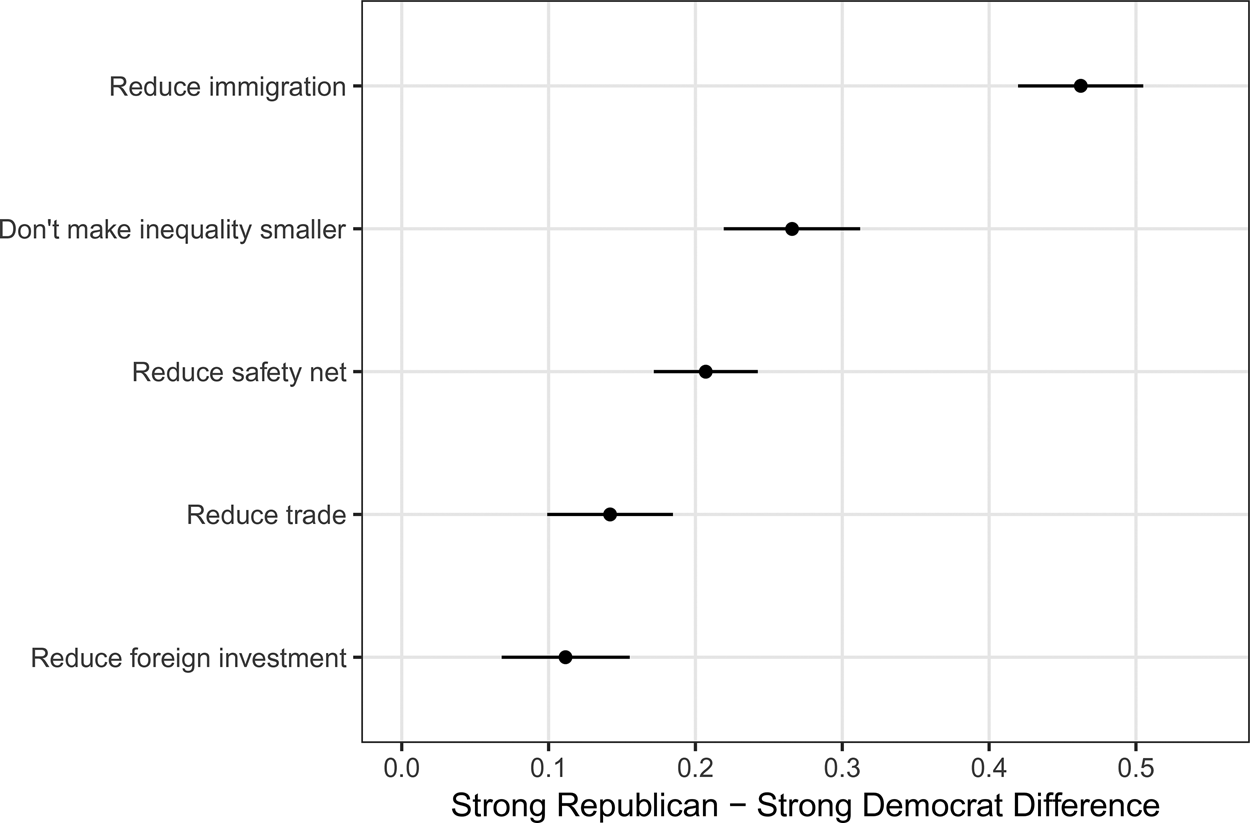
However, several features of our data suggest that ideological geographic sorting into the large metropolitan areas that we study is insufficient to eliminate partisan polarization. First, our analysis includes the entire metropolitan statistical area for each city and consequently a great number of suburban residents, who tend to be more conservative (Nall, Reference Nall2018). Additionally, a number of our MSAs are in relatively Republican states: in all but Seattle at least 24 percent of the respondents identify as Republicans, which is not lower than those identifying as Democrats. Second, the partisans in our cities have significantly different opinions about national policy issues. Figure 1 reports the results of an OLS regression of several national policy measures on dummy variables for partisanship, controlling for sociodemographic characteristics.Footnote 4 There are significant differences in policy positions for all five national issues and the differences between “Strong Democrats” and “Strong Republicans” are large in magnitude—for most issues, Strong Republicans are at least 20 percentage points more likely to express a conservative opinion, relative to Strong Democrats.
National policy opinions by partisan identification. This plot shows differences in opinions between Strong Republicans and Strong Democrats across a range of national policy issues. The estimates are based on a regression of an indicator for choosing a conservative response to each policy measure on a set of dummy variables for partisanship and a number of sociodemographic characteristics. The bars indicate robust 95 percent confidence intervals. Across all issues, Strong Republicans are at least 10 percentage points more likely to hold a conservative opinion, after controlling for other covariates.

We know that voters in our MSA data are divided on national policy issues and that this divide is partly explained by party affiliation. However, is that necessarily the case for local policy issues? We discuss two potential reasons why partisanship in preferences for local policies could be different than for national policies: competition among jurisdictions for capital and high-income residents, and fewer elite cues about what policies go with which partisan orientations at the local level.
One aspect of local politics that could affect partisanship in preferences over different policies is the fact that cities are in competition with each other. Jurisdictions compete for capital and high-income residents which could make local policy preferences across partisans (and across areas) converge. Peterson (Reference Peterson1981) and others have argued that because cities compete for firms and need to attract and retain high-income residents, they will have very similar policies on many local issues. In particular, we would expect this to be relevant for policies that are salient and easy for cities to compete over and for businesses or residents to act upon, such as tax breaks. To the extent that citizens internalize these constraints, their preferred policies may not vary even if they have very different underlying ideological orientations. This is different from national policies, since mobility of capital and residents is greater across areas within a country than across countries, which increases competition.
Another mechanism that could limit partisan polarization is the fact that there are fewer elite cues about what policies go with which partisan orientations at the local level—potentially because politicians are attuned to competitive pressures. Hopkins (Reference Hopkins2018) and others have argued that political behavior has become increasingly nationalized. One of the factors contributing to this trend is that individuals have less information about local politics as they become increasingly reliant on national media sources. This possibility suggests that we should expect variation in the level of partisanship across different local development issues depending on how important the issues are in national political discourse—for instance, the parties have clear positions on issues like rules governing union activity.
A further reason that preferences over local development policies might be less polarized than those over national policies is if voters did not think such policies were important. In that case, they simply might not have well-defined preferences on these issues, rendering average opinion indistinguishable between Democrats and Republicans. However, several pieces of evidence in our survey lead us to conclude that voters pay at least some attention to local politics. First, we asked respondents an open-ended question about what they think is the most important issue facing their metro area. A plurality of respondents say that issues related to the economy and employment are major issues, and other responses are in line with topics covered by our conjoint. Appendix B reports this evidence. Second, we asked a question about whether national or local policies were an important factor in determining the economic performance of their local area over the last 20 years. Respondents tended to attribute just as much responsibility to local economic policies as to national economic policies. This analysis is also presented in Appendix B. Based on this evidence, we conclude that local policies are of high importance to voters, and the specific policies used in our conjoint experiment seem relevant for what voters consider the most important issues facing their metro area.
Alternative predictions point in the opposite direction: that partisan sorting and polarization might be relatively high for local development policies. First, many of these policies are related to left-right positions about the optimal size of government and the role of the state versus markets in organizing economic activity. To the extent that citizens have become more consistently sorted on these issues in national economic policymaking, we might expect similar positions on local issues. Second, de Benedictis-Kessner and Warshaw (Reference de Benedictis-Kessner and Warshaw2016), Gerber et al. (Reference Gerber, Henry and Lubell2013), and others have found significant partisan patterns in local policymaking which seem plausibly related to underlying differences in the policy preferences of voters. Additionally, Tausanovitch and Warshaw (Reference Tausanovitch and Warshaw2014) find that local policy questions load onto the same left-right dimension in an ideal point model as national issues, suggesting that local policy preferences might exhibit similar partisan cleavages as national policy questions.
Hence, the question of whether there are partisan divides in preferences for local development policies is ultimately an empirical question, and the remainder of the paper evaluates how deeply partisan polarization pervades American politics. Our research design does not allow us to distinguish between different mechanisms that produce (or limit) sorting and polarization; however, our paper establishes new facts about the extent to which partisanship shapes public opinion on local policies.
Partisanship and local development policy preferences
To measure public preference over local development policies, we report the results of a choice-based conjoint survey experiment that varied attributes of proposed local development plans for eight large US MSAs: Charlotte, Cleveland, Houston, Indianapolis, Memphis, Rochester, St. Louis, and Seattle. The surveys were conducted by YouGov in January and February 2018 and are representative samples of the adult population of each MSA.Footnote 5 These MSAs were selected based on three main criteria: Each MSA needed to be large enough so that it was possible to construct a representative sample using YouGov's panel and matched sampling methodology; the MSAs needed to be selected from different regions of the US; and the MSAs needed to vary in their economic development success over the last four decades.
Conjoint experiment
Consistent with our interest in how individuals think about local public policy problem solving and with recent trends in the drivers of local economic performance, the conjoint experiment is framed in terms of how the MSA should respond to globalization and technological change and implement policies that will generate economic growth and good jobs. The introduction to the conjoint experiment emphasized that increased spending would require tax increases or spending reductions in other areas. Appendix C contains the specific wording of the conjoint introduction.
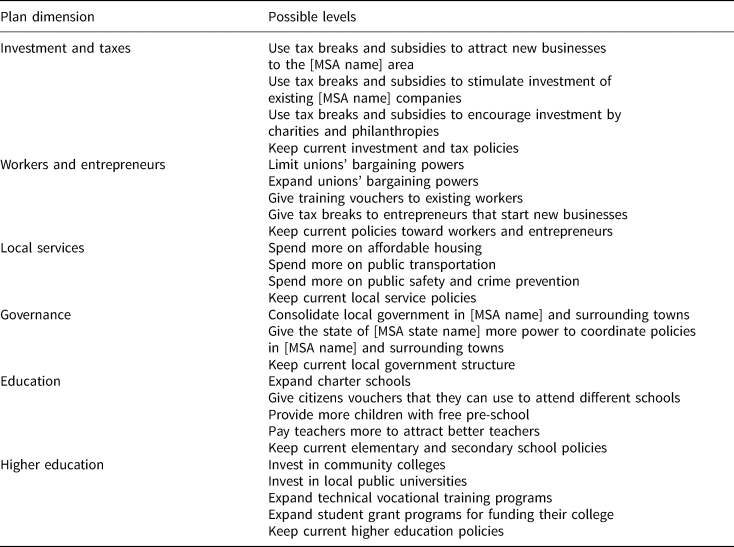
Respondents were presented with pairs of hypothetical plans for local development. Each plan was composed of six attributes corresponding to six critical areas of local development policymaking: Investment and Taxes, Workers and Entrepreneurs, Local Services, Governance, Education, and Higher Education. For each issue area, a possible value was randomly drawn from an underlying set of potential values that included alternative reform or spending priorities as well as the status quo in that policy area. Table 1 lists each possible value for each dimension.
Conjoint dimensions and attribute values for local development plans

This table reports the attribute values for each dimension of the conjoint experiment.
Respondents were presented with randomly generated pairs of potential policies for their MSA to adopt as a local development plan and were asked to choose which plan they would prefer to see implemented.Footnote 6 Using this style of forced-choice design, we are able to evaluate the direction and relative weight individuals place on each dimension of local development. Respondents were presented with five sets of local development plan pairs. For our analysis, we constructed a binary measure Local Development Plan Support that equals one if a respondent selected a particular policy proposal as their preferred choice, and zero otherwise.
We estimate an ordinary least squares regression of Local Development Plan Support on dichotomous indicator variables for all treatment categories, with the exception of the baseline for each conjoint dimension.Footnote 7 For the sake of consistency, we take the value that expresses the status quo as our baseline for each dimension. This estimation yields the average marginal component-specific effect (AMCE) for each treatment group relative to the baseline.Footnote 8 Standard errors are clustered at the respondent level.
Intuitively, the coefficients give the average change in probability of selecting a development plan with the specific feature over a development plan that contains the status quo policy in that issue domain. Positive coefficients thus indicate that a given feature makes a plan more popular, relative to the status quo.
One of the main advantages of conjoint survey experiments is the ability to investigate multidimensional phenomena in an efficient way. This feature makes this approach attractive for studying polarization in policy opinions over local policies, where there may be different patterns of heterogeneity across different policies. Even if Democrats and Republicans have different preferences over the size of government or differential willingness to pay for public goods, we expect the magnitude of those differences to vary across policies. The conjoint allows us to study many policies without focusing arbitrarily on just a few aspects of economic development policy. A related advantage of conjoints for studying local politics is that because there are fewer representative studies of public opinion about local issues, it is less well-known what tradeoffs individuals will make between issues, or to put it differently, which issues they weigh more heavily when faced with tradeoffs.
Experimental conjoint estimates
Because our primary goal in this paper is assessing the extent to which attitudes toward development vary by party identification, we present estimates that pool across all respondents in Appendix Figure A-4. We find that on average, citizens support active policies to support businesses in their communities. They are also supportive of greater investments in human capital. While there is some variation across MSAs, the general pattern of estimates is quite similar across communities.
Partisanship and local development
Next, we examine the extent of sorting and partisan polarization about local development policy. Given the design of our conjoint experiment, we define sorting as a policy alternative having a different effect on the probability that Democrats and Republicans choose a development plan relative to the status quo. Polarization is defined as the policy alternative having an opposite effect on the two groups, increasing the probability of selecting a plan for one party and decreasing the probability for the other party. This definition is particularly compelling in this setting for which status quo policies are the baseline. Our approach requires that we estimate the conditional average marginal component effect (CAMCE) for Strong Democrats and Strong Republicans (Hainmueller et al., Reference Hainmueller, Hopkins and Yamamoto2014). Our initial CAMCE estimates are based on a split-sample approach in which we estimate the same regression for the AMCE separately for Strong Democrats and Strong Republicans.
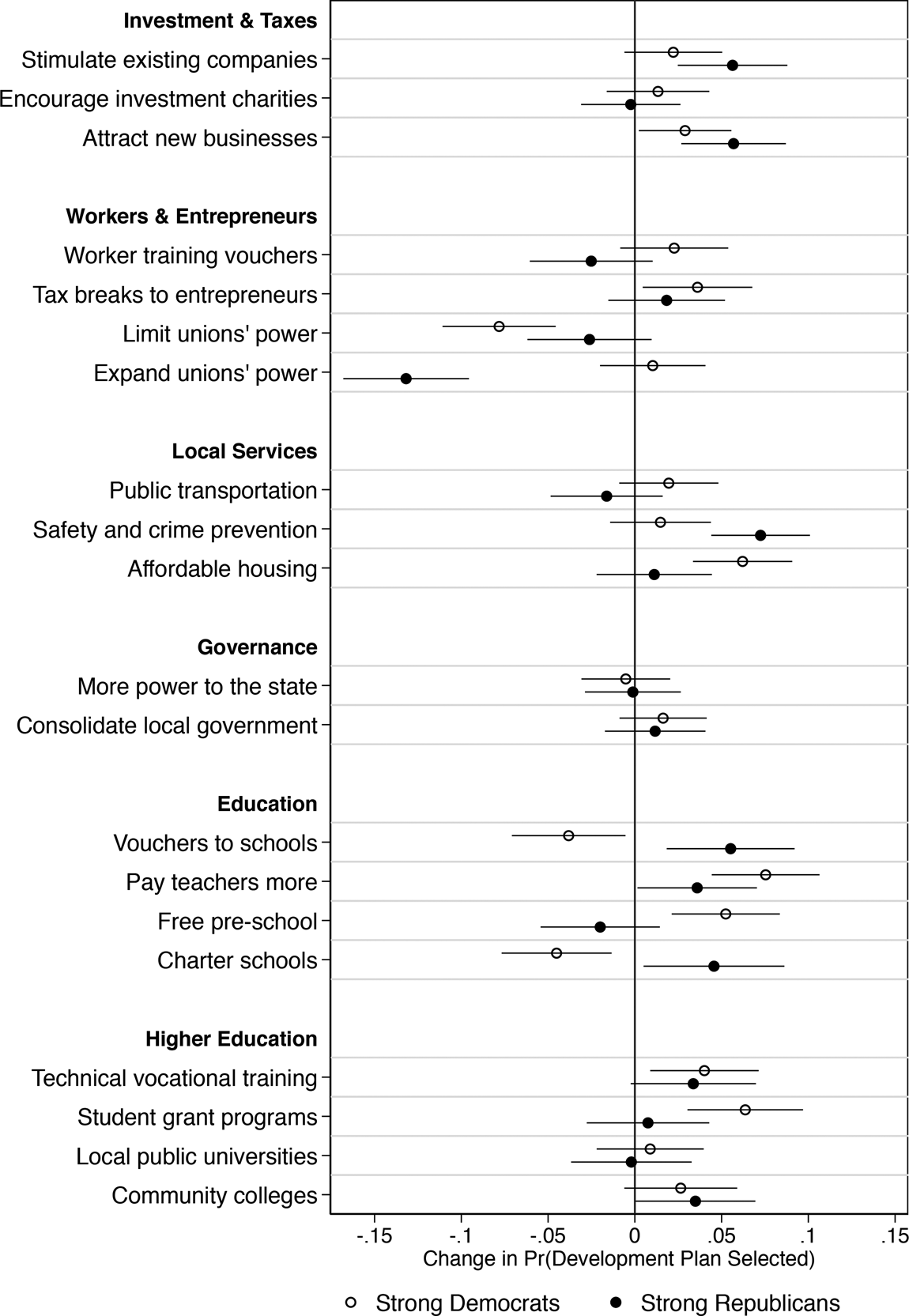
Figure 2 presents our split-sample CAMCE estimates for Strong Democrats and Strong Republicans. Generally, these results show that Democrats and Republicans have broadly similar attitudes toward many of these proposals.Footnote 9 The point estimates for Strong Democrats and Strong Republicans are neither statistically nor substantively different from each other on a wide range of policies that we study, indicating an absence of pervasive partisan sorting. Moreover, even when such differences exist, the point estimates have the same rather than opposite signs as we would expect if opinions were polarized. The exceptions to these patterns tend to be a subset of issues relating to primary and secondary education and, to a lesser extent, labor.
Split-sample results. CAMCE estimates show differences between Strong Democrats and Strong Republicans. Points show coefficient estimates from separate OLS regressions, and bars show robust 95 percent confidence intervals.

Beginning with the top panel, we present the CAMCEs for the Investment and Taxes factor. First, we find that the probability that Strong Republicans and Strong Democrats select a plan is increased if that plan includes subsidies and tax breaks to stimulate existing companies as opposed to the status quo. The CAMCE for Strong Republicans is 3.4 percentage points higher than for Strong Democrats, but this difference is not statistically significant.Footnote 10 Next, the same general pattern holds for a policy of using subsidies and tax breaks to attract new businesses. Democrats and Republican alike support this policy. The estimate for Strong Republicans is slightly higher but again this difference is not significant. On the other hand, respondents from both parties are less enthusiastic about encouraging investments by charities: the estimate is indistinguishable from 0 for both groups and there is little evidence of partisan sorting or polarization, again underscoring the partisan consensus that appears on each policy related to Investment and Taxes.
The next panel shows the results for the Workers and Entrepreneurs factor. Here, we find mixed evidence of sorting and polarization. There is almost no difference in the point estimates for the policy of giving tax breaks to entrepreneurs that start new businesses—in line with the previous results, this policy is popular across the board. However, when it comes to labor, there is more evidence of partisan differences: Democrats are more supportive of unions than Republicans. Both are opposed to limiting unions’ power relative to the status quo, though the effect is larger for Democrats. When it comes to expanding unions’ power, there is a large negative effect for Republicans but essentially zero effect for Democrats. Partisans are clearly sorted in this case, and there is some evidence of polarization. When it comes to providing vouchers for workers to get training, there is again evidence of sorting and some evidence of polarization.
Next, we turn to the results for the Local Services factor. Here, we see evidence of partisan sorting for all three alternatives to the status quo and some evidence for polarization in the area of public transportation. Republicans are less supportive than Democrats of affordable housing, though there is only weak evidence of polarization. Republicans are more supportive of spending more money on public safety and crime prevention, though respondents of both parties mostly support this policy proposal relative to the status quo. Finally, there is mild division on the issue of public transit. We will revisit these results in the next section: after controlling for other characteristics of respondents besides partisanship, we find smaller partisan differences over affordable housing and no polarization for any of these issues.
The next factor we consider are two Governance reforms: giving more power to the state and consolidating local governments. Both of these policies, on average, garnered neither support nor opposition relative to the status quo. There is no evidence of partisan differences.
Now, we consider the Education factor. This issue domain is where we see the greatest evidence of partisan polarization. We start with an issue that has received attention in national media: issuing vouchers that citizens can use to attend private schools. This policy has a large positive effect on the probability that Republicans select a development plan (relative to the status quo) but a negative effect for Democrats. There are similar divisions when it comes to charter schools and free pre-school—with Republicans supporting the former and opposing the latter, and vice versa for Democrats. Finally, the last education policy proposal, paying teachers more, indicates partisan sorting but not polarization. Inclusion of this policy increases the probability a platform is supported by both Democrats and Republicans, though the effect is stronger for Democrats.
The final factor we examine, in the bottom panel of Figure 2, is related to Higher Education policy. There is little evidence of partisan sorting in these estimates and no evidence of polarization. Increased investment in community colleges garners roughly equal support from both Democrats and Republicans. We see the same pattern for expanding technical vocational training. For investing in local public universities, the estimates are nearly zero for both Strong Democrats and Strong Republicans. Finally, for a proposal to expand student grant programs, the estimate is positive for both groups, though about 5.6 percentage points larger for Democrats—suggesting sorting on this policy proposal.
On the whole, we take our split-sample results to indicate that citizens exhibit similar preferences over local policies aimed at spurring economic development. Before discussing the substantive implications of the results, we raise two questions about these estimates. The definitions of sorting and polarization used in this analysis are specific to the experimental conjoint research design that we employ. One might wonder whether this method is well-suited for detecting partisan sorting. Is the absence of evidence of sorting and polarization due to a lack of partisan differences over local issues, or is it due to an inability of this tool to uncover such differences? Two observations suggest that it is the former rather than the latter. First, our estimates do detect partisan differences for some labor and education policies. Second, previous experimental conjoint studies of national policies have uncovered large partisan differences in AMCEs for policies where other survey methods would also find partisan differences (e.g., Hansen et al., Reference Hansen, Olsen and Bech2015; Ballard-Rosa et al., Reference Ballard-Rosa, Martin and Scheve2017). Another potential concern about these estimates is whether the presence or absence of partisan differences in the AMCEs is because Strong Democrats and Strong Republicans also have other characteristics which lead them to react similarly or differently to various policy attributes. We investigate this possibility in the next section.
Conditional partisanship and local development
The split-sample estimates of the CAMCEs presented in the previous section are unbiased estimates of the AMCEs for each partisan group. Given the CAMCE estimand, there is no bias created by not “controlling for” other individual characteristics in the split-sample estimates. Nonetheless, to fully understand heterogeneity in the AMCEs, it is helpful to define the estimand of interest as the CAMCE, controlling for a wide number of observed characteristics of each respondent. We want to know if the absence or presence of partisan differences is sensitive to conditioning on other potentially relevant characteristics such as income and race for predicting local development policy preferences. In this section, we introduce a hierarchical model for estimating CAMCEs conditioned on observed individual characteristics and present these results focusing on differences among Strong Democrats and Strong Republicans.
A hierarchical model for estimating CAMCEs from experimental conjoint data
Our approach unifies two separate tasks: first, the preference measurement task that traditional OLS analysis of conjoint data enables; and, second, fitting a regression of the estimated preferences on individual-level characteristics.
To motivate the method, consider the more familiar setting of measuring preferences via a standard survey question. For instance, we might directly ask whether respondents support or oppose expanding charter schools. To investigate the correlates of support for charter schools, we could then regress responses on respondent-level covariates.Footnote 11 In conjoint experiments, this exercise is not as straightforward, because we must first measure preferences from the choices made in the conjoint tasks and typically respondents do not complete enough tasks to nonparametrically identify individual-level marginal component effects. As such, the conjoint literature has typically focused on estimating AMCEs or simple CAMCEs that can be estimated via split-sample approaches. We refer to this approach as “complete pooling” because it does not explicitly model individual-level heterogeneity in parameter estimates across respondents (Gelman and Hill, Reference Gelman and Hill2007).
Alternatively, one could nonparametrically estimate individual-level marginal component effects (IMCEs) if each respondent completed a large enough number of conjoint tasks. In that case, we could run separate OLS regressions for each respondent. These estimates would converge to the true IMCEs as the number of tasks grows large. In the limit, we could perfectly measure individual-level parameters, then regress these preference parameters on individual-level covariates—just as we would with traditional survey questions. This “no pooling” approach does not share information between respondents in estimating parameters. While theoretically possible, this strategy is typically not feasible in practice because each respondent completes only a relatively small number of tasks.
Our proposed method provides an intermediate between the complete-pooling and no-pooling approaches. We use a hierarchical model that allows for individual-level heterogeneity in the way that conjoint levels affect the probability that the respondent prefers a particular profile. We then model these individual coefficients in a second-level regression as a function of respondent-level covariates. We estimate the model using a random-effects framework that allows for partial pooling between similar observations.
We briefly describe the setup here. For more details and further discussion, see Appendix E. Let $i$ index respondents ($i = 1\comma\; \dots \comma\; N$
 ) and let $j$
 index conjoint profiles ($j = 1\comma\; \dots \comma\; J$
 ). If respondent $i$
 preferred profile $j$
 to the alternative, then we observe $y_{ij} = 1$
 ; otherwise $y_{ij} = 0$
 . Let $X_{ij}$
 denote a vector of dummy variables that specifies the conjoint levels that respondent $i$
 saw for profile $j$
 .
The first-level regression models conjoint responses as a linear function of the conjoint levels:

In this equation, $\alpha _i$ is an intercept term, which may vary at the individual level, that indicates the probability respondent $i$
 chooses a profile that features the baseline level of each factor. $\beta _i$
 is a parameter vector that relates the conjoint profile features to the probability of choosing that profile. Finally, $\epsilon _{ij}$
 is a mean-zero error term. Under the complete-pooling approach, we set $\alpha _i = \alpha$
 and $\beta _i = \beta$
 for all respondents, and estimate Equation 1 via OLS. Under randomization, $\beta$
 represents the vector of AMCEs.
Instead, we allow for some heterogeneity, allowing elements of $\beta _i$ to vary as a function of individual-level covariate vector $Z_i$
 (which includes a column of 1's as an intercept). In particular, we specify the following linear functional form for element $k$
 of $\beta _i$
 :

The coefficient vector $\gamma _k$ indicates how the expected individual-level marginal component effect varies as a function of respondent-level covariates, and $\eta _{ik}$
 is a mean-zero error term. Because $Z_i$
 may contain several variables, it allows us to characterize how some variable of interest—such as partisan identification—covaries with conjoint preferences after adjusting for other covariates. We set up an analogous model for $\alpha _i$
 , the individual-level probability of selecting the status quo as the preferred policy.
It is useful to consider Equation 2 as analogous to the approach taken when modeling answers to traditional survey responses. In that case, we would replace $\beta _i^{k}$ on the left-hand side with the actual survey response, and the $\gamma$
 coefficients would be the usual linear regression coefficients. In our case, we are jointly estimating the preference parameter $\beta _i$
 , along with the second-level coefficients $\gamma$
 .
Finally, we place several distributional assumptions on $\epsilon _{ij}$ and $\eta _{ik}$
 —namely, that they are normally distributed. We estimate the model in a Bayesian framework using Stan (Carpenter et al., Reference Carpenter, Gelman, Hoffman, Lee, Goodrich, Betancourt, Brubaker, Guo, Li and Riddell2017). Estimation in a Bayesian framework is useful for several reasons. It provides a simple method of estimating IMCE parameters and associated uncertainty—a task that is more difficult with maximum likelihood estimation. Additionally, hierarchical models in a Bayesian framework have built-in regularization that helps deal with the multiple comparisons problem (Gelman et al., Reference Gelman, Hill and Yajima2012)—an attractive feature for our application, where we have many parameters to estimate and many quantities of interest. For more details on estimation, including methods used to assess convergence, see Appendix E.
Our approach allows a richer description of heterogeneity in conjoints, enabling us to make statements of the form, “On average, Democrats are $x$ percentage points more likely than demographically similar Republicans to support a plan that includes expanding union power, relative to the status quo.” However, there are several potential limitations, which we discuss in more detail in Appendix E. Most importantly, we can only control for observable individual-level characteristics; standard caveats about omitted variables bias apply. The second-level coefficients cannot be interpreted as causal without stronger assumptions. This approach is primarily a method for richer description—not for causal inference.
Multivariate estimates
Our main specification models the conditional average marginal component effect as a function of a seven-point party identification scale (with indicators for each response option), along with extensive sociodemographic control variables including age, race, sex, education, income, employment status, homeownership, length of time living in the region, and MSA indicators. The coefficients on partisanship therefore capture differences between Democrats and Republicans, after adjusting for other observable characteristics.
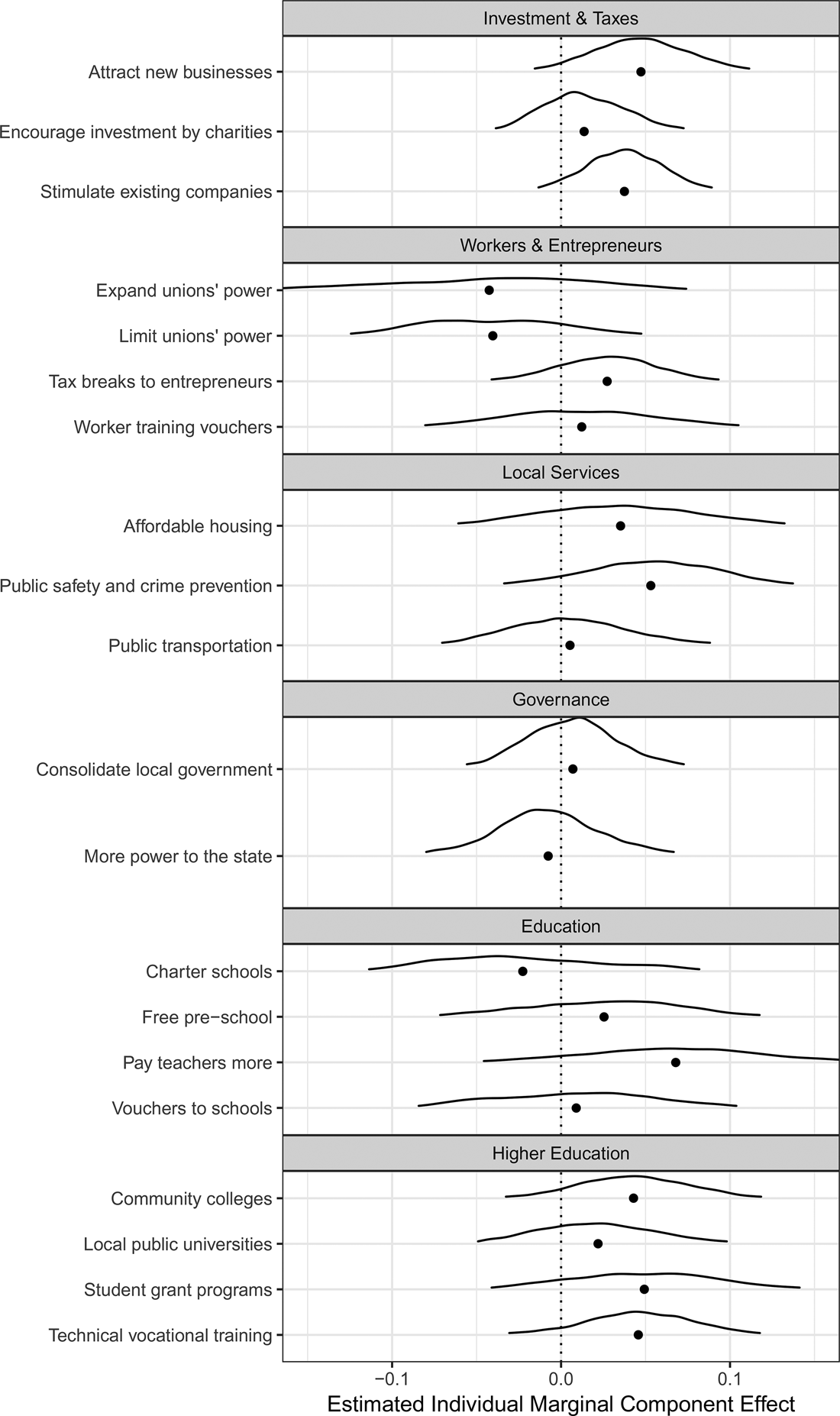
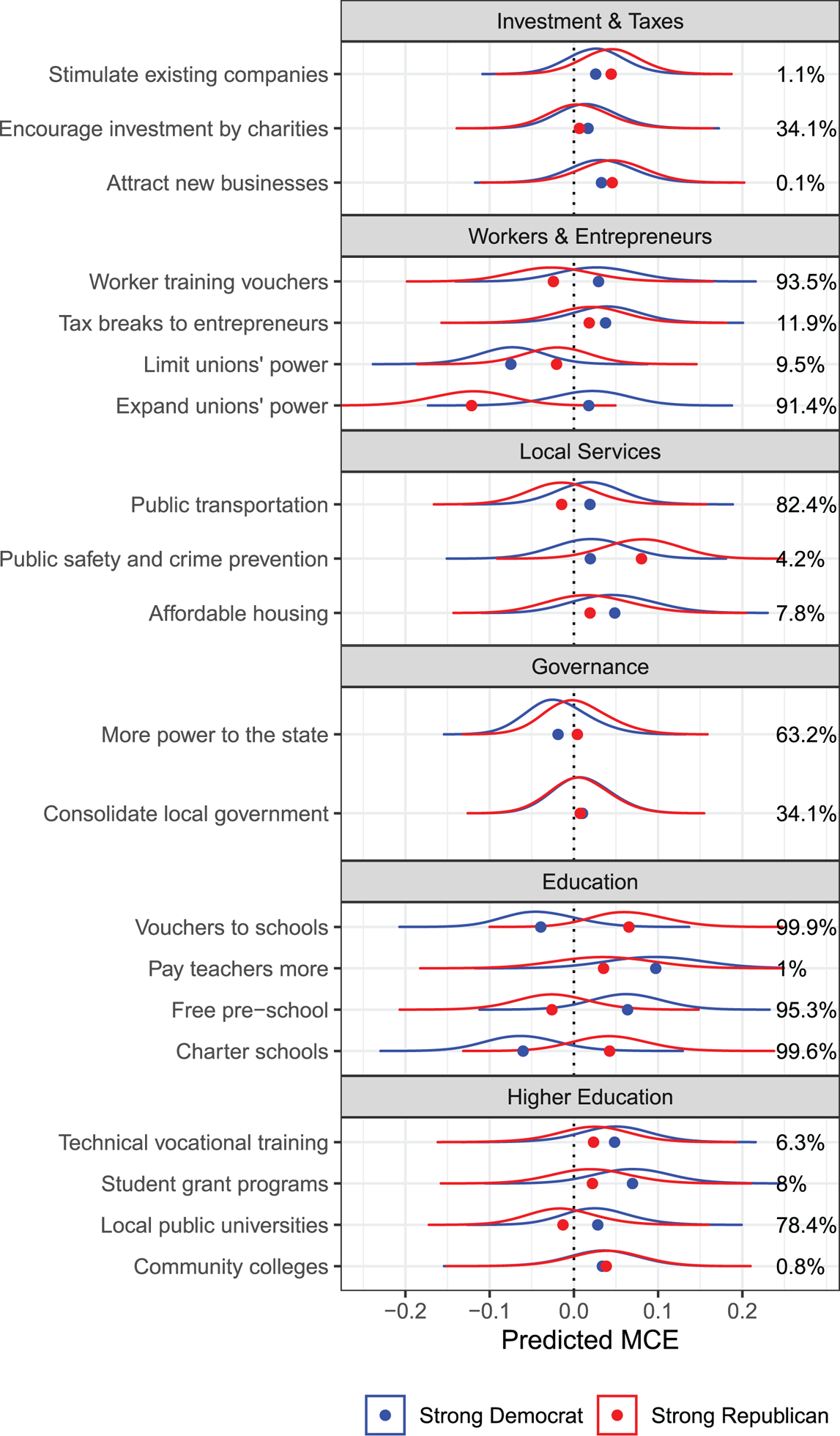
First, to demonstrate the advantage of the hierarchical model, we plot the distribution of estimated individual marginal component effects—in the notation of the previous section, the distribution of the $\beta _i$ 's—in Figure 3. The lines in this figure show kernel density estimates of the posterior means across all 7800 survey respondents, while the points show the mean of the distributions—the model-based equivalent of the AMCEs presented earlier in the paper. This figure visualizes the variation in the effect of individual policies’ inclusion in a policy bundle on respondents’ probability of preferring that bundle.
Estimated individual-level marginal component effects. The lines show a kernel density estimate of the posterior means of the IMCEs, while the dots show the average of the posterior means. Estimates are from the hierarchical model with sociodemographic covariates predicting IMCEs.

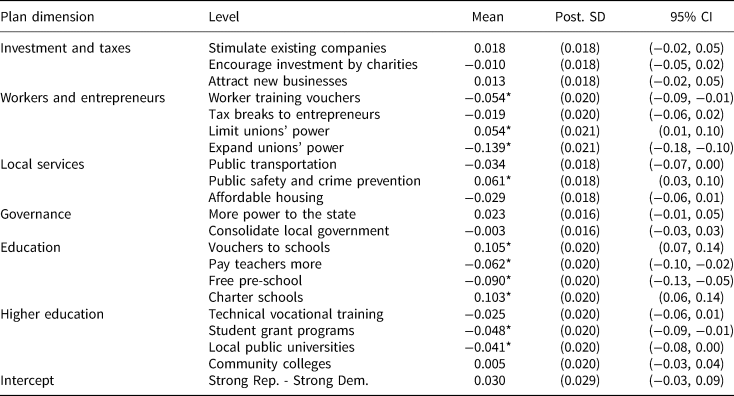
Next, we can use the second-level regression estimates to investigate the nature of this heterogeneity, especially as it pertains to partisan sorting and polarization. Table 2 shows the estimated difference between the CAMCEs for Strong Democrats compared to Strong Republicans on each policy proposal, after adjusting for observable sociodemographic variables. The table reports the posterior means, posterior standard deviation, and central 95 percent credible intervals.
Comparison of partisan CAMCEs

Estimated second-level coefficients on the indicator for Strong Republican, relative to Strong Democrat. The first two columns specify the policy proposal. “Mean” refers to the posterior mean of the coefficient, while “post. SD” is the posterior standard deviation. The final column shows the 0.025 and 97.5 quantiles of the posterior distribution, i.e., the central 95 percent credible interval. Asterisks indicate that the 95 percent credible interval excludes 0.
This table is especially useful for understanding sorting, which again we define in our context as a significant difference in CAMCEs. The patterns are broadly similar to what we saw previously. There are minimal differences between Democrats and Republicans across all Investment and Tax policy proposals, giving tax breaks to entrepreneurs, Governance policy proposals, and several Higher Education proposals. We find that the disagreements over unions, worker training vouchers, and Education policy that we documented previously are all robust to inclusion of sociodemographic covariates.
The main differences from our previous results arise in the Local Services dimension. In the split-sample approach, we found some mild differences across all three of these policy proposals. However, after adjusting for covariates, the only significant difference between Democrats and Republicans is on the proposal to spend more on public safety and crime prevention. Strong Republicans have a 6 percentage point higher CAMCE for this proposal, on average, than Strong Democrats. On affordable housing and public transportation, Democrats still have larger CAMCEs but these differences are small and the 95 percent credible interval includes 0.
We also see a difference in the results for investing in local public universities. There was no evidence of partisan sorting over this issue in the split-sample results but once we control for the demographic characteristics of respondents, Strong Republicans have a 4 percentage point lower CAMCE for this policy, on average, compared to Strong Democrats. This difference in the conditioned and unconditioned partisan comparisons is consistent with Republicans having demographic characteristics associated with greater support for higher education but once we control for these characteristics, Republicans may be ideologically more skeptical about higher education investments.
To investigate the extent of partisan polarization, we need a measure of whether Democrats and Republicans stand on opposite sides of an issue—not just whether they have a significant difference in CAMCEs, on average. To approach this question, we use the model to generate predictions of IMCEs for each respondent in the sample under two assumptions. First, we create two modified individual-level covariate matrices, $\tilde {Z}^{dem}$ and $\tilde {Z}^{rep}$
 , which are identical to the actual $Z$
 matrix except we set partisanship to Strong Democrat or Strong Republican, respectively. Second, we predict the marginal component effects for each individual under these counterfactual covariate values. Third, we summarize the resulting distributions. The amount of overlap of the two resulting distributions, as well as whether they tend to fall above or below 0, tell us about the extent of partisan sorting and polarization on each issue.
Additionally, we compute the posterior probability that the means of the respective distributions have opposite signs. To do this, we simply compute the counterfactual AMCEs for $\tilde {Z}^{dem}$ and $\tilde {Z}^{dem}$
 for each sample drawn from the posterior distribution of parameter values (i.e., the average of the predicted IMCEs). We then compute the proportion of times that the counterfactual AMCEs have opposite signs.
These results are presented in Figure 4, which plots the predicted distribution of conditional average marginal component effects under the assumption that everyone is a Strong Republican (red line) or a Strong Democrat (blue line). The points show means of the respective distributions, and percentages give the probability that the means have different signs.
Simulated partisan marginal component effects. Distribution of predicted individual-level marginal component effects, assuming everyone is a Strong Democrat or a Strong Republican, holding other covariates fixed at their observed values. Lines show posterior means of kernel density estimates applied to 500 samples from the posterior; points show posterior means. Percentages refer to the posterior probability that the partisan means have different signs. The omitted default category for each dimension is the status quo.

There are several issues on which partisans are sorted—in the sense of some partisans having different CAMCEs—but not polarized. On the issue of limiting unions’ power, while Democrats are much less amenable to this policy than Republicans, there is still substantial overlap in the distributions, and the means of the distributions are both negative (with only a 9.5 percent probability of having different signs). A similar pattern exists for spending more on public safety, paying teachers more, and expanding student grant programs—all of which have less than 10 percent probability of the average partisans being on opposite sides of the issue. In these cases, partisans have different CAMCEs in magnitude, but the sign is the same on average. Partisans, then, may differ in the strength of their opinions on these issues relative to the status quo but they do not find themselves in opposition.
There is substantial polarization, however, on three of the primary and secondary education policy proposals: school vouchers, free pre-school, and charter schools. On these issues, the average difference between Democrats and Republicans is so large that shifting the distributions results in almost no common ground. On all three of these proposals, the probability of partisans being on opposite sides of the issue is greater than 95 percent.
Finally, there is also some evidence of polarization when it comes to labor policies, though it does not meet the strict 95 percent threshold. For worker training vouchers and expanding union power, the probability of partisans standing on opposite sides is roughly 93 percent and 91 percent, respectively.
Conclusion
Partisan polarization seems pervasive in American politics. Academics and pundits point to the increasing divide between Democrats and Republicans as an impediment to solving pressing policy problems. But extant evidence on polarization focuses primarily on national policy issues, with less research on the extent of polarization in subnational policy domains. On the one hand, there is evidence that partisanship of mayors matters for local policymaking, suggesting that citizens, too, may hold divergent views over local policy. On the other hand, there are good reasons to think that polarization over local political economy issues, in particular, would be muted. Residential, capital, and labor mobility within and across regions makes it difficult for localities to pursue dramatically different economic policies, as cities compete to attract high-income residents and businesses. Additionally, and possibly as a consequence, there are relatively few cues from elites about which policies partisans should support. However, if there is polarization and partisan sorting over these local issues, it could have large policy implications. There is increasing economic divergence across metro regions in the US, meaning local economic policy is of central importance. Partisan polarization could lead to policy delay and inaction that prevents effective responses to evolving economic conditions.
In this paper, we study the extent of partisan disagreement on these local issues. We provide a research design employing conjoint survey experiments to study both partisan sorting and partisan polarization. We further develop a hierarchical model for estimating conditional average marginal component effects for strong partisans controlling for other individual characteristics. This methodology provides numerous new ways to study heterogeneity in average marginal component effects that complement commonly used split-sample estimates.
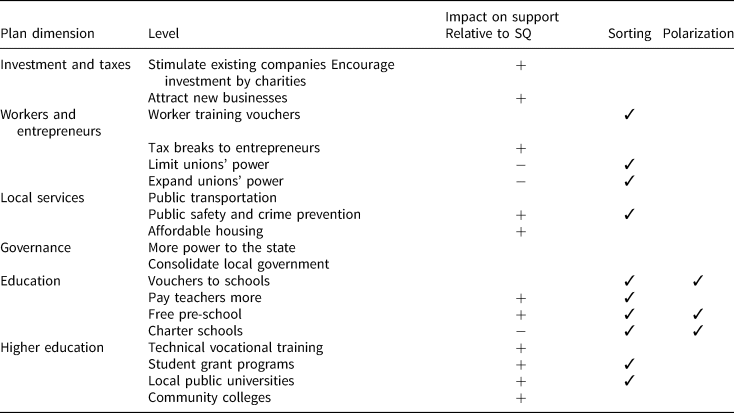
To aid with interpretation of our results, Table 3 presents a concise summary of our findings—both in terms of overall support for the policy change as well as in terms of the extent of partisan sorting and polarization. Across both our split-sample and hierarchical model estimates, there is broad bipartisan support for policies aimed at encouraging business investment. In particular, policies to use taxes and subsidies to encourage investment draw strong support from both sides of the aisle. Additionally, citizens of all political stripes support similar higher education policy proposals, notably investment in community colleges, technical training, and student grant programs. Though these policies are riskier in terms of attracting businesses—because people can move away after they are educated—empirically there is evidence that having skilled workers and innovation spurred by higher education institutions are important components of a thriving local economy (Moretti, Reference Moretti2012). These results are broadly consistent with theories that emphasize the pressure cities are under to compete for firms and high-income residents.
Summary of results

We define sorting as Democrats and Republicans having significantly different levels of support for the policy relative to the status quo (i.e., significantly different CAMCEs, with 95 percent credible interval excluding 0). Polarization occurs when one set of partisans prefers the policy to the status quo on average and the other opposes it (i.e., Democrats and Republicans having CAMCEs of opposite signs with posterior probability of at least 95 percent).
On the other hand, across both estimation strategies, we observe strong evidence of polarization on primary and secondary education policy, specifically on policies related to charter schools, school vouchers, and free pre-school. We also observe some weaker evidence on labor issues—particularly on proposals to provide training vouchers to workers and on expanding union power. Citizens appear to be aligned with their parties on these issues, with Republicans supporting school choice and opposing labor unions, and Democrats supporting traditional public education and supporting labor unions. These differences may reflect the strength of national partisan cues about these issues and the absence of sufficiently clear competing pressures to overcome those associations.
Finally, for several issues, particularly local services, our two estimation strategies yield different results. The split-sample estimates suggest a good deal of partisan sorting over the policy to increase spending on local services but these differences substantially disappear in the hierarchical models that control for other respondent characteristics. We interpret these differences as indicating that while partisans on average react differently to these policy deviations from the status quo those differences are largely a function of differences in sex, race, and homeownership rather than partisanship among otherwise similar citizens.
Overall, we conclude that on many core development issues, there is a relatively broad scope for compromise. Especially when it comes to issues that affect business investment, partisanship appears not to structure public opinion. The low levels of polarization on these sets of issues run in contrast to the partisan divides seen on national policy issues—even among the same set of respondents. The results are consistent with cities being relatively constrained in the policies they can pursue, leaving less room for parties to stake out distinct positions.
Acknowledgements
We thank Jim Alt, Cameron Ballard-Rosa, Adam Bonica, Liz Gerber, Jens Hainmueller, Shanto Iyengar, Chris Tausanovitch, and Chris Warshaw for helpful advice on the paper. The survey data for this study were originally collected by bgC3. Scheve, Slaughter, and Jensen worked as paid consultants for bgC3. All the analyses and interpretation in this paper are the work of the authors and were not reviewed by bgC3. The analysis of the bgC3 data was reviewed and approved by Stanford University's Institutional Review Board. Scheve thanks the Institute for Research in the Social Sciences at Stanford University for support.
Supplementary material
The online Appendix for this article can be found at https://doi.org/10.1017/psrm.2020.56.