Introduction
Sudden cardiac death accounts for more than one-half of all coronary heart disease deaths in the United States, with approximately 326,200 cases of out-of-hospital cardiac arrest patients assessed by Emergency Medical Services (EMS) each year.Reference Hubble and Tyson 1 The importance of bystander cardiopulmonary resuscitation (CPR), early defibrillation, and optimal post-resuscitation care on outcomes is well-documented. However, notwithstanding the Class IIb recommendation of vasopressors and some antiarrhythmic agents in the 2015 American Heart Association (Dallas, Texas USA) Advanced Cardiac Life Support (ACLS) guidelines, the effectiveness of drug therapy is not well-established.Reference Mozaffarian, Benjamin and Go 2 In particular, there is considerable controversy regarding the effectiveness of vasopressors in cardiac arrest.
Several systematic reviews and meta-analysis studies on vasopressors have noted an increase in the likelihood of return of spontaneous circulation (ROSC), but failed to identify a benefit to survival to discharge or survival with favorable neurological outcome.Reference Link, Berkow and Kudenchuk 3 - Reference Patanwala, Slack, Martin, Baskin and Nolan 5 However, to date, no randomized clinical trial has controlled for the timing of epinephrine administration, which has been noted to be substantially delayed in comparison to animal studies which previously demonstrated the drug’s effectiveness.Reference Larabee, Liu, Campbell and Little 6 , Reference Rittenberger, Bost and Menegazzi 7 Nonetheless, several observational studies have noted the influence of the timing of drug administration on ROSC, but either did not investigate longer-term outcomes or were underpowered to demonstrate an impact on favorable neurological outcomes.Reference Reynolds, Rittenberger and Menegazzi 8 - Reference Hubble, Johnson and Blackwelder 11
Because of the lack of randomized trials and the limitations of previous observational studies, the influence of the timing of drug administration on survival and neurological outcomes remains poorly quantified. Therefore, using a statewide dataset, this study sought to develop a model describing the likelihood of favorable neurological outcome as a function of the public safety answering point call receipt (PSAP)-to-pressor-interval (PPI) measured on a time continuum. It was hypothesized that the likelihood of favorable neurological outcome declines with increasing PPI.
Methods
Data Sources
With approval from the Institution Review Board at Western Carolina University (Cullowhee, North Carolina USA), a retrospective observational study of cardiac arrest was conducted using the Cardiac Arrest Registry to Enhance Survival (CARES) database (Centers for Disease Control and Prevention [Atlanta, Georgia USA]; American Heart Association [Dallas, Texas USA]; and Emory University Department of Emergency Medicine [Atlanta, Georgia USA]), a prospective clinical registry of out-of-hospital cardiac arrests, and the North Carolina Prehospital Medical Information System (PreMIS) database. While the CARES registry has been described in detail elsewhere,Reference Ewy, Bobrow and Chikani 12 PreMIS is the data collection and management system that collects statewide data from over 400 North Carolina EMS agencies. Data are submitted to PreMIS for all EMS responses in North Carolina, and the data points for collection are a subset of the National Emergency Medical Services Information System (NEMSIS; Salt Lake City, Utah USA) data set.Reference McNally, Stokes, Crouch and Kellermann 13 Data elements selected from the CARES database included patient outcomes, field hypothermia, and the use of CPR feedback devices, while all other elements were obtained from the PreMIS database. The CARES data were then matched to corresponding EMS records in the PreMIS database.
Outcome Measures
The primary outcome measure was the relationship between the timing of the initial administration of vasopressors measured on a continuum of one-minute time increments, and survival with favorable neurological outcome using the five categories of the Glasgow-Pittsburg cerebral performance category (CPC) scale: (1) good cerebral performance; (2) moderate cerebral disability; (3) severe cerebral disability; (4) coma or vegetative state; and (5) death.Reference Dawson 14 Favorable neurological outcome was defined as CPC 1 or 2. Secondary outcome measures included ROSC, survival to hospital discharge, and on-scene delays in vasopressor administration associated with drug route (intravenous [IV] versus intraosseous [IO]) and airway control procedures.
Study Setting
North Carolina is the nation’s ninth most populous state with a residential population of approximately 10 million dispersed across a land mass of 48,617 square miles.Reference Jennett and Bond 15 Demographically, the state is comprised of urban, suburban, and rural populations, with 33.9% of the population living in rural areas. 16 Cardiovascular disease is the second leading cause of death in the state resulting in 17,547 deaths in 2014. 17
Sample
The CARES database was queried to identify individuals who suffered a cardiac arrest in North Carolina between January 1, 2012 and June 30, 2014. These records were then filtered to meet pre-specified inclusion and exclusion criteria. Inclusion criteria consisted of all adult patients (≥18 years) suffering a bystander-witnessed, non-traumatic cardiac arrest. Patients were excluded if they did not receive any resuscitation attempt or if they responded to CPR and/or defibrillation alone and did not receive any vasopressors. Because patients with EMS-witnessed arrests may have already received some treatment prior to the arrest which would have biased PPI intervals (eg, airway procedures or venous access), these patients were excluded. Because of the need for an estimate of the onset of cardiac arrest to calculate PPI, unwitnessed arrests also were excluded.
Data Collection
For each patient meeting inclusion criteria, relevant data were abstracted from the linked databases, including demographic, response, treatment, outcomes, and times of key interventions. The PPI was calculated as the elapsed time in minutes between 911 PSAP call receipt and administration of the first dose of either epinephrine or vasopressin. The time to ROSC was estimated as the interval between PSAP call receipt and the first documented blood pressure.
Statistical Analysis
Abstracted data were analyzed using IBM SPSS Statistics version 23 (IBM Corporation; Armonk, New York USA) with P≤.05 indicating statistical significance. Continuous variables and time intervals are presented as means (standard deviation [SD]), and categorical variables are presented using frequency distributions and percentages. Continuous variables were compared using Student’s t-test or the Mann-Whitney test. Categorical data were analyzed using the chi square test, continuity correction, or Fisher’s exact test, as appropriate. Adjusted odds ratios (OR) were calculated using logistic regression to control for potentially confounding variables identified a priori as PPI; patient age, gender, and non-Caucasian race; endotracheal intubation (ETI); shockable presenting rhythm; layperson CPR; and field hypothermia.
A cumulative frequency distribution curve was used to display the relationship between PPI and favorable neurological outcome. Student’s t-test was used to analyze differences in the secondary outcome measures of scene arrival time to first vasopressor administration based on drug route (IV vs IO) and order of procedures (airway first or vasopressor first).
Results
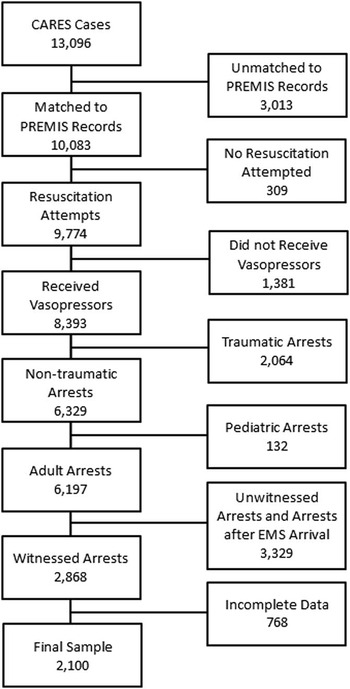
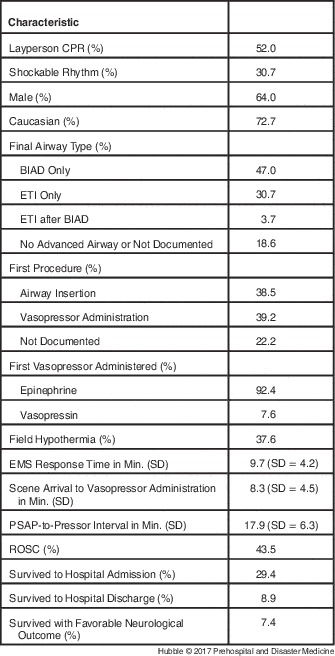
During the study period, 10,083 CARES records were matched to PreMIS records, of which 2,868 patients met inclusionary criteria. Of these, 768 were excluded due to incomplete data elements: PPI (549), initial electrocardiogram (ECG; 184), race (67), ROSC (43), and gender (9; Figure 1). Of the patients included in the analysis, males accounted for 64.0% of the sample. The mean age of the participants was 66.3 (SD=14.8) years. A shockable rhythm (ventricular fibrillation or pulseless ventricular tachycardia) was the presenting rhythm upon EMS arrival in 30.7% of cases. The mean EMS response time from 911 PSAP call receipt-to-scene arrival was 9.7 (SD=4.2) minutes, and layperson CPR was performed prior to EMS arrival in 52.0% of cases. A CPR feedback device was used in 24.4% of cases while mechanical CPR was used at some point during the resuscitation in 13.6%. The first advanced airway was a blind insertion airway device (BIAD) in 50.0% of cases while ETI was the initial advanced airway for 659 patients (31.4%). In total, 913 (43.5%) experienced ROSC, 618 (29.4%) survived to hospital admission, 187 (8.9%) survived to hospital discharge, and 155 (7.4%) were discharged with favorable neurological outcomes (CPC 1 or 2). Additional details of the sample are provided in Table 1.
Schematic Demonstrating the Flow of Patients Included in the Study Sample. Abbreviations: CARES, Cardiac Arrest Registry to Enhance Survival; EMS, Emergency Medical Services; PreMIS, Prehospital Medical Information System.

Descriptive Data of the Sample

Abbreviations: BIAD, blind insertion airway device; CPR, cardiopulmonary resuscitation; EMS, Emergency Medical Services; ETI, endotracheal intubation; ROSC, return of spontaneous circulation.
Vasopressin was the first vasopressor administered in 160 (7.6%) cases, while the remainder received epinephrine. The mean PPI was 17.9 (SD=6.3) minutes and the scene arrival-to-first pressor interval was 8.3 (SD=4.5) minutes. The scene arrival-to-first pressor interval was slightly shorter for drugs administered via the IO route compared to the IV route (7.9 vs 8.4 minutes; P=.02). The scene arrival-to-pressor interval was substantially shorter when vasopressors were administered prior to inserting an airway (6.8 vs 9.9 minutes; P<.01).
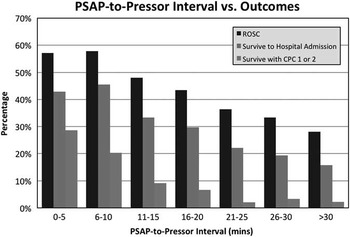
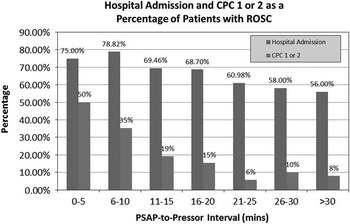
The proportion of patients attaining ROSC, surviving to hospital admission, and surviving with favorable neurological outcome decreased substantially with increasing PPI (Figure 2). In addition, the proportion of patients with ROSC who survived to hospital admission remained relatively stable for the first 20 minutes of PPI (Figure 3). In contrast, the proportion of patients surviving with favorable neurological outcomes dropped precipitously with a 15% absolute reduction between five and 10 minutes and another 16% absolute reduction between 10 and 15 minutes (Figure 3).
Outcomes by PSAP-to-Pressor Interval. Abbreviations: CPC, cerebral performance category; PSAP, public safety answering point; ROSC, return of spontaneous circulation.

Hospital Admission and Survival with CPC 1 or 2 as a Percentage of Patients with ROSC. Abbreviations: CPC, cerebral performance category; PSAP, public safety answering point; ROSC, return of spontaneous circulation.

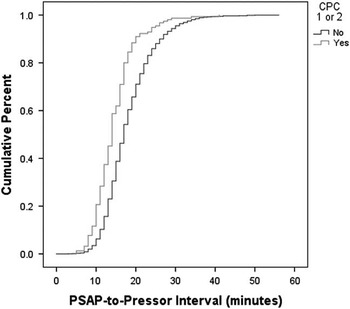
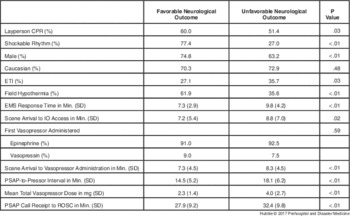
The results of the univariate analysis of neurological outcomes are presented in Table 2. Notably, compared to patients with unfavorable neurological outcomes, a greater proportion of patients with CPC 1 or 2 received layperson CPR (60.0% vs 51.4%; P=.03), were more likely to be male (74.8% vs 63.2%; P<.01), presented with a shockable rhythm (77.4% vs 27.0%; P<.01), received field hypothermia (61.9% vs 35.6%; P<.01), and were less likely to receive ETI (27.1% vs 35.7%; P=.03). Patients with favorable neurological outcomes received a lower total epinephrine dose (2.3 vs 4.0 mg; P<.01) and had shorter EMS response times (7.3 vs 9.8 minutes; P<.01), scene arrival to vasopressor administration times (7.3 vs 8.3 minutes; P<.01), PPI (14.5 vs 18.1 minutes; P<.01), and PSAP call receipt to ROSC intervals (27.9 vs 32.4 minutes; P<.01). In addition, the cumulative frequency distribution curve demonstrated a shorter cumulative PPI for those with favorable neurological outcomes (P<.01; Figure 4).
Comparison of PSAP-to-Pressor Interval Between Those With and Without Favorable Neurological Outcomes (CPC 1 or 2). Abbreviations: CPC, cerebral performance category; PSAP, public safety answering point.

Univariate Comparison of Those With and Without Favorable Neurological Outcomes

Abbreviations: CPR, cardiopulmonary resuscitation; EMS, Emergency Medical Services; ETI, endotracheal intubation; IO, intraosseous; PSAP, public safety answering point; ROSC, return of spontaneous circulation.
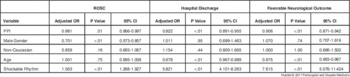
Logistic regression was used to control for potentially confounding variables. Based on clinical reasoning, the following variables were entered into the model: PPI; patient age, gender, and non-Caucasian race; ETI; shockable presenting rhythm; layperson CPR; and field hypothermia. Favorable neurological outcome was less likely with increasing PPI (OR=0.90; P<.01) and increasing age (OR=0.97; P<.01). Compared to patients with non-shockable rhythms, patients with shockable rhythms were more likely to have favorable neurological outcomes (OR=7.61; P<.01), as were patients receiving field hypothermia (OR=2.13; P<.01). Male gender, non-Caucasian race, layperson CPR, and field intubation were not independent predictors of favorable neurological outcome. The PPI was also an independent predictor of hospital discharge (OR=0.92; P<.01) and ROSC (OR=0.98; P=.01). Details on the logistic regression results for favorable neurological outcome, as well as hospital discharge and ROSC, are provided in Table 3.
Adjusted Odds Ratios for Outcome Variables

Abbreviations: PPI, public-safety-answering-point to pressor interval; ROSC, return of spontaneous circulation.
Discussion
In previous randomized trials, prehospital epinephrine has been shown to improve the short-term outcomes of ROSC and hospital admission, but not survival to hospital discharge; however, neither of these randomized trials controlled for the timing of drug administration. 18 , Reference Jacobs, Finn, Jelinek, Oxer and Thompson 19 One possible reason for the lack of longer-term benefit is that epinephrine may be given too late during resuscitative efforts to be effective. The principal finding in this retrospective study is that time to first vasopressor administration is significantly associated with favorable neurological outcome, with the odds of CPC 1 or 2 declining by 10% for every one-minute delay of the PPI (OR=0.90; P<.01).
While not considered in either of the aforementioned randomized trials, the clinical effect of the timing of drug administration has been previously investigated in several retrospective studies. Cantrell et al. dichotomized drug delivery into early (within 10 minutes of call receipt) and late administration (>10 minutes after call receipt) and reported a greater likelihood of ROSC when vasopressors were administered within the first 10 minutes of arrest (OR=1.91; P=.04).Reference Reynolds, Rittenberger and Menegazzi 8 However, their study did not evaluate longer-term outcomes. In a similar retrospective analysis of cardiac arrests, Koscik et al. noted an increased likelihood of ROSC with early epinephrine (≤10 minutes; OR=1.78), but lacked statistical power to demonstrate an impact on survival to discharge (OR=1.48; 95% CI, 0.50-4.36).Reference Cantrell, Hubble and Richards 9 In a later study by Hubble et al. using statewide data in North Carolina, the timing of drug administration was measured on a time continuum rather than dichotomized into early and late administration.Reference Koscik, Pinawin and McGovern 10 They observed that the likelihood of ROSC declined by four percent for every one-minute delay between call receipt and vasopressor administration, demonstrating a time-dependent function of vasopressor effectiveness across the entire range of administration delays rather than just the first 10 minutes. More recently, Ewy et al. measured delays in drug delivery on a time continuum and observed that the likelihood of ROSC declined by six percent per one-minute delay between call dispatch and drug delivery.Reference Hubble, Johnson and Blackwelder 11 Moreover, they observed a similar trend on favorable neurological outcome, but failed to achieve statistical significance (OR=0.96; 95% CI, 0.90-1.02).
Several retrospective studies of Japanese cardiac arrests have also linked the timing of epinephrine administration and neurological outcome. Nakahara et al. reported that patients who received epinephrine early (within 10 minutes of EMS arrival) had higher rates of intact neurological survival (OR=1.39), but they did not include response times, which added an additional seven to eight minute delay in drug delivery.Reference Olasveengen, Sunde, Brunborg, Thowsen, Steen and Wik 20 Using the same cardiac arrest registry, Goto et al. observed an increased likelihood of ROSC and one-month survival, but not one-month survival with favorable neurological outcome when epinephrine was administered to patients with non-shockable rhythms within nine minutes of EMS arrival.Reference Nakahara, Tomio, Nishida, Morimura, Ichikawa and Sakamoto 21 Unfortunately, they too excluded EMS response time in their definition of early drug administration.
Although the studies above provide persuasive evidence of a time-dependent relationship between delays in vasopressor administration and ROSC, the present study is the first among US EMS systems to suggest that this relationship may also extend to favorable neurological outcome. More importantly, these data reveal that favorable neurological outcome is profoundly more sensitive to delays in drug administration than is ROSC. However, epinephrine is also associated with post-arrest complications, including acidosis, myocardial dysfunction, ventricular dysrhythmias, and altered cerebral microcirculation.Reference Goto, Maeda and Goto 22 - Reference Ristagno, Tang, Sun and Weil 26 Thus, a time-dependent paradoxical relationship emerges where epinephrine becomes essential to attain ROSC as the duration of arrest lengthens, but is also increasingly associated with post-ROSC complications.
In an animal model, Angelos demonstrated that post-arrest myocardial dysfunction is worse when epinephrine is given later in the duration of the arrest compared to animals that did not receive epinephrine.Reference Goto, Maeda and Goto 22 In addition, human studies have reported that time from collapse to ROSC is an important post-arrest prognostic indicator.Reference Tang, Weil, Sun, Noc, Yang and Gazmuri 27 - Reference Komatsu, Kinoshita and Sakurai 29 Thus, it may be that when epinephrine is required to attain ROSC, earlier administration improves outcomes via two mechanisms: (1) shortening arrest duration, and (2) minimizing post-ROSC complications associated with delayed administration.
Even if early epinephrine administration should ultimately be shown to improve survival and neurological outcomes in randomized trials, administering epinephrine within the first 10 minutes of arrest remains challenging. Under the current EMS model of care, much of the delay in drug administration is attributed to the EMS response interval. Consequently, assuming that response times cannot be substantially improved, the only option to reduce delays is reprioritizing on-scene care, such as favoring IO over IV access and prioritizing drug administration over ETI. Although these strategies may be easy to implement, the results from the current study suggest that PPI may be reduced by only one to three minutes. Ultimately, more meaningful improvements in neurological outcomes may require envisioning a new model of care whereby Emergency Medical Technician-Basic first responders, who typically arrive on the scene several minutes prior to EMS, are permitted to administer the first dose of epinephrine.
Limitations
Limitations in study design and data require that these findings be interpreted with due caution. This study is subject to the usual limitations of a retrospective design, including the accuracy of data collection and the potential for measured and unmeasured confounders which may account for the observed outcomes. Of particular concern is CPR quality, which is associated with the hemodynamic effects of epinephrine as well as ROSC.Reference Kjaergaard, Nielsen and Winther-Jensen 30 - Reference Vaillancourt, Everson-Stewart and Christenson 32 Although CPR feedback devices were used in 24% of cases, CPR quality data were not available even for this small subgroup of patients. Therefore, it is possible that the true effect of the timing of vasopressor administration in the study sample is obscured by unmeasured variations in CPR quality.
With regard to the use of historical data, a further limitation is that the times used in computing PPI and other interventions are based on the times recorded in the patient record. It is unknown as to what proportion of these times were recorded in real-time at the scene by a time-keeper versus post-event estimates guided by electronically recorded sentinel events such as defibrillation and ECG changes. The reliance on time intervals that were not universally recorded electronically or by an on-scene time-keeper injects uncertainty about parameter estimates.
Although this study found an association between field hypothermia and survival with good neurological outcome, this finding should be interpreted cautiously. The use of historical data does not permit discriminating between patients who received intra-arrest hypothermia and those receiving therapeutic hypothermia post-ROSC. Consequently, a survival bias may exist in that patients who received field hypothermia did so only after attaining ROSC.
The design of this study does not allow for implying causality or making recommendations on whether vasopressors should be given. Instead, the aim was to clarify whether there was a time-dependent relationship between vasopressor administration and favorable neurological outcome in prolonged arrests. Although the data demonstrate that early vasopressor administration is favorable to delayed administration, it is still possible that early administration may indeed be inferior to no vasopressor administration at all. Determining the true influence of vasopressor administration on favorable neurological outcomes requires large, randomized trials that also control for the timing of drug administration.
Finally, many procedures are performed during out-of-hospital resuscitation attempts, including professional CPR, defibrillation, drug delivery, and airway control. It is possible that PPI is only one of several time-sensitive therapies that influence patient outcomes.
Conclusion
Within the limits of the retrospective study design, this investigation found that time to vasopressor administration is significantly associated with favorable neurological outcomes, and the odds of survival with CPC 1 or 2 declines by 10% for every one-minute delay between PSAP call-receipt and vasopressor administration. However, the influence of other time-sensitive therapies that may have been provided within temporal proximity of vasopressor administration cannot be ruled out. Consequently, these findings should be interpreted cautiously until the true relationship between vasopressor administration and favorable neurological outcomes is quantified by large, randomized trials that also control for the timing of drug administration.
Acknowledgement
The authors would like to acknowledge the Cardiac Arrest Registry to Enhance Survival (CARES) Program for providing components of the data set used in this project; CARES receives grant funding from the Medtronic Foundation (Minneapolis, Minnesota USA).