INTRODUCTION
Karst environments develop in many locations around the globe: where limestones and dolomite rocks outcrop, and where there is sufficient flowing water for rock dissolution to induce process of karstification. (Note: In exceptional cases karst also forms on quartz-bearing rocks [Wray Reference Wray1997]). Later, under favorable conditions by degassing and/or biomediated, precipitation of secondary carbonate features, such as speleothem, tufa, travertine, lake sediment, etc., occurs. As a result of these processes, a special type of karst landscape is formed, which is characterized by landforms derived from dissolution as well as by various depositional forms such as tufa barrages and cascades, among others (Ford and Pedley Reference Ford and Pedley1996; Ford and Williams Reference Ford and Williams2007).
Karst environments preserve some of the best archives of past climate, vegetation, hydrology, human impact, and landscape evolution (Fairchild et al. Reference Fairchild, Frisia, Borsato, Tooth, Nash and McLaren2007; Frisia and Borsato Reference Frisia and Borsato2010). The climate and environmental data can be framed in a precise time span because karst deposits can be dated by various methods. The two most important dating methods applied in karst regions are radiocarbon (14C) and 230Th-234U-238U disequilibrium radiometric dating (in further text U-Th dating) techniques.
The aim of this paper is to present research based on 14C chronology of secondary carbonates at a specific location within the Croatian Dinaric karst—the Plitvice Lakes. The dominant carbonate deposits in the area are tufa and carbonate sediments deposited in karst lakes (later referred as lake sediments) and this overview is restricted to research on their isotope composition. They archive multi-proxy data that allow the reconstruction of past climate and environmental changes, as well as trace the carbon cycle and anthropogenic influence in the area.
In what follows, a short introduction to the process of karstification is given, the study site is described, and the basic history of the research at the Zagreb Radiocarbon Laboratory of the Ruđer Bošković Institute (RBI) and the most important results are presented. The complete list of publications describing the corresponding research and the methods applied can be found in the supplementary materials.
KARST PROCESSES
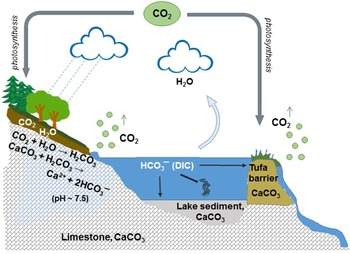
The processes of carbonate rock dissolution and precipitation of secondary carbonate sediments have been described in detail in literature (Srdoč et al. Reference Srdoč, Horvatinčić, Obelić, Krajcar and Sliepčević1985a; Horvatinčić et al. Reference Horvatinčić, Krajcar Bronić and Obelić2003; Ford and Williams Reference Ford and Williams2007; Frisia and Borsato Reference Frisia and Borsato2010; Tanner Reference Tanner2010). The process referring to tufa and karst lake sediments is schematically presented in Figure 1.
Schematic presentation of the karstification process (restricted to tufa and lake sediment formation) and the carbon cycle in karst.

The first step in the formation of karst archives is the dissolution of carbonate bedrock by meteoric water with dissolved carbon dioxide (Eq. 1).
 $${\rm{CaC}}{{\rm{O}}_3} + {{\rm{H}}_2}{\rm{O}} + {\rm{C}}{{\rm{O}}_2} \rightleftharpoons {\rm{C}}{{\rm{a}}^{2 + }} + 2{\rm{HCO}}_3^ - $$
The origin of the karst water is precipitation which enters the soil and dissolves soil CO2 that is a product of root respiration and organic matter decomposition and the carbonic acid (H2CO3) is formed. Concentration of CO2 in soil atmosphere can be several orders of magnitude higher than that in the air. (Note: Soil, however, is not always present. In arid or high mountain regions there might be little or no soil, and CO2 is supplied directly from the atmosphere [Horvatinčić et al. Reference Horvatinčić, Krajcar Bronić and Obelić2003; Frisia and Borsato Reference Frisia and Borsato2010]). The carbonic acid dissolves bedrock carbonates forming bicarbonate ions HCO3 –. Thus, water becomes enriched with dissolved inorganic carbon (DIC). Under geochemical conditions typical of karst, where pH in spring waters ranges between 7 and 8, DIC is composed mostly of HCO3 –.
Precipitation of calcite from the solution can occur if the solution is supersaturated with respect to this phase. Where karst groundwaters come to the surface at springs, CO2 passes from aqueous solution to the air (Figure 1) because of higher CO2 partial pressure in water than in the atmosphere. Degassing typically results in calcite supersaturation and shifts reaction (1) to the left, leading to calcite precipitation. Rapid CO2 degassing is aided at rapids and waterfalls (Chen et al. Reference Chen, Zhang, Wang, Xiao and Huang2004; Della Porta Reference Della Porta2015).
Besides physico-chemical conditions, plants/biota have important role in tufa precipitation process in surface karst environments. Calcium-carbonate deposition may be actively promoted by CO2 removal related to photosynthesis. Thus, the level of saturation increases and biota (vegetation and microbial biofilms) act also as a convenient substrate for trapping calcite seed crystals (Chafetz et al. Reference Chafetz, Srdoč and Horvatinčić1994; Golubić et al. Reference Golubić, Violante, Plenković-Moraj and Grgasović2008; Zippel and Neu Reference Zippel and Neu2011; Della Porta Reference Della Porta2015). Tufa formation is favored where well-developed plants exist in streams and waterfalls. The process is known as biogenically enhanced or biomediated carbonate deposition (Pedley Reference Pedley2009; Tanner Reference Tanner2010).
The international karst terminology can be very confusing, specifically the use of the term “tufa” (Ford and Williams Reference Ford and Williams2007). In this paper, “tufa” indicates freshwater surface calcium carbonate deposits precipitated at or near ambient temperature, which commonly contain the remains of macro- and microphytes (Ford and Pedley Reference Ford and Pedley1996; Horvatinčić et al. Reference Horvatinčić, Čalić and Geyh2000; Pedley Reference Pedley2000, Reference Pedley2009; Frančišković-Bilinski et al. Reference Frančišković-Bilinski, Barišić, Vertačnik, Bilinski and Prohić2004; Ford and Williams Reference Ford and Williams2007; Gandin and Capezzuoli Reference Gandin and Capezzuoli2008; Capezzuoli et al. Reference Capezzuoli, Gandin and Pedley2014; Della Porta Reference Della Porta2015). Historically, some authors referred to the Plitvice Lakes deposits as “travertine” (e.g., Golubić et al. Reference Golubić, Violante, Plenković-Moraj and Grgasović2008). The term “meteogene tufa” was suggested for deposits precipitated from waters in which the dissolved CO2 comes from soil and atmosphere as opposed to the “thermogene travertine” for deposits that precipitated from waters in which the dissolved CO2 predominantly comes from deep fluids (Pentecost Reference Pentecost1993).
Karst processes have also an important role in the carbon cycle since they are dependent on rainfall, temperature, and vegetation changes. Carbon and oxygen stable isotope compositions archive data on environmental conditions at the time of formation of carbonate deposits, so in addition to their role in deciphering secondary mineral precipitation in karst environments they can point to both global and local changes in the past and in the present. Carbon isotope records in karst sediments could help determining the beginning of the recently proposed new epoch of Anthropocene (Zalasiewicz et al. Reference Zalasiewicz, Waters, Williams, Barnosky and Oreskes2015 and references therein).
STUDY AREA
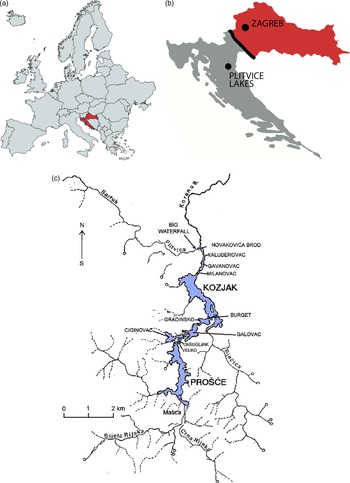
Dinaric karst, known worldwide as the locus typicus of classical karst, occupies half of the Croatian territory including the islands and the Adriatic coast, the high mountain regions, and part of central Croatia between the eastern Adriatic coast and the Pannonian Plain (Figure 2) (Surić et al. Reference Surić, Czuppon, Lončarić, Bočić, Lončar, Bajo and Drysdale2020 and references therein).
(a) Map of Europe with Croatia in red; (b) position of the Plitvice Lakes on the map of Croatia: a black line divides karst region (grey, below the line) from the rest of the country; (c) lake area of the National Park Plitvice Lakes from the main streams (Crna Rijeka and Bijela Rijeka) along 16 lakes to the outflow of the Korana River. (Please see electronic version for color figures.)

The Plitvice Lakes (PL) is a unique system of 16 cascade flow-through lakes, situated in the Dinaric karst, Central Croatia (44°53ʼN, 15°37ʼE) (Figure 2). Tufa precipitates very intensively in the presence of macrophytes and microphytes forming numerous barriers or barrages that dam the lakes. Calcium carbonate also precipitates as lake sediment. The system lies on dolomites in the southern part, while four smaller and shallower lakes and the Korana River canyon sit on highly permeable limestone (Polšak et al. Reference Polšak, Juriša, Šparica and Šimunić1977; Sironić et al. Reference Sironić, Alegro, Horvatinčić, Barešić, Brozinčević, Vurnek, Krajcar Bronić, Borković and Lovrenčić Mikelić2021). The two main streams (Crna Rijeka, Bijela Rijeka, Figure 2c) form the first Lake Prošće. The lakes discharge into the Korana River, which is a part of the Danube River watershed area. The total distance from the springs to the Korana River is approximately 12 km. The largest and the deepest is Lake Kozjak, followed by the uppermost Lake Prošće (“big lakes”).
The PL area has been protected as a national park since 1949, and since 1979 it has been included in the United Nations Educational, Scientific, and Cultural Organisation (UNESCO) World Heritage List. The lake system covers 1% of the total park area of 298 km2 with the remainder being largely deciduous forest (75%) and meadows (23%) (Horvatinčić et al. Reference Horvatinčić, Sironić, Barešić, Sondi, Krajcar Bronić and Borković2018). The area is scarcely populated and thus protected from direct anthropogenic influence; however, it cannot be protected from global changes such as the current climate change.
The climate is typical continental, classified as Cfb type (temperate humid climate without dry season with warm summer) according to Köppen-Geiger climate classification (Köppen Reference Köppen1936; Filipčić Reference Filipčić1998; Peel et al. Reference Peel, Finlyanson and McMahon2007). The average annual air temperatures at the Plitvice Lakes range from 8.0 to 10.8°C (1986–2019), with the mean value of 9.2 ± 0.5°C. An increase of mean annual air temperature of 0.06 ± 0.01°C per year was observed, p < 0.05 (Krajcar Bronić et al. Reference Krajcar Bronić, Barešić, Sironić, Lovrenčić Mikelić, Borković, Horvatinčić and Kovač2020). Annual precipitation the Plitvice Lakes ranges between 1148 mm and 2113 mm in the same period. (Meteorological data were obtained on request [free of charge] from the Croatian Meteorological and Hydrological Service.) Monthly precipitation at the Plitvice Lakes is distributed relatively uniformly throughout the year.
HISTORICAL OVERVIEW OF RESEARCH AT RBI
The Plitvice Lakes area is one of the most studied karst areas in Croatia, where various scientific studies have been performed since the beginning of 20th century (Bencetić Klaić et al. Reference Bencetić Klaić, Rubinić and Kapelj2018). Scientific projects stopped during the Homeland War (1991–1995) and after that they were continued with the aim to monitor and protect the ecosystem of the National Park.
The Zagreb Radiocarbon Laboratory, the first of this kind in the southeastern Europe, was founded in 1968. The first 14C dating results were obtained in 1970 (Srdoč et al. Reference Srdoč, Breyer and Sliepčević1971). Dating of inorganic/carbonate samples (speleothem, shell, tufa) was soon implemented with the idea of determining the age of carbonate deposits in caves of the Dinaric karst (Sliepčević and Planinić 1973). A gas-proportional counting technique was used in the beginning. Later, it was replaced by liquid scintillation counting (LSC) in benzene matrix (Horvatinčić et al. Reference Horvatinčić, Barešić, Krajcar Bronić and Obelić2004) and accelerator mass spectrometry (AMS; Krajcar Bronić et al. Reference Krajcar Bronić, Obelić, Horvatinčić, Barešić, Sironić and Minichreiter2010; Sironić et al. Reference Sironić, Krajcar Bronić, Horvatinčić, Barešić, Obelić and Felja2013). Several Zagreb Radiocarbon Laboratory data lists were devoted partially or exclusively to the dating of various materials from the Dinaric karst (see data lists nos. 4, 7, 9, 12, 13, 14, and 17 in the supplementary file).
During the 1970s, the RBI group commenced research at the Plitvice Lakes with the initial aim of establishing geochronology of tufa and lake sediments (Srdoč et al. Reference Srdoč, Obelić, Horvatinčić and Sliepčević1980). However, before long, the research was supplemented by systematic measurements of physico-chemical parameters of the waters to determine conditions required for the calcium carbonate precipitation in the form of tufa or lake sedimentary particles and by application of different isotope methods (Srdoč et al. Reference Srdoč, Horvatinčić, Obelić, Krajcar and Sliepčević1985a). It turned out that comprehensive studies should include analyses of isotope composition of DIC, tufa, lake sediments, atmosphere, soil, terrestrial and aquatic plants, i.e., various environmental influences that contribute to the secondary carbonate precipitation. With this approach, the aim was expanded to paleoclimate and paleoenvironmental reconstructions, as well as to effects of recent climate change and anthropogenic impact on the system. In addition to the use of 14C (for dating and as a marker of the carbon cycle), stable isotopes of carbon and oxygen were used, as well as various dating methods of tufa and lake sediment, such as U-Th, 210Pb and 137Cs (Srdoč et al. Reference Srdoč, Obelić, Horvatinčić, Krajcar Bronić, Marčenko, Merkt, Wong and Sliepčević1986c, 1994; Horvatinčić et al. Reference Horvatinčić, Čalić and Geyh2000, Reference Horvatinčić, Krajcar Bronić and Obelić2003, Reference Horvatinčić, Barešić, Babinka, Obelić, Krajcar Bronić, Vreča and Suckow2008, Reference Horvatinčić, Sironić, Barešić, Krajcar Bronić, Todorović, Nikolov, Hansman and Krmar2014, Reference Horvatinčić, Sironić, Barešić, Sondi, Krajcar Bronić and Borković2018). Radioactive (3H, 14C) and stable isotopes (2H, 18O, 13C) were applied also to studies of various water bodies (precipitation, groundwater, surface, and lake waters) (Krajcar Bronić et al. Reference Krajcar Bronić, Barešić, Sironić, Lovrenčić Mikelić, Borković, Horvatinčić and Kovač2020). The 30-yr-long record of various physico-chemical parameters enabled determination of the impact of climate change on geochemical conditions for tufa precipitation (Sironić et al. Reference Sironić, Barešić, Horvatinčić, Brozinčević, Vurnek and Kapelj2017). The knowledge acquired in the studies of the Plitvice Lakes tufa and lake deposits was later extended to studies of other types of secondary carbonates, such as submerged speleothems (Surić et al. Reference Surić, Juračić, Horvatinčić and Krajcar Bronić2005) and algal rims (Faivre et al. Reference Faivre, Bakran-Petricioli, Barešić, Horvatić and Macario2019), which are beyond the scope of this paper.
RESULTS
DIC and Tufa
The presentation of results concerning secondary carbonate precipitation must start with the analyses of water solution from which they are formed. Both the isotope and physico-chemical data at springs in the PL area showed atmospheric (meteoric) origin of waters (Srdoč et al. Reference Srdoč, Horvatinčić, Obelić, Krajcar and Sliepčević1985a; Krajcar Bronić et al. Reference Krajcar Bronić, Barešić, Sironić, Lovrenčić Mikelić, Borković, Horvatinčić and Kovač2020) with constant values in different seasons, implying that the recharge water was well mixed with the existing water in aquifer. Short mean residence time of the water was determined based on the tritium activity concentration (Srdoč et al. Reference Srdoč, Horvatinčić, Obelić, Krajcar and Sliepčević1985a; Krajcar Bronić et al. Reference Krajcar Bronić, Horvatinčić, Srdoč and Obelić1986, Reference Krajcar Bronić, Barešić, Sironić, Lovrenčić Mikelić, Borković, Horvatinčić and Kovač2020). A fast decrease in CO2 concentration within a short distance after emerging in springs causes oversaturation with calcium carbonate and precipitation occurs. As a consequence, a decrease in bicarbonate and calcium ion concentrations and increase in pH were observed from springs to the end of the lake series (Srdoč et al. Reference Srdoč, Horvatinčić, Obelić, Krajcar and Sliepčević1985a, Reference Srdoč, Krajcar Bronić, Horvatinčić and Obelić1986b; Barešić et al. Reference Barešić, Horvatinčić and Roller-Lutz2011a, Sironić et al. Reference Sironić, Barešić, Horvatinčić, Brozinčević, Vurnek and Kapelj2017). The 13C (δ13C) and 14C (a14C) isotope composition of DIC in karst springs is mostly the result of limestone bedrock dissolution by CO2 dissolved in water. While δ13C values were almost equal in the main springs, the a14C was lower and more variable in the spring of the Crna Rijeka Stream (Krajcar Bronić et al. Reference Krajcar Bronić, Horvatinčić, Srdoč and Obelić1986; Sironić et al. Reference Sironić, Krajcar Bronić, Horvatinčić, Barešić, Borković, Vurnek and Lovrenčić Mikelić2020). Farther on, along the lake series, no large seasonal variation was observed in isotope composition of DIC, but the increase in both a14C and δ13C values along the water course became a distinct characteristic of the system, as will be discussed below.
A partial origin of carbon from limestone in the DIC in karst waters makes the 14C dating of secondary carbonates precipitated from DIC more difficult than dating of organic material. Secondary carbonates are depleted in 14C at the moment of calcite formation yielding too-old 14C ages. The effect is known as hard-water effect (Philippsen Reference Philippsen2013 and references therein) that may be quantified differently: as dead carbon proportion, as the reservoir age or as the initial activity a0. Here we use the term initial activity a0 as the 14C activity of the secondary carbonate at the moment of formation assuming the atmospheric and biogenic 14C activity equals 100 pMC. Hard-water effect in the PL area was identified in early stages of the isotope studies (Srdoč et al. Reference Srdoč, Obelić, Horvatinčić and Sliepčević1980; Pedley Reference Pedley2009).
An attempt was made to estimate the initial 14C activity of the two main karst springs by using several theoretical models (Krajcar Bronić et al. Reference Krajcar Bronić, Horvatinčić, Srdoč and Obelić1986). The results justified an assumption of karst system as the geochemical system open to the atmospheric CO2 through karst fractures and showed that application of theoretical models to the complex natural site may lead to erroneous a0 values. Therefore, the initial 14C activity was determined empirically from available experimental data by several methods (Krajcar Bronić et al. Reference Krajcar Bronić, Horvatinčić, Srdoč and Obelić1992). Ratio of 14C activities of carbonate and organic matter associated with it resulted in similar a0 values as the extrapolation of measured a14C of long sediment cores from both Prošće and Kozjak lakes (Figure 2) (Srdoč et al. Reference Srdoč, Obelić, Horvatinčić, Krajcar Bronić, Marčenko, Merkt, Wong and Sliepčević1986c). However, it was noted that the terrestrial origin of the organic matter had to be checked by δ13C measurements. When the associated organic matter (e.g., in lake sediments) consisted of aquatic plants that used carbon from DIC for photosynthesis, the a0 values were not realistic since the aquatic plants themselves exhibited some hard-water effect, thus having their own a0 values.
To make 14C dating of tufa possible, it was necessary to show that the tufa preserved the isotopic composition from the time of formations and changes occurred only by radioactive decay. The equivalence of the 14C activities of DIC and the precipitated tufa was shown (Srdoč et al. Reference Srdoč, Obelić, Horvatinčić and Sliepčević1980). Some examples of tufa coating on old wood proved that tufa deposits preserve their isotopic composition and can give the age of tufa formation if the correct a0 value is applied (Srdoč et al. Reference Srdoč, Horvatinčić, Obelić and Sliepčević1983). Tufa was thus recognized as a potential source of information on climatic conditions in the past (Srdoč et al. Reference Srdoč, Horvatinčić, Obelić and Sliepčević1983; Pedley Reference Pedley2009). Diagenetic alteration of primary precipitates starts contemporaneously with carbonate deposition, but in the porous calcareous tufa, diagenesis is uneven, and primary precipitates remain locally preserved (Chafetz et al. Reference Chafetz, Srdoč and Horvatinčić1994; Golubić et al. Reference Golubić, Violante, Plenković-Moraj and Grgasović2008). However, later contamination by younger calcite precipitated over the inactive tufa can affect the tufa age. No appreciable effect was observed for the Holocene tufa, whereas porous older tufa gave in such cases unexpectedly young ages (Srdoč et al. Reference Srdoč, Horvatinčić, Obelić, Krajcar Bronić and O’Malley1986a).
Systematic dating of tufa samples from active barriers and old deposits revealed two distinct groups of deposits: tufa deposits from the Holocene, with an age limit of ca. 6000 BP (ages corrected with the appropriate a0 values), and old tufa outcrops found far from the current lakes with 14C ages older than 25,000 BP (Srdoč et al. Reference Srdoč, Horvatinčić, Obelić, Krajcar and Sliepčević1985a; Horvatinčić et al. Reference Horvatinčić, Krajcar Bronić and Obelić2003). Implications of such a result were that paleoclimatic conditions favoring tufa formation must have been similar in all periods of tufa growth, and that the old tufa deposits should be associated with warm interstadials. Although based on a limited number of data, these conclusions were later justified by dating outcrops of old tufa deposits found at the PL area by the U-Th dating method (Srdoč et al. Reference Srdoč, Osmond, Horvatinčić, Dabous and Obelić1994; Horvatinčić et al. Reference Horvatinčić, Čalić and Geyh2000). Most of the old tufa samples clustered around marine isotope stage MIS 5, MIS 7, and MIS 9. 14C and U-Th ages thus demonstrated that the formation of tufa barriers in the PL area was stimulated during interglacial periods with warm and humid climate (Horvatinčić et al. Reference Horvatinčić, Krajcar Bronić and Obelić2003).
Carbon isotope data obtained after intensive sampling of DIC and precipitated carbonates enabled an important observation of an increase of both a14C and δ13C values of DIC and precipitated carbonates downstream along the water course, similarly as observed earlier by Thorpe et al. (Reference Thorpe, Otlet and Sweeting1980). It was explained by CO2 exchange among DIC, atmospheric CO2 and organic matter (Srdoč et al. Reference Srdoč, Krajcar Bronić, Horvatinčić and Obelić1986b; Horvatinčić et al. Reference Horvatinčić, Barešić, Babinka, Obelić, Krajcar Bronić, Vreča and Suckow2008). This observation enabled estimates of variable contributions of atmospheric and plant carbon to the DIC and lake sediment carbonate at different flow regimes (e.g., lakes, waterfalls, steady flow) (Barešić et al. Reference Barešić, Horvatinčić and Roller-Lutz2011a, Reference Barešić, Horvatinčić, Vreča and Sironić2011b; Sironić et al. Reference Sironić, Krajcar Bronić, Horvatinčić, Barešić, Borković, Vurnek and Lovrenčić Mikelić2020, Reference Sironić, Alegro, Horvatinčić, Barešić, Brozinčević, Vurnek, Krajcar Bronić, Borković and Lovrenčić Mikelić2021). A semi-empirical model of the mechanism controlling the carbon isotope composition (a14CDIC and δ13CDIC) attributed the observed changes to simultaneous processes of (1) degassing of dissolved CO2, (2) exchange of dissolved CO2 with atmospheric CO2, and (3) exchange with CO2 from surface soil and decomposed organic matter in almost equal proportions (Sironić et al. Reference Sironić, Krajcar Bronić, Horvatinčić, Barešić, Borković, Vurnek and Lovrenčić Mikelić2020).
Tufa systems are often associated with specific algae and calcium carbonate precipitation on mosses in the whole region, which supported the hypothesis of the importance of the biomediation in carbonate precipitation in these karst environments (Srdoč et al. Reference Srdoč, Horvatinčić, Obelić, Krajcar and Sliepčević1985a; Chafetz et al. Reference Chafetz, Srdoč and Horvatinčić1994; Pedley Reference Pedley2000, Reference Pedley2009; Della Porta Reference Della Porta2015). Recently it was demonstrated that true aquatic and amphiphyte moss species use different sources of carbon for photosynthesis, which may have an impact on tufa chronology (Sironić et al. Reference Sironić, Alegro, Horvatinčić, Barešić, Brozinčević, Vurnek, Krajcar Bronić, Borković and Lovrenčić Mikelić2021). Since secondary carbonates contain also a certain small amount of organic fraction, knowing its origin through its carbon isotope composition, may help refining chronology of carbonate sedimentation. For example, if the organic fraction is of terrestrial origin, the reservoir age could be determined from the ratio of 14C activities of the carbonate and the contemporary terrestrial organic fraction (Krajcar Bronić et al. Reference Krajcar Bronić, Horvatinčić, Srdoč and Obelić1992). However, if the organic fraction is of aquatic origin having itself some inherent reservoir age, a simple ratio of carbonate to the organic fraction 14C activities would not yield the proper a0 value. In that sense, a study of isotopic composition of plants such as mosses that grow in karst water and can use CO2 of different origins (atmospheric CO2 and/or DIC) presents an important contribution to radiocarbon chronology of karst deposits, namely tufa and karst lake sediments (Sironić et al. Reference Sironić, Alegro, Horvatinčić, Barešić, Brozinčević, Vurnek, Krajcar Bronić, Borković and Lovrenčić Mikelić2021).
Lake Sediments
The studies of the Plitvice Lakes sediments included comprehensive investigation of the following: (1) the 12-m-long cores from two big lakes, Prošće and Kozjak (Srdoč et al. Reference Srdoč, Obelić, Horvatinčić, Krajcar Bronić, Marčenko, Merkt, Wong and Sliepčević1986c), (2) recent sediments (top ≈40 cm) from the same lakes (Srdoč et al. Reference Srdoč, Horvatinčić, Ahel, Giger, Schaffner, Krajcar Bronić, Petricioli, Pezdič, Marčenko and Plenković1992), (3) recent sediments (top ≈40 cm) from four lakes (Horvatinčić et al. Reference Horvatinčić, Briansó, Obelić, Barešić and Krajcar Bronić2006, Reference Horvatinčić, Barešić, Babinka, Obelić, Krajcar Bronić, Vreča and Suckow2008, Reference Horvatinčić, Sironić, Barešić, Krajcar Bronić, Todorović, Nikolov, Hansman and Krmar2014), and (4) sediment from different locations with different characteristics from the same lake (Horvatinčić et al. Reference Horvatinčić, Sironić, Barešić, Sondi, Krajcar Bronić and Borković2018). The main results proved that lake sediments record recent and past environmental changes, both local and global, and both carbonate and organic components of lake sediment should be used for better interpretation of the data obtained by isotope and classical geochemical methods.
Sediment cores from Lake Prošće and Lake Kozjak, of total length of ≈12 m, were extracted in 1983. The performed analyses (seismic profiling of lakes, geochemical and sedimentological analyses, dating of lake sediment and organic detritus, δ13C and δ18O analyses, analyses of pollen and diatoms) contributed to the understanding of lake geochronology (Srdoč et al. Reference Srdoč, Obelić, Horvatinčić, Krajcar Bronić, Marčenko, Merkt, Wong and Sliepčević1986c). Dominantly carbonate sediments contained only a minor fraction of organic matter (< 4%). The Lake Prošće cores reached the bedrock at the deepest point, while in Lake Kozjak the bedrock was not reached and a large disturbance of the layers was observed at about 2 kyr ago. 14C dating showed that the sedimentation in Lake Prošće began about 8000 yr ago, and in Lake Kozjak the deepest layer was formed 6500 yr ago. The a0 was determined by the use of the contemporaneous organic material of terrestrial origin found in the sediment core. Sedimentation rate of 1.5 mm/yr in Lake Prošće was uniform throughout the whole profile. In Lake Kozjak the uniform sedimentation rate of 0.8 mm/yr was determined for the upper ≈2 m of the core. Steady δ18O values along the sediment profile (Lake Prošće –9.0 ± 0.3‰, Lake Kozjak –9.3 ± 0.2‰) pointed to stable climatic conditions during the deposition of sediment. Good correlation of data obtained by 14C dating of active tufa (Srdoč et al. Reference Srdoč, Osmond, Horvatinčić, Dabous and Obelić1994), lake sediments and peat deposits (Srdoč et al. Reference Srdoč, Obelić, Horvatinčić, Culiberg, Šercelj and Sliepčević1985b) confirmed that the formation of the Plitvice Lakes started about 8000 years ago (Horvatinčić et al. Reference Horvatinčić, Krajcar Bronić and Obelić2003). For comparison, speleothem growth in the Dinaric karst started several thousand years earlier than tufa growth (Horvatinčić et al. Reference Horvatinčić, Krajcar Bronić and Obelić2003). Such a delay was explained by the importance of the biological component in the process of tufa precipitation from surface water, e.g., the presence of macrophytes (moss) and microphytes (algae, bacteria), whereas speleothem formation in caves was initiated by the change of climatic conditions at the beginning of the Holocene.
The top ≈40 cm layers of the lake sediments were used to study natural environmental changes or human-induced impact. These sediment cores, dated by 210Pb and 137Cs, encompass time span of ≈100 to 150 years. The reflections of global 14C bomb peak and 137Cs fallout were observed in the sediment profiles, as well as changes in isotope compositions δ18O and δ13C as consequences of modern global warming (Srdoč et al. Reference Srdoč, Horvatinčić, Ahel, Giger, Schaffner, Krajcar Bronić, Petricioli, Pezdič, Marčenko and Plenković1992; Horvatinčić et al. Reference Horvatinčić, Barešić, Babinka, Obelić, Krajcar Bronić, Vreča and Suckow2008, Reference Horvatinčić, Sironić, Barešić, Krajcar Bronić, Todorović, Nikolov, Hansman and Krmar2014). No significant contamination caused by local anthropogenic influence was found in the sediments (Horvatinčić et al. Reference Horvatinčić, Briansó, Obelić, Barešić and Krajcar Bronić2006).
In all cores taken from four lakes (lakes Prošće, Gradinsko, Kozjak, Kaluđerovac), stratigraphic variations in a14C in both carbonate and organic fractions were observed and interpreted as a delayed and damped response to bomb-produced 14C in the atmosphere. The increase of δ13C of carbonate sediments in the last two decades, better visible in the small lakes, was attributed to an increase in primary productivity that enhanced biologically induced calcite precipitation (Horvatinčić et al. Reference Horvatinčić, Barešić, Babinka, Obelić, Krajcar Bronić, Vreča and Suckow2008, Reference Horvatinčić, Sironić, Barešić, Krajcar Bronić, Todorović, Nikolov, Hansman and Krmar2014, Reference Horvatinčić, Sironić, Barešić, Sondi, Krajcar Bronić and Borković2018) due to the contemporaneous increase of the lake water temperature (Sironić et al. Reference Sironić, Barešić, Horvatinčić, Brozinčević, Vurnek and Kapelj2017; Krajcar Bronić et al. Reference Krajcar Bronić, Barešić, Sironić, Lovrenčić Mikelić, Borković, Horvatinčić and Kovač2020).
A study of sediment cores retrieved from three locations having different characteristics from two karst lakes by combined geochemical and isotopic analyses of both carbonate and organic sediment components showed no significant difference between the sediments found away from the tributaries and shores in both lakes (Horvatinčić et al. Reference Horvatinčić, Sironić, Barešić, Sondi, Krajcar Bronić and Borković2018)—in situ calcite precipitation and aquatic OM produced in both lakes were observed. However, in the big Lake Prošće, surrounded with mostly deciduous forest, the sediment composition at the location close to the shore and the confluence of the feeding stream was significantly different. Significant fractions of land-derived both carbonate and organic components were recognized in the shallow, coastal area, showing that the local water inputs could have had great influence on the sediment. Such sediments are more appropriate for the determination of local short-term paleoenvironmental events. Indeed, extreme hydrological events in 1981 and 2010 were identified by disturbances in carbon isotopes distributions along the sediment profile. If regional and long-term paleoclimatic records in lake sediments are to be studied, the chosen sampling location should be far from local-scale influences.
The sedimentation rate was determined based on the 14C (AMS) dating of macrofossils in Lake Kaluđerovac sediments (3–7 mm/yr) and the known occurrence of extreme hydrological events in Lake Prošće sediments (7 mm/yr). These values are in good agreement with the previously determined sedimentation rates obtained by 210Pb dating (Horvatinčić et al. Reference Horvatinčić, Barešić, Babinka, Obelić, Krajcar Bronić, Vreča and Suckow2008).
CONCLUDING REMARKS
Comprehensive multi-proxy study of the secondary carbonate sediments (tufa and lake sediment) from the Dinaric karst resulted in some new knowledge on present and past of the karst system of the Plitvice Lakes. Several problems were recognized and discussed during almost half a century of research, and most of them are related with the geochronology. Secondary carbonates can be used for establishment of the time scale and give information of the past if the problem of initial radiocarbon activity a0 is properly taken into account. Other dating techniques can be also applied, extending the dating possibility to either ages beyond the 14C limit or to recent periods characterized by anthropogenic 14C disturbance. Stable isotopes of carbon, oxygen and nitrogen can provide additional information on the origin of secondary carbonates and processes involved in their formation.
One of the most important results obtained at the Plitvice Lakes system is that they have existed in the present shape over the last ca. 8000 years, while in the past, during warm interglacial stages, water took different courses, as proved by the outcrops of old tufa far from the current lakes. Tufa, as the most prominent secondary carbonate feature in the area, as well as lake sediments, can provide valuable information on climate and environmental changes in the past. Combination of various geochemical and isotope methods is conditio sine qua non (a necessary condition) for understanding the complex system in which all environmental compartments must be included into the study (atmosphere, various water bodies, soil, bedrock, DIC, terrestrial and aquatic biota, and of course various secondary carbonates).
The research also opened some new questions and new possibilities, coupled with advances in experimental techniques, especially implementation of the AMS 14C dating technique that enabled studies of organic matter in sediment, usually present in low concentrations. Future studies will include the relation of organic matter of aquatic origin with the ages of tufa. Long-term data (geochemical and isotope) of the Plitvice Lakes karst system will also help in studying the impact of recent climate changes on lakes in general, and on tufa in particular, and thus help in determining the epoch of the Anthropocene.
ACKNOWLEDGMENTS
This paper presents a tribute to Dušan Srdoč, who initiated establishment of the Zagreb Radiocarbon Laboratory and the application of isotope techniques in environmental karst studies. We appreciate also indispensable contributions of former and present laboratory scientific and technical staff, especially Nada Horvatinčić, Bogomil Obelić, and Adela Sliepčević. Without exquisite co-operation of the National Park Plitvice Lakes (NPPL) this long-term comprehensive study would not have been possible. The investigations were performed within various projects of the Croatian Ministry of Science and Education. Croatian Science Foundation funded project HRZZ-IP-11-2013-1623, Reconstruction of the Quaternary environment in Croatia using isotope methods (REQUENCRIM) 2014–2018, and NPPL financed projects Influence of environmental and climate changes on the biologically induced calcite precipitation in form of tufa or lake sediment at the Plitvice Lakes, 2011–2014, and JN–75/19, 2018–2019. Some studies were performed also within projects funded by the European Commission: FP5–ANTHROPOL.PROT, FP7–SOWAEUMED, and FP7–STRAVAL.
SUPPLEMENTARY MATERIAL
To view supplementary material for this article, please visit https://doi.org/10.1017/RDC.2021.74