Site fidelity and homing ability are characteristic of insect species that have nests: for example, several larval butterflies, cockroaches, and nest-making Hymenoptera (Ugolini Reference Ugolini1985; Tsubaki and Kitching Reference Tsubaki and Kitching1986; Rivault and Durier Reference Rivault and Durier2004). Long-distance homing is common in females of nest-making Hymenoptera (e.g., Wehner and Wehner Reference Wehner and Wehner1990; Dyer et al. Reference Dyer, Berry and Richard1993). This ability is documented for males of several social and solitary nest-making wasps and bees (Matthes-Sears and Alcock Reference Matthes-Sears and Alcock1986; Tengö et al. Reference Tengö, Schone and Chmurzynski1990; Alcock Reference Alcock1996). Males of nest-making Hymenoptera are known to repeatedly patrol a specific area searching for mates (Alcock Reference Alcock1978; O'Neill Reference O'Neill2001; Paxton Reference Paxton2005). This behaviour appears linked to site fidelity and homing ability because the males have the ability to return to their own patrol area from a remote location where they have been released (Matthes-Sears and Alcock Reference Matthes-Sears and Alcock1986; Tengö et al. Reference Tengö, Schone and Chmurzynski1990; Alcock Reference Alcock1996). However, to our knowledge no previous study has confirmed site fidelity and long-distance homing in nonnest-making solitary Hymenoptera.
The family Scoliidae (Hymenoptera) is believed to be an evolutionary transition phase from parasitoids to solitary nest-provisioning wasps (Evans and West Eberhard Reference Evans and West Eberhard1970; Iwata Reference Iwata1971; O'Neill Reference O'Neill2001). This family belongs to the Aculeata, a monophyletic group in Hymenoptera where diverse life history traits are found (e.g., parasitoids, brood parasites, solitary nest provisioners, and social bees, wasps and ants). Scoliid wasps are ectoparasitoids of scarabaeid beetles (Coleoptera: Scarabaeoidea) and the females do not make nests. Males of scoliid wasps are known to patrol a specific area where virgin females may be emerging (Miyagi Reference Miyagi1960).
In this study, we discovered that males of five scoliid species showed site fidelity and long-distance homing ability. The discovery of homing ability for male scoliid wasps can give significant insight into the evolution of long-distance homing behaviour in Hymenoptera.
The study was conducted in Matsuyama City, Ehime Prefecture, Japan in June 2007 and in the city of Fukuoka, Fukuoka Prefecture, Japan from July to August 2008. Five species of scoliid wasps common to western Japan were used in our study. Scolia oculata (Matsumura) were observed in Matsuyama City. Scolia histrionica (Fabricius), Scolia decorata (Burmeister), Megacampsomeris schulthessi (Betrem), and Megacampsomeris prismatica (Smith) were observed in Fukuoka. Scolia oculata, S. histrionica, M. schulthessi, and S. decorata often live in flat areas, such as coastal regions and riverbeds. In contrast, M. prismatica usually lives in mountainous areas.
Patrolling behaviour of the wasps was observed from 06:00 to 18:00 hours in small specific areas. Because the size of patrol areas greatly differed among the places (from ∼5 × 10 m to 100 × 100 m), we first determined the size of the observation areas by following patrolling males. When the males reached their border areas, they turned back into their area. In many areas, roads acted as the border. In addition, we found that the females emerged from male patrolling areas.
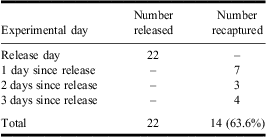
Two experiments were conducted on the males of S. oculata. In the first experiment, we captured 22 males using an insect net in a 100 × 100 m area where patrolling males occurred, marked their pronota with marker paint (Mitsubishi Paint Marker; Mitsubishi, Tokyo, Japan). To distinguish individual males we used different colours for marking. The marked males were transferred in black bags. Captured males were released at an adjoining area ∼300 m from the collection area. For the following three days, we searched for marked males in their original collection area. Recaptured marked males were held in the laboratory to avoid repetitive capture of the same individuals. Recaptures were undertaken from 07:00 to 11:00 hours.
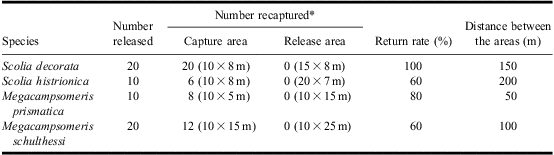
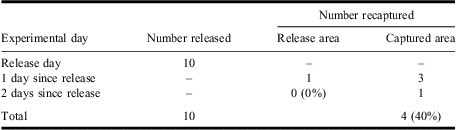
In the second experiment, we investigated whether males went to a suitable mating area randomly or returned to their own patrol area. We captured 10 patrolling males in the area used for the first experiment. After marking, we released them in another area (50 × 10 m) where numerous S. oculata males were found patrolling. The two patrol areas were ∼800 m apart. We recaptured released wasps in both areas over the next two days to check whether they had returned to their own patrol area. We repeated the second experiment on the other four species (S. histrionica, S. decorata, M. schulthessi, and M. prismatica) in Fukuoka City (see Table 1).
The mark-recapture experiments with the males of four scoliid species in the field.
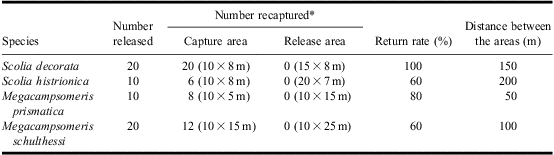
Notes: *Male scoliids were collected in one of the areas where conspecific males were been found (capture or natal area) and were released in another area (nonnatal area). The area of each area is shown in parenthesis.
In the first experiment, 14 of the 22 wasps released (63.6%) returned to their collection area (Table 2). In the second experiment, four out of 10 wasps (40.0%) returned to their own patrol area (Table 3). However, after two days no marked wasps were detected in the release areas, even though nonmarked conspecific males were located. Similarly, in the other four species ⩾60% marked wasps returned to their own patrol area. However, we were unable to recapture these wasps in the release areas even though many nonmarked males were found (Table 1).
The first mark-recapture experiment with male Scolia oculata in the field.
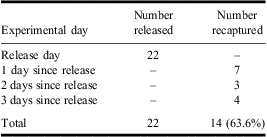
Notes: The release area was ∼300 m from the capture area. Conspecific males were not found patrolling in the release area (see main text for details).
The second mark-recapture experiment with male Scolia oculata in the field.
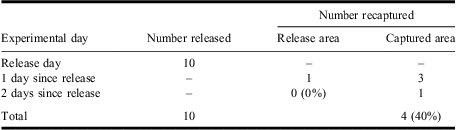
Note: Males were collected in an area (capture area) and then released in another area (release area), ∼800 m apart, where many conspecific males had also been found patrolling (see main text for details).
These results suggested that males of the five scoliid species had long-distance homing ability and strong site fidelity to their own patrol area. Scoliid males are often found flying or patrolling around just above ground level and are confined to relatively small areas where females emerge. Because male patrol areas have patchy distributions and are limited in number, a high rate of recapture does not imply that a marked male wasp selectively returns to his own patrolling area. In the second experiment, we released males in an area where conspecific males patrolled. Nevertheless, marked males were recaptured only in their own patrol areas, whereas no marked males were found in the release areas despite the presence of nonmarked males. We found that S. histrionica males returned to their own patrol area from up to 3 km. Thus, this study has demonstrated that male scoliid wasps show site fidelity and have a long-distance homing ability.
In some scoliid species, males emerge earlier than females and patrol a specific area where females may emerge (Miyagi Reference Miyagi1960). Once females emerge, males mount them and copulate (Miyagi Reference Miyagi1960). Because females emerge from underground and because the exact female emergence site is difficult to detect, scoliid males are likely to have difficulty find their mate from aboveground before female emergence. In some nest-making wasps (e.g., Bembicinus quinquespinosus (Say) and Nomia melanderi (Cockerell)), males can locate newly emerging females from their underground sites by olfactory means or the sound of the preemergent females (O'Neill Reference O'Neill2001). However, for male scoliids, mate searching is probably more difficult because females neither make nests nor leave digging traces. Therefore, persistently patrolling within a specific area where females may emerge would be an effective strategy for males.
We suggest that male homing behaviour in Scoliidae evolved under the following conditions: (1) males need to persistently be in the patrol area to search for mates; and (2) males are not able to remain in the patrol area and need to leave repeatedly for ecological and physiological reasons such as food acquisition. The patrol period is relatively long, usually greater than one month. Male scoliids would require sustained energy reserves to sustain patrol flights. Scoliid males have been observed to repeatedly visit flowers and feed on nectar to compensate for their large energy expenditure (Inoue Reference Inoue and Endo2006). Because feeding areas are often separated from patrol areas, the males must frequently move between feeding and patrolling areas. In addition, scoliid wasps inhabit areas with strong winds such as coastal regions, where males could be blown from their patrol areas. Furthermore, it may benefit males to occasionally explore the broader habitat in search of more productive female emergence areas, and if none are found, they may return to their own patrol areas.
In a preliminary observation, we found that female scoliid wasps used site fidelity and homing ability. This may be associated with their host search strategy to exploit scarabaeid larvae aggregated in the soil (Allsopp and Bull Reference Allsopp and Bull1989).
Male and female scoliid wasps have homing ability. Although the males and females use this ability in a different context, i.e., mate and host finding, a shared ecological background may underlie the evolution of the homing ability in scoliids. Both sexes of scoliids employ search strategies to obtain underground resources (mates and host grubs). Site fidelity and homing would be effective strategies to use when potentially aggregated resources occur underground.
Very few studies have focussed on long-distance homing by males in nonnesting Hymenoptera. The discovery of long-distance homing behaviour of male scoliid wasps is important, clarifying the evolution of homing behaviour. From this behaviour of scoliid wasps, we propose two hypotheses about the evolution of the homing behaviour of Hymenoptera. One hypothesis is that the homing behaviour in male scoliids may simply be convergent with that of males from nest-making Hymenoptera that search emergence areas for virgin females. Another hypothesis is that the homing behaviour of scoliids is a preadaptation, enabling the ancestors of solitary nest-provisioning wasps to move between nesting and food hunting sites. The homing habit to a nesting site may have evolved from the homing habit to aggregated potential resources that are difficult to locate.
Acknowledgements
The authors thank Professors M. Takagi of Kyushu University, N. Ohbayashi and M. Sakai of Ehime University for their support and guidance to the first author. This research was partially supported by the Grant-in-Aid for Japan Society for the Promotion of Science Fellows, number 23-1411.