On the 18th of January 1952, Messaoud Salhi requested permission from French authorities to present a play called “The Deluded Youth” (Al-Maḡrūr) in the Constantine municipal theater in Algeria.Footnote 1 Salhi was the president of an artistic association called Al-Malhat Al-Jazā‘rīyya or La Comédie Algérienne (The Algerian Comedy) as well as a teacher at Jām‘īyat al-tarbīya wa ‘l-talīm al-islāmiyya, a reformist madrasa (school) that the troupe's seven members also attended. His request was not out of the ordinary: every play performed by the indigenous population, as the French called the Algerian Muslims, required a visa, affixed to the text itself, before it could be staged. Even though the play had been authorized and performed in the central Algerian city of Blida five years earlier, it needed a new visa for performance in the department of Constantine. Following an initial rejection on grounds that the script contained nationalist rhetoric, and then a round of censorship and revision, Salhi's play was authorized on 6 February, albeit with the standard caveat that the event “must unfold in the utmost calm and maintain the character of a purely artistic event.”Footnote 2
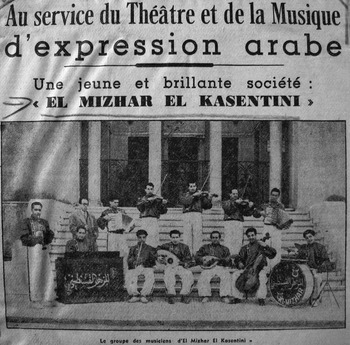
El Mazhar El Fenni El Qassantini. La Dépêche de Constantine, 25 Mar. 1955. Centre des Archives d'Outre-Mer, Aix-en-Provence, France, Fonds Ministériels (FR CAOM) 93 4224.

We know little about Al-Malhat Al-Jazā‘rīyya. The group's president Messaoud Salhi was born in 1922. In 1952, he seems to have been more or less in the good graces of the colonial administration.Footnote 3 He was described by one administrator as “‘ulama of moderate tendency”Footnote 4 and as having demonstrated “good faith” in revising the script.Footnote 5 A note from colonial police files (Service des Liaisons Nord-Africaines, or SLNA, which oversaw indigenous affairs) attests that the information they possessed on M. Salhi “was not unfavorable.”Footnote 6 He appears to have enjoyed good relations with the artistic luminary Ahmed-Reda Houhou,Footnote 7 director of the renowned orchestra and theatrical troupe El Mazhar El Fenni El Qassantini.Footnote 8 One of Houhou's plays, “The Three Misers,”Footnote 9 had been staged between 1949 and 1951 by Al-Malhat Al-Jazā‘rīyya throughout the Constantine region, and El Mazhar El Fenni had provided the musical portion of the program for at least one of the troupe's performances. Their audiences of around three hundred would have filled the Constantine municipal theater, where both “The Three Misers” and “The Deluded Youth” were performed. Although one police report characterized the 1949 performance of “The Three Misers” as “apolitical,”Footnote 10 the script of “The Deluded Youth” clearly indicates that by 1952 the troupe had nationalist inclinations.Footnote 11 Members of the nationalist (and soon to be revolutionary) MTLD (Mouvement pour le triomphe des libertés démocratiques, or Movement for the Triumph of Democratic Freedoms) could be found in its audiences.Footnote 12
The themes of “The Deluded Youth” revolve around oppositions that were common at the time. One main character, the muḥtadā, is a model of Islamic reform—studious, disciplined, and committed to his nation. The other, the “deluded youth,” or maḡrūr, represents the vain young man caught up in the leisures and pretensions of European life. The play contrasts social space, mores, and cultural practices in relation to these familiar tropes. The “deluded youth” frequents bars, nightclubs, casinos, cinemas, and cabaret singers—signs of how deeply into decadence and debauchery Algerians had fallen.Footnote 13 In contrast, the muḥtadā and his colleagues enact the essence of reformist modernity: they entertain themselves through intellectual debates in the Arab Club, engage in daily practices of prayer and spiritual discipline, and are committed to education. The trajectory of this four-act play is one of conversion: gradually the deluded youth comes to his senses, joining the side of the muḥtadā and his fellow reformists, who include al-ḥākim (the arbiter), and several others, referred to as “brothers.” Together, they develop a plan to create an institution with a tripartite mission:
(1) The diffusion of Arab culture and national education including sports of all kinds.
(2) The revival of the national economy; the encouragement and promotion of industry.
(3) The struggle against social scourges such as alcohol, adultery, and so forth.
Before they can enact their plan, however, they are foiled: overheard by spies, they are arrested by the French police and thrown into jail, where they languish for months. Here, scenes unfold whose primary interest to me is that the censor did not remove them. For instance, while in prison they recite nationalist poetry and read aloud an article from the smuggled newspaper Al-Waḥda (Unity) that is sympathetic to their cause. The charges against them resonate in Algeria to this day: that they plotted against the government and were a threat to the internal security of state. In the end, the prisoners are acquitted and released. They immediately resume their plans: they hold a general assembly, elect officers, and vote on their project to create an institution that they hope will lead them toward an independent Algeria (the term “independence,” al-istiqlāl, is crossed out but legible on the archival script).
What strikes me about this play—aside from the fact that it passed French censorship—is not its by then familiar coupling of reformism and nationalism, or the conversion story that it portrays, or even the fascinating trial. What I find most intriguing is a small detail that audiences of the time, and perhaps even today, may not have noticed: every vote, every decision, and every plan the characters consider was unanimously approved. In all, four votes were taken. The first was held in the home of the muḥtadā about their initial plan. This was the only vote preceded by a brief discussion. The other three took place at the general assembly. The first was a unanimous voice vote to approve a slate of temporary officers; the second and third were via unanimous showing of hands—initially to elect permanent officers, then to endorse the project of building an institution. (The maḡrūr was elected treasurer; the muḥtadā was, of course, president; and a new, self-nominated volunteer became secretary, thus modeling the combination of experience and new initiative that would be needed to attain their collective goals.) In each of these votes, they not only agreed, but they agreed with one voice, without debate. Moreover, they delegated full power to the elected officials. The three officers were endowed with the authority to designate their assistants, advisors, and all subcommittee members. When the president asked the assembly if they concurred with this, the public unanimously assented. As one attendee put it: “The fact that we chose them … shows that we have confidence in them and that we agree with all their decisions.”
What are we to make of these displays of unanimity? Knowing Algerians’ propensity for a good debate, when I first read the script I took the unanimous votes as an artifice of this kind of pedagogical play, where the focus was obviously to exhort audience members to align with the reformist-nationalist cause.Footnote 14 Clearly, there would have been no political or didactic interest in representing dissent or divergence of opinion. The purpose of the play was not to linger on discord, but rather to demonstrate concord.
Had I not been working with several contemporary theater troupes in Algeria while reviewing this archival material, I might not have given the votes further thought. The play would stand as little more than a text of reformist pedagogy. But the emphasis on unanimity at key decision points resembled what I was finding in my field research with five troupes nearly six decades later. In these troupes, displays of unanimity were de rigeur at moments such as selecting group officers and determining annual programs. These were not perfunctory endorsements: failure to reach unanimity could lead to schism and rupture, with some members leaving to join other troupes or form new ones.
Such performances of unanimous agreement are not limited to cultural associations, and point to what several scholars have identified as a fault line running through Algerian political life since at least the revolutionary period: the tension between unanimism and diversity (see especially Colonna and Daoud Reference Colonna and Daoud1993; Colonna Reference Colonna1996a).Footnote 15 From 1962 to 1989, Algeria was a single-party state governed by the National Liberation Front (FLN); under the FLN, elections were essentially displays of unity rather than occasions for pluralist debate. Unanimism has pervaded many other domains of public culture as well. For Fanny Colonna, breaking with “the cardinal value of unanimism” represented an “impossibility” not only in political or ideological terms but, more significantly, in “cognitive” terms (1996b: 4).Footnote 16 As she put it, differences among Algerians—be they linguistic, religious, ethnic, gendered, or sexual—have been disavowed in public life via a kind of “blackmail of unanimity” (chantage à l'unanimité) that was “readily internalized by the social subjects themselves” (ibid.: 5). Colonna and her colleagues have productively troubled the presumption of unanimity by bringing to light some of the less visible diversity that animated Algerian society throughout the twentieth century. In the present essay, I make the opposite move. I seek to understand how Algerian publics learned to produce unanimism as a social practice. Drawing on archival date from artistic troupes of the 1930s to the 1950s, I suggest that Algerians began performing unanimity well before the revolution, and I explore some possible reasons why this might have been the case. I also attend to the flip side of unanimism: splitting, fissure, or rupture.
In focusing on practices of unanimism in reformist theatrical associations I am not suggesting that what made sense to Algerians in those decades somehow automatically transferred to independent Algeria. The social meanings of unanimism have no doubt shifted. Yet the “affinities of the [single-party] state with the Reformation” (Colonna Reference Colonna, Colonna and Daoud1993: 8) are clearly visible in the articles of faith on which the Algerian republic was founded: the unicity of religion (Islam) and official language (Arabic), both constitutionally enshrined,Footnote 17 were consolidated during the rise of reformism in the 1930s and 1940s even as the country's pluralism was officially silenced.Footnote 18
In focusing on the unanimist practices of Algerian civic associations in the early to mid-twentieth century, I seek to complicate a prominent line of argument in democracy theory, which has long accorded to voluntary associations a storied niche. Alexis De Tocqueville (Reference De Tocqueville2003) was among the first to argue that democratic societies operate horizontally, lacking the strong vertical ties that aristocratic societies provide, where one man can marshal around him a loyal following if need be. As he saw it, civic associations provided the strength in numbers that could counter the relative weakness of each individual. In a similar vein, Jurgen Habermas linked the emergence of a democratic public sphere to the kind of “rational-critical debate” fostered in Europe's literary clubs, coffee houses, and salons, which were free, he contended, of the doxic authority of church and state (Reference Habermas1991 [1962]). Habermas' work fueled a proliferation of scholarship conjoining voluntary associations, civil society, and a democratizing public sphere. For some scholars, the presence of voluntary associations has been used as a kind of litmus test to assess the democratic potential of nonwestern regimes and, in its most extreme form, as a way to “differentiate states according to their potential for democracy and civilization” in the manner of Samuel Huntington (White Reference White, Hann and Dunn1996: 147, critiquing Huntington Reference Huntington1993). Indeed, the connection between voluntary associations and democracy has become so naturalized in some circles that voluntary or civic associations (now more often called non-governmental organizations or NGOs) are being used prescriptively—that is, they are deliberately “injected” into a society by international aid organizations in order to foster democratic practice, as Steven Sampson has described for Albania (Reference Sampson, Hann and Dunn1996; see also Hann Reference Hann, Marlies Glasius and Seckinelgin2004; Hann and Dunn Reference Hann and Dunn1996).
While civic associations are often viewed as spaces for the promotion and management of the kind of diversity associated with pluralist democracies, they can articulate with the state in other ways. Pierre Rosanvallon has shown how associations could function as sites for “learning about unity and translating it into action” (2007: 234) within what he calls “the political culture of generality” in Jacobin FranceFootnote 19—a culture that so aspired to the vision of “a single, unified society” (ibid.: 4) that it sought to tightly control intermediary bodies into the twentieth century.Footnote 20 In the contemporary Algerian case, Andrea Liverani (Reference Liverani2008) has demonstrated the ways voluntary associations have taken on the work of the neoliberalizing state, performing functions that the state no longer assumes. An adjacent body of scholarship offers an important corrective to the Habermasian focus on voluntary associations by identifying manifestations of civic practice in alternative arenas (e.g., Chakrabarty Reference Chakrabarty2000, ch. 7; the essays in Comaroff and Comaroff Reference Comaroff and Comaroff1999; Karlström Reference Karlström1996; Snyder Reference Snyder2001).
In this essay, I expand on these lines of scholarship. I argue that while voluntary associations may well be sites for experimentation in democratic practice, this need not be their only or even primary function. I suggest that the Algerian theatrical and musical associations of the reformist period may anticipate another kind of civic history, a history of displays of unanimism in public life. In focusing on the artistic performances and the social practices of these associations, I hope to elucidate how expectations of unanimism both reverberated through and were constituted within local practice. I am interested in how and why Algerians learned to produce public displays of agreement for particular audiences (including themselves) at particular historical moments.
One reason scholars have sought to move away from a focus on voluntary associations as sites for the production of civil society has to do with the nature of colonial rule, which drew a sharp legal distinction between citizens and subjects that foreclosed any number of civic possibilities to those considered “subjects,” which included most of the indigenous population (see Mamdani Reference Mamdani1996; see also Chatterjee Reference Chatterjee1993). Throughout Africa, whereas urban areas were typically governed under civil law, rural regions were placed under the rule of “custom.”Footnote 21 Civil law was intended for rights-bearing European settlers, but a third group also fell under its purview: urban-based natives (Mamdani Reference Mamdani1996: 19). Mamdani devotes little attention to this group, considering it “of limited significance” (ibid.: 20) and tangential to the dual form of power wielded by the colonial state. Here I make this group my focus. While Mamdani and others have demonstrated how colonial administrators used indigenous institutions (particularly via so-called “indirect rule”), my emphasis is on how indigenous populations appropriated European institutions of civil society, turning these institutions to their own ends. Moreover, the urban population I consider is by and large not the group generally characterized as the “native elites” or “les évolués,” who may have been more practiced in the use of French institutions. Rather, I am interested in the arabophone youth educated in the madrasas associated with the Islamic Reform or iṣlāḥ movement. In highlighting the ways in which this group made use of the institutional possibilities afforded them by French law, I aim to extend recent scholarship on “Africanized modes of civil society” (Comaroff and Comaroff Reference Comaroff and Comaroff1999: 20) from its largely contemporary, post-independence focus to an earlier formative period.Footnote 22
In approaching unanimity in terms of performance, I consider both collective displays of unanimous agreement and the extensive social labor entailed in their production. In the material I examine, displays of unanimity are generally made manifest in moments of ritual such as voting. Such displays constitute fleeting but potent symbolic occasions that Durkheim initially characterized in terms of collective effervescence and that anthropologists have analyzed as specially marked domains of reflexive display that can help to generate a sense of belonging and common purpose (e.g., Singer Reference Singer1958). I examine how social actors helped to generate these moments through the specific ways they made use of language and gesture (Austin Reference Austin1962). To so do, I draw on a line of scholarship in linguistic anthropology that views society and culture as communicatively constituted and focuses on social meaning as emergent in every interaction, from the most highly marked to the most mundane.Footnote 23 From this perspective, I will be interested in the participant structure (the organization of interaction) of the associations, in the speech genres employed at meetings, and in the ways persuasive speech may have operated in generating unanimity.
Yet, focusing solely on displays of unanimity risks erasing from view the equally compelling practices that undergird such displays. To address these behind-the-scenes practices, I am inspired by a related approach, outlined in the work of sociologist Erving Goffman (Reference Goffman1959), that employs theatrical metaphors to characterize the relationship between front-stage forms of social interaction (such as collective ritual) and the back-stage forms of communication that can support and enable, or sometimes undermine, collective display. Differences and disagreements, for instance, may be relegated to a backstage that is rarely made visible. Without ongoing and purposeful back-stage labor, I contend, front-stage unanimity risks losing its social force.
I begin by situating reformist plays like Messaoud Salhi's in relation to a wider history of Algerian theater during the same period. I then consider the political and legal environments in which theatrical and other associations emerged. Next, I examine practices of unanimism engaged in by numerous theatrical associations at the time, as described in the archival records. I consider how unanimity was both represented in play scripts and enacted, however tenuously, at key moments in the social life of an association. My focus is on representations and practices of voting, as unanimous voting was both portrayed in Salhi's script and regularly practiced by association members in their annual meetings. In the second half of the essay, I devote sustained attention to three factors that may have fostered the production and performance of unanimism: first, the reformist doctrine of tawḥīd, or unicity; second, consensus-based vernacular decision-making practices (such as those found in the Berber assembly or tajma‘at); and third, specific measures instituted by the French colonial administration that may have encouraged Algerians to produce public displays of unanimity.
REFORMIST THEATER
Reformist plays like the one staged by Salhi's troupe lie on the margins of mainstream histories of Algerian Arabophone theater. Sources concur in locating the beginnings of Algerian theater in the years following World War I.Footnote 24 In 1921, the Lebanese-Egyptian actor and director Georges Abiad’ put on two historical dramas in Algiers, both in classical Arabic. While these were not particularly well received, they did impress a group of madrasa students and Arabophone elites, who began to produce their own morality plays dealing with subjects such as alcoholism (Roth Reference Roth1967: 22). The students came together under the auspices of voluntary associations that were forming at the time, such as the Association of Muslim Students, the theatrical association Al-Muhadiba, and the musical association Al-Mutribiyya (ibid.: 20).Footnote 25 Amateur actors affiliated with one or more of these associations began performing morality plays, historical dramas, and pedagogical skits at Muslim holidays. Their plays, however, met with little popular success. In 1926, a new genre of theater appeared on the scene, led by actors including comedians Allalou, Dahman, and Rachid Ksentini, as well as the important singer, actor and, later, director and producer Mahiéddine Bachetarzi. In contrast to the madrasa students, these actors performed in derija (spoken Algerian Arabic) and focused largely on comedic skits and farces that simultaneously operated as social critique. For instance, comedies might highlight conflicts of morality and mores, particularly with regards to European influence.Footnote 26 This comic genre, which came to dominate the early history of Algerian theater, would form the basis for vernacular theater's eventual professionalization as it moved away from the religious plays that launched theater in Algeria earlier in the twentieth century.
Religious and comic genres were not entirely separate in the early years. For instance, the Mahiéddine troupe would perform for Muslim holidays; Bachetarzi himself was hired for the Fête de Al-Kheiria in 1934, where he joined on the stage such reformist notables as the Shaykhs Ben Badis, El-Oqbi, Ahmed Toufiq Madani, and other ‘ulamā members (Bachetarzi Reference Bachetarzi1968: 180–82). Bachetarzi and Toufiq Madani remained on friendly terms, and the latter wrote two plays—an adaptation of Shakespeare's Othello (in derija) and another of Hannibal (in classical Arabic—which Bachetarzi staged at the Opera of Algiers in 1952) (ibid.: 182). Moreover, local associations, including some reformist ones, were often the sponsors of the Mahiéddine troupe's productions (ibid.: 218, 221; Roth Reference Roth1967: 36). According to Bachetarzi, in some cases the troupe's visits would inspire the creation of new local youth associations (1968: 225).
POLITICAL AND LEGAL CONTEXTS OF ASSOCIATIONAL LIFE
By the time Al-Malhat Al-Jazā‘rīyya was founded in Constantine in the mid-1940s,Footnote 27 the city already had a burgeoning associative sector. The 1930s alone had seen the birth of over one hundred associations (Merdaci Reference Merdaci2007: 102, citing Benhassine Reference Benhassine2005). These formed in an environment governed by two laws that would make available to Algerians new possibilities of sociability and solidarity: the French 1901 law on associations, and the 1919 Jonnart law. The 1901 law,Footnote 28 titled the “Law relative to the contract of association” (Loi relative au contrat d'association),Footnote 29 was passed in the metropole in what appeared in retrospect as a pivotal moment in the struggle in France between what Pierre Rosanvallon has described as a unanimist Jacobin culture of “generality,” which concentrated power at the center of the state, and the emergence of more particularistic and dispersed “intermediary bodies” that would allow citizens to congregate around discrete interests and agendas.Footnote 30 This law was not specifically targeted at Algeria, and it is unclear whether its potential repercussions in Algeria entered into the debate over the law in France.Footnote 31 However, it is apparent from French archives that surveillance became one of the key applications of the law in Algeria, in keeping with the regime of exception (termed the Code de l'indigénat) that Algerians had been living under since 1881; the Code, building on groundwork previously laid in the 1865 Senatus-Consulte, had made Algerians subjects rather than citizens of France and subjected them to a different regulatory environment.Footnote 32 The 1901 law gave officials a means of keeping track of what associations were doing by requiring each to register with the police, supply the names, addresses, and professions of its officers, and provide an annual report of its activities. The Code further specified that Algerians had to get an official authorization before any meeting (Kaddache Reference Kaddache1993: 36). Yet surveillance had its limits, and whatever its shortcomings, the 1901 law did provide a sanctioned means for Algerians to gather around a common set of concerns. Moreover, social practice did not always follow the letter of the law; I saw little evidence in the archives that theatrical or musical associations in fact did request authorization every time they met,Footnote 33 though they clearly did so for performances.Footnote 34
The Jonnart law of 1919 did not directly target associations, but it attempted to address—albeit in a limited way—Algerians’ desire for a fuller engagement in political life by attenuating some aspects of the unpopular Code de l'indigénat.Footnote 35 Most significantly, under the Jonnart law, some 425,000 Algerian subjects, or 43 percent of the adult male population (Ruedy Reference Ruedy1992: 112), were allowed to vote for their own candidates in local elections, more than seven times as many as had been able to vote under previous legislation (Kaddache Reference Kaddache1993: 44). While this represented a significant gain, the Jonnart law maintained the indigenous exception by requiring Algerians to vote in a separate electoral college and instituting caps that ensured that they could never hold more than one-third of the available seats.
In 1930, some of the elected officials came together to form the Fédération des élus musulmans de Constantine (Federation of Muslim Elected Officials of Constantine), affiliated with the national Fédération des Elus that had formed in 1926.Footnote 36 A year later, the Association of Algerian Muslim ‘ulamā or AUMA (Association des ‘ulamā musulmans algériens) formed, led by the prominent reformist Ibn Ben Badis; the Ben Badis Institute—de facto center of the Reform movement in Algeria—was located in Constantine. Both the Fédération des élus and the AUMA exerted considerable influence on local and national politics and energized associative practice.Footnote 37 Jām‘īyat al-tarbīya wa ‘l-talīm, the Ben Badis Institute's supporting madrasa, was Ben Badis's first associational project. He founded it in 1930, a year before the AUMA came into existence, and he was its first president. Recall that all of the members of Messaoud Salhi's troupe Al-Malhat Al-Jazā‘rīyya had attended this madrasa and that Salhi himself was a teacher there.
Neither the Jonnart law nor related legislation debated nearly two decades later, the Blum-Viollette bill,Footnote 38 satisfied Algerians’ demands for change.Footnote 39 As the Fédération des Elus and the Islaḥ movement gained strength during the 1930s, other formations were also taking shape. The Etoile Nord-Africaine (ENA), created in 1926, was forming among the Algerian immigrant community in France under the leadership of Messali Hadj. The ENA was the first party to voice nationalist demands, for which it was banned in France, only to reemerge as the Parti du Peuple Algérien (PPA), which had a presence in both France and Algeria although it, too, was eventually banned. In 1946, Messali Hadj formed a new movement, the Mouvement pour le triomphe des libertés démocratiques (MTLD), to serve as a front for the PPA (Ruedy Reference Ruedy1992: 151). The Algerian Communist Party, formed in 1936 after a break from the French Communist Party, did not have a widespread following because of its embrace of a proletarian rather than a nationalist agenda. However, the PPA later imitated some of its administrative and recruitment tactics, including the cellular, networked organization it adopted (ibid.: 148). The cellular model may have had some influence on the development of an expectation of unanimity among members, although this remains speculative. What is clear is that within the burgeoning associative climate in Constantine in the late 1930s and 1940s one thing police looked for when they received association membership lists was any potential party affiliation; most suspect was affiliation with the PPA (or PPA-MTLD).
UNANIMITY IN ASSOCIATIVE PRACTICE
In the early years of associative practice, unanimity does not appear to have been a guiding principle. Consider Mouhibbi El Fen, the first musical and theatrical association created in Constantine, in May 1933. At first its members were remarkably diverse. Some were loyal to Ben Badis while others, including its first president, Abdelmadjid Rahmouni, were affiliated with one of the many zawāyā (sufi brotherhoods) popular in Constantine at the time (Merdaci Reference Merdaci2008: 166). Professionally, the members were a mixed group: six employees in local administrations, six in economic enterprises, five artisans, three landlords, and two teachers. While many were graduates of the French high school Jules Ferry, others came out of the arabophone madrasas (ibid.: 210). Mouhibbi El Fen's statutes allowed for political diversity. Gradually, however, the group adopted a reformist orientation, described as “a subtle form of allegiance, essentially to the person of the shaykh Abdelhamid Benbadis” (Merdaci Reference Merdaci2007: 103). This was clear in Mouhibbi El Fen's performance for the Ben Badis Institute following a speech by Ben Badis; this performance would likely have included the hymn “Ša‘b al-Jazā‘ir” (“The Algerian people”), a setting of Ben Badis's poem of the same title, which had been composed by Mouhibbi El Fen's music director, one Si Brahim Ammouchi, at the request of Ben Badis (ibid.: 104).
Mouhibbi El Fen's diversity was also its demise. It was one of the few associations for which I found a reference to a lack of unanimity at the general assembly. Indeed, according to Merdaci, the 1937 assembly featured “a head-on fight between those close to the ‘ulamā, led by Ahmed Bouchemal, and the president Abdelmadjid Rahmouni, who had declared his sympathies for the sufis” (2008: 166–67). At that point, the troupe ceased to exist as such; those members aligned with Ben Badis, led by Ahmed Bouchemal and Mohamed-Larbi Bentellis,Footnote 40 formed a new troupe, Chabab El Fenni (ibid.: 96), which had a much more homogeneous membership. Chabab El Fenni lasted only a few years, until the outbreak of World War II in 1940. After the war, in 1945, some of its former members created l'Etoile Polaire, which in turned spawned El Amal El Masrahi in 1949. The genealogy of Messaoud Salhi's troupe Al–Malhat Al-Jazā‘rīyya is less clear. Given its close ties to Jām‘īyat al-tarbīya wa ‘l-talīm, it likely emerged directly out of this reformist madrasa. It would have overlapped in time with first Etoile Polaire and then El Amal El Masrahi.
Similar stories of splitting and reconstitution characterized other theatrical groups of the day. El Hilal Ettemthili El Qassantini, formed in 1938, had a fleeting existence (ibid., 162). Like Mouhibbi El Fen, El Hilal Ettemthili (graced by the brief but contentious presence of the comedian Rachid Ksentini of the renowned Mahiéddine troupe) initially included members of competing ideological tendencies. Of twenty-two members in February 1939, three were identified with sufis, ten with reformists (called ‘ulamā in the police reports, though not all ‘ulamā were reformists), and six with the Féderation des élus, and two were considered neutral; one ‘ulamā-identified member was further affiliated with the communists.Footnote 41 Their audiences may have been similarly diverse, since on 1 February 1939 some eight hundred came to see their play “Crime of the Fathers.” This audience included Dr. Bendjelloul of the Féderation des Elus and Ahmed Bouchemal of the ‘ulamā, who had served as president of Al-tarbīya wa ‘l-talīm and as publisher of the ‘ulamā newspaper al-Shihāb, and was a founder of the Algerian Muslim Press.Footnote 42
Yet it appeared almost impossible to maintain such diversity; El Hilal Ettemthili reportedly was close to scission over a difference between the adjunct secretary (described as of “‘ulamā tendency”) and the treasurer, who had reportedly turned the site of the association into a bar during the ‘Aid festivities.Footnote 43 In 1941, after two years of inactivity due to disagreement among its directors, the troupe tried to come back together. They reportedly reached an agreement after what the French police report termed “an exchange of views” (une échange de vues),Footnote 44 but it did not last long. Other troupes went so far as to prohibit all political discussion, such as Jider El Masrahi,Footnote 45 or to expel members who were affiliated with particular parties. El Hilal Ettemthili, for instance, unanimously voted to expel its comptroller because of his affiliation with the PPA in July of 1938.Footnote 46 Eventually El Hilal Ettemthili appears to have become entirely ‘ulamist and by 1944 was performing such well-known reformist plays as Bilal Ibn Rabah,Footnote 47 to be discussed presently.
Why did associations struggle so hard to reach unanimity? What made unanimity a more attractive option than, say, majority rule? What transpired in the 1930s that led to a “head-on battle” in an association like Mouhibbi El Fen, which had initially included both reformists and sufis? To address these questions, I consider three factors: first, the importance of tawḥīd, or unity, in the reformist imagination; second, local practices of decision-making, including the size and nature of elected committees as well as what Andrea Liverani calls “associative familism” (2008: 62); and third, the over-determining presence of the colonial apparatus, which, paradoxically, both sharpened the line between reformists and sufis and laid the groundwork for the emergence of a singular Islamic identity by making practice of the Muslim faith the key grounds for excluding Algerians from French citizenship.
Tawḥīd, or Unicity
A key rationale for discourses and practices of unanimity is no doubt linked to the reformist doctrine of tawḥīd, which derives from the Arabic root meaning “one” and can translate as unicity, unification, or union as well as belief in the unity of God.Footnote 48 Doctrinally, tawḥīd refers to the conviction, central to reformist thought, that Muslims must return to the source of their religion, to practices grounded in the belief in a single God and in the foundational authority of God's words as conveyed in the Quran, the Hadith, and the Sunna. The premise of tawḥīd led reformists to categorically reject the various intermediaries (sometimes referred to as marabouts or saints) who had long dominated popular practice throughout the Maghrib.Footnote 49 For the reformists, practices related to such intermediaries were considered “innovations” (bidā‘at) that were at odds with Islam's basic tenets. Within the broader reform movement, which by the 1940s was emerging as a dominant religious force across the Arab world, tawḥīd was also invoked to attenuate antagonisms between the four schools of Islamic jurisprudence, each of which elevated the teachings of its particular foundational imām over the underlying unity of the Islamic community, or umma (Commins Reference Commins1990).Footnote 50 Divisions among Sunni and Shi'a Muslims were similarly subordinated, at least in theory, to the overarching unity contained in the notion of tawḥīd. In Algeria, which was primarily Sunni,Footnote 51 and almost exclusively aligned with the Maliki school of legal thought, the reformists concentrated their energies primarily on the sufis and their many followers. The sufi organizations, called zawāyā, were built around a saint and his followers or adepts (sometimes called ikhwān, brothers), but they could bring together hundreds or, for the most popular saints, thousands of people for saint-day festivities and other ritual occasions. While some saints were associated with a single locality, others had regional and even national renown, and belonged to brotherhoods that stretched across the Maghrib and the Middle East. Although many sufi organizations had challenged colonial power during the early decades of conquest and occupation, by the 1940s, most had reached accommodation with the French ranging from mutual tolerance to working relationships to outright support. To the reformists, however, the sufi leaders were little better than charlatans who took advantage of an uneducated population to enrich themselves and their organizations. The doctrine of tawḥīd challenged the entire sufi edifice—both the presumed existence of intermediaries between Muslims and their god and the many kinds of miraculous or, from a reformist viewpoint, “superstitious” practices associated with these intermediaries.
Tawḥīd was not merely a theological doctrine. It was also a factor “at every level, and in all aspects of Islamic life.” Indeed, tawḥīd was to serve as a unifying force for the Islamic community “in the moral, psychological, political, and even cultural sense” (Merad Reference Merad1999: 238). As James McDougall put it, tawḥīd constituted “a theological principle to be rigorously applied to social life” (2006: 114). Yet how did the unifying principle of tawḥīd articulate with the rich plurality of social experiences and political perspectives? How was agreement produced on the ground? If, in Omar Carlier's words, “community is placed under the sign of unicity while society itself unceasingly produces diversity,” how was the resulting tension handled in practice? (Carlier Reference Carlier1998, cited in McDougall Reference McDougall2006: 234). Although Carlier was speaking of the resurgence of Islamism in Algeria in the 1990s, the question is equally relevant to the reformist period.
One way unicity was produced was via the pragmatics of speech, through speech acts that bring into being what they call for (Austin Reference Austin1962). As Ben Badis toured the countryside in the 1930s, he called for “unitarism (tawḥīd), union, and generosity toward all human beings (‘ibād), concord and mutual assistance (ta'alūf, ta’āwun) among all the inhabitants of Algeria, without distinction of race or creed” (Merad Reference Merad1999: 127, quoting Ben Badis). This message was recast on a more intimate level in the play under consideration here, where it was performatively invoked at key decision points. During the general assembly, for instance, the muḥtadā (who had just been approved by voice vote as temporary president) evoked a divinely bestowed unity prior to the final two unanimous votes (held to elect the permanent committee and agree on the project): “I am grateful,” says the muḥtadā, “that you granted me the honor of presiding over this general assembly. And I congratulate you for your honorable determination and your zeal in striving for the common good. You are driven by sincerity and goodness toward the flourishing of Arabness (al-‘arūba). I thank God for bringing together our dispersed affairs and unifying the word of the disunifed umma in this blessed general assembly. ‘What is brought together by the hand of God cannot be separated by the hand of Satan.’”Footnote 52 As a speech act, this may have worked to produce the very sense of oneness that it references: If God were on the side of unity, how could a member of the assembly dissent?
The tawḥīd model seems to have been adopted even by the AUMA at its creation. According to Merad, the association formed after five and a half years of discussion and debate (1999: 115). By the time of the AUMA's first general assembly, in May of 1931, they had largely reached agreement. On the very first day, the statutes were adopted and the administrative council designated. The rapidity of these moves suggests that the details had been hammered out beforehand. In such a situation, the general assembly comes to resemble a ritual festival of unity more than a moment of electoral decision, which is how Malika Rahal characterized the general assemblies of the Union démocratique du manifeste algérien (UDMA) from 1945 to 1954. As she put it: “The systematic and repetitive character of the election of the committee gave it a surprising ritual value.… The number of these elections shows that they go beyond basic organizational necessities to constitute an activity in and of themselves, participating in the normal activity of members of the section and symbolizing the beginning of any collective action” (Rahal Reference Rahal2007: 66). The Muslim Scout organization appears to have worked in much the same way. Brahim Mamouchi reported in his memoirs that when he helped to bring the scout organization to Constantine he called a general assembly in April of 1932 at which “comrade Belattar M'Hamed was designated president” (Mamouchi n.d.: 4, my emphasis).Footnote 53 It seems that once an association was at the point of selecting a slate of officers, its members had had so much advance back-and-forth discussion that they knew already who their representatives would be; in effect, they had reached unanimity before the general assembly took place, so that it became a rubber stamp of sorts.Footnote 54 The vote thus had a different significance than it would in an election governed by majority rule—it was not usually a moment of choice. Rather, it was a ratification of a decision that people had already labored long and hard to reach. Associations that could not reach prior agreement ended up splitting or dividing. Meetings and elections thus became celebratory occasions, “festive reunions” (Rahal Reference Rahal2007: 66) at which members celebrated their common vision in a Durkheimian moment of collective effervescence.
The public nature of the votes themselves also merits attention. Whether by voice vote or show of hands, association members were called on to publicly perform their allegiance to a common agenda. This is an entirely different use of the vote as social activity than voting by secret ballot, which became naturalized within Western democracies over the course of the nineteenth and twentieth centuries.Footnote 55
Vernacular Decision-Making Practices
Members of artistic associations may also have been drawing on vernacular modes of decision-making found in adjacent forums for argumentation and debate, such as those found in the Berber tajma‘at system. The tajma‘at, commonly translated by the French as the “assemblée du village” (village assembly),Footnote 56 was an all-male body that met regularly (typically weekly, on Fridays or on the day following the regional market) to discuss matters of importance to the collective life of a village, ranging from the upkeep and development of public space to the issuing of fines for transgressions of social mores or violations of established rules (al-qanūn). Decision-making in the tajma‘at typically operated via consensus: all able-bodied men of the village had to assent to the group's decisions before they could take effect.
In situating consensual decision-making practices in relation to the social organization of Berber villages, I follow William Murphy (Reference Murphy1990) in adopting a Goffmanian rather than a Durkheimian lens.Footnote 57 Consensual practices need not be interpreted, Murphy argues, as a communitas-like occasion to display solidarity or as “a mirror of social cohesion” (32). Instead, consensus-based decision-making may be more productively viewed in dramaturgical terms, as a strategy for building a “front stage” that appears consensual through “back stage” practices that might be anything but (ibid.: 25). From a dramaturgical perspective, the apparent equality of all voices present at the tajma‘at can be seen as a strategic means of obscuring very real differences in power and status. For if in theory all voices were equal, in practice this was not the case. Historically, most tajma‘ats had an amīn (president), a wakīl (adjunct), and various tamen who were appointed by and represented the patrilineages that made up the village (Mahé Reference Mahé2001: 80). This small group could act as a village council; they would set the agenda for the larger tajma‘at, represent the village to outside authorities, and could come together outside of the weekly tajma‘at meetings if there were urgent matters to discuss. As Mahé notes, some analysts have concluded that the true power in the village was located in this smaller group, with the full tajma‘at acting merely as “a registration chamber or a solemn proclamation through which the citizen body unanimously ratified a decision that was already made” (ibid.: 81). Yet on the ground, things were not so straightforward: the tamen patrilineage representatives would have had to be able to garner the support of their respective kin groups. Moreover, “the restricted assembly [village council], like the plenary, was obliged to … achieve strict unanimity” (ibid.: 82). The achievement of unanimity in what Mahé calls the “plenary” tajma‘at could thus be hard-won, the product of long negotiations among multiple parties and competing interests. Moreover, many tajma‘ats anticipated the possibility of secession—that is, the constitution of a parallel village assembly—and would levy high fines on anyone suspected of or engaged in such a dissident action (ibid.: 84). The tajma‘at also established fines for breaching codes of public conduct at the meeting, thereby preventing the kinds of fights that might otherwise break out during heated discussions (ibid.: 86).Footnote 58
Because consensus was the expected outcome, the tajma‘at had no need to follow the kinds of voting procedures that have been associated with democratic practice since the advent of the secret ballot (see Bertrand, Briquet, and Pels Reference Bertrand, Briquet and Pels2006). It was governed not by a principle of majority rule, but by something closer to the Islamic tawḥīd, in practice if not in name. In the cultural associations of the 1930s to 1950s, however, the apparatus of voting had become increasingly familiar to members from the political elections that surrounded them, even as their participation in those elections was limited. Electoral practices seem to have taken hold in the artistic associations, where—as in the scenes of voting represented in Messaoud Salhi's play—a voting procedure appears to have been laminated into a consensus-based participation structure.
Consider, for instance, the election held by Chabab El Fenni at its general assembly of 21 October 1940. The society had apparently been in some disarray, the former president was resigning, and there was a budget shortfall. The purpose of the meeting was to regroup and start afresh. After the “moral” and “financial” reports had been given, those present “participated in an exchange of views.”Footnote 59 Only after this were new elections held. At the same meeting there was also an “exchange of views” concerning artistic activities, which culminated in a consensus decision to organize a concert for the upcoming holiday Aid al-Saghir. Another “exchange of views” took place at a meeting later that fall, where “each one gave his opinion about the play they were preparing.”Footnote 60 The “exchange of views,” as the French termed it, seems to have been a key speech genre that would have documented the labor entailed in achieving unanimity; unfortunately, it is not elaborated in the archival records.
In noting resemblances between the decision-making structures at work in the tajma‘at and the Constantine artistic associations, I am not suggesting that the tajma‘at functioned as a self-conscious political model that the associations sought to imitate, as, decades later, the Berber ‘arūsh movement of the early 2000s tried to do.Footnote 61 Nor am I arguing that Algerians were somehow mired in vernacular forms of social interaction and unable to adopt other forms of civic practice. It is plausible, however, that association members were familiar with tajma‘at-style modes of collective decision-making and that they turned them to new uses. Omar Carlier, for instance, has shown how older social bodies (such as the kinship faction known as sof) and their associated styles of interaction can inhabit newer kinds of civic association (Reference Carlier1995: 151–62): “born of what already exists,” associations can go on “to initiate another cultural practice” (ibid.: 159).
While the tajma‘at is generally associated with rural, primarily Berber areas rather than urban, predominantly Arab environments, “rural” and “urban” were fluid categories in Constantine during the 1930s. The city of Constantine is located between the large Kabyle Berber region to its northwest and the Aurès Berber region to its south. The global depression that began in the late 1920s was by the early 1930s severely impacting Algerian agriculture, forcing rural residents to the cities.Footnote 62 Between 1931 and 1936, the indigenous Algerian urban population grew by over six hundred thousand people, or almost 11 percent, and during the same period, the indigenous population in Constantine increased by almost eight thousand, or 15 percent. The figures are even more dramatic if we take into account the previous five years: from 1926 to 1936 the indigenous Algerian urban population expanded by nearly 20 percent.Footnote 63 Yet in the tajma‘at institution, strong familism and vertical ties extending from a patriarch down to his sons and nephews help to ensure continuity over time. When this kind of model was laminated onto artistic associations that lacked the tajma‘at's perduring familial relationships and vertical ties, it faced new challenges.
Unanimous votes in artistic associations may also have had to do with the large size of the elected committees, which resembled a community of participants more than a small number of electoral representatives. Mouhibbi El Fen's first administrative council (conseil d'administration), selected in 1933, had twenty-two members (Merdaci Reference Merdaci2008: 212). Similarly, in October of 1940, the newspaper Dépêche de Constantine reported that El Chabab El Fenni unanimously elected a slate of twenty-two officers.Footnote 64 Only thirty people attended El Chabab El Fenni's meeting,Footnote 65 meaning that more than two-thirds of those present became part of the governing body and thus were assured of having at least some voice in future decision-making. El Hilal Ettemthili elected a twenty-one-member administrative council, out of some forty total members, in 1939.Footnote 66 Records indicate a proliferation of titles and positions: president, vice president and four designates; treasurer and one adjunct; secretary, one designate and one adjunct; a theater director; and nine assessors.Footnote 67 It seems that whoever wanted a say in the association's operations could probably secure himself a position.
A related avenue to consider is what Liverani calls “associative familism” (2008: 62), the tendency of civic associations in the Middle East and North Africa to be built around a core of individuals from the same family. Liverani is concerned primarily with contemporary, post-independence associations, and my work with theatrical associations from 2008 to 2011 is consonant with his argument. By far the most stable troupe I worked with, the thirty-year-old El Moudja Theater of Mostaganem, is built around a core of five people from the same family—the director and four of his children (his wife and two other sons had previously acted as well). Three of the other four troupes I followed each had two active family members. Was this also the case in earlier decades? For Salhi's troupe Al-Malhat Al-Jazā‘rīyya, three of the seven members (including the director) lived at the same address and two of those three shared the same last name.Footnote 68 Yet not all associations displayed this tendency. Chabab El Fenni had two members of the same last name, but other associations showed few or no family connections.
Colonial Discourses and Practices
Finally, the aspiration toward unanimity may have been in part a response to particular aspects of the French colonial apparatus. Police decided what plays these associations could and could not stage. They were present at every play, every concert, and even many meetings, looking for lurking nationalists who, the French feared, were using theatrical scripts and performances to advance an anticolonial agenda. The enveloping presence of the colonial state worked paradoxically. On one hand, by accentuating differences between reformists and sufis, it drove a sharp wedge between Algerians who might otherwise have found ways to work together. On the other, it grouped all Algerians into a monolithic category of “Muslims,” thus making Islam emerge as the single factor around which the indigenous population could unite (McDougall Reference McDougall2006). This “rule of colonial difference” (Chatterjee Reference Chatterjee1993) was mapped onto and conjoined with the Islamic principle of tawḥīd, which came, in the Algerian case, to signify an expectation of sociocultural singularity that continues to exert force to this day.
As we have seen, when the first theatrical troupes formed in the early 1930s, it was common for them to include members of both reform and sufi persuasion, and even some who affiliated unproblematically with both. For instance, Brahim Mamouchi, one of Mouhibbi El Fen's founding members, reported that in 1932 he was both active in the Hansaliya sufi order and a member of the reformist madrasa Jām‘īyat al-tarbīya wa ‘l-talīm.Footnote 69 What happened during the 1930s that might have made it more difficult for reformists and sufis to occupy the same social space? The decade was problematic for many Algerian Muslims from its inception: in 1930, gala centenary festivities were held around the country to mark one hundred years of French colonial rule. While Algerian Muslims hoped that the French government would use the occasion of the centenary to announce new rights for the indigenous population, this did not transpire. A list of eleven desired changes drawn up by the Muslim Elected Officials of Algeria (Élus des musulmans d'Algérie) in 1931 went nowhere.Footnote 70 Meanwhile, as already described, Ben Badis began to tour the Algerian countryside in 1932 disseminating reformist ideas (Merad Reference Merad1999: 127). The colonial administration took note, and in 1933 issued two decrees to isolate so-called “agents of reformist propaganda”: they were forbidden to preach in the official state mosques, and they were put under surveillance (ibid.: 132).Footnote 71 On the ground, these measures entailed “numerous closings of Arab schools, refusal to open new schools, limits on freedom of movement, and even jail time” (ibid.: 132).
As the decade wore on, the French did everything they could to accentuate divisions between the reformists, who were generally seen as threatening to the colonial state, and the sufi organizations, perceived largely as supporters if not collaborators. French police records insistently drew a sharp dividing line between reformists and sufis. Indeed, all members of theatrical or musical associations were repeatedly noted as being either one or the other: along with their names and addresses, the police would typically record each member's sufi (“marabout”) or salafi (“ulama”) affiliation. Moreover, local disputes between reformists and sufis may have taken on larger significance by the very fact that they were mediated through the French police system. McDougall describes how what began as a relatively minor scuffle between salafis and ikhwān (brothers of a sufi order) in the town of Mila in 1936 was amplified by French administrators and through local rumors into a wider conflict between two opposing ideologies (2006: 116–20). This and other “small symbolic spectacles” (ibid.: 120) helped to produce what became, as the 1930s wore on, an intractable dividing line between salafism and sufism.
In this climate, one can imagine that it might have been difficult for someone like Ahmed Bouchemal—a frequent figure in police reports who was simultaneously a founding member of Mouhibbi El Fen, a director of Chabab El Fenni, the president of the administrative council of the madrasa Al-tarbīya wa ‘l-talīm (ibid.: 132), and a founder of the important Algerian Muslim press (Merdaci Reference Merdaci2007: 102)—to stay on good terms with Mouhibbi El Fen's first president, Si Abdelmadjid Rahmouni, himself a sufi and thus not subject to the same level of surveillance. How could a theatrical association sustain internal diversity when everything surrounding it, from the reformists’ own emphasis on uniformity to colonial police practices, reinforced and polarized members’ differences? Could Ahmed Bouchemal and Si Abdelmadjid Rahmouni have managed to relate to each other outside the intersecting salafi and colonial logics in which their lives were inscribed? If in the early years it was still possible for sufi adepts and reformists to work together in the same social space, it had now become far more challenging.
The colonial context also opened a symbolic and political space in which the principle of tawḥīd was able to take hold in the imaginations of Algerians (see McDougall Reference McDougall2006). Like all late colonial democracies, France faced the predicament of how to minimize the tension between its own republican proclamation of equality among all citizens with the imperial requirement to maintain the colonized population in a state of subordination (see e.g., Chatterjee Reference Chatterjee1993; Cooper and Stoler Reference Cooper and Stoler1997). This was not, of course, solely a colonial problematic: the liberal state itself was developed on a foundation of difference (Mehta Reference Mehta1999). As Immanuel Wallerstein has shown for the case of post-revolutionary France, although “the concept of citizen was intended to be inclusive … the other face … was exclusion.… The way to define citizenship narrowly in practice, while retaining the principle in theory, is to create two categories of citizens” (Reference Wallerstein2003: 651). While in France the division between “active” and “passive” citizens had been constructed around property ownership, in Algeria the line was drawn differently. In 1848, with the advent of the Second Republic, Algeria's status had changed from a colony to an overseas extension of France itself.Footnote 72 As I have already noted, following the 1865 Senatus-Consulte decree, Algerians were accorded French nationality but were not granted citizenship; instead, they were considered “French subjects.”Footnote 73 Although the Senatus-Consulte put in place a procedure through which Algerian Muslims could attain full citizenship, few sought to do so, largely because it meant relinquishing their civil status under Muslim law (Brett Reference Brett1988: 453; Ruedy Reference Ruedy1992: 76). In 1870, Algerian Jews were “naturalized” as French citizens (via the Crémieux Decree), but Algerian Muslims who refused to give up their “personal status” continued to be excluded from citizenship.Footnote 74 The French tinkered with this status over the decades and eventually accorded limited political rights to a handful of Muslim Algerians through mechanisms such as the Jonnart law, but these mechanisms ensured that the indigenous population would remain a political minority until very late in the game.
As McDougall has persuasively argued, the reformists entered into the space opened up by the personal status laws by the “recuperation and reformulation of the statut personnel as the key signifier of ‘Algerian-ness’” (2006: 94). This, McDougall contends, “constituted a kind of discursive tawḥīd: the multiplicity of Algerian religious and cultural realities were […] reduced to a single sign of ‘authentic’ selfhood” (ibid.: 94). The ‘ulamā essentially appropriated the Jacobin language of singularity that the French had been imposing on them for decades, and seized for their self-definition the very category—Islam—into which they had already been uniformly slotted. By appropriating the French colonial category of the statut personnel, the ‘ulamā were able to “construct new claims to unitary, sacred authority” built on “an exclusive conception of national community reduced to a unitary and unanimist ‘essence’” (ibid.: 96). The colonial power itself, in other words, helped to generate the very category that Algerians would later embrace as their common rallying cry. The statut personnel became the symbolic space that was at once “the key site of exclusion from French citizenship” and “the key space in which an alternative, Algerian citizenship would be created” (ibid.: 92).
The reformist plays were among the cultural products that populated this alternative space. They constitute one of the media in which tawḥīd was discursively and performatively enacted. In this regard, Messaoud Salhi's play is of particular interest. Many aspects of the play represent the reformist message and invite spectators into the fold: from the conversion story to the portrayal of the muḥtadā's practices of spiritual discipline to the project to create an institution with education and social mores as its twin concerns. Yet at the same time, tawḥīd was viscerally embodied in this play as a social practice of unanimous decision-making: on four occasions, the actors are enjoined to perform their collective assent via a voice vote or a showing of hands.
Other plays of the period likewise represent the singularity of behavior, mores, and thought that Algerians were expected to embrace. Scripts regularly singled out two groups of Algerians for critique or comic ridicule: those who had pretentiously embraced European habits (such as the maḡrūr or “deluded youth” in Salhi's play), and those who were seen as mindlessly following traditional or “backward” practices and were thus consigned to the realm of ignorance (jāhiliyya) that the reformists sought to combat (such as the sufis and their followers). Indeed, the plays may have provided a vocabulary in which these practices could be evaluated and critiqued in relation to the goals of tawḥīd. Some plays—among them, “The Story of Ignorants Who Call on Science: Bring the Flame,”Footnote 75 staged by the troupe “La Chabiba” (The Youth), also referred to as the “Jeunesse Musulmane d'Education Sociale” (Muslim Youth of Social Education) in the central Algerian city of Blida in 1938—revolved around an exaggerated portrayal of a battle between modern, scientific knowledge and the kind of practical knowledge associated with rural folk practice. Those on the side of tradition are invariably depicted as ignoramuses or buffoons, out of touch with the modern world.Footnote 76 La Chabiba's play invites rural sages who claim to have scientific knowledge to submit to a series of tests imposed by a Western-educated professor. If they fail, they agree to be burned on the forehead. Needless to say, the sages fail each test and must subsequently bear the sign of their ignorance. Clearly, only one kind of knowledge was to be valorized. Other plays were based on well-known stories from the Islamic tradition, such as the frequently performed Bilal Ibn Rabah, in which the protagonist, a slave named Bilal, initially hides his Muslim faith from his idolatrous Abyssinian masters. He is found out and tortured, but refuses to renounce his beliefs, instead uttering: “I believe in God alone … Allah is my destination, my refuge, my path, my source … the one I lean on.” When Bilal, chained to a rock, is close to death, he continues to praise God, punctuating each line with “the only,” “the unique.” This phrase is then detached from its surrounds, echoing alone, repeatedly, as the scene ends.
CONCLUSION
To conclude, I return to the tripartite project that the characters in Salhi's script unanimously endorsed: the diffusion of Arab culture, national education, and sports; the revival of the national economy; and the struggle against social scourges. What does this outline if not a far-reaching program encompassing all aspects of society: from culture and education to the economy to social morality? This was a blueprint for a projet de société, as it would be termed following Algeria's opening to multiparty democracy in 1989. It was a vision of an alternative way of organizing civic life that conjoined the national interest with a kind of moral discipline that everyone was expected to embrace. Salhi's play offers a creative attempt to outline in performance the terms of an alternative civic sphere in which citizens can collectively reach agreement on a shared vision of public morality and the public good. In so doing, the play offers a model of unanimism in public culture that seems to anticipate contemporary practices.
The Algerian reformist theatrical associations brought into being a lively, multidimensional performance sphere in which participants were engaged in modeling and producing unanimism through various creative means. In the play I have focused on, the script highlighted speech acts designed to produce a feeling of collective unity preceding what would then turn out to be a unanimous vote, thus mirroring the forms of persuasive speech reformist leaders were using in appearances around the country. I alternately adopted Durkheimian and Goffmanian lenses in looking at the general assemblies that association members regularly engaged in, which were also modeled in the script itself. The assemblies worked on one level as ritual occasions for the festive celebration of unity. At the same time, these were clearly on-stage moments when the social labor entailed in producing unanimity was momentarily masked. A potentially rich back-stage discourse was hinted at in tantalizing archival references to a speech genre that French surveillance officers termed an “exchange of views.” I have also considered the large elected committees as a participant structure that could mitigate the unanimity apparent in their election. Throughout, my emphasis has been on unanimity as a social achievement that required considerable discursive and performative labor to produce and maintain. At the same time, by focusing on unanimism as a social practice, I hope to have troubled the easy linkages between voluntary associations and a democratizing public sphere that have long haunted the civil society literature. The Algerian theatrical troupes made use of voluntary associations to constitute alternatives to the practices of individual choice and majority rule that are often associated with democracy.
This material suggests that theories of democracy and civil society may not offer the sole or even the most helpful lenses through which scholars should approach civic associations. Indeed, such theories may work to obscure the social and performative labor that goes into the achievement of consensus. At the same time, however, a consensus model of public life need not be celebrated as a utopian alternative to a practice of majority rule. Indeed, achieving consensus is fraught with problems of its own. Such a model rests particularly uneasily in a nation-state framework, where the backstage labor entailed in its achievement not only is undercut by other powerful interests, be they military, political, or economic, but also leads necessarily to the exclusion or marginalization of those with divergent agendas. Yet despite unanimism's potential pitfalls, it is crucial to recognize it as a social accomplishment in and of itself. As scholars examine the practices of contemporary civic associations in states with unanimist models of public life, the theatrical associations of the 1930s to 1950s can remind us to look not only to ritual displays of consensus, or its flip side, fissure, but also to the far messier practices of social and linguistic labor entailed in the achievement of unanimity.