Introduction
Health care workers (HCWs) who participate in humanitarian aid work experience a range of ethical challenges in providing care and assistance to communities affected by war, disaster, and extreme poverty. Crucially, few receive training, preparation, or resources for managing these challenges in ways that can help them cope with ethical issues and provide ethically sound care and services to those they aim to assist.Reference Hunt, Schwartz and Elit 1 Ethical analysis tools increasingly are being developed and promoted as practical instruments to support HCWs in ethical deliberation in a variety of health care contexts, 2 - Reference Schaffer, Cameron and Tatley 4 including humanitarian aid.Reference Clarinval and Biller-Adorno 5 , Reference Hunt 6
To date, very little empirical research has been undertaken to evaluate HCWs’ perceptions of the usefulness of ethical analysis tools in facilitating ethical deliberation. The definition of deliberation here is twofold: (1) ethical decision making, which is thoughtful, intentional, and subject to careful consideration on an individual level; and (2) deliberation as a formal discussion process between relevant stakeholders on an ethical issue. These definitions are not mutually exclusive, as ethical deliberation occurring on an individual level can inform group discussion and vice versa. This research presents the development of a Humanitarian Health Ethics Analysis Tool (HHEAT) and findings of a study investigating humanitarian HCWs’ perceptions of the usefulness of the HHEAT for analyzing and deliberating upon ethical cases. The study primarily focused on ethical deliberation as it related to a formal discussion process between HCWs, as this was reflective of the inter-professional, team-based approach to ethical decision making widely endorsed in health care today. Because of the humanitarian health care context, these teams frequently will be diverse in many other ways, such as culturally, educationally, and composed of people of different nationalities.
Participants in the study, all experienced humanitarian HCWs, were asked to reflect upon a case scenario presenting an ethical challenge and come to a decision on how they would respond. Five case-analysis groups were given the HHEAT to use and one was not. The aim of these case-analysis sessions was to identify whether participants thought the tool helpful in facilitating ethical deliberation and whether elements were missing or required improvement. Results enabled the refinement and improvement of the tool to be more responsive to the needs of humanitarian HCWs and inspired the development of an accompanying handbook. The study also provides preliminary insight into the ethical deliberation process of humanitarian HCWs, as well as an account of the type of organizational ethics support (such as pre-departure training and retrospective debriefing sessions) that might assist HCWs faced with challenging ethical decisions in humanitarian contexts.
Background
Over the past few decades, the meso- and macro-level challenges confronting the provision of humanitarian health aid have received considerable scrutiny.Reference Barnett 7 - Reference Anderson 10 More recently, the micro-level ethical challenges encountered by humanitarian HCWs have begun to attract greater attention.Reference Sheather and Shah 11 - Reference Wall, Arrowsmith and Lassey 13 One qualitative study exploring the moral experiences of humanitarian HCWs who had practiced in contexts ranging from acute disaster response, acute or protracted conflict, post-disaster or post-conflict reconstruction, or development assistance in context of extreme poverty, identified four sources of ethical challenges confronting humanitarians in the field: (1) resource allocation and scarcity; (2) inequalities associated with historical, social, political, and commercial structures; (3) aid policies and agendas; and (4) norms surrounding health professional roles and interactions.Reference Schwartz, Sinding and Hunt 14
Responding to these challenges has several implications. First, there is increasing recognition that “humanitarian judgment” (ie, the ability to reconcile humanitarian principles with practice) is a necessary condition for humanitarianism in the 21st century. 15 Humanitarians are trusted to provide support and assistance to vulnerable groups and populations, and this fiduciary responsibility makes it necessary for humanitarian actors to consider carefully how and why they make the choices they do. Second, empirical evidence suggests that responding to the types of micro-level ethical challenges described above has important repercussions for the sense of professional and personal identity of HCWs, and many report struggling to address these issues.Reference Hunt 16 This impacts the psychological health and well-being of aid workers and those they care for, and this may have implications for staff retention. Research in other areas has demonstrated that feelings of unmitigated moral distress contributes to attrition from the health care professions.Reference Elpern, Covert and Kleinpell 17 , Reference Austin, Bergum and Goldberg 18
A variety of ethical approaches and resources are available to support HCWs in moral reflection, including professional norms and codes of ethics, 19 , 20 international codes of conduct and guidelines, 21 , 22 international and humanitarian law, and ethical theory, amongst others.Reference Hunt 6 Ethical analysis tools (variously called frameworks, models, or guidelines) have also been developed to assist HCWs in resolving ethical issues arising in humanitarian settings.Reference Clarinval and Biller-Adorno 5 Analysis tools generally consist of a series of steps or questions that prompt decision makers to consider important elements of a scenario with the aim of producing thoughtful, systematic, and well-reasoned recommendations. Consensus in the ethics literature suggests that analysis tools help clarify values, promote comprehensive analysis, explain a decision-making procedure, and improve accountability and transparency by providing documentation and a rationale for the decision-making process.Reference Oberle and Raffin-Bouchal 23 Research examining the perceived usefulness and value of ethical analysis tools among HCWs is limited.Reference Garcia, Froehlicj and McGuire-Kuletz 24 - Reference Cameron, Schaffer and Park 26 This study begins to address this knowledge gap by exploring humanitarian HCWs’ perceptions of the HHEAT for use in deliberation on an ethics case.
Development of the HHEAT
The inspiration for the HHEAT came from three empirical studies that explored, in detail, the ethical issues encountered by HCWs in the field.Reference Schwartz, Sinding and Hunt 14 , Reference Hunt 16 , Reference Hunt 27 The HHEAT was developed in response to the ideas that: (1) an ethical analysis tool will enable humanitarian aid workers to better prepare for and process the ethical dilemmas they are likely to encounter, and (2) there are a range of features of care planning and delivery unique to humanitarian aid settings which require a tailored tool. The primary goal of the tool is to facilitate a decision-making process that is more systematic, comprehensive, well reasoned, and ultimately just. The preliminary version of the tool consisted of six main steps and over 30 questions on eight cue-card sized cards. The stepwise process of the HHEAT was designed specially to be responsive to ethical challenges by prompting decision makers to consider carefully key considerations arising in humanitarian aid contexts: (a) participation, perspectives, and power; (b) community, project, and policies; and (c) resources, clinical features, and obstacles.
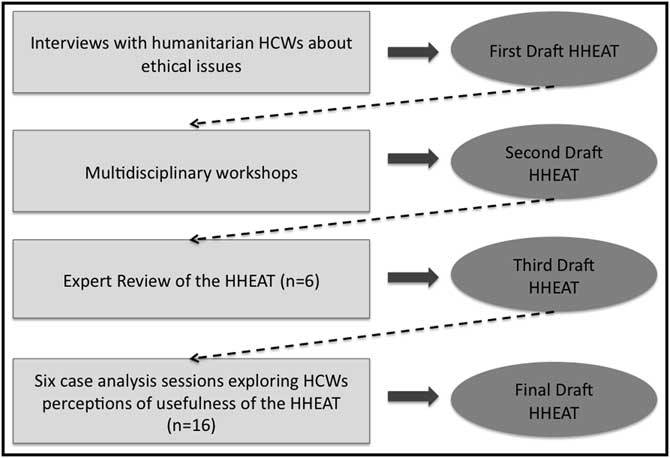
Early iterations of the tool were presented at several multidisciplinary workshops (attended by academics specializing in humanitarian health care aid, as well as staff from humanitarian aid organizations and front line HCWs) and in an article in Disasters. Reference Hunt 6 Feedback from these forums was used to refine the tool. The HHEAT was then presented to six reviewers with expertise in decision-making models and clinical ethics, public health ethics, and humanitarian medicine and nursing, who provided feedback on the structure and content of the tool, prompting further refinement (Figure 1).
Development of the HHEAT. Abbreviations: HCWs, heath care workers; HHEAT, Humanitarian Health Ethics Analysis Tool.

Methods
Design
A series of case-analysis sessions were conducted to explore perceptions of the usefulness of the HHEAT among HCWs. The use of small groups for case analysis is representative of the inter-professional, team-based approach to decision making in the field. These case-analysis sessions were inspired by focus group methodsReference Litosseliti 28 , Reference Morgan 29 and oriented by an interpretivist paradigm.Reference Denzin and Lincoln 30 Data sources in this project included: (1) observation of small groups of humanitarian HCWs as they discussed an ethical case study, and (2) questionnaires filled out by participants at the completion of the case study. The goal of the case-analysis sessions was to understand participant perceptions of the usefulness of the HHEAT for ethical decision making. Small group discussion sessions are well suited for facilitating an interaction in which participants can discuss the information and concerns they identify to be relevant.Reference Litosseliti 28 These sessions enabled researchers to observe how participants asked questions; identified values, beliefs, and moral arguments; and reached decisions.
Participants
Participants were licensed Canadian health care professionals, or humanitarian team coordinators or project leaders, with experience providing or organizing health-related services in global health settings. The field experiences of participants ranged from acute disaster or conflict response to providing development assistance in contexts of extreme poverty. Recruitment was initiated through investigator contacts and through university-based global health interest groups and programs; further recruitment occurred through snowball sampling. Participants were contacted by e-mail with an invitation including detailed information about the project and a consent form.
A total of 16 individuals participated in the case-analysis sessions: seven physicians, four nurses, two physiotherapists, and three coordinators (a logistician, a project-coordinator, and a head of mission). This sample is broadly representative of inter-professional humanitarian health care teams. Collectively, participants had worked with 17 nongovernmental organizations (NGOs) with an average field experience of 3.4 years spanning a range of five months to 11 years.
Data Collection
Case-analysis Groups
A total of six case-analysis sessions were held. Groups ranged in size from two to four participants, reflecting some of the diversity in the size of teams making decisions in the field. Prior to arriving for the small groups, participants in five groups were e-mailed a copy of the HHEAT and encouraged to familiarize themselves with it. One group did not receive the tool and was used as a point of comparison. Participants in this group were given the HHEAT only after the case-analysis sessions and then asked whether or not they thought that using the tool would have influenced the group’s deliberative process or final decision.
The two cases used for deliberation were based on actual events and reviewed for verisimilitude by the panel of experts who reviewed the HHEAT. One case was based on an emergency scenario in which a health care team had to decide whether to evacuate an acutely ill child in a context of extreme resource scarcity and security concerns. The other case concerned a health care team facing a decision on whether to implement a new treatment protocol for an endemic disease in a context in which a variety of factors contributed to a climate of local distrust towards the humanitarian NGO. The two cases are available in full at the Humanitarian Heath Ethics (Ontario, Canada) web site. 31 The use of two different scenarios allowed for comparison on whether different types of humanitarian field situations (one more acute and time sensitive than the other) impacted the use and evaluations of the HHEAT. A facilitator and note-taker were present for all sessions and each session was audio recorded. Groups were asked to examine the case study from the perspective of a field-based humanitarian team required to make a decision. Each group was given 30 minutes to discuss the case study, at the end of which they were asked to present a decision and rationale for the course of action selected.
Questionnaires
Following small group discussions, participants were asked to fill out a questionnaire describing their experience with the case analysis. Two questionnaires consisting of demographic and open-ended questions were designed, one for the five groups using the HHEAT, the other for the group without the HHEAT. Both questionnaires included questions related to: (1) demographic information and field experience; (2) impressions of group discussion and deliberation; and (3) perceptions of the usefulness of the HHEAT.
Data Analysis
Descriptive and thematic analyses were conducted of the small group audio recordings, questionnaires, and observational field notes. These data sources were analyzed using constant comparison techniques with the goal of identifying patterns and linkages between different data sources.Reference Thorne 32
Detailed observational notes were taken during the case-analysis session, and audio recordings were transcribed and later reviewed. Summaries of each case-analysis group were then generated based on transcripts and observational notes. These summaries noted the main discussion points, areas of dissent and consensus, and a general impression of the groups’ discussion and conclusions, including observations on the decision-making process and how participants engaged with the HHEAT. Two pairs of investigators (VF and MH, and SD and LS) each analyzed three case-analysis sessions. These analyses were then compared and discussed until consensus was achieved on the main patterns and linkages within the data. Two authors (VF and SD) conducted a second stage of analysis in which preliminary themes were explored in greater depth across all six case-analysis sessions. As part of this stage, areas of the tool that required improvement, alterations, additions, or removal were identified.
Triangulation of multiple data sources was used to enhance the rigor of the analysis, including observational field notes, audio recordings of small group discussion sessions, and questionnaires. For instance, questionnaires reporting that the HHEAT provided structure to ethical decision making were reinforced by field notes documenting participants checking the analysis tool, taking notes, and proceeding in a careful and systematic fashion and audio recordings of the dialogue surrounding ethical analysis with the use of the HHEAT.
This study was reviewed and approved by the McGill University Faculty of Medicine Institutional Review Board (Montreal, Quebec, Canada) and the McMaster/Hamilton Health Science Research Ethics Board (Hamilton, Ontario, Canada). All participants read and signed an informed consent form.
Results
Three key themes identified from the case-analysis sessions included participant perceptions of: (1) the usefulness of the HHEAT for ethical deliberation; (2) potential opportunities to use the HHEAT; and (3) general observations on ethics in humanitarian health care aid.
The Usefulness of the HHEAT for Ethical Deliberation
Participants noted benefits and limitations of the HHEAT in facilitating ethical deliberation. The majority of participants (14/16) agreed that they would use the HHEAT in the future. As one participant put it: “A framework to guide difficult decision making is potentially useful. It keeps everyone on the same page” (FG1 Questionnaire). Participants suggested that the HHEAT ensures comprehensiveness, structures decision making, clarifies thinking and assumptions, and promotes rational decision making.
Ensure Comprehensiveness
Participants believed the HHEAT brought to light issues and concerns which otherwise might have remained overlooked, thereby ensuring a more inclusive and thorough decision-making process:
Make sure we don’t forget any important information (FG1 Questionnaire).
Think more of different resources, people, consequences. More comprehensive approach (FG6 Questionnaire).
Structures Decision Making
Some participants expressed that using the HHEAT contributed to a more organized discussion:
Provided structure and prevented jumping to conclusions/decisions (FG2 Questionnaire).
All participants reported being satisfied or very satisfied with the decision made, including the group who deliberated without the HHEAT. Although participants in this group did not believe that using the HHEAT would have changed their final decision, some noted that using the HHEAT may have led to a more organized decision-making process:
I am not sure that the outcome would have been any different. I think we touched on several of these topics; but with the model, our discussion may have been more fleshed out/detailed. The process certainly would have been more organized (FG3 Questionnaire).
Clarifies Thinking and Assumptions
Some participants noted that using the HHEAT clarified values and assumptions by rendering them more explicit and transparent:
Yeah… at the individual level, you can have various interpretations of what a value is; what humanity means; or what autonomy means; so if you have core principles it is a good start; but this kind of model allows you to make clearer your thinking and your understanding of these issues…I am very happy to know about this model (FG2 Recording).
Promotes Rational Decision Making
Participants reported that using the HHEAT might help ensure a more well-reasoned, less emotional decision-making process. One participant stated that this might particularly be important given the potential for interpersonal issues and team dynamics to affect decisions:
It allows a group of individuals with potentially differing opinions to focus on the issue in a constructive way instead of emotionally (FG2 Questionnaire).
Participants also noted several challenges and limitations with using the tool, including that the HHEAT was too long and time consuming, was dense and difficult to follow, was not suited to all organizational cultures, and the word “ethics” might discourage usage.
Too Long and Time Consuming
The majority of participants felt that the 8-card version of the HHEAT was lengthy and required too much time to work through:
Too many things for our allocated time… In this particular case, we would have had max. 10-15 minutes to make a decision (FG1 Questionnaire).
In “real life,” I don’t know if people would consider to go through 8 cards (FG3 Questionnaire).
Dense and Difficult to Follow
Many participants suggested that the tool was complex and hard to follow. This was reflected both in specific comments and in suggestions for improvement, many of which recommended simplifying the tool:
Needs to be very simple- with minimal writing on the actual cards so it’s easy to use (FG6 Questionnaire).
Simplify it for on-the-spot decisions. Produce a small work flow chart of questions. Half a page maximum (FG3 Questionnaire).
Not Suited to All Organizational Cultures
Participants suggested that the tool might not be applicable to all organizations, which differ with respect to organizational culture, values, and priorities. One participant felt that the tool may not readily be adopted or applied by all humanitarian workers:
I don’t know if people on the ground will sit down and use it… I don’t know if the big guy with the beard and the cigarette would use it… it might be useful to use in a training workshop or when you are in a stressful situation and need to calm down… but I don’t know if it would be useful with people I work with often. It is a lot of text… I don’t know (FG3 Recording).
The Word “Ethics” Might Discourage Usage
Participants reflected that the name “Humanitarian Health Ethics Analysis Tool” might limit the use of the tool by clinicians more inclined to view the situation pragmatically:
I have a feeling that the word ethics narrows the possible use of this model. And maybe some people would consider that they are not facing an ethical issue. But still they would. Or maybe it would be needed to use the model even though it is not an ethical issue at first (FG2 Recording).
One participant noted that it would be interesting to see whether variations in the understanding of the word “ethics” lead to “false positives” and greater use of the tool. Another noted that humanitarian workers may be intimidated by the use of the word “ethical” and be less likely to use the tool as a result.
Potential Opportunities to Use the HHEAT
Participants highlighted different forums in which they thought the HHEAT might especially be applicable and/or helpful to decision makers: pre-departure training sessions, retrospective debriefing sessions, and long-term development work and opening/closing projects.
Pre-departure Training Sessions
Many participants brought up the importance of prior training in the HHEAT as integral to ensuring use in the field. Most cited pre-departure training sessions, typically a series of short training sessions offered by humanitarian organizations before sending clinicians overseas, as an ideal venue for this training:
Very helpful in pre-departure training for all health professionals (FG6 Questionnaire).
Some noted that including the HHEAT in pre-departure training would raise awareness about the types of ethical scenarios that may arise in the field:
Good tool to use in pre-departure training to at least be aware of the situations, to think about (FG6 Questionnaire).
Others felt that clinicians with prior familiarity and training in the HHEAT would be more likely to use it:
I would think that it would be useful to have a training including this tool, this model. Because when you are in the field, you don’t, especially in humanitarian contexts, you don’t take time to read this kind of document. Sometimes you can, sometimes you don’t, and you are pressed by the time, pressed by people. So I think as a pre-training, it would be very useful and having it as a, as something physically available, like cards, would be an additional thing to do, I mean to provide after the training (FG2 Recording).
Retrospective Debriefing Sessions
A few participants suggested that the HHEAT might be useful for retrospective debriefing of cases in which decision making is difficult, controversial, or emotionally charged:
In my case, there was no ethics training at all. And then, there were some cases when I was left out of decisions… it might have helped to have something to go back to. Because it makes it hard to work with people again. Even as a follow up kind of thing, regardless of whether you have had training before, maybe as a debrief (FG3 Recording).
Another participant believed using the HHEAT as a debriefing tool might prove a valuable learning experience:
Can kind of look back and say what we would do differently as a team (FG1 Recording).
Development Projects and Opening Closing Projects
Some participants suggested that the HHEAT might be more relevant in long-term aid scenarios or development projects, and/or discussions surrounding the ethics of opening and closing projects:
When I read it, the thing that keeps popping up is ethics, ethics, ethics, and this makes me think long term… In my personal opinion, you need to think of these things before you get on the ground (FG3 Questionnaire).
General Observations on Ethics in Humanitarian Health Care Aid
The case-analysis sessions offered some insight into the ethical decision-making process of participants. Throughout the case-analysis session, participants discussed: identifying ethical issues; identifying values, norms, and principles; and identifying the “real” ethics issues.
Identifying Ethical Issues
Some participants found it difficult to identify what constituted an ethical issue. For example, one group spent time at the beginning of the discussion debating whether the central problem in the scenario was “ethical” or “pragmatic” before concluding by describing the scenario and their decision as “quasi ethical” (FG2 Recording). Some participants were explicit about their uncertainty in identifying ethical issues:
I don’t know if people know what ethical issues and values are or how to identify them (FG 5 Recording).
What are we supposed to be saying in answer to that question? What are the ethical issues (FG 1 Recording)?
Identifying Values, Norms, and Principles
Many participants struggled when prompted by the HHEAT to reflect on the salient ethical aspects of a case scenario. For example, when asked to identify the moral principles and values at stake in the case, a participant responded: “You mean like saving lives?” (FG1 Recording). Participants in a different group discussed ethical themes such as: colonialism, power differentials, hegemony of western medicine, and obligations to local communities, but struggled when asked to frame these in terms of ethical argumentation and to use “ethics” language of principles and values.
Two participants categorized the unfamiliarity with ethics somewhat negatively, suggesting that this emphasis was unnecessary and the tool could be improved by omitting such analysis altogether:
Hard to differentiate between ethical issues, values, principle – unhelpful – to know (FG5 Questionnaire).
A couple of participants linked the uncertainty surrounding using ethical concepts to a lack of ethics education:
This is where my academia lets me down a little in terms of being able to identify ethical values (FG6 Recording).
Identifying the “Real” Ethics Issues
Participants spontaneously discussed what they felt were the most important ethical issues arising in humanitarian health work. While most felt that the ethical themes brought up in the case studies resonated with their experience, some participants noted that the ethical concerns that preoccupied them most related to broader, more systemic questions relating to the value of humanitarian aid:
Is this project even accomplishing what you set out to accomplish? Sometimes (the) team seems so cut off from the reality on the ground… Disconnected from the reality of the people (FG1 Recording).
…The big question, is this helping anyone? The last job I did with…. was a terrible project. I quit, it is the only time I have ever quit anything. No one in that organization would even address this kind of question. Tough to go there (FG1 Recording).
Some of the specific ethical concerns raised by participants included: long term impacts of aid organizations and questions of sustainability, misalignment of project goals with population needs, and differences in remuneration between foreign and national staff, amongst others.
Discussion
This study generated preliminary insight into the perceived usefulness of an analysis tool for addressing ethical issues in low-resource humanitarian health contexts. Such evidence increasingly is relevant as ethical analysis tools are developed and promoted for use in a variety of contexts. Clarinval and Biller-AndornoReference Clarinval and Biller-Adorno 5 recently published an ethical framework to assist humanitarians in decision making. This framework focuses on humanitarian values, provides a decision-making process, and includes a component on institutional requirements for ethical deliberation, making it particularly well-suited for meso- and macro-level deliberations. Different analysis tools vary in terms of length, level of detail, areas of emphasis, and theoretical orientation, and may be better suited to certain contexts than others. Further research should be undertaken to explore the impact of different tools on ethical deliberation.
Study results highlighted the ways in which experienced humanitarian HCWs perceive the role and value of ethical deliberation in their practice and brought to light suggestions for the types of organizational ethics training and support humanitarians may find helpful in order to better negotiate ethical issues. Participant feedback on the benefits and limitations of the tool prompted further development and refinement of the HHEAT.
Perceptions of Ethics Among Humanitarian Aid Workers
There is some evidence to suggest a tendency among humanitarians to view ethical issues as geopolitical or management problems, as opposed to moral ones.Reference Clarinval and Biller-Adorno 5 This study supports these findings, with participants voicing varied, and at times, contradictory perceptions of the value and role of ethics in humanitarian work. Participants in all groups found it difficult to identify relevant ethical issues and struggled when asked to discuss ethical values, norms, and principles. Very few participants made reference, for example, to the humanitarian imperative or other humanitarian principles, professional codes of ethics, principles of medical or public health ethics, or other elements of moral philosophy.Reference Hunt 6 This is perhaps unsurprising given that several participants reported a lack of formal ethics education. There was also a tendency among participants to differentiate between “pragmatic” and “ethical” problems and to address the issues arising in the case studies as pragmatic problems to be solved.
While a comprehensive discussion of the merits of defining the nature and scope of ethical issues is beyond the scope of this report, it may be argued that differentiating ethical issues from non-ethical issues, such as clinical standards, prudential issues, or legal claims, has important implications because it helps clarify the nature of the choice that is being faced,Reference Burnor and Raley 33 as well as existing resources for resolving them. Although it may not always be possible to separate these considerations, it is important to do so, where possible, because identifying an ethical issue allows one to deliberate, judge, and accept moral responsibility. Failure to identify the ethical dimensions of a decision may have the (often unintended) consequence of inadequately considering and accounting for the reasons behind a given choice, including the values, principles, and beliefs which account for an action being considered good or bad, right or wrong. This moral justification and accountability is essential to “humanitarian judgment,” 15 especially in contexts where scarce resources need to be distributed fairly and equitably. 15 , 21 Interestingly, a minority of participants suggested that the very word “ethics” might limit the use of the tool among HCWs who may be more inclined to see the practical and clinical side of a problem. Among other things, the ambiguity espoused by many participants regarding the role of ethics in decision making, as well as participants’ uncertainty in identifying ethical issues and values, indicates the need for greater organizational support and training on the nature and role of ethical decision making in humanitarian health work.
A separate issue to emerge from the case-analysis sessions was the apparent paradox between participants’ desire for a simplified ethics analysis tool on the one hand and acknowledgment of a lack of ethics knowledge and training on the other. None of the participants had ever used an ethics analysis tool and few had any training in humanitarian or biomedical ethics, a finding that is consistent with other research.Reference Hunt, Schwartz and Elit 1 , Reference Clarinval and Biller-Adorno 5 It bears emphasizing that participants suggested the need for a shorter and more concise tool irrespective of the case under discussion. Although one case involved an acute emergency situation requiring a time-sensitive decision, the other centered on a long-term, post-conflict resolution project with greater latitude for discussion and deliberation. It is possible that requests for a simplified version of the HHEAT, in part, reflects participants’ perceptions that the initial format of the tool was overly detailed and/or difficult to follow.
Another possible explanation for the preference for a very short and concise tool may be what has been described elsewhere as the pervasive acceptance in emergency medicine of the need to operate within the constructs of an “ideology of scarcity” in which emergency responders come to value and are rewarded for quick problem solving and efficient processing strategies.Reference Rodney, Pauly and Burgess 34 Humanitarian medicine has also been associated with the “normalization of emergency,” in which humanitarian agency culture comes to support approaches to non-emergency situations with an emergency mentality.Reference Hilhorst and Schmiemann 35 Acting in this manner when the situation does not warrant it may limit approaches in the field by generating decisions that are thought through poorly. Greater organizational ethics training and support may help sensitize HCWs to this possibility and provide them with the resources they need in order to make complex decisions in a more comprehensive, systematic, and thoughtful way.
Organizational Support and Ethics Training
Few health care aid organizations offer specialized ethics training for HCWs, counting instead on the professionalism of clinicians and professional codes of ethics to provide guidance.Reference Schwartz, Sinding and Hunt 14 However, as noted in the previous section, uncertainty among participants about the nature and scope of ethics in decision making may suggest that this approach is insufficient and may point to a need for more robust organizational support and ethics training. It is worth noting that almost all of the participants in this study reported having experienced similar ethical issues to those presented in the case studies for analysis, and many also reported struggling with more existential questions relating to the inherent moral value of humanitarian aid itself. The case-analysis sessions provide preliminary insight into some of the forums HCWs identified as potentially being helpful in preparing them to better engage with ethical issues. The organizational opportunities identified by participants included using an ethical analysis tool, such as the HHEAT, in pre-departure training and retrospective debriefing sessions.
With respect to pre-departure training, participants suggested that training on the HHEAT would ensure better knowledge and understanding of the tool and promote more effective uptake in the field. Examining the role pre-departure training might have on the future uptake of an ethics analysis tool is an area for further inquiry. Using the HHEAT in pre-departure training sessions may serve as a useful springboard to introduce other important features of ethical analysis in a simple and straightforward manner. Analysis tools are used increasingly in health care curricula to introduce students to the core components of ethical deliberation. Introducing an ethical analysis tool into pre-departure training has the potential to familiarize humanitarian HCWs with how to identify ethical issues and values, weigh benefits and burdens, and promote accountability and transparency in decision making.Reference Derenzo and Strauss 36 Pre-departure training also provides an opportunity to familiarize HCWs with existing resources (for instance, codes of ethics and policies) that can help inform decision making.
Participants also identified pre-departure training as relevant given the acuity and time-sensitive nature of decision making in the field. Some participants suggested that this reality made prior contemplation of frequently encountered moral issues necessary. It is worth noting that many of the ethical questions practitioners struggle with – Does aid do more harm than good? Should the good of the many trump the needs of a few? – are not new to humanitarianism,Reference Barnett 7 or moral philosophy for that matter. Contemplating some of these issues, and the varied responses and discussions surrounding them (whether in the literature, in the guidelines of NGOs, or in discussion with respected colleagues) before being confronted with them directly, may help practitioners feel better prepared when it comes time to face them in practice. As Hugo Slim has pointed out: “A moral position which does not gloss over difficulties but sets out a clear and acceptable moral vision within such difficulties, can make a great contribution to the morale of the helpers and the helped in any situation.”Reference Slim 37 A greater emphasis on ethical engagement and analysis in pre-departure training courses may contribute to generating and promoting this moral vision and clarity; ethical analysis tools may be one step in facilitating this learning process.
Participants also suggested that the HHEAT might be useful in retrospective debriefing sessions. Retrospective review of cases may be helpful when moral issues reoccur or when the outcomes of a decision are unsatisfactory. DeRenzo and StraussReference Derenzo and Strauss 36 argue that following up on ethical decisions in a comprehensive and structured manner may reduce the likelihood that mistakes are repeated and ensure that future outcomes are improved. Ethics debriefing sessions are also an opportunity for inter-professional collaboration and are a platform for HCWs to cope with moral distress and compassion fatigue.Reference Santiago and Abdool 38 By facilitating a comprehensive discussion of difficult cases, ethics debriefing may also help mitigate feelings of frustration, isolation, anxiety, and moral angst.Reference Santiago and Abdool 38 For instance, retrospective debriefing using an analysis tool such as the HHEAT may help address feelings of moral distress or uncertainty by ensuring that decisions are scrutinized with the aim of improving patient care and/or organizational policy, as well as fostering a proactive approach to avoiding or addressing similar ethical issues in the future. Participants suggested that retrospective debriefing using the HHEAT might especially prove beneficial in humanitarian contexts characterized by high rates of expatriate staff turnover. By “getting everyone on the same page” (FG1 Questionnaire), and potentially providing a written record of arguments supporting a decision, retrospective team-based review of significant moral decisions may improve inter-professional practice, organizational memory, and project continuity.
Refinement of the HHEAT Based on Participant Feedback
In spite of constructive criticism of the original format of the tool, and the reservations expressed towards ethics more generally, the majority of participants agreed that the HHEAT is something they would use in the future. Clarinval and Biller-AndornoReference Clarinval and Biller-Adorno 5 report similar consensus among humanitarian aid workers and donor agencies that tested their ethical framework. This study supports the theoretical consensus in the ethics literature that ethics analysis tools facilitate ethical deliberation by promoting systematic and comprehensive analysis of moral problems.Reference Oberle and Raffin-Bouchal 23 , Reference Cottone and Claus 39 Participants found the HHEAT fostered a more comprehensive approach to decision making by enabling identification of concerns that might otherwise have been overlooked, including identification and discussion of resource availability, stakeholder involvement, and identification of the consequences associated with various courses of action. Deliberation using the tool was also helpful in making value assumptions and beliefs more explicit, which participants suggested added clarity and transparency to the discussion.
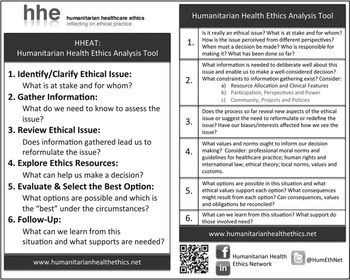
Participants were near unanimous in their preference for a simplified version of the HHEAT. Suggestions for improvement included: using less text, including bullet points, and shortening the tool. Balancing the level of detail and substantive content with practical utility is one of the challenges facing all analysis tools. If, as many authors note, a primary benefit of analysis tools lies in promoting comprehensive deliberation and discussion,Reference Cottone and Claus 39 then a tool is only as successful as the step-by-step deliberation it helps facilitate. The tool was shortened from eight to two cue-card-sized cards (Figure 2), and a 35-page handbook was created to accompany the tool (available at the Humanitarian Heath Ethics web site 31 ). The handbook provides detailed instructions on how to use the HHEAT, as well as a short synopsis of relevant moral concepts and theories. The aim of this design is to ensure that HCWs have access to an ethics analysis tool that is simple and easy to use, while simultaneously providing access to a resource with more detailed information and guidance for practitioners when time permits.
Humanitarian Health Ethics Analysis Tool.

Limitations
It bears emphasizing that this study was not designed to investigate whether using different ethics analysis tools yields different processes or outcomes. Nor did this study critically evaluate the final decision made by participants for ethical value or moral argumentation. A cross-over design in which comparison is made between the HHEAT and other ethics analysis tools, or no tool, is an area for future study. Furthermore, case-analysis sessions were conducted in a safe university environment, among participants who had never worked together. This is greatly removed from the realities of humanitarian health care practice and represents an abstract exercise. Future research is being planned to test the use of the HHEAT in the field. Participants were all Canadian HCWs and perceptions of the HHEAT may not be generalizable to all health professionals participating in humanitarian health work. Limitations of case-analysis sessions include the possibility of the emergence of a false consensus wherein the opinions of strong personalities in the group overshadow the views of those who are more reserved.Reference Litosseliti 28 Questionnaires provided an opportunity to offset this by allowing participants to express individual opinions and respond to specific questions. While questionnaires are subject to the limits of self-report, including the risk that participants may say what they think the researchers want to hear, efforts were made to mitigate this by reminding participants that researchers were seeking honest responses and that anonymity would be protected.
Conclusion
The process of refining the HHEAT through a series of six case-analysis sessions generated preliminary insight into perceptions of ethics analysis tools and ethical deliberation within humanitarian health care contexts. Participants believed that using the HHEAT supported comprehensive, rational, and transparent decision making. Case-analysis sessions drew attention to the need for greater organizational support and ethics training. Participants suggested pre-departure training with the HHEAT would promote more effective use of the tool in the field and contribute to the recognition of common ethical issues arising in humanitarian health care contexts. Most participants had little or no training in humanitarian and biomedical ethics, and pre-departure training might prove a valuable opportunity to introduce humanitarian aid workers to relevant moral theory and resources. Participants also suggested the HHEAT may be helpful in retrospective debriefings sessions, especially after decisions which are emotionally charged, or in situations in which outcomes did not meet with intentions. Promoting structured ethics debriefing with the use of an ethics analysis tool may help mitigate feelings of moral distress and ensure that there is an opportunity to learn from past decisions. Based on participant feedback, the HHEAT was simplified and shortened and a handbook was developed to accompany the tool.