Introduction
Entrepreneurial leadership (EL) has attracted much attention in entrepreneurship and management literature (Fernald, Solomon, & Tarabishy, Reference Fernald, Solomon and Tarabishy2005; Leitch & Volery, Reference Leitch and Volery2017; Sundararajan, Sundararajan, & Henderson, Reference Sundararajan, Sundararajan and Henderson2012; Vecchio, Reference Vecchio2003). EL is an emerging leadership style that mobilizes employees to follow the entrepreneurial vision, leads the organization to explore and develop opportunities, and ultimately turns them into value creation (Gupta, MacMillan, & Surie, Reference Gupta, MacMillan and Surie2004). Compared with other leadership styles, EL reflects the leadership process of achieving successful entrepreneurship and highlights the core characteristics of opportunity identification and development (Renko, El Tarabishy, Carsrud, & Brännback, Reference Renko, El Tarabishy, Carsrud and Brännback2015). The effectiveness of EL in enterprise development has been widely recognized by scholars. Leadership effectiveness refers to the extent where the organization led by an executive can successfully complete work and achieve goals (Fiedler & Garcia, Reference Fiedler and Garcia1987), which is the behavior ability, work status and work results of an organization shown in leadership process to accomplish challenges. By building a constructive vision to gain followers’ approval and support, creating a positive atmosphere to stimulate them to innovate and entrepreneurship, EL can effectively enhance organizational competitiveness to cope with the uncertain environment and achieve sustainable development of the organization (Chen, Zhu, & Mao, Reference Chen, Zhu and Mao2017; Mishra & Misra, Reference Mishra and Misra2017).
Despite many studies recognizing the beneficial effect of EL on effectiveness outcomes, the empirical results are mixed and inconsistent because of multiple levels of leadership effectiveness and varied correlation coefficients, so that the form and strength of the relationship between EL and effectiveness outcomes remain unclear. On the one hand, leadership effectiveness involves the outcomes of leadership playing roles at the organizational, team and individual levels, which leads to complex and mixed research on the different-level effectiveness of EL. For example, Huang, Ding, and Chen (Reference Huang, Ding and Chen2014) found that EL positively affects the performance of Chinese start-ups. According to Bagheri (Reference Bagheri2017), EL has a beneficial impact on employees’ innovation and opportunity identification in high-tech small and medium enterprises. Cai, Lysova, Khapova, and Bossink (Reference Cai, Lysova, Khapova and Bossink2019) also pointed out the positive influence of EL on team creativity and employee creativity. On the other hand, existing studies have a large gap in the correlation between EL and effectiveness outcomes with coefficients being weak in some cases and strong in others. For instance, Park, Hu, Wu, and Hooke (Reference Park, Hu, Wu and Hooke2014) found the negative connection between EL and team innovation. Some research reflects that EL highly relates to organizational performance or employee innovation behavior (e.g., Liu, Zhang, & Zhou, Reference Liu, Zhang and Zhou2018; Mgeni, Reference Mgeni2015), whereas other studies show a low correlation between EL and these two outcomes (e.g., Al Mamun, Ibrahim, Yusoff, & Fazal, Reference Al Mamun, Ibrahim, Yusoff and Fazal2018; Chen, Reference Chen2015). The above confused findings and heterogeneous correlations across studies indicate that such relationship is likely to be affected by some factors. However, no systematic attempt has been made to summarize these findings to analyze the link between EL and effectiveness outcomes from multiple levels, and to clarify the moderators of this relationship.
To address the variability and fragmentation of the research on the effectiveness of EL, it is necessary to employ a meta-analysis approach to comprehensively evaluate the form and strength of the relationship between EL and effectiveness outcomes by synthesizing related empirical research evidence. In doing so, this study systematically investigates and determines the association of EL with effectiveness outcomes from multiple levels to comb the mixed results, and further searches for contextual and methodological moderators influencing this relationship to explain the heterogeneous findings in the literature. Based on the quantitative literature and meta-analysis technique, this study aims to clarify the relationship between EL and different-level effectiveness outcomes, and identify the boundary conditions of this relationship, thus providing a more systematic and evidence-based review of the multilevel effectiveness of EL. This endeavor can reveal the research status and raise knowledge in the effectiveness of EL, as well as contribute to leadership reform and enterprise benefit improvement in the context of entrepreneurship and innovation.
Theory and hypotheses
Entrepreneurial leadership
The concept of EL stems from the leadership practice of small and medium-sized emerging enterprises in the rise of venture capital in business world, as well as the urgent demand of all organizations, including large enterprises, for a new entrepreneurial-oriented leadership pattern due to the turbulent competitive environment (Harrison, Paul, & Burnard, Reference Harrison, Paul and Burnard2016). Many scholars focus on interpreting this concept and try to analyze the core competence and behavioral characteristics of EL. Through semi-structured in-depth interviews, life history studies or case studies, they explored the connotation of EL from different perspectives and situations. Specifically, this refers to the female perspective (Dean & Ford, Reference Dean and Ford2017; Henry, Foss, Fayolle, Walker, & Duffy, Reference Henry, Foss, Fayolle, Walker and Duffy2015), relationship perspective (Leitch, McMullan, & Harrison, Reference Leitch, McMullan and Harrison2013), process perspective (Sklaveniti, Reference Sklaveniti2017), university entrepreneurship education context (Bagheri & Pihie, Reference Bagheri and Pihie2011; Bagheri, Pihie, & Krauss, Reference Bagheri, Pihie and Krauss2013) and high-tech or small and medium-sized organization context (Simba & Thai, Reference Simba and Thai2019; Swiercz & Lydon, Reference Swiercz and Lydon2002).
Despite a lot of research on the concept of EL, the diversity of research perspectives and situations has led to a lack of consensus on a precise definition (Leitch, McMullan, & Harrison, Reference Leitch, McMullan and Harrison2013). In general, the current definition of EL is categorized into the following two views. The ability view, regards EL as the capability traits of entrepreneurs, mainly including vision building, risk taking, innovation pursuit and opportunity development (Cogliser & Brigham, Reference Cogliser and Brigham2004; Kuratko, Reference Kuratko2007). Ireland, Hitt, and Sirmon (Reference Ireland, Hitt and Sirmon2003) defined EL as the ability to strategically manage resources by influencing others, especially in terms of opportunity seeking and advantage searching. The behavior view, regards EL as the behavior process of leaders in entrepreneurship, that is, leaders stimulate subordinates’ intrinsic motivation, guide organizations to identify and develop opportunities and ultimately transform them into value creation (Gupta, MacMillan, & Surie, Reference Gupta, MacMillan and Surie2004; Roomi & Harrison, Reference Roomi and Harrison2011). The representative definition was proposed by Gupta, MacMillan, and Surie (Reference Gupta, MacMillan and Surie2004), who described EL as a leadership way to mobilize the support and participation of subordinates through creating a vision, and make them committed to exploring and realizing the strategic value of the organization. Renko et al. (Reference Renko, El Tarabishy, Carsrud and Brännback2015) further asserted that EL guides and influences the behavior and performance of members to achieve organizational goals that involve recognizing and utilizing entrepreneurial opportunities.
Based on the above views, we argue that EL is a combination of leadership behaviors and abilities, which can direct organizational members to continuously change and innovate, realize organizational entrepreneurship vision and value creation by opportunity identification and exploitation, so as to effectively cope with highly uncertain environment and achieve sustainable development of the organization. The uniqueness of EL lies in the orientation of strategic entrepreneurship and the emphasis on opportunity development, such leaders can be entrepreneurs and managers of new ventures, or general managers trying to transform enterprises through entrepreneurial activities in the changing market (Cardon, Wincent, Singh, & Drnovsek, Reference Cardon, Wincent, Singh and Drnovsek2009; Renko et al., Reference Renko, El Tarabishy, Carsrud and Brännback2015).
Multilevel effectiveness of EL
The connotation of EL reflects the essence of its influence on effectiveness at the individual, team and organizational levels. Leadership effectiveness is regarded as a multidimensional construct with multiple measurement indicators (Judge, Piccolo, & Ilies, Reference Judge, Piccolo and Ilies2004). Derue, Nahrgang, Wellman, and Humphrey (Reference Derue, Nahrgang, Wellman and Humphrey2011) provided a comprehensive interpretation of leadership effectiveness, which covers the following aspects: the evaluation sources of leadership effectiveness, such as satisfaction with leaders or performance; the forms of leadership effectiveness, such as attitudes and behaviors; the levels of leadership effectiveness, such as individuals, teams and organizations. Accordingly, we select performance, behaviors and attitudes at the organizational, team and individual levels as the measurement indicators of leadership effectiveness. Based on the existing empirical literature, we classify the effectiveness outcomes of EL at the organizational, team and individual levels, and only discuss variables with high attention and consistent concept to meet the requirements of meta-analysis approach, while ensuring the universality of the relationship between EL and effectiveness outcomes.
Organizational effectiveness of EL. The impact of EL on organizational effectiveness focuses on the two multidimensional constructs, entrepreneurial performance and organizational performance. Compared with organizational performance referring to the financial and non-financial performance (e.g., innovation performance) related to the achievement of organizational goals, entrepreneurial performance involves the outcomes of start-ups in operation and growth (Wiklund & Shepherd, Reference Wiklund and Shepherd2005). Considering the limited resources and the dynamic environment, how to effectively and flexibly use scarce resources is crucial to the growth of new ventures (Ensley, Pearce, & Hmieleski, Reference Ensley, Pearce and Hmieleski2006). EL is an important driving factor for new ventures to continuously acquire competitive advantages and strategic value, which improves their strategic flexibility and then plays a promoting role in good performance of new ventures (Zhang & Ding, Reference Zhang and Ding2016). According to strategic entrepreneurship theory (Ireland, Hitt, & Sirmon, Reference Ireland, Hitt and Sirmon2003), EL can affect the wealth creation of start-ups by strategic resource management. Through effective allocation and flexible application of resources, EL not only influences start-ups to make full use of extant resources to maintain competitive advantages, but also encourages them to explore new knowledge and opportunities, thus stimulating exploitative and exploratory innovation that contribute to the short-term performance and long-term benefits of new ventures (Chen, Zhu, & Mao, Reference Chen, Zhu and Mao2017; Huang, Ding, & Chen, Reference Huang, Ding and Chen2014).
In fact, apart from start-ups, EL exists in organizations of different types, sizes and stages, influencing and guiding members to attain organizational goals and performance (Renko et al., Reference Renko, El Tarabishy, Carsrud and Brännback2015). Previous studies have confirmed the positive effect of EL on organizational performance in small and medium-sized enterprises (Mgeni, Reference Mgeni2015), micro-enterprises (Al Mamun et al., Reference Al Mamun, Ibrahim, Yusoff and Fazal2018) and mergers and acquisitions (Strobl, Bauer, & Matzler, Reference Strobl, Bauer and Matzler2020). From the perspective of resource-based view regarding organizational resources as the key driver of superior performance, EL manages resources strategically, and then applies creativity and develops innovation to strengthen organizational competencies for wealth creation (Covin & Slevin, Reference Covin, Slevin, Hitt, Ireland, Camp and Sexton2002), which exerts a beneficial influence on organizational performance and sustainability (Al Mamun et al., Reference Al Mamun, Ibrahim, Yusoff and Fazal2018; Sawaean & Ali, Reference Sawaean and Ali2020; Supartha & Saraswaty, Reference Supartha and Saraswaty2019). Given the links between EL and entrepreneurial performance and organizational performance, we offer the following hypotheses:
Hypothesis 1a: EL has a positive effect on entrepreneurial performance.
Hypothesis 1b: EL has a positive effect on organizational performance.
Team effectiveness of EL. Team creativity and team performance are effectiveness outcomes of EL at the team level. Team creativity is defined as the joint efforts of team members to develop and produce novel and useful designs, products and processes (Cai et al., Reference Cai, Lysova, Khapova and Bossink2019), whereas team performance refers to the effective results of team members’ cooperation (Miao, Eva, Newman, & Cooper, Reference Miao, Eva, Newman and Cooper2019). With the flexibility of organization and the simplification of process, enterprises tend to carry out activities in the form of teams, which improves the communication efficiency and work quality. EL pursues innovation to develop entrepreneurial opportunities so that it focuses on inspiring employees to work together toward collective creation (Gupta, MacMillan, & Surie, Reference Gupta, MacMillan and Surie2004), which leads to team collaboration for creative outcomes (Chen, Reference Chen2007). Specifically, EL encourages teams to challenge, change and innovate, motivates them to set higher standards for creative achievements and entrepreneurial goals (Ruvio, Rosenblatt, & Hertz-Lazarowitz, Reference Ruvio, Rosenblatt and Hertz-Lazarowitz2010), which triggers exploratory activities and promotes strong creativity in teams (Cai et al., Reference Cai, Lysova, Khapova and Bossink2019). In this process, as the change agent and facilitator, EL helps teams integrate and coordinate, constantly explore new opportunities and make creative solutions to problems, thereby generating team creativity and innovativeness (Park et al., Reference Park, Hu, Wu and Hooke2014).
In addition, through communicating a constructive entrepreneurial vision, EL directs teams to recognize and take advantage of opportunities (Roomi & Harrison, Reference Roomi and Harrison2011), and further guides them to actively engage in related activities for higher achievements and performance goals (Renko et al., Reference Renko, El Tarabishy, Carsrud and Brännback2015; Ruvio, Rosenblatt, & Hertz-Lazarowitz, Reference Ruvio, Rosenblatt and Hertz-Lazarowitz2010). Moreover, according to social learning theory (Bandura, Reference Bandura1977), EL plays a role model that the opportunity-oriented behaviors such as initiative, innovation, goal setting and risk taking can serve as the objects of team learning, inspire members to proactively participate in innovation and entrepreneurship and finally produce better performance (Koryak, Mole, Lockett, Hayton, Ucbasaran, & Hodgkinson, Reference Koryak, Mole, Lockett, Hayton, Ucbasaran and Hodgkinson2015; Miao et al., Reference Miao, Eva, Newman and Cooper2019). Consequently, we posit that EL can significantly enhance team creativity and performance, and make the following hypotheses:
Hypothesis 2a: EL has a positive effect on team creativity.
Hypothesis 2b: EL has a positive effect on team performance.
Individual effectiveness of EL. EL plays an important role in employee behavior, ability and performance. Employee innovation behavior refers to individual employees creating and implementing new ideas to improve their tasks (De Jong & Den Hartog, Reference De Jong and Den Hartog2010), whereas employee creativity involves the generation of novel and useful thoughts, products and processes by individual employees (Anderson, Potočnik, & Zhou, Reference Anderson, Potočnik and Zhou2014). Employee performance can be viewed as the achieved output from employees’ efforts and abilities in the workplace (Sani, Ekowati, Wekke, & Idris, Reference Sani, Ekowati, Wekke and Idris2018). EL adapts to the uncertain environment, identifies new opportunities and leads continuous innovation and change, which can create an innovative atmosphere that encourages risk taking and emphasizes trust and support, driving employees to innovate and internalize such behavior into conscious action (Chen, Reference Chen2015; Liu, Zhang, & Zhou, Reference Liu, Zhang and Zhou2018; Newman, Neesham, Manville, & Tse, Reference Newman, Neesham, Manville and Tse2018). By enacting the role of framing challenges and absorbing uncertainty, in this innovative atmosphere, EL fully empowers employees to strengthen their job autonomy and self-efficacy, stimulate individual initiative and potential and trigger them to generate and implement new ideas (Bagheri, Reference Bagheri2017; Fontana & Musa, Reference Fontana and Musa2017). Besides, in the process, EL provides an organizational environment and structural system of sustainable innovation for individual creation, demonstrates the proactive and adventurous spirit to urge employees to focus on creative activities, take creative endeavors as their tasks, and then lead to stronger creativity (Cai et al., Reference Cai, Lysova, Khapova and Bossink2019; Guo, Gao, & Li, Reference Guo, Gao and Li2019). Moreover, with the inspiration and support of this leadership, employees are confident in their work and actively respond to opportunities or challenges, which can accomplish better performance (Miao et al., Reference Miao, Eva, Newman and Cooper2019; Sani et al., Reference Sani, Ekowati, Wekke and Idris2018). Based on the above discussion on the impact of EL on the innovation behavior, creativity and performance of individual employees, we provide the following hypotheses:
Hypothesis 3a: EL has a positive effect on employee innovation behavior.
Hypothesis 3b: EL has a positive effect on employee creativity.
Hypothesis 3c: EL has a positive effect on employee performance.
In addition to the influence on individual actions and performance, EL effectively affects employees’ work attitudes. Job satisfaction refers to the degree of pleasant and positive emotions from employees toward work environment such as salary, promotion opportunities, colleagues, management and work itself (Judge, Bono, Thoresen, & Patton, Reference Judge, Bono, Thoresen and Patton2001). Organizational commitment reflects employees’ sense of belonging, attachment, trust and loyalty to the organization (Supartha & Saraswaty, Reference Supartha and Saraswaty2019). As previously mentioned, EL empowers employees to build a platform for self-presentation and value realization with their work, and self-realization is directly related to their job satisfaction (Li, Li, Chen, & Wu, Reference Li, Li, Chen and Wu2014). Furthermore, as a positive emotional response, job satisfaction leads to a higher level of organizational commitment among employees (Yang, Pu, & Guan, Reference Yang, Pu and Guan2019). Building vision and commitment, as the major ability of EL, can inspire employees’ recognition and commitment to entrepreneurial vision and goals (Gupta, MacMillan, & Surie, Reference Gupta, MacMillan and Surie2004). Emotional contagion theory states that individuals and groups are infected by the emotions and attitudes of others (Schoenewolf, Reference Schoenewolf1990), and such emotional experience has spillover effect that can positively affect individual attitudes and behaviors (Hasford, Hardesty, & Kidwell, Reference Hasford, Hardesty and Kidwell2015). Accordingly, EL, the source of entrepreneurial emotion, influences organizational members in multiple directions and stages to form entrepreneurial consensus and mobilize entrepreneurial passion. Motivated by shared positive emotions and identity, employees will follow the behavior pattern of EL and develop a high degree of loyalty, belonging and attachment to the organization, thereby reinforcing their organizational commitment (Newman et al., Reference Newman, Neesham, Manville and Tse2018; Supartha & Saraswaty, Reference Supartha and Saraswaty2019). Therefore, we give the following hypotheses:
Hypothesis 3d: EL has a positive effect on employee job satisfaction.
Hypothesis 3e: EL has a positive effect on employee organizational commitment.
Moderators of the relationship between EL and effectiveness outcomes
The divergent empirical results on the effectiveness of EL drive to explore the factors resulting in the research differences, that is, potential moderators of the link between EL and effectiveness outcomes. In view of this, we comprehensively compared the literature content regarding the effectiveness of EL, and found the obvious differences in research context and method that may cause changes in this relationship. Specifically, the contextual and methodological moderators concentrate on cultural context, enterprise type and leadership measure among existing empirical studies, which represent various conditions that affect the direction and strength of the above relationship. Thus, we infer that cultural context (western culture vs. eastern culture), enterprise type (start-ups vs. incumbents) and EL measure (self-rated vs. other-rated) act as such moderators.
Cultural context. Research on the effectiveness of EL is based on different cultural backgrounds, including western culture (e.g., Fontana & Musa, Reference Fontana and Musa2017; Strobl, Bauer, & Matzler, Reference Strobl, Bauer and Matzler2020) and eastern culture (e.g., Sani et al., Reference Sani, Ekowati, Wekke and Idris2018; Yang, Pu, & Guan, Reference Yang, Pu and Guan2019). Western culture in Europe, North America and other countries advocates individualism and contract spirit, and emphasizes rational communication, whereas eastern culture in Asia and other regions pursues collectivism and harmony, and attaches importance to interpersonal communication and emotional connection (Barkema, Chen, George, Luo, & Tsui, Reference Barkema, Chen, George, Luo and Tsui2015; Hofstede, Reference Hofstede1980). In the context of western culture, individual goals are likely to conflict with collective goals, and employees may find it difficult to recognize the entrepreneurial vision and development goals set by EL, and fail to follow the innovative and entrepreneurial actions of leaders. However, in the context of eastern culture, employees value leadership authority with high dependence and obedience, take the interests of the organization as the priority, and are willing to maintain a good relationship with the organization (Tepper, Carr, Breaux, Geider, Hu, & Hua, Reference Tepper, Carr, Breaux, Geider, Hu and Hua2009). Thus, eastern culture is more conducive for EL to gain recognition, commitment and support from employees to achieve innovation and entrepreneurship goals. Based on this inference, we propose a hypothesis:
Hypothesis 4: Cultural context moderates the relationship between EL and effectiveness outcomes such that this relationship is stronger in eastern culture than in western culture.
Enterprise type. Among empirical studies on the effectiveness of EL, some take new ventures as research samples (e.g., Liu, Zhang, & Zhou, Reference Liu, Zhang and Zhou2018; Zhang & Ding, Reference Zhang and Ding2016), whereas some focus on incumbent enterprises (e.g., Cai et al., Reference Cai, Lysova, Khapova and Bossink2019; Park et al., Reference Park, Hu, Wu and Hooke2014). In the current highly uncertain environment, the types of enterprises, start-ups and incumbents represent different development stages of enterprises, which may affect the effectiveness of EL. Start-ups and incumbents differ greatly in resource endowment, market share and competitive ability. Abundant resources and capital enable incumbent enterprises to successfully grasp opportunities and cope with crises and challenges in the volatile marketplace. In contrast, the weakness of start-ups often leads to a series of challenges, such as entry barriers, market competition and resource scarcity, which can make start-ups vulnerable to growth dilemmas and risk of failure (Su, Xie, & Wang, Reference Su, Xie and Wang2015). EL is the key driver for the survival and development of start-ups in the dynamic and complex environment, where start-ups get access to entrepreneurial opportunities and derive competitive advantages through EL to fit with rapid changes and operate effectively (Chen, Reference Chen2007; Huang, Ding, & Chen, Reference Huang, Ding and Chen2014). Hence, the impact of EL on effectiveness outcomes in start-ups is more prominent than that in incumbents. According to the aforementioned discussion, we produce a hypothesis:
Hypothesis 5: Enterprise type moderates the relationship between EL and effectiveness outcomes such that this relationship is stronger in start-ups than in incumbents.
EL measure. The rating methods commonly used to measure EL in exiting studies concerning the effect of EL on effectiveness outcomes can be classified into two types: self-rated (e.g., Al Mamun et al., Reference Al Mamun, Ibrahim, Yusoff and Fazal2018; Hunter & Lean, Reference Hunter and Lean2014) and other-rated (e.g., Cai et al., Reference Cai, Lysova, Khapova and Bossink2019; Newman et al., Reference Newman, Neesham, Manville and Tse2018). The former refers to the assessment of EL by leaders themselves, and the latter refers to the assessment of this leadership by their employees. Considering that the self-rated method with the deviation of self-service and self-improvement is more subjective compared with the other-rated method (Stewart, Bing, Davison, Woehr, & McIntyre, Reference Stewart, Bing, Davison, Woehr and McIntyre2009), this study holds that the self-rated method leads to a stronger association between EL and effectiveness outcomes. Therefore, the strength of this link varies with the different measurement of EL. Following this, we generate a hypothesis:
Hypothesis 6: EL measure moderates the relationship between EL and effectiveness outcomes such that this relationship is stronger when EL is self-rated than when it is other-rated.
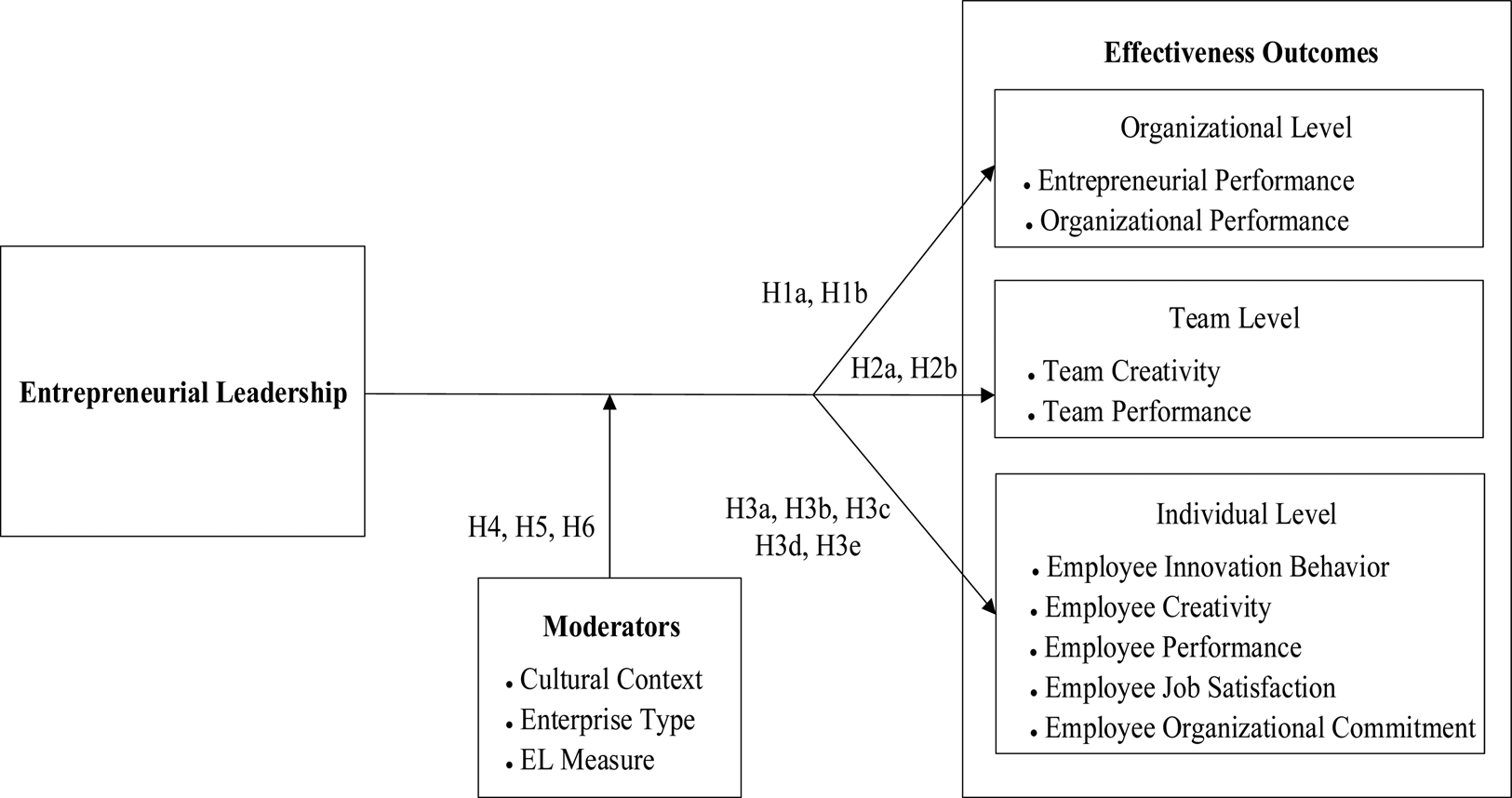
Based on all the hypotheses developed above, Figure 1 depicts an integrated framework for the effectiveness of EL at multiple levels.
Integrated framework of the multilevel effectiveness of EL.

Method
Literature search and inclusion criteria
To thoroughly collect studies on the effectiveness of EL, an extensive literature search for journal papers, conference papers and dissertations was conducted. We took entrepreneurial leadership, entrepreneurial leader or entrepreneurial leadership behavior as keywords to carry out the automatic search in databases such as Web of Science, ProQuest, Springer, Wiley, Google Scholar, Taylor & Francis, EBSCO and CNKI. Besides, to avoid missing important literature, we manually searched for articles from core journals and conferences in management and organizational behavior, and checked references to review or empirical articles of EL. The literature search was not limited to publication year, but only focused on English and Chinese articles. With the above search strategy, a preliminary collection of 257 articles was available as of June 2019.
The following inclusion criteria were set to filter searched studies for our research purpose and meta-analysis. First, studies need to be targeted at enterprises and adopt the quantitative or empirical approach. Second, the effectiveness outcomes of EL among studies should be within the common categories elaborated in our hypothesis section so that each research subset has a certain amount of literature for subsequent meta-analysis. Third, studies have to report the sample sizes and correlation coefficients between EL and effectiveness outcomes or other statistics that can be converted into effect sizes. Fourth, studies are ensured to be independent without overlapping samples. Finally, we obtained 35 independent samples from 35 eligible studies, with a total sample size of 7707.
Coding procedure
Each study was coded based on this information: author and publication year of the article; effectiveness outcome of EL; sample size of the research; variable reliability of EL and effectiveness outcome; correlation coefficient between EL and effectiveness outcome. Notably, as the effectiveness outcomes of EL in some studies were more refined, several outcome variables were appropriately classified following the above hypothesis section. Besides, three potential moderators in every study were also coded regarding cultural context, enterprise type and EL measure. Considering the country and its cultural background where each study was conducted, cultural context was classified into western culture and eastern culture. According to whether enterprises targeted by the study cover only new ventures or different growth stages, enterprise type was categorized into start-ups and incumbents. Depending on EL evaluated by whether leaders or subordinates, EL measure was coded as self-rated or other-rated.
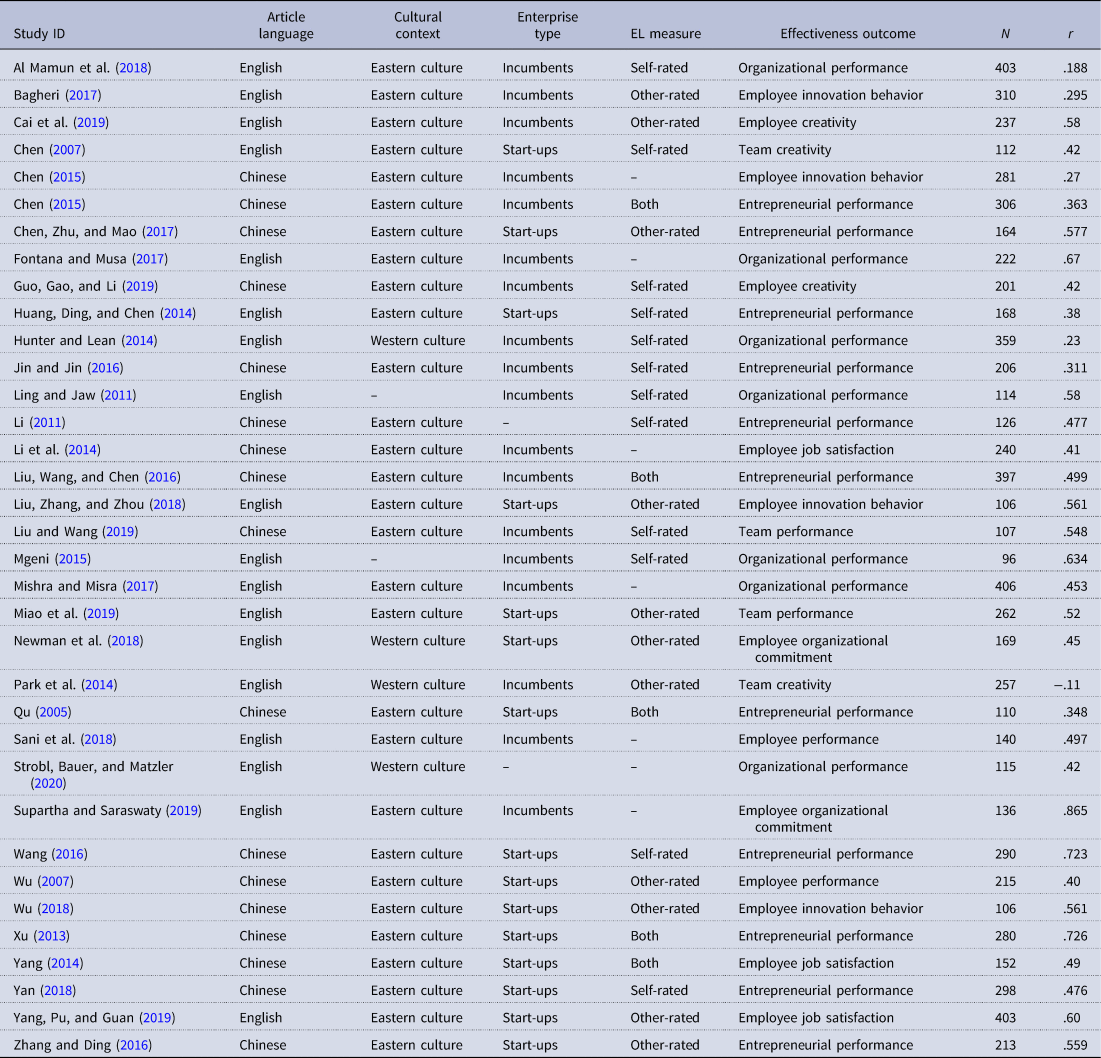
When the same sample appeared in multiple studies or different effectiveness outcomes existed in the same study, only one study or outcome was selected to code. If the study did not explicitly report the details of the above moderators or had mixed categories of a moderator, these items would not be coded and the study would not be involved in moderator analysis. We corrected the raw correlations for measurement errors using reliability coefficients available in primary studies (Hunter & Schmidt, Reference Hunter and Schmidt2004). In the case of an unreported variable reliability for either EL or effectiveness outcome, the weighted average reliability of the corresponding variable across studies was replaced by the missing value (Frank, Lindred, & Karen, Reference Frank, Lindred and Karen2012). When the study only provided correlations between multiple dimensions of variables, the composite correlation was made up of these correlation coefficients (Hunter & Schmidt, Reference Hunter and Schmidt2004). This coding was independently completed by the two authors, and their coding contents reached substantial agreement whereas the discrepancies were double-checked and solved. The characteristics of all included studies are listed in Table 1.
Characteristics of studies included in the meta-analysis

Note. N, total sample size; r, raw correlation between EL and effectiveness outcome.
Analytic approach
We performed the meta-analysis employing the comprehensive meta-analysis program, when at least two independent effect sizes calculated by modified correlation coefficient and sample size were available. The adopted meta-analysis procedures are as follows: (1) Heterogeneity test. Q-test examines whether there is heterogeneity among independent samples, where the Q-statistic reflects the within-group heterogeneity of effect sizes and the I 2-statistic represents the proportion of heterogeneity in the total variance of effect sizes (Borenstein, Hedges, Higgins, & Rothstein, Reference Borenstein, Hedges, Higgins and Rothstein2009). A significant Q-statistic and high value of I 2-statistic indicate heterogeneity and further suggest the presence of moderators (Higgins, Thompson, Deeks, & Altman, Reference Higgins, Thompson, Deeks and Altman2003), where the random effect model is used for data analysis, otherwise the fixed effect model is selected (Hedges & Vevea, Reference Hedges and Vevea1998). And the significant Q b-statistic referring to between-group difference can reveal a moderating effect. (2) Publication bias test. Funnel plot, Egger’s test of the intercept and fail-safe N referring to how many additional studies with null results need to be added to make the present mean effect size insignificant, check the potential publication bias of studies (Borenstein et al., Reference Borenstein, Hedges, Higgins and Rothstein2009). The distribution symmetry of effect sizes in funnel plot, the statistical insignificance of Egger’s test of the intercept and the value of fail-safe N greater than 5K + 10 (K is the number of independent samples), can demonstrate the absence of publication bias (Rothstein, Sutton, & Borenstein, Reference Rothstein, Sutton and Borenstein2005). (3) Hypothesis test. The model selected above analyzes data, and the estimation of effect size verifies the research hypothesis when the mean effect size is statistically significant, that is, 95% confidence interval does not contain zero. It is necessary to sort out different research subsets for separate meta-analysis in each subset according to the main effect and moderating effect on the effectiveness of EL.
Results
Heterogeneity and publication bias analysis
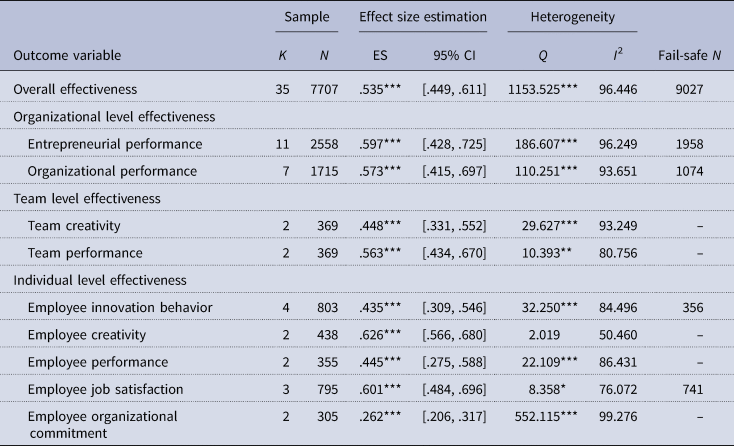
Table 2 reports the heterogeneity test results of the analyzed studies. Taking the relationship between EL and overall effectiveness as an example, the high significance of Q-statistic (p < .001) and the high value of I 2-statistic (I 2 = 96.446) reflect the high heterogeneity of effect sizes, and indicate that 96.446% of observed variation is caused by the real difference of effect sizes. Thus, the random effect model is used for the meta-analysis of this relationship. It can be seen that except for the effect size between EL and employee creativity without heterogeneity (the Q-statistic does not reach significant level, p = .155) and the fixed effect model applied to analyze this relationship, the effect sizes of other relationships are heterogeneous where the random effect model is applied. The heterogeneity also shows that there are potential moderators in the link between EL and effectiveness outcomes, which provides support for subsequent moderating effect analysis. For the publication bias of studies, the funnel plot with effect size points is relatively symmetric, the Egger’s test around effect sizes yields statistically insignificant intercepts at .05 level, and all fail-safe N values are far larger than the critical value of 5K + 10 (see Table 2). Therefore, the publication bias is considered as negligible or absent.
Meta-analysis results of the relationship between EL and effectiveness outcomes

Note. K, number of samples; N, total sample size; ES, mean effect size (correlation); CI, confidence interval; Q, test statistic of within-group heterogeneity; I 2, percent of true heterogeneity; ***p < .001, **p < .01, *p < .05; Fail-safe N cannot be calculated when K is less than 3.
Main effect analysis
The meta-analyzed correlations between EL and multilevel effectiveness outcomes are displayed in Table 2. According to the point estimate, statistical significance and confidence interval of the effect size, the research hypothesis proposed is tested. We first considered the overall effectiveness of EL by applying the entire research set. At the overall level, EL is significantly and positively related to overall effectiveness (ρ = .535, p < .001) where the 95% confidence interval does not include zero. This strong association is traceable because the relationship between EL and effectiveness outcomes has been proved to be highly correlated in many studies used in the meta-analysis, although there are still individual studies with relatively weak correlation or even negative correlation.
We then examined the effectiveness of EL at different levels to test our hypotheses by analyzing different research subsets separately. At the organizational level, hypotheses 1a and 1b predict the beneficial role of EL in the performance of new ventures or other enterprises. As seen in Table 2, EL has the significantly positive association with entrepreneurial performance (ρ = .597, p < .001) and organizational performance (ρ = .573, p < .001), which verifies hypotheses 1a and 1b. These two effect sizes are very close, indicating that EL is suitable for all kinds of enterprises rather than limited to new ventures. The included studies also demonstrate the similarity about the role of EL in entrepreneurial performance and organizational performance. At the team level, hypotheses 2a and 2b emphasize the positive impact of EL on creativity and performance in teams. The results suggest that the two relationships between EL and team creativity (ρ = .448, p < .001), team performance (ρ = .563, p < .001) are all positive and significant, hypotheses 2a and 2b are thus supported. Although there are few independent samples about team-level effectiveness outcomes in this meta-analysis, these studies mostly find a significantly positive connection between EL and team creativity or team performance. At the individual level, hypotheses 3a–3e put forward the effectiveness of EL in behavior, ability, attitude and performance of individual employees. It can be found that EL yields a significantly positive correlation with employee innovation behavior (ρ = .435, p < .001), employee creativity (ρ = .626, p < .001), employee performance (ρ = .445, p < .001), employee job satisfaction (ρ = .601, p < .001) and employee organizational commitment (ρ = .262, p < .001). Correspondingly, these five hypotheses are accepted. Compared with studies at the organizational and team levels, more studies concentrate on the individual-level effectiveness of EL. These empirical results all confirm the importance of EL for employees’ behavior attitude and ability performance related to innovation and entrepreneurship.
Moderator analysis
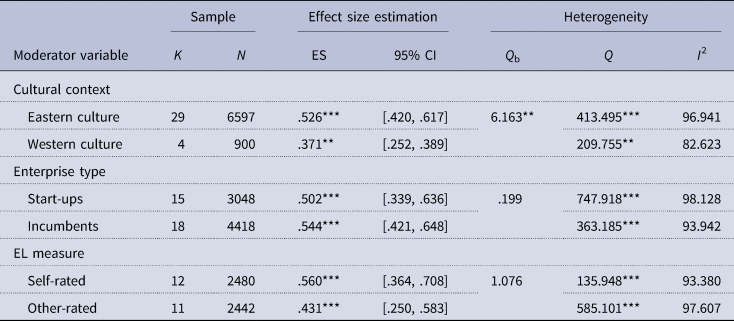
Table 3 illustrates the meta-analysis results about three moderatos in the effectiveness of EL. Due to the limited number of studies at each level, we focused on the moderating effects of the link between EL and overall effectiveness. For cultural context, shown in Table 3, EL exhibits a stronger positive correlation with overall effectiveness in eastern culture (ρ = .526, p < .001) than in western culture (ρ = .371, p < .01). Moreover, the relationship between EL and overall effectiveness is significantly heterogeneous in different cultural contexts (Q b = 6.163, p < .01). As hypothesized, cultural context moderates the association of EL with effectiveness outcomes, hypothesis 4 is therefore supported. In fact, it is easy to find that the correlation between EL and effectiveness outcomes in many eastern-contextualized studies included in the meta-analysis is obviously higher than that in few western-contextualized studies (see Table 1).
Meta-analysis results of moderators for the relationship between EL and overall effectiveness

Note. K, number of samples; N, total sample size; ES, mean effect size (correlation); CI, confidence interval; Q b, test statistic of between-group heterogeneity (moderating effect); Q, test statistic of within-group heterogeneity; I 2, percent of true heterogeneity; ***p < .001, **p < .01, *p < .05.
In contrast to hypotheses 5 and 6 that enterprise type and EL measure exert moderating influence on the effectiveness of EL, there is no strong evidence to support the two hypotheses. For enterprise type, studies targeted at start-ups (ρ = .502, p < .001) and incumbents (ρ = .544, p < .001) present somewhat differential correlations, however, different enterprise types do not lead to significant difference in the relationship between EL and effectiveness outcomes (Q b = .199, p = .602). This finding echoes the similar effect of EL on performance of new ventures and other enterprises mentioned above. For EL measure, although a larger effect size is estimated when EL is self-rated (ρ = .560, p < .001) compared with the other-rated EL (ρ = .431, p < .001), this difference caused by EL measure is not significant (Q b = 1.076, p = .359). In sum, enterprise type and EL measure have no moderating effects on the link between EL and effectiveness outcomes. Hence, hypotheses 5 and 6 are not valid.
Discussion
This study meta-analyzed the effectiveness of EL at the organizational, team and individual levels integrating relevant empirical research, and further examined the moderating effects of cultural context, enterprise type and EL measure on the effectiveness of EL. The results reveal a positive overall relationship between EL and effectiveness outcomes, whose medium-sized correlation highlights the significance of EL to the survival and development of enterprises in the context of entrepreneurship and innovation. Simultaneously, EL is confirmed to be positively associated with different-level effectiveness outcomes regarding performance (entrepreneurial performance, organizational performance, team performance and employee performance), ability (team creativity and employee creativity), behavior (employee innovation behavior) and attitude (employee job satisfaction and employee organizational commitment) of the organization, team or individual. These comprehensive findings align with the results of prior studies on the relationship between EL and effectiveness outcomes at different levels (e.g., Guo, Gao, & Li, Reference Guo, Gao and Li2019; Ling & Jaw, Reference Ling and Jaw2011; Liu & Wang, Reference Liu and Wang2019). Moreover, EL has the most direct and efficient impact on employee creativity with the strongest correlation, which corresponds to scholars’ interpretation of EL that this leadership can mobilize the initiative of individual employees to reform and innovate (Gupta, MacMillan, & Surie, Reference Gupta, MacMillan and Surie2004; Kuratko, Reference Kuratko2007).
In this meta-analysis, the number of studies on some effectiveness outcomes is small, such as team and employee creativity, and team and employee performance, but the positive role of EL at the team and individual levels can be further supported through the analysis results of more literature on organizational performance, entrepreneurial performance and employee innovation behavior. Most importantly, since we developed a research framework for the multilevel effectiveness of EL and established a corresponding database for meta-analysis, our study makes a breakthrough in current meta-analysis of leadership effectiveness that usually focuses on the role of leadership at a sole level (e.g., Fosse, Skogstad, Einarsen, & Martinussen, Reference Fosse, Skogstad, Einarsen and Martinussen2019; Wu, Cormican, & Chen, Reference Wu, Cormican and Chen2020; Young, Glerum, Joseph, & McCord, Reference Young, Glerum, Joseph and McCord2020). This differentiation or specificity is important to account for scholars’ view on the multilevel phenomenon of leadership (Yammarino & Dansereau, Reference Yammarino and Dansereau2011). Consequently, our study advances the understanding of leadership effectiveness at multiple levels.
In terms of moderating effects, this study detected whether there is heterogeneity in the above relationship caused by different cultural contexts (western culture vs. eastern culture), enterprise types (start-ups vs. incumbents) and EL measures (self-rated vs. other-rated). Among the three moderators, interestingly, only cultural context shapes the link between EL and effectiveness outcomes where this correlation is stronger in eastern culture than in western culture. It means that EL in eastern cultural context is more beneficial to the organization relative to western cultural context. This may be due to the fact that high power distance and collectivism of eastern culture make employees more compliant to the leader, carry out activities oriented to enterprise interests and strive to accomplish goals set by the leader (Tepper et al., Reference Tepper, Carr, Breaux, Geider, Hu and Hua2009), where employees are more likely to be influenced by EL to jointly realize the organizational vision. Although western culture emphasizes low power distance and individualism where employees dare to challenge authority, question leaders and express their own will and ideas freely, resulting in the conflict between personal activities and organizational goals (Barkema et al., Reference Barkema, Chen, George, Luo and Tsui2015; Marcus & Le, Reference Marcus and Le2013). Hence, our study adds to the understanding about the impact of cultural difference on the effectiveness of EL. In line with the research findings of other leadership effectiveness (e.g., Aaron, Chris M, & Yan, Reference Aaron, Chris M and Yan2020; Peng, Li, Wang, & Lin, Reference Peng, Li, Wang and Lin2020), our study shows the broader influence of cultural context on leadership effectiveness.
Inconsistent with our expectations, the correlations of EL with effectiveness outcomes do not yield significant difference in start-ups and incumbents, or self-rated EL and other-rated EL. It implies that enterprise type and EL measure cannot affect the effectiveness of EL. Our study features these interesting findings because they are different from research results of other leadership effectiveness. Some possible explanations are provided to learn about this differentiation. On the one hand, as believed, EL is applicable not only to new ventures, but also to incumbents carrying out entrepreneurial activities (Renko et al., Reference Renko, El Tarabishy, Carsrud and Brännback2015). More studies have gradually realized this point and extended the research object of EL to enterprises of different sizes or stages (e.g., Fontana & Musa, Reference Fontana and Musa2017; Guo, Gao, & Li, Reference Guo, Gao and Li2019; Strobl, Bauer, & Matzler, Reference Strobl, Bauer and Matzler2020).
On the other hand, differing from some leadership effectiveness studies that corroborate the moderation of leadership measure (e.g., Lee, Lyubovnikova, Tian, & Knight, Reference Lee, Lyubovnikova, Tian and Knight2019; Peng et al., Reference Peng, Li, Wang and Lin2020; Wu, Cormican, & Chen, Reference Wu, Cormican and Chen2020), our study excludes this effect in the case of EL. Studies on the effectiveness of EL usually take leaders as the evaluation object to examine organizational outcomes to obtain more accurate measurement where EL is self-rated (e.g., Al Mamun et al., Reference Al Mamun, Ibrahim, Yusoff and Fazal2018; Hunter & Lean, Reference Hunter and Lean2014), and adopt leader–employee pairing method to measure EL and team or individual outcomes to reduce common method variance where EL is other-rated (e.g., Cai et al., Reference Cai, Lysova, Khapova and Bossink2019; Newman et al., Reference Newman, Neesham, Manville and Tse2018). Consequently, this effectively avoids biased correlations because the evaluation object and method depend on the level of effectiveness outcomes, resulting in the insignificant moderation of EL measure.
Theoretical and practical implications
This study has important theoretical significance in leadership effectiveness. By systematically exploring the influence of EL on effectiveness outcomes at different levels of organization, team and individual, our findings reveal the positive role of EL in improving organizational, team or individual performance, and shaping team or individual behavior, ability and attitude related to innovation and entrepreneurship. In doing so, this study clarifies existing empirical literature from the multilevel perspective, reconciles prior mixed findings on the effectiveness of EL, and draws a more universal and convincing conclusion. Furthermore, it contributes to breaking through the paradigm of discussing leadership effectiveness from a single level, advancing a more comprehensive understanding about the effectiveness of EL, and providing a theoretical basis for the subsequent empirical research on the multilevel effectiveness of EL. In addition, the results point out that cultural context is a compelling decisive factor of the differential relationship between EL and effectiveness outcomes, which corresponds to the research findings of other leadership effectiveness and impels scholars to pay attention to the effectiveness of EL in different cultural contexts or its localization. Unlike extant leadership effectiveness studies, however, the results suggest that such relationship does not vary with different enterprise types and EL measures. Our findings identify the moderators of the link between EL and effectiveness outcomes, which interprets previous variability in the literature from a contingency perspective. Furthermore, through comparing the similarities and differences with other leadership effectiveness studies, this study is helpful to deepen the research on the effectiveness of EL and offer valuable insights into the uniqueness of EL.
This study also provides practical guidance for enterprises to effectively adapt to the dynamic changes and respond to challenges or opportunities in the context of entrepreneurship and innovation. First, to improve individual innovativeness, team creativity and organizational performance, managers should perform EL to direct staff to develop entrepreneurial opportunities and facilitate reform or innovation. Specifically, managers need to build entrepreneurial vision, take risks and fully empower employees to gain their recognition and follow, and motivate their innovative and entrepreneurial activities, which improves individual attitude, behavior and performance ultimately translated into the progress of team and organizational performance. Second, the effectiveness of EL has certain cross-cultural difference. Given that collectivist employees with eastern cultural background are more effectively affected by EL, for multinational enterprises, managers should consider more about how to lead individualist employees with western cultural background. Finally, EL plays an effective role in both start-ups and incumbents. In the current highly uncertain environment, enterprises of any size and stage should consciously change the leadership pattern to maximize the effectiveness of EL. For example, managers create the ideal atmosphere and supportive working conditions for innovation and entrepreneurship, where employees proactively explore entrepreneurial opportunities and participate in creative actions to help enterprises build competitive advantages and realize sustainable development.
Limitations and future research
This study has several limitations that point to necessary attention and demands for future research. First, although EL has been widely discussed, the number of both overall and subgroup empirical studies on the effectiveness of EL is still small. Due to these few empirical studies and their lack of necessary details, the literature used for this meta-analysis to investigate the overall and different-level effectiveness of EL is more limited. Furthermore, constrained by the independent sample size, this study only detected the moderating effects on the association of EL with overall effectiveness, which affects the acquisition of robust evidence to some extent. Hence, we call for more such empirical studies to expand different research subsets so that meta-analysis can be performed with enough independent samples to obtain more accurate research results and provide stronger support for them. Second, most prior studies used the scale from Gupta, MacMillan, and Surie (Reference Gupta, MacMillan and Surie2004) to measure EL, but some oriental scholars have been aware of the cultural difference in leadership effectiveness, and there is a trend to develop a localization scale of EL to engage in relevant research. This study just used different evaluation methods to analyze whether EL measure affects leadership effectiveness, and the results negate our expectation. In view of this, future research could discuss the moderating role of EL measurement scales featuring different cultural contexts, in order to comprehensively corroborate the impact of EL measure on such relationship. Third, this study only confirmed the moderating effect of cultural context accounting for the divergent results in the literature, which implies that additional potential moderators merit further examination to expose other important contingency factors determining the changes of the relationship between EL and effectiveness outcomes. In addition, future research may explore the mediating mechanisms in the effectiveness of EL to understand the ways where EL contributes to effectiveness outcomes.
Conclusion
The purpose of this study is to systematically analyze the multilevel effectiveness of EL and further identify the important moderating factors between EL and effectiveness outcomes through the meta-analysis of synthesizing scattered research. Our findings highlight the importance of EL that can exert positive multilevel effectiveness for enterprises. From different levels, EL helps organizations, teams and individuals improve their ability and performance, as well as shape their behaviors and attitudes. Interestingly, EL performs distinct effectiveness in different cultural contexts. More importantly, enterprises of any size or stage have the potential to give full play to the effectiveness of EL. Furthermore, with the standardization of empirical research in this emerging field, the optimized variable evaluation effectively reduces common method variance, which makes the research results more reliable. Overall, the study is conducive to revealing the effectiveness of EL at multiple levels, clarifying its boundary conditions that cause previous inconsistent findings, understanding broader leadership effectiveness and the uniqueness of EL, as well as guiding EL practice to promote innovative or entrepreneurial activities for enterprise competition and sustainability.
Funding
This study was supported by the National Natural Science Foundation of China (No. 71972074) and East China Normal University Research Plan Program (No. YBNLTS2020-017).
Qin Lin is a doctoral candidate at the School of Business Administration, Faculty of Economics and Management in East China Normal University. Her research focuses on leadership, entrepreneurship and innovation.
Lingfeng Yi is a professor at the School of Business Administration, Faculty of Economics and Management in East China Normal University. He received his PhD from this university, Shanghai, China. His research focuses on leadership, organizational behavior and human resource management.