Introduction
Poultry production has been characterised by remarkable advances in recent years. For maximum efficiency, producers must contemplate the requirements of management, health, nutrition and environment. However, the interaction of these factors is not always met, generating a series of malfunctions in the metabolism, physiology and anatomy of birds. In addition, inadequacies may result in increased mortality and processing plant carcass downgrading.
According to Tardin (Reference TARDIN1995), the lack of a standardised terminology to accurately describe the different locomotor abnormalities in poultry contributes negatively to the correct quantification of the damage. Broilers’ fast growth and great capacity for meat deposition give rise to metabolic disorders that lead, in most cases, to sizable losses, estimating that mortality and downgrading may in future rise by 2.1% (Yogaratnam, Reference YOGARATNAM1995).
The rapid growth and heavy body weight associated with a bone structure still in development, are the main causes for the occurrence of skeletal disease in broilers, which affect both the appendicular and axial skeleton. Using an immature skeleton to support oversized muscular mass has resulted in the emergence of disorders of the locomotor system. In parallel, numerous nutritional factors are involved in normal bone development, such as protein and amino acids, vitamins, minerals, and electrolytic balance (Mendonça Jr., Reference MENDONÇA2000).
The incidence of locomotor problems in rapidly growth poultry has become a major concern in the poultry market, mainly for export, not only due to poor performance and loss of birds in slaughterhouses, but aspects of animal welfare. The following paper aims at reviewing the main causes of non-infectious and nutritional factors related to the onset of locomotor disorders in broiler chickens.
Leg abnormalities
According to Elkin (Reference ELKIN1978), the incidence of leg abnormalities in broilers is related to a disorder in the organic matrix of bone, in which the physical properties of collagen is probably be altered. The bone structure is closely related to locomotor problems, therefore, knowledge of the basic structure and the normal growth of bones assist in understanding how leg problems occur in broilers. According to Howlet (Reference HOWLET1980), the growth of long bones is a process that involves simultaneously the radial growth of the epiphysis, accompanied by endochondral ossification, and the shaft, which is by intramembranous bone apposition of periosteal endochondral and osteogenic activity in the epiphyseal plate. This process is regulated by complex interactions between genetic potential, environmental influences and nutrition of birds.
Twenty-two percent of the bone consists of the organic matrix, 9% water and 69% of inorganic materials. The organic matrix (osteoid) is the predominant composed of collagen (90%), which participates in the process of bone mineralisation. The other 10% corresponds to an amorphous substance (Banks, Reference BANKS1991).
The fundamental cellular elements of bone are osteoblasts, osteocytes and osteoclasts, cells which are responsible for bone matrix synthesis and mineralisation, and key factors for the chemical, geometric and bone strength (Rath et al., Reference RATH, HUFF, HUFF and BALOG2000). Osteoblasts are the cells responsible for skeletal tissue (bone) formation, synthesis and regulating the organic matrix. Osteocytes are mature osteoblasts, located within bone matrix, and responsible for bone maintenance by synthesis and absorption of bone tissue, filling partially a gap of canaliculi within the matrix, and which communicate with adjacent cells. Osteoclasts are essential for absorption of the calcified cartilage and bone modelling, also responsible for maintaining the requirements of calcium homeostasis (Gay et al., Reference GAY, GILMAN and SUGIYAMA2000).
Locomotor problems in chickens are of complex etiology and involve several factors that may favour the onset of clinical signs. Non-infectious diseases are responsible for most of the locomotor problems in poultry (Riddell, Reference RIDDELL1981). Thorp (Reference THORP1994) classified leg diseases of broilers into two categories, the non-infectious (angular and torsional deformities of the bone; dyschondroplasia, rickets, osteochondrosis and chondrodystrophies) and the infections (osteomyelitis, chondritis and suppurative arthritis).
In 1996, members of the Scientific Committee on Animal Health and Animal Welfare described leg problems as one of four main causes of reduction in the welfare of broilers reared under commercial conditions. The other three items were population density, litter condition and maintenance/purchase of equipment (Brito and Carrer, Reference BRITO and CARRER2006).
Predisposing factors
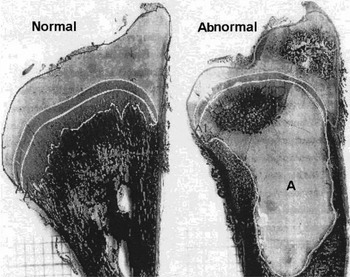
Leg problems in broilers have a direct relationship with increasing weight gain, a parameter that is pursued as the ultimate goal of animal production. According to Goliomytis et al. (Reference GOLIOMYTIS, PANOPOULOU and ROGDAKIS2003), the rate of muscle development is most rapid from all tissues during the first weeks of age. Vertebrae and leg bone structure, as well as the heart and lungs, do not maintain the same rate as muscle growth. This mismatch in the growth rate of broiler tissues promotes an overload into the cardio-respiratory system and throughout the bone structure, which results in locomotion disorders. However, excessive weight only accelerates or chronifies a tendency related to broiler physiology, which is the delay in cartilage matrix calcification of long bones. For proximal long bone calcification, chondrocytic proliferation, hypertrophy and final degeneration (cartilage cells of the tissue) are needed, leaving a space soon filled by the bone matrix. Prior to mineral deposition, bone organic matrix modelling occurs, usually composed of connective tissue represented by collagen type I. Modelling usually occurs between the third and fourth weeks of age. A bone weakness period during broiler growth occurs in the epiphyseal and metaphyseal regions of long bones, as a physiological event similar in most animal species and humans (Figure 1).
The quality of ingredients used in the diet, especially in pre-starter, as the reduced nutritional value of corn infested by insects or fungi, can increase the incidence of metabolic problems, which increases the conviction rate of housing (Stringhini et al., Reference STRINGHINI, MOGYCA, ANDRADE, ORSINEL, CAFÉ and BORGES2000).
Epiphyseal cartilage of long bones of broilers at 42 days old. (A) abnormal accumulation of organic matter.
Source: Goliomytis et al. (Reference GOLIOMYTIS, PANOPOULOU and ROGDAKIS2003)

Major disorders of the locomotor system
Among the main changes in the chicken's locomotor system, the most commonly occurring include spondylolisthesis, valgus and varus, tibial rotation, tibial dyschondroplasia and rickets.
spondylolisthesis
Spondylolisthesis is a deformity that affects the fourth thoracic vertebra of broilers, resulting in compression of the spinal cord and, consequently, paralysis of hind limbs. This condition, also known in the poultry industry as ‘kinky back’, affects broilers between three and six weeks of age. The incidence of spondylolisthesis, which can reach 2% in the field, depends on factors such as age, rapid growth rate and genetics (Osbaldiston and Wise, Reference OSBALDISTON and WISE1967; Wise, Reference WISE1970; Wise, Reference WISE1973).
Spondylolisthesis is a progressive condition in which sub-clinical cases of distortion of the spine may or may not develop stenosis and cord compression with the manifestation of neurological signs. Death results from dehydration and starvation due to impossibility of access to water and feed (Wise, Reference WISE1970). According to Wise (Reference WISE1973), the incidence of spondylolisthesis can be decreased with the delay of the rapid early growth of chickens. Abnormal physical stress, nutritional disorders and genetic factors are considered important or predisposing factors for spondylolisthesis.
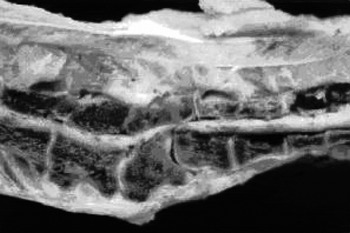
Paixão et al. (Reference PAIXÃO, RIBEIRO, HOERR and SANTOS2007) reported that spondylolisthesis affected broilers initially suffer from lack of co-ordination, characterised by limited mobility that evolves for the lateral displacement, cranial or caudal one of the members and thereafter, resting on lateral decubitus or on the hock (tibiotarsal tarsometatarsal) joint. The authors described emaciation and abnormal spine deviation. On microscopic examination of sagital section of the spine, the fourth thoracic vertebra dorsal caudal was directed against the fifth, which had a cranial dorsal displacement. Protrusion of the caudal end of the body of the fourth thoracic vertebra and the cranial end of the fifth body into the spinal canal was also shown, resulting in compression of the spinal cord (Figure 2).
Sagittal section of the thoracolumbar region of the spine of broilers.
Source: Paixão et al. (Reference PAIXÃO, RIBEIRO, HOERR and SANTOS2007)

valgus and varus
The angle inward (valgus) or outward (varus) of the tibiotarsal tarsometatarsal joint is the most common skeletal deformation in chickens. The injury may be present during the first weeks of age and can occur at any time during the bird's life. The hock is the bone most commonly involved although the femur and metatarsus can be affected (Riddell, Reference RIDDELL1992).
This disease is progressive and affected birds become crippled, with decreased locomotor activity. Chickens may be downgraded at the processing plant due to cachexia or muscle atrophy of the affected leg. The angular deformity of the bone seems to be specifically related to the rapid growth that does not provide enough time for alignment and proper formation of bone. The specific cause of defects in the angle is not fully known and may be congenital or developmental. The pathogenesis may be associated to an abnormal load on the growth plate or on the immature bone epiphysis, resulting in axial deviation in the frontal plane. The pressure on the bone growth plate may affect the orientation of chondrocytes in the column and, consequently, its growth or directional angle. Broilers raised under intermittent lighting regimen show greater activity during the light period than the birds that received continuous illumination for 24 hours. This increased activity of the bird during the lighting could be responsible for improving the structure of bone tissue and may decrease the incidence of these deformities. Raising birds in cages provides greater susceptibility to the occurrence of crooked legs than found in birds raised on the ground because of restricted movement (Mendonça Jr., Reference MENDONÇA2000).
tibial rotation
Tibial rotation is a less common musculoskeletal disorder in poultry. It is characterised by the rotation of the hock axis and can be confused with other distortions such as angular deformation. A rotation of 90° is common, but can be up to 180°. It affects males and females alike, and especially affects slow growing Leghorn birds type (Riddell, Reference RIDDELL1992). According to Coello et al. (Reference COELLO, MENOCAL and FERNÁNDEZ2009), tibial rotation is generally observed unilaterally or bilaterally in chickens after three weeks of age. Although the etiology not well understood, has been associated with malabsorption syndrome and rickets. However, research has shown that the incidence is influenced by strain and sex, and that a higher level of vitamins and minerals in the diets of broilers had no beneficial effects (Haye and Simons, Reference HAYE and SIMONS1978).
tibial dyschondroplasia
Tibial dyschondroplasia is a common pathology of bone growth in chickens, ducks and turkeys. It is characterised by the persistence of an abnormal cartilage mass in the metaphyseal region, just below the growth plate, especially the tibia. No hypertrophy, mineralisation, vascular invasion and removal of hypertrophic cartilage zone occur. However, its pathogenesis is not well understood, but its incidence may be influenced by genetics, nutrition and management (Whitehead, Reference WHITEHEAD1992). Halley et al. (Reference HALLEY, NELSON, KIRBY and JOHNSON1987) found a high correlation between dyschondroplasia and acid-base imbalance, indicating the existence of a mineral effect on the buffering capacity of blood, which can affect functions such as bone mineralisation.
The relationship between growth rate and incidence of dyschondroplasia is controversial. Increased growth rate, resulting from genetic selection, and manipulation of the diet are associated with an increase in tibial dyschondroplasia occurrence (Thorp et al., Reference THORP, DUCRO and WHITEHEAD1993). However, when evaluating strains selected for low and high incidence of tibial dyschondroplasia, Thorp et al. (Reference THORP, DICK, ZEFFERIES, HOUSTON and WILSON1997) found no differences between the mean body weight of male broiler chickens with and without tibial dyschondroplasia.
The incidence of tibial dyschondroplasia can reach more than 30% of the batches of broilers and turkeys. It is a disorder found in modern broilers, which have been genetically and nutritionally manipulated to reach a large body mass. In most cases, the damage is sub-clinical. Severe injuries lead to bowing of the tibia, fibula fractures or irregular floor (Leeson et al., Reference LEESON, DIAZ and SUMMERS1995). According to Orth et al. (Reference ORTH, FENTON and CHLEBEK-BROWN1999), the chain of events necessary for the proper growth of long bones is broken, so that a large lesion appears in the cartilage of the proximal metaphysis of the hock, where the trabecular bone should be formed. Cartilage, which originated from the growth plate chondrocytes, is avascular and not mineralised.
rickets
Rickets is a widespread failure in bone mineralisation, affecting both the cartilage of conjugation and the bone itself. Onset of symptoms typically occurs between seven and 14 days of age, with regression of lesions after several weeks, depending on the nutritional growth potential status of the chick and the severity of the disability. There are two recognised types of rickets, one caused by the deficiency of calcium/vitamin D and another due to phosphorus deficiency (Mendonça Jr., Reference MENDONÇA2000). Rickets in young animals is characterised as a deficiency disease, like osteomalacia in adults, with evidence of bone fragility, long bone bowing, joint expansion, locomotor difficulties, anatomic defects, fractures, among others. The signs of deficiency include mild reduction in feed intake and performance (McDowell, Reference McDOWELL1992).
Rickets-affected birds are reluctant to walk, remain seated and use their wings for balance when walking. In hypocalcemic rickets, the epiphyseal thickening is the result of chondrocytes proliferation. In calcium and vitamin D deficiencies, the proliferation zone is thick and the area is low in hypertrophied vasculature. On the other hand, a simple phosphorus deficiency does not alter the normal thickness of the cartilage of conjugation and vascularisation, characterising the differential diagnosis of these deficiencies (Tardin, Reference TARDIN1995).
Nutritional factors and locomotor problems
Understanding o the numerous nutritional factors involved in bone development is of utmost importance in the study of skeletal disorders, as the bone is a metabolically active tissue, multifunctional and comprising different cell populations. Bone cell complexes produce a wide variety of biological regulators that control bone metabolism. Endocrine hormones, oestrogen, vitamins, prostaglandins, cytokines and other factors co-ordinate the main activities of bone metabolism (Tardin, Reference TARDIN1995).
The incidence of leg abnormalities is related to the dietary protein level. When birds consume diets with low protein levels the incidence of leg problems decreases (Hulan et al., Reference HULAN, PROUDFOOT, RAMEY and McRAE1980). Skinner et al. (Reference SKINNER, BEASLEY and WALDROUP1991) observed that, by increasing the levels of total amino acids to 20% above requirements, there was a significant reduction in tibial mineralisation in birds fed diets with 0.5% and 1% calcium. These authors reported that urinary calcium excretion may be increased when high protein diets are used showing a negative balance of this mineral. Diets with high levels of amino acids decrease the rate of bone calcification, but this effect is not observed when the levels of calcium and phosphorus in the diet are adequate.
According to Whitehead (Reference WHITEHEAD1992) the increase in dietary protein level increases the incidence of perosis in birds. Inadequate levels of protein or amino acids, with the addition of 1.5 g/kg lysine diets based on corn and soybean meals, may result on the development of bone abnormalities. However, Bruno et al. (Reference BRUNO, LUQUETTI, FURLAN and MACARI2007) reported that the restriction of dietary protein affected the bone tissue development, specifically the length of the femur, but the dietary energy restriction did not affect bone development.
High levels of methionine and cystine are associated with a deficiency in vitamin B6 and are associated with claudication due to abnormal development of bone collagen (Massé et al., Reference MASSÉ, BOSKEY, ZIV, HAUSCHKA, DONOVAN, HOWELL and COLE2003). According to these authors, vitamins A, B, C, D and K, as well as calcium and phosphorus in the correct balance are essential for bone development.
According to Thorp et al. (Reference THORP, DUCRO and WHITEHEAD1993), supplementing the diet with 1,25-dihydroxy cholecalciferol, resulted in a significant reduction in the incidence and severity of tibial dyschondroplasia in broilers. In birds fed a diet containing 5 mg/kg of 1,25 dihidroxi-colecalciferol, the incidence of dyschondroplasia was reduced by 21%. When the supplementation was increased to 10 mg/kg, the incidence was zero. Results indicated that supplementing the diet with 1,25 dihydroxy cholecalciferol is associated with a dose-dependent reduction in the incidence of tibial dyschondroplasia lesions in broilers.
Deficiency or imbalance of vitamins and minerals may be associated with rickets and tibial dyschondroplasia (Leeson et al., Reference LEESON, DIAZ and SUMMERS1995). According to this research, oxidized fat in the diet causes degradation of fat soluble vitamins including vitamins A, D and E, which can reduce the availability of these vitamins, resulting in lameness. Inadequate mineral supplementation during the growth phase will result in an imbalance in mineral homeostasis and leads to poor bone development in birds, in other words, abnormal bone calcification. However, excessive calcium can act as an antagonist hindering the absorption of inorganic minerals such as iron, copper, zinc, magnesium, sodium, potassium, among others (Waldroup, Reference WALDROUP1996). According to the NATIONAL RESEARCH COUNCIL NRC (Reference NATIONAL RESEARCH COUNCIL NRC1994), the calcium requirements of broilers are 1% of the 21 days of age and 0.9% from 22 to 42 days old bird.
The exact mechanism of the acid-base balance influence on bone calcification is not well defined. However, Mongin and Sauveur (Reference MONGIN and SAUVEUR1977) suggested an involvement with metabolism of vitamin D. Metabolic acidosis can impair the cartilage maturation by altering the renal synthesis of 1,25 dihydroxy cholecalciferol and 25 hydroxy cholecalciferol in the liver.
Murakami (Reference MURAKAMI2000), studied the electrolyte balance of diets in one to 21 day old broilers (200 to 320 mEq/kg) and showed a decrease in the tibial hypertrophic cartilage zone, typical of dyschondroplasia, when the electrolyte balance was 253 mEq/kg. Similarly, a reduction of the total area of the tibial epiphysis was observed when the balance was increased, with the smallest area observed at 248 mEq/kg. Oliveira et al. (Reference OLIVEIRA, ARANTES and STRINGHINI2010) recommended the use of diets with an electrolyte balance of 200 mEq/kg in broilers up to 38 days old to prevent negative effects on bone quality and broiler litter.
Monitoring and control of non-infectious diseases of the locomotor system
The genetic influence on the leg problems can be minimised with the use of programmes that restrict feed intake. This practice can be used in flocks with high weight gain during the first few weeks of life. The most common way to restrict feed consumption is to reduce daylight, aimed at reducing weight at 21 days of age (Brito and Carrer, Reference BRITO and CARRER2006). Birds with accelerated growth in the initial phase have a higher propensity for developing locomotor problems. The big question surrounding the practice of food restriction refers to the ideal period of fasting for no weight loss.
According to Su et al. (Reference SU, SØRENSEN and KESTIN1999), the use of a period of moderate dietary restriction substantially reduces the appearance of leg problems without significantly reducing slaughter weight. In an experiment carried out by these authors, the period implemented for restriction began at five, seven and nine days of age until the end of the initial phase (day 21). During this period birds were offered 25, 50, 75 and 100% of normal consumption levels for poultry. It was concluded that there was a reduction in mortality and average weight between the birds that consumed 25% of total feed and the control group (100% of the total diet). The level of reduction varied when different ages were assessed in terms of live weight at 21, 28, 35 and 42 days of age, whereby it was reduced by 19, 12 and 9%, respectively. This showed that the difference in weight between the chickens tends to be greater the higher age is evaluated. The values of tibial dyschondroplasia and locomotion score differed significantly from the control group in any period of food restriction assessed.
When evaluating different periods of light as a form of food restriction for broiler chickens of both sexes and different ages, Sorensen et al. (Reference SORENSEN, SU and KESTIN1999) observed that short periods of light restriction resulted in increased occurrence of leg problems, but prolonged restriction significantly reduced the performance results. The photoperiods they used were eight, 16, 21 and 23 hours light/day were evaluated for three days.
Evaluating bone problems in poultry
There are several ways to assess locomotion problems in broilers, one of these being ‘Gait Score’ (the ability to walk). This is a subjective measure of the ability of the bird to walk on a surface, as verified at a distance of one meter. A normal bird (score 0) should walk without limping and give at least ten steps in this distance, a bird with a score 1 walks with some difficulty and gives between six and ten steps uninterrupted at this distance, score 2 has difficulty to walk and gives less than six steps without interruption at a distance of one meter (Nääs et al., Reference NÄÄS, PAZ, BARACHO, MENEZES, BUENO, ALMEIDA and MOURA2009). Some authors (Weeks et al., Reference WEEKS, DANBURY, DAVIES, HUNT and KESTIN2000; Garner et al., Reference GARNER, FALCONE, WAKENELL, MARTIN and MENCH2002) reported that the gait score developed by Kestin et al. (Reference KESTIN, KNOWLES, TINCH and GREGORY1992), is an empirical methodology and, therefore inaccurate.
Histopathological examinations are used in research to detect development patterns of bone and adjacent tissues. Techniques were developed for assessing less invasive methods for allowing bone development problem degree evaluation. These techniques are based on radiographic images evaluation, optical densitometry of radiographs and tomography, which allow an immediate diagnosis of bone malformation, decalcification or degeneration (PAZ, Reference PAZ2008).
Conclusions
The broiler poultry industry's main objective has been to maximise muscle mass formation in minimal time, through the appropriate combination of genetic selection, nutrition and management. Avian geneticists and nutritionists should pursue genetic improvement of strains and establish their nutritional needs, with the appropriate evaluation of skeleton integrity and functions.
In practice, nutrition and management failures, associated with rapid growth of broilers, resulting in locomotor dysfunction, have been causing significant economic losses. The study of skeleton abnormalities for continuously faster growing broilers have become of paramount importance. Moreover, recent studies indicate that the locomotor disorders affect the welfare of birds, leading to the need for more research to be conducted into this area.