Background and aim
Ensemble playing is considered central in different genres in specialist higher music education, not least because of its collaborative nature. One can say that ‘ensemble music-making is an obvious example of collaborative learning in music’ (Lebler, Reference LEBLER, Gaunt and Westerlund2013). An ensemble must consider each individual group member, while the individual group members must consider the ensemble, as in any collaborative learning situation (Hunter, Reference HUNTER2006). A final agreement or compromise is reached through all members contributing their own ideas, and hearing and respecting the ideas of the others. During their many unsupervised ensemble rehearsals, students in higher education are expected to take significant responsibility, by acting as their own teachers and by assessing and improving their musical performance together.
The present article investigates musical problem-solving in undergraduate students’ ensemble rehearsals within the tradition of Western classical music, with emphasis on the ensembles’ collective listening efforts. Musicians are at once both performers and listeners when they perform. Their attention is directed towards creating a good performance and assessing their own playing. Scholars in the fields of both aural training pedagogy and music education hold the view that there is an important connection between listening and performing, though the two fields approach the subject from different perspectives and underlying belief systems. Karpinski (Reference KARPINSKI2000), a proponent of aural training pedagogy, says, ‘Listening skills are essential to musicians because music exists fundamentally in the aural domain. It is important that musicians develop musical listening skills’ (p. 6, italics in original). Karpinski's concern is individual mental processes and, as I understand him, he describes listening skills as a prerequisite for performing music.
Within the field of music education, Elliott (Reference ELLIOTT and Elliott2005) discusses music-listening abilities and their importance within education, drawing a more explicit connection to musical performance: ‘I suggest [. . .] that the performing art of music [. . .] depends on a multidimensional form of understanding called musicianship that always includes music-listening abilities, or what I call “listenership”’ (Elliott, Reference ELLIOTT and Elliott2005, p. 9). In Elliott's view, therefore, performance depends on good listenership.
Ensemble playing in educational and professional contexts
Research on classical ensemble playing relevant to the present study is found in studies within educational as well as professional contexts. Under the educational umbrella, King (Reference KING2006) investigated collaborative aspects of three undergraduate quartets, asking what team roles are manifested by student musicians in rehearsals, and how such team roles impact on group work. She found eight kinds of roles: ‘leader, deputy-leader, contributor, inquirer, fidget, joker, distractor, and “quiet one”’. King also found that these roles often changed during and across the rehearsals. Investigating the social and musical co-ordination between members of an undergraduate string quartet, Davidson and Good (Reference DAVIDSON and GOOD2002) showed that the group focused on ‘technical aspects of the performance related to stylistic and structural features of the music’ and that process issues concerned matters such as ‘entries and exits, expression, and dynamics in the music’ (p. 199).
Under the professional umbrella, Williamon and Davidson (Reference WILLIAMON and DAVIDSON2002) have examined two expert pianists rehearsing piano duets, focusing on their non-verbal communication. The findings show the most striking feature of these ensemble rehearsals was the lack of verbal communication: ‘Over 90% of the rehearsal time was spent playing’ (p. 59). The musicians themselves explain this by saying they were so used to accompanying and hence responding to others, that no one took the solo role, instead they ‘listened with accompanists’ ears’. In conclusion, the researchers found that these piano duet musicians mainly used the rehearsals to consolidate ‘the timing, phrasing and sense of musical style’ and that ‘an emergent set of coordinated, non-verbal gestures and eye-contact’ were developed and used in this respect (p. 53). Furthermore, Seddon and Biasutti (Reference SEDDON and BIASUTTI2009) discuss different modes of communication between members of a string quartet, focusing in particular on group communication and creativity. The study revealed six modes of communication: verbal or non-verbal ‘instruction, cooperation, and collaboration’.
Aim of the study
What we learn from the selected research studies is that social as well as communicative aspects are subjects of investigation within the field of ensemble playing. The present study will concentrate on social and communicative aspects emerging when knowledge is articulated among the ensemble members, either ‘verbally’ or through ‘action’ (Grimen, Reference GRIMEN, Molander and Terum2008). Being aware of the growing research field of musical gestures (see for example Godøy & Leman, Reference GODØY and LEMAN2009), I restrict this study to an investigation of the verbal-communicational articulations of student ensemble rehearsals, and the musical actions that often elaborate on or accompany verbal communication. The purpose is to study how ensemble members articulate knowledge so that it leads to negotiations, which may in turn lead to solving musical problems that appear during rehearsals.
The overall aim of this exploratory study is to understand how undergraduate student ensembles negotiate musical problem-solving in their unsupervised ensemble rehearsals, with an emphasis on how they are aurally aware during such processes.
A sociocultural perspective
My analytical lens in the interpretation of the data in this study has been a sociocultural one. A sociocultural view of knowledge advancement implies that knowledge resources are shared through human interplay and communication (Vygotsky, Reference VYGOTSKY1978, Reference VYGOTSKY, Wertsch, Cole and Leont'ev1981; Säljö, Reference SÄLJÖ2001). Learning is then a question of how individuals and collectives acquire, develop, and maintain social experiences (Säljö, Reference SÄLJÖ2006), which means that an important aspect of a sociocultural view of learning is understanding how the society ‘preserves’ different kinds of knowledge, and how people utilize these collective historical and cultural resources.
In this article such collective knowledge (Säljö, Reference SÄLJÖ2006) refers to different musical knowledge resources. A fundamental precept is that students in higher education have access to a collective ‘reservoir’ of available knowledge that has the potential of being utilized within ensemble rehearsals. Wertsch's (Reference WERTSCH1998) understanding of ‘tools’, as well as his concepts of ‘implicit and explicit mediation’ (Reference WERTSCH, Daniels, Cole and Wertsch2007) are important in understanding how knowledge is shared within the ensembles in the present study. Wertsch emphasizes that tools require actions. Tools ‘can have their impact only when an agent uses them’ (Wertsch, Reference WERTSCH1998). In this article, it is assumed that knowledge that is utilized and shared becomes a ‘tool’ when it contributes to a problem-solving process.
Joint Problem Space
As ensemble musicians constantly seek to improve their musical performance, they are naturally focused on problem-solving. Consequently, at least three aspects are of particular importance for ensembles: i) to define a common understanding of a problem; ii) to negotiate the problem; and iii) to find a solution to the problem. Among other things, such a problem-solving process depends on how well each musician communicates his or her listening experience to the others.
Roschelle and Teasley (Reference ROSCHELLE, TEASLEY and O'Malley1995) aim to examine ‘the construction of shared knowledge in collaborative problem solving’. Hence, they focus specifically on the process of collaboration, not just its outcome. In order to be very specific about what collaboration is, they give the following definition: ‘Collaboration is a coordinated, synchronous activity that is the result of a continued attempt to construct and maintain a shared conception of a problem’ (Roschelle & Teasley, Reference ROSCHELLE, TEASLEY and O'Malley1995, p. 70). Thus a Joint Problem Space (JPS) is a shared conceptual space that is negotiated through collaborative problem-solving:
Specifically we hold that collaborative problem solving consists of two concurrent activities: solving the problem together and building a JPS. These activities necessarily co-exist. Conversation in the context of problem solving activity is the process by which collaborators construct and maintain a JPS. Simultaneously, the JPS is the structure that enables meaningful conversation about problem solving to occur (Roschelle & Teasley, Reference ROSCHELLE, TEASLEY and O'Malley1995, pp. 75–76).
This statement underscores the need for a group to find common ground when they encounter a problem, and, importantly, shows that this is done by constructing and then maintaining a JPS. In ensemble rehearsals I suggest that the construction of a JPS is itself crucial to problem-solving. Roschelle and Teasley (Reference ROSCHELLE, TEASLEY and O'Malley1995) emphasize, however, that there is a distinction between ‘collaborative’ and ‘cooperative’ problem-solving. They claim that ‘cooperative work is [. . .] an activity where each person is responsible for a portion of the problem solving’, and that collaboration, on the other hand, is ‘the mutual engagement of participants in a coordinated effort to solve the problem together’ (Roschelle & Teasley, Reference ROSCHELLE, TEASLEY and O'Malley1995).
Negotiations of meaning
Central to this article is the view of collaborative learning as a salient condition of ensemble practice. From a sociocultural perspective, this implies that meaning must be negotiated in some way between members of an ensemble. In Wenger's (Reference WENGER1998) concept of ‘negotiations of meaning’ negotiations are part of a process in which we are all constantly engaging in experiencing things anew. Though we know our colleagues well, we repeatedly engage them in conversation, and though we eat lunch every day, we still taste the food anew. ‘Our engagement in practice may have patterns, but it is the production of such patterns anew that gives rise to an experience of meaning’ (Wenger, Reference WENGER1998). This is a good description of what may happen in students’ ensemble rehearsals. Though they are practising the same piece of music, they engage with it anew each time they play it. In each rehearsal, they produce new situations and seek solutions to new problems, and in doing so they are creating new experiences which are meaningful to them. Both verbal and non-verbal communication can be called negotiation in Wenger's terminology, which supports the emphasis on verbal and musical articulations in this study.
Listening in an ensemble
In the context of the collective learning situation of ensemble rehearsals, the sociocultural theory of learning also has a strong influence on the way listening can be defined. Ensemble playing is a situated, communicative practice that demands the individuals’ listening experiences to be articulated and shared in order to be in play. Collaborative aspects of listening must thus serve as superior to psychological aspects in the present context. Such an operationalizing of the concept makes it possible to investigate ensembles’ collective listening efforts. Gordon (Reference GORDON2012) relates performing in ensemble to his concept of ‘audiation’:
Obviously, it is more difficult for ensemble players to audiate what other ensemble players are performing concurrently than to audiate their own part. However [. . .] audiation is a matter of concentrating on one set of musical sounds while at the same time attending to or performing one or more sets of other musical sounds (Gordon, Reference GORDON2012, p. 6).
Gordon is pointing to a basic challenge within ensemble rehearsals: that of simultaneously performing and listening, and simultaneously having an individual (personal) and a collective (ensemble) focus. I will refer to this particular type of performing-and-listening, along with the attentiveness it requires as ‘aural awareness in ensemble rehearsals’, from now on referred to as an ensemble's attentiveness and their sharing of ideas from their minds’ ears (for elaboration on the concept of ‘aural awareness’, see Pratt & Henson, Reference PRATT and HENSON1987; Pratt, Reference PRATT, Henson and Cargill1998; Slette, Reference SLETTE2014). Ensembles may or may not be explicitly familiar with their ways of articulating aural awareness as part of their problem-solving activities.
Methodology
Case study design
The delimitations in participants, purpose, time, and place made ensemble rehearsals in undergraduate studies suited for a qualitative case study. A case study design is an empirical approach to investigating a phenomenon in depth, within its real-life context (Yin, Reference YIN2009). In the present study, the phenomenon of musical problem solving has been studied within the real-life context of ensemble rehearsals.
In order to shed light on the problem and research questions in the study with a certain variety in data I decided to include more than one participating ensemble. Hence, I use the term ‘collective case study’ (Stake, Reference STAKE, Denzin and Lincoln1994). Furthermore, it is also what Stake (Reference STAKE, Denzin and Lincoln1994) calls an ‘instrumental case study’, as opposed to an ‘intrinsic case study’ (p. 237), where the particular case is of specific interest. Within an ‘instrumental’ case study, the cases facilitate the understanding of the research problem.
The participating ensembles
The participants in the study comprise a ‘purposive’ sample (Miles & Huberman, Reference MILES and HUBERMAN1994, p. 27), and they were recruited from the Norwegian Academy of Music (NMH). One selection criterion was that the ensemble's curricula had to include the mandatory chamber music course. As a further circumscription, I limited the number of different instruments represented. Another selection criterion was that chamber music groups had to be trios, quartets, or quintets. As a final criterion, I wanted the participants to have attended at least one year of aural training, as a common point of reference. This implied that only the students in their second, third, or fourth year were of interest for selection.
The NMH's list of ensembles within the chamber music course was the best way to get hold of potential participants for the study. I found that 20 ensembles fulfilled the selection criteria, and I sent these an e-mail with an invitation to participate. Three groups volunteered:
• A string quartet consisting of second-year students, playing Piano Quintet in G Minor, op. 57, by Dmitri Shostakovich (1906–1975), in anticipation of a pianist, and String Quartet No. 2 in A minor, op. 13, by Felix Mendelssohn (1809–1847)
• A clarinet trio consisting of third-year students, playing Trio for Piano, Clarinet (or Viola) and Violincello in A minor, op. 114, by Johannes Brahms (1833–1897)
• A piano trio consisting of fourth-year students, playing Piano Trio No. 4 in E minor, op. 90, by Antonin Dvořák (1841–1904)
Video observations
Observations were used as a method for data collection to get insight into the natural setting of students’ ensemble rehearsals and their problem-solving processes. The term ‘video observations’ emphasizes that I video recorded as well as observed rehearsals.
Video recordings are often considered as having a greater impact on the setting than the presence of a researcher alone:
Working with a camera in the field, there is always a focus on your presence, your doings, on all your tasks, to a greater extent than when the anthropologist takes notes. (Møhl, Reference MØHL and Hastrup2003, p. 166, my translation)
The video recordings were necessary from a practical perspective, however, because they served as a basis for ‘stimulus material’ in the focus group interviews (Wibeck, Reference WIBECK2000). From an analytical perspective, the video recordings also gave me the opportunity to watch the rehearsals several times, to analyse the ensembles’ problem-solving in depth, and to spot details in their verbal and musical negotiations that I could not have noticed by observing the rehearsals only once (Rønholt et al., Reference RØNHOLT, HOLGERSEN, FINK–JENSEN, NIELSEN, Rønholt, Holgersen, Fink–Jensen and Nielsen2003).
In addition to the recordings, I chose to be present and observe the rehearsals because I did not want to hide the researcher, but rather to get to know the ensembles before the focus group interviews. My role as a researcher during the rehearsals was mainly quiet and non-interruptive. The label closest to this kind of role is ‘partially participating observer’ (Bryman, Reference BRYMAN2012), described as participation in the core activity, but not as a full member.
I observed each ensemble three times, with each rehearsal lasting between one and two hours. The observations focused on what kinds of musical problems the students faced and chose to work on, what kinds of strategies they used to solve problems, what kind of vocabulary they used, how they interacted, and whether they discussed different problems during different stages in the rehearsal process. This article emphasizes the ensembles’ interactions.
Focus group interviews
Focus group interviews were used as an additional method of data collection in order to contribute to triangulation of data, and thereby to complement the video observations. The interviews also allowed me the opportunity to adjust impressions from the rehearsals.
Morgan (Reference MORGAN1997) defines focus groups as ‘a research technique that collects data through group interaction on a topic determined by the researcher’. The researcher is mainly there to make sure the discussion is fruitful and to the point. The focus on group interaction means that listening to the other participants, interrupting, and perhaps changing one's own opinion during the interview are important features of a focus group interview.
In focus group interviews, ‘stimulus material’ is used as a way of initiating a discussion (Wibeck, Reference WIBECK2000). I presented video excerpts from the students’ own rehearsals as stimulus material. These made up good starting points for the reflections and discussions during the interviews. The focus group interviews were conducted as soon as possible after the last rehearsal I attended.
Analytical approaches
Reflexive interpretation is the overarching analytical approach in the study. Alvesson and Sköldberg (Reference ALVESSON and SKÖLDBERG2009) view ‘reflexive research’ as a particular and specific version of reflective research, involving reflection on several levels. They relate reflexivity closely to an interest in how we construct research – including the research object that is constructed, the constructing researcher, and the social context that constructs the researcher. Furthermore, they claim that reflexivity ‘means paying attention to these aspects without letting any one of them dominate’ (Alvesson & Sköldberg, Reference ALVESSON and SKÖLDBERG2009, p. 269). In practice, this means it is the researchers’ responsibility to be aware of all these aspects by constantly asking ourselves critical questions.
Even more specific analytical approaches were used to analyse the video observations and focus group interviews. For the video observations I used a combination of video analysis (Rønholt, Reference RØNHOLT, Rønholt, Holgersen, Fink–Jensen and Nielsen2003) and content analysis (Krippendorff, Reference KRIPPENDORFF2004). For the focus group interviews, I used principles for group interview analysis (Krueger, Reference KRUEGER1998).
When analysing empirical data there is a fundamental question of what analysis can actually reveal. As the researcher, I am aware that I am constructing knowledge on the basis of my preconceptions and by looking at the data provided in this particular study. However, it is of great importance to work hard to understand the participants’ perspective, while at the same time bringing along a researchers’ preconceptions and theoretical overview.
Trustworthiness and transferability
Lincoln and Guba (Reference LINCOLN and GUBA1985) claim that the basic issue in relation to ‘trustworthiness’ is about persuading the audience (including oneself) that the findings of an inquiry are worthy of attention. From among Lincoln and Guba's suggestions, I have used prolonged engagement, triangulation, peer debriefing, and member checks. Furthermore, Guba and Lincoln (Reference GUBA and LINCOLN1989) suggest that rather than generalization, one talks about ‘transferability’. This means that it is the receiver (not the sender or researcher) who decides whether the results can be applied to the next situation. What may be transferred, though, are the larger theoretical concepts (Krueger, Reference KRUEGER1998). I will discuss such possible contributions at the end of this article.
Findings in the next section are presented as a ‘cross-case analysis’ (Stake, Reference STAKE2006) of the three cases, discussing empirical data in light of the theoretical framework of this article. The examples used are selections of ‘in-depth episodes’ from the empirical data. An episode was defined as a unity limited by the specific musical excerpt in focus, as well as the beginning and end of a Joint Problem Space.
Four ways of negotiating musical problem-solving in ensemble rehearsals
The findings of the present study can be described as different ways of negotiating musical problem-solving in ensemble rehearsals. It is within these negotiations that aural awareness has appeared as a central feature within the problem-solving processes, as each group member makes and shares personal, aural observations, for the benefit of the improvement of the common musical performance.
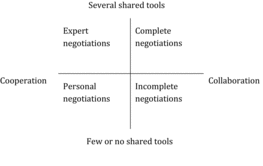
Analyses of the observations and interviews from all the three cases revealed four specific forms of interplay between a collaborative dimension on the one hand, and a dimension of shared tools on the other. These are complete negotiations, incomplete negotiations, personal negotiations, and expert negotiations. Each of them are represented by a square in Figure 1, according to how they fit the scale degrees of collaboration and shared tools respectively.
Four ways of negotiating in ensemble rehearsals

The horizontal dimension shows a continuum from cooperation to collaboration. Joint Problem Spaces (JPS) were constructed and maintained in quite a variety of ways by the ensembles. A JPS was sometimes constructed quickly and sometimes slowly; some remained not fully constructed. There was also variation in the degree to which the various ensemble members participated in the construction and maintenance phases, as well as that of suggesting problem-solving actions.
The vertical dimension shows the number of shared tools within a problem-solving process, and the continuum is therefore from few or no shared tools, to several shared tools. The scope of this article does not allow me to go into detail about the six different tools that were identified, but their function in a collaborative setting is of importance.
I will now describe the four ways of negotiating musical problem-solving in ensembles, and their special features. I will describe the first category most in depth.
Complete negotiations
The upper right square of the model in Figure 1 has been titled complete negotiations. In this way of negotiating, there are several shared tools, and the members of the ensemble collaborate. The negotiations build upon one another in an organic way, and because there is mutual engagement and knowledge resources are shared, the ensemble is aurally aware as a group, and not primarily as individuals. All or most of the ensemble members contribute in the problem-solving process. This is in terms of both constructing and maintaining a Joint Problem Space, and the coordinated effort to solve the problem together (Roschelle & Teasley, Reference ROSCHELLE, TEASLEY and O'Malley1995). Several shared tools also indicate that there is ‘construction of shared knowledge’, which is the overall aim of the JPS. The following description of successful problem-solving illustrates and underlines the characteristics of the complete negotiations in this study:
In analysing collaborative work, we look for dialogues in which turn transitions are smooth, and the sequence of talk follows a cooperative pattern. In periods of successful collaborative activity students’ conversational turns build upon each other and the content contributes to the joint problem solving activity. (Roschelle & Teasley, Reference ROSCHELLE, TEASLEY and O'Malley1995, p. 76)
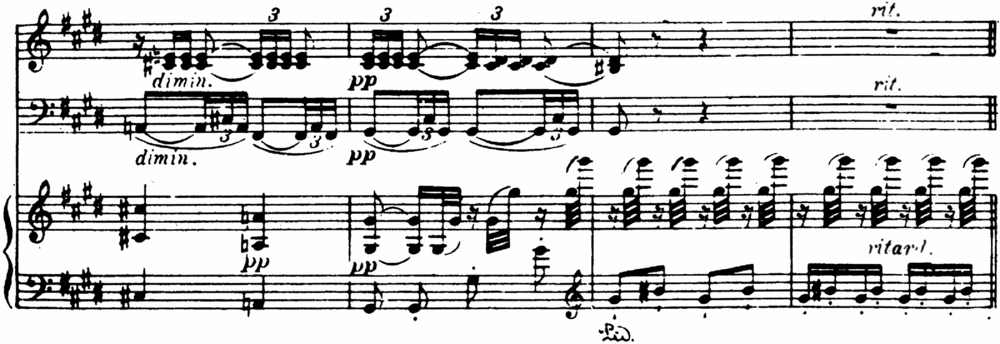
In ‘Rhythm session by the piano’, an empirical episode from the Piano Trio rehearsals, the group decided to sing a difficult polyrhythm instead of playing it, and also to read together from the pianist's full score (see Figure 2). A JPS is constructed around how to get the rhythms correct:
Pianist: Can we do it the way we have done once before, that we read the rhythm together? You don't know what everyone has. Only I can see what everybody's got. And then it is difficult to know what it's like. They all go to the piano.
Pianist: Here. Points in the score and starts counting in.
Cellist: I just have to see what you've got first. [. . .] Oh!
They all speak at once, but one understands that they are discovering what rhythms the others have got. The pianist and the cellist both count in, and they sing the rhythms. Laughter as they stop.
Pianist: Once more?
Cellist: Perhaps we should have had a metronome?
Pianist: Maybe. I can knock. Knocks on the piano and counts in.
Cellist: Aha!
Pianist: This was better. Once more? The pianist counts in and they sing again.
Cellist: Once more! They sing again, and then go back to their seats.
Violinist: We can try to play very clear [. . .] They play the rhythm, with instruments.
Cellist: Oh, I could just listen to you! Directed to the violinist.
Measures 154–157 (Dvořák, Reference DVOŘÁK1973, p. 14).

The ensemble is primarily using practical knowledge resources in order to solve the problem; they decide to sing the rhythms, they keep the pulse by knocking on the piano, and in the end, they play the rhythm on their instruments. The aural awareness becomes salient as all of them are sharing ideas from their mind's ears. The pianist is sharing ideas as she constructs the JPS, and along the way, as she is assessing their performance. As she is knocking the beat on the piano, she is also sharing an idea from her mind's ear: her sense of the pulse. This is similar to Seddon and Biasutti's (Reference SEDDON and BIASUTTI2009) category of ‘non-verbal instruction’, in which the musicians in their study communicated through something they labelled as ‘aural demonstrations’ (p. 127).
Furthermore, when they are about to read and sing the rhythms by the piano, the cellist says, ‘I just have to see what you've got first. [. . .] Oh!’ This comment indicates that the cellist needs to read the other's rhythms as imagined sound before they go on, and the ‘Oh!’ seems to indicate that she is discovering something she did not know on beforehand, and therefore learned by listening to the imagined sound in her mind's ear. After they have played the rhythm on instruments, the cellist also exclaims, directed to the violinist: ‘Oh, I could just listen to you!’ This indicates that the cellist has discovered a new way of orienting herself in the musical landscape of the polyrhythm: she can listen to what the violinist is playing.
The Piano trio seemed particularly satisfied with their way of solving the problem they had described. In the focus group interview, we discussed it closer:
Me: But why did you choose this episode?
Violinist: We have done it once before.
Pianist: Because I think we were aurally aware in a good way. We did it on some of our first rehearsals as well, because there were so many rhythmical things happening in the piece. And then it became easier to play.
Violinist: Also, one time we switched parts and sang different parts, in order to know how the rhythms related to each other.
Cellist: Yes. Know each other's rhythms.
Violinist: Then, you can have your own rhythm in your head while saying someone else's rhythm. [. . .]
Pianist: I also think it was relevant, because this piece [Dvořák] is so, it has many rhythms, or rhythmical things happening. The others are nodding.
Cellist: [. . .] I think it worked doing it like this, and when you do it without the instrument, it's easier to do it with the instrument afterwards, because you have to sort of know it in your head before you know it on the instrument. The others are nodding. [. . .]
(Interview C).
With this comment, the cellist emphasizes that singing the rhythms as they did enhances their ideas of the music in their mind's ears. Having this rhythm session by the piano is an idea the ensemble claims to have got from the aural training course:
Me: [. . .] did you get ideas from there [the aural training course] that you are using now?
Cellist: Yes.
Pianist: Yes. Reading from the score is something we learned there.
(Interview C).
Judging from the ensemble's comments, singing the rhythms before playing them seems to be useful, in particular in the beginning of their rehearsal process.
Incomplete negotiations
The lower right square of the model in Figure 1 has been titled incomplete negotiations. In this way of negotiating musical problem-solving, there is clearly collaboration. All or most of the ensemble members contribute to construct a Joint Problem Space. However, there is a lack of aural awareness, and knowledge resources are not accepted into the JPS. With few or no shared tools, the ensembles’ negotiations are unable to sustain the JPS or even solve the problem.
In ‘It will probably be all right’, an empirical episode from the Clarinet Trio rehearsals, the group decided to work on the rhythm and the phrasing of a transition. The clarinettist is the one identifying this musical problem, and attempts to construct a Joint Problem Space around their lack of coordination. However, they do not manage to construct this JPS. Quite soon, they start constructing another JPS, which is to interpret the composer's intentions, instead of maintaining and solving the original problem, which was to coordinate their playing. Hence, their goal also changes, and in the end they do reach the goal of interpretation, but they do not solve the original problem of timing the crotchets with the cellist's upbeat.
Personal negotiations
The lower left square of the model has been titled personal negotiations. In this way of negotiating, there are few or no shared tools; cooperation is salient, but the negotiations are hardly even cooperative, because only one ensemble member seems to be responsible for the problem-solving. Often, a single ensemble member shows extra energy during the problem-solving process, but is not collaborating much with the others. This makes it difficult for the ensemble to construct a Joint Problem Space, and it is unclear whether the problems are ultimately solved. This is because the problem-solving processes leading to these solutions have an individual character and are difficult to grasp, both for the rest of the ensemble and for the researcher.
Expert negotiations
The upper left square of the model has been titled expert negotiations. In this way of negotiating, there are several shared tools. The problem-solving appears to be cooperative, meaning that each ensemble member seems to take responsibility for only a portion of the problem. One ensemble member therefore appears as an expert at solving the problem that is constructed, or the ensemble members are experts by turns. The one acting as expert suggests one or more tools that are shared in the ensemble. Hence, expert negotiations are a bit disconnected and incohesive, because there are few comments during the problem-solving process confirming – or rejecting – suggestions of problem-solving actions. Yet, one may still call them negotiations, because even though one takes the lead, the others are responding to the suggestions, whether verbally, non-verbally, or musically. It is interesting to note that the ensembles’ problems do often seem to be solved within the expert negotiations.
Conclusion
Complete negotiations were the most common kind found in the episodes analysed, which mean that in the majority of these episodes, the ensembles managed to construct a problem, maintain it, and solve it, and they did this through collaborative negotiations in which different knowledge resources were accepted into the problem-solving process and led to several shared tools. It is within the complete negotiations that the ensembles’ aural awareness is most salient, because they were attentive, they managed to share their ideas from their mind's ear, and they utilized available knowledge resources. It should be noted that the different ways of negotiating were distributed across the three ensembles; no ensemble stood out by emphasizing one way of negotiating.
Summary and educational contributions
The present study has aimed at exploring how undergraduate students negotiate musical problem-solving in their unsupervised ensemble rehearsals, with an emphasis on how they are aurally aware during such processes. The findings show that the most prominent distinction within the ensembles’ problem-solving processes was whether they were aurally aware in a collaborative or cooperative way. During collaborative problem-solving, the ensemble members shared ideas from their mind's ears, as well as musical opinions, in a way that I would call collective listening. During cooperation, the ensemble members shared similar ideas and opinions to a much lesser degree, more in the sense of individual listening. Second, the findings show that the ways and degree to which the ensembles managed to collaborate had an impact on their efforts to improve their musical performance. This conclusion takes into account that aural ideas and knowledge must be shared in order to be negotiated. Hence, four ways of negotiating were identified: 1. Complete negotiations promoting collective listening through several shared tools and collaboration. 2. Incomplete negotiations promoting collective listening, but with less influence on the playing than in complete negotiations, because the collaboration was accompanied by no or few shared tools. 3. Personal negotiations promoting individual listening though a cooperative form of interaction, but with no or few shared tools and cooperation, which ultimately led to little influence on the playing. 4. Expert negotiations, promoting individual listening, because the problem-solving appears so that each ensemble member seems to be responsible for only a portion of the problem-solving.
This study makes two main educational contributions. The first is the two-dimensional model as such, giving analytical insight into how musical ensembles collaborate and negotiate. It should be possible to operationalize this model into ensemble supervision, and to better guide the students in their rehearsing processes. The model might also be informative for professional musicians. The second contribution is the way the study uses a sociocultural perspective to discuss the location of listening within the collective learning situation of ensemble rehearsals, thereby challenging the assumption that listening is merely an individual phenomenon.
Further research might investigate musical problem-solving, collaboration, and aural awareness in ensembles from different theoretical starting points, with different research methods, in other genres and so forth. This is still an area with much research potential.