During the 1820s, the British musical festival underwent a profound shift in function and audience. Contemporary periodicals such as Richard Mackenzie Bacon's The Quarterly Musical Magazine and Review (hereafter QMMR) and William Ayrton's The Harmonicon considered festivals to be entering into a ‘new era’.Footnote 1 These festivals were held on a grander scale than before, included a much larger percentage of the middle class in their audiences and, as Brian Pritchard notes, went from being a local phenomenon to a national one, even becoming a point of national pride.Footnote 2 Between 1823 and 1835, four such musical festivals were held in the city of York.Footnote 3 Organizers hoped to produce festivals that bordered on the spectacular, bestowing civic and musical value onto the city. One of the primary ways to achieve such spectacle was hiring the most famous musicians of the day. Thus, for the first Yorkshire Grand Musical Festival in 1823, the roster of performers included Westminster Abbey organist and Royal Academy of Music professor Thomas Greatorex as the conductor, François Cramer and Nicholas Mori as concertmasters, Robert Lindley and Domenico Dragonetti leading the cellists and the double-bassists, respectively, and Catherine Stephens, Eliza Mundy Salmon, Thomas Vaughan, and William Knyvett, among others, as singers. But the most important individual performing at the festival by far – judging both by the effort the festival's managing Committee put into obtaining her services, and the press reaction to her performance, onstage and off – was the prima donna Angelica Catalani.
Catalani was, as Hilary Poriss puts it, ‘the most renowned (many would say notorious) soprano of her generation’.Footnote 4 Between 1811 and 1828, she appeared in numerous provincial English musical festivals (Table 1). Catalani's performances in these venues led inexorably to a conflict between two distinct aspects of the contemporary musical world: the desire by cultural ‘gatekeepers’, such as music critics, to educate the new, larger middle-class audience in the importance of festival traditions, and the perceived need by festival officials to create large-scale spectacles, via expanded musical forces and the presence of musical ‘stars’, like Catalani, to attract these larger audiences. In the case of the 1823 York festival, as well as festivals at Birmingham, Newcastle, Bath, Cambridge, Manchester and Derby in this decade, the spectacle (Catalani) challenged the tradition (ways of performing Handel's Messiah). This led the cultural gatekeepers to try to use the English allegorical everyman figure of John Bull – as well as the rhetoric of John Bull – as a foil to the Italian soprano, thereby educating the newly expanded audience in manners of both festival and musical taste. Catalani's behaviour at these festivals, and critical reaction to that behaviour, was thus a catalyst for the contemporary musical press to assert concepts regarding ‘the composer's intentions’, and use the idea of festival ‘traditions’ as a way of convincing the middle-class audiences of the concept's validity.
British Music Festivals Featuring Angelica Catalani, 1811–1828

Of course, the middle class (or middling class, or professional class, depending on one's historical bent) had existed before the 1820s.Footnote 5 What made the 1820s so important for the middle classes, as David Cannadine and Dror Wahrman note, was the new rhetorical emphasis on them.Footnote 6 This increased emphasis led to the perception if not the reality that the middle classes needed to be successfully integrated into the cultural life of Britain. Thus, the York Festival's organizers and music critics such as Bacon and Ayrton felt they ought to educate them and acknowledge – even praise – their place. Within The Harmonicon and QMMR, this meant extolling the middle class’ knowledge of music as being as good, if not better, than the aristocracy's, noting with delight their presence at festivals and other concerts, and even the potential of the middle classes to educate the aristocracy in matters of music.Footnote 7 For the York festivals, this meant creating a hierarchic performance space where the aristocracy would be on a platform, literally above the seats available for purchase by the middle classes, but also ensuring that there were more tickets available for purchase by the middle classes than by the aristocracy.Footnote 8 It also meant guaranteeing that the middle class would be able to attend the festival balls, and that their presence would be noted in reports of them.Footnote 9
At the same time that contemporary writers assumed this middle class to be growing in its political ability and cultural consumption, the allegorical John Bull coalesced into a representation of the ‘bemused but complacent everyman’.Footnote 10 In the years leading up to the Reform Act of 1832, periodicals using John Bull employed him ‘increasingly … to show how [the middle classes] differed from what one contemporary called the “follies of vices of the two extremes”‘ – those of the aristocracy and the lower classes – and to portray ‘… a middle class that at long last was finally attaining responsibility and therefore needed respectability to legitimize it’.Footnote 11 The tenets of this expression of the allegorical everyman, however, were built on the shifting needs of different historical events. When created in 1712 by John Arbuthnot, the invented character of John Bull was used to attack Whig foreign policy.Footnote 12 By the 1760s, John Bull came to represent ‘the voiceless bulk of British subjects [who] were the backbone of the nation’.Footnote 13 For six decades, John Bull appeared in caricatures, representing an ‘ordinary, common Englishman, who suffered in the same way as the public suffered … he became the visual expression of what Wahrman calls the “middle-class itself”‘.Footnote 14 John Bull was used during this time to complain about excess taxation, to question the morality of the nobility (especially during the Regency of George IV), and (during the Napoleonic wars) to solidify a national resistance to the threat of foreign ideas and French occupation.Footnote 15 His typical expressions were to cry ‘humbug’ (an interjection declaring the object to be a fraud) and to complain particularly about ‘cant’ (jargon used to whine, or for the purposes of secrecy). As Tamara L. Hunt notes:
John Bull … could function like a Greek chorus, questioning, probing, and commenting on the actions of virtually everyone in the name of the British public. Even when he was wrong, deluded, or ignorant, his good intentions, respectability, and devotion to his family and his nation made him a model for Britons. Generally depicted as a member of the middle classes, he represented the growing self-confidence of that portion of the public, and its burgeoning desire that its leaders share the values and goals John Bull had come to represent.Footnote 16
As will be shown below, Bacon, Ayrton and others used the rhetoric of John Bull – complaining about excessive costs of singers and occasionally expressing a thinly veiled xenophobia – when criticizing Catalani. At times such criticism was implicit, simply connecting into the values that the middle classes as a polity either projected themselves or had projected for them by contemporary newspapers and periodicals. But in one case – a letter to the editor within Ayrton's The Harmonicon – John Bull was used explicitly to castigate both Catalani and the nobility for their taste and lack of sensibility to middle-class aesthetics.Footnote 17
Educating the Festival Audience
One of the most important mechanisms for the production of music in eighteenth- and early-nineteenth-century Great Britain was the musical festival. The origins of the festival were charitable. The first major festivals raised money for families of clergy: the Festival of the Sons of the Clergy in London and the Three Choirs Festivals in Gloucester, Worcester and Hereford. Both festivals – which still exist today – began from massing choral forces together to sing religious services, during which a collection for the charity was taken.Footnote 18 With the inclusion of performances of Handel's oratorios, such as Messiah, Three Choirs grew into what we understand as a choral festival today: a multi-day festival (two or three days were common throughout the eighteenth century) of sacred, semi-sacred and secular compositions. When held in chapels, large churches and cathedrals, festivals would open with a religious service. Once secular music regularly became a feature of such festivals, performances would be split between the religious building for morning performances of sacred music and, after the introduction of Messiah into the cathedral at the Three Choirs Festival in 1759, oratorios as well.Footnote 19
The number of English cities holding festivals grew steadily over the eighteenth century. Frequently occurring ones were organized in Winchester, Salisbury, Oxford and Cambridge; many other cities held them infrequently. The festivals were charitable, social and musical occasions. They gathered together star vocal soloists as well as choral and orchestral forces into the local provincial area that would not otherwise have been possible. With the advent of the 1784 London Handel ‘commemorations’ held at Westminster Abbey and the Pantheon in London, the significance of festivals increased greatly.Footnote 20 William Weber notes that the gigantic forces and deification of Handel put musical festivals onto a ‘national plane’.Footnote 21 Festivals were now regularly advertised and discussed in the growing press, some of the greatest foreign opera stars of the day – such as the prima donna Gertrud Elisabeth Mara – began singing regularly at them, and festival organizers looked to and received patronage from both regional and national members of the nobility. In the wake of the 1784 commemorations, new festivals were founded throughout England, and, after 1800, in Scotland and Ireland as well. Such festivals traded on the fame and spectacle of the commemorations, including frequently copying the Handel-centred programmes and roster of performers. Some, like that of Birmingham, became regular events that began to rival the Three Choirs Festival for prominence.Footnote 22 This era of festival expansion ended in 1810, and was followed by a decade of economic stagnation in Great Britain. Increased unemployment at the end of the Napoleonic wars, as well as agricultural and social difficulties caused some festivals to be postponed, and ended others. Donations from the local gentry and nobility fell.Footnote 23 As economic prosperity increased, in the 1820s, musical festival fortunes revived. Partially this was because of the recovery of the income of the nobility and gentry. With agricultural stability and industrial expansion, incomes for the middle-class professions also grew, which led to an increase of interest in leisure activities.Footnote 24
The desire to educate the new middle-class audiences in matters of taste and festival traditions can be seen most obviously in the histories of many festivals written in the first three decades of the nineteenth century. Authors modelled these histories on eighteenth-century works by John Hawkins and Charles Burney. Frequently, they touched only on the history of a single festival, such as those by Daniel Lysons (the Three Choirs Festival) and George Farquhar Graham (the Edinburgh Festival).Footnote 25 Others had greater ambitions. For the first York festival, local author John Crosse wrote a 436-page compendium. He presented the 1823 festival as a triumphant culmination of the entire history of British musical festivals to that point, and consequently created what was in essence a narrative encyclopaedia of all known musical festivals.Footnote 26 In a contemporary discussion of Crosse's account, the reviewer of the QMMR (likely Bacon) noted how closely Crosse's volume was modelled ‘after the manner of Dr. Burney's Commemoration of Handel, mingling musical facts, criticism, biography and anecdote, in such a succession so agreeable, that he carries his readers on with undiminished interest to the end’.Footnote 27
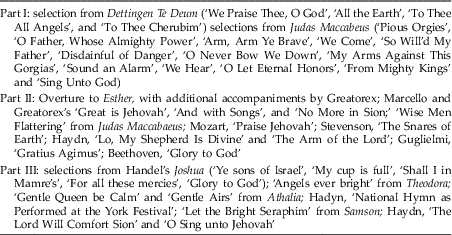
Crosse's historical account focused on how festival traditions coalesced, particularly seen in the after-effects of the 1784 Handel Commemoration concerts.Footnote 28 One tradition was presenting concerts using the same sort of musical organization as had occurred at the 1784 Commemoration.Footnote 29 Morning concerts included a performance of Handel's Messiah (always given complete) and one or more concerts of selections from his oratorios and sacred music, as well as the sacred music of other composers. This was still the typical mode for sacred morning concerts at festivals in the 1820s, even if the selections were not identical to the 1784 concerts; an example may be seen in Table 2a: the Chester Musical Festival of 1829. This festival featured three morning performances held in Chester Cathedral, with two ‘miscellaneous’ concerts bookending Handel's Messiah. A complete version of the programme for one such miscellaneous concert (Tuesday, 8 September) may be seen in Table 2b. This concert includes some larger selections from Handel's oratorios, such as Judas Maccabaeus and Joshua, smaller selections from Samson, Theodora and Athalia, and additional sacred music by Beethoven, Greatorex, Haydn, Marcello, Mozart and Stevenson. By the 1830s, this would change, as some festivals (such as Norwich and Birmingham) began presenting new works complete.Footnote 30 But Messiah was always whole and (mostly) inviolate.Footnote 31 The importance of Messiah to the English festival in this era is well known. While a few evangelical critics voiced occasional scorn of the oratorio and its presence within churches and cathedrals,Footnote 32 most contemporary music criticism described Handel's composition in entirely fulsome terms.Footnote 33 The above-mentioned festival historians certainly did so. Graham included a long extract on Messiah from Burney's An Account of the Musical Performances in Westminster-Abbey and the Pantheon entitled ‘Dr. Burney's Account of Handel's Messiah’ as an appendix to his history of the Edinburgh festival.Footnote 34 Crosse spent 31 pages discussing the execution of Messiah at the 1823 York festival, far more than his discussion of any other composition; there is scarcely a page in his book that does not praise or at least mention the work, and much of his description also reprints large quotations from Burney's Account.Footnote 35 Thus festivals in the first few decades of the nineteenth century attempted both to maintain the programming traditions of the 1784 Handel Commemoration and to use music criticism from that time to cement the importance of Messiah for the new audiences.
Morning Concerts at the Chester Musical Festival, 1829 (information taken from Chester Grand Musical Festival (Chester: Richard Evans, c. 1829), found in the Cheshire Records Office)

Complete List of Works Performed at the Chester Musical Festival, Tuesday, 8 September 1829 (all compositions by Handel, unless otherwise stated)

Festival historians such as Graham and Crosse were only one potential source of taste education for this new, middle-class audience. Much more accessible (and prolific) were writers from the new music magazines, Ayrton's The Harmonicon and Bacon's QMMR.Footnote 36 These critics were increasingly positioned in the 1820s as gatekeepers, and the concert and festival reviews within them, though presented as ‘objective’, were meant at least partially as a didactic aid to lead the newly expanded middle-class audiences into the realm of proper musical taste. This is made clear in the ‘Prefatory Address’ on the first page of the initial issue of The Harmonicon, when Ayrton discusses how the journal was meant to serve ‘thousands of amateurs’ and guide them in ‘correctness of taste’ in music via ‘fair, manly, and open Criticism’.Footnote 37
Indeed, it was partly the emergence of the middle class itself that drove the development of most periodical literature in the first few decades of the nineteenth century.Footnote 38 While a great deal of musical writing published between 1800 and 1845 was meant simply to ‘amuse and instruct’, The Harmonicon and QMMR forwarded specific aesthetic ideals within their pages to advance particular agendas: Bacon was concerned with the promotion of provincial musical festivals, and Ayrton with Italian opera.Footnote 39 Ayrton and Bacon were middle-class professional men themselves. Their opinions might have been occasionally idiosyncratic, but they did reflect the tastes and mores of their class.Footnote 40 Yet two caveats must be stated: first, the print runs of both magazines under consideration were never more than 2,000 copies each, and frequently less. Second, at least Bacon thought that the two publications catered to different audiences. Bacon saw his magazine's audience as musically discriminating and upper-middle class, and thought that Ayrton's The Harmonicon was pitched to a broader, more popular one.Footnote 41 Yet they generally agreed when criticizing Catalani.
The Prima Donna as Spectacle
The sense of projecting tradition and taste onto the audience in the 1820s was increasingly at odds with what festival committees thought these larger audiences needed to stimulate their interests. Organizers believed that the middle-class festival audience required spectacle; besides sheer numbers of musicians (in 1823, following the lead of the 1784 Handel Commemoration, York included a huge number of performers – 459 – for the Minster concerts of Handel's music), the most obtainable spectacle during the decade was the presence of one or more contemporary operatic stars, such as Catalani. She had first been heard on the operatic stage in London in 1806, and was regarded as an immense success.Footnote 42 For much of the next decade she could be heard there, as well as touring the provinces and performing at festivals. Between 1814 and about 1821, she was on the Continent, for a time both singing at and managing the Théâtre Italien in Paris. The 1820s saw her frequently moving between Great Britain and the Continent. She retired from the operatic stage in 1824, but continued to sing at English festivals until 1828. Catalani's return to Great Britain in 1821 was an unalloyed triumph, and great audience enthusiasm made her a natural choice for festival committees to hire her to sing. An early announcement for the 1823 Birmingham Festival referred to Catalani as ‘the finest talent, not that the kingdom, but the world affords’.Footnote 43 Thus, hiring her as the principal soprano for the first York Festival of 1823 became a priority of the Committee.Footnote 44 They certainly believed that her presence at York would be its greatest draw, and consequently acquiesced to a huge salary for her performances – 600 guineas, three times the salary of the next highest-paid performer at the Festival that year, and the highest festival salary for a performer to that date.Footnote 45
Catalani's salary, and her demands of the York Festival Committee, show the potential power of the singer in the 1820s. Her husband, Paul Valabrèque, was likely the source for the most famous anecdote about her: ‘If you want an opera company, my wife with four or five puppets is quite sufficient.’Footnote 46 While all anecdotes are, of course, suspect, this one reveals a kernel of truth: Catalani's devotees considered her much more important than any singer, composer or composition. Her repertoire choices show her to be a singer interested in highlighting the great abilities of her voice over all other potential artistic and aesthetic concerns. Poriss comments that Catalani's performances featured her singing in ‘substandard operas by second-rate composers’ and notes her ‘alleged refusal to perform alongside any prima donnas who were as accomplished, or even nearly as talented, as she was. Instead she insisted on appearing only with third- or fourth-rate singers whose weakness highlighted her strengths …’.Footnote 47 During opera performances in London, she frequently interpolated pieces. While this was a standard practice at the beginning of the nineteenth century for many singers, other singers usually emulated Catalani's particular choices. Thus, her substitution of the virtuosic but musically empty version of Pierre Rode's Air varié in G minor (popularly known throughout the first half of the nineteenth century simply as ‘Rode's Variations’) into the music lesson scene in Simon Mayr's Che originali at the King's Theatre in 1824 helped start a trend of substituting bombastic vocal variation sets into the lesson scene from Gioachino Rossini's Il Barbiere di Siviglia (replacing ‘Contranto un cor’).Footnote 48 Finally, particularly in concert performances, Catalani would transpose to suit her voice – even compositions that were meant for other Fächer altogether, such as ‘Non più andrai’ from Mozart's Le Nozze di Figaro, which she was famous for singing. Her performance of this work at the Argyll Rooms on 16 July 1821 was the audience favourite of the entire concert. Because of this reaction, the QMMR somewhat nonsensically declared that Catalani ‘returns to this country greater when she left it, greatest’.Footnote 49
What qualities made her so desirable? According to the late-nineteenth-century biographer George T. Ferris, Catalani had great beauty combined with a virtuous character:
It is not a marvel that the public was captivated with Catalani. She had every splendid gift that Nature could lavish – surpassing physical beauty, a matchless voice, energy of spirit, sweetness of temper, and warm affections. Her whole private life was marked by the utmost purity and propriety, and she was the soul of generosity and unselfishness.Footnote 50
While her physical attributes were important to contemporaries, aspects of her reputation – as described in the last sentence of this quotation – were perhaps even more so. There was a general suspicion of the propriety of singers and actresses in the first few decades of the nineteenth century.Footnote 51 In Catalani's case, the ‘purity and propriety’ she displayed were accompanied by an extremely public sense of philanthropy, a generosity extended to many of the same sorts of charities that musical festivals supported, including hospitals and poor houses. She even gave back part of her fee at the 1811 Three Choirs Festival when it was ascertained that the festival would only raise £24 for charity in that year.Footnote 52
But beauty, virtue, and charity were but one factor in a singer's popularity; ultimately, long-lasting success depended on the power and quality of the singer's voice itself. Contemporaries described Catalani's voice as unequalled. Crosse's account is by no means unusual for the 1820s:
Endowed with the most extraordinary natural gifts, the image of resistless power and overwhelming magnificence, the first notes of Madame Catalani's voice can never be forgotten by those who have heard it burst upon the astonished ear. With this voice,—extending in its most perfect state from G to F in altissimo, full, rich, and grand in its quality beyond previous conception, capable of being attenuated, or expanded into a volume of sound that pierced the loudest chorus,—she has borne down by force the barriers of criticism, and commanded the admiration of Europe.Footnote 53
Most critics and writers of the nineteenth century are similarly united in proclaiming Catalani's facility as unforgettable.Footnote 54 But many also saw her as being a singer ‘of nature rather than acquirement’.Footnote 55 By this, the writer meant that she possessed great technique but lacked musical feeling and expression. This sentiment allowed Crosse to move quickly from praise to criticism:
Nevertheless, it is we think incontestable, that Madame C. is a singer of execution rather than expression; indeed it is scarcely possible that a person so peculiarly endowed should be otherwise: in the Italian, therefore, and not in sacred, drama, must we look for her brightest triumphs. That her exuberance of florid ornament has not a little dazzled the judgment of the public, and contributed to a declination from pure taste, we venture to express our belief …Footnote 56
Here are the seeds of much criticism of Catalani throughout the 1820s: that her voice was suited only for Italian bel canto-style opera, that sometimes her virtuosity was in bad taste, and that her technique ‘dazzled’ – almost mesmerized – the public, instead of making a strong musical impression on the elite critics. Such criticism only increased in the wake of the 1823 festivals.
Catalani at the 1823 York and Birmingham Festivals: A Tale of Transpositions
Because of the York Committee's relative inexperience, Catalani clearly felt that she could dictate most of her terms for singing at the 1823 festival. The record of correspondence shows that she and her husband and manager Valabrèque easily manipulated the Committee. According to the Festival's Minute Books, Catalani was not contacted to sing until 4 July 1823 for a festival scheduled to begin on 23 September.Footnote 57 In late August and early September, Catalani and the Committee were still negotiating over what pieces she would sing. The Committee wished for her to take part in the performance of Handel's Messiah on the morning of Wednesday, 24 September. Evidently, she agreed, but required the pieces be transposed from the key of E to D major to suit her voice. On 25 August, the Committee sent a letter to Catalani requesting that she ‘open the Messiah provided she consent to sing it in the key of E natural in which it is composed’ – that is, the recitative ‘Comfort Ye’ and the following aria, ‘Every Valley’.Footnote 58
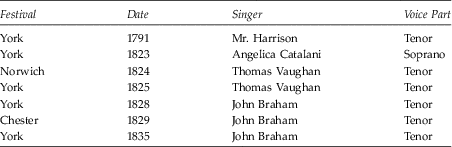
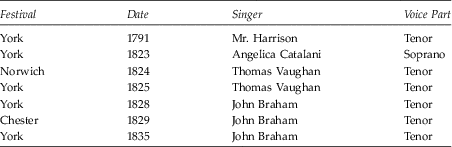
To have Catalani sing the opening of Messiah was contrary to traditional contemporary festival performances. As Table 3 indicates, these opening two selections were considered at the time to be tenor pieces, and were not sung by any other voice part.Footnote 59 The tenor Thomas Vaughan, who sang the excerpts at Norwich in 1824 and York in 1825, was present at York in 1823, and the Committee initially wanted him to sing these movements.
Festival Singer Assignments for Handel's Messiah, ‘Comfort Ye’ and ‘Every Valley’
But Catalani's request caused more than just challenges to the traditional role of the tenor: there were musical considerations as well. To transpose the opening vocal movements from E major to Catalani's D major required transposition of the opening sinfonia from E to D minor as well, making additional work for the accompanying orchestra. Without further transposition, the following chorus, ‘And the Glory of the Lord’, would also no longer be as closely related to the recitative and aria. While the transposition was certainly a sticking point with the Festival Committee, it was Catalani's request to interpolate another composition into Messiah (as she would into an opera) that caused them to assign the opening of Messiah to another singer (possibly Vaughan) on 4 September. On this date, the Committee wrote to Catalani to inform her that no interpolations or changes to Messiah would be possible. Only when Catalani threatened to pull out of the Festival (and leave York without the requisite star-driven spectacle), did the Committee retract the prohibition on the transposition – but not the interpolation of another piece into Messiah.Footnote 60
Thus through tough negotiation Catalani partly won her way with the Committee, and did indeed sing ‘Comfort Ye’ and ‘Every Valley’ in her chosen key of D major. The reaction of the festival's audience is not recorded, but critical condemnation was swift. The Harmonicon stated that ‘such a practice cannot be sufficiently reprobated’.Footnote 61 The QMMR strongly objected to both Catalani's taking the pieces away from the tenor and their transposition:
And there are some points upon which unqualified disapproval must alight – at least we feel it duty to raise our voice against them. These are the concessions made to Madame Catalani in the way of choice of songs and of transposition, at the expence of musical propriety and to the breach of professional delicacy. There never was a more flagrant instance of the one or the other than in submitting (for we cannot imagine it to have been a matter of choice), to the opening of the Messiah [sic] being taken from the tenor by Madame Catalani, and transposed a note lower for her accommodation …. If such a principle be once admitted, there is no saying to what a length it may proceed – certainly to utter confusion, because it goes neither more nor less than to admit that a pre-eminently great performer has a right to choose from treble, tenor, or base … and this too, be it remembered, to the destruction of effects of a most important nature, wherever transpositions are allowed, as for both these instances.Footnote 62
Crosse's history of the 1823 festival went further, condemning the displacement of tradition, but also presenting the issue as one at odds with the composers’ intentions, especially regarding the contrast of keys:
By transposition … the peculiar character of the key in which a piece is composed must be wholly lost; and the order and succession of the keys established by the composer, being thus broken in upon, the contrast intended to be produced thereby, which is of no small importance to the effect of an entire oratorio … is likewise destroyed.Footnote 63
Besides the two opening vocal pieces, Catalani sang ‘I Know that My Redeemer Liveth’, which she also had transposed down a semitone.Footnote 64 While at the Birmingham festival several weeks later, Catalani repeated both the selection and the transposition, and once again the QMMR condemned it on the grounds of the composer's intentions:
Madame Catalani lowered ‘I know that my Redeemer liveth’ half a note – namely to the key of E flat. Surely many of the brilliant and beautiful effects of temperament must be lost by this transposition, to say nothing of interpolating amidst the order of keys which the composer has thought fit to establish! We protest against these innovations, which are certainly not to reform.Footnote 65
Only six sentences in this review of the Birmingham festival were allotted for a discussion of Messiah, and the rebuke of Catalani's transposition garnered three of them. In the last sentence, the author identifies this as an ‘innovation’ of Messiah, but not one (like, for instance, the use of Mozart's accompaniments) that was meant to ‘reform’. Instead, the practice was condemned because it suited the singer and not the composition.
From Transposition to Interpolation: Catalani's Response to the Festivals, 1823–24
In the wake of the 1823 York and Birmingham festivals, Catalani appeared to pay little attention to these criticisms. She continued to transpose Handel at festivals. For a short time – the 1824 festival season – she even sought to insulate herself from the demands of committees by refusing to sing at festivals unless she was allowed to direct them herself, taking on much of the control traditionally held by both committees and a festival's conductor. In doing so, Catalani did not work for a salary, but instead for a percentage of ticket sales at the door. In addition to her vocal services, Catalani would arrange and secure the other singers, the music director, a concertmaster, and the principal cellist. Three acquiesced: the 1824 festivals at Bath, Cambridge and Newcastle-upon-Tyne.Footnote 66 In each case, after expenses were paid, one fifth of the profits went to the assigned charities, and Catalani took the rest for herself. Catalani made £400 from the festival at Cambridge (less than her 600-guinea salary at the 1823 York festival), but made over £1000 at Newcastle. Once given the opportunity to control the festivals, Catalani continued her transpositions of ‘I Know that My Redeemer Liveth’ at Newcastle, and she sang transposed versions of both ‘Comfort Ye’ and ‘Every Valley’ at Cambridge.Footnote 67
Such control over the festivals, however, led Catalani to treat the ventures even more like operatic performances: at Newcastle, Catalani interpolated other arias into Messiah. Between the first and second part of the oratorio, she sang Pietro Carlo Guglielmi's ‘Gratias agimus’. This piece was evidently written by Guglielmi for Catalani, and, like many pieces written for her, it is predicated on its melody, gives great opportunity for the vocal soloist to engage in florid ornament, and requires a larger than normal range for the soprano. It is operatic in style, and not at all solemn or contemplative. Musical critics condemned the practice, but she continued: when Catalani returned to England to sing at festivals in 1828 (only as a singer, and not as a director), she repeated such interpolations at Derby and Manchester. The former was the aforementioned Guglielmi composition; the critic from The Harmonicon, when discussing Catalani's interpolation at this festival, was succinct in condemnation, stating that he had ‘never witnessed a more ludicrous exhibition…’Footnote 68
The interpolation at Manchester was ‘Domine, Labia mea aperies’ by Pio Cianchettini. The piece had been in Catalani's repertoire for several years; she sang it at both the York and Birmingham festivals in 1823 in the miscellaneous sacred morning concert, and it may have been the composition she requested to interpolate into Messiah in York that year. The piece was published in 1823 as a souvenir of the York and Birmingham festivals, as is evident from its title page.Footnote 69 Cianchettini's style in ‘Domine, Labia mea aperies’ is about as far from Handel's oratorios as one can venture. It is arranged like a bravura aria, with a slower cabaletta (an Andantino) to the text ‘Domine labia mea aperies et os meum os um annuntiabit ladem tuam Domine’ and a faster cavatina (an Allegro Giusto) to the ‘Gloria Patri’ text.Footnote 70 A short excerpt from the ‘Gloria Patri’ section (bars 35–44) will suffice to show the general elements of the piece. The lower vocal staff of Example 1 presents the work as published for potential amateur performance. The ossia staff above presents it ‘as sung by Catalani’ – a parallel set of the performer's ornamentations published in the score. The ornamentations themselves are typical of ones used by Italian opera singers of the time. Here, they were perhaps ‘saleable’ because of their associations with Catalani. Both versions use identical uncomplicated harmonies; while the composition as a whole is in A major, this section is in the process of tonicising the dominant E in a straightforward fashion. Aside from the use of D♯ as a leading tone, there are no accidentals. The accompaniment is also simple, with syncopes in bar 44 being its only moment of rhythmic complexity. Only the melody of the work is ornamented with additional scalar passages. The overall effect is one of florid cheerfulness. The style is obviously radically different from both what would be expected in a general performance of sacred music and Handel's Messiah itself.
Pio Cianchettini, ‘Domine Labia Mea Aperies’ 51st Psalm and Sacred Bravura ‘Gloria Patri’ as Sung by Madame Catalani at the York & Birmingham Musical Festivals (Dublin: L Willis, [1823]). Parallel Versions: Simplified Melody (lower vocal staff) and Catalani's Ornaments (upper vocal staff).
Critics were quick to condemn both the composition and its interpolation into Messiah. Crosse noted that when sung in a morning miscellaneous sacred concert at the 1823 York festival, ‘Domine Labia mea aperies’ did ‘not admit of much dignity and elevation’ and further ‘would probably afford greater pleasure in a concert room than in a cathedral’.Footnote 71 This was gentle condemnation, but condemnation of the style itself as improper sacred fare at a festival. When the composition was interpolated into Messiah at the Manchester Festival of 1828, criticism ran deeper. The reviewer from The Harmonicon noted in horror the complicity of the Manchester committee in presenting this interpolation (since the text for Cianchettini's composition ‘actually was printed as part of the text of The Messiah!’) and referred to it succinctly as a ‘gross blunder’.Footnote 72 The reviewer forgave the Manchester committee, stating that its relative inexperience likely caused it to be bullied by the singer, but he roundly criticized the conductor (Greatorex) for allowing the interpolation. The review in the QMMR was also brief, simply calling the inclusion of Cianchettini's composition in Messiah ‘the climax of absurdity’.Footnote 73 In the case of all three reviews, the remarks were short, disparaging and calculated to show that Catalani had poor taste.
The discussion of Catalani's taste included numerous attacks on her repertoire choices. By singing ‘showcase’ works that emphasized floridity, like those of Guglielmi and Cianchettini, she left herself open to criticism that her taste in music was insubstantial. This corresponds to Poriss’ tenet that, in the opera world, Catalani ‘insisted on singing arias that were perceived by many to be void of aesthetic value.’Footnote 74 Because of her behaviour at the 1823 York festival, Crosse could describe Catalani as not engaging in ‘serious’ repertoire, since she had not ‘shewn much predilection for the works of Mozart … [nor] until very recently, selected many of Rossini's compositions for performance.’Footnote 75 Crosse further criticized Catalani's choice of both Guglielmi and Cianchettini, claiming that by singing them, Catalani ‘degraded’ her voice by treating it like an instrument.Footnote 76The Harmonicon, discussing the Birmingham festival of 1823, concurred with many of Crosse's opinions. Catalani's singing of Cianchettini's ‘Gratias, agimus tibi’ was unfortunate: ‘it would have been charming anywhere but a church; it was too florid for the place’. Further, her performance of ‘Holy, Holy, Holy’ from Samuel Arnold's pastiche oratorio Redemption – the aria itself based on ‘Dove sei’ from Handel's Rodelinda and frequently heard at contemporary festivals – ‘showed how a fine composition might be misunderstood, and great talent misapplied’. Catalani's performances of additional works by Cianchettini and Francesco Morlacchi were compositions ‘not to be commended’ and did not make the writer ‘wish to court a further acquaintance with the author [composer]’.Footnote 77 To these critics, Catalani's favoured bel canto repertoire failed aesthetically, and she herself failed as a singer when attempting to sing traditional festival fare.
Critical Reaction: Condemnation of Catalani's ‘Foreign’ Taste, 1825–28
Catalani's transpositions and interpolations consequently increased criticism of her singing. This criticism focused on her technical abilities and (increasingly) her Italian origins, to show that not only was her taste poor, it was also not English. Condemnation of Catalani was found in musical journals as well as in other media that publicized festivals or even used them as a dramatic backdrop, including poetry and drama. It counted on a sense of outrage that the middle-class audiences would feel regarding Catalani and her alterations to Messiah, and it used stereotypes about singers as well as a reference to John Bull in attempting to curtail her power and influence.
Such criticism was often vindictive. York held another festival in 1825, and Catalani contacted the Festival authorities by 17 January of that year, offering her services to sing at it, on the same terms as 1823. The Committee responded on 9 February that her services would not be required. From 4 April to 30 May, the Committee briefly considered engaging Catalani again, on the conditions that they could pay her less (500 guineas instead of the 1823 salary of 600), and that she would sing no arias from Messiah transposed. The Committee would not yield these terms, and Catalani did not accept them.Footnote 78 Even though she did not sing at the 1825 festival, writers still found a way to castigate her by recalling her behaviour at the festival in 1823. For instance, the article reviewing the entire 1825 festival in the QMMR discussed Catalani's insistence on singing the opening two vocal selections of Messiah and her demand to transpose them at the 1823 festival from the point of view of the Festival Committee. This history was a prelude to a sweeping criticism, questioning her judgment:
The Committee consulted the dignity of the meeting in the endeavour to engage Madame Catalani, who by the majesty of her transcendent power and by many other requisites, stands beyond all question at the top of the profession; but they did not consider it less when they courageously determined to adhere to the laws of fine taste and mature judgment, though the loss of her great talents to the celebration was the consequence.Footnote 79
‘Great’ as her talents might be, Catalani was not welcome at the 1825 festival; allowing her presence and performance (according to the passage) would have been a poor example, since it would upset the ‘laws of fine taste and mature judgment’.
The official history of the 1825 festival went further, speaking to ideas of xenophobia.Footnote 80 The majority of this 48-page pamphlet consists of lists of the repertoire performed, as well as the names of the festival's performers, organizers, members of the nobility and gentry present, and the attendees at the costume ball and their outfits. Yet four paragraphs were devoted to a denunciation of Catalani – a performer who was not even engaged to sing at the festival. The report traced the same history described in the paragraph above, but blamed the failure in negotiation on Catalani's husband and manager, Valabrèque: ‘… by the extreme insolence of his pretensions, and the meanness and illiberality which mark his conduct, he has succeeded in producing a most unfavourable impression against Catalani’. After this condemnation, the history attacked foreign musicians who ‘inundate’ England and ‘bask in the sunshine of our liberality, till they have enriched themselves at the expense of our too credulous countrymen – and afterwards turn round, and sting the hand which feeds them …’. While criticizing Catalani by association, the passage was quick to point out that Catalani did ‘not deserve to be classed with these mercenary adventurers’.Footnote 81 This is a rapid change in rhetorical tactic, and the discussion of Catalani's potential worth that followed (mentioning her charity and sincerity) is not written as powerfully as the condemnation of the ‘needy foreigners’. Further, the author of the history continued by referring to Catalani's transposition requirements as ‘interfering’:
The negociation with this lady failed, after pecuniary terms had been arranged, in consequence of a stipulation on her part having been insisted upon, of interfering in the transposition of several songs into a lower key, to suit her voice – a condition, which though conceded by the Committee with respect to detached songs, was firmly opposed in the instance of songs which were connected with choruses; as it could not have been acceded to without considerable disadvantage to the performances.
Finally, in a footnote to this paragraph, the author noted that ‘… Catalani ruined’ the performance of ‘Sing Ye unto the Lord’ from Israel in Egypt at the 1824 Newcastle Festival by transposing it. Thus, the anonymous history both plays on stereotypes (the greedy impresario; the ‘needy foreigner’) as well on the need to curb the prima donna's musical excesses in order to assure musical success (transposition would create ‘considerable disadvantage’ and even potentially destroy a performance). The history's narrative presents the Committee's refusal of Catalani's singing as inevitable; doing so was partly patriotic, and partly required because of her character and the poor taste of her musical desires.
More pointed implicit and explicit criticism of Catalani appears in souvenir literature from the festivals, such as books of poetry praising the York performances in epic-style verse. One, by John Nicholson for the 1825 festival, continues the xenophobic strand from the anonymous An Account of the Second Yorkshire Musical Festival. His poem mentions Catalani directly, contrasting her ‘Italian trills’ with patriotic ‘British songs’:
Though Madame Catalani be not there,
Braham, to England's bosoms, is as dear:
For shall our native poets’ words give way,
To foreign lines, forgot ere ends the day?
To foreign pride shall British genius bend,
While Albion's isle to Braham is a friend?
No – British songs, well touched in ev'ry part,
Are those which please the best, and reach the heart:
Italian trills may thro’ fine feelings creep,
But Braham's voice can make the stoutest weep.Footnote 82
The contrast with Catalani was obvious and pointed, especially given the description of Braham as a ‘friend’ of Albion, whose music would ‘touch the heart’ of all Britons. This is in direct opposition to the music of the Italian singer, which would ‘creep’ only through ‘fine feelings’. Braham, to this poet, was the singer who would communicate best with the majority of the audience precisely because he competently executed British songs. Opposing the ‘heart’ to rarefied feelings further played on the practical everyman represented by John Bull. Earlier, the poem identified Handel as one of the ‘native [English] poets’. The rest of this verse insists that such words belonged to singers like Braham, and not foreign ones like Catalani.
Sometimes, criticism of Catalani was subtler than such explicit references in poems, and required the reader of souvenir literature to have at least a basic understanding of current musical events. This is clearly shown within a satirical play about anti-Catholicism in York; the work was published for the 1828 festival, at which Catalani once again sang.Footnote 83 Satirizing festivals in general and York in particular is a major part of the verbal scenery of this play, and Catalani – though not specifically identified – is not immune from it. The fictional festival's two prima donnas cause no end of trouble for the Committee. The English Mrs Lemon is secretly pregnant with the antagonist's child and consequently cannot sing at the festival; the Italian Signora Rimbombardi absolutely refuses to sing unless she has rum jelly supplied to her before, during and after all the concerts.Footnote 84 The satire on Rimbombardi is an attempt to make the prima donna seem both petty and intransigent: like Catalani's behaviour at the 1823 festival, Rimbombardi would not sing unless her demands (presented here as extremely silly) were met.Footnote 85
Perhaps the strongest criticism regarding Catalani's ‘foreignness’ came wrapped in the persona of John Bull through that most English of epistles, a ‘letter to the editor’ of The Harmonicon under the pseudonym ‘Clio’. This letter was published immediately after the journal's own less-than-dispassionate review of Catalani's 1823 performance at the Birmingham festival. Clio noted Catalani's beauty and technical talents, but concluded that because of defects, she was not musical enough to perform Handel properly:
Beautiful she is, with an expression of countenance truly fascinating; her voice, too, is powerful and flexible in an astonishing degree, and her shake the most perfect that ever was, or will be heard. But Catalani is deficient in one of the indispensible qualities of a singer,–She has a bad ear: when she conceals this imperfection by adhering to passionate recitative and airs of intricate execution, all goes on well; but when the lengthened melodies of Handel are attempted by her, the charm is dissolved.
Madame Catalani sung in the course of the present performances ‘Angels ever bright and fair’, and she sung it half a note below the orchestra, for which extraordinary feat, the President, high seated among the great dons and donnas in the chancel gallery, held up, for I think the third time during the performance, the silent but expressive symbol of encore!–Alas, Mrs. Salmon, Miss Stephens, Mr. W. Knyvett, Mr. Vaughan, where were your encores? Not one to either [sic] fine singer.–This, sir, is sickening, and I shall begin to think of cant, and humbug, and other John Bullical expressions…Footnote 86
Clio's opinion is clear, and Catalani's purported faults as a singer were laid bare in her selection from Handel's oratorio Theodora. Catalani could not execute Handel's ‘lengthened melodies’ – a direct musical communion by England's ‘native poet’ (in the words of Nicholson, quoted above). Instead, the foreign musician could only successfully sing music that Clio implied to be vapidly virtuosic, emotionally undignified and even possibly licentious. She was incapable of properly singing the very music beloved by the expanding English festival audience – the same music that journals like The Harmonicon promoted to the middle classes.
Clio's use of John Bull in the last line of the quoted passage was a way to interpolate a broad range of complaints about the singer and the nobility into one compact criticism. As John Bull was usually depicted as ‘a steady fellow who refused to be overborne by show without substance’,Footnote 87 the discussion of Catalani's musical faults within Handel's ‘English’ music (the substance) becomes all the more damning, since she could only cover this in ‘passionate recitative and airs of intricate execution’ (the show). But Clio's assertion goes much further than this, since John Bull's ‘hatred for foreigners was one of his fundamental traits.’Footnote 88 The writer conflates playing on middle-class xenophobia and the suspicion of the ‘follies of vice’ of the nobility by forcefully identifying the status of those who not only accepted Catalani's purported defect but praised it over other ‘fine’ English singers: members of the English nobility, those therefore less likely to identify with the constructed middle-class English values of John Bull. Clio sarcastically addresses this portion of the audience as the ‘great dons and donnas’, pointedly using the Italian, and not the English, form of address to the nobility. The writer is also incredulous of the behaviour of the President of the Festival, Charles Chetwynd Chetwynd-Talbot, the Second Earl Talbot. Talbot was a politician and former Lord Lieutenant of Ireland, president of the festival by virtue of the tradition of being the highest-ranking member of the nobility from the festival's vicinity willing to be a patron. As was the case at many contemporary festivals, he had the privilege of calling for encores.Footnote 89 Talbot requesting Catalani to encore a bad performance is used to show the vapidity of the nobility's taste, while Clio's reaction – to utter ‘John Bullical expressions’, ‘cant and humbug’ – aligns the writer with middle-class tastes. Further, the writer shares John Bull's horror of monetary excess, as he expresses great disdain at the high salary paid to Catalani, referring to her conditions for performing at Birmingham to be a ‘sweeping clause’ and noting in astonishment that ‘It is confidently said, that this lady's remuneration for singing at the church and theatre, was six hundred pounds!’Footnote 90 The substitution of distaste for salary rather than taxes (John Bull's usual complaint) is but a small step for the reader to undertake.
Conclusion: Money, Taste and Catalani at York in 1828
For a singer of Catalani's popularity, such rebukes likely were mere pinpricks, but their existence speaks to a shifting musical world. This world was one in which the vocalist should no longer reign supreme, even if she did so in the minds of the nobility and even some of the public. All Catalani's demands at the 1823 York Festival were standard behaviours within the world of the London opera stage when Catalani first sang there, from 1806 to 1814.Footnote 91 But for festivals of the 1820s, such operatic practices required bulldozing expected elements of tradition and propriety. Even if Catalani engaged in them for the next few years in other locales, they could not continue.
After the denial of her services at the 1825 festival, the Committee invited Catalani back for the 1828 York Festival, on markedly different terms. The invitation was authorized on 20 February of that year, some six weeks after other singers were approached for their services, and Catalani agreed (by 2 April) to the same 600-guinea fee she received for the 1823 festival.Footnote 92 For the festival Committee, then, the problem was not one of finances: clearly they thought her worth the expense. But her participation included specific conditions: that she would not ‘open’ Messiah (singing the first recitative and aria pair) or interpolate any other pieces into it. Even though she was allowed to transpose ‘I Know that My Redeemer Liveth’ (an aria not attached to a chorus), the press roundly censured this as a ‘mutilation’.Footnote 93
Responding to her fee and musical practices, the QMMR condemned Catalani's presence at the Festival. The discussion included a new argument, a claim that her star power was unnecessary for musical and charitable success:
… it is with regret we relate, because we consider it to be a practical error of the greatest consequence to these celebrations, that it was determined to offer Madame Catalani the absurdly exorbitant sum of Six Hundred Guineas for her [name rather than her] [sic] services. We say this with no invidious feeling towards Madame Catalani, whose astonishing supremacy we have been ever amongst the foremost to acknowledge. But admitting that she had more abilities than she possesses, we deny the propriety – we deny the policy of such extravagant terms. No singer can be worth such an expenditure, when taken in addition to the rest of the mighty preparations which the York festival embraces.Footnote 94
The passage contains reference to the criticism of Catalani's talents common in the festival press between 1823 and 1824 and again in 1828 (‘admitting that she had more abilities than she possesses’), but focuses much more now on how the expense of her spectacle was ‘extravagant’. And, in a style typical of John Bull, the writer identifies her behaviour as typical pecuniary overreaching by foreign singers. The passage continues, accusing others, including Giuditta Pasta and Henrietta Sontag, of the same sort of monetary vanity:
No singer would ever think of asking such terms, did committees understand their own interests, their own dignity, their own power, and steadily and in conjunction refuse them. Pasta asked five hundred guineas for Norwich. The offer was instantly and peremptorily rejected. She came to the evening concerts, on her own application, for £200. Now mark the contrary effect. Madame Sontag, encouraged by her Cambridge engagement, demanded for York and Manchester no less than Two Thousand Three Hundred Pounds for herself!! And Two Hundred for Mr. Pixis!!! Such a demand was too monstrous for even the prodigal liberality of Yorkshire and the young inexperience of Manchester – and Mademoiselle lost it all. A negotiation began with Madame Pasta also fell to the ground on account of the high terms demanded by that lady.Footnote 95
Thus, for this period, Catalani's monetary demands were by no means unusual, just more successful than those of her contemporaries. And even if organizing committees flouted these other singers’ monetary demands, they acquiesced to some of the same musical behaviours for the rest of the decade. Indeed, Pasta also insisted on interpolating Guglielmi's ‘Gratias agimus’ into Messiah (before the chorus ‘Behold the Lamb of God’) at the Leicester festival in 1827. Contemporary critics, including those from the QMMR, lambasted it; the only difference between this criticism and that of Catalani was that in Pasta's case, the journal stated simply that, ‘Such a monstrous anomaly requires no comment’.Footnote 96
Pasta and Sontag were cited for their errors and overreaching, but only Catalani evidently deserved critical rebuke for her musicality. The denouncement of the musical journals continued in An Account of the Third Yorkshire Musical Festival (1828), but with a nationalist, rather than a pecuniary slant. Catalani's singing was both criticized and praised, depending on the composition performed; the anonymous author described her performances of Arnold's ‘Holy, Holy, Holy’ and a transposed version of ‘Luther's Hymn’ as ‘failed’ and ‘not redeem[ing] her credit’, and her singing of a piece referred to as ‘Sarmiento's bolero’ as ‘surprising, but not pleasing: and though, during the performance of it, we wondered at the powers of the singer, it left no impression on the feelings afterwards.’Footnote 97 Her performance of ‘Rule, Britannia’, however, came in for great praise:
She never sang it better: and the majesty of her attitude, the energy of her action, the lightning that sparkled in her eyes, and the intelligence which shone in every feature, might well have caused her to have been taken for the Genius of the Island, descended to animate her sons to resist the threats of haughty ‘tyrants,’ and to induce them, with a determined resolution, to declare that they never would be slaves.Footnote 98
Thus, even if Catalani's performance of either sacred music or Italian secular music was not to the taste of the writer, she could animate and even convince through her performance of British patriotic words.
Yet even this praise was belied in the history by two means: first, a substantial footnote rehashed the story of Catalani's transpositions at the 1823 festival and the Committee's subsequent refusal to hire her in 1825. Included in this discussion was a damning criticism:
She appeared at the [1828 Derby Musical Festival] for the first time after her return, and the papers were loud in their praise. A musical friend of ours, however, whose opinion is bourne out by the result of her performances, told us, she sang wretchedly, and that if the York Committee had heard her there, they would not have given her £60! So opinions differ.Footnote 99
The rhetorical stroke at the end (‘So opinions differ’) does nothing to alleviate the attempt of this passage to present a strong suspicion in the mind of the reader that Catalani was overpaid, and her abilities could no longer support the mania her appearances typically garnered.
The opening of the Account also contained a ten-page patriotic history of music in England, to prove the thesis that ‘to say that such a country is not musical, is an absurdity.Footnote 100 Throughout, this narrative attempts to distinguish between English taste in music and the ‘natural’ presentation of music in other countries by the labouring classes: ‘It has been falsely and foolishly said that England is not a musical nation. We admit, that our labourers do not go singing in part about the streets, as in Germany, nor do our watermen emulate the gondoliers of Venice, who warble their barcaroles, as they ply their oars …’Footnote 101 When discussing Italian singers of the present time – the 1820s – this brief history turns Catalani into an ‘other’, presented as both foreign and an example of excess. She was a singer who
… brought to England the vices of some singers on the continent, and formed a new school, who sang their own music instead of that of the composer, if the latter was not sufficiently calculated to set of their own peculiar achievements; and ‘Composers (those of Italy especially) now thought themselves compelled to yield to the torrent, for they found that the singer transmuted their passages at will;—in their own defence then, they thought themselves obliged to fill their scores with notes, in order to secure themselves against the chances of bad taste in the execution.’Footnote 102
Thus, the modern composer was merely in thrall of the singer, doing her will – even if the consequence was music for show and devoid of taste. The spectacle of Catalani at York by 1828 required criticism from many quarters in order that the audience understood her power, her faults, and – for John Bull's adherents, especially – her foreign difference from English sensibility.
For a brief period, Catalani, the most famous soprano of her time, felt that she could dictate operatic terms to musical festival committees. After 1828, because of such criticism, festival committees did not show the same deference to singers’ demands as they had for the five previous years. Partially, this was because many of the festivals discussed in this essay, which wanted to use spectacle to make an impact – York, Derby, Leicester, Cambridge, Manchester, Bath, etc. – did not survive the economic vicissitudes of the 1830s. Musical stars, while still considered important to the general success of festivals, were paid far less in the following decades after various agricultural and industrial shocks.Footnote 103 And with the developing interest in the ‘composer's intentions’ or the ‘work-concept’, vocalists, festival conductors, and above all festival committees left Messiah alone.Footnote 104 The opening of the work remained firmly in the hands (or voices) of tenors such as Braham and Vaughan, and the musical demands of prima donnas such as Catalani diminished, all while John Bull (both allegorically and by his representation, in the guise of the increasingly powerful middle classes) attended festivals with great pleasure.