Schoolteacher and judge James Gilchrist Swan (1818–1900) resided in Washington Territory (now Washington State, USA) in the mid- to late nineteenth century. Living and working in both Port Townsend and the Makah Reservation on Neah Bay, his ethnographic knowledge of Northwest Coast Indigenous peoples was published by the Smithsonian Institution, either as monographs by Swan himself or incorporated into writings of his contemporaries. Swan's collection of anthropological and natural-history materials in the 1870s and 1880s relied on a ‘colonial infrastructure produced by a combination of state, corporate, and religious agencies operating along the Northwest Coast’.Footnote 1 At the request of Smithsonian Institution secretary Spencer Baird, Swan made collections of Indigenous material culture from the Queen Charlotte Islands, a place known by its original inhabitants and stewards as Haida Gwaii. These collections are now held by the Smithsonian's National Museum of Natural History (NMNH) in Washington, DC.
Swan collected all the objects classified by the late nineteenth-century Smithsonian's US National Museum (USNM) staff as Haida rattles.Footnote 2 Thirty-five rattles were entered into museum records between 1881 and 1885 in four accessions, the majority collected from the Haida communities of Masset and Skidegate. Most are of a globular form, intricately carved of cedar and vibrantly painted, and formally depict a variety of subjects: from fish hawks, ravens, bears and anthropomorphic faces to geometric designs. Of these thirty-five rattles, only seventeen remain in the collection. While the itineraries of four rattles no longer held by the Smithsonian remain untraceable, fourteen are known to have been exchanged by the Smithsonian with other museums in the United States and abroad. The historical particularities of these objects’ itineraries are underpinned by norms of specimen exchange: its function as a means of diversifying collections, the exchange of duplicate specimens and the reckoning of exchange equivalence, and the utility of specimens received through exchange for exhibition and education.Footnote 3
This article considers how the USNM's catalogued anthropological museum specimens were designated by late nineteenth-century curatorial staff as exchangeable duplicates using rattles from Haida Gwaii. The categorization of specimens as duplicates has been considered primarily in museum-based contexts, to which articles in this issue add critical institutional breadth.Footnote 4 In its use as both a descriptive modifier and a noun, ‘duplicate’ may be defined as an ‘exact counterpart’ or a number of things ‘exactly or virtually alike’.Footnote 5 In the context of the natural-history museum, I suggest that duplicate specimens were illustrative, material representatives of knowledge categories deemed alienable by their possessors, on the condition that the specimen's presence was no longer required for institutional needs and practices. In his discussion of the division of the USNM's collection into series, assistant director George Brown Goode pronounced that ‘it has been the long-established policy of the Museum to reserve only a sufficient number of specimens’ to permit the author of a monograph to completely re-create that knowledge.Footnote 6 Specimens needed for knowledge production were retained in the ‘reserve series’, while ‘duplicate[s]’ were taken out of the reserve, to be used for exchange.Footnote 7
Within a museum-based context, I begin by suggesting that ‘duplicate’ is a contingent status conferred on objects with respect to epistemological practices associated with natural-history taxonomy as enacted by nineteenth-century anthropologists. USNM records demonstrate that specimen exchange was a routine practice in the late nineteenth century, one which is necessarily understood by considering related practices of collecting, cataloguing, publishing and spatially organizing objects in the museum. I limit the discussion of these practices to the USNM, and closely analyse existing evidence such as collection catalogues and publications, which I contextualize with correspondence and other textual sources. I also discuss the formal qualities of a sample of Haida rattles, both retained and exchanged by the USNM. I argue that anthropological duplicates were produced by nineteenth-century curatorial staff through operationalizing similarity with respect to object names and forms, and that these decisions were shaped by catalogue technology and storeroom arrangements, as well as by the epistemological space of disciplinary praxis.
Unpacking duplicate specimens
In the late nineteenth-century USNM, an anthropological specimen's categorization as a duplicate was contingent on its similarity to other like objects within its proximity, the veracity of its material representativeness to a category of anthropological knowledge, and its alienability.Footnote 8 A specimen becomes a duplicate when, over the course of its social life, it meets these temporal–spatial, epistemic and political criteria.Footnote 9
In arguing that a specimen is a material representative of a knowledge category and a duplicate specimen is an alienable representative, I offer an example from one of the USNM's natural-history departments in order to draw out some epistemological considerations of nomenclature. In the 1881 Proceedings of the United States National Museum, curator Richard Rathbun published a list of marine invertebrates available for distribution from the USNM, which exemplified the diversification of the ‘knowledge networks’ which mediated and organized ‘flows of data’.Footnote 10 These specimens had been collected by the US Fish Commission (USFC), a federal scientific organization charged with monitoring and promoting conditions to support commerce in fish and aquatic resources in the coastal and inland environs of the United States. In addition to his role at Smithsonian, Baird was the USFC's first commissioner, which resulted in close interorganizational efforts toward the collection, assessment, and curation of aquatic specimens.
Rathbun's list was made up of ‘species’ representing ‘a portion of the duplicate material’ from the USFC's recent explorations. The first enumerated knowledge category on the list reads, ‘1. Gelasimus pugnax Smith. U.S.F.C. – Narragansett Bay, R.I., shore.’Footnote 11 The Latin binomial refers to a species or knowledge category, the common name of which is the Atlantic mud fiddler crab or Atlantic marsh fiddler crab, first described by USFC crustacea specialist Sidney Irving Smith in 1870, in Transactions of the Connecticut Academy of Arts and Sciences. In publishing the species, thereby entering it into zoological taxonomy, Smith noted that he had arrived at the description after ‘examining carefully more than a hundred specimens’, and finding only ‘the slightest variations’ among them, save for a single specimen he considered to be ‘a remarkable exception’.Footnote 12 While Smith notes studying over a hundred specimens in the course of his scientific labours, not all these biological individuals would be needed perpetually to validate his findings. At this time, the description of taxa was based on characteristics exhibited by many individual crabs, each of which functioned as a material representative of the knowledge category.Footnote 13 No holotype, or name-bearer specimen, was provided, and there is no indication that the illustrated crabs in Transactions are linked to individual crab specimens. Shifts in biological nomenclature conventions in the 1890s ushered in new taxonomic practices, specifically the ascendance of the holotype, where knowledge categories (taxa) were tied to distinct individuals.Footnote 14
Rathbun's 1881 list indicates that not all USFC/USNM-collected G. pugnax crabs would need to be retained by the USNM. Rathbun had determined which and how many crab specimens were placed in the reserve series, materially representing the knowledge category. These specimens were kept in order to document intraspecific variability, or the degree of variation that was tied to the knowledge category of G. pugnax at Rathbun's curatorial discretion.Footnote 15 Those remaining, that could adequately materially represent G. pugnax in other organizational settings, were referred to as duplicate material and would be removed from the USNM's stores, freeing up space that was always in short supply. Once integrated in a different museum or university, these specimens would no longer be considered duplicates, as they would materially constitute the knowledge category in that particular organizational space, joining the equivalent of that organization's reserve series. This alienable quality of duplicate specimens intersects with Staffan Müller-Wille's discussion of natural-history data as extractable, a characteristic necessary for redistribution.Footnote 16 Further, duplicates’ quality of alienability are evidenced by their mobility. While Driver, Nesbitt and Cornish have argued for a broader consideration of how museum objects have long been imbricated in global circulations, duplicates are particularly visible in moments of exchange.Footnote 17 Indeed, Fleming suggests that it is the circulation and mobility of duplicate specimens as a currency within ‘barter forms’ of exchange which serves to strengthen the circulation and use of standardized species names.Footnote 18 As a counterpoint to their mobile duplicates, museums made a concerted effort only in the late nineteenth century to ‘mark, conserve, and register’ their type specimens, to immobilize them, in an effort to stabilize botanical nomenclature.Footnote 19 Duplicates are specimens most commonly discussed in contexts where a museum would alienate, or no longer curate, a particular specimen.
While the discipline of anthropology has undergone significant epistemological developments over the course of the twentieth century, scientists practising museum-based anthropology at the nineteenth-century Smithsonian were largely trained as natural historians.Footnote 20 In his first annual report to Baird, curator of ethnology Otis Mason stressed the centrality of nomenclature to his curatorial work. He articulated five rules of naming, which he had ‘found to be of the greatest service to anthropo-biologists, [and] will certainly meet with favor from all comparative technologists’.Footnote 21 Mason's anthropological classification was in service of comparative science. The rules emphasized the need for a name for every ‘class or species of objects and every distinct part of each object’.Footnote 22 Names should be singular and distinctive, applying to only one class of objects or distinct parts of objects, with preference for the retention of names already in use. Nomenclature is a product of classification, a practice which Mason articulated as taking into account ‘concepts or categories’ in use by ethnologists undertaking comparative work, including ‘function, tribe, geographical distributions, degree of elaboration, material, classes of investigators, etc.’.Footnote 23 No concept was necessarily or absolutely principal. Ethnological units of analysis, or knowledge categories, were shaped by the realities of field science as well as museum-based practices such as cataloguing. Depending on context and purpose, the variables of geographic distribution or object function were commonly employed to generate comparative frameworks.Footnote 24 Accessions from field collections often came from one geographic area, though Mason preferred to privilege object function and structure (form), as this classificatory scheme was relatively less reliant on object documentation, which in the past had not been collected and recorded systematically.Footnote 25 As Jacobs notes, duplicate status is a ‘consequence’ of museum-based engagements with ‘typological and classicatory principles’ that then produce ‘many examples’ of a type.Footnote 26 While the specific typological and classificatory principles may not be universal or similarly operationalized, their role is paramount in the production of duplicates in museum and scientific contexts.
Using the knowledge category of Haida rattles, I explore how these classificatory concepts or variables intersected with museum-based technologies, such as catalogue records and scientific publications. While Haida people have relationships with these objects that manifest not only in how they speak of them or to them, but also in how they understand their duties of care and responsibility, I focus here on how USNM museum staff, including cataloguers, collections assistants, curators and administrators, used these objects. Rattles from Haida Gwaii exhibit a striking amount of formal variation, a product of Haida peoples’ extraordinary skill and knowledge of material-culture production, particularly wood carving. Determining the formal variations across the Haida rattles was only made possible by tracking down exchanged objects in recipient museums and comparing these with the rattles still held by the NMNH. My analysis brings together both textual data and object-based (visual and material) data to explore how curators operationalized and integrated domains of object similarity – nominal and formal. I suggest that these different kinds of data be considered together as a means of studying how duplicate specimens were produced in the space of the museum.
Collecting Haida rattles
The Smithsonian Institution was the US-based organization at the vangard of systematic scientific collecting in the mid- to late nineteenth century. It worked inter-organizationally with federally funded scientific agencies to amass North American natural and cultural objects in Washington, DC to advance the development of US scientific knowledge production and dissemination. Assistant secretary Spencer Baird, with his assistant and later USNM director George Brown Goode at his side, oversaw the production of all government exhibits for the 1876 Centennial Exposition, including an interagency exhibition on the ethnology and natural history of North America.Footnote 27 Drawing on collections, many of which lacked sufficient scientific documentation, from the USNM and supplemented by the Bureau of Indian Affairs and other government agents, Baird understood first-hand the need to support and provision efficient and knowledgeable scientifically conversant collectors such as James Swan.Footnote 28 Baird's commitment to scientific collecting, especially of anthropological materials, was further institutionalized in the establishment of the Bureau of Ethnology (BE) under the Smithsonian administrative umbrella. As specimen numbers increased, and exhibition and storage space dwindled in Washington from the inflow of Centennial collections, Baird secured an annual Congressional appropriation to fund a new museum building and its operational costs, including the employment of a full professional staff, adding curators, assistants and preparators to the Smithsonian's ranks. Though cataloguing backlogs loomed, Goode embarked on an ambitious mission not only to innovate educational exhibits in Washington, but also to impress European audiences with Smithsonian contributions to international expositions.Footnote 29
In addition to John Wesley Powell's cadre of scientific collectors carrying out anthropological collecting and research in the American Southwest through the BE, Baird's own extensive network of research collaborators and collectors remained strong, and he continued to divert funds to support collecting, particularly in western North America.Footnote 30 United in their emphasis on securing federal fiscal support for developing and organizing anthropological science, Baird and Powell understood that field collecting was essential for creating the evidentiary basis in support of the intellectual agenda of American anthropology of the time, unilinear cultural evolution, as articulated by anthropologist and social theorist Lewis Henry Morgan. While Powell's approach to field research was in service of a much more comprehensive dataset, encompassing linguistic, mythological, sociological, and historical domains, Baird's political manoeuvring ensured that a part of BE funds would result in anthropological collections destined for the USNM.Footnote 31
Baird funded Swan's collecting throughout the Northwest Coast and Alaskan territories in the 1880s with funds from the BE and the USFC, the latter of which he drew on for preparation of the Smithsonian exhibition at the London Fisheries Exhibition.Footnote 32 From 1881 to 1885, four accessions from Swan were entered into the USNM accession register and catalogue ledger books. The 1881 accession contained less than ten ethnological specimens, 1882 contained around sixty-five, and 1885 contained nearly sixty. The 1883 accession was comparatively quite large – around 550 ethnological objects collected from June to October in Alaska and the Queen Charlotte Islands.Footnote 33 In response to reports of foreign competition, as well as that of a burgeoning private and tourist market, Baird directed $2,100 for collecting to Swan in 1883, which Swan overspent by $1,147.82.Footnote 34 The 1882, 1883 and 1885 accessions all contain paper documentation created by Swan, who relied on his Haida co-collector and collaborator Johnny Kit Elswa to ensure the accuracy of descriptions and note item-level identification, including the amount Swan paid for each object.Footnote 35 Though Swan had been tasked in 1883 by Baird to ‘make the fullest collection of all kinds’, and had been able to procure objects at lower prices on Haida Gwaii through the intercession of Kit Elswa, he was primarily limited by fiscal resources.Footnote 36
Collecting instructions issued by Baird in 1852 for natural-history specimens encouraged the collection of materials in ‘considerable numbers’ not only for ‘the purpose of having complete series in the different stages of age and sex’, but also ‘for supplying other museums’.Footnote 37 The implication here is that Baird intended that some collected specimens would be designated as duplicates and exchanged. Baird included the collection of human crania in his list of desiderata, but it was not until 1863 that ethnologist and Smithsonian research collaborator George Gibbs penned instructions for ethnological and philological collecting. Gibbs invokes ethnological collecting under a salvage paradigm when he states the special importance of making ‘immediate collections, as many articles are of a perishable nature, and the tribes themselves are passing away or exchanging their own manufactures for those of the white race’.Footnote 38 As historian Samuel Redman argues, the salvage movement in anthropology fuelled the collection and movement of information about Indigenous peoples into non-Indigenous respositories while also transforming these diverse socieities into essentialized ‘static and unchanging entitities’.Footnote 39 While these repositories have been drawn upon by contemporary Indigenous educators and artists to bolster cultural revitalization efforts, the ‘salvage movement's practitioners also caused injury spanning multiple generations, a pain never fully dealt with by the museums, universities, and others benefiting from the acquistitions in the first place’.Footnote 40 The sheer amount of materials collected from Indigenous communities in the late nineteenth century contributed to acceleration of cultural change, while simultaneously providing data for the expansion of anthropology and museums globally, particularly through the practice of specimen exchange.
In 1875 Mason, who was a research collaborator at the time, wrote Ethnological Directions Relative to the Indian Tribes of the United States, which the Smithsonian ushered into wide circulation, seeking to reach all its correspondents with news of its expectations for collecting anthropological materials. This collecting guide further expanded and elaborated the earlier ‘object types of desiderata’.Footnote 41 Neither Gibbs nor Mason's instructions specify how many similar objects should be collected, which was primarily limited by the amount of money allocated for purchasing or trading for objects. Ethnological Directions prompted collectors to send a ‘manuscript catalogue’ of numbered specimens in which should be written ‘the native and vulgar name of the article, the locality and tribe, the use, the date of collection, the number of pieces belonging to the entry; in short the full history of the object in as few words as possible’.Footnote 42 Swan's paper documentation usually specified date collected, idenfication number, item descriptions and locality. At times, he was less systematic about recording tribal name and native name. These paper inventories were kept in the USNM's collection records and used in the creation of catalogue entries in the Department of Anthropology's ledger books. Though the ledger book entries and Swan's paper documentation can still be cross-referenced, the entries made into the ledger book tend to truncate or amend some of Swan's descriptions. Limited line space and staff time are the likely practical culprits for these edits, in addition to the parameters of the ledger book catalogue fields.
Cataloguing Haida rattles at the USNM
The cataloguing of Swan's 1881, 1882 and 1883 collections at the USNM was most likely performed by Dr Edward Foreman, with assistance from US Navy ensign Albert P. Niblack.Footnote 43 Trained as a natural historian by Baird, Foreman had been involved in anthropological cataloguing for decades.Footnote 44 Goode, who also served as curator of arts and industries (which included ethnology), oversaw these collections until Mason was installed as curator in the ethnology department on 1 July 1884. Though inconsistently applied, Foreman employed the use of lot cataloguing, a method of recording specimen similitude. Mason described this practice in 1886:
Whenever a collection of special importance is received from the same locality, the objects are first carefully classified so as to bring all things together that are alike or that have the same use. These are then entered as formerly, a separate number being given to each piece that is sufficiently distinct to receive it, but those that are alike or that form a set receive the same number.Footnote 45
The USNM ledger books used for cataloguing bird specimens were a precise copy of Baird's ledger for his personal collection.Footnote 46 These same pre-printed books were used for cataloguing anthropological specimens, effectively providing cataloguers with data fields such as ‘Name; Sex; Locality’, with additional fields to note other object attributes including the name of the collector and/or donor.Footnote 47 While the ‘Sex’ field was routinely left blank, cataloguers of Swan's collections generally entered information about the function and material of the object in the ‘Name’ field, and ethnic and/or geographical provenience information in the ‘Locality’ field. The original catalogue entry for a rattle from the 1883 accession is as follows:
Current No. 88716
Name Dance Rattle
Sex
Locality Ditto [Massett Indians (Haida) Br[itish] Columbia, Q[ueen] Charlotte I[slands]]Footnote 48
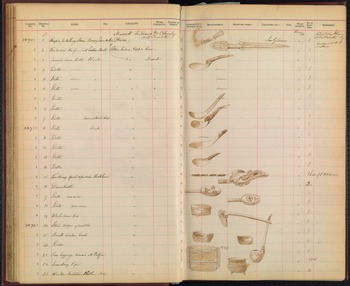
A sketch of the rattle occupies the fields for ‘Measurements’ and ‘Received from’, and ‘Jas. [James] G. Swan’ is written in the top entry of the page under the field ‘Collected by’ (Figure 1). While this entry includes the ethnonym Haida in the ‘Locality’ field, but also specifies the Haida village of Masset, other entries use either only the term ‘Haida’ and ‘B.C.’, or ‘Queen Charlotte Islands’. The ledger books added a field for ‘People’ in 1899, prompting efforts for more consistent entry of information about ethnic or tribal origin. Prior to this, however, ethnic identifiers and geographic locations were used interchangeably and in combination.Footnote 49
Ledger book, vol. 19, p. 57, Department of Anthropology, Smithsonian Institution. Rattle 88716 is listed on this page.

The ledger book catalogue was only one of the locations where scientific data about individual objects were recorded. Mason implemented a card catalogue system upon assuming his curatorial post, motivated by the limited space in the ledgers. The card system of ‘an encyclopedic character’ would allow the curator to ‘gather from many sources all that is valuable about the objects in hand’.Footnote 50 Indexable cards were filled with information from the ledgers and were intended to contain ‘verified and well-documented information about the objects and their place within the larger classificatory schemes’.Footnote 51 Though Hannah Turner has reconstructed the history of the USNM anthropology card catalogues, it remains difficult to verify when now-existing cards were created and edited. The descriptive terms on the now-digitized cards for Haida rattles minimally diverge from those of the ledger book entries.Footnote 52 Both the ledgers and the card catalogue, and their use in the fixing and stabilization of nomenclature, are essential in the creation of duplicate specimens in that they provide an epistemological infrastructure for duplicate specimens to function as material representatives of knowledge categories.Footnote 53
Cataloguing not only produces anthropological specimens, but is also ‘related to methods of authoritative knowledge production and control’.Footnote 54 The transformation of material culture into museum objects via the structures of information technology such as the catalogue establishes what information is relevant and valuable, and who is understood as an authoritative source of that information. The fact that Swan is credited as the collector while Kit Elswa's contributions are erased at the moment of museum cataloguing – information which is then concretized through the reproduction of the catalogue into subsequent formats – is but one example of Indigenous exclusion.Footnote 55 Even when documentation instructions shared with collectors requested notations of Indigenous terminology, the limiting of this to functional vocabularies obscures the nuance of the relationships objects have with other objects, landscapes, events, individuals, lineages and communities. Krmpotich and Somerville have noted the relative absence of affective terms and descriptions for Anishinaabeg and Cree bags in computerized museum catalogue records, though these objects are important in personal and familial relationships.Footnote 56 Cataloguing is a descriptive practice that operates with respect to epistemological frameworks and values.
A close reading of the entries for Haida rattles in the ledger books reveals inconsistencies in the way the ‘Name’ and ‘Locality’ fields were operationalized, raising questions about the degree of tolerance for variation within a knowledge category. Ledger book entries sometimes exclude the ethnonoym ‘Haida’, and fail to consistently note the provenience of rattles on Haida Gwaii in all but the 1883 accession, a result of time constraints and Swan's documentation. Though rattle 88716 (above) names both Haida and Massett (sic) (where Masset is a village on Haida Gwaii), the catalogue record for rattle 88793 refers only to ‘Massett Indians Collection, Massett BC, Queen Charlotte Is’. Geographic locations partially constituted knowledge categories, and curators made disciplinarily meaningful distinctions between different locations on Haida Gwaii in their designation of duplicate specimens, ensuring that rattles from each location (Masset, Skidegate and the more general Queen Charlotte Islands or British Columbia) were retained in the collection.
Though inconsistent in their use of terms for ‘Name’ and ‘Locality’ fields, cataloguers’ entry of descriptive information in the ledgers suggests concepts of duplication. Likely employed as a time saver, cataloguers liberally marked ‘Ditto’ or used the double-quote symbol when filling object records, or they simply left the field blank, implying that the top-line term applied to those below (Figure 1). Similarly, a single sketch might spatially occupy the rows for two or three records, implying that each object was of a similar form. Sometimes cataloguers indicated ‘same as [catalogue number]’ to make the concordance clear, though perhaps effectively subordinating the ‘same as’ objects to the object sketched. Notions of similarity are suggested through the habitual repetition of the ‘Ditto’, serving to practically structure the knowledge category. In Figure 1, most object names contain ‘rattle’ or ‘ladle’, with frequent use of ‘Ditto’. The corresponding sketches use the ‘Ditto’ term less frequently, and demonstrate more formal variation in the catalogued ladles and rattles. The nominal terms denote a descriptive difference between ‘Dancing Rattle’ and ‘Dance Rattle’ or ‘Carved Rattle’ and ‘small rattle’, but these were not meaningful epistemological differences for curators at that time, nor are they now. Differences reckoned by modifiers create knowledge categories which are too narrow to produce duplicates, especially considering the variation in ethnic and geographic terms, and in the rattle form. Also notable is that these modifers were not transferred consistently onto exchange inventory forms.
Operationalizing similarity in the catalogue and storeroom at the USNM
The contents of the anthropological collection at the USNM were and are dynamic. Voluminous quantities of anthropological material flowed into the USNM in the late nineteenth century, prompting persistent requests for additional museum labour. Selecting duplicates was one of many curatorial duties, and was performed concurrently with the influx of specimens from both unrepresented and well-represented knowledge categories. At the USNM, duplicate was a status that shifted in relation to the total population of specimens in a knowledge category under a curator's purview over time, and was not determined by the collector prior to accession.
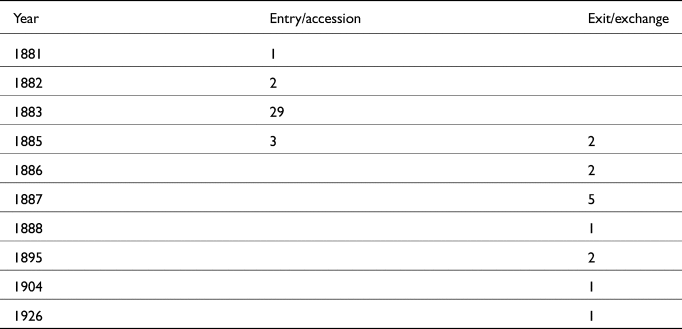
Accession and exchange records involving Haida rattles from the Smithsonian registrar's office provide an accounting of the actual contents of the collection at different points in time as they relate to the selection of specimens as duplicates (Table 1).Footnote 57 Thirty-five Haida rattles were accessioned between 1881 and 1885; no more were added until 1920. The first rattle exchanged had been accessioned in 1882 and was sent in August of 1886 to Paris's ethnographic museum, the Trocadéro.Footnote 58 Three months later, a rattle from the 1883 accession was sent to the Canterbury Museum in Auckland, New Zealand.Footnote 59 The year 1887 saw the most Haida rattles exchanged, with single rattles going to the Musée Guimet in Paris and the Annecy Museum in France's Upper Savoy region; two rattles exchanged with Mary Elizabeth Brown, whose collection is now held by the Metropolitan Museum of Art in New York; and a single rattle to Professor Frederic Putnam of Harvard's Peabody Museum.Footnote 60 The increase of Haida rattles at the USNM enabled the Smithsonian curators and scholars to gain a better sense of their diversity and make judgements about similarity.
Table of entries and exits of Haida rattles at the USNM (1880–1926).

Anthropological knowledge categories were shaped by museum technologies such as catalogues, and they were also reflected in spatial arrangements of specimens in exhibition and storage areas. These technologies and arrangments can be understood as a means for museums to engage in ‘clearance’ via institutional classification and sorting practices that are informed by epistemological ideals and pratical realities.Footnote 61 I suggest that both the catalogue and the storeroom impacted how curators detected and determined duplicate specimens. At the USNM, anthropological classification, evidenced by nomenclature recorded in the catalogue, consistently used two variables: provenience (ethnic origin and/or geographic location), and object function, of which form is a part. Divisions based on form, design and ornamentation variation were sometimes used to further refine typological classifications.Footnote 62 Object nomenclature did not consistently employ or rank variables, but there is usually an initial separation between terms associated with the formal–functional–material description of the object (catalogue's ‘Name’), and its ethnic and/or geographic origin (catalogue's ‘Locality’). In Ethnological Directions, Mason classifies rattles under ‘Instruments for Beating’, a subcategory of ‘Music’.Footnote 63 Here, function is the principal variable in the classification scheme and the term ‘rattle’, distinct from other material means for instruments used for beating, refers to its form or structure.
Writing to musical instrument collector Mary Elizabeth Brown, Mason – responsible for making or approving the designation of ethnological specimens as duplicates – articulated aspects of this process on the basis of classificatory variables. He wrote,
I have asked Mr. Hawley to go through the entire collection [of musical instruments] and make out a card catalog, which I am having typewritten so as to show what is really duplicate. Two questions arise in my mind on this point, namely: What is the structure, and what is the method of functioning each piece; and What ethnic and geographic distribution each class of instruments had.Footnote 64
Function, including form (structure), and ethnicity/geographic location were the primary classificatory variables Mason used in determining the knowledge category, a requirement for the designation of specimens as duplicate.
The USNM exhibited and stored specimens using a combination of cases and drawers. Similar specimens were physically grouped together, and object similitude was ‘the most important organizing principle of the storage drawers for study, exhibition, and the arrangement of the card catalogue’.Footnote 65 Mason preferred a function-based arrangement, as this would ‘make up for the fact that, most of the time, there was simply not enough information accompanying any given specimen’.Footnote 66 Ethnic and geographic information was more difficult to discover or attribute than function, whereas similarity in form could be detected through visual comparison. By looking at objects grouped together, Mason could effectively see which objects (particularly in terms of function and form) the department had in duplicate.
Because anthropologists understood that object forms could be geographically widespread, efforts were made during cataloguing to inscribe catalogue numbers and terms (ethnic and geographic origin, collector) directly onto objects. Ledger sketches did similar work. Both reflect efforts to associate scientifically valuable descriptive information with the objects themselves, to create specimens in discrete spaces of the museum – the records room and the storeroom. Though housed in a single building, the physical distance between catalogue pages or cards and the objects themselves, if not organized in a legible and predictable system, threatens the validity of scientific inquiry. The destruction of the link between the object and the information entails the loss of scientific data, though the information and the object itself may remain physically close. Though the ledger book suggests duplication through the use of the ditto shorthand and lot cataloguing, it is a less robust system than the card catalogue and storeroom in allowing curators to make visual assessments and consult records indexed by function and ethnicity/geographic origin when deciding on duplicates.
Rattle forms: visual and material similiarity
The production of anthropological knowledge relied on the publication of scholarship. Though Swan collected the rattles, and together with Kit Elswa systematically documented their function and provenience, he is not credited with authoring the Smithsonian's scientific treatise on the Indigenous peoples of the Northwest Coast region, of which the Haida are one nation. This task was undertaken by US Navy ensign Albert P. Niblack, who also made collections and ethnographic observations on behalf of the Smithsonian Institution while serving on the US Coast and Geodetic Survey.Footnote 67 He travelled extensively in the Northwest Coast region and Alaska during the field seasons of 1885, 1886 and 1887. His monograph, ‘The Coast Indians of southern Alaska and northern British Columbia’, published in the USNM's annual report for 1888, was based on his own observations as well as the collections in the USNM made by Swan and others. This publication was left in unfinished draft form by Niblack upon his hasty departure from Washington, and was subsequently edited with sections rewritten by Mason and his assistant, Walter Hough.Footnote 68 It bears an organizational resemblance to Mason's Ethnological Directions, though it does not reproduce the classificatory descriptive divisions exactly.
The seventh section of ‘Coast Indians’ contains a subsection titled ‘Music: singing; drums, rattles and whistles’.Footnote 69 Object function is the primary classificatory principle, as Niblack notes cultural distinctions, but subordinates these to a more general description of the Northwest Coast culture area. Haida rattles are presented, both in textual description and photography, alongside those from the Tlingit and Tsimshian nations. ‘Coast Indians’ contains illustrations of eight Haida rattles, which were then considered USNM type specimens on this basis, a status that invoked both scholarly value and a resulting mandate to keep such objects.Footnote 70 None of these type specimens were exchanged while under Mason's curatorial purview.
Like much Northwest Coast material culture, especially carved wood objects, Haida rattles exhibit extensive formal variation. Niblack noted, with reference to carved wooden rattles of the entire Northwest Coast, that the ‘form, variety of carving, and general shapes are so great that only a few typical ones are illustrated in the accompanying plates’.Footnote 71 This was not a comprehensive typology, though Niblack does use object form to refer to the constitution of types. Of the rattles illustrated in ‘Coast Indians’, two are raven (the most common form), two depict the bear, one is the fish hawk, and three are globular in appearance, one with painted geometric designs, while the other two include anthropomorphic representations. These illustrations do not document the full range of formal variation of Haida rattles at the USNM. Notably absent are rattles which carry representations of the owl and the long-beaked bird sometimes referred to as the woodpecker.
An analysis of catalogue and exchange data for all USNM North American rattles collected prior to 1910 demonstrates that curators were attentive to keeping at least one material representative (specimen) of each knowledge category as constituted by ethnic identifier (e.g. Hopi) and geographic location (e.g. [Hopi] Pueblos of Walpi, Mishongovi, etc.), and function (e.g. rattle).Footnote 72 For Haida rattles from all geographic areas, the USNM kept about half of what they originally had. Here I compare objects kept by the USNM, and those exchanged with other museums to consider the extent to which curators examined the objects themselves to assess similarity of form, design and ornamentation in making decisions about which objects were duplicates.
Close looking: raven rattles
The most common rattle form is the raven rattle, or chief's rattle, with thirteen of thirty-five USNM rattles exhibiting this form. Of these thirteen, six were exchanged. The Haida likely received the raven rattle form through prehistoric trade from mainland tribes, as this form is present throughout the Northwest Coast.Footnote 73 Based on form alone, within the space of the USNM collections, there were more than thirteen raven rattles (including those catalogued as Haida, Tsimshian and Tlingit). For the first rattle entry in the 1883 accession, USNM staff lot catalogued two raven rattles under the same catalogue number (88716), suggesting their similarity. One of these rattles was retained by the USNM and the other was exchanged in 1886 with the Peabody Museum in Salem, MA, now the Peabody Essex Museum (PEM).
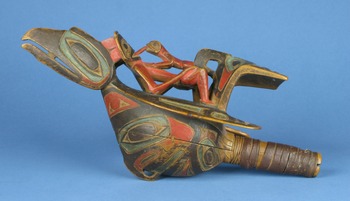
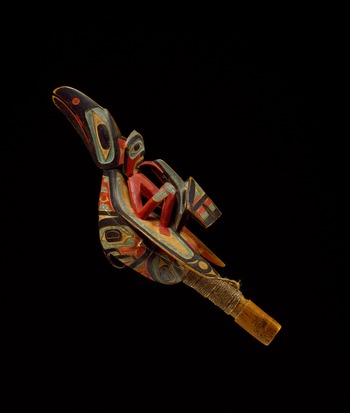
While the catalogue description of these rattles is the same (it is one description applied to two specimens), there are observable differences in rattle form. Analysis of material culture is guided by the observer's positionality, experience and knowledge. As a white settler anthropologist, I suggest distinctions of rattle form based on visual and tactile interactions with these objects as I studied them in person (NMNH rattles) and through photographs (NMNH and PEM rattles). Jennifer Gould's formal analysis of raven rattles among the Tlingit, Tsimshian and Haida suggests that these rattles are constituted by three main motifs. The first motif is the overall bird shape with wings partially spread and a small object carried in the beak. Second, there is a ‘reclining figure’ on the back of the rattle ‘sharing a tongue with some other creature’. Third, the ‘belly of the rattle’ is ‘a face with a protruding recurved beak or nose, and a mouth’.Footnote 74 Both the NMNH and PEM rattles I studied exhibit these three motifs. Gould goes on to note that minor variations have been observed to occur in the second ‘reclining-figure, joined-tongue motif’.Footnote 75 Either there is a frog-like figure between the reclining figure and the bird, or the bird face on the tail may point to the front or back of the rattle, or the frog is omitted.Footnote 76 In the rattle kept by NMNH, there is the presence of a frog-like figure with an extended tongue (Figure 2). In the PEM rattle, there is not (Figure 3).
E88716, Haida dance rattle, Department of Anthropology, Smithsonian Institution.

Haida artist; rattle, mid- to late nineteenth century; wood, paint, plant fibre, stone; Haida Gwaii (Queen Charlotte Islands), British Columbia, Canada; 13 × 4¼ × 5 inches (33.02 × 10.795 × 12.7 cm). Gift of the Smithsonian Institution, 1884; E7328; Courtesy of the Peabody Essex Museum. Photograph by Mark Sexton/Jeffrey Dykes. This rattle is formerly USNM 88716. It was sent in exchange by the USNM on 8 June 1886 and received by the Peabody Museum in Salem, MA on 12 June 1886; see D4766, RU 186, SIA.

No typology of raven rattles was published by the USNM in the late nineteenth century, so it is not explicitly known how curators tolerated variations in formal similarity or whether they would have analysed them like Gould or myself. The variations in the second motif – particularly the presence or absence of a frog-like figure – were not noted in Niblack's description, an interpretation which he credits to Swan. The two raven rattles illustrated in his publication both lack the form of the frog-like figure, though Niblack's description includes it:
According to Judge Swan, the carving on the breast of the bird represents the sparrow-hawk, the bird itself presenting Hooyeh, the raven. The tail of the raven is carved to represent a bird's head, carrying in its beak a frog. The frog is supposed to possess a subtle poison in its head, which, when sucked out, enables a medicine man to work bad spells. The figure on the back is Oolalla, or Ka-ka-hete, the whistling demon, who lived in the mountains and was once traveling in his canoe when he capsized and nearly drowned. He swam ashore and ran into the woods for shelter. He occasionally descended to the villages and stole the children, which he took into the woods and ate. Ka-ka-hete afterwards turned into a land-otter. This type of rattle is found quite generally among all the northern tribes, and is carried by the chiefs in the ceremonial dances.Footnote 77
When comparing these rattles, the lack of a frog-like figure on the PEM rattle is a clear formal difference which can be easily detected via photographs of each rattle. The decision to catalogue these rattles as a lot indicates that this variation did not merit any meaningful classificatory distinction by curatorial staff. Of the five raven rattles currently held by NMNH, four lack the frog, and one (88716) carries it. Of the three locatable exchanged rattles, one carries the frog (56470), while two do not. The frog-like figure appears to be less commonly represented on the raven rattles, and both varieties were exchanged. Whether intentionally or not, USNM curators preserved this motif variation in the Haida raven rattles they retained. The presence or absence of the frog was tolerable variation within the category of Haida raven rattles for USNM curators. These rattles did not share the exact same observable form, but they were similar enough to result in five of the thirteen being designated as duplicates.
Close looking: puffin beak rattles
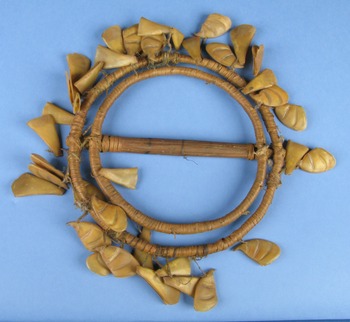
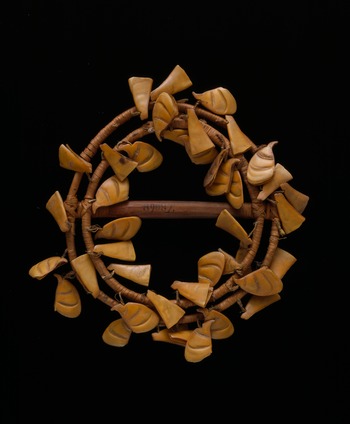
While carved wood Haida rattles exhibit a wide range of formal variation, particularly in their representation of anthropomorphic beings and animals, included in Swan's 1883 accession were two rattles described as ‘Rattle with puffin beaks’ (89087 and 89088). Both rattles exhibit the same form of two concentric rings of wood with cedar bark wrapping with cross-bar handle and puffin beaks attached to both rings with sinew. Rattle 89087 was retained by the USNM while 89088 was exchanged with the PEM in 1886 (Figures 4, 5).
E89088, Haida rattle with puffin beaks (kept by the USNM; former number 89087), Department of Anthropology, Smithsonian Institution.

Haida artist; rattle, late nineteenth century; wood, sinew, beak; Skidegate, Haida Gwaii (Queen Charlotte Islands), British Columbia, Canada; ½ × 7 inches (1.27 × 17.78 cm). Gift of the Smithsonian Institution, 1884, E3490, courtesy of the Peabody Essex Museum. Photograph by Mark Sexton. This rattle is formerly USNM 89088. It was sent in exchange by the USNM on 8 June 1886 and received by the Peabody Museum in Salem, MA on 12 June 1886; see D4766, RU 186, SIA.

Puffin beak rattles in this form were, like raven rattles, used throughout the Northwest Coast region. Niblack notes that the ‘most primitive rattle, mentioned by the early voyagers, is that shown in Fig. 73, Plate XVII, composed of two hoops joined by a wooden cross-piece, the circumference being closely strung with the beaks of the puffin’.Footnote 78 The referenced illustration (a drawing) occurs in a section of Niblack's ‘Coast Indians’ on ceremonial dress and accoutrements. The explanation of the plate, which consistently lists catalogue information, indicates ‘No number’ for this rattle, and no tribal group is listed.
A visual comparison of the two Haida puffin beak rattles indicates two objects with formal similarities. The rattle kept by the USNM has a marginally larger diameter (approximately eight inches) than the PEM rattle (approximately seven inches). The USNM rattle has far fewer puffin beaks on the lower right quarter of the rattle (Figure 4). The illustrated rattle in ‘Coast Indians’ shows beaks attached to the entirety of both concentric rounds, a feature of the PEM rattle. The cataloguing and exchange of these rattles took place over 130 years ago, during which time the NMNH rattle may have lost a number of puffin beaks while under the curatorial care of the Smithsonian. The catalogue ledger book sketch associated with the kept rattle shows puffin beaks completely surrounding what appears to be one ring, though the sketch, somewhat abstracted, is meant to represent both rattles. The PEM rattle, because of the consistent coverage of beaks, appears to be a high-quality specimen worthy of exhibition. USNM curators did not exchange low-quality or broken specimens.Footnote 79 While these rattles exhibit few formal distinctions, the retention of the one Haida puffin beak rattle and the exchange of the other further demonstrates that curators considered form in the selection of specimens as duplicates. They were careful to retain at least one Haida puffin beak rattle.
Curators’ mistakes
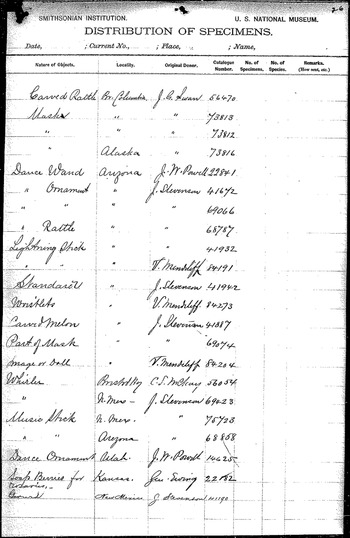
Heavy, constant and diverse workloads resulted in errors made by museum staff. Within the eleven exchanges involving Haida rattles, there are two types of error that further understandings of duplicates – errors of imprecision and inaccuracy in the transfer of descriptive information during exchange, and the exchange of specimens which were categorically not duplicates (type specimens). The first kind of error concerns the way knowledge categories were determined, particularly the level of specificity or the parameters of meaningful distinction. In advance of the transmission of specimens, curators oversaw the preparation of inventory forms, which were often titled ‘Distribution of Specimens’ (Figure 6). While catalogue ledger books carried up to fifteen descriptive fields, exchange inventory forms reduced that number down to six or seven. Fields for name, location, collector and catalogue number, along with fields for number of specimens and number of species (the latter meant for natural history, and routinely left blank for anthropology), were retained. Curators and assistants involved in preparing exchanges were tasked with filling the forms, which they did in part by consulting the catalogue ledger books. Beyond the USNM, duplicate specimens sent by museums were typically enumerated on lists containing a ‘catalog number, a name for the object, and a locality associated with the object’, effectively obscuring contextual information about collecting practices and circumstances of assemblage.Footnote 80 While anthropologists Robert Welsch and Kevin Mooiman argue that the impact of this practice buoyed the value of duplicates as fungible commodities, exchanges influenced how objects were transformed into scientific data in various moments in their itineraries.
Rattle 56470, collected by Swan, listed on first row. ‘Distribution of specimens’ (exchange inventory) form for D4400, exchange transmission sent by USNM to Trocadéro, 1885. Smithsonian Institution Archives, Record Unit 305, Accession # 15758.

The first rattle exchanged, sent to the Trocadéro in 1885, is described in the catalogue ledger book as ‘Dancing Rattle’, ‘Haida B.C.’ The exchange form lists it as ‘Carved Rattle’, ‘Br. Columbia’ (Figure 6). Swan's paper documentation describes it as ‘Dancing Rattle. The crow with the sparrowhawk on its breast. On its back is a Kakahete, the Hiawatha of the Haida, a famous Shaman of ancient times, sucking poison from the frog, which is held in the beak of the King Fisher. Haida, BC’.Footnote 81 Swan's iconography details have been truncated in the translation of information to the ledger book and truncated again on the exchange form. The second rattle exchanged, sent to the Canterbury Museum in 1885, is described in the ledger as ‘Ditto [Haida Dance Rattle] fish hawk’, ‘Ditto [Obtained from Massett Indians Br. Columbia]’. The exchange form lists it as ‘Rattle’, and ‘British Columbia’. These are not errors of inaccuracy, but rather imprecision and abstraction.
Nominal description in ‘Coast Indians’ followed suit: a ‘Doctor's rattle’ in the ledger book was called ‘Dance rattle. Of wood. Used by Shamans’.Footnote 82 The modifications on the exchange forms supply evidence for the suggestion that curators practically positioned the knowledge category at the level of function (rattle) and used the more general geographic location (Queen Charlotte Islands or British Columbia) and ethnic identifiers (Haida), though fewer modifications truncating information were made in later exchange paperwork. While the first rattle was a specimen representative of Haida dance rattles at the USNM, which held expansive North American collections, it would be representative of a rattle from British Columbia at the Trocadéro, a museum with fewer North American collections. It was a duplicate specimen at the USNM, but not when it reached the Trocadéro. It remains in the collections at the Trocadéro's current iteration, the Musée du quai Branly.
Though the above examples document slight modifications to the nominal data as they were reproduced at subsequent moments of object mobility, there are at least four instances where information was entered incorrectly on the exchange forms. Rattle 88716 sent in 1886 to the Peabody Museum in Salem, MA is described in the ledger as ‘Dance Rattle’, ‘Ditto [(Haida) Massett Indians, Br Columbia]’. The exchange form lists it as ‘Carved dance rattle’, ‘Copper R. Alaska’. The location terms ‘Copper River’ and ‘Alaska’ are wholly inaccurate, introduced due to a misreading of the ledger resulting from the use of the ditto indicator. The term ‘Copper River’ is used to describe a knife from ‘Atna Indians’ (or Ahtna, an Alaskan Athabaskan-speaking group) listed on the same page (Figure 1). The Peabody Essex Museum currently describes the rattle as Haida, from Haida Gwaii, correcting the mistake.
Similarly, rattle 88729, sent in 1887 to the Harvard Peabody Museum, is described in the ledger as ‘Ditto [Haida Dance Rattle fish hawk]’, ‘Ditto [Obtained from Massett Indians Br. Columbia]’. The exchange form lists it as ‘Rattle’, ‘Sitka, Alaska’. The location is incorrect, but the ledger is not the obvious source of the error. Sitka has been continuously occupied by Tlingit Indigenous people for thousands of years prior to colonization by white settlers. The Peabody Museum of Archaeology and Ethnology currently describes the rattle as Tlingit, from Sitka, Alaska. The change in information on the exchange form has been preserved in the catalogue records of the Peabody. While the rattle was selected by the USNM as a (duplicate) specimen to represent the fish hawk form of Haida rattles, it has become a material representative of Tlingit rattles at the Peabody. Though the Haida are linguistically distinct from their geographic neighbours, the Tlingit and Tsimshian, the design of their art shares many similarities, so this is not an inaccuracy that can be easily corrected via attribution.Footnote 83
While the use of ‘ditto’ in the catalogue ledger is functionally a shorthand, it is also part of classification praxis that suggests similarity, a requirement for the production of duplicates. Translations of the ‘Name’ and ‘Locality’ fields onto the exchange forms suggest a broadness in the constitution of the knowledge category, its lack of fixity to a highly specific name. Whereas nomenclature for biological specimens operated under stricter conventions, the success with which anthropologists were able to apply natural-history classification to material culture was confounded in practice by the nature of material culture itself and the ability of humans to innovate and recombine characteristics of objects through less systematic means, in contrast with processes that govern biological reproduction. When considering anthropological duplicates specifically, it is critical to understand that these objects are designated as such in relation to their status as scientific objects with a museum context that is underpinned by temporal and spatial grammars based on epistemic approaches of empiricism, comparison and taxonomy.Footnote 84
The second kind of error concerns the effects of rushed curating and poor record keeping, resulting in the mistaken exchange of a type specimen. In 1896, Mason wrote to anthropologist Frederick Hodge,
I have for a long time been anxious to keep up the relationship between the publications of the Bureau of Ethnology and our work here, and, as far as I have been able, I have put green tags upon all the specimens that you have illustrated. In the early days of the Bureau, however, no record of this kind was kept and I was mortified to find that when material had been drawn and illustrated in your books the specimens could not be found in the National Museum. Evidently, they had been given away or exchanged and no relationship preserved between specimens and the book that described them.Footnote 85
Mason realized that specimens illustrated in publications had been exchanged as duplicates because there was no system in place to record when they had been used in the publication-based production of anthropological knowledge. As a result, the USNM was unable to produce these specimens to validate published knowledge. Upon realizing that the USNM had sent a Haida slate carving to Italian zoologist and anthropological collector Enrico Giglioli, Mason pleaded that Giglioli make a plaster cast for the USNM. Mason noted, ‘in packing it up we failed to notice that it had been made a type in the National Museum. The subject of Haida mythology is now revived and a young student of Harvard is giving his whole attention to the carving and mythology of that region’.Footnote 86 Photographs and drawings of specimens were not as desirable for knowledge production. In this case, a cast was the best option since the USNM understood exchanges to be permanent trades.
In 1926, rattle 88727, one of eight illustrated in ‘Coast Indians’, was sent to the Wyoming Historical and Geological Society in Wilkes-Barre, Pennsylvania.Footnote 87 Mason's assistant, Walter Hough, had taken up the curatorial post. Assuming that the rattle had been tagged, perhaps Mason's green tag reading ‘Type’ had been separated from the rattle. The rattle was decidedly not a duplicate, but its status as such was not made evident through the USNM's information infrastructure, further highlighting the element of contingency when designating specimens as duplicates.
Discussion
In the case of Haida rattles at the USNM, I suggest that the duplicate specimen is as ‘original’ as a specimen without that status. Indeed, in the context of the museum, duplicate refers to a temporary and contingent status of a specimen; it does not intimate that the specimen is a copy of an original. Objects become specimens as they are incorporated into systems of scientific knowledge. Though there are differential valuations placed on type specimens (particularly holotypes) and duplicate specimens in their relation to the production of scientific knowledge, this does not necessarily make one more valuable than another. Rather, it suggests an interpretation of value that emanates from the object's utility. As argued by Gwyneira Isaac, twentieth-century postmodern Euro-American perceptions of the production of copies from originals are understood as processes of alienation, rupture and fragmentation resulting from the re-presentation of objects in new or subsequent contexts.Footnote 88 The devaluation of the copy reflects a particular temporal, political and epistemological moment, one which follows the vast nineteenth-century circulation of duplicate specimens. When duplicates are now interpreted as lesser derivatives of a specimen that was kept, this results in questions about the value of duplicates, in that they are seen as less valuable because they were alienated by repositories that are nowadays associated with keeping. It also responds to the concerns voiced by scholars about ‘so-called duplicates’ or notions that these objects were not really duplicates.Footnote 89 These objects were duplicate specimens, but duplicate does not refer to the devalued copy of an original. These were valuable specimens that circulated to diversify collections and educate learners.Footnote 90
Duplicate was a status contingent on an object's relation to other objects in the museum as understood by the curatorial staff who exchanged them. The concept of duplicate is one that is governed by perceptions of similarity, mediated by epistemological frameworks. In the anthropology department of the nineteenth-century museum, the impact of natural-history taxonomy shaped both the emphasis on and the doing of classification. My focus on Haida rattles, and details related to their itineraries into and out of the USNM, considers the intersection of museum information technologies, particularly the catalogue format, as it was iterated in both the ledger book catalogue and the exchange records. As technologies, the catalogue format structures the production of anthropological data, though it differs in the parameters of what is possible for representing names and forms. The role of the techniques and technologies of classification is one aspect in the production of duplicate specimens, but one which I argue is essential in uncovering how duplicates were designated in the museum.
Acknowledgements
I extend my sincere thanks to Rainer Buschmann, Ina Heumann and Anne MacKinney for the invitation to contribute to this special issue, as well as their insightful editorial suggestions. I am exceptionally grateful to the archival and museum professionals at the Smithsonian Institution Archives, the National Museum of Natural History and the Peabody Essex Museum for their support and willingness to share data during a time when repositories were largely closed for research; my thanks go to Tad Bennicoff, Carrie Beauchamp, Heidi Stover, Esther Rimer, Kathryn Smith and Suzanne Inge. I also extend my thanks to Amanda Rees, Trish Hatton and the anonymous external reviewers whose close readings and suggestions have markedly improved this article.