

 , Lâhō t
 -m
I. Introduction
I have always been intrigued by formulaic expressions,Footnote 1 since prefabricated, ready-made collocations play such an important role in human languages.
On the lexical level, many East and South-East Asian languages abound in four-syllable expressions that are stylistically highly valued, but semantically equivalent to simpler one- or two-syllable words. These quadripartite elaborate expressions are especially characteristic of monosyllabic languages; indeed, from one point of view they may be considered primarily a stratagem for adding “phonological bulk” to tiny morphemes. In a language like Lahu, they include two identical syllables, either the first and the third, or the second and the fourth;Footnote 2 the other two syllables constitute an “elaborate couplet”, morphemes which have a semantic connection with each other, either as synonyms or antonyms, or with a looser metonymic relationship.Footnote 3 The adjectival verbs  ‘be big’ and mu ‘be high’ are coupled in expressions like chî--chî-mu ‘praise to the skies’ (“lift-big-lift-high”) and -la-mu-la ‘come up in the world’ (“big-become-high-become”); the verbs câ ‘eat’ and d
 ‘drink’ are paired in thi-câ-thi-d ‘eat, drink, and be merry’ (“feast-eat-feast-drink”) and câ-bûʔ-d-bûʔ ‘have plenty of food and drink’ (“eat-full-drink-full”); fâʔ ‘rodent’ and ŋâʔ ‘bird’ are paired in expressions like fâʔ-
 -ŋâʔ- ‘food for rats and birds’ (“rat-rice-bird-rice”, i.e. crops left in the fields too long), fâʔ-th-ŋâʔ-th ‘a zoo’ (“rat-jail-bird-jail”). The two halves of an elaborate expression (AB and CD) thus have parallel structure.
On the sentential level, a particularly interesting type of formulaic expression is the proverb. As we shall see, most Lahu proverbs are bipartite, and like elaborate expressions they are typically parallel in structure. Although I had collected a few dozen Lahu proverbs in the course of my fieldwork,Footnote 4 the impetus for the present study has been the extraordinary collection of 1,343 Lahu proverbs presented, along with Chinese translations, in Peng, Wang and Li (1993).Footnote 5 The proverbs in this book are unnumbered, listed in roman alphabetical order by their first Lahu word. They are written in the pinyin-influenced Lahu orthography now in general use in China,Footnote 6 with the tones indicated by arbitrary consonants after the vowel.Footnote 7
A few preliminary remarks on terminology are in order at this point. The Lahu words I am translating as proverb are t -m (lit. “old words”) or chɔ-m-kh (lit. “language of the elders”).Footnote 8 On the English side, we have a large number of terms to characterize various types of proverbial wisdom. Although it is irrelevant for our purposes to attempt to make rigorous repartitions among them, I list them here along with my rough interpretations of the differences in their meanings:
• Saying is the most general term, but usually means more or less the same as proverb. It could also mean a favourite utterance of a certain individual, whether or not it expresses proverbial wisdom: Grandma had a saying. That's it then. There you have it.Footnote 9
• Epigrams are witty, paradoxical or satirical. Here is a cynical French one, from the message of which I would like to dissociate myself: Les traductions sont comme les femmes: plus elles sont belles, moins elles sont fidèles; plus elles sont fidèles, moins elles sont belles.
• Mottos or maxims are the guiding principles of a person or institution. The motto of the US Marines is semper fidelis, or semper fi. The motto of Harvard University is Veritas.
• (Old) saws are sayings that are felt to be trite and shopworn, or in which people no longer believe: Spare the rod and spoil the child. I wasn't born yesterday. March comes in like a lion and goes out like a lamb.
• Slogans are mostly political: Tippecanoe and Tyler too. I like Ike. Change you can believe in.
• Adages are more or less the same as aphorisms. This is a rather rare term nowadays.
• Aphorisms are sober, serious statements of general truths. The word is from Greek aphorizein < apo- + horizein “to delimit, define” (cf. horizon): It is better to give than to receive. Do unto others as you would have others do unto you. It takes a village to raise a child.
• Proverbs are like aphorisms in that they try to convey general truths, and are usually moralistic and didactic in intent, but they usually involve figurative language (e.g., a simile or a metaphor), so that it is sometimes not immediately obvious what their underlying meanings are: Never pray for the death of a king. All roads lead to Rome. In this paper, I will refer to all the Lahu t
 -m or chɔ-m-kh as proverbs, while occasionally using the term aphorism for the more sober, less figurative type of proverb.
There are many cross-cutting ways of classifying the proverbs, both by their syntax and their meaning. Not all of the nearly 1,400 proverbs collected for Lahu can be cited in this paper, but several hundred of the most interesting ones are categorized.
II. Syntactic structure
2.1 Non-binary proverbs
Once in a while we find a monopartite proverb, with a single clause (sometimes these turn out to be just half of a fuller proverb):
(#1064)Footnote 10šā-ku m -ni ú-g
 te mâ ph
 ʔ.
‘You can't use dried meat for a cat's pillow.’
Even rarer are Lahu proverbs with tripartite structure, with only one example in the collection:
(#1193) vàʔ bûʔ šā nʔ, ph bûʔ y
 ʔ qhɛ, chɔ byq.
‘When a pig is full it puts on flesh; when a dog is full it sleeps; when a person is lazy the house is empty.’
The overwhelming majority of Lahu proverbs are binary/bipartite in structure.
2.2 Bipartite but non-parallel syntax
It is convenient to have terms for the two halves of a binary proverb. Borrowing from the terminology of conditional sentences, let us call the first part the protasis (or simply “A”) and the second part the apodosis (or simply “B”).Footnote 11
The more aphoristic type of proverb, lacking figures of speech, is the most likely to have non-parallel syntax in (A) and (B):
(#734) mû â dàʔ mâ dàʔ, nā-qh-bòʔ-i thàʔ ni.
‘To gauge the strength of a horse (“horse strength good not good”), look at the size of its nostrils.’
(#797) nve ŋâ mâ nù, p -ma mâ là p.
‘If your fish doesn't stink, flies won't come.’
(#864) pâ-t-nʔ-po ch, mû-nɔ mì-nâʔ qmâ šī.
‘The frog stays in the lake, not knowing the breadth of heaven and earth.’Footnote 12
(#894) pû-tì p mâ tà qo, ŋâ bía tù mâ hêʔ.
‘If you can't part with the worm, you can't hook a fish.’
(#907) phkhɨ-pâ gà, á-du ca mâ mi.
‘When the dog has reached your legs, it's too late to look for a stick.’
(#941) qâ mâ qhêʔ pqo, qhʔ-cpâ tâ hú tā.
‘If you don't know how to dance, don't stand near the New Year's Tree.’Footnote 13
(#1021) šɨ-kʔ-nà-kʔ qo, y-mí chi thàʔ tâ lòʔ.
‘If you fear death and sickness, do not enter this door.’ [i.e. the door of life]
(#1063) šā-k-ŋâ-k, á-phèʔ-á-lʔ khʔ dê.
‘To spoiled meat and rotten fish, it is vain to add chillis and salt.’
(#1230) -cá tê pu-qhɔ, mâ dàʔ ve tê phàʔ tí.
‘In the whole head of cabbage, only one leaf is no good.’Footnote 14
(#1294) yâ-pɔ-pā mâ dhā, yâ-tâʔ-pā d-hā tù mâ lō.
‘If the one who bore the child isn't worried, there's no need for the one holding the baby to worry.’
2.3 Bipartite parallel syntax
Most Lahu proverbs do in fact have parallel syntactic structures in their protases and apodoses. There is unfortunately not space to give interlinear grammatical glosses for more than a few of them:
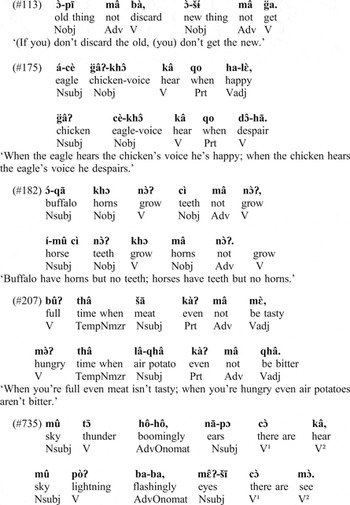
‘(If) you have ears, you'll hear booming thunder; (if) you have eyes you'll see flashing lightning.’Footnote 15
Similarly parallel structures are found in dozens of other proverbs, such as the following:
(#35) a-y-yhā gâ qo fī d, laʔ-há hā gâ qo phày dʔ.
‘If you want to get poor slowly, smoke opium; if you want to get poor fast, play cards.’
(#238) câ mâ cqo tê p tí, qay mâ cqo tê pī tí.
‘Making a mistake in eating takes but one mouthful; making a mistake in walking takes but one step.’
(#322) chɔ-khchɔ c, ŋâʔ-khŋâʔ c.
‘People have human language; birds have bird language.’
(#327) chɔ mâ te, nê mâ c.
‘If people don't worship them, the spirits don't exist.’
(#356) chɔ mâ qo ká te ša, chɔ mâ mâcâ ša.
‘When there are many people, the work is easy; when there are few people, eating is easy.’
(#381) dmâ qoû la, câ mâ qo nà la.
‘If you think too much you'll go crazy; if you eat too much you'll get sick.’
(#413) fâʔ-yfâʔ hàʔ, ŋâʔ-yŋâʔ hàʔ.
‘Rats love their baby rats; birds love their baby birds.’
(#418) ha-pa khɨ thâ khɛ, mû-cha lthâ cà-šī hú.
‘In the moonlight spin thread; in the sunshine dry the rice-grains.’
(#436) hɔ-ló ph-še chèʔ mâ j,-po í-kâʔ ní mâ yɔ.
‘An elephant can't feel a flea's bite; the water of a lake can't be scooped out.’
(#476) i thâòʔ qh,la cê qh.
‘Steal a needle when little, steal cattle when grown up.’
(#553) kho ve qo mʔ, kày ve qo p.
‘The monkey is mischievous, the bee is hard-working.’
(#565) lâ qhà-ná m kàʔ chèʔ la, jqhà-ná mkàʔ bûʔ la.
‘However tame the tiger is, he'll still bite you; however tasty the liquor is, it will make you drunk.’
(#603) lù ve mâ tʔ, dàʔ ve mâ lòʔ.
‘If the bad does not come out, the good cannot go in.’
(#612) mâ ca mâ m, mâ lmâa.
‘If you don't search you won't find it; if you don't ask, you won't get it.’
(#675) mì-gqhô qhâʔ ve t-kh, šʔ-cló qhâʔ ve-bà.
‘The most precious in the world is language; the most precious in a great tree is its shade.’
(#692) mû-kâʔ nú-šô, mû-lk-šô.
‘In winter snot drips; in summer sweat drips.’
(#702) mû nâʔ cì mâ qa, lâ kù lâ mâ là.
‘The sky is black [but] no dew falls; a tiger roars [but] no tiger comes.’
(#727) mû-nɔ-ma ši mâ ce la pî, mì-nâʔ-ma phu mâ tʔ la pî.
‘The heavens don't drop down gold; the earth doesn't bring forth silver.’
(#747) mve qo á-lʔ, tèʔ ve qo.
‘What tastes good is salt; what supports life is rice.’
(#748) mve p-yâ-, qhâ ve y-yá-kɨ.Footnote 16
‘What is sweet is honey; what is bitter is the gall of a bear.’
(#751) mʔ-cú-pā ve mʔ-šī qo jû-f, chɔ-qā-pā ve mʔ-qɔ qo làʔ-nɔ.
‘The eyes of a blind person are his cane; the mouth of a dumb person is his fingers.’
(#785) nâʔ tâʔ šā mâ phû, vʔ-jî yâ-mî-há mâ phû.
‘Carry a gun and meet no game; get dressed up and meet no dame.’Footnote 17
(#786) nâʔ-chdàʔ bve thàʔ mâ gu, jdàʔ ni-ma yʔ ve thàʔ mâ k .
‘Good medicine cannot cure laziness; good liquor can't clear your mind of worries.’
(#798) ni-mapā c-cî-lâ-cî, ni-ma i pā m-ni qh-qhɔ cî.
‘The great of heart ride dragons and tigers; the faint of heart ride a cat's ass.’
(#829) nā-pɔ v-kna, mʔ-šī nê-kni.
‘The ears hear afar, the eyes see close up.’
(#870) pve mmâ dàʔ, dàʔ ve mmâ p.
‘Cheap things are not good; good things are not cheap.’
(#993) qhɔ-ná-l-ná fâʔ-ŋâʔ phôʔ, hɛ-ná-mùʔ-náa mʔ-šɨ.
‘In the deep mountain forests game is plentiful; if the fields are deeply overgrown you will starve to death.’Footnote 18
(#1001) qhɔ thàʔ mâ tâʔ,-tmâ m.
‘If you don't climb the mountain, you don't see the plain.’
(#1017) y-pcè mʔ kō mâa,-tì ŋâ mʔ bà mâa.
‘Thickets of grass cannot block the eagle's eye; muddy water cannot fool the eye of the fish.’
(#1018) ya-ŋə thàʔ kʔ, a-ŋə mû-ni thàʔ kʔ.
‘Grass fears the frost; frost fears the sun.’
(#1029) š-vêʔ qhɔ-lh , ph-šū y-qhɔ h.
‘Flowers are fragrant in the hills; garlic smells good in the house.’
(#1115) tâ-vâ qhà-qhe dqo, tâ-khqhà-qhe m.
‘As you think by day, so will you dream at night.’
(#1136) ti-mi mâ qo cà-šīa mâ, ni-ma mâ qo y-qhɔ mâ hàʔ dàʔ.
‘If the paddy-fields are many, the rice is abundant; if the heart is fickle there is no love in the house.’Footnote 19
(#1155) têâ cò c, têâ cò phâʔ.
‘One person builds a bridge, another person tears a bridge down.’
(#1263) d-tû mâ m,câ vàʔ-phmâ m.
‘When you drink water you don't see the source; when you eat rice, you don't see the chaff.’
(#1309) yàʔ-qɔ nê kàʔ mâ tô mâ gà, ká i kàʔ mâ te mâ p.
‘No matter how near the road, if you don't set out you won't get there; no matter how small the work, if you don't do it, it won't get done.’
As in all the above examples, A and B are usually simply juxtaposed, with nothing overtly suggesting that there is a basis for comparison between them. Once in a great while the protasis ends with the connector qhe or qhe-lê “like”:Footnote 20
(#3) a-bú-ni qa qhe-lê, têâ tê qa jî e yò.
‘Just as the head of the a-b  plant branches out, people will move out to different households.’
(#844) ŋâ phûʔ ve qhe-lê, th-phûʔ-n-phûʔ.
‘Just like a writhing fish, squirming back and forth.’
(#896) pû-tì-pû-qphêʔ-dqhe, a-šu y-qhâ-yphêʔ-d.
‘Just like a mass of writhing worms, everybody has to struggle for himself [in life].’
III. Semantic content
Lahu proverbs may be classified according to the particular social or moral issue to which they refer. The following sections present several of the most common themes to be found in the proverbs, reflecting important cultural preoccupations of the Lahu people.
3.1 Unity
Traditional Lahu society was egalitarian and co-operative, characteristics which were necessary for the survival of a minority group eking out a hardscrabble existence. Many proverbs make the point that “In unity there is strength” or that “It takes two to tango”:
(#533) khɨ-šɛ tê pá tí qo pʔ mâ là, šʔ tê thɛ tí qo tú mâ ša.
‘On one foot it's hard to jump; a single piece of wood is hard to burn.’
(#604) làʔ-nɔ tê nɔ cɛ tí, nʔ-šī tê šīʔ mâa.
‘With a single finger you can't pick up a single bean.’
(#855) ŋâʔ mâ cè mâ kʔ, chɔ mâ lâ mâ kʔ.
‘When birds are many they don't fear an eagle; when people are many they don't fear a tiger.’
(#1037) šʔ mâ à-mī h, chɔ mâ-â.
‘When there is lots of wood the fire is strong; when there are many people their strength is great.’
(#1047) šʔ tê ctí-chɨ mâ phʔ, chɔ têâ tí ká te mâa.
‘A single tree cannot make a forest; a single person cannot get the work done.’
(#1144) tê gɛ câ qo mà, tê gɛ tâʔ qo là.
‘When you eat together [the food] is delicious; when you lift something together [the load] is light.’
(#1324) y-khɨ tê mà tí yte mâa, làʔ-nɔ tê nɔ tí lâ-ph-tû vʔ mâa.
‘A single pillar cannot make a house; a single finger cannot lift a plough-handle.’
3.2 Poverty/hunger and cold
Many proverbs refer to poverty, hunger and cold, unfortunately all too pervasive characteristics of Lahu life:Footnote 21
(#204) bûʔ thâ mʔ ve thàʔ tâ l , hɔ thâ kâʔ ve thàʔ ntā.
‘When full don't forget being hungry; when warm remember being cold.’
(#594) lyàʔ ŋâ khâʔ tê ymʔ šɨ, qhɔ tâʔphʔ tê ytèʔ ch.
‘Go down to the river to fish and the whole family will starve; go up to the hills to pick vegetables and the whole family will live.’
(#691) mû kâʔ mâ phû m, mû lthâ mâ šī.
‘Not having experienced the cold of winter, you can't understand the warmth of spring.’Footnote 22
(#646) mâ lêʔ-pāla mâ p, mʔ jɔ ve chɔ šcâ p.
‘If you haven't slipped and fallen, you can't become great; a person who has experienced hunger knows how to arrange his livelihood.’
(#649) mʔ qo câ-tù mâ lʔ, kâʔ qo vʔ-tù mâ lʔ.
‘If you're hungry don't be picky about food; if you're cold, don't be fussy about clothes.’
(#650) mʔ kàʔ šu-khtâ lu, kâʔ kàʔ šu á-pòʔ tâ qh.
‘Even if you're hungry, don't grab another's rice bowl; even if you're cold, don't steal another's shirt.’
(#914) phmʔàʔ mâ qay, chɔ mʔ mâ yàʔ-tɔ.
‘A hungry dog cannot be chased away; a hungry person knows no shame.’
(#966) qhâʔ-g-l-g, yâ-mʔ-j.
‘If a village is all quiet, the people are starving.’
3.3 Ecology/the natural environment
A large number of proverbs reflect the Lahu people's deep familiarity with the natural environment in which they have traditionally lived:
(#465) hʔ-p-qhɔ à-mī tòʔ qo,-m-qu làʔ-šɛ tha ve.
‘When a forest catches fire, the leopard-cat claps its paws.’
(#502) í-šī mɛ ve thàʔ fâʔ-ŋâʔ-lšī, š-vêʔ pù ve p-ma-lm.
‘The rats and birds know first when fruit is ripe; bees know first when flowers bloom.’
(#721) mû-l-yâ kh-phôʔ thàʔ ni, mû-g-yâ cà-phôʔ ni.
‘In the spring behold the piles of fertilizer; in the fall behold the piles of paddy.’
(#753) m-ni lɛ fâʔ tê gɛ mâ yʔ, chɨ lɛ kh-ytê gɛ mâ tô.
‘A cat and a rat don't sleep together; a muntjak (barking-deer) and a sambar deer do not walk around together.’
(#769) mdû hā-khɨ ši,phʔ làʔ-šɛ nɔ.
‘Digging tubers one's trouser-cuffs get yellow; picking vegetables one's hands get green.'
(#884) pchîʔ qo tê phôʔ chîʔ, í-šī šá qo-ctɛ.
‘When burning bees, burn the whole nest; when picking fruit, leave the tree.’
(#916) phphû tê hí, m-ni phû tê š.
‘A dog is worth a thousand; a cat is worth a hundred thousand.’
(#952) qú-pu mâ kù-ymâ ji, tá-ve mâ kù h-yè mâ ti.
‘Before the cuckoo calls, don't prepare the seeds; before the cicada calls, don't plant the rice seedlings.’
(#956) qha-gà-šɨ à-mī tâ tú, yàʔ-qɔ jâ ve sʔ tâ chɔ bà.
‘Don't set fire in all directions; don't chop down the trees by the roadside.’
(#1178) ú-mšʔ-qá mâ mɨ, pí-cù-nmì-châ mâ gâʔ.
‘The quail doesn't sit on branches; the swift doesn't scratch on the ground.’
(#1208) vdʔ ú-qō dʔ, lâ dʔ cʔ thàʔ dʔ.
‘When striking a snake, strike the head; when striking a tiger, strike the waist.’
(#1262) mâ cšʔ mâ c, šʔ mâ cmâ c.
‘Without water there are no trees; without trees there is no water.’
3.4 The importance of education
One of the chief purposes of proverbs is to educate. The Lahu have been acutely aware of the importance of learning, since for the most part they have not had access to formal education until very recently. On the other hand, great emphasis is placed on instructing children by precept and example,Footnote 23 both on moral issues and with respect to earning a living by working the land.
(#230) cqhà-ná bù kàʔ mâ dʔ mâ bù, chɔ qhà-ná làʔ kàʔ mâ mā mâ šī.
‘No matter how loud a drum is, if you don't strike it, it won't make a sound; no matter how clever a person is, if you don't teach him he won't know anything.’
(#290) cû-yì šī mâ p, mʔ-kəɔ mâ p.
‘There is no end to learning; the stars cannot be counted.’
(#534) khá-ce mâ cmâ thê, yâ mâ mā mâ šī.
‘A crossbow's bolt if not set upright won't be straight; a child if not taught will not understand.’
(#580) làʔ-šī-qú mâ nûʔ qo chàʔ à, yâ mâ mā qo lù la.
‘Nails not trimmed are dirty; a child not taught turns bad.’
(#599) lìʔ-dɔ nâʔ-chphʔ, chɔ-qā-chɔ-bthàʔ gua.
‘Books are medicine; they can cure stupid people.’
(#600) lìʔ-š -pā hā-kàʔ lìʔ mâ h, pō-ló mʔ kàʔ á-thɔ mâ hcâ.
‘A learnèd person, no matter how poor, will not sell his books; a great officer, even if he starves, will not sell his sword for food.’
(#636) mâ tē qo mâ cʔ, mâ mā qo mâ šī.
‘If you don't pound it, it won't pulverize; if you don't teach they won't know.’
(#957) qhà-ná dàʔ ve šo mâ šī mâ cʔ, qhà-ná làʔ ve chɔ mâ hê mâ šī.
‘However good the knife, if it's not honed it won't be sharp; however clever the person, if he doesn't study he won't know.’Footnote 24
(#1233) -ma-phu hîʔ-hîʔ qola, yâ-ymā mā qo šī la.
‘A radish that is often shaken gets big; a child that is often taught gains understanding.’
(#1282) âʔ-ma-p-lgâʔ,-y-qhʔ-nhê.
‘The mother hen first scratches, the chicks follow her and learn.’
3.5 Age and youth
The Lahu have been deeply influenced by the Confucian world-view, according to which one of the basic societal obligations is that of younger people toward their seniors. It is not surprising that Lahu chɔ-m -kh should emphasize the positive aspects of being a chɔ-m !Footnote 25
(#51) á-cu-ka yù šā bêʔ câ, á-cu-ka tɛ-e thàʔ dê.
‘Pick up the chopsticks to scoop up your meat; put down the chopsticks to scold your mother.’
(#63) á-mòʔ-qō-šīkàʔ ymâ h, yâ-nkàʔ šī mâ gà.
‘Though a gourd be big, its seeds aren't strong; though a young man be big, he doesn't know much’ (lit. “know not reach”).
(#229) cè mmu mâ pì, lâ mmo mâ nû.
‘An old eagle doesn't lose his feathers; an old tiger doesn't lose his prowess.’
(#332) chɔ-m-chɔ-kt-mšī à, šā-m-šā-k-pèʔ šī à.
‘Old people know ancient teachings; old animals know scents.’
(#337) chɔ-mtphu-ši phû, a-pa-a-e ve tnâʔ-chphʔ.
‘The words of elders are worth silver and gold; the words of one's parents are like medicine.’
(#561) lâ mcì mâ ši, chɔ mkû mâ m.
‘An old tiger's teeth are not yellow; an old person's character is not old.’
(#763) mʔ-phû-mu mâ nʔ, tyɔ yàʔ-tɔ-khšī.
‘He who has no hair on his face should know how to speak humbly.’
(#817) nû-my-nû fā, chɔ-myâ-yfā.
‘An old cow loves tender grass; an old person loves little children.’
(#960) qhâ-cî-pcí-tâ phèʔ, chɔ-mû-šdà-qho tâ ph.
‘Don't spit near the fireplace; don't boast in front of your elders.’
(#1035) šʔ-kù-nà-mī-m, yâ-nchɔ-mcè.
‘Dry sticks are tinder for the fire; young folks are servants for the elders.’Footnote 26
(#1039) šʔ-m-gə mâ, chɔ-mcû-yì mâ.
‘Old trees have many roots; old people have much wisdom.’
(#1291) yâ-nte šē hʔ dve, chɔ-mdšē hʔ te ve.
‘Young people act before thinking; elders think before acting.’
(#1292) yâ-nšī ve, chɔ-mlve ma mâ c.
‘What young people know does not equal what elders have forgotten.’
(#1343) cʔ ve á-thɔ vâ-mthàʔ kʔ, cʔ ve á-cê šʔ-mthàʔ kʔ.
‘Sharp knives fear old bamboo; sharp pickaxes fear old trees.’
3.6 Speech and silence
The large number of proverbs relating to speech and silence makes it seem as if being a blabbermouth is viewed with particular disdain in Lahu culture:
(#59) á-lʔ khʔ mâ qo qhâ, tyɔ mâ qo na ba.
‘Put in too much salt and it's bitter; talk too much and it's tedious to listen.’
(#64) á-mòʔ-qō qhô cha, chɔ-yâ mʔ-qɔ chmâa.
‘You can stopper a gourd; you can't stop up a person's mouth.’
(#180) tê khnî pò mâ câ, ttê pnî pʔ mâ yɔ.
‘One bowl of rice cannot be used for two meals; one sentence should not be spoken twice.’
(#222) câ a tte qo nù ni, yɔ a tte qo dni.
‘Smell before you eat; think before you talk.’
(#239) câ mâ qo mâ m, yɔ mâ qo ú-nʔ cʔ.
‘Eat too much and it doesn't taste good; talk too much and the head aches.’
(#520) kù qhɛ veâʔ-ma-qu-u mâ u.
‘A hen that clucks a lot lays no eggs.’
(#521) kù qhɛ ve m-ni fâʔ chèʔ mâ gà, tmâ yɔ ve chɔ-chte hā.
‘A cat that meows a lot won't catch mice; a person who talks too much will have trouble making friends.’
(#787) nâʔ-chdàʔ qhà-ma mâ y, tdàʔ-ma qhà-ma mâ yɔ.
‘Good medicine should not be overused; good words should not be repeated too much.’
(#822) nâʔ-mšàʔ kî bʔ mâ pôʔ, tdjâ šē qo yɔ mâ tʔ.
‘Gunpowder stuffed in too tightly won't explode; words thought about too much won't come out.’
(#824) nù ni šē lɛ câ, dni šē lɛ yɔ.Footnote 27
‘Smell before you eat; think before you talk.’
(#936) phu qha-p-è tâ y, tqha-p-è tâ yɔ.
‘Don't spend all your money; don't say everything [on your mind].’
(#1119) t-mtê pmû-kâʔ šʔ mà l, t-nà tê pšɛ-qhʔ-šɛ-bâ g.
‘A sweet word will warm you for three winters; a hurtful word will chill you for three years.’
(#1126) t-tmâ m, t-mmâ t.
‘True words are not sweet; sweet words are not true.’
3.7 Parallel admonitions
A well-defined subtype of parallel proverb conveys parallel admonitions; that is, (A) and (B) each express a separate piece of instruction on how to live one's life, or how not to live it. In the latter type, the adverbs mâ ‘not’ or tâ ‘negative imperative’ usually appear in each part. Examples:
(#232) câ gâ qo m, dgâ qo qho e.
‘If you want to eat, plough the fields; if you want to drink, fetch water.’
(#393) j-d-pā šā tâ chîʔ cɨ, fī-d-pā á-qhɔ tâ šɔ cɨ.
‘Don't let a drunkard cook meat; don't let an opium addict mind the house.’
(#1091) šu mqhqo làʔ-šɛ thɛ, šu mqhcâ qo mʔ-qɔ k.
‘Steal others' things and your arm will break; steal others' food and your mouth will rot.’
(#1103) šu ve mí-jʔ-phɨ tâ phʔ, šu ve á-thèʔ-tû tâ šôʔ.
‘Don't open somebody else's flint-bag; don't stroke somebody else's knife-handle.’
(#1187) ú-qō a-šu yqhâ gâʔ, dàʔ kšu thàʔ chî-mu cɨ.
‘Comb your own hair; let others praise your good points.’
(#1190) vâ-tu jûʔ qo-qɔ-ji ve jûʔ, màʔ bʔ qo l-thòʔ yù.
‘When piercing bamboo shoots, pierce the middle; when at war, take the flag.’
(#1221) vʔ-jʔ mâ qō thâ tkə, à-mī mâthâ jʔ-ší.
‘Sew torn clothes when the hole is not wide; beat out a fire when it's not big.’
(#1336) ytmû-yè pthâ t, lìʔ hê qhʔ i thâ hâʔ hê.
‘If plugging a leak (“sewing the house”), plug it when the rain has stopped; if studying, hurry and study when you're young.’
The following is a more indirect parallel admonition. It does not overtly say that the activities in A and B are bad, but leaves the deduction to the hearer:
(#1243) âʔ-ma-ptî lɛ-u yù ve, í-šī šá lɛ-cthu ve.
‘Killing a hen to get an egg, chopping down a tree to pick the fruit.’
3.8 Interesting semantics (often revelatory of cultural beliefs)
Many of the proverbs shed light on Lahu cultural beliefs, or the Lahu view of the world. It must be admitted, however, that quite a number of such proverbs in the collection are semantically obscure to the outsider, including me! Here are a few of the more comprehensible ones:
(#42) a-chɨ qhô ve pí-ʔ, šu làʔ-šɛ qhɔ veâʔ-u.
‘An ant atop a wok, a hen's egg in someone else's hand.’Footnote 28
(#66) á-nâʔ-qā kù šā câ, jû-lí-ma kù vɛ-chɔ là.
‘When the crow caws it's eating meat; when the drongo cuckoo calls guests will come.’
(#94) -mū mū tā ve v-nâʔ dʔ qo, mû-phe šʔ-bthàʔ-lni.
‘If you want to kill the newly hatched cobra, first look up above in the tree.’
(#126) -vêʔ qhà-ná hkàʔ,-šī qhe mâ gà.
‘A flower, no matter how fragrant, does not equal a fruit.’
(#346) chɔ šɨ lâ tê khɛ, lâ šɨ š-vêʔ tê dì.
‘When a person dies, [he becomes] a tiger; when a tiger dies, [he becomes] a clump of flowers.’Footnote 29
(#662) m-pā-šā câ, nê kàʔ-šlʔ.
‘When the spirit-doctor eats meat, the spirits get to lick the blood.’
(#687) mû dàʔ làʔ-tɔ-qɔ, m -dàʔ ha-chɨ-t.
‘Heaven's beauty is the palm of one's hand; earth's beauty is the bottom of a pot.’
(#709) mû-qh-thàʔ yì, mù-ší-phôʔ-qhɔ nâʔ.
‘Horse manure is shiny on the outside; the ší-phôʔ mushroom is black on the inside.’
(#726) mû-nɔ-ma-pa, mì-nâʔ-ma-e.
‘The Heavens are our father; the Earth is our mother.’
(#759) m-ni qhqò qʔ gâʔ tū, khá-ce cšē qʔ mni.
‘After a cat shits it scratches and buries it; after you set a crossbow's bolt properly you still have to take aim.’
(#830) ni-ma mâh-qhâʔ mâ š, ú-mu mâ yyâ-mî mâ š.
‘If you aren't courageous you're not considered a man; if your hair isn't long you're not considered a woman.’
(#917) ph-šā mâ câ, ph-d.
‘Not eating dog meat, but drinking dog-meat soup.’Footnote 30
(#955) qha nɔ ve qo, qha nâ ve qo šā.
‘Everything green is a vegetable; everything that moves is meat.’
(#1244) âʔ mâ kù, mû mâ thî.
‘If the cock doesn't crow the dawn won't break.’Footnote 31
(#1295) yâ-pā má-pā qha šū qɔ, yâ-mî kh-ma qha šū hàʔ.
‘Son and son-in-law equally intimate; daughter and daughter-in-law equally loved.’
3.9 Mutually contradictory proverbs
There is always more than one way to look at a life situation. All languages reflect this by having proverbs which seem to contradict each other. Familiar English examples include “Fools rush in where angels fear to tread” vs. “He who hesitates is lost”; or “Too many cooks spoil the broth” vs. “Many hands make light work”. Yet each of these makes perfectly good sense from a certain point of view. Sometimes it is advisable to be cautious, at other times it is necessary to be bold. Sometimes one requires help, at other times it is annoying to have others meddling in one's business.
One Lahu proverb praises the good conversation that can arise with a little alcoholic lubrication, much like the Latin saw “In vino veritas”:
(#137) -tò-ma qhô š-vêʔ ba, j-khqhô tdàʔ tʔ.
‘Flowers bloom in the plains; good talk comes out of a wine-cup.’
On the other hand, drunken speech is decried in several other proverbs:
(#715) mû-yè-yâ yàʔ-qɔ lêʔ, j-bûʔ-pā mʔ-qɔ lêʔ.
‘In the rainy season the paths are slippery; a drunkard's mouth is glib.’
(#1165) t-dàʔ j-khmch, lù-kj-khqh-tch.
‘Good words are at the top of the wine-cup; bad deeds are at the bottom of the wine-cup.’
(#1253) âʔ-u šā mâ ta, j-khtmâ te.
‘Hen's eggs can't serve as meat; drunken words don't count as [real] speech.’
We have seen several proverbs praising old age (above, §3.5). The following three describe the other side of the coin:
(#269) cê mkhʔ l, chɔ mtl.
‘An old ox forgets his corral; an old person forgets how to speak.’
(#1040) šʔ-mni-ma ph, chɔ-mú nmì mâ n.
‘The heart of an old tree is rotten; an old person's mind is muddled.’Footnote 32
(Matisoff Reference Matisoff2006: 450, #16) nû-mqo mùʔ-nwɛ câ qo qhhʔ lɔ.
‘If an old ox eats new grass he gets diarrhoea.’
IV. Semantics of the A/B relationship in parallel proverbs
4.1 Riddle type
Parallel proverbs that belong to what I would like to call the “riddle type” have much in common with the variety of Chinese chéngyû 成语 (4- or 5-character set expressions) known as xiēhòuy  歇后语, perhaps best translated as enigmatic folk similes.Footnote 33 These sayings have two parts, to which the terms protasis and apodosis have already been applied. In the words of the pioneering Chinese lexicographer H. A. Giles, xiēhòuy are “set phrases of which only the protasis is uttered, the apodosis [being] understood by the speaker…”.Footnote 34 In other words, the protasis gives you a simile or metaphor, while you have to wait for the apodosis to learn the actual phenomenon to which the trope is applied. (Chinese with traditional literary educations do not have to wait, since they have already memorized both halves of the saying in childhood.)
A few Lahu proverbs in the collection are of this type, where I conventionally use a colon to punctuate between A and B:
(#664) mʔ làʔ-šɛ qhɔ veâʔ-u: qhà-thâʔ khô kàʔ mâ šī.
‘An egg in a monkey's hand: you never know when it will break.’
(#733) mû phʔ la mû-ỳe: mla ve nà.
‘Rain that comes at twilight: sickness in old age.’
(#835) nû clâ-phpû: chɔ-hày mî thàʔ dê.
‘A skinny ox carrying a plough: an evil man cursing his wife.’
(#930) phu-ši vphʔ lɛ,-š-phâ thàʔ qʔ thʔ la.
‘Silver and gold become a snake: they can bite their owner.’
Occasionally both the protasis and the apodosis are riddles; that is, two images are given but no direct comparison with the real world is drawn. This is closer to the Chinese variety, since the real-world meaning is left to be deduced by the hearer:
(#1184) ú-phu qo ú-nâʔ, cì qhʔ qo cì-yè.
‘From white hair to black hair; from chipped teeth to strong teeth.’Footnote 35
(#1249) âʔ-u há-pɨ thì, nʔ-bâ á-thɔ thà.
‘An egg smashing a rock; bean-curd stopping a knife.’
(i.e. situations where resistance against a superior force is futile)
(#1285) -cá-qhɔ ve á-lʔ, qa-m-khqhɔ ve š-vêʔ.
‘The salt in a vegetable soup, the flower in a poem.’
(i.e. the indispensable or precious part of something)
In the following sections (§4.2–§4.5), Lahu parallel proverbs are classified according to the “external” vs. “internal” referents of their two halves. Sometimes both the protasis and apodosis refer internally to human beings and their actions (§4.2); sometimes a protasis referring to humans is juxtaposed with an apodosis referring to a similar phenomenon in the outside world (§4.3), or (more commonly) vice versa (§4.4); finally, sometimes both elements in the proverb refer to external phenomena, with the internal analogy left to be deduced by the hearer (§4.5).
4.2 Internal (A), Internal (B); both are examples of the same general truth
(#11) a-šu hā-thɔ a-šu vʔ, a-šu yʔ-ka-šu t.
‘Everyone wears his own pants; everyone remembers his own sleeping place.’
(#1076) še-cí-pā mâ jʔ, j cha mâ pā šɨ mâ kʔ.
‘A louse-infested person does not itch; one owing many debts does not fear death.’
4.3 Internal (A) is like external (B)
(#350) chɔ têâ nî cwe mâ tèʔ,âʔ-u tê šī nî pʔ mâ hu.
‘A person does not live two lifetimes; a hen's egg cannot be fried twice.’
(#363) chɔ thàʔ te lù ve fī, á-thèʔ-á-thɔ lù ve vâ-mʔ.
‘What ruins people is opium; what ruins knives is bamboo nodes.’
(#366) chɔ thàʔ ga qo ni-ma ga, ší-vêʔ í-kâʔ-kh-ppū.
‘When helping someone, help the heart; when watering flowers, spray the roots.’
(#1120) t-chàʔ-t-chêʔ ni-ma nà, šā-k-šā-b-pèʔ nù.
‘Harsh and mean words hurt the heart; rotten meat stinks.’
4.4 External (A) is like Internal (B)
In this very common type of parallel proverb, the protasis refers to something in the outside world (either an inanimate object or an animal), while the apodosis refers to an analogous emotional or social phenomenon in the human world.
(#3) a-bú-ni qa qhe-lê, têâ tê qa jî e yò.
‘Just as the head of the a-b plant branches out, people will separate to different households.’Footnote 36
(#7) a-p-chàʔ dmâ c, yâ-cù-ši khʔ ná mâ šɨ.
‘A duck doesn't get thin from drinking dirty water; an orphan doesn't die from his struggles.’
(#81) á-thɔ qo-vî thàʔ ni, chɔ qo ni-ma thàʔ lni.
‘If it's a knife look at the blade; if it's a person examine his heart.’
(#84) á-thɔà šīà cʔ, lìʔ-mʔà hêà šī.
‘The more one whets a knife the sharper it gets; the more one studies the more one knows.’
(#276) cdʔ jâ qo pèʔ la, yâ dê mâ qo qā la.
‘A drum beaten often will crack; a child scolded often will get stupid.’
(#371) chèʔ-šī qhɔveâ-qha, chɔ-yâ qhɔve-e.
‘Among grains, buckwheat is the greatest; among people mothers are the greatest.’
(#548) kh -nôʔ-pī cša, šī dàʔ ve chɔ yɔ ša.
‘Old shoes are easy to wear; old acquaintances are easy to talk to.’
(#567) lâ šɨ-gc, chɔ šɨ-mìʔ c.
‘When a tiger dies it leaves its skin; when a person dies he leaves his reputation.’
(#677) mû-qhô á-nâʔ-qā qha-šū nâʔ, mì-qhô Lâhō tê hō tí.Footnote 37
‘In the sky crows are equally black; on earth the Lahu are all one people.’
(#700) mû mqo cî ša, chɔ nû qo yɔ ša.
‘A tame horse is easy to ride; a gentle person is easy to talk to.’
(#736) mû gtê jʔ-khɔ, chɔ gttê p.
‘A horse quickens at the flick of a whip; a person quickens at a word.’
(#758) m-ni-qhtâ qʔ gâʔ tʔ, t-pī-ku tâ qʔ qhʔ.
‘Don't go rummaging through cat-shit; don't keep bringing up old discussions.’
(#783) nàʔ-wmve tê p, ni-ma dàʔ ve tê cwe.
‘Cane-sugar is sweet for one mouthful; a heart is good forever.’
(#811) nû-khɔ cmâ thê, chɔ-qā mā mâ náy.
‘An ox's horn cannot be straightened; the stupid cannot be taught.’
(#847) ŋâ šɨ mʔ mâ mèʔ, chɔ šɨ dmâ p.
‘When a fish dies its eyes don't close; when a person dies you never stop thinking of him.’
(#1023) š-vêʔ hqo p-ma mâ, ni-ma dàʔ qo-chmâ.
‘When flowers are fragrant, the bees are many; when the heart is good, friends are many.’
(#1024) š-vêʔ hkàʔ-šī qhe mâ m, t-khdàʔ kàʔ te ve qhe mâ gà.
‘Though flowers be fragrant, they're not as sweet as fruit; though words be good, they can't compare to actions.’
(#1033) šʔ-cla-qá qá, yâ-phula ya p.
‘When a tree grows big it branches out; when children grow up they set up their own households.’
(#1081) šôʔ-šôʔ qo mla, mā mā qo šī la.
‘By stroking and stroking [an animal] becomes tame; by teaching and teaching [a person] comes to know.’
(#1196) vàʔ-ló câ bûʔ yʔ šɨ tā, chɔ-bcâ bûʔ dà-qhu ph.
‘When a great pig is full it sleeps dead away; when a lazy person is full he brags.’
In the following example, there is a double equation of two external situations with two internal ones:
(#1325) y-mí-thà jèʔ mâ-chmâ, go pâ mùʔ ná-chmâ ni.
‘If there's a lot of mud on the threshold, one has many friends; if the weeds near the entry ramp are deep, there are no friends to be seen.’
4.5 External (A) is like external (B); the relevance to internal must be deduced
(#4) a-ŋō-ma mdàʔ, khɨ-šɛ tê cɛ fá.
‘The peacock has a beautiful tail, [but] it hides its pair of feet.’
Deduction: Everybody has his weak points.
(#49) á-ci-ku-ma-pcē-ce-lê tô qo,-ykàʔ cē-ce-lê tô ve.
‘If the mother crab walks zigzag, her babies will walk zigzag.’Footnote 38
Deduction: A leopard can't change its spots.
(#54) á-chèʔ qha-p-è pâ-cʔ nʔ, pâ-cʔ qha šwí tí mâ hêʔ.
‘Goats all grow beards, (but) the beards are not the same.’
Deduction: People are different from each other.
(#761) m-ni šā qhkʔ jtā, chɨ yqhtʔ yqʔ t.
‘When a cat is stealing meat it stops in fear; when a muntjac farts it scares itself.’
Deduction: Some fears are justified, but others are not.
(#805) ni ša ve m-ni fâʔ mâ chêʔ, dàʔ pve phšā mâàʔ.
‘Pretty cats don't catch rats; good-looking dogs can't hunt.’
Deduction: Good looks aren't everything.
(#825) nû m-tu qh-qhɔ bɛ mâ y, hɛ-phm-tu fá mâa.
‘A cow can't cover its ass with its tail; a fox can't hide his tail.’
Deduction: You can't hide your salient characteristics.
(#826) nû-ló šɛ ša, fâʔ-chàʔ yù hā.
‘A big cow is easy to lead; a rat is hard to catch.’
Deduction: Size isn't everything.
(#842) ŋâ-ló ŋâ-ycâ, ŋâ-yjèʔ-nʔ câ.
‘Big fish eat little fish; little fish eat mud.’
Deduction: The weak are oppressed by the strong.
(#862) pá-cèʔ mʔ jûʔ šmâ tʔ, tāw-qú-mu cʔ mâa.
‘Poke a grasshopper's eye and it won't bleed; you can't pluck hair from a turtle.’
Deduction: You can't get blood out of a turnip.
(#868) pā-p-qu pā-t-nʔ phʔ qo, m-tu thàʔ lšē ve.
‘When a tadpole becomes a frog, it forgets its tail.’
Deduction: When a person becomes a big shot, he forgets his old friends.
(#887) pò qay ve mò, mû-yè là tʔ tâ d-lɔ.
‘Clouds that fly by, don't hope for rain from them.’
Deduction: Don't expect help from casual sources.
(#900) phàʔ-ši tí pì mâ hêʔ, phàʔ-nɔ kàʔ pì p-à.
‘It's not only yellow leaves that drop; green leaves may drop as well.’
Deduction: Some people die young.
(#1042) šʔ-mú-ku mâ phšē kàʔ, á-nâʔ-qā mɨ lɔ tā ò.
‘Even before the tree stump has rotted, the crows are sitting there waiting.’
Deduction: Some heirs can't wait for their elders to die.
(#1254) âʔ-uà cáà hɛ, šià chîʔà k.
‘Hen's eggs get harder the more you boil them; gold gets purer the more you burn it.’
Deduction: We are strengthened by adversity.
V. Proverb variants
Proverbs, being orally transmitted, naturally acquire variant forms from region to region and from generation to generation. These variations may be roughly classified as either lexical (i.e. many of the same words are used in each variant) or semantic (i.e. the actual words in the proverbs are completely different but the meanings of the proverbs are more or less the same).
Three variant proverbs are cited in Matisoff Reference Matisoff2006: 450 as rough equivalents to “When in Rome, do as the Romans do”:
(a) t-kɔ-de chqo, t-kɔ-nea chʔ ve.
‘When you're in a grove of t -kɔ palms, you must tie things with t -kɔ fibres.’
(b) m-mô-de chqo, m-mô-nea chʔ ve.
‘When you're in a grove of m  ;-mô bamboo, you must tie things with m ;-mô fibres.’
(c) vâ-q-de chqo, vâ-q-nea chʔ ve.
‘When you're in a grove of vâ-q bamboo, you must tie things with vâ-q fibres.’
Two proverbs referring to the theme of unity (see §3.1 above) have the same protasis:
(#577) làʔ-šɛ tê pá tí tha mâ bù, têâ tí yàʔ dàʔ mâ p.
‘You can't clap with one hand; one person can't fight alone.’
(#578) làʔ-šɛ tê pá tí tha mâ bù, á-cu tê pá tí bêʔ mâ gà.
‘You can't clap with one hand; you can't pick anything up with a single chopstick.’
Two proverbs of type 4.5 (above) have the same protasis:
(#880) p-šī-phàʔ mû-yè tē mâ nʔ, šʔ-mú-ku phlmâ nâ.
‘Rain cannot soak a taro leaf; a dog's bark cannot shake a tree stump.’
(#881) p-šī-phàʔ mû-yè tē mâ nʔ, há-pɨ-šī mû-cha qɔ mâ gà.
‘Rain cannot soak a taro leaf; the sun cannot roast a rock.’
Similarly, three proverbs in the collection involving speech (see §3.6 above) begin with the same protasis:
(#1251) âʔ-u šā mâ ta,âʔ pū tmâ te.
‘Hen's eggs can't serve as meat; a chicken squawking is not [real] speech.’
(#1252) âʔ-u šā mâ ta, yâ khna mâ tà.
‘Hen's eggs can't serve as meat; children's talk is not worth listening to.’
(#1253) âʔ-u šā mâ ta, j-khtmâ te.
‘Hen's eggs can't serve as meat; drunken words don't count as [real] speech.’
Proverb (#996) incorporates the entire content of (#991) into its protasis:
(#991) qhɔ qhà-ná mu kàʔ, khɨ-c-qu mu mâ c.
‘However high the mountain, it's not as high as your knee.’
(#996) qhɔ qhà-ná mu kàʔ khɨ-tɔ-pɛ hcɛ,qhà-ná ná kàʔ hɔ-lòʔ-qō hcɛ.
‘However high the mountain it's only under your feet; however deep the water, it's still under the boat.’
Both of the following proverbs have the same protasis. The second is of the External/External type (§4.5), with the Internal reference to be deduced:
(#159) -phùʔà tēà né, yâ-yà māà šī.
‘The more you pound glutinous rice cakes the stickier they get; the more you teach children the more they understand.’
(#160) -phùʔà tēà né, p-hà yèʔà nû.
‘The more you pound glutinous rice cakes the stickier they get; the more you knead beeswax the softer it gets.’
Two proverbs about old people (see §3.5 above) vary slightly in each of their components:
(#814) nû-mhɛ-qhâ šī à, chɔ-mt-qhâ šī à.
‘Old cows know the paths in the fields; old people know the paths of speech.’
(#815) nû-mkhʔ šī à, chɔ-mtšī à.
‘Old cows know their corral; old people know words.’
The following proverb is known in several slightly different versions:
(#36) â-tòʔ mâ hqo p-gâ-phôʔ tâ th,-gmâ thu qo qá-chû-ctâ tâʔ.
‘If your torch isn't hefty, don't touch a giant tree-wasp's nest; if the skin (on your belly) isn't thick, don't climb a thorny-coral tree.’
Instead of -g ‘skin’, one can say q-g or chèʔ-g ‘skin on one's belly’; instead of p-gâ-phôʔ ‘giant tree-wasp's nest’ one can say p-gâʔ-wí.Footnote 39
(A) and (B) can both be used alone, and in my own fieldwork I heard each half on different occasions.Footnote 40
The following two equivalent proverbs are reminiscent of the Kikuyu saying “When two elephants fight the grass gets trampled”:
(#187) -qā-pā ló nî khɛ gûʔ dàʔ ve,-kā ve y-mùʔ câ mâ gà.
‘When two big male buffalo butt each other, they don't get to eat the grass between them.’
(#188) -qā ló nî khɛvɛ câ ve, y-mùʔ nâʔ šɨû-pè q.
‘When two big buffalo fight over food, the grass gets trampled to death and their stomachs are empty.’
The following proverbs (the first from my own fieldwork) are all roughly equivalent to English ‘Still waters run deep’:
(Matisoff Reference Matisoff2006: 450, #30) l-qáve qo-khmâ bù.
‘A great river does not make a loud noise.’
(#202) bù ve í-kâʔ mâ b, bve í-kâʔ mâ bù.
‘Noisy water doesn't boil; boiling water is not noisy.’
(#203) bù ve í-kâʔ mâ ná, ná ve í-kâʔ mâ bù.
‘Noisy water is not deep; deep water is not noisy.’
A similar message occurs as the protasis of two fuller proverbs:
(#482) í-kâʔ ná ve-khmâ bù, cû-yìpā-mìʔ mâ te.
‘Deep waters make no sound; learnèd people don't work for glory.’
(#1269) -ló-ma-khmâ bù, chve chɔ a-šu ythàʔ mâ chî-mu.
‘A great river makes no sound; a worthy person does not praise himself.’
In the following proverb, the protasis is similar to elements of the last five, although the general meaning is more like ‘His bark is worse than his bite’:
(#592) lqhɛ ve phmâ chèʔ,-khbù ve í-kâʔ mâ ná.
‘A dog who likes to bark doesn't bite; noisy waters are not deep.’
More than one proverb conveys the message that ‘Misfortune often strikes from an unpredictable source’:
(#75) á-phèʔ-ckh-pchɔ mâ šɨ, pû-chɔ-ckh-pchɔ šɨ la.
‘People don't die at the base of a chilli-bush; people die at the base of a sugar-cane.’
(#670) mì-hā-mì-kù tô mâ pā, tky-de lêʔ-kla.
‘On rough precipices one doesn't fall down; on grassy level places one trips and falls.’Footnote 41
VI. Translatability of Lahu proverbs: analogous semantics in other languages
As evidenced by the several cross-linguistic comparisons scattered above, a good number of Lahu proverbs have rough equivalents in other languages, and are easily understood cross-culturally. Interestingly enough, proverbs literally translated from another language always sound particularly profound! On a trip to a Lahu village in 1966, after I had elicited several proverbs, I was asked to give some examples of proverbs from my own culture. I offered:
kèw-yFootnote 42 ch ve chɔ šu àʔ há-pɨ-šī tâ bà
glass house dwell REL people others ACC stones NegImp throw
After a moment's thought, everybody broke into appreciative laughter.
Sometimes the wording of semantically equivalent proverbs in different languages is so close that borrowing or calquing is to be suspected:
- English:
Don't look a gift horse in the mouth.
- German:
Einem geschenkten Gaul sieht man nicht ins Maul.
- English:
Time flies like an arrow.
- Japanese:
Tsukihi no tatsu no wa ya no gotoku.
More interesting are cases where the overall meaning is the same, but the images are quite different:
- English:
He can't walk and chew gum at the same time.
- Chinese:
Tā yīnggāi tuō kùzi fàng pì. (“He has to take off his pants to fart.”)
- French:
Chat échaudé craint l'eau froide. (“A scalded cat fears cold water.”)
- Russian:
Obžegšisj na moloke, budešj dutj i na vodu. (“Burnt by milk, you'll even blow on water.”)
- Chinese:
Yī zhāo bèi shé yǎo, shí nián pà jǐngshēng. (“One morning bitten by a snake, for ten years fear a well-rope.”)
Strangely enough, this well-known Chinese saying is not given as the translation of any of the following four Lahu proverbs with similar meaning:
(#873) pchèʔ jɔ qo, p-ma là kàʔ kʔ.
‘Once stung by a bee, you're afraid when a fly comes.’
(#1214) v-nɔ thʔ jɔ qo, y-nɔ mkàʔ kʔ.
‘Once bitten by a green pit viper, you're afraid of green grass.’
(#1215) vthàʔ tê pʔ yù cqo, tê cwe ŋâ-vyù mâ phʔ.
‘Having chanced to grab a snake once, you can't catch an eel for your whole life.’
(#1216) vtê pʔ thʔ jɔ qo, šɛ qhʔ á-khɛ mkàʔ kʔ.
‘Bitten once by a snake, for three years you're scared to see a rope.’
The straightforward meanings of the above group are more or less the same: once a bad thing happens, one is afraid of an analogous harmless thing. If there were a close English equivalent, it would be something like *A burnt child fears a used match. Instead, the nearest sayings we have are A burnt child dreads the fire or Once bitten twice shy, where the meanings are subtly different, and less interesting: one is afraid of something bad that one has experienced before.Footnote 43
The following Lahu proverbs (cited in Matisoff Reference Matisoff2006: 449–50) all have semantically equivalent English analogues:
- Lahu:
á-thèʔ-tû á-thèʔ tì mâ
a. ‘A knife can't whittle its own handle.’- English:
One hand washes the other. / You scratch my back and I'll scratch yours.
- Lahu:
câ a qo nù a ni. ‘Smell before you eat.’Footnote 44
- English:
Look before you leap.
- Lahu:
to šɨ, vî â šɨ. ‘The body is dead, (but) the stinger lives.’
- English:
The evil that men do lives after them.Footnote 45
Two fuller versions appear in the collection:
(#478) í-chû-cšɨ chû mâ šɨ, p-mâʔ-ū šɨ vî mâ šɨ.
‘A bramble bush dies but the thorns don't die; a honeybee dies, but the stinger lives.’
(#1212) všɨ mmâ šɨ, pšɨ vî mâ šɨ.
‘The snake dies but the tail does not die; the bee dies but the stinger does not die.’
- Lahu:
šú-qhu màʔ-hí-kwi qo há-pɨ àʔ tâ th
ʔ.‘Don't knock out [the ashes from] a clay pipe on a rock.’
- English:
Don't build a fire in a wooden stove.
- Lahu:
lâ mâ šɨ qo lâ-g
qhʔ mâ phʔ.‘You can't skin a tiger until he's dead.’
- English:
Don't count your chickens before they've hatched.
The following examples are all from Peng et al. (1993):
(#43) a-chɨ mùʔ-qho nâʔ tâ qôʔ, mùʔ-qho a-chɨ kàʔ mâ phu.
‘The wok shouldn't call the pot black; neither one of them is white.’
Cf. Eng. The pot calling the kettle black. This one looks like a calque.
(#46) à-mī mâ tòʔ, mû-qhmâ du.
‘If a fire isn't burning, smoke does not rise.’
Cf. Eng. Where there's smoke there's fire.
(#69) á-nâʔ-û-phû-šī-thàʔ dàʔ lɛ-qhɔ k, nû-f-qō-šī-thàʔ mâ dàʔ-qhɔ m.
‘The fruit of the gymnopetalum integrifolium vine is beautiful on the outside, but the inside is rotten; the outside of the jackfruit is ugly, but its inside is delicious.’
Cf. Eng. You can't tell a book by its cover.
(#104) -hí khɛ pò tô chve ŋâʔ, làʔ-šɛ qhɔ ve tê khɛ qhe mâ gà.
‘A thousand birds flying around are not as good as one in your hand.’
Cf. Eng. A bird in the hand is worth two in the bush.
(#248) câ tù-po tèʔ ve mâ hêʔ, tèʔ tù-po câ ve.
‘You don't live to eat, you eat to live.’
(This is frequently said in English too.)
(#450) hqhɛ ve yâ-, cú-a dmâ.
‘The baby that cries a lot gets to drink a lot of milk.’
Cf. Eng. The squeaky wheel gets the grease.
(#508) jʔ-khɔ-šā thàʔ cɛ nà, mâ dàʔ ve t-mùʔ-ku thàʔ gà.
‘A whip only hurts the flesh; evil words hurt to the bones.’
Cf. Yiddish A patsh fargeyt, a vort bashteyt (‘A blow passes, a word remains’).
(#572) lâ-qhâ-pɨ šɨ šē h, hɛ-phqāa qhêʔ ve.
‘Only when the tiger is dead does the fox get to dance.’
Cf. Eng. When the cat's away the mice will play.
(#668) mʔ-qɔ ŋá ve phu, mʔ-qɔ mèʔ ve ši.
‘Opening one's mouth is silver; shutting one's mouth is golden.’
Cf. Eng. Speech is silver but silence is golden. (This one is so close that it looks like a calque, but from where? See §3.6 above.)
(#852) ŋâʔ mɨ mɔ qo šu bʔ la, chɔ chmɔ qo šu ni-bla.
‘If a bird sits too long somebody will shoot it; if a person [sc. a guest] stays too long people [sc. the host] will be sick of him.’
Cf. Eng. Fish and guests stink after three days.
(#859) pâtây yʔ-kpâ ve ymâ câ, vàʔ-phɨ qhɔ qhmâ qò kə.
‘A rabbit does not eat the grass around his sleeping place; a pig does not shit in his nest.’
Cf. Yiddish Dort vu men est, kakt men nit (‘Where you eat you don't shit’).
(#1083) šíve qha-p-è ši mâ hêʔ,lâ ve qha-p-è hàʔ lâ ve mâ hêʔ.
‘Not everything that is yellow is gold; not everybody who smiles at you loves you.’
Cf. Eng. All that glitters is not gold.
(#1144) tê gɛ câ qo mà, tê gɛ tâʔ qo là.
‘When you eat together [the food] is delicious; when you lift something together [the load] is light.’
Cf. Eng. Many hands make light work.
(#1221) vʔ-jʔ mâ qō thâ tkə, à-mī mâthâ jʔ-ší.
‘Sew torn clothes when the hole is not wide; beat out a fire when it's not big.’
Cf. Eng. A stitch in time saves nine.
(#1245) âʔ-ma-u tê-ni-tâ-vâʔ kàʔ,-u tê šī.
‘The mother hen clucks the whole day long – one egg.’
Cf. Eng. Much ado about nothing or Latin Parturient montes, nascetur ridiculus mus (‘the mountains are in labour; a silly little mouse will be born’).
VII. Mistranslations into Chinese
The Chinese translations of the proverbs in Peng et al. were presumably done by the authors themselves, especially the Chinese author Li Jia. They are generally good, but there are also many inaccuracies, some of them quite serious:
(#28) a-šu yva yte thɔ, a-šu yyàʔ-qɔ ynâʔ ch.
‘Everybody sets his own trap; everybody blocks his own way.’
[Translated as *‘One buttons one's own buttons; one blocks his own way.’]
(#75) á-phèʔ-ckh-pchɔ mâ šɨ, pû-chɔ-ckh-pchɔ šɨ la
‘People don't die at the base of a chili-bush; people die at the base of a sugar-cane.’Footnote 46
[Translated as *‘Use a chili's root and you won't kill anyone; sugar cane root will seal one's fate.’]
(#114) -pi-ma ve cú,-má-pā dmâ hâʔ.
‘The mother-in-law's milk the son-in-law dares not drink.’
[Translated as *‘How can the younger generation endure the elders' suffering?’]
(#326) chɔ mâ šɨ ká mâ p, mû mâ šɨ lá mâ pâʔ.
‘As long as a person lives, his work is not done; as long as a horse lives, his saddle is not loosened.’
[Translated as *‘One cannot plan life away; the horse in the saddle isn't messy.’]
(#434) hā-pi-câʔ mâ chʔ pqo qā tâ qhêʔ, thɛ-du mâ chôʔ pqo khɛ-šī tâ bà.
‘If you can't tie the belt of your pants, don't dance; if you can't tuck in your skirt, don't throw beanbags.’Footnote 47
[Translated as *‘If you can't tie your pants-belt, don't try to sing antiphonally; if your don't know how to tie your skirt, don't sneak any bags.’]
(#510) kʔ pve pí-pa-ku, mpve á-nâʔ-qā.
‘Cockroaches are timid; crows are far-sighted.’
[Translated as *‘The timid have to count cockroaches, the good-sighted have to count crows.’]
(#614) mâ cá qo mâ nʔ, mâ cɔ qo mâ q.
‘If you don't boil it, it won't go soft; if you don't put it over coals it won't get cooked right.’
[Translated as: *‘Meat that's not cooked won't spoil; rice that's not steamed won't be done.’]
(#719) mû-yè mâ là-qhâ š, à-mī mâ tòʔ í-kâʔ qho phôʔ.
‘Before it rains dig drainage ditches; before there's a fire store up water.’
[Translated as: *‘In the rainy season protect against floods; in the dry season protect against fires.’]
(#1003) qhcâ qo qhm, qhqôʔ qo qhkâ.
‘If you eat in secret someone will watch you in secret; if you say something in secret, someone will listen in secret.’
[Translated as: *‘As long as no one has stolen anything, why would there be anyone disappearing?’]
Particularly striking in the Chinese translations is an extreme tendency to bowdlerize any proverb with scatological imagery. It seems that the authors were embarrassed to translate some of the saltier specimens literally, perhaps for fear of feeding into the Chinese stereotype of the moral and cultural inferiority of minority groups. This leaves the Chinese reader with colourless paraphrases:
(#323) chɔ-lù gɛ-chte qo, šu ve qhnla cê.
‘If you make friends with a bad person, his shit will stick to you.’
[Translated: *‘If you make friends with a messy person, the evils of the messy will rub off on you’.]
(#969) qhâʔ-qhɔ qhtâ qò, y-qhɔ jtâ pí.
‘Don't shit in the village, don't piss in the house.’
[Translated: *‘The village should pay attention to cleanliness; the household should pay attention to hygiene’.
(#1005) qhmâ qò, qhtâ qho.
‘If you haven't shat, don't invite guests.’
[Translated: *‘If you've not yet set the refreshments, don't invite guests’.]
(#1006) qhmâ phmâ câ, tmâ šu mâ na.
‘If there's too much shit a dog won't eat it; if you talk too much, people won't listen.’
[Translated: *‘Cows don't eat dried grass; people won't listen to vexing talk’.]
(#1007) qh-qò-yvɛ tā, qhmâ qò.
‘Fighting over a latrine, nobody gets to shit.’
[Translated: *‘Occupy houses where no one is living’.]
(#1009) qhtʔô-pè qâ, yɔ pni-ma ša.
‘Having farted one's stomach feels better; finally saying something makes you feel good.’
[Translated: *‘Having finished matters one feels better; saying things kept in, one is happy.’]
(#1070) šá-qhâʔcâ lɛ, šá-qhâʔ qhqʔ qò kə.
‘After eating rice from a steamer, he takes a shit in it.’Footnote 48
[Translated: *‘Face to face say good things, act treacherously behind one's back.’]
(#1102) šu ve qh-qhɔ, a-šu ymʔ-phû tâ te.
‘Don't make somebody else's buttocks into your own face.’
[Translated: *‘Don't take another's shortcomings to be your strong points’. This is actually what it means.]
(#1133) tchʔ qo tjâ, vî chʔ qo vî nù.
‘A whispered word is loud; a suppressed fart is a stinky fart.’
[Translated: *‘When whispering in the ear the sound is loud; fermented beancurd's odour is thick’.]
(#1158) têâ-vtêâ mâ pû, têâ qh-qú têâ mâ šîʔ.
‘Don't carry another person's load; don't wipe anybody else's ass.’
[Translated: *‘Don't go carrying with another's pole; don't go uncovering others’ shortcomings'.]
VIII. Questions for further research
To what extent are these proverbs original to the Lahu themselves, and which ones have been borrowed from other languages, especially Chinese? This is not an easy question to answer, and I am not qualified to answer it in any case. The awkwardness of some of the Chinese translations is no guarantee that there is no close Chinese equivalent. The translators may not have been familiar with the Chinese originals, if they did indeed exist. As noted above (section VI), the well-known Chinese proverb Yī zhāo bèi shé yǎo, shí nián pà jǐngshēng (“One morning bitten by a snake, for ten years fear a well-rope”) was not given as the translation of any of the several Lahu proverbs with that meaning.
On the other hand, those proverbs which mention jungle flora and fauna – e.g. air potatoes (#237), the gymnopetalum integrifolium vine (#69), the a-b vine (#3), the ší-phôʔ mushroom (#709), the drongo cuckoo (#66), the leopard cat (#465) – seem clearly to be of native Lahu origin, since the corresponding plants and animals do not loom large in Chinese lore. Similar conclusions may be drawn with respect to those proverbs that refer to elements of traditional Lahu culture and beliefs: e.g., being reborn as a tiger (#346), spirit-doctors (#662), the spirits (#800), the New Year's tree (#941), divinations (#1123).
The proverbs which look like literal equivalents of Western sayings are particularly tantalizing. Were they introduced by missionaries? If not, what could the paths of transmission have been? Was India an important transmission route as well as China? Or are the resemblances purely fortuitous, reflecting universal human experience?
It would be fascinating to undertake a full-scale comparative study of proverbial wisdom in a variety of Tibeto-Burman languages, including both those under heavy Chinese influence (Sinospheric) and those that are more under the cultural influence of India (Indospheric).


