Introduction
In recent years, self-employment has become an attractive career alternative for many workers. Figures show that the highly skilled solo independent professionals are the fastest growing group in the European labor market (Leighton & Brown, Reference Leighton and Brown2013). These independent professionals work for themselves, do not employ others, and are engaged in service activities. They offer their skills, know-how, and work to a range of different organizations (Rapelli Reference Rapelli2012). Self-employment is often assumed, and indeed can be a strategy to deal with the competing demands of work and other life domains (Johansson, Sevä & Öun 2015). Work–life balance is an important indicator for the independent professionals’ health, well-being, quality of life, and duration of self-employment (Organisation for Economic Co-operation and Development (OECD) 2011; Williams Reference Williams2004). Work–life balance does not presume that there is an optimal division of work, home, and leisure that would suit all (Leitner & Wroblewski, Reference Leitner and Wroblewski2006). Individuals have different role demands, but also experience their roles in different ways (Thompson & Bunderson, Reference Thompson and Bunderson2001). In this qualitative study, work–life balance is defined in terms of the independent professionals’ possibilities to participate in different spheres of life, such as work, family, friends, oneself, and society, given their circumstances. Central to this study is not what an independent professional achieves, but what options the person has had to choose from (Hobson, Reference Hobson2014).
One of the most important ‘resources’ assumed to be contributing to work–life balance, is social support (Thompson & Prottas Reference Thompson and Prottas2006; Schieman, Milkie, & Glavin, Reference Sen2009). Social support, also called informal support, is derived from social relationships, whereas formal support is provided by external agencies and services (Hilbrecht, Reference Hilbrecht2016). The primary functions of social support are emotional and instrumental. Emotional support includes behaviors that provide encouragement, understanding, attention, and positive regard, whereas instrumental support includes the provision of financial aid, material resources, advice, and cognitive guidance (Cohen & Wills, Reference Cohen and Wills1985).
This qualitative study aims to explain how social support resources enable independent professionals to achieve work–life balance. It can be expected that social support is especially important for increasing the capabilities for work–life balance of independent professionals, substituting coworker and institutional support. Independent professionals, when compared with employees, generally receive less formal institutional support for work–life balance, such as maternity, paternity, and parental leave as well as childcare in all European countries (Annink, den Dulk, & Steijn, Reference Annink, den Dulk and Steijn2015a). Furthermore, in comparison with employees, they work under relatively lonely conditions with less social support as a consequence. For example, tensions that arise from irregular and long working hours and insecurity cannot be mitigated by a supervisor or coworkers (Parasuraman & Simmers, Reference Parasuraman and Simmers2001). Isolation was identified by Grant and Ferris (Reference Grant and Ferris2012) as a source of occupational stress in entrepreneurs, caused by a lack of support networks, loneliness, and having no one to bounce ideas off or consult with.
Strikingly, social support shows no significant effect on the work–life balance of the self-employed in a study of Annink, den Dulk, and Steijn (Reference Annink, den Dulk and Steijn2015b). This nonsignificant result might be caused by poor measurement in quantitative studies based on large data sets. For instance, social support indicators such as ‘the number of hours the respondent’s partner spends doing household chores’ and ‘the number of times the respondent participates in social activities compared with other people of their age’ do not cover the depth of this concept. The nonsignificant effect might also be explained by the simultaneously enabling and constraining, or positive and negative, effects of social support on work–life balance. One source might provide different types of social support, which can have different effects on work–life balance. Danes, Craft, Jang, and Lee (Reference Danes, Craft, Jang and Lee2013), for example, show that emotional support from family might be beneficial, while family members providing instrumental business advice might cause irritation. Furthermore, they argue that the effectiveness of social support depends on the relationship between the entrepreneur and the supporter, which should be coconstructive. Kim, Longest, and Aldrich (Reference Kim, Longest and Aldrich2013) argue that having more support does not always lead to better outcomes. Albert and Couture (Reference Albert and Couture2013) explained how support may decrease autonomy and develop dependence on others. An unequal relationship between an entrepreneur who needs help and a person of support who gives advice may have a very negative impact on entrepreneurs as well as their businesses. These findings suggest that social support does not have the same effect on work–life balance for every independent professional. However, relatively few studies have focused on the factors that promote or hinder effective social support processes. So far, the patterns that underlie the effects of social relations on health and well-being are unknown (Feeney & Collins, Reference Feeney and Collins2014).
Different types and sources of social support are likely to increase agency for the work–life balance of independent professionals in different ways, but how? The research question to be answered in this article is ‘How does social support enable independent professionals to achieve work–life balance?’. To understand in-depth how social support increases the independent professionals’ possibilities for work–life balance, the context in which they are situated is taken into account. Face-to-face interviews were conducted with 50 independent professionals in the Netherlands, Spain, and Sweden. These countries differ in societal and institutional characteristics such as labor market situation and work–family state support. In general, the highly educated independent professionals are not associated with precarious self-employment, but rather engaged in innovation and implementation of new technology (Burke, Reference Burke2015).
Several theoretical contributions are made. First, the cross-cultural qualitative approach allows us to understand how individual, institutional, and social context factors influence the independent professionals’ possibilities for work–life balance. Second, this article complements research on social support for work–life balance by describing sources and types of support available to independent professionals across these contexts. This is relevant, since research has shown that different types of social support influence work–life balance differently (Kossek, Pichler, Bodner, & Hammer, Reference Kossek, Pichler, Bodner and Hammer2011). Third, the capability approach, adjusted to the work–life balance of employees by Hobson (Reference Hobson2011, Reference Hobson2014), will be applied in the work context of the self-employed for the first time. This increases understanding of the conditions under which social support actually functions as a resource for work–life balance, as research has shown that there are different work–life mechanisms at play for this group of workers (Annink et al., Reference Annink, den Dulk and Steijn2015b). The capability approach might be especially meaningful in the work context of opportunity-based independent professionals, since, for this group of workers, work–life balance is even more a matter of choice and individual responsibility. The personal control of time implies human agency and choice to, for example, work harder and longer in times of financial hardship or to prioritize different aspects of life in times of abundance (Caproni, Reference Caproni2004).
This article starts by introducing the capability approach. It continues with a description of the methods applied and the context of the three countries in this study. The result section provides an explanation of individual, institutional, and societal factors that enable (or hinder) independent professionals to achieve work–life balance. The article ends with a conclusion and a discussion of the results.
Capability Approach
The capability approach is a normative and evaluative framework for individual welfare. It was created by political economist and philosopher Amartya Sen (Reference Schieman, Milkie and Glavin1985) as a human-centered alternative to traditional utilitarian economics. Sen (Reference Schieman, Milkie and Glavin1985) argues that the latter, by focusing on commodities only, neglects important factors of well-being such as the unique physical conditions, values, norms, societal conventions, and the diverse needs of humans. Hobson (Reference Hobson2014) adjusted the Capability Approach to work–life balance, which allows us to understand that firstly, independent professionals value work–life balance differently and have diverse social support needs and second, that the effect of social support on work–life balance depends on each independent professionals’ specific abilities and experiences and the institutional context they are situated in.
The main interest of the Capability Approach lies in explaining situated agency (Hobson, Reference Hobson2014). This contextual approach shifts the focus from measuring work–life balance outcomes to understanding the options on work–life balance that independent professionals are able to choose from (given their personal and institutional context). The Capability Approach is also a gender-sensitive framework. It recognizes that the power of norms in family and society circumscribes womens’ agency and work–life balance choices (Hobson, Reference Hobson2014).
The core concepts in the Capability Approach are functionings, capabilities, freedom, and agency. Sen (Reference Schieman, Milkie and Glavin1985) defines a functioning as an achievement of a person, that is, an individual’s activities and states of being (such as work–life balance). Capability reflects the various functionings a person can potentially achieve. Together these feasible activities and states of beings form a person’s capability set from which the person has the freedom to choose (Kuklys, Reference Kuklys2005). Agency freedom is ‘the ability to achieve whatever the person, as a responsible agent, decides he or she should achieve’ (Sen, Reference Schieman, Milkie and Glavin1985, pp. 203–204). The level of achieved welfare (or work–life balance) is interpreted as a choice variable. For example, the individual has the freedom to choose a lower level of work–life balance if he or she has other regarding preferences (Kuklys, Reference Kuklys2005). Therefore, freedom also involves the meta-freedom to rethink and revise what we value and want to achieve in our lives (Kremakova, Reference Kremakova2013).
Agency freedom, in this case, the possibilities of independent professionals to achieve work–life balance, depends on the available resources and the so-called conversion factors. Resources are entitlements and commodities available to individuals (Sen, Reference Schieman, Milkie and Glavin1985). Sen’s point is that individuals facing the same kind of contingencies (for instance, stress from not having enough customers), and having access to the same set of resources (unemployment benefits, maternity leave, social support, etc.), will not have an identical ability for everyone to overcome their situation and achieve work–life balance. This is because resources are only means to achieve work–life balance if they increase a person’s specific capabilities. The extent to which a person can generate capabilities from resources depends on how smoothly this conversion can be made. How conversion factors either promote or impede capabilities is referred to as the conversion process. Two examples of conversion processes are given. In the Netherlands, independent professionals are entitled to 16 weeks of maternity leave, with a compensation of minimum wage (vs. the last earned wage if employed). Besides a minimal compensation, taking 16 weeks of leave might be at risk of losing customers and disturbing the continuity of the business (Annink & Den Dulk, Reference Annink and den Dulk2014). The second example is related to social support. Research shows that family supporters often show relatively high levels of trust, intimacy, and commitment. They are likely to express concerns and to protect business owners against harm. However, although family members are very willing to provide information, their role within the family expectations might affect their perspective on what is valuable and useful to business owners. On top of that, business owners may feel obligated to accept informational support from family members without critically evaluating its merits (Kim et al., Reference Kim, Longest and Aldrich2013). This suggests that receiving family-based informational support may actually impede the business as this type of social support may not be converted into a resource for work–life balance.
Conversion factors
The conditions allowing for the translation of formal rights and social support into real rights and resources are called conversion factors. These factors are situated in people’s very specific circumstances. Sen (Reference Schieman, Milkie and Glavin1985) originally constructed three categories (1) individual factors, abilities, and skills; (2) environmental factors, including physical surroundings and technological infrastructure; and (3) societal factors that encompass social norms, legal norms, and public policies. Hobson (Reference Hobson2014), who adjusted Sen’s Capability Approach to work–life balance, distinguished between (1) individual factors; (2) institutional factors; and (3) societal factors. Hobson (Reference Hobson2014) operationalized individual factors as skills, age, gender, class, partner’s situation, and family situation. Institutions are deeply linked to the existence and functioning of social arrangements such as maternity, paternity, parental leave arrangements, and childcare allowances. Societal factors refer to the construction of norms around gender, care, and employment. Institutions, rules, and informal norms held by others not only affect access to resources, but also agency freedom to make choices or imagine alternatives (Sen, Reference Schieman, Milkie and Glavin1985). Informal norms and values might influence overt preferences, also regarding social support for work–life balance. Literature suggests that in the Netherlands, for example, positive societal norms towards childcare and work are crucial factors for participation and childcare use. Institutional childcare costs have a negligible effect in the Netherlands (Van Gameren, Reference Van Gameren2013). A study of Borra (Reference Borra2010), on the contrary, shows that the labor force participation of Spanish mothers is very elastic to changes in childcare costs, which implies that institutional factors have a stronger influence on capabilities.
In summary
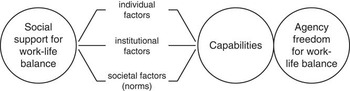
Figure 1 is based upon Hobson’s (Reference Hobson2014) modification. It shows that social support available to independent professionals is converted into capabilities by individual, institutional, and societal factors. These three factors act as conversion factors; they enable or hinder independent professionals to achieve agency freedom for work–life balance. The aim of this article is to explain what happens in between the brackets. How do individual, institutional, and societal factors and norms enable or hinder independent professionals’ capabilities to achieve work–life balance?
The conversion process of social support into capabilities and agency freedom for work–life balance

Method
Design
Data were collected by designing an inductive, explorative comparative case study (Boeije, Reference Boeije2009). To explain conversion processes, a semistructured questionnaire was constructed based on the Capability Approach adjusted to work–life balance (Hobson, Reference Hobson2014) as well as literature on social support and work–life balance. Based on a review of cross-national comparative work–life literature and the analysis of the institutional and societal context in terms of work–life support, values, and norms, the Netherlands, Spain, and Sweden were selected as differing European countries. Contextual information on these three countries and how they differ in terms of societal and institutional characteristics is provided after the methodological section and is summarized in Table 2. The participants were interviewed in Rotterdam (the Netherlands), Valencia (Spain), and Malmö (Sweden). These are large cities, but not the main capitals, which increased the likelihood of selecting native independent professionals rather than so-called digital nomads working in an internationally oriented context.
Participants
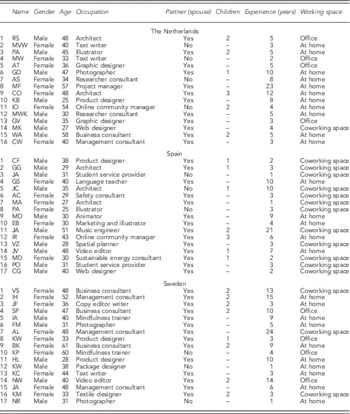
The cases in this study were purposive sampled. Independent professionals were selected because they form the fastest growing group in the European labor market and their specific characteristics are of interest (Leighton & Brown, Reference Leighton and Brown2013). Clear criteria was formulated in order to avoid a researchers bias. Participants were all engaged in full-time professional, scientific, and technical activities (NACE code M), because this is the sector with the highest percentage of independent professionals (25%) in Europe (Leighton & Brown, Reference Leighton and Brown2013). This implies that their activities were limited to management and consultancy activities, public relations and communication activities, architectural activities, technical consulting, research activities, design activities, photography, and translation. Furthermore, they were not financially dependent on a spouse or partner. Participants vary in terms of individual, institutional, and societal context in order to detect and understand conversion processes. This implies that participants were of various genders, parental statuses, and had varied working environments (i.e., whether they were flexible to work at any (coworking) location or were restricted to a practice at home). An overview of the participants is provided in Table 1.
Overview of participants

Procedures
In each country, the owners of several coworking spaces were approached to invite independent professionals to participate in the research. The owners were asked whether they could forward an invitation for the interview to independent professionals who met the criteria mentioned above. Next, the interviewees were asked to forward our invitation to colleagues working from home via the snowballing method. A pro of this method is that it allowed to ensure variation in the sample, for example in location of the work place, occupation, gender, and parental status. Furthermore, it decreases the probability of self-selection bias. The final sample consists of 50 participants (N=16 the Netherlands, N=17 Spain, N=17 Sweden).
Data collection and analysis
Data were collected through audio-recorded interviews, lasting ~1 hr. The interviews took place from January to August 2015 at coworking spaces, cafés, or at homes in Rotterdam, Valencia, and Malmö. All interviews were conducted by the author. The interviews in Rotterdam were conducted in Dutch and the Valencia and Malmö were conducted in English. The interviews covered four topics: (1) work–life balance at the moment of interviewing; (2) capabilities and restrictions to achieve the ideal work–life situation; (3) social support for work–life balance; and (4) state support for work–life balance. The topic list was piloted in the three countries to see whether there were any cultural (interpretation) difficulties. Data collection and analysis was alternated to allow for constant comparison. After transcribing the interviews, the text was coded with the help of the computer program MAXQDA. First, the data were segmented by coding parts related to social support based on operationalization from literature. Open coding was conducted to detect and identify the data relevant to the research question. After completing open coding, axial coding categorization was used to categorize types and sources of social support and the conversion factors (Boeije, Reference Boeije2009). As the study progressed, coding focused on confirming, elaborating, and validating relationships between social support, conversion factors, work–life balance, and the Capability Approach as a whole. The last coding phase, selective coding, involved looking for the most important conversion factors. Coding was done by country; first, all data from the Netherlands was coded and analyzed to understand the conversion processes in this specific country, then, data were collected and analyzed in Spain, and lastly in Sweden. After having analyzed all countries separately, the context-specific findings were compared. After a total of 50 interviews, the author found no further conversion factors in the final interviews to explain the possibilities of independent professionals to achieve work–life balance. The saturation point was reached and thus the process of data collection could be ended (Boeije, Reference Boeije2009).
National Context
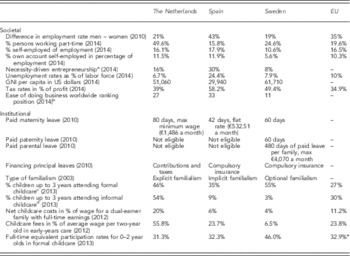
A description of the societal and institutional context in the Netherlands, Spain, and Sweden is needed to understand the conversion processes of social support for work–life balance. Agency is situated in social relationships and institutional arrangements that reproduce social cultural norms regarding work–life balance. The societal and institutional contexts are summarized in Table 2.
Societal and institutional Indicators for the Netherlands, Spain, Sweden and the EU average

a % of entrepreneurs running a business from 0 to 3.5 years who are involved in entrepreneurship because they had no other options for work.
b The ease of doing business ranking ranges from 1 to 189. The ranking of economies is determined by sorting the aggregate distance to frontier scores.
c Childcare at day-care center organized/controlled by public or private structure.
d Informal childcare: arranged by a professional child-minder or by grandparents, other household members (outside parents), other relatives, friends or neighbors.
e OECD 30 average.
The societal context in the Netherlands is characterized by the family having a large caretaking responsibility. Women are primarily seen as caretakers and, as a consequence, often work part-time and are economically dependent on their husbands. For a long time, public work–family policies have promoted the male-breadwinner model resulting in many women working part-time. Work–life issues are mainly administrated by trade unions and employers organized into private corporations. This excludes independent professionals, who are appointed to social insurance (Ferrarini & Sjöberg, Reference Ferrarini and Sjöberg2010). Spain is characterized as ‘familialistic’, placing importance on close family relationships (Campos, Schetter, Abdou, Hobel, Glynn, & Sandman, Reference Campos, Schetter, Abdou, Hobel, Glynn and Sandman2008). This cultural value is represented in policies in the field of (child) care, which actively aim at strengthening the family in its caring function. De-familializing policies by contrast, often found in Nordic countries, aim at unburdening the family in its caring function through the market. A survey carried out in EU countries, found that only 11% of Spanish families preferred the man working full-time/woman working part-time option, compared with 67% in the Netherlands (Jaumotte, Reference Jaumotte2003). In Sweden, social rights are designed early on to encourage parents’ employment and the sharing of unpaid care work. This earner–carer orientation of policy is characterized by principles of equality of opportunity and a compressed wage structure. Access to benefits and services is based on citizenship and previous employment. This provides all citizens with relatively high autonomy (Korpi, Ferrarini, & Englund, Reference Korpi, Ferrarini and Englund2013). However, although gender ideals are changing and equality is an important value, working life shows a persistent trend towards preservation of breadwinner masculinities. These social cultural norms are reflected by the gender gap in employment rates of men and women, for example. There are 19% more men than women in the labor force in Sweden. In the Netherlands and Spain, these percentages are 21 and 43%, respectively. Part-time working is much more common in the Netherlands, although it is unknown whether these percentages are representative for independent professionals too. Noteworthy is the rapid growth (93% compared with 45% in Europe on average in the period 2004–2013) of independent professionals in the Netherlands (Leighton & Brown, Reference Leighton and Brown2013). Spain has the least favorable social economic situation (in terms of unemployment rate and Gross National Income (GNI)). Specific taxes for business owners are highest in Spain (58.2% of profit). This might explain why the percentage of necessity-driven entrepreneurs, who had no other options for work, is higher in Spain than the other two countries (GEM, 2015). The DoingBusiness ranking (2014) shows that the Swedish regulatory environment is most conducive to starting and running a business.
The institutional context is described in terms of work–life policies and childcare arrangements. Leitner (Reference Leitner2003) characterizes Dutch care policies by explicit familialism; they not only strengthen the family in caring for children through familialistic policies, but it also lacks the provision of any alternative to family care. Implicit familialism in Spain neither offers de-familialization nor actively supports the caring function of the family through any kind of familialistic policy. The family will be the primary caretaker since there are no alternatives at hand. Within the optional familialism in Sweden, services as well as supportive care policies are provided. The family is enabled to care, but not obliged. In the Netherlands, independent professionals receive a childcare allowance based on their number of worked hours. This may vary per year in accordance to their business, resulting in insecurity and the risk of having to return the allowance (Annink & Den Dulk, Reference Annink and den Dulk2014). Unfortunately, no data are available on the use of the childcare allowance by independent professionals. The percentages in Table 2 show that despite relatively high costs the rates of children aged <3 years of age attending formal and informal childcare is very high (46 and 54%, respectively). In Spain, childcare allowances are income related. After the age of 3, children have the option to attend public schools without cost. Childcare facilities for children under three are not very well developed in Spain and most of them are private. As a result, upon completion of paternity or maternity leave, the childcare options available to working parents mainly consist of unpaid care by relatives (Borra, Reference Borra2010). Note that 2013 data, however, shows that only 9% of the children up to the age of three are taken care of informally. In Sweden, independent professionals have parental leave rights with benefits based on their expected income. Since long parental leave is available, most parents take care of their child(ren) during the 1st year. Formal childcare is provided by the municipality and is available to all children from age one. Up to the age of 3, childcare is mainly formally arranged (55%). Only 3% are taken care of by childminders, grandparents, relatives, friends, or neighbors. Swedish children under the age of two spend the most hours in formal childcare; in 2013 46% of children under two were in full-time childcare (OECD, 2013).
Findings
This section starts with describing work–life balance as experienced by independent professionals. Next, it provides an overview of sources and types of social support for independent professionals’ work–life balance. The main part focuses on explaining how conversion factors (individual, institutional, and societal) enable or hinder independent professionals to convert social support into a resource for work–life balance.
Work–life balance experiences
Most respondents are very well aware of the importance of work–life balance. Respondents narrate the work domain as consisting of different sub domains: jobs to earn money; jobs for expressing creativity and personal fulfillment; and jobs to contribute to society. Also the formal and informal network are important domains. Many participants mention the risks of being too occupied with work and having little time left for family, friends, and themselves. For almost all of the independent professionals in all three countries, the work is closely related to the self. The work is often a manifestation of personal interests, experiences, skills, ideas, time, illusions, talking to people, education, and their family’s investments. Some participants cannot make an (emotional) distinction between their work and themselves and experience this blurring between work and other life domains as limiting their capabilities for work–life balance. In general, strong identification with the job is experienced as limiting the creativity in work and the quality of relationships outside work. Participants feel like they ‘are the company’ when they spend too many hours working, and invest too much energy and mind space. Strong job identification is experienced to be at the cost of participation in family and social life as illustrated by this quote:
Work-life balance … for a long time there wasn’t really a ‘life’ part. When people would ask me: ‘How are you?’, I would say: ‘The company is fine’. Work was the only thing I did over the last six years. It’s like you are getting addicted. I’m now trying to take a day off sometimes. Wow, I feel guilty! I feel so responsible. It’s my image. It’s my name. (ES4, language teacher, female [40])
Sources and types of social support for work–life balance
Participants mention their partner, family, work, and nonwork-related friends (in order of importance) as providing them with emotional and instrumental support. The most important type of social support for work–life balance appeared to be others showing trust in the participants. This is in line with Reis, Sheldon, Gable, Roscoe, and Ryan (Reference Reis, Sheldon, Gable, Roscoe and Ryan2000), who found that the best predictors for general well-being were meaningful conversations and feeling understood and appreciated by those they interacted with. Expressing doubts, on the contrary, is experienced as very stressful to most participants, as illustrated by a Spanish architect:
She [my partner] is always asking how it goes [with the business] and how we should manage if it doesn’t work out. Every time she asks, I feel more pressure. She thinks about it much more than I do’. She needs to realize I can do it. If she starts to stress and puts too much pressure on me, it will be even more difficult. (ES2, Spanish architect, male [29], one child)
The partner, if one is present, is the one most involved in daily life and work–life balance. He or she mainly offers emotional support, in this, the act of understanding clearly appeared to be the most important. Instrumentally, the partner has the ability to enable the independent professionals’ work–life balance by negotiating childcare, household tasks, and time schedules. For those without a partner, the parents of the independent professional provided similar and important emotional and instrumental support. On top of that, many parents offer financial support. Only the mere idea of their parents being able to financially support them if necessary, makes the independent professionals feel more secure, which has a positive influence on their work–life balance. Friends could be work related or nonwork related. Work-related friendships are often established at coworking spaces. These spaces allow independent professionals to be directly in contact with likeminded people, resulting in friendships. More importantly, it allows them to see that others go through difficulties too, not just them. Words of encouragement or practical advice felt more valuable with the knowledge that other has had similar experiences. Working at a coworking space facilitates direct support such as the ability to ask for advice or opinions, taking breaks together, and also personal feedback:
My colleague at the co-working space understood the situation. After my baby was born I started to work at the co-working space again. But she told me not to work and enjoy my child, because you cannot go back in time. [At that time] being with my child was more important than being at work. Baby over business. (ES15, sustainable energy consultant, female [30], one child)
Nonwork-related friends support work–life balance instrumentally by providing the independent professionals with social gatherings and breaks, which allows them to distance themselves from work. Emotionally, these ties are relatively strong because nonwork-related friends are often closely involved in the independent professionals’ private life. Especially friends whom participants have known for years are able to put things into perspective and show more understanding. Literature suggests that people feel understood to the extent that others manifest support for the unique vision they hold. Feeling understood provides people with a sense of capability and a will to continue with actions in a similar way (Cahn, Reference Cahn1987). Participants mentioned this effect explicitly:
Talking to others helps you to reflect on yourself. You get a clearer idea of what you want in work and in life. This interview helps me too, by the way. (NL7, Dutch researcher consultant, female [34]).
However, a lack of understanding of what it is like to be an independent professional sometimes causes frustration:
Many of my friends are independent, they understand. They work in different sectors, but they feel the same. Other friends work as teachers at a school and have a lot of time. They even don’t understand that you cannot have a coffee with them [anytime] even if you have flexible hours. My work is important, you know. (ES10, Spanish marketer and illustrator, female [30])
The (in)formal network mainly provides instrumental support for the work domain. Knowing others and meeting them at events makes the independent professionals feel more integrated in a network. This is in line with research that shows informal communities of support comprised of other self-employed people were valued for mentoring, assistance, and friendship and were less emotionally intense compared with experiences of support from family members (Hilbrecht, Reference Hilbrecht2016). Other persons that provide independent professionals with social support are customers (providing feedback), neighbors (as a back-up). Also the dog constitutes temporal and physical boundaries, helping self-employed workers to secure and manage their home and working lives (Mustafa & Gold, Reference Mustafa and Gold2013).
Conversion processes
The aim of this paragraph is to explain how individual, institutional, and societal factors enable or hinder independent professionals to convert social support into a real resource for work–life balance. Support may be offered by one of the sources mentioned in the previous section, but whether support is effective for work–life balance depends on the processes described below.
Individual factors: gender and cohabitation
The interview data shows that gender hinders the conversion of social (childcare) support into work–life balance capabilities in several ways. First, the independent professional women in this sample, especially mothers, in all countries were more likely than men to prioritize their family life over work. As already noted by Sen (Reference Schieman, Milkie and Glavin1985), women may starve themselves in order to feed their families. They may lack a notion of their own work–life balance, because their identities are so tied to the household needs of others (Hobson, Reference Hobson2014). Female business owners felt they had to simultaneously meet the role demands of being a mother, a housekeeper, a wife, a friend, and a businesswoman:
It is very difficult to have a company, house, husband, and children. You need to be a business woman, householder, wife, and friend … all those roles in the same day. When it is night, I am very tired. I would like to work more time and to enjoy my child more without work things in my head. My company is like my second baby. (SE15, Spanish sustainable energy consultant, female [30], one child)
Indeed, gender act as a conversion factor that limit the use of formal rights. This appeared to be present in all countries, regardless of gender equality practices and supportive work–life policies that are, for example, seen in Sweden. This immediately illustrates that conversion processes regarding the individual, institutional, and societal context are interrelated. Regarding the individual, gender result in the conversion process of mothers feeling responsible for being caretakers, even though they might have decided to share the responsibility with their partner. This is in line with Gornick and Meyers (Reference Gornick and Meyers2009), who show that mothers are likely to conform to expectations they will manage the home even if they are employed. The following quote illustrates how mothers feel forced to even prioritize their role as a mother above being a business owner:
I live in a country where a woman’s position is pretty good and equal. I have the same rights [as a man], but of course there are traditions here and the mother role is very sacred. When my child was just born, other women told me what to do. And they were just talking to me … I was like, ‘Hello, there are two parents!’. When my husband was helping [to look after] our child, they said, ‘Oh what a nice husband!’. I was like, ‘What the fuck. We share the responsibility to raise him together. That’s our work. We share the work.’ (SE8, Swedish product designer, female [33], one child)
Gender also acts as a conversion factor for male independent professionals. The cultural constructions of fatherhood can privilege men by prioritizing their role as earners and releasing them from care responsibilities (Crompton et al., 2007). However, the independent professionals who are fathers in this sample mention the role of being a breadwinner as stressful. This role prescribes them to earn adequate money which limits their freedom and capabilities for work–life balance:
She is taking care of our baby now and she feels dependent on me. It’s only me who can bring in money. That’s a bit the role of the father. I don’t want money to be my priority, there are other things that are much more important. (ES2, Spanish architect, male [29], one child)
Cohabitation acts as a second conversion factor. The quote above illustrates how gender expectations regarding social support for work–life balance may be reinforced by cohabitation. In the example above, the male independent professional feels pressured by financial expectations of the partner who is taking care of the child. Couples consisting of two independent professionals with insecure incomes and who share a household sometimes put pressure on each other to work more. One participant even feels like she has to compete with her independent professional partner to bring in more money. In these situations, couples are trying to support each other, but unconsciously focus so much on work that they might even hinder their work–life balance. On the contrary, cohabitation might also promote social support processes. Capabilities are enhanced by support from a partner who is an independent professional too, because he or she understands what it is like to work irregular hours, having to invest during the 1st years of business, has encountered the same stress and insecurities, and does not blame the independent professional for the (negative) consequences of that. With both partners having flexible schedules, this allows them the ability to adjust their schedules to take turns with looking after household chores and the children, for example. Because of a deeper understanding, partners who are both independent professionals experience that they can offer each other more effective practical support. For example, this can be seen as helping the other to: think strategically, focus, and formulate objectives. Furthermore, the partner can offer opportunities for networking as well as feedback on presentations.
Institutional factors: the ease of doing business and formal childcare
The interview data suggests that experienced difficulties in doing business act as a conversion factor, resulting in independent professionals making use of social support instead of government support more often. Especially Dutch and Spanish participants note that they have developed an attitude of ‘never mind, I will take care of it myself’ towards institutions over time, as illustrated by this quote:
For me it’s like: you [the government] don’t care about me, I don’t care about you. I feel like this since a long time. Many people try to do things without the government. Sometimes that’s a problem, especially for architect, there are rules and bureaucracy. (ES5, Spanish architect, male [35], one child)
Deci and Ryan (Reference Deci and Ryan2000) explain that indifferent attitudes towards institutions are the result of an ‘accommodative’ process. Independent professionals who say they don’t need governmental support and seem fine with it, may have accommodated to the need-impoverished environment. As a result, they focus on social relationships as a source of support for work–life balance rather than the government. Participants mentioned obstacles such as disproportional amount of taxes; unfairness and corruption (in Spain); and administrative burden and lack of information related to surcharges (in the Netherlands). Pensions were mentioned as a threat to work–life balance later in life, although this might be related to the current political debate in the Dutch media on pensions. Dutch independent professionals tended to compare their social situation to employees and feel deprived. Swedish independent professionals, on the contrary, were grateful for the easiness of doing business in their country, and often participated in projects as a mentor, for example, to support other entrepreneurs in return.
The second institutional conversion factor found in the data is formally arranged childcare. A lack of formal childcare support is often replaced by childcare support from parents, especially in the Netherlands and Spain. On the one hand, this is experienced as financially attractive, but on the other hand, the involvement of parents in childcare is experienced as decreasing the quality of life. Informal arrangements often become business-like meetings, where the informal family relationship is experienced as formal:
They [my parents] take care of my son very well, but I am not happy about them taking care of my son. I want to have a more personal relationship with my parents. But our relationship is only about the care of my son. It seems like I have no personal life with my parents anymore. (ES14, Spanish video editor, male [48], one child)
Extensive formal childcare support may also act as a conversion factor reinforcing other sources of social support. Swedish participants note that their 12-month parental leave, which is meant to be shared between partners, increases their flexibility. Furthermore, formal childcare supports enables parents to mutually support each other in work–life balance because they understand each other much better, as illustrated by the following quote:
Half a year is perfect; you bond with your child. But I got pretty bored after a while, I have to say. Next time [I have a child] I would open a web shop, so I could continue my sales from home. Mentally it is good for the other [the partner] to understand because you can support each other better. Especially if you are an independent [professional] and are flexible. I don’t want to focus only on my child, I care about my friends too. With this shared leave I can. (SE8, Swedish product designer, female [33], two children)
Societal norms: financial hardship and familialism
In Hobson’s (Reference Hobson2014) adjustments to the Capability Approach, societal factors refer to the construction of norms around gender, care, and employment. These norms are relevant, because they might influence preferences for social support and work–life balance. Norms regarding the economic situation appeared to act as a conversion factor limiting social support for work–life balance capabilities. Many (young) Spanish independent professionals experience financial hardship. Participants talked about the social economic context mostly in terms of their own financial situation. They explain that, although they are supported by their partner, family, and friends, they feel powerless. The high unemployment rates and negative prospects make them worry about having to work more hours for less income, which negatively influenced their work–life balance. In some cases, financial hardship hinders social support from friends to result in work–life balance capabilities. Participants noted that in times of crisis, nonwork-related friends do not always understand the consequences of being independent professionals. In these cases, social support unintendedly results in frustration, as illustrated by this quote:
I could not talk about my economic situation with friends. My business was not doing so well, but my friends thought that I was complaining. At some point, they are just tired of it. It is like new parents talking about their baby all the time. They did not ask me about my business anymore, or started a new topic. Or they would give me suggestions which were not useful at all. Sometimes I got mad about that. You want to be understood. I am open to feedback and I will listen. But most [of their suggestions] I already tried like a long, long time ago. But you don’t want to tell them that either. (NL11, Dutch online community manager, female [54])
Financial hardship can also enable social support for work–life balance. Especially in Spain, many independent professionals are financially supported by their parents. This resulted in the independent professionals being somewhat shielded from the financial crisis. Financial support from social relationships sometimes results in independent professionals extensively discussing their business ideas with their parents, for example, which can increase and intensify family connections:
For me, my mother is like a [business] partner. She is giving me the money for the business and we have discussions about that. I call her three times a week. I start by telling my personal things, then work, work, work, and I then finish [the conversation] with something that I did. But mainly it is like, ‘Should I do this or this?’. Then she says, ‘Ok, that makes sense. How much do you need?’. (ES3, Spanish student service provider, male [31])
A second societal conversion factor is familialism, which is a cultural norm that places great importance on interpersonal relations. Supportive relationships, particularly family relationships, are a highly valued cultural ideal (Campos et al. Reference Campos, Schetter, Abdou, Hobel, Glynn and Sandman2008). The quote of a Dutch web designer who lives in Spain could very well explain the impact of this societal norm on work and life:
It all changed when I met my Spanish girlfriend. Suddenly I was part of the family, and family is everything here. It’s such a big part of what they do. They work and live in these circles, their networks. They always take into account their family, in every decision. You cannot make your own plans, there are always expectations. Also when you are free. They don’t tell you are obliged to visit them, it is just the way it is. (NL7, Dutch web designer, male [27])
In Spain, it is very common to visit the family every weekend and go on Sunday lunches. Spanish independent professionals are also less likely to move houses further away from their family, even if this choice would be better for their business. Besides family, the data shows that Spanish independent professionals spend more time with friends than the Swedish and Dutch independent professionals. Spanish participants would often meet friends for lunch during work days. Dutch and Swedish participants place less importance on close (family) relationships. Participants described a more distant and formal cultural context, in which (formal) network occasions were more common. Especially in the Netherlands, independent professionals often are members of professional associations. They can fill their whole day with a business breakfast, open coffees, and networking events to meet potential clients in a formal and structured way. This social structure acts as a conversion factor limiting flexibility for work–life balance, since formally organized meetings take a lot of time and energy. Being embedded in a cultural system in which high levels of familialism are normative, such as in Spain, augment the benefits that social support can provide. This is in line with Campos et al. (Reference Campos, Schetter, Abdou, Hobel, Glynn and Sandman2008), who conclude that although not all individuals desire or obtain this cultural ideal of positive relationships, the expectations surrounding these cultural values may create a context that makes it easier for members of the culture to perceive, obtain, and benefit from social support from their close relationships, including family relationships.
Conclusion and Discussion
This article explains how social support enables independent professionals to achieve work–life balance by describing underlying conversion processes. The findings show that individual (gender and cohabitation), institutional (the ease of doing business and formal childcare), and societal factors (financial hardship and familialism) may enable or hinder independent professionals to achieve work–life balance. Gender hindered the conversion of social support into capabilities. Female independent professionals with children struggled with meeting various role demands and having to be a ‘good mother’. This made them feel solely responsible instead of accepting social support. Male independent professionals, on the other hand, felt pressured by the expectation of being the breadwinner, limiting their capabilities. Cohabitation could either convert social support from the partner into pressure to earn adequate money or into providing understanding and flexibility which enables work–life balance. At the institutional level, experienced difficulties in doing business resulted in independent professionals making use of social support instead of government support more often. In Sweden, formal childcare support acted as a conversion factor enabling time for other types of social support for work–life balance. A lack of formal support increased grandparents’ social support in the Netherlands and Spain, but hindered the quality of personal relationships. At the societal level, financial hardship hindered social support for an independent professional’s work–life balance by feeling misunderstood and lonely. However, financial hardship increased the involvement of family, which was, for example in Spain, expressed by discussing business ideas and going back to live at home. Financial hardship made it necessary for independent professionals to look for solutions, which enabled social support. Lastly, in Spain, social support from the family is taken for granted because of the familialistic societal norms. These norms act as a conversion factor, increasing the benefits of social support for work–life balance. Dutch and Swedish participants placed less value on close personal relationships. The formal network structure was experienced as limiting social network support because of its time and energy consumption. The cross-national comparison shows that the institutional and societal context may hinder and reinforce social support for work–life balance, resulting in different experiences across countries. The implications of these findings are discussed next.
Theoretical implications
First and foremost, this article explains how social support actually functions as a resource for work–life balance. It is assumed that social support is an important resource for work–life balance (Thompson & Prottas, Reference Thompson and Prottas2006; Schieman et al., Reference Sen2009), but the findings of this study show that intended support does not necessarily improve work–life balance and may even hinder work–life balance because of conversion factors.
Second, this study adds to the conceptualization of social support types and sources for work–life balance in the context of self-employment, which is complex. Findings of this study show that instrumental social support was only provided by emotionally connected ties. Participants mentioned the precondition to feel understood, but in practice this might also be provided by other professionals in the field. Hilbrecht (Reference Hilbrecht2016) adds that different types of social support often exist simultaneously. Furthermore, the same author argues that female and male independent professionals might have different social support needs. Women more often identified financial support from their partner as essential to operating a business, whereas men valued instrumental support in the form of childcare and domestic activities. These findings are likely to be the result of gender norms, which emphasizes the need for future research to re-conceptualizing social support for work–life balance and take into account conversion factors.
Third, the conversion processes described in this article confirm that ‘context matters’, as noticed by many work–life researchers in the past decade (Hobson, Reference Hobson2014). An explanation of these conversion processes is a valuable addition to current quantitative studies which have included individual, institutional, and societal variables in (multilevel) regression analysis (see, e.g., Annink et al., Reference Annink, den Dulk and Steijn2015b). Future research should take into account that work–life balance capabilities cannot be compared across countries without taking into account conversion factors at the institutional and societal level. More research is needed on the specific components of cultural values, such as familialism, which may influence work–life balance (Allen, French, Dumani, & Shockley, Reference Allen, French, Dumani and Shockley2015).
Fourth, the Capability Approach also shows that choice in work–life balance is multidimensional, involving relational and structural features that are complex, contingent, and contradictory (Crompton & Lyonette, Reference Crompton and Lyonette2006). Conversion factors are often interrelated and constitute dynamic processes, rather than well-defined measurements for work–life balance. The Capability Approach emphasizes that individuals are not isolated, but that their opportunities greatly depend upon relations with others. This is illustrated by the individual conversion factor cohabitation, that appeared to be more influential than age, for example. The influence of age on work–life balance has been found to be curvilinear in former research, which might be explained by the various stages of life and its relation to family situation (Nordenmark, Vinberg, & Strandh, Reference Nordenmark, Vinberg and Strandh2012). In order to explain how social support resources enable independent professionals to achieve work–life balance, conversion factors are disentangled in this article. Future research could study the way societal and institutional factors interact with each other.
Lastly, this article studied conversion processes of social support into real resources; future research might study the element of agency freedom for work–life balance in the context of self-employment. It is often assumed that independent professionals freely choose self-employment and therefore have human agency and choice to achieve work–life balance (Caproni Reference Caproni2004). However, as Lin, Yates, and Picot (Reference Lin, Yates and Picot1999) note, this ‘assumes entrepreneurs as individuals with particular abilities and argues that self-knowledge of these particular abilities motivates them to engage in risk-taking entrepreneurial pursuits’ (p. 6). Vosko and Zukewich (Reference Vosko and Zukewich2006) argue that the dichotomous distinction between opportunity and necessity-driven entrepreneurship based on the dominant understanding of ‘choice’ is inadequate. Four dimensions should be taken into account: regulatory protection and social benefits, job certainty, control over one’s employment situation and income adequacy. Furthermore, the authors argue that gender norms should be taken into account, as ‘individual choice’ is limited by gender role responsibilities such as domestic care. This study has shown that for some labor market conditions or sector-related traditions may limit individual choice. Others chose being independent over wage work because of a lack of adequate childcare. Besides individual considerations, Van der Klink et al. (Reference Van der Klink, Bültmann, Brouwer, Burdorf, Schaufeli, Zijlstra and van der Wilt2011) emphasize that individual choices are not solely rational and aimed at optimizing own interests and work–life balance, but relate to the norms in their societal context. Future research should take into account that, from a capability approach, it is not about the actual choice that an individual makes, but about understanding how this choice is made out of all alternatives.
Practical implications
First, this article described the specific sources and types of social support for the work–life balance of independent professionals who work in a different context than employees. Comparative researchers using large data sets should be aware of the operationalization of social support. Based on the findings of this study, researchers are suggested to distinguish between sources and types of support, adding complexity and depth to the ways in which support is constructed.
Second, the results of this study could also directly increase capabilities for the work–life balance of independent professionals. Although the importance of self-support should not be underestimated, independent professionals could rely more on social support if they become aware of the sources and types available to them. Relatives could increase support in terms of understanding and avoid expressing worries and concerns.
Third, institutions and (local) governments could improve support systems by showing understanding for this specific group of self-employed workers. According to Hobson (2014), those with less individual resources, skills, and networks/social capital are more reliant on laws and policies that support work–life balance. However, Annink et al., (Reference Annink, den Dulk and Steijn2015a) show that work–family public policies have no significant effect on the work–life balance of self-employed workers. This implies that more work–family state support does not necessarily result in more agency freedom to achieve work–life balance for self-employed workers. Hobson (2014), however, argues that the sense of entitlement to make claims for support is important because it increases the scope of alternatives to achieve work–life balance. The sense of entitlement reflects not only what individuals can claim, but also expectations about what is feasible and imaginable in order to achieve work–life balance. Research shows that being integrated into a social network may provide people with emotional or psychological resources that enable them to avoid certain stressors. Similarly, researchers note that people who believe support is available to them tend to experience less stress than do those who do not (Lakey, Adams, Neely, Rhodes, Lutz, & Sielky Reference Lakey, Adams, Neely, Rhodes, Lutz and Sielky2002). Therefore, increasing institutional support could be an important investment. Currently, the European Union stimulates and regulates policies that support work–life balance (for an overview of these policies see Annink et al., Reference Annink, den Dulk and Steijn2015a). However, specific institutional support varies across countries because it is based on path dependency and is related to cultural logics. Because of this interrelatedness of individual, institutional, and societal conversion factors, work–family state support is more likely to be effective if it is designed in line with a country’s societal values.
This study may inspire researchers, independent professionals, and policy makers to prioritize social support differently. By doing so, social support for the work–life balance of independent professionals is most likely to outweigh the lack of coworker and supervisor support.
Acknowledgement
This study has been funded by the Netherlands Organization for Scientific Research (4010002.006).