By the close of the eighteenth century, a peculiar tale had spread throughout the mining communities of the German states. In fields and forests, a stag appeared to the miners, now with a blinding golden luminescence, now with antlers of silver ore. ‘Still in 1793’, Alexander von Humboldt (1769–1859) griped, miners continue to believe that ‘a “Golden Stag” (a four-footed mine-spirit)’ aided them in their search for metals. Stationed as a mine official (Oberbergmeister) in Prussia's Franconian territories, Humboldt evoked the Golden Stag in a memorandum that outlined his plan for a ‘Royal Free Mining School’, established in Bad Steben in the winter of 1793/4. Its aim: to cultivate miners’ children into a new generation of ‘rational’ mine foremen.Footnote 1
To the young administrator, recently graduated from the Mining Academy in Freiberg, Saxony, talk of spirits – gnomes, goblins, witches, and the like – made for ‘feeble-minded’ miners. It epitomized the ‘ignorance’ that ‘undermines prosperity’ in Franconia and which allegedly made miners vulnerable to the ‘greed of the investors’ (Gewerken, who comprised Gewerkschaften).Footnote 2 Though deeply dependent upon investors, state officials were also wary of those who, ‘left to their own free will’, would dig pits too hastily and exploit only the most immediate ores, ‘thereby blocking the way to future exploitation’.Footnote 3 This they called ‘Raubbau’, literally ‘robbery-construction’.Footnote 4 Definitions of Raubbau regularly targeted investors, reminding them of their obligation to abstain from ‘räuberisch’ practices and encouraging officials to mind ‘that investors not dig to steal’ (daß die Gewerken nicht auf den Raub bauen).Footnote 5 Yet as state records would have it, ‘ignorant foremen’ and other undisciplined officials were also complicit in investors’ myopic designs. Raubbau thus posed a grave threat to the long-term interests of the state. In fact, mining law from the period explicitly opposed Raubbau to ‘sustainability’ (or Nachhaltigkeit), part of a broad lexicon with which officials drew wood and mineral resources into political economy.Footnote 6
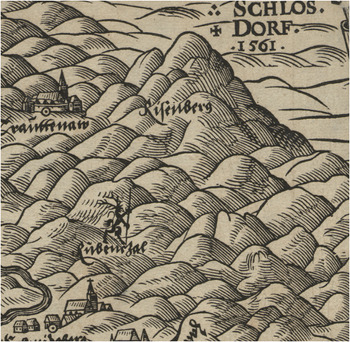
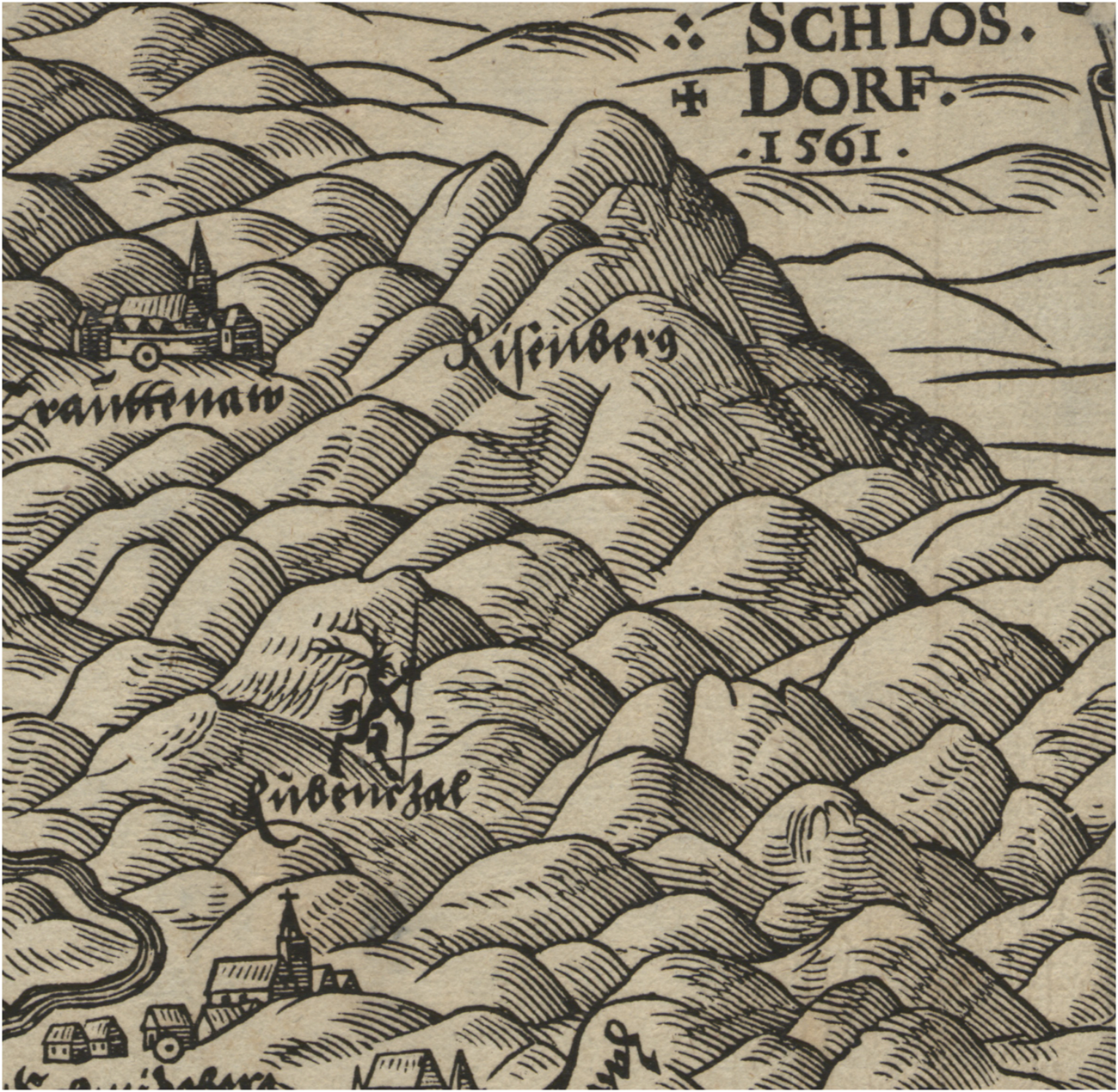
In the realm of mining mythology, the tale of the Golden Stag similarly condemned greed and avarice amongst miners. Like other spiritual entities said to govern the underground – Rübezahl, for instance, who sometimes bore the antlers of a deer and more often appeared as a monk (Figure 1) – the Golden Stag was the keeper of subterranean riches that might otherwise be plundered. So said legends that miners passed from the mountains of Silesia to those of Saxony, the Harz, and Franconia. In Saxony's Ore Mountains, the luminous Stag identified mineral riches to a man in sworn secrecy. Soon, though – according to a modern collection of Bergmanssagen – word of the treasures spread amongst the villagers, who besieged the earth in a ‘feverish search for the treasure’. Their lust was their demise. For the coveted deposit of gold ‘remains undiscovered to this day, concealed and protected’ in the earth. In the Harz, too, the tale of a White Stag warned miners that if new pits were dug before exhausting the old, their toil would only beget misfortune.Footnote 7
The antlered Rübenzal (or Rübezahl) in the Sudeten Mountains of Silesia as depicted in a detail of the map ‘Silesiae typus descriptus et editus a Martino Heilwig Neissense’ (Breslau, 1685). 57.5 cm x 73 cm. Map Department of the Wroclaw University Library, 2448-IV.B.
This article views Humboldt's Mining School within administrative and vernacular discourses. It argues, first, that mine officials of the period understood sustainable resource management – questions of the exhaustion or endurance of mineral deposits – as a matter of labour discipline. Political concerns about social order in the ‘mining state’ (or Bergstaat) were constitutive of material concerns about natural resources. Humboldt's School not only sought to discipline the physical practice of mining, but also its moral and psychological substrate. In this, he aimed to promote a culture of work closely aligned with state interests.
Academy-trained officials of Humboldt's generation intervened in mining culture in order to align workers’ identities with state interests and ‘make labour supply to mines more reliable’.Footnote 8 Humboldt's particular case shows how labour discipline in mining entailed a re-working of the industry's deep-seated analogy between material practice and moral constitution. Administrative and folkloric discourses betray a common view of excessive exploitation as a moral offence, whether punishable by the Bergstaat or the Berggeist. And in promoting a ‘spirit of the practical’ (Geist fürs Praktische) to supplant the ‘mine spirit’ (Berggeist), Humboldt actually drew upon elements of the industry's rich vernacular culture.Footnote 9
In a literature that identifies eighteenth-century Germany as a fountainhead of modern environmental thought, scholars have devoted special attention to the concept of sustainability as it developed within the field of ‘scientific forestry’. A central thesis of this literature is, as Paul Warde writes, that ‘sustainability emerged from acts of political as much as ecological imagination’.Footnote 10 As the fiscal-military states of early modern Europe consolidated their territorial units and developed expansive bureaucracies to manage growing populations and standing armies, resource management became a central feature of statecraft.Footnote 11 Thus, in 1713, the Saxon mining official Hans Carl von Carlowitz called for a systematic ‘conservation and cultivation of wood’ to ensure the metallurgic industry's ‘continuous, durable and sustained use (nachhalthende Nutzung)’ of timber resources.Footnote 12 But sustainability's first utterance was also steeped in political design. As Joachim Radkau writes, the ‘specter’ of wood shortages that haunted Carlowitz's age served as a regulatory instrument ‘to open up fines for forestry violations as a source of revenue’ – a tool for the state to extend its dominion over the mining industry and its primary source of fuel.Footnote 13 In turn, efforts to quantify and control forests sparked violent conflict after the turn of the nineteenth century as states restricted local populations’ access to timber, so vital to everyday life in the period.Footnote 14
Shifting from wood to mineral resources, the case of Humboldt's Mining School underscores an overlooked aspect of the social strife embedded in early environmental thought: resource management in late eighteenth-century Germany also entailed the strict control of labour relations and a programme of ‘psychological policy’.Footnote 15 Cameralist parlance for the state's paternalist oversight of the mental life of the commonwealth, psychologische Polizey, is the heading under which Humboldt's School fell in the Franconian records of the Prussian Mining Department.Footnote 16 In Humboldt's own words, the School was to promote Prussia's interests by combatting ‘minerly ignorance’ (bergmännische Unwissenheit) with a ‘minerly sense of honour’ (bergmännisches Ehrgefühl), curbing Raubbau by cultivating miners.Footnote 17 Indeed, the term bergmännisch – ‘minerly’ – opens a vast lexicon through which miners expressed normative claims about social order through resource management. In its narrowest sense, the adjective refers to all things mining, Bergmann being the German for miner. Within the industry, however, to be ‘minerly’ was to embody the virtues of piety, loyalty, order, and (o)economy. Conversely, officials used ‘un-minerly’ interchangeably with Raubbau, demarcating the miner's very identity by his adherence to state protocol.Footnote 18
By studying the early history of sustainability with respect to mining culture, this article joins in a broader effort to bring ‘vernacular knowledges’ to bear on histories of science and environment.Footnote 19 The sense that nature defends itself against the greed and immoderation of miners, which echoes through mining mythology, might well be called an ‘environmentalism of the poor’, a sort of care ethic that arises amongst people for whom preserving nature accords with the preservation of their livelihood.Footnote 20 (Hence the Stag's mythological role of safeguarding the earth against those who would plunder it hastily.) Yet the case of early modern mining also resists the dichotomy sometimes drawn between the ‘official landscapes’ of the powerful and the ‘vernacular landscapes’ of the powerless.Footnote 21
Folklore was fundamental to what Tina Asmussen called the ‘intrinsic logic of the early modern mining industry’. Mine spirits gave meaning – even a sense of equity and hope – to the violence of underground labour and the volatility of the industry's booms and busts.Footnote 22 Often, Bergmännlein and other spirits took revenge upon miners for invading their realm, thus explaining mine collapses and other fatal accidents. Other times, mine spirits were thought to protect miners from the exploitation of their superiors. But belief in mine spirits was not exclusive to ‘common’ miners. Keeper entities were minted on silver coin and reported in official records of the sixteenth and seventeenth centuries, and the educated officials of the early eighteenth century still ‘left some room for otherworldly forces to operate’, while pastors warned workers of the ‘Mine Devil’.Footnote 23 ‘Learned worldviews functioned well in conjunction with folk beliefs’, Hjalmar Fors writes of Swedish mining in the period, describing keeper entities as ‘vital parts of widely held cultural belief structures, according to which the material world was closely intertwined with, indeed inseparable from, spiritual and subtle realms populated by mostly unseen denizens’.Footnote 24 Certainly, by the century's close, Humboldt's generation of officials tried to purge their practice of ‘occult’ beliefs about mine spirits and mineral effluvia. Yet even the ‘rational’ sciences of Enlightened elites have been shown to co-exist with folk knowledge about dowsing and divining for instance.Footnote 25 Ostensibly, Humboldt's Mining School aimed to expel ‘superstition’ from the mines.Footnote 26 Yet his generation's call for a ‘measured exploitation’ also bears a striking semblance to the extractive ethos embedded in mining mythology.Footnote 27
Humboldt himself has recently received considerable attention for his own environmental stance, which placed human activity amidst the confluence of forces in nature and taught that society ought to mirror the harmony found there.Footnote 28 ‘A Humboldtian social ecology would have to be as fluid and inclusive as the world itself’, Aaron Sachs has written, tracing Humboldt's influence upon later conservationist movements alive to the malevolent relationship between environmental degradation and human subjugation.Footnote 29 But before Humboldt drew from nature an image of society, his administrative gaze had already constituted the natural world as a political realm.Footnote 30 This aspect of the ‘Humboldtian social ecology’ has deep roots in the social ecology of mining, where environmental concerns found expression through social governance.
It is not the savant-explorer of the famed American voyage (1799–1804) that makes Humboldt particularly illuminating in this study, but rather the ‘savant-technician’ of Germany's emergent administrative elite.Footnote 31 In recent years, scholars like Ursula Klein, Frank Holl, and Eberhard Schultz-Lüpertz have reinterpreted Humboldt within a generation of officials who graduated from technical institutes like Saxony's Bergakademie to pursue practical science – ‘useful knowledge’ – in the service of absolutist states, as chemists, cartographers, mechanics, and miners.Footnote 32 Though Humboldt's later renown as the leading polymath of his day would certainly distinguish him as a singular figure, his zeal for ‘sustainability’ and hostility to Raubbau as a Prussian official in the 1790s are more illustrative than exceptional.Footnote 33 Like many of his generation, gravely concerned with wood shortages, Humboldt set out to increase the efficiency of blast furnaces and substitute peat and coal for wood and charcoal.Footnote 34 Thus, one managed the so-called ‘mine-household’ (Grubenhaushalt), echoing the popular view that the state itself ought to be managed like a thrifty household (Staatshaushalt).Footnote 35
What follows is a study of the socio-political project undergirding ‘sustainable’ resource management in Humboldt's Germany – and, more specifically, in his Mining School. Raubbau, as we will see, was an affront, at once ethical and economic, to the prudence with which officials sought to manage the ‘mine-household’. For Humboldt and his ilk, governing the natural meant governing the social: to expand state territory deep into the earth, they sought to expand its sovereignty into the minds and bodies of those who worked there. And yet this state-building project also echoed older vernacular traditions that, in miners’ songs and sagas, had long conceived of mineral resource extraction as a fundamentally moral concern.
I
Foremen (Steiger) were the highest-ranking of labouring miners but lowest in the state's bureaucratic apparatus.Footnote 36 Amongst workers, the foreman was feared and revered in equal measure. ‘Glück auf, Glück auf! / The foreman comes’, goes the canonical ‘Steigerlied’, beginning with the miner's famous mantra, ‘and his miner's lamp – in the night – / he has already lit’.Footnote 37 Here the foreman is idolized as a guide in the depths: ‘Our foreman must lead the others / breaking a path through the mine.’Footnote 38 In folklore, the foreman appears a familiar but formidable figure, a commoner cloaked in authority. The social distance between foremen and hewers was marked not only by the uniforms they donned, but also by the distinctive etchings they carved into the walls of the shafts.Footnote 39
Yet foremen also inhabited an extremely precarious position in the social ecology of mining. In the industry's estate-like hierarchy, they were situated between ‘service of the Leder’ (the miner's leather smock) and ‘service of the Feder’ (the bureaucrat's feather pen).Footnote 40 So said Johann Gottlieb Voigt's Mining state – one of the eleven texts listed in the Mining School's ‘inventory’ of 1802 – which defined the foreman as a figure who fused practical skill with administrative oversight. But the ambiguity of the foreman class also represented a threat to the mining state. One-part labourer, one-part administrator, foremen were caught between the long-term interests of state mining departments and the short-term interests of private investors, as between competing claims for authority.Footnote 41 The ‘Principle of Direction’ (Direktionsprinzip), a legal-bureaucratic complex first imposed in Saxony after the Thirty Years War and later taken up by Prussia after the Seven Years War, outlined the territorial state's control over mining and smelting operations, allowing investors to open mines provided that 10 per cent of their earnings flowed into state coffers.Footnote 42 This allowed mining administrations to enforce a ‘military-like’ discipline over labour in the second half of the eighteenth century, and it also ensured that foremen were directly answerable to the state.Footnote 43 In parts of the Harz, for instance, foremen were forced to pledge their own homes as collateral for any ‘mine-mischief’ – fires, collapses, or theft.Footnote 44 Investors, meanwhile, came to see foremen as an instrument ‘of their resistance against the rigid administration of the Direktionsprinzip’.Footnote 45 In late eighteenth-century Saxony, for instance, local investors sometimes waged ‘personnel-politics’, appointing their own foremen and shift bosses in a direct affront to the Principle of Direction.Footnote 46 These circumstances help to explain why, although various parties could be accused of Raubbau (including state officials and surveyors), administrators often identified foremen as the culprits of the earth's ‘robbery’.
What is Raubbau exactly? A broad survey of Raubbau in the parlance of miners reveals three interlinked notions of the concept: (1) a literal ‘robbery’ by which miners transgress property lines; (2) an architectural definition referring to the lack of structural integrity in a mine's timber work; and, relatedly, (3) a general definition of mining ‘without consideration for the future’.Footnote 47 In defining Raubbau, cameralists dreamed of a ‘measured’ rather than ‘excessive exploitation’, a regulated practice of extracting ore ‘according to the powers of the mine’.Footnote 48
Above all, the Raubbau discourse reveals the way in which officials understood resource exhaustion chiefly as a matter of labour discipline. Indeed, officials of Humboldt's time sometimes wrote that mineral deposits would yield inexhaustible riches if properly mined and managed. Some experts maintained a belief in the regeneration of metals within the earth. Such claims testify to the persistence of early modern ideas about the ‘vegetable’ ripening of minerals, grown according to the influence of the moon and stars, or produced by a ‘juice’ secreted from the rock by subterraneous heat.Footnote 49 The eminent German mineralogist Heinrich von Trebra, for instance, wrote of the ‘continual generation’ of ore and described the ‘growth’ of silver on wooden props fixed within a mineshaft some 200 years beforehand.Footnote 50 And learned officials in France reported on ‘inexhaustible’ (inépuisable) matrices of iron in the Parisian Journal des Mines.Footnote 51 But mining experts did not, to my knowledge, explicitly link theories of metallic growth to speculations about the inexhaustibility of subterranean resources. Instead, a deposit's inexhaustibility was thought to depend, paradoxically, on the manner in which it was exhausted. For certain mines ‘would be inexhaustible’, wrote one inspector in 1794, ‘if they were not abandoned to labourers who, having no other interest than the present moment, extract only that which costs them little trouble, and leave that which presents difficulties’.Footnote 52
This Ur-conception of ‘sustainable’ resource extraction is markedly distinct from modern meanings, which express concern for the degradation of fragile environments and the depletion of scarce resources. ‘It remains the duty of the miner to set his sights henceforth on the most exhaustive measures’, wrote one Saxon official, speaking to the ‘well-being’ of ‘many ages of Mankind’ in the same breath.Footnote 53 Mining with consideration for future generations meant digging deeper – and doing so bergmännischer. For officials evoked Raubbau not to forewarn an impending exhaustion, but to decry the under-development of mines. As Paul Warde notes, sustainability itself then referred not so much to the over-use of wood resources as to their under-use.Footnote 54 Thus, some definitions of Raubbau even suggest leaving ‘Reservebaue’ of unexploited ore in the upper sections of a mine to ensure its longevity.Footnote 55 In one case from Saxony's Schwarzenberg District in 1820, a mine official (Geschworner) was censured for ‘leaving the minor deposit of iron untouched’, while elsewhere carrying out a ‘true and entirely prohibited Raubbau’ – a practice judged ‘un-minerly’ for compromising ‘posterity’.Footnote 56
Humboldt spoke the same language when he arrived in the Franconian Principalities of Ansbach and Bayreuth. In his initial report of 1792, he described an alum mine, for instance, as ‘utterly irregular and more un-minerly than anything I have seen in both principalities’.Footnote 57 And in his ‘Oeconomic-Plan’ of 1794, Humboldt encouraged fellow officials ‘to persevere in regular operations and beware the unruly’, ‘obstinate investors’. ‘Resistant shift bosses and foremen’, who worked at the bidding of the investors, were to be ‘reprimanded’ for their first offence of disobedience to the state and ‘punished with a monetary fine for all further insubordination’.Footnote 58 From such documents, an image emerges of internal court proceedings by which officials in Saxony and Prussia disciplined labour relations. Once a complaint of Raubbau was lodged, an official ‘of the Leder’ was often ‘summoned to speak’ (zu Rede gesetzt). In the tomes of documentation that such disputes yielded, losses were quantified, and infractions mapped – a process by which state surveyors made the earth's ‘robbery’ a legible offence.Footnote 59
Reports compiled in response to ‘the plan prepared by Humboldt’ reveal the bitterness with which officials condemned the ‘un-minerly’. In one document, an official strikes out another's sedate description of a mine's poor state, adding ‘ransacking’ (Herumwühlen) to disparage the practice of ‘investors who have no desire to work according to regulations’. Where the report continues to describe how ‘the exploitation as well as the very construction of the old mine are defiled by the ignorance of the foreman named Ender’, the editor-administrator again adds his own repudiation – ‘obstinance’ (Halsstarrigkeit) – in the margin.Footnote 60 A liability when working under the influence of investors, foremen like ‘Ender’ might, Humboldt thought, be turned into a valuable asset.Footnote 61 It was the foreman class, therefore, that the Mining School hoped to make anew.
II
One of the School's pupils was Johann Georg Spörl, who left behind only a faint paper trail in its records. Encircled by low-lying hills mined for silver and iron ore since the early medieval period, Bad Steben came under Prussian aegis in 1792, when Spörl was eleven years old. This is the age when he would have joined the other miners’ sons (and in some cases daughters) in various above-ground tasks – hoisting rock out of the shafts, sifting through heaps of extracted earth, washing and crushing iron ore en route to the ovens. Then, at age seventeen or eighteen, Spörl would begin his apprenticeship, assisting the master hewers, masons, carpenters, smelters, or mechanics until achieving a specialization of his own.Footnote 62
It is in this latter phase that we find Spörl in the School's attendance charts. Spörl had attended the School since at least the winter of 1800, alongside thirty-six other boys and young men who gathered at the instructor's lodgings twice a week through the winter months. By 1806, the instructor (an older relative of his) noted that while the younger two Johanns in the family ‘learn slowly’, twenty-four-year-old Johann Georg was ‘the most diligent and best of them all, possessing also the greatest knowledge’. Perhaps, the teacher wrote, eighteen-year-old Georg Heinrich Spörl would follow the elder Johann's example, if his ‘diligence does not abate’.Footnote 63
We can get a sense of Spörl's exemplary knowledge from the schoolbook that Humboldt drafted in 1794, and which, the instructor noted, ‘was nearly unreadable from long years of use’ but still taught a decade on.Footnote 64 Humboldt's text buttressed practical knowledge of ore extraction with a sort of geophysical journey that oscillates between local and global phenomena, working out from the ‘ancient, sedimentary, and alluvial’ strata of Franconia to the ‘heights of mountains’ on far-off continents, like South America's ‘Schimborasso’ – ‘6 times as high as our Fichtel Mountains’ – before circling back to the ‘ore-bearing rock masses’ beneath their feet.Footnote 65 Eventually, students graduated to lessons that were both increasingly theoretical and increasingly practical. In a set of exercises from his time at the School, we find Spörl trained in ‘subterranean surveying’, defining and measuring various features of the mine. As a future foreman or shift boss, he also practised drafting administrative reports, on the location and extraction of a local vein of ‘thick brown iron ore’ for instance, ‘not more than 10 inches in breadth’.Footnote 66
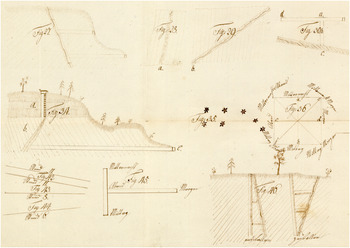
Spörl was schooled, therefore, in solutions to the problem of Raubbau. Officials saw Raubbau manifest in the very construction of the mines, where poorly built shafts prevented a deposit's ‘sustained’ exhaustion. Humboldt specifically lamented that the ‘boys’ were ignorant of framing devices meant to keep the shafts from caving in.Footnote 67 As a corrective, lessons on structural integrity began with the rudiments of underground orienteering, as instructed by a set of figures Humboldt drafted himself (Figure 2).Footnote 68 Later, advanced students like Spörl would learn the ‘rules’ of blasting, boring, and framing.
Detail from Humboldt's schoolbook. These figures correspond to lessons in ‘subterranean surveying’. Note the specific instruction on how to read the orientation of mineral veins and mineshafts in the industry's parlance, indicated by the compass on the right. StABa, Karten und Pläne (A 240), T 5022.

But there was also a political agenda embedded within Spörl's education in the physical properties of the earth and the material demands of mining operations. In the School's founding document, Humboldt criticized the notion that the industry would advance in pace with the rising number of administrators produced by technical academies in Schemnitz and Freiberg and training schools in Berlin and Clausthal-Zellerfeld.Footnote 69 The core idea of these institutions was to produce cameralists, like Humboldt, tasked with overseeing mining and smelting operations. Yet Humboldt's School had a different aim: rather than install more administrators (what he decried as a ‘miserable policy of tutelage’), he wanted to instil administration in the miners themselves – as a set of practices, a way of thinking, an atmosphere.Footnote 70 Humboldt's agenda in Bad Steben is consistent with a broader surge in ‘Bergschulen’ and other ‘industry schools’ founded throughout Germany's mining centres at the turn of the century.Footnote 71
Considering again the education of Spörl, we see that lessons in the construction of mineshafts and methods of mineral extraction were bound also to the School's ‘psychological policy’. Alongside the two dozen mineralogical specimens listed in the School's ‘inventory’ were books ranging from mathematics and mining law to stratigraphy and carpentry. Leafing through them, one finds descriptions of mining practice laden with prescriptions about miners’ behaviour – a self-conscious analogy between structural and moral integrity. ‘The greatest possible utility combined with the most enduring sustainability’, says one text on timber work, preaching ‘oeconomy in all aspects of mining’ and stressing, like Humboldt's ‘bergmännisches Ehrgefühl’, the ‘honourableness of the carpenters’.Footnote 72 ‘The children must not turn their backs to the instructor’, Humboldt wrote while describing the very architecture of the School's classroom.Footnote 73 Indeed, one course of study during Spörl's time at the School culminated in a final ‘Lesson on the conduct of the students towards their superiors as well as their co-workers’.Footnote 74
Humboldt's Mining School fused the Enlightened humanism of contemporary educational reform with statist ambitions. In 1792, Alexander's elder brother Wilhelm began outlining his now-famous vision for the humanistic cultivation of common people at a time when literacy rates were rising in Germany, from about 15 per cent in 1770 to 25 per cent in 1800.Footnote 75 ‘In this way’, Wilhelm wrote, ‘artists may be made of all peasants and workmen, that is, men who learn to love the craft of their craft’ (die ihr Gewerbe um ihres Gewerbes willen liebten).Footnote 76 It was the role of the state, moreover, to ensure the individual freedom required for such Bildung. These lofty ideas found a home in the lesser-known educational reforms of Wilhelm's brother, who similarly exalted ‘the value of the education of common people’. But the political language with which the Mining School treated foremen is also revealing of a more localized agenda. Cultivating foremen into loyal ‘citizens’ of the cameralist state, Humboldt wished to ‘stimulate them to intellectual independence’ – independence, that is, from the ‘stubborn will of the investors’.Footnote 77 Moreover, in texts like Voigt's Mining state, pupils learned that decisions about labour organization were ‘not to be left to the despotism of the foreman [but] rather to the Mining Administration’.Footnote 78
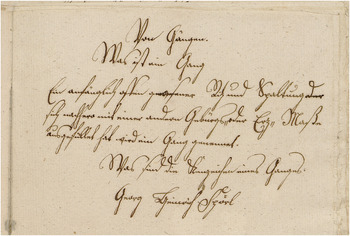
Humboldt's own schoolbook makes a concerted effort to normalize miners’ judgement by stigmatizing ignorance. While comparing the heights of the Harz Mountains to other peaks around the world, he was sure to note, for instance, how only ‘simple-minded people believe that witches dance’ on the Brocken.Footnote 79 To a fellow Freiberg graduate, Humboldt complained of finding ‘everywhere ignorance amongst the miners’, noting above all the ‘prejudices of prospecting’ – that is, folk knowledge about dowsing and divining.Footnote 80 Against these ‘prejudices’, the School marshalled Abraham Gottlob Werner's science of geognosy, which ordered the earth's strata (Gebirgsarten) according to the age of their formation.Footnote 81 Combating the dowser's occult sense of mineral effluvia, Werner's geognosy made ore veins a mappable phenomenon, the result of a historical process by which metal-rich liquids were deposited within the fissures of the rock.Footnote 82 When asked ‘What is a vein’, sixteen-year-old pupil Georg Heinrich Spörl offered a distillation of Werner's theory (Figure 3): ‘A cleft originally open and a cleavage which has then been filled by another Gebürgs – or ore – mass is called a vein’, Spörl wrote, drawing upon the School's lessons ‘on the formation-time’ and ‘formation-type of Gebirge, after Werner's theory’.Footnote 83
The careful penmanship of Mining School pupil Georg Heinrich Spörl (b. 1788), presumably a relative of the School's instructor (of the same name) and possibly the brother of Johann Georg Spörl (b. 1781). The document lay amongst exercises dated 1804. StABa, KDK, no. 7114, vol. 1, p. 314.

Replacing the dowser's rod with the geognist's map, the Mining School was to ‘bring the mountain folk to science’.Footnote 84 Armed with compasses, surveying skills, and geognostic theory, schooled in masonry and carpentry, the ‘citizens’ of Humboldt's mining state were to serve the Administration in its campaign against Raubbau and the ‘obstinate investors’. Indeed, they were to embody administration itself.
III
How did labouring miners view Raubbau and resource use, investors, and administrators? Miners’ voices are all but silent in the School's records, noted only when reproducing knowledge bestowed upon them. But this diffusionist model of knowledge was itself a fantasy of the cameralist elite.Footnote 85 In truth, miners of various ranks mediated between a variety of knowledge-forms, translating ontological worlds that were ruled by, or ruled out, spiritual entities. Historians have engaged the vernacular culture of mining as a rich repository of pre-modern beliefs about the natural world, its sacral elements, and the place of humankind within it.Footnote 86 By reading against the grain of early modern texts on mineralogy and palaeontology, moreover, scholars have identified the conditions under which miners, quarrymen, and ditch-diggers supplied social elites with knowledge and naturalia from the earth.Footnote 87 Mining folklore, in turn, offers a rare, if highly mediated, impression of labourers’ own understandings of nature and its exploitation.
Passed through generations of labourers and eventually transcribed by folklorists and local historians in the nineteenth and early twentieth centuries, early modern mining folklore consistently linked good fortune in mineral extraction with moral virtues of thrift, honesty, and modesty. As in the Raubbau discourse of officials, so in mining mythology: environmental alarms were triggered by social and ethical concerns. In folklore, this was particularly true when the exploitation of the mines entailed that of miners themselves. Mining myths and songs thus exhibit a set of social sensibilities, betraying deference to investors and hostility towards state officials.
When Humboldt's mentor, the naturalist Georg Forster, witnessed a mining parade in Freiberg in 1784, he noted in his journal the particular ‘zeal’ of the cantor who led the chorus. Forster believed him entirely justified, ‘for all that the little boys knew, they knew from him’.Footnote 88 Miners’ oral traditions were indeed a vital means of communicating knowledge and identity between generations, and in the days that followed Forster tuned his ear to their vernacular. Forster pinpointed the matter of cobalt, a by-product of copper and nickel whose blue pigment gave Saxon porcelain its distinctive colour, in emulation of Chinese ceramics. Elites of Forster's learning knew cobalt as a ‘semi-metal’, the designation given by Swedish chemist Georg Brandt in 1735. Nevertheless, Forster cryptically asserted that knowledge of cobalt remained ‘a secret in the hands of common workers that, having fallen into stagnation, will never be improved’.Footnote 89
Forster was concerned primarily with the advancement of the science of mining (Bergbaukunde); yet he was right that miners possessed a far more expansive understanding of the semi-metal. In defining cobalt as a strictly material phenomenon, Brandt's ‘discovery’ of the metal precluded older understandings of cobalt as a keeper entity.Footnote 90 Cobalt itself derives from Kobold, meaning ‘goblin’. Humboldt displayed cobalt specimens at the Mining School, alongside other ‘useful fossils’ (copper, arsenic, and galenite) of which he believed the children painfully ignorant.Footnote 91 The identification of ores and minerals figured in the School's civilizing mission. Yet the tales of Kobold and his goblin-kin Nickel, widespread in German and Scandinavian mining culture, were part of a mythological framework through which miners described nature's resistance to exploitation.Footnote 92
One legend, sourced from the Ore Mountains north of Franconia, tells of the earth's rebellion again to those who would ‘ransack it’, digging ‘ever deeper into the subterraneous realm’. ‘I transformed my silver into cobalt’, said one goblin, ‘and I transformed mine into nickel’, said the other, as they conspired to destroy the ladders and pumps with which miners assailed their dwellings. ‘One accident followed another’, yet the miners were unrelenting, now exploiting cobalt and nickel instead of silver. ‘Gradually, Kobold and Nickel came to realize that they had misjudged men. They felt their powers dwindle and they fled the region.’ Impervious to nature's warnings, deposits of silver, then nickel and cobalt, were utterly extinguished, along with the lives of many miners.Footnote 93
What administrators codified as Raubbau resonated also through centuries of mining myth. Not entirely unlike Humboldt, Rübezahl and his kind manifested themselves in the mines to punish the greedy, reward the honourable, and safeguard the earth. ‘Frivolity’, ‘excess’, ‘arrogance’, and ‘recklessness’ – this was not only the language of administrators, but also that of a mythology whose keeper entities policed administrators in turn.Footnote 94 Above ground, administrators condemned Raubbau in courts and with the quill, while in the mines such infractions were met with the wrath of the earth's ghostly denizens. Rash exploitation, neglect for the blessing of mines, and cruel treatment of miners were all punishable offences in the jurisdiction of the Berggeist. ‘The Berggeist ought to do away with him’, cursed the hewers in a Harz legend, summoning their patron to punish an official who imposed ten-hour shifts. (In Franconia miners worked twelve-hour shifts, which Humboldt believed ‘encouraged laziness’, and reduced to eight.Footnote 95) Promised unknown treasures by a ‘Little Man’ (Männchen), the cruel Harz official was lured into the depths only to be ‘locked in the earth’ by a quake. ‘Remain here and guard your treasure’, spat the Männchen, ‘which means more to you than men!’Footnote 96
Tales about mine officials, captains, and foremen suggest a particular hostility towards state oversight. Lacking the legal-bureaucratic power of the pen, miners wielded the spoken word to right the wrongs of their working worlds. ‘In the saga – and only in the saga’, Ortrud Krause wrote in her study of Harz folklore, ‘could the unjust master be punished!’Footnote 97 Sometimes it was the ‘Mine-God’ who administered justice.Footnote 98 More often, it was the Mine Spirit who presided over the subterranean in his many forms. According to the Romantic folklorist Johann Musäus, the ‘autocratic rule’ of Rübezahl, the ‘Prince of Gnomes’, began ‘just a few leagues beneath the arable crust of the earth…extending 860 miles to the earth's centre’.Footnote 99 Where officials imposed ‘punitive shifts’ on the miners, or denied them good pay, Rübezahl sought retribution, tossing entire pits into heaps of rubble.Footnote 100 One legend told of a mouse who crawled out of the nostrils of a sleeping ‘Mine Master’ (the rank Humboldt held when he opened his School) and scuttled through the shafts to spy on the workers.Footnote 101 A clear breach of miners’ moral economy, subterranean spirits set about deceiving officials who ‘eavesdropped’ on the hewers, procuring three ladders in the place of one.Footnote 102 Back in the Harz, it was said that the ‘Mine Monk’ once crushed the head of a particularly ‘evil foreman’ between his knees.Footnote 103 This, at least, was one way to understand structural collapse.
In this tradition, stags of silver and gold can be read as parables. Mining ore, as legend had it, was like hunting a stag: only those who were patient and measured in tracking the beast could reap the benefits of its killing. ‘He who sights the stag, while going unnoticed by him, shall have great happiness so long as he lives’, goes one Thuringian legend; ‘But he who lacks the poise to sit still in the dark forest at dusk, and frightens the animal off, will be pursued by bad luck and all misfortunes of body and soul until the last of his days.’Footnote 104
In the industry's official and vernacular landscapes, the exploitation of natural resources was conceived as a moral matter, the prerogative of the measured and moderate. Recent scholarship has portrayed mining culture as a system of symbols and expressions that spanned the industry's peasant, bourgeois, and noble estates.Footnote 105 So, too, the imperative to regulate the ‘ransacking’ of the earth was integral to its administrative and mythological discourses. For elites of Humboldt's rank, deposits were thought to be inexhaustible but for rash, thief-like practices of investors. In folklore from the period, these riches drew from ‘an inexhaustible treasure trove’ that yielded metals according to Rübezahl's ‘subterraneous governance’.Footnote 106
Yet the differences, of course, are just as striking. Aside from obvious formal distinctions, these official and vernacular landscapes also differed in their politics. While mining myths frequently expressed animosity towards state officials, traditional songs reinforced miners’ allegiance to investors. Vernacular culture was contested terrain within the mining industry. Songs not only strengthened solidarity amongst the miners, but also served the commercial ends of their lords by ‘reproducing labour-power’.Footnote 107 The aggrandizing territorial state of early modern Germany used songs and sermons to pacify miners in times of unrest amongst the peasantry.Footnote 108 Moreover, the same power-struggle that placed foremen between states and shareholders reached into the realm of song and lore as well. Here, it appears that the investors had gained the upper hand. This may be due to the fact that Gewerkschaften were composed not only of wealthy foreigners but also of familiar townspeople of modest means. ‘Rejoice now, you investors’, begins one song; ‘and sing the glory of God.’Footnote 109 Variations abound in compendia sourced from the seventeenth and eighteenth centuries: ‘Be cheerful, investors…’; ‘Gratify the enterprising investors…’; ‘May the investors rejoice…’.Footnote 110 Some songs were composed by the investors themselves, likely in an effort to encourage further investment. In them, state officials are eclipsed by the ‘paternal administration’ of God, that ‘High-Lord of Mines’.Footnote 111
Mining folklore suggests a scepticism toward investors’ sole interest in profit but also conveys an abiding sense of loyalty to them. In some stories, that loyalty is sanctified by the Berggeist himself, who tempts a poor labourer to steal the silver he discovered. ‘I cannot do that’, answered the faithful miner Daniel, in spite of his family's desperate want, ‘for it belongs to the investors.’ That night, the Berggeist visited Daniel in a dream, promising a handsome reward for the ‘honour’ he had shown. Where lightning struck the next day, there the poor man discovered ‘a rich vein of silver ore’.Footnote 112
In the Mining School, by contrast, young foremen were to ‘imbibe a minerly sense of honour’ through the written word. This phrase must be understood within the language of early modern estate society. In Germany's ‘home towns’, honour – ‘the respect of the respected’ – was a hallmark of artisanal guildsmen, jealously guarded social capital; and phrases like ‘ehrbares Handwerk’ and ‘Handwerksehre’ signalled the dignity of their craftsmanship. Honour was thus bound to the artisan caste, an exclusive and inherited virtue denied to peasants, journeymen, women, and all outsiders.Footnote 113 ‘Honour eternal to the miner's estate!’, wrote one Prussian mine official, riffing on the mining industry's own traditions of honourable distinction: ‘honour to you, too, brother smelter!’Footnote 114 Humboldt's School sought to cultivate a particular brand of honour bound not to the guild – or the Gewerkschaft – but to the state. Thus, the moral of Daniel's story can also be found in Voigt's Mining state, which forewarns the Steiger, ‘by punishment of removal from his service, not to attempt theft in the mines’.Footnote 115 Here, too, miners were to be rewarded for the honour they showed.Footnote 116 ‘Love of one's métier need not be preached directly’, Humboldt wrote, suggesting the instructor make a show of ‘public examinations and gifts for the diligent’.Footnote 117
In cultivating a ‘minerly sense of honour’, Humboldt also drew upon notions of the bergmännisch steeped in song and lore. ‘The minerly wisdom gives me great joy’, begins a traditional song, naming the ‘minerly virtues three’: ‘to be earnest, God-fearing, and diligent’. Such a miner possessed ‘a bergmännisch heart’, rang the chorus of another, ‘with metallic lustre, white- and red-gold ore’.Footnote 118 Humboldt did not want to be rid of these oral traditions; he wanted to reinscribe them in the language of reason and realign them with stately Direktion.Footnote 119
In the Deutsches Wörterbuch compiled by the brothers Grimm – famous collectors of folklore and fairy tales – bergmännisch is defined in all its moral and material valences: first with respect to the miner's underground exploits, ‘rich yields’ harvested from the earth; then as an architectural practice, to ‘build minerly, carefully’; and finally as a moral virtue, to be ‘true and faithful’.Footnote 120 All these meanings were implied in Humboldt's use of the term, as in the industry's widely held view of resource extraction as a matter of structural and moral integrity.
IV
When miners of Humboldt's time spoke about resources, they spoke, in fact, about labour. A mine's yield was thought to be determined by the social organization and moral comportment of the miners themselves. This is true not only of the Raubbau discourse through which elite officials waged an administrative campaign against ‘obstinate investors’, but also of folk traditions whose keeper entities similarly shielded the earth from human avarice. ‘In the early modern as in the postmodern world’, Simon Schaffer wrote, ‘challenges to cultural order were often seen as threats to nature itself.’Footnote 121 Thus, the environmental alarms sounded by miners of both Feder and Leder were triggered by transgressions of a social nature. In turn, officials like Humboldt conceived of sustainable resource management as a matter of labour discipline. Challenges to the cultural and social order of mining were met with psychological politics.
The Mining School can be seen within a broader cameralistic effort in eighteenth-century Germany to ‘stabilize workers’ group identities within the State’.Footnote 122 Mining culture, as Sebastian Felten argues, was not only produced in the mines, but also fashioned in courts and bureaucracies. Rulers, officials, and investors wielded various aspects of the industry's rich material culture to advance their own agendas, donning the dress and axe of the miner in parades for instance. In his own intervention in mining culture, Humboldt's Mining School seized upon miners’ mental and spiritual world. This meant supplanting the moral economy of the ‘mine spirit’ with a ‘spirit of the practical’ grounded in administrative protocol. More an act of translation than erasure, Humboldt sought to enrol ‘minerly virtues’ into a statist vision of sustainable resource management. However dismissive towards the ‘mining folk’, Humboldt was also keenly aware of their vernacular traditions. Tales of the Golden Stag, he observed, were a ‘daily phenomenon’ for ‘anyone who works amongst the miners’.Footnote 123 Noting also how ‘every foreign manner of speech is incomprehensible to the boys here’, Humboldt appointed a local shift boss as the School's first instructor precisely for his Franconian dialect.Footnote 124 He himself did not trust ‘a foreigner’ to lecture students on Franconian geology and mining law. ‘Never have I encountered such a thorough knowledge of the region’, Humboldt boasted of his appointee.Footnote 125
The early modern state has justly been viewed as the original agent of ‘sustainable’ resource management. But its bureaucracies and administrative cultures were not insulated from, and did not simply impose themselves upon, the vernacular cultures of miners. It may be tempting to view the early modern mine as a ‘state space’, where territorial rulers enforced a severe hegemony over human and natural resources, and to see Humboldt's Mining School essentially as an instrument of discipline and disenchantment.Footnote 126 It was this – but not only this. Certainly, as I have argued, sustainable resource management in central Europe around 1800 consisted largely in the strict oversight of labour. But the School's implicit analogy between natural and social order ran through both bureaucratic and folkloric discourses, confounding clear-cut dichotomies one might draw between states and subjects, the learned and the labouring, or official and vernacular landscapes. Here were two social groups – one beholden to the Berggeist, the other to the Bergstaat – who may indeed have inhabited different ontological worlds, but who nonetheless shared common assumptions about the correlation between moral constitution, material practice, and mineral abundance. Rübezahl, after all, who opened the earth to the true and modest, was said to have been a just mine master – just the kind of Oberbergmeister Humboldt aspired to be.Footnote 127