Introduction
Background
In 2000, the Department of Health (DH) published the National Health Service (NHS) Cancer Plan, evaluating radiotherapy provision in England and deemed there was a shortfall for the populations needs.1 The plan established funding mechanisms to increase the numbers of radiotherapy equipment available nationally. During the same period, advances in technology occurred leading to improvements in radiotherapy delivery.2 Major developments have included the introduction of MultiLeaf Collimators (MLCs), assisted field sequencing, verification and recording systems and improved on-treatment imagers. Two of the technologies, Intensity Modulated Radiotherapy (IMRT)Reference Veldeman, Madani, Hulstaert, De Meerleer, Mareel and De Neve3 and Image Guided Radiotherapy (IGRT),Reference Chen, Riboldi and Gierga4 offer the potential to improve the therapeutic benefit of radiotherapy by improving both the conformality of treatment dosimetry and accuracy of delivery.5 In 2005, the DH therefore invited bids specifically for Image Guided Radiotherapy (IGRT) technologies. Addenbrooke’s was successful in its bid and was funded to purchase Tomotherapy.
IMRT/IGRT
Tomotherapy is a fully integrated technology, combining an IMRT treatment planning system, an IMRT delivery system and an IGRT treatment verification system.Reference Mackie6 IMRT is an advanced form of three-dimensional conformal radiotherapy (3DCRT), whereby the dose through the target volume is modified as it is being delivered. By varying the MLC position during the delivery, the radiation can be attenuated to produce complex dose distributions and steep dose gradients, enabling radiation to be minimised to tissues within and adjacent to the target.Reference Veldeman, Madani, Hulstaert, De Meerleer, Mareel and De Neve3 However, in using planned steep dose gradients, it is essential that the accuracy of treatment delivery is maintained throughout the entire treatment course. Minor variations in accuracy and precision of delivery can have a catastrophic effect, where the normal tissues can receive large doses and the target volume, low doses. The variability of daily patient positioning, movement of internal organs, or mechanical instabilities all affect this.7 IMRT needs image-guided radiotherapy.Reference Staffurth8
IGRT is a technique where the position of the tumour target can be determined immediately before treatment delivery so positional errors can be corrected for the actual delivery.Reference Forrest, Mackie and Ruchala9 Images acquired from the treatment imagers are compared against the planning reference data (often CT scans) to provide a quantitative measure of any differences. The position of treatment equipment can then be adjusted to resolve this difference, ensuring that the radiation is accurately directed to the target.
Full image guidance utilises daily on-line imaging protocols to detect and correct uncertainties in internal and external motion.Reference Kupelian, Langen, Willoughby, Zeidan and Meeks10 On-line verification is the process where the corrections are made before treatment delivery and is thus more effective in removing delivery errors, as the corrections are made based on where the tumour is now.11 Off-line techniques assess images retrospectively, after the treatment has been given; the treatment for that day may have been delivered to the wrong place. Off-line techniques have the advantage of reducing treatment session times; no time is lost making image comparisons and more time can be spent in assessing the images fully. On-line techniques may take slightly longer on the treatment unit and decisions have to be made faster. For very precise tumour targeting, on-line verifications techniques are needed, so that no treatment session is uncorrected before delivery.11 To maximise the effectiveness of IMRT, the aim is to produce methods of efficiently and effectively using on-line verification.
Tomotherapy
Tomotherapy was the first treatment unit that had fully integrated IMRT and IGRT. Tomotherapy is a form of rotational therapy, where the radiation is delivered as the treatment unit rotates through 360° arcs as the couch translates into the treatment unit. This helical delivery pattern achieves highly precise dose distribution over very long (160 cm) uninterrupted volumes. Tomotherapy acquires megavoltage computed tomography (MVCT) images to verify the exact placement of the radiation by capturing the radiation as it exits the patient. The images acquired show good bony and soft tissue anatomies, with virtually no distortion as the detector array is curved and uses the same X-ray source for both imaging and treatment.
All patients treated with Tomotherapy at Addenbrooke’s radiotherapy centres have daily MVCT scans. The images are acquired immediately pre-treatment delivery and are matched against (registered)Reference Forrest, Mackie and Ruchala9 the original planning scan. The radiographer reviews the anatomical image registration, assessing the match through sagittal, coronal and axial anatomical planes and making any manual adjustments using their clinical judgements. It is not enough to know where the anatomy is, it is important to know where the prescribed dose is being given. Tomotherapy imports the dose plan from the planning system and superimposes it on to the kilovoltage CT reference image; so that the final decisions on accuracy of planned delivery can be made based on dose coverage of the tumour.
Discrepancies between where the radiation is about to be delivered and where it was planned to be given are calculated automatically and corrections made before the treatment is delivered. The entire verification process needs to be rapid in order to ensure the correctional moves calculated are still valid; the patient may move if the time between imaging and treatment is too long. Image registration and critical decision-making for positional corrections therefore need to be carried out by staff on the treatment unit and radiographers are best placed to do this.Reference Suter, Shoulders, MacClean and Balyckyi12 In Addenbrooke’s, Tomotherapy is a therefore radiographer-led treatment unit. Its efficient operation relies on the radiographer skills for rapid, accurate image registration and good decision-making that encompasses the patient’s daily needs.
Education and training
This new technology requires different decision-making skills and image registration training. As part of the funding agreement, the DH required assessment and identification of the processes that would optimise its use under NHS service conditions. A component of this was to identify the staff educational and training needs, in order to offer a high-quality service to patients. For this, treatment delivery accuracy needs to be achieved while using resources efficiently, optimising capacity for all patients needing the treatment.Reference McNair, Francis and Balyckyi13 At this time, no national accredited education programmes were available. Programmes therefore needed to be created locally. One advantage of this was that the programme could be tailored according to the local Tomotherapy process. The knowledge and skill requirement for implementing Tomotherapy into the department needed to be defined.
This paper outlines the practical, clinical-based educational and training processes established at Addenbrooke’s to successfully implement Tomotherapy.
Methodology: Assessment of training needs
Six months before installation, the process of identifying training needs began; an important part of this was identifying exactly what staff needed to know in order to effectively and efficiently operate a Tomotherapy unit. The education and training programme would be created by the radiographer selected to lead the clinical implementation. The Tomotherapy education programme lead was selected based on their previous knowledge and experience. They had previously taken part in a departmental audit of imaging competencies and found to have skills equivalent to that of oncology consultants. Additionally, the lead was chosen because of their high technical and implementation skills. The knowledge-base of the lead was supplemented from attendance at national and international courses covering IMRT, IGRT and Tomotherapy. Practical experience had been gained from temporary work experience at other Tomotherapy centres.
An issue with creating an education and training programme for Addenbrooke’s hospital was that there were no existing Tomotherapy users in the NHS in the UK. USA, European and other private radiotherapy practices differ greatly from the UK. Within the NHS, cost has to be a consideration and hence efficiency of use. Radiotherapy resources still do not meet the expected demand,Reference Williams, Summer, Drinkwater and Barrett14,Reference Williams and Drinkwater15 and so the number of patients that can be treated during a clinical day remains important. There was no other template for practice to adopt and no academic institution covering the educational requirements for Tomotherapy use in the NHS. The creation of an educational programme therefore had to be pragmatically based, start from first principles of evaluating the needs, seeing how other practices work and copying what would be suitable for the NHS.
The assessment method started with reviewing the operational processes at other centres with Tomotherapy experience. A number of visits were made observing the clinical use at The Cromwell Hospital in London and AZB in Brussels. Theoretical use was also assessed from attendance at the ESTRO IGRT course in Brussels. The principles behind tomographic imaging were reviewed by working with the CT scanning department at Addenbrooke’s.
By identifying the tasks involved in the Tomotherapy delivery process, the skills required by the radiographers carrying out these activities were determined.Reference Head16 The major difference in radiographer practice in using Tomotherapy from using a conventional radiotherapy treatment unit was the use of daily on-line verification using MVCT imaging. The use of tomographic imaging and the need for rapid decision-making needed different skill-sets.
Results: Skills required for Tomotherapy
These visits highlighted that training was essential in 3D cross-sectional anatomy and that an introduction to the basic principles of imaging was required. The on-line verification process involves the radiographer being able to acquire, process, compare the images against a reference and make decisions regarding positional corrections. The most common disease sites requiring Tomotherapy were found to be prostate, head and neck and thorax.
Image acquisition requires careful thought to optimise the quality needed for soft tissue visualisation on a per patient basis. For Tomotherapy the image quality is dependent on slice width and resolution of the CT scan. An understanding of CT imaging and reconstruction techniques is therefore required so that the radiographers could adapt the acquisition method according to patient needs.
Dose to the normal tissues to the patient needs to be minimised and justifiable under Ionising Radiation (Medical Exposure) Regulations.17 An understanding of the concomitant dose risk (deterministic and stochastic)Reference Dische18 is important so that the necessary size and position of the acquired CT volume can be changed by the radiographer on a per patient need basis. The eyes, for example, do not need to be included in the scanning volume; the maximum dose to the lens is specified within the treatment plan and dose from imaging procedures would be additional to that prescribed and may cause treatment-related toxicity.
Image processing requires an understanding of image formation so that the image can be optimised. Image manipulation skills, such as setting image window widths and levels, are needed to optimise contrast.
Image registration requires knowledge of anatomy for rapid identification of structures. An understanding of abnormal anatomy and the effect of changes with patient position, physiological processes and tumour size changes are also required: large rectal volumes can displace and change the shape of the prostate.
Clinical decision-making skills are essential for radiographers undertaking this process. A perfect match is not always going to be achievable. Although the process of resolving discrepancies may be managed under protocols, prescribing exact tolerances for acceptable displacements, these displacements may not always be rigidly along one axis of movement. Patient anatomy articulates in several directions; some positional discrepancies may therefore not be completely correctable and fast judgements have to be made as to how best to correct this treatment.
Decision-making also requires an understanding of the dosimetric principles behind IMRT. Decisions on radiation placement will often change for each patient treatment, depending on where the dose is seen to be delivered each day.
The need for accuracy of delivery for each anatomical site has to be balanced against the overall needs of the patient: poor performance status of the patient or patients with concomitant illness may need less time in the supine position and greater flexibility on treatment accuracy.
Corrections to patient positioning require an understanding of the sources of where geometric uncertainties may arise so that the right correction method can be applied. If large rotations are seen within the image, the radiographer needs to know when to correct the patient’s position and when to simply adjust the geometric centre of the delivery. Changes caused by weight loss or tumour shape change may necessitate changes in immobilisation.Reference Barker and Ang KK19
Resolution plan
Educational support
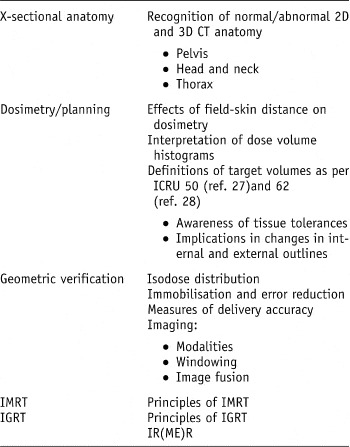
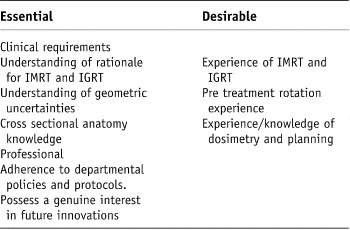
In order to gain the skills required, an educational programme was constructed, encompassing all of the areas where additional knowledge and skills for Tomotherapy were required. To fulfil the educational requirements, an in-house study programme (Table 1) was created. The first stage of the programme was attendance at the ‘Fundamentals of Radiotherapy Planning’ course run by the Royal College of Radiologists at Addenbrooke’s Hospital and the University of Cambridge.20 This is one of the two nationally accredited courses for oncology staff education in IMRT and IGRT. All teaching information from this course is held electronically within the Addenbrooke’s radiotherapy centre. The second stage of the programmes involved one-to-one tutorials covering this information, with the Tomotherapy lead. Demonstration of understanding is assessed by the Tomotherapy lead in the areas specified in Table 2.
Syllabus for fundamentals of radiotherapy for radiographers

CT, computed tomography; ICRU, International Commission on Radiation Units and Measurements; IGRT, Image Guided Radiotherapy; IMRT, Intensity Modulated Radiotherapy; IR(ME)R, Ionising Radiation (Medical Exposure) Regulations.
Skills and knowledge outline for Tomotherapy staff

IGRT, Image Guided Radiotherapy; IMRT, Intensity Modulated Radiotherapy.
Operational training
All grades of radiographer staff received training for handling the Tomotherapy equipment (applications training). Image matching and decision making requires additional knowledge, skills and experience; this was therefore given to radiographers band 6 and above. The aim was to have a core of at least 16 radiographers who were confident and competent in operating a Tomotherapy unit. Two radiographers is the minimum number specified by the Society and College of Radiographers, but four radiographers are generally assigned for a clinical placement.21 It is more efficient to have three radiographers operating a treatment unit at any one time, as one radiographer is available for the non-patient logistics of operation, such as paperwork preparation, while two radiographers treat the patient.Reference Routsis, Thomas and Head22 When running long working days, an additional radiographer is required to maintain staff cover. As 25% of staff in the Addenbrooke’s department are on non-clinical related activities or absent at any one time, such as training or leave, training 16 radiographers gave the possibility of three teams being available. This advanced preparation reduced the pressure on the trainer, so they could concentrate on supporting the clinical staff for the first few months of operation.
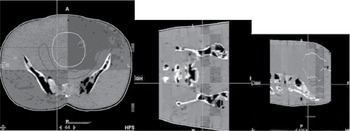
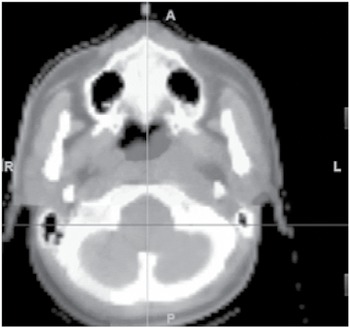
Applications’ training, to physically operate the equipment, was provided by TomoTherapy Inc. before Tomotherapy entered clinical operation, familiarisation with the system controls and image matching was achieved using an anthropomorphic phantom (Alderson Research Laboratories, Stanford, CA) (Figure 1). Clinical image matching training is achieved in two stages; first the radiographers closely observes a minimum of 10 real-time patient image registrations; second, they have to perform a minimum of 20 registrations using real patient images away from the treatment unit.Reference Li, Qi and Pitterle23 These can be from a variety of disease sites, but must include at least 10 complex head and neck procedures.
Anthropomorphic phantom, prostate plan with megavoltage computed tomography overlay.

Competency
The number of iterations required for training were been derived from experience of the initial radiographers. To identify the competency standards needed and the number of image-matching procedures required for this level to be achieved, the first staff to be trained were monitored. A series of dummy and real patient images were created. For dummy patients, the match discrepancies were known; for patients, the radiographer lead had pre-determined the discrepancy value by multiple repetitions. These values were checked by a second observer from the departmental imaging team. It was decided by the Tomotherapy management team that the desired standards should be 1 mm discrepancy and 4 min to complete the match. The 4-min time scale was set as it is important to maintain rapid image registration for validity of information.Reference Kitamura, Shirato, Seppenwoolde, Onimaru, Oda and Fujita24 It was determined that most radiographers required this level of repetitions to achieve this standard.
An additional check is made where the radiographer is observed while handling the Tomotherapy equipment. To be approved as clinical competency, the radiographer has to demonstrate correct and efficient handling of the equipment and the image matching process.
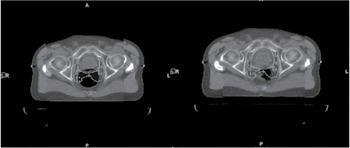
A training package was created detailing the guidance for imaging protocols and clinical decision-making. The package includes a detailed MVCT anatomy atlas for the main sites treated (Head and Neck, Thoracic and Pelvic). Explanations are provided regarding how to optimise image matching and correction strategies. These include examples of how to mange unusual situations such as when flatus distends the rectum and the strategies to fix such as asking the patient to emptyReference Bortfeld, van Herk and Jiang25 their bowels so that treatment delivery can be optimisedReference Engels, Soete, Verellen and Storme26 (Figure 2). Other situations may require managing by additional procedures, such as adaptive assessments, when shape changes are noted (Figure 3).
Demonstrates a large rectum on the left and the same rectum post flatus.

Tumour reduction after 3 weeks of Intensity Modulated Radiotherapy delivery.

Subsequent training
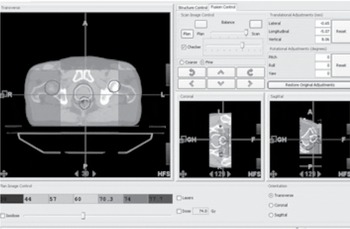
As the number of patients increased, access to the treatment unit for training purposes decreased. Physical equipment training therefore has to now occur during clinical operation of the Tomotherapy unit as a supernumerary staff member. Fortunately some of the image matching training can be performed remotely using a web-based application, TomoPortal™ (Figure 4).
TomoPortal screen showing checkerboard function.

On-going competencies are assessed by regular audit of the image matching process, carried out by the radiographer-lead using TomoPortal™. Refresher training is given for radiographers where the image match accuracies consistently vary greater than 1 mm from the gold standard. The length of time required for image matching is recorded within the Tomotherapy system and is therefore also audited against the 4-min standard. Annual refresher training is mandatory.
Conclusion
The success of the introduction of this new technology relies on education and training. The Tomotherapy process was assessed to determine the differences from standard practices and the knowledge and skills required to optimise the process were derived. These formed the basis of a clinical-based educational programme. This programme has contributed to the ease of implementation of Tomotherapy at Addenbrooke’s NHS Trust. Radiographer image matching competencies are maintained at high levels of accuracy and efficiency (1 mm and 4 min) using this programme. This in-house training and education programme was found to be a pragmatic solution to implementing Tomotherapy into the NHS working environment. Further work is now needed to determine how some of these concepts could be transferred into academic education, so that the skills required for IMRT and MVCT IGRT could be learnt at an earlier stage in the radiographer’s career.