1 Introduction
In Korean compound nouns (represented in this paper as WA + WB), the onset consonant of the second element (WB) frequently undergoes tensification: e.g. /pjəl + picʰ/ ‘star + light’ → [pjəl.p*icʰ] ‘starlight’.Footnote 1 It has been assumed in some previous literature (e.g. Kim Reference Kim1970, Kim-Renaud Reference Kim-Renaud1974, Ahn Reference Ahn1985) that this tensification occurs due to the insertion of sai-sios, i.e. an epenthetic /s/ (phonetically [t]), followed by general processes of post-obstruent tensification and three-consonant cluster simplification: /pjəl + picʰ/ → /pjəl + s + picʰ/ (sai-sios insertion) → [pjəlt.p*icʰ] (post-obstruent tensification) → [pjəl.p*icʰ] (three-consonant cluster simplification). However, tensification in Korean compound nouns is not automatic, but is rather a general tendency with a large number of exceptions, e.g. /mul + kə.pʰum/ ‘water + bubble’ → [mul.kə.pʰum] ‘foam’. Various researchers have pointed out conditioning factors blocking the occurrence of tensification, most of which are morphological and/or semantic, for example (a) coordinate compounding (Ahn Reference Ahn1985), e.g. /son + pal/ ‘hand + foot’ → [son.pal] ‘hand and foot’; (b) an animate WA (Yun Reference Yun2006), e.g. /kɛ + so.ri/ ‘dog + sound’ → [kɛ.so.ri] ‘nonsense’; (c) a [+material] WA (Kim-Renaud Reference Kim-Renaud1974, Yun Reference Yun2006), e.g. /na.mu + pɛ/ ‘tree + boat’ → [na.mu.pɛ] ‘boat made of wood’.
Historically, sai-sios originates from a genitive marker /-s/, suffixed to the first element of the compound (WA) in Middle Korean (MK; 15th–16th centuries) when the referent of WA was either inanimate or ‘revered animate’ (An Reference An1968), and is assumed here to have appeared regardless of the phonological properties of WB. In Contemporary Korean (CK), the genitive case is no longer marked by /-s/, but only by /-ɨj/, which derives from another Middle Korean genitive suffix, used with a non-revered animate WA.Footnote 2 Middle Korean had consonant clusters such as /sp st sk/, which correspond to tense consonants in Contemporary Korean (e.g. /spɨl/ > /p*ul/ ‘horn’, /stʌl/ > /t*al/ ‘daughter’, /skwəŋ/ > /k*wəŋ/ ‘pheasant’). Thus we might hypothesise that the tensification observed in compound nouns in CK resulted from this historical sound change: e.g. MK /pɨls.picʰ/ ‘flame’ (‘fire + gen + light’) > CK [pɨl.p*icʰ]. As an alternative diachronic path, the /-s/ that triggered tensification of the following obstruent may have been retained when there was a following morpheme boundary (e.g. /pɨls.picʰ/ > [pɨls.p*icʰ]), in which case the absence of /s/ in these words in Contemporary Korean is due to a three-consonant cluster simplification process (/pɨls.p*icʰ/ → [pɨl.p*icʰ]) which is independently attested in Korean phonology: [əp.s*ə] (< /əps-ə/) ‘do not exist-inf’ vs. [əp.t*a] (< /əps-ta/) ‘do not exist-inf sentence ender’ (Kim Reference Kim1970). In fact, when compound tensification occurs synchronically in Contemporary Korean and WA ends with a vowel, sai-sios appears only optionally (Kim Reference Kim1970): /hɛ+picʰ/ ‘sun + light’ → [hɛ.p*icʰ]~[hɛt.p*icʰ] ‘sunlight’. Given the sound changes mentioned above, we can assume either that the former variant is the regular development (MK /hajs.picʰ/ > [hɛ.p*icʰ]) and that [hɛt.p*icʰ] (orthographic hɛs.picʰ) is a spelling pronunciation, or alternatively that [hɛt.p*icʰ] is the regular reflex, due to a morpheme boundary following /-s/. In any case, there are two facts that strongly suggest that the synchronic analysis of sai-sios is not just a simple recapitulation of the state of affairs in Middle Korean via the sound changes mentioned above. First, when WA ends with a vowel, the sai-sios consonant is not always realised, as seen above with [hɛ.p*icʰ] ~ [hɛt.p*icʰ]. This contrasts with the automatic tensification triggered by a coda obstruent on a following onset, as in [nat.t*a] (< /nas-ta/) ‘be better’, with post-obstruent tensification, vs. [na.ta] (< /na-ta/) ‘come out’). Second, when WB starts with any vowel other than i, there are essentially no examples with the sai-sios consonant (*[CVt.V]).Footnote 3 This is in sharp contrast with the automatic resyllabification of a stem-final consonant across any juncture including phrases: e.g. /him + əps.ta/ ‘strength + do not exist’ > [hi.məp.t*a]. This surprising gap can be traced back to an allomorphic alternation of genitive /-s/ in MK which is documented in several texts (the most representative is Yongpiechenka (1447); see Fukui Reference Fukui1993, Reference Fukui2013: 66–70 for more details): /-s/ alternated with [z] in intersonorant position, as in [na.raz.il.hum] (< ‘country + gen + name’), [nunz.mɨl] (< ‘eye + gen + water’), [pa.rʌlz.uh] (< ‘sea + gen + upside’). I assume that the general absence of the sai-sios consonant in intervocalic (or intersonorant) position in CK resulted from dropping the lenited [z] in this context. Consequently, the virtual absence of the sai-sios consonant in intervocalic position suggests that sai-sios has been morphologised as a component of the compound construction. Given this, in this paper I treat sai-sios as a floating [tense] feature, which is realised by association to the first available host segment to its right, as in Japanese rendaku (Itô & Mester Reference Ito and Mester1998, Reference Ito and Mester2003). The RealiseMorpheme constraint of Kurisu (Reference Kurisu2001) forces the floating [tense] to dock onto the first consonant of WB, since a coda in WA is unreleased and hence cannot be tensified, due to a general syllable structure constraint of Korean phonology. (1) shows the application of RealiseMorpheme in CK compound tensification.Footnote 4 I assume that the [tense] feature in the input is supplied by the morphology, and that variation in sai-sios insertion comes from the variable ranking of RealiseMorpheme and Faith(WB).
-
(1)


In sum, the attachment of the genitive marker /-s/ in MK, which would have been originally morphologically and phonologically transparent, was obscured by subsequent historical sound changes. These changes eliminated all traces of this linking element, except for the tensification of the first consonant of WB. The Standard Korean orthography indicates sai-sios only when WA ends in a vowel. In their overview of Korean grammar, Lee & Ramsey (Reference Lee and Ramsey2000: 77, 110–111) observe that the synchronic syntactic and semantic function of sai-sios is not completely clear, and that its occurrence is also not phonologically predictable.
Zuraw (Reference Zuraw2011) is the first systematic survey of the distribution of sai-sios. Based on a corpus of more than 26,000 compound nouns from the Korea National Research Resource Centre, she found that there are various factors which influence the distribution of sai-sios: branching morphological structure, etymology, frequency, stem length and the presence of tense consonants in the word. Zuraw points out that none of these factors by themselves clearly divide the compounds into those which can and those which cannot undergo sai-sios. Rather, each factor seems to contribute to the overall probability of sai-sios. Given the historical source of sai-sios as a genitive marker, the fact that phonological factors as well as frequency effects are observed in the distribution of sai-sios in Contemporary Korean is especially important, even though their effects cannot be straightforwardly explained.
In this paper, I carry out a study similar to Zuraw (Reference Zuraw2011), investigating sai-sios tensification in compound nouns in the Yanbian dialect of Korean (north-eastern China). Yanbian Korean is closely related to the Hamkyeng dialect, spoken in North Korea. It is one of the most conservative dialects: it preserves a distinctive accent system, as well as several other phonological properties that existed in Middle Korean but have been lost in Standard Korean.Footnote 5 Yanbian is particularly suitable for the investigation of the distribution of sai-sios tensification, since sai-sios is never reflected in the orthographic system utilised in Yanbian, even if the pronunciation shows the tensification: cf. Standard tam.pɛs.kaps vs. Yanbian tam.pɛ.kaps ‘the price of tobacco’. This rules out any potential influence of orthography on the distribution of sai-sios. In this paper, I focus on phonological factors affecting sai-sios distribution, and do not deal with morphological/semantic factors. Analysis of the data shows that sai-sios distribution, which varies significantly among the speakers, is influenced by a number of phonological factors. Some of these factors are similar to those observed by Zuraw (Reference Zuraw2011): frequency (familiarity ratings), stem length and presence of tense consonants in the word. However, additional factors are also observed: WA coda type and the presence of aspirated consonants in the word.
The most noteworthy effect observed in sai-sios distribution in Yanbian is a co-occurrence restriction or OCP (Obligatory Contour Principle; Leben Reference Leben1973) effect involving laryngeal features. OCP effects have been extensively discussed and examined in the literature. For example, the phonotactics of genetically unrelated languages repeatedly show similar co-occurrence restrictions in the form of either a complete prohibition or a gradient restriction: segments with the same place of articulation or suprasegments of the same category tend to be avoided if they would appear close to each other (Greenberg Reference Greenberg1950, McCarthy Reference McCarthy1986, Mester Reference Mester1988, Kawahara et al. Reference Kawahara, Ono, Sudo, Vance and Jones2006, Coetzee & Pater Reference Coetzee and Pater2008). Long-distance restrictions on laryngeally marked segments in various languages are also observed by MacEachern (Reference MacEachern1999), and the existence of such phonotactic restrictions has been substantiated through nonce-word experiments by Gallagher (Reference Gallagher2010, Reference Gallagher2012, Reference Gallagher2013). For example, Gallagher (Reference Gallagher2013) shows that a repetition task conducted with speakers of Cochabamba Quechua provides evidence of their knowledge of the non-local restrictions on ejectives observed in their language.
Sai-sios in Korean is similar to rendaku in Japanese (voicing of the onset of the second element of a compound word), in that both are junctural morphophonological processes (Labrune Reference Labrune1999). It is well known that rendaku can be blocked if the second element already contains a voiced segment (Lyman's Law; Lyman Reference Lyman1894). The role of OCP[voice] in Japanese phonology has been analysed formally, and its relevance has been confirmed by nonce-word experiments (Vance Reference Vance1980, Ito & Mester Reference Ito and Mester2003, Nishimura Reference Nishimura2006, Kawahara Reference Kawahara2008).
In this study I also report the results of two nonce-word experiments, in which both an OCP effect and phonological factors affecting sai-sios distribution were tested. The results show that statistical tendencies in existing compound words are mirrored, with one exception (syllable-count effect), and also that a locality effect with respect to a laryngeal co-occurrence restriction emerged, which is not clearly observed in the existing lexicon.
The acoustic feature underlying the OCP laryngeal co-occurrence restriction in Yanbian is also examined. Based on a preliminary acoustic analysis, the relevant factor is found to be [long non-modal voicing], a property which is shared by aspirated and tense obstruents in Yanbian. This finding not only supports the analyses of MacEachern (Reference MacEachern1999) and Gallagher (Reference Gallagher2011), in which the co-occurrence restriction of two laryngeally marked segments in Quechua is explained by the shared feature [long VOT], but also sheds more light on the acoustic factors involved in the co-occurrence restrictions.
Furthermore, examination of laryngeal co-occurrence restrictions in
simplex nouns reveals that while the co-occurrence of two aspirated
onsets tends to be avoided, that of two tense onsets is overrepresented. In
addition, co-occurrence of an aspirated onset with a tense onset is
underrepresented, but does not reach statistical significance. The apparent
contradiction with the OCP[tense] effect observed in compound words is explained by
a directionality difference between the two phonological processes:
sai-sios tensification is a progressive process, which may be
blocked by another laryngeally marked segment in WB, whereas the
overrepresentation of the co-occurrence of two tense onsets in simplex words is due
to regressive assimilation induced by harmony between the vowel of the initial CV
syllable and the vowel of the following C* syllable
(C=lax), which underlies the consonantal harmony:
CV.C* → C.C* →
C*.C*. Thus Yanbian
Korean exhibits two different co-occurrence patterns in long-distance restrictions
on laryngeal features (assimilation and dissimilation), based on the availability of
an environment for regressive assimilation. It is also important that the
co-occurrence of two tense consonants is overrepresented in simplex nouns and that
the underrepresentation of an aspirated onset with a tense onset does not reach
statistical significance, since this suggests that OCP[tense] and
OCP[aspirated-tense], observed in compound nouns, are emergent patterns without
clear lexical precedents.
The results reported in this paper thus not only confirm various phonological factors influencing sai-sios distribution discussed by Zuraw (Reference Zuraw2011), along with some additional factors, but also provide evidence for analytic biases (or ‘overlearning’; Zhang & Lai Reference Zhang and Lai2008) embodied in Universal Grammar and implicit knowledge of typological universals, as discussed in much previous literature. For example, Wilson (Reference Wilson2003) conducted experiments which employed the Artificial Grammar paradigm to show that there are cognitive biases that favour ‘natural’ phonological processes over formally matched ‘random’ processes. Moreton (Reference Moreton2008) shows that analytic bias can by itself create typological asymmetries without assistance from channel bias (phonetically systematic errors in transmission), based on an experiment in which English speakers learned a height-height pattern (dependencies between the heights of neighbouring vowels) better than a height-voice pattern (dependencies between the height of a vowel and the voicing of a following consonant). Becker et al. (Reference Becker, Ketrez and Nevins2011) found that some lexical statistical regularities of Turkish phonotactics that are phonologically motivated are productively extended in nonce words, while phonologically unmotivated generalisations are not. They propose that Universal Grammar acts as a filter on lexical statistics, resulting in phonotactic knowledge in which phonologically implausible interactions are not actively incorporated (‘underlearning’ in the sense of Zhang & Lai Reference Zhang and Lai2008). This paper shows that a process that was originally morphologically/phonologically transparent, but became opaque due to diachronic sound change, has been reshaped and reinterpreted, and that phonological factors have arisen in conditioning sai-sios. I assume that statistically significant phonological factors and variation among speakers observed in Yanbian compound tensification result from the interactions between the RealiseMorpheme constraint and lower-weighted constraints on tense consonants. The relative weights of the relevant constraints may be partly informed by lexical data of Yanbian, but ‘universal’ preferences that have not yet managed to shape the lexicon in a measurable way (OCP[tense] and OCP[aspirated-tense] with a locality effect) emerge in historical restructuring and in wug tests. On the other hand, a factor that cannot be straightforwardly explained as a universal preference (a syllable-count effect) is not productively generalised in the novel words.
This paper is organised as follows. In §2 I analyse the elicited lexical data relevant to Yanbian compound tensification, and clarify the phonological factors affecting the overall statistical distribution. In §3 I show the results of two wug tests, and discuss to what extent the patterns observed in existing compound words are mirrored in these experiments. §4 examines the acoustic factors relevant to the OCP constraints at work in Yanbian, and conducts a survey of lexical statistics in simplex disyllabic and trisyllabic nouns, in order to compare them with sai-sios distribution. §5 is a summary and conclusion.
2 Data analysis
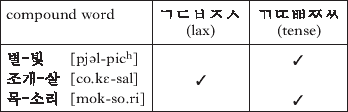
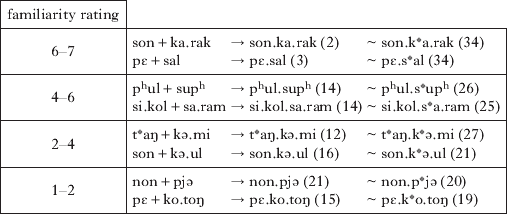
In this section I report the results of the phonological analysis of elicited lexical data with regard to compound tensification. The material consists of 1171 compound nouns, both of whose components are native (non-Sino-Korean) words (including some words nativised from Sino-Korean).Footnote 6 As pointed out by Zuraw (Reference Zuraw2011), this is the context in which tensification appears most frequently. The original data was taken from two Korean dictionaries (Kadowaki et al. Reference Kadowaki, Matsuo, Takashima and Yutani1993, Kwuklip kwuke yenkwuwen 1999), and some words were added from interviews with consultants. They were assembled into a 190-page booklet with spaces for marking the tensification (tense or lax) by choice, as shown in Table I, and were distributed to 35 Yanbian native speakers, who were asked to indicate their answers on the basis of their intuitions. When a subject answered that both tense and lax forms are used, then each case was counted as one datapoint, giving a total of 44,345 datapoints. The years of birth of the 35 native speakers (14 males, 21 females) ranged from 1928 to 1990, allowing an examination of variation in the application of tensification.
Sample questionnaire. Speakers were asked to judge whether the first onset consonant after the hyphen in the compound word (i.e. the first consonant of WB) was tense or lax, and mark their choice.

2.1 Variation
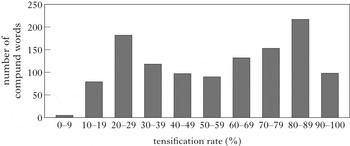
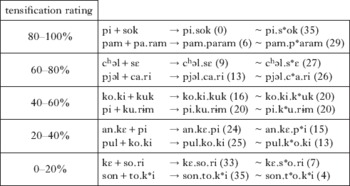
As mentioned above, the compound tensification process is highly opaque in Contemporary Korean. Given this, we expect a substantial amount of variation to be observed in the application of sai-sios. Indeed, in our data there are very few compound words for which all 35 speakers agreed in their judgement of tensification (only four words). Figure 1 shows the tensification rate (the ratio of the application of tensification) and the number of compound words. For example, the tensification rate of /kil + pa.tak/ ‘road + surface’ is 84% (32 tense; 6 lax). The tensification rate seems to be quite gradient: some words are tensified very frequently, others less frequently, and some others are rarely tensified. Examples of variation are given in Table II.
Tensification rate for 1171 compound words, divided into deciles.

Examples of variation. Numbers in parentheses indicate the number of speakers. The total number of speakers is in some cases greater than 35 (the number of subjects in this study), since some speakers reported that both tensified and non-tensified forms are used.
For reasons of space, glosses are not given in this and similar tables. Further examples, with glosses, can be found in the online supplementary materials.Footnote 7
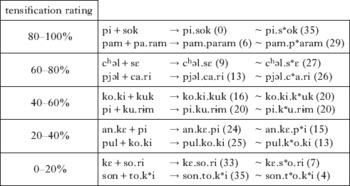
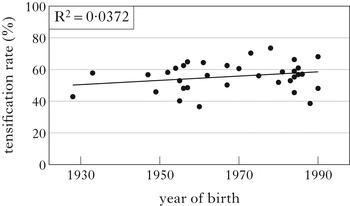
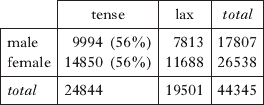
Figure 2 shows the correlation between year of birth and tensification rate. In this case, the tensification rate was calculated by dividing the counts of the application of tensification by the total number of responses by one speaker. When an individual speaker offered multiple responses for a single word, both were counted. There does not seem to be any significant correlation between year of birth and tensification rate (p-values for linear/quadratic/cubic models are 0·2667, 0·3174 and 0·3431 respectively), nor, as seen in Table III, is there a clear difference in tensification rate between males and females. Thus variation in tensification rate appears to depend neither on age nor on gender; rather, tensification rate varies for each individual.
Compound tensification rate as a function of year of birth for the 35 speakers.

Compound tensification rate as a function of gender.

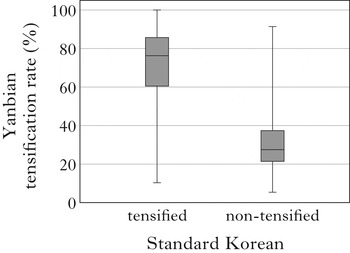
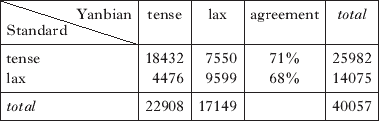
Given this, we can ask to what extent the Yanbian data agrees with the Standard Korean dictionary data. Table IV and Figure 3 show the correlation between Standard Korean and Yanbian. The Standard Korean data is based on Kwuklip kwuke yenkwuwen (1999), in which the application of tensification in compound words is indicated (as a rule, variation is not reported). The Yanbian data in Table IV (tense vs. lax) gives the total number of datapoints for each word with or without sai-sios tensification in Standard Korean. Interestingly, for both tense and lax, the Yanbian data agree with Standard Korean in about 70% of the cases.
Correlation between Standard Korean and Yanbian tensification. The horizontal line in each box indicates the median value, the ends of the vertical lines give the minimum and maximum data values, and the bottom and top of each box are the first quartile (25th percentile) and third quartile (75th percentile) respectively.

Correlation between Standard Korean and Yanbian sai-sios tensification. Words that do not appear in the Standard Korean dictionary (mostly dialectal) are not included here. Note that the same word may appear as either tense or lax in Yanbian, depending on the speaker.

These data clearly show that significant variation is observed in compound tensification in Yanbian. This may be partly attributed to the different orthographic conventions in Standard Korean and Yanbian mentioned above: in Standard Korean, sai-sios is marked by the character s, at least when WA ends in an open syllable, while it is never reflected in the orthographic system utilised in Yanbian. This difference may have resulted in the substantial individual variation seen in Yanbian (how much speaker variation is observed in the compound tensification of Standard Korean is a topic for future research).
2.2 Token frequency (familiarity ratings)
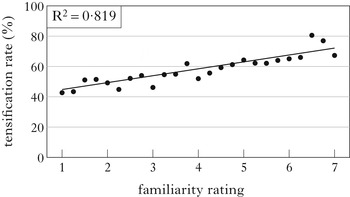
Zuraw (Reference Zuraw2011) points out that compound tensification is more often observed in more frequent lexical items. In order to test this token-frequency effect, familiarity ratings of all compound words in our corpus were judged by four Yanbian native speakers.Footnote 8 Familiarity ratings were based on a seven-point scale from 1 (least familiar) to 7 (most familiar). Examples are given in Table V. Figure 4 shows the correlation between the average scores of the four raters and the tensification indexes from the 35 speakers. For example, for items with a familiarity average of 5·5, there are 916 datapoints for tense and 559 datapoints for lax, a tensification rate of 62%. As seen in Fig. 4, even the familiarity-rating data obtained from naive native-speaker judgements correlate with tensification rate: the higher the familiarity rating, the higher the tensification rate. A linear regression analysis with tensification rate as the dependent variable and familiarity rating as the independent variable shows a significant result (est.=0·05, SE=0·00, t=10·2, p<0·0001). Thus our data confirm Zuraw's (Reference Zuraw2011) results.
Compound tensification rate as a function of averaged familiarity rating for 1171 words evaluated by four Yanbian native speakers.

Examples of compound tensification and averaged familiarity rating.

2.3 Number of syllables
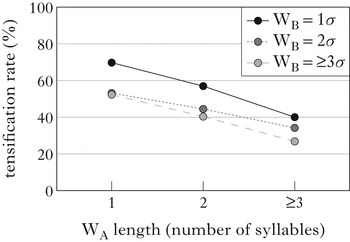
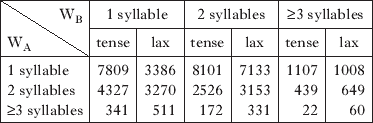
According to Zuraw (Reference Zuraw2011), sai-sios is less probable when WA and WB both contain more than one syllable. Our data confirm this, as shown in Table VI and Fig. 5. Moreover, in our data, the probability of tensification correlates more linearly with the stem length of WA and WB (except for monosyllabic WB) than reported by Zuraw (Reference Zuraw2011).Footnote 9
Compound tensification rate for first (WA) and second (WB) elements as a function of the number of syllables.

Compound tensification rate for WA and WB elements as a function of the number of syllables.

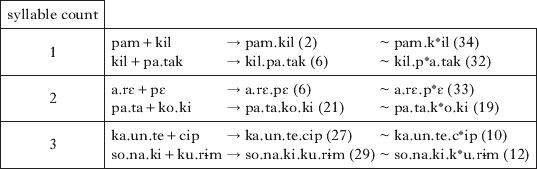
Examples are given in Table VII.
Examples of compound tensification and syllable count in WA.

I hypothesise that the stem-length effect is correlated with phrase structure. In Yanbian, compound words tend to have only one pitch peak, and its location is as a rule determined by the WB accent, e.g. /ó.ri + ál/ ‘duck + egg’ → [o.ri.ál] ‘duck's egg’, /pa.tá + ó.ri/ ‘sea + duck’ → [pa.ta.ó.ri] ‘guillemot’. However, when a compound word has four syllables or more, speakers may pronounce these words as two accentual phrases, probably due to a *Lapse-L constraint, which penalises a candidate with two successive syllables without H at the left edge of the word (Ito Reference Ito2013), e.g. /múl + o.cíŋ.ə/ ‘water + cuttlefish’ → {mul.o.cíŋ.ə} ~ {múl}{o.cíŋ.ə} ‘living cuttlefish’. The occurrence of sai-sios (tensification) implies that there is no phrase boundary between WA and WB, which is a countervailing condition for longer words. Thus the lower tensification rate for longer words is explained as a result of a conflict between the compounding process and a tendency to divide a long word into shorter accentual phrases.Footnote 10
2.4 WA final-segment type
In Standard Korean, tensification applies automatically after an obstruent coda (post-obstruent tensification). However, our investigation of Yanbian compound nouns has found quite a few words that do not tensify even in this environment, as exemplified in Table VIII.
Examples of compound tensification with WA obstruent codas.

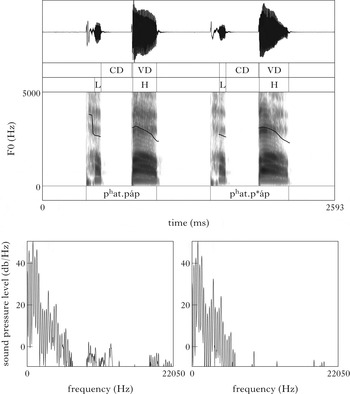
Tonal patterns indicate that these compound words (at least the shorter ones) constitute a single phonological word, and hence satisfy the structural description of the process. The same word can sometimes have tense and lax variants for a single speaker, e.g. /pʰatʰ + pap/ ‘red beans + rice’ → [pʰat.páp] ~ [pʰat.p*áp] ‘rice cooked with red beans’, as seen in Fig. 6.Footnote 11
Sample waveforms, spectrograms and spectra from speaker PKL (female, born in 1985) for (left) [pʰat.páp] and (right) [pʰat.p*áp] ‘rice cooked together with red beans’. CD=closure duration (270 ms for [pʰat.páp]; 294 ms for [pʰat.p*áp]). VD=vowel duration of WB (214 ms for [pʰat.páp]; 259 ms for [pʰat.p*áp]). H1 – H2 of the vowel onset in the second syllable=5·1 dB for [pʰat.páp] and −3·6 dB for [pʰat.p*áp].

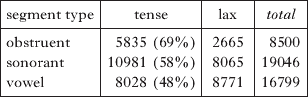
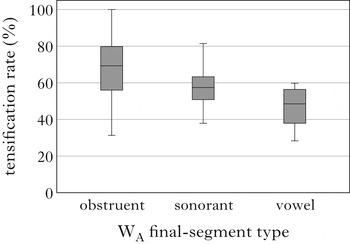
Nevertheless, the probability of tensification is still much higher after an obstruent coda than after a sonorant coda or a vowel, as seen in Table IX, suggesting that it is motivated by post-obstruent tensification.Footnote 12 A Pearson's χ2 test with Yates' continuity correction shows that obstruent and sonorant codas are significantly different in their sai-sios effects (χ2=298·15, p<0·0001). Similarly, a sonorant coda and vowel are significantly different (χ2=348·46, p<0·0001).
Compound tensification rate as a function of WA final-segment type (35 speakers, 1171 words).

Fig. 7 shows WA final-segment type and tensification rate for all speakers.
Compound tensification rate as a function of WA final-segment type (35 speakers, 1171 words).

Given that the tensification rate is highest in obstruent codas and post-obstruent tensification is obligatory in Yanbian if the targeted sequence appears within a simplex word (e.g. /sɛk.si/ [sɛk.s*i] ‘maiden’, /nak.ci/ [nak.c*i] ‘octopus’), the observed pattern of variation can be modelled as the interaction of at least three constraints, with different weights: RealiseMorpheme, Post-obstruent Tensification in Compounds (Post-obsTens/Comp) and a faithfulness constraint to the base simplex words (Faith(WB)), as shown in (2) for /apʰ + ta.ri/ ‘front + leg’ → [ap.ta.ri]~[ap.t*ari] ‘front leg’. Multiple candidates are shown as winners, since there is variation, but the untensified candidate is less probable than it would be when WA ends with a sonorant, due to the violation of Post-obsTens/Comp in the former. A more detailed weighted constraint analysis of sai-sios distribution is presented in §2.6.
-
(2)

The relatively higher tensification rate after a sonorant coda than after a vowel may reflect a typological preference for lenition, such as shortening or voicing of an intermediate consonant: V__V is preferred to R__V for lenition (where R=sonorant), due to the higher sonority or more open vocal tract of vowels. In the case of compound tensification, this typological preference may work against the application of sai-sios, resulting in different tensification rates for sonorant codas and vowels in WA.
2.5 Laryngeal co-occurrence restrictions
Zuraw (Reference Zuraw2011) shows that Standard Korean sai-sios is blocked if the stem (either WA or WB) already contains tense consonants. As noted in §1, this is similar to rendaku in Japanese, in that voicing of a consonant is blocked when the WB stem contains a voiced obstruent.Footnote 13 Our Yanbian data confirm this, but, in addition, aspirated consonants in WA and WB tend to block tensification.Footnote 14
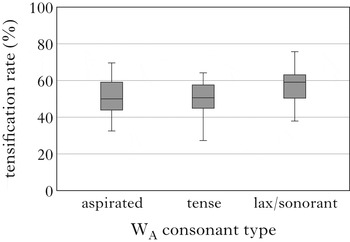
As seen in Table X and Fig. 8, the tensification rate is lower when WA contains either aspirated or tense consonants. A Pearson's χ2 test with Yates' continuity correction shows that aspirated vs. lax and tense vs. lax in WA are significantly different in their effect on sai-sios, whereas aspirated vs. tense is not (χ2=69·14, p<0·0001; χ2=88·03, p<0·0001; χ2=0·01, p=0·9227).Footnote 15
Compound tensification rate as a function of WA consonant type (35 speakers, 1171 words).

Compound tensification rate as a function of WA consonant type (35 speakers, 1171 words).

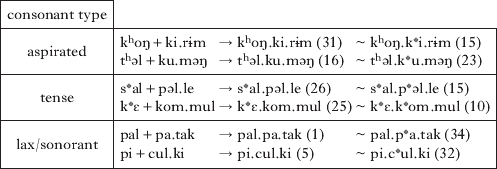
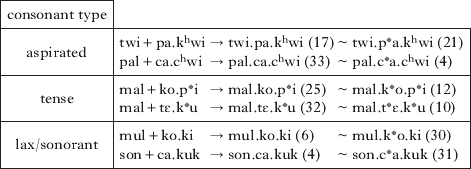
Examples are given in Table XI.
Examples of compound tensification as a function of WA consonant type.

This variation in compound tensification contrasts markedly with the automatic and general post-obstruent tensing process of Yanbian Korean phonology that applies whenever a stem-final obstruent combines with a suffix-initial obstruent, regardless of the laryngeal features in the preceding stem: e.g. /cap-ko/ [cap.k*o] ‘catch + gerund’, /cʰap-ko/ [cʰap.k*o] ‘be cold + gerund’, /c*ap-ko/ [c*ap.k*o] ‘be salty + gerund’; /tək-to/ [tək.t*o] ‘virtue + also’, /tʰək-to/ [tʰək.t*o] ‘jaw + also’, /t*ək-to/ [t*ək.t*o] ‘rice cake + also’.
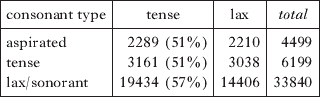
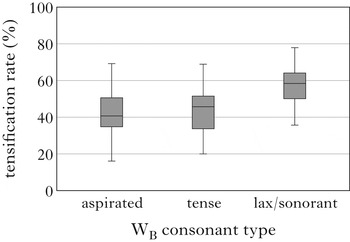
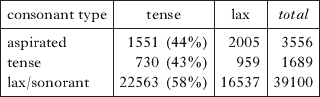
The compound tensification rate is also lower when WB contains either aspirated or tense consonants (Table XII and Fig. 9).Footnote 16 A Pearson's χ2 test with Yates' continuity correction shows that aspirated vs. lax and tense vs. lax in WB are significantly different in their effect on sai-sios, while aspirated vs. tense is not (χ2=262·75, p<0·0001; χ2=138·09, p<0·0001; χ2=0·6, p=0·8102). Examples are given in Table XIII.
Compound tensification rate as a function of WB consonant type (35 speakers, 1171 words).

Compound tensification rate as a function of WB consonant type (35 speakers, 1171 words).

Examples of compound tensification as a function of WB consonant type.

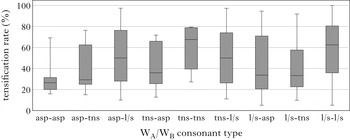
Figure 10 shows the combined result of Figs 8 and 9. Except for the case in which both WA and WB contain tense consonants (‘tns-tns’), which appears in just a handful of examples, gradient OCP effects are observed.
Compound tensification rate as a function of WA and WB consonant type (35 speakers, 1171 words). ‘asp-asp’ means that both WA and WB contain aspirated consonants; ‘l/s-tns’ means that WA contains lax/sonorant consonants and WB tense consonants.

It is well known that co-occurrence restrictions on laryngeal features (aspiration, glottalisation, etc.) are observed in many languages. For example, MacEachern (Reference MacEachern1999) and Gallagher (Reference Gallagher2010, Reference Gallagher2011, Reference Gallagher2012) report that Peruvian Aymara and Quechua show co-occurrence restrictions on multiple features (aspirated and ejective). The gradient restriction on compound tensification in Yanbian provides further evidence for this typological generalisation.
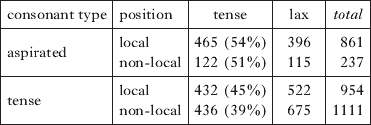
As seen in Table XIV, it is unclear from our data whether compound tensification is locality-sensitive, i.e. whether or not a laryngeally marked segment in an adjacent syllable blocks tensification more than one which is not in the adjacent syllable. In this table, compound data whose WA is monosyllabic are excluded, since monosyllabic WA does not have a non-local case. WA words that contain both aspirated and tense consonants are also excluded. The tensification rate is higher when the marked feature (aspirated or tense) is adjacent to WB than when it is not. A Pearson's χ2 test with Yates' continuity correction shows that the distribution is not statistically significant for aspirated consonants (χ2=0·38, df=1, p=0·5366), while it is significant for tense consonants (χ2=7·44, df=1, p=0·0064), but the bias is in the opposite direction from what is expected. For WB, all the instances except for one (/ma.nɨl + caŋ.a.c*i/ ‘garlic + slices of radish or cucumber dried and seasoned with soy’ → [ma.nɨl.caŋ.a.c*i] ~ [ma.nɨl.c*aŋ.a.c*i] ‘pickled garlics’) are local (a laryngeally marked segment appears in the second syllable of WB), so the locality effect cannot be checked in WB.
Compound tensification rate as a function of position of WA consonant type.

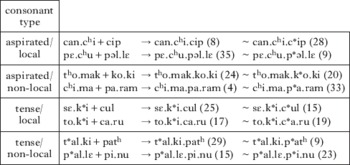
Examples are given in Table XV.
Examples of compound tensification as a function of locality of WA consonant type.

2.6 Summary
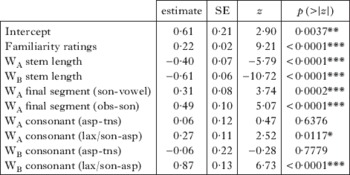
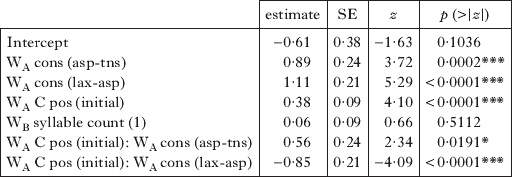
As a summary of the phonological effects mentioned so far, I constructed a mixed effects logistic regression model using the glmer function from the lme4 package (Bates et al. Reference Bates, Maechler, Bolker and Walker2014) in R (R Development Core Team 2011). Tensification was the dependent variable (non-tensified as the reference category) and the various factors mentioned above were the independent variables: familiarity ratings (numerical), WA/WB stem length (numerical), WA final-segment type (obstruent, sonorant, vowel) and WA/WB consonant type (aspirated, tense, lax/sonorant). Random intercepts were set for item and subject. For WA final-segment type and WA/WB consonant type, backward difference coding was utilised: WA final-segment types (vowel > sonorant > obstruent), WA/WB consonant type (tense > aspirated > lax/sonorant). An ANOVA() for likelihood-ratio test was carried out for model comparison, to rule out the more complicated models. Table XVI shows the results. As the familiarity ratings increases, items tend to be tensified; as the stem length increases, the tensification rate declines; vowel-final WA is tensified less than a sonorant coda, which is in turn tensified less than an obstruent coda; tense consonants in WA/WB are not significantly different from aspirated consonants in WA/WB, while aspirated consonants in WA/WB are less tensified than lax/sonorant consonants. More complicated models, with an interaction of each of the predictors (e.g. a model with an interaction of WA and WB consonant types), either failed to converge or were not significantly different from this simpler model.
Results of a mixed effects logistic regression model (lexical data). Significant values are indicated by * (p<0·05), ** (p<0·01) and *** (p<0·001).

I also tried to find a gradient constraint weighting, using Hayes' (Reference Hayes2009) Maxent Grammar Tool. The constraints employed in the simulation are given in (3).
-
(3)
Footnote 17
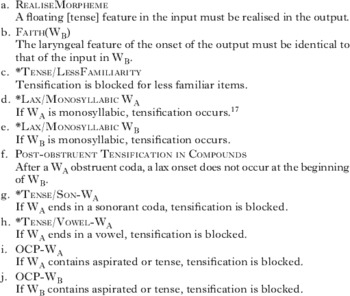
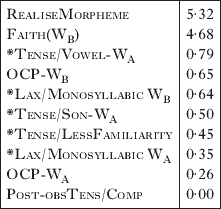
The weights obtained are shown in Table XVII.
Weights obtained using Hayes' Maxent grammar tool.

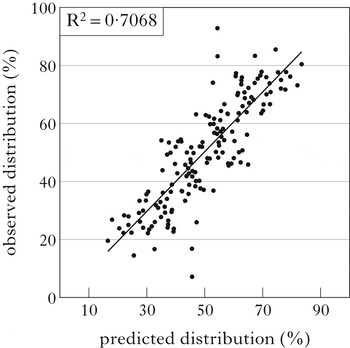
Two constraints with opposing effects (RealiseMorpheme and Faith(WB)) are weighted highest, with the slightly higher value for the former (5·32 vs. 4·68) probably mirroring the overall distribution of sai-sios in Yanbian: tensified (24,844; 56%) vs. non-tensified (19,501; 44%). *Tense/Vowel-WA is weighted higher than *Tense/Son-WA (0·79 vs. 0·50), reflecting the higher tensification rate in the latter. OCP-WB is weighted higher than OCP-WA (0·65 vs. 0·26), which is similar to Japanese rendaku, in that rendaku can be blocked if the second element already contains a voiced segment. *Lax/Monosyllabic WB is weighted higher than *Lax/Monosyllabic WA (0·64 vs. 0·35). In my observation, monosyllabic WB nouns rarely constitute an independent phonological phrase in Yanbian, while monosyllabic WA nouns may do so more frequently, explaining the less frequent occurrence of sai-sios. Finally, Post-obsTens/Comp plays no role in this model. Unlike *Tense/Vowel-WA and *Tense/Son-WA, which block the application of sai-sios tensification, Post-obsTens/Comp by definition does not work against RealiseMorpheme: even if Post-obsTens/Comp does not promote more tensification, RealiseMorpheme forces sai-sios, unless other factors against tensification are involved. Based on this result, we can assume that the relatively higher tensification rate after an obstruent coda is not because it is promoted by post-obstruent tensification, but because the relevant environment does not introduce any violation. Figure 11 shows the correlation between observed and predicted distributions. Two outlier combinations were excluded, due to the relatively small number of datapoints (36 and 35 respectively).Footnote 18 A linear regression analysis with observed distribution as the dependent variable and predicted distribution as the independent variable shows a significant result (est.=1·03, SE=0·05, t=19·32, p<0·0001).
Correlation between observed and predicted distributions of compound tensification, calculated using Hayes' Maxent Grammar Tool.

In sum, compound tensification in Yanbian, which is motivated by a junctural floating [tense] feature, shows considerable variation between speakers, and its application is significantly affected by various phonological factors: familiarity ratings, WA/WB stem length, WA final-segment type and WA/WB consonant type. The higher the familiarity ratings, the higher the tensification rate. The longer the stem length, the lower the tensification rate. The probability of tensification is much greater after an obstruent coda than after a sonorant coda, which in turn shows a higher tensification rate than after a vowel. The tensification rate is also relatively lower when WA or WB contains either aspirated or tense consonants. As discussed in Zuraw (Reference Zuraw2011), all of these factors contribute probabilistically to the distribution of the occurrence of tensification. The overall distribution can be predicted by several weighted constraints with a substantial degree of accuracy. On the other hand, speaker age, gender and locality are not factors which have a clear effect on sai-sios distribution.
3 Wug tests
In this section I report the result of two wug tests, which were designed to test whether the phonological factors mentioned in §2 control tensification for Yanbian speakers. In wug test 1, novel compound words consisting of an existing WA and a nonce WB were utilised, to examine whether syllable count, WA coda type and WB consonant type play a role in the application of sai-sios. In wug test 2, novel compound words consisting of a nonce WA and an existing WB were constructed, to test the effect of WA consonant type and its position in a word, as well as syllable count. In the light of the discussion in §2, we expect tensification rates to differ depending on the environment of each novel compound word, reflecting the patterns observed in the lexicon. With one exception, this turned out to be in general true in our wug-test results, but a tendency that was not clearly observed in the lexicon also emerged – a locality effect. In §3.1, I show the results of wug test 1, and in §3.2 the results of wug test 2.
3.1 Wug test 1: existing word + nonce word
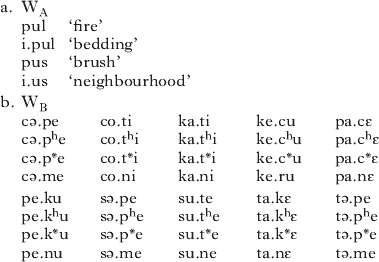
In wug test 1, WA was an existing monosyllabic or disyllabic word with a sonorant or obstruent coda, while WB was a nonce word with the structure CV.CV, CV.CʰV, CV.C*V or CV.RV (where C=a lax consonant). The onset of WB was /p/, /t/, /k/, /c/ or /s/. The four WA words and 40 WB words, listed in (4), were combined, resulting in 160 test words.
-
(4)
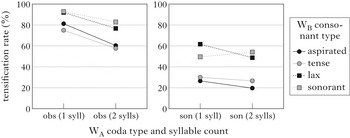
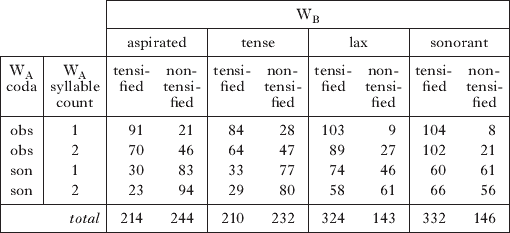
Eleven Yanbian native speakers participated in the experiment. They were instructed to report whether the onset consonant of WB is pronounced as tense, lax or either. The test items were sorted randomly and presented as a list, with spaces for marking the presence or absence of tensification, which was distributed to each speaker. Table XVIII shows the results. On the whole, tensification was reported more frequently when WB contained medial lax or sonorant consonants than when it contained medial aspirated or tense consonants. The tensification rate was also lower for WA sonorant codas than for obstruent codas. For obstruent codas, the tensification rate was lower when the WA syllable count changed from 1 to 2, whereas it was more or less the same for sonorant codas, as seen in Fig. 12.
Compound tensification rate as a function of WA coda type, WA syllable count and WB consonant type in wug test 1.

Results of wug test 1.

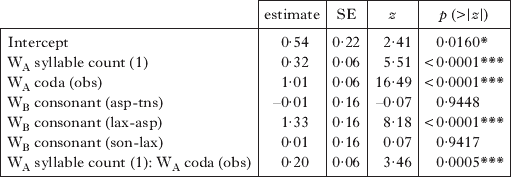
A mixed effects logistic regression model was constructed, with tensification as the dependent variable (non-tensified as the reference category) and WA coda type (obstruent, sonorant), WA syllable count (1 or 2) and WB consonant type (aspirated, tense, lax, sonorant) as the independent variables. WA coda type and WA syllable count were sum-coded, while backward difference coding was utilised for WB consonant type: tense > aspirated > lax > sonorant. Random intercepts were set for item and subject. Table XIX shows the results.
An obstruent coda and a lower syllable count for WA increase the tensification rate. Their interaction is significant. Tukey's multiple comparison test, using the glht function from the multcomp package (Hothorn et al. Reference Hothorn, Bretz, Westfall, Heiberger and Schuetzenmeister2013), showed that the obstruent coda–2 syllable combination results in significantly less tensification than the obstruent coda–1 syllable combination (est.=−1·04, SE=0·1800, z=−5·80, p=0·0001), while the sonorant coda–2 syllable combination is not significantly different from the sonorant coda–1 syllable combination (est.=−0·24, SE=0·15, z=−1·62, p=0·364). For WB consonant type, tense consonants are not significantly different from aspirated consonants, which are in turn less tensified than lax consonants. Lax and sonorant consonants are not significantly different.
Results of a mixed effects logistic regression model (wug test 1).

3.2 Wug test 2: nonce word + existing word
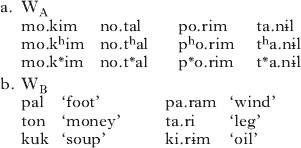
A second wug test was conducted. This time WA was a disyllabic nonce word with the structure RV.CVR, RV.CʰVR, RV.C*VR or CV.RVR, CʰV.RVR, C*V.RVR. WB was an existing monosyllabic or disyllabic word. The twelve WA words and six WB words, listed in (5), were combined, resulting in 72 test words.
-
(5)
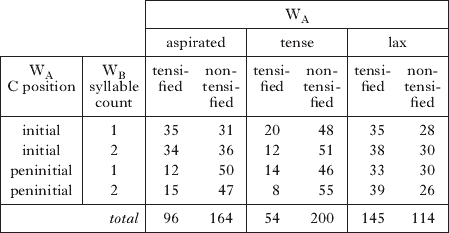
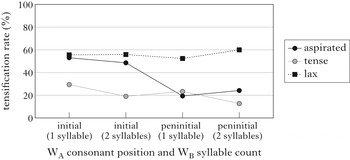
Ten Yanbian native speakers were instructed to report whether the onset consonant of WB is pronounced as tense, lax or either, using the same procedure as wug test 1 (seven speakers were also participants in wug test 1). Table XX shows the results. When WA contained a tense consonant, the tensification rate was very low, regardless of the position (24% for tense in the first syllable; 18% for tense in the second syllable) and the WB syllable count (27% for monosyllabic WB; 16% for disyllabic WB). On the other hand, when WA contained a lax consonant, the tensification rate was relatively high, regardless of the position (56% for lax in the first syllable; 56% for lax in the second syllable) and the WB syllable count (54% for monosyllabic WB; 58% for disyllabic WB). Aspirated consonants showed a different pattern from tense and lax consonants: when an aspirated consonant appeared in the second syllable of WA, the tensification rate was quite low (22%), but when it appeared in the first syllable of WA, the tensification rate was around the same as lax (51%); there was no clear difference for the WB syllable count (37% for monosyllabic WB; 37% for disyllabic WB).
Results of wug test 2.

Although it is unclear if there is any locality effect in existing words, the effect seems to be found in wug compounds, in that they tend to resist tensification more strongly when WA contains an aspirated consonant in the second syllable (i.e. when the aspirated consonant is adjacent to the site of tensification) than in the first syllable, as seen in Fig. 13.
Compound tensification rate as a function of WA consonant position, WA consonant type and WB syllable count in wug test 2.

A mixed effects logistic regression model was constructed, with tensification as the dependent variable (non-tensified as the reference category) and the laryngeal features contained in WA (aspirated, tense, lax), the position of the laryngeal features in WA (first or second syllable) and WB syllable count (1 or 2) as the independent variables. For WA consonant type, backward difference coding was utilised (tense > aspirated > lax), while WA consonant position and WB syllable count were sum-coded. A random intercept was set for item and subject. Table XXI shows the results. Sai-sios tensification is less frequent if WA contains tense consonants rather than aspirated consonants, and most frequent if it contains lax consonants. Tensification is observed more when the laryngeal features in WA are in the first syllable. The interaction between WA consonant and WA C position is also significant, reflecting the strong locality effect observed in aspirated consonants. Tukey's multiple comparison test, using the glht function, showed that lax–first and tense–first are not significantly different from lax–second and tense–second respectively (est.=0·01, SE=0·27, z=0·04, p=1·000 for lax; est.=−0·58, SE=0·36, z=−1·63, p=0·575 for tense), whereas aspirated–first is significantly more tensified than aspirated–second (est.=−1·70, SE=0·32, z=−5·35, p=0·0001). On the other hand, WB syllable count was not a significant factor.
Results of a mixed effects logistic regression model (wug test 2).

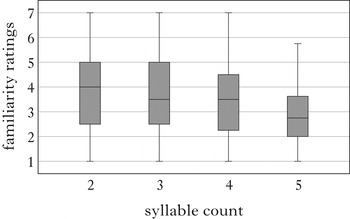
In sum, the two wug tests showed the OCP effect as well as the effect of coda type, mirroring tendencies observed in existing compound nouns: the probability of tensification is higher after an obstruent coda than after a sonorant coda, and the tensification rate is relatively lower when WA or WB contains either aspirated or tense consonants. On the other hand, a locality effect emerged in the experiment which was not clearly confirmed in the existing lexicon. The effect of stem length (the longer the stem, the lower the tensification rate) was partially observed in wug test 1 in WA with an obstruent coda, but was not clearly observed in the other cases. A possible reason for this is that stem length or the number of syllables in a compound noun correlates with familiarity: more familiar compound words tend to be shorter, as seen in Fig. 14 (mean familiarity ratings are 3·86, 3·75, 3·43 and 2·87 for compound nouns of two, three, four and five syllables respectively). A linear regression analysis with familiarity as the dependent variable and size of compound nouns as the independent variable shows a significant result (est.=−0·25, SE=0·06, t=−4·38, p<0·0001). This may suggest that the syllable-count effect is in fact due to lexical familiarity. If so, the fact that the syllable-count effect did not clearly appear in the results of wug tests except for one case is understandable, since the novel compound words used in wug tests have by definition frequency zero. However, two mixed effects logistic regression models, one of which includes both WA/WB syllable length and familiarity as factors and the other which includes WA/WB syllable length but excludes familiarity, are significantly different according to an ANOVA() for a likelihood-ratio test (χ2=81·92, df=1, p<0·0001); furthermore, the model in which both WA/WB syllable length and familiarity are included is significantly different from one in which familiarity is included but WA/WB syllable length is excluded (χ2=128·57, df=2, p<0·0001). Given this, we can conclude that syllable count and familiarity are separate factors affecting sai-sios distribution, even though these two overlap at least partially.
Correlation between syllable count of compound nouns and averaged familiarity ratings.

The fact that the syllable-count effect was not clearly observed in the wug-test results may be because the association between shorter/longer words and more/less compound tensification is not straightforwardly explained as a ‘universal’ preference. Hence there is no reason to expect it to be generalised to the novel words. We will return to this question in §4.2 below.
4 Causes of the laryngeal OCP effect in Yanbian
Up to now, we have investigated phonological factors affecting the distribution of
sai-sios, and have shown that the results of two wug tests not
only mirror the distributional patterns in the lexicon, but also evidence a
lexically unattested pattern. Still, why are these patterns, in particular the
laryngeal OCP effect, observed in compound words? In this section, I examine
possible causes of the laryngeal OCP effect in Yanbian. First, in §4.1, I
analyse the acoustic features of the three-way laryngeal contrast in Yanbian, and
show that the feature shared between aspirated and tense consonants is [long
non-modal voicing], which blocks the co-occurrence restriction of these two marked
segments. In §4.2, I examine whether there is an OCP effect in disyllabic
and trisyllabic simplex nouns. If such an effect exists in simplex nouns, then we
can conclude that the OCP effect in compound words is generalised from simplex
words. The analysis shows that the co-occurrence restriction between two aspirated
consonants is observed in simplex nouns, whereas the co-occurrence of two tense
onsets is overrepresented in the lexicon. The co-occurrence between aspirated and
tense onsets is underrepresented, but does not reach statistical significance. I
hypothesise that the apparent violation of OCP[tense] in simplex nouns is due to a
long-distance regressive assimilation anticipating the creaky voice of the following
syllable (harmony between the vowel of the CV syllable and that of the
C* syllable). These facts (the
overrepresentation of two tense consonants in simplex nouns and the statistically
non-significant co-occurrence patterns between aspirated and tense consonants) also
suggest that the co-occurrence restrictions on two tense consonants, as well as
those between aspirated and tense consonants in compound nouns, are emergent
patterns without clear lexical precedents. In §4.3, I briefly discuss
alternative possible causes of the laryngeal OCP effect in Yanbian.
4.1 Acoustic features
What is the cause of the co-occurrence restriction between two aspirated/tense consonants in Yanbian? Gallagher (Reference Gallagher2011) mentions that when the co-occurrence of multiple laryngeally marked segments in the stem or word is restricted in some languages, the restricted segments always share an articulatory or acoustic property, and she concludes that the feature shared by aspirated consonants and ejectives in Quechua is [long VOT]. The same observation was made by MacEachern (Reference MacEachern1999). Can our Yanbian data be explained in the same way? I conducted a preliminary acoustic analysis of the Yanbian laryngeal contrast.Footnote 19 Six words or phrases of the same type (Ca/C*a/Cʰa, with a high or low tone in the initial syllable) were recorded in isolation at a sampling rate of 44·1 kHz and 16 bits, resulting in a total of 54 items for each speaker (6 words×3 laryngeal categories×3 places of articulation).Footnote 20 The recording was conducted in a quiet room, using a Sony linear PCM recorder PCM-D50 and a Sony microphone ECM-MS957, and was analysed in Praat (Boersma & Weenink Reference Boersma and Weenink2012). VOT was measured from the point of stop burst release to the onset of voicing in the following vowel. A list of the items recorded can be found in Appendix A.
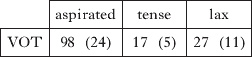
Table XXII shows the mean VOT values in word-initial position based on the phonation types, taken from 61 Yanbian native speakers born between 1935 and 1992 (25 male, 36 female), among whom were twelve speakers who were subjects for our sai-sios survey. Yanbian aspirated consonants have a relatively long VOT (average 98 ms), while tense consonants have a much shorter VOT (average 17 ms). Unlike Quechua, where both aspirated consonants and ejectives have a similarly long VOT, Yanbian (and Korean in general) has a long VOT only for aspirated consonants. Tukey's multiple comparison test on a linear mixed model, using the lmer function from the lme4 package and the glht function from the multcomp package, with item and subject as random factors showed that the VOTs of the three laryngeal categories are all significantly different from one another (lax vs. aspirated: est.=−71·60, SE=2·39, z=−29·97, p<0·0001; tense vs. aspirated: est.=−81·32, SE=2·39, z=−33·98, p<0·0001; tense vs. lax: est.=−9·72, SE=2·39, z=−4·07, p=0·0001).
Mean VOT values (in ms) for phonation types in word-initial position in Yanbian. Standard deviation is given in parentheses.

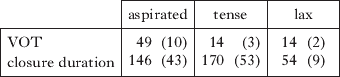
The same is true for word-medial position. 54 trisyllabic words/phrases containing Ca/C*a/Cʰa in the penultimate syllable (6 words×3 laryngeal categories×3 places of articulation) were recorded in isolation and analysed for 14 Yanbian speakers (7 males, 7 females), using the same procedure mentioned above. The recorded items can be found in Appendix B.
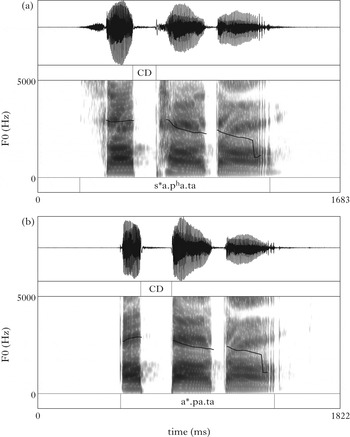
Lax consonants are voiced intervocalically for some speakers but are voiceless for others. The VOT value for lax is based on data from speakers who pronounced lax as voiceless. As seen in Table XXIII, the VOTs of both lax and tense are shorter than aspirated, and as a whole the VOT values in word-medial position are shorter than those in word-initial position. Tukey's multiple comparison test on a linear mixed model with item and subject as random factors shows that the VOTs of lax and tense are significantly shorter than that of aspirated (est.=−35·39, SE=2·43, z=−14·58, p<0·0001 for lax; est.=−35·13, SE=2·30, z=−15·28, p<0·0001 for tense), while the VOTs of tense and lax are not significantly different (est.=0·26, SE=2·43, z=0·11, p=0·994). In addition, the closure duration of tense is significantly longer than that of aspirated and lax (est.=23·99, SE=4·55, z=5·27, p<0·0001 for aspirated; est.=115·73, SE=4·56, z=25·40, p<0·0001 for lax), and the closure duration of aspirated is significantly longer than that of lax (est.=−91·74, SE=4·56, z=−20·13, p<0·0001). Thus aspirated and tense consonants in word-medial position share similar acoustic correlates: they have comparably long silent periods, which is due to their long closure duration. The mean total of closure duration plus VOT is 195 ms for aspirated and 184 ms for tense, while it is 68 ms for lax. Figure 15 shows sample waveforms and spectrograms.
Sample waveforms and spectrograms from speaker KMH (female, born in 1992) for (a) /s*a.pʰa.ta/ ‘It is a sofa’ (CD (closure duration) 127 ms; VOT 59 ms) and (b) /a.p*a.ta/ ‘It is my father’ (CD 184 ms; VOT 9 ms).

Mean VOT values and closure durations (in ms) for phonation types in wordmedial position in Yanbian. Standard deviation is given in parentheses.

This suggests that, in Yanbian, the feature shared between aspirated and tense consonants is [long non-modal voicing]. This interpretation does not contradict the findings of MacEachern (Reference MacEachern1999) and Gallagher (Reference Gallagher2011), but can cast light on the acoustic factor involved in the co-occurrence: having two relatively less sonorant sequences characterised by [long non-modal voicing] tends to be avoided. In our analysis, [non-modal voicing] includes frication, thus /s*/ is also the target of co-occurrence restrictions. As pointed out by Cho et al. (Reference Cho, Jun and Ladefoged2002), there is a significant duration difference between /s/ and /s*/ in word-medial position in both Seoul and Cheju Korean: /s*/ has a much greater duration than /s/. This supports the argument that /s*/ differs from /s/ in ‘long’ [non-modal voicing].
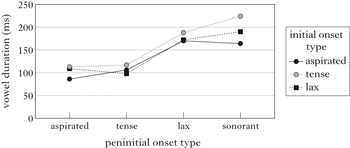
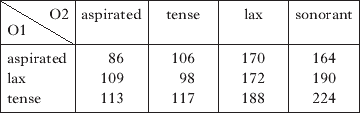
Furthermore, the duration of a vowel followed by a syllable with an aspirated or tense onset tends to be shorter than that followed by a syllable with a lax onset in Yanbian. Table XXIV and Fig. 16 show the mean vowel durations of V1 in CV1.CV2 words in each environment, based on recordings of the words taken from four native speakers (three words each with twelve structures, giving 36 words for each speaker). A list of the recorded items can be found in Appendix C.
Mean vowel duration (ms) of V1 in CV1. CV2 words as a function of initial and peninitial onset type.

Mean vowel durations (ms) of initial syllable. O1=onset of the initial syllable; O2=onset of the peninitial syllable.

Tukey's multiple comparison test on a linear mixed model with item and subject as random factors showed that the vowel durations in a first syllable followed by a syllable with a lax or sonorant onset are significantly greater than those in one followed by a syllable with an aspirated or tense onset (lax vs. aspirated: est.=73·83, SE=7·28, z=10·15, p<0·001; sonorant vs. aspirated: est.=89·65, SE=7·28, z=12·32, p<0·001; tense vs. lax: est.=−68·63, SE=7·32, z=−9·38, p<0·001; tense vs. sonorant: est.=−84·45, SE=7·32, z=−11·55, p<0·001), while the vowel durations in a syllable followed by a tense onset vs. aspirated onset and those in a syllable followed by a sonorant onset vs. lax onset are not significantly different (tense vs. aspirated: est.=5·20, SE=7·35, z=0·71, p=0·894; sonorant vs. lax: est.=15·82, SE=7·24, z=2·19, p=0·127). These results indicate that the shorter vowel duration makes the two onsets closer, which may be an additional factor regulating compound tensification.
4.2 Simplex nouns
The next question with regard to the co-occurrence restriction on two laryngeally marked segments observed in compound words is whether or not the same pattern appears in simplex words as well. If there is such an effect in simplex nouns, this suggests that the OCP effect in compound words is generalised from simplex words. In this section, I examine the co-occurrence patterns of onset consonants in disyllabic and trisyllabic simplex nouns taken from the two Korean dictionaries mentioned in §1, as well as some words collected from Yanbian native speakers.Footnote 21 The total of simplex nouns collected this way is 1991 for disyllables and 884 for trisyllables. For the phonotactics of Korean monosyllabic stems, see Ito (Reference Ito2007).
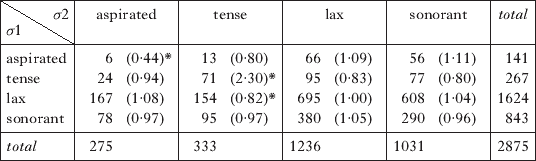
Table XXV shows the distribution of consonant types in the onsets of initial and peninitial syllables in disyllabic and trisyllabic simplex nouns. Interestingly, the co-occurrence of two aspirated consonants is strongly underrepresented, while that of two tense consonants is overrepresented in the lexicon.Footnote 22 The co-occurrence of aspirated and tense onsets is also underrepresented, but this does not reach statistical significance, and the co-occurrence of lax (initial)-tense (peninitial) is also underrepresented.
Co-occurrence of onset types in initial and peninitial syllables in disyllabic and trisyllabic simplex nouns. The observed/expected value is given in parentheses. Significant correlations (p<0·05) are indicated by *·(χ2=45·72, df=9, p=<0·0001).

Examples are given in (6).
-
(6)
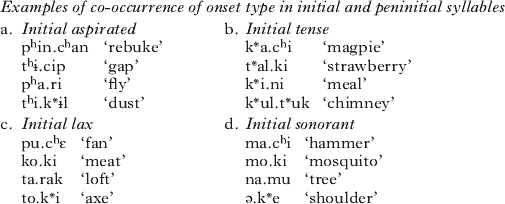
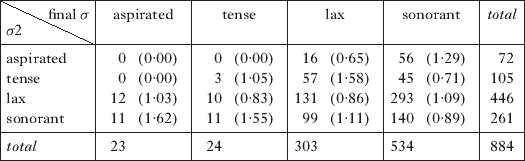
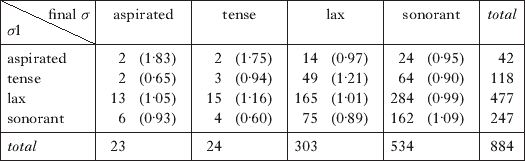
Tables XXVI and XXVII show the onset distribution of peninitial and final syllables, and initial and final syllables in trisyllabic simplex nouns. We do not show χ2 statistics here, since aspirated/tense onsets rarely appear in the final syllable (respectively 23 and 24 occurrences) and there are many cells with a value below five. Based on the observed/expected values, some combinations seem to be underrepresented (aspirated (peninitial)–aspirated (final), tense (initial)–aspirated (final), etc.), while others seem to be overrepresented (aspirated (initial)–aspirated (final), aspirated (initial)–tense (final), etc.). However, it is difficult to draw any conclusions about the laryngeal OCP effect on the basis of this limited data.
Co-occurrence of onset types in peninitial and final syllables in trisyllabic simplex nouns. The observed/expected value is given in parentheses.

Co-occurrence of onset type in initial and final syllables in trisyllabic simplex nouns. The observed/expected value is given in parentheses.

Examples are given in (7) and (8).
-
(7)
-
(8)
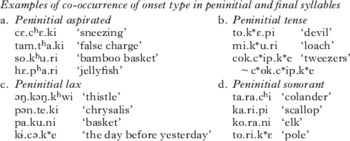
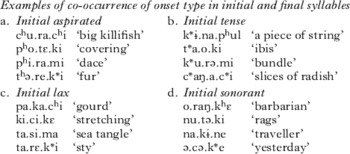
How can we explain the apparent contradiction between the OCP effect observed in compound tensification (recall Tables X and XII) and the overrepresentation of the co-occurrence of two tense onsets in initial and peninitial syllables of simplex words (Table XXV)? According to Gallagher (Reference Gallagher2010, Reference Gallagher2012), long-distance restrictions on laryngeal features fall into one of three patterns: assimilation, dissimilation and mixed. In ‘assimilatory’ and ‘dissimilatory’ languages roots with heterorganic and homorganic pairs of consonants show the same co-occurrence patterns, while in ‘mixed’ languages heterorganic and homorganic pairs pattern differently. The three patterns are shown in (9), where TT and TK denote a pair of homorganic and heterorganic consonants respectively, and C' is a laryngeally marked consonant.
-
(9)

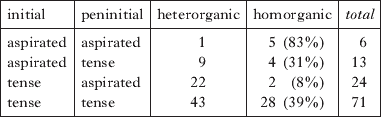
In our database of simplex words (initial and peninitial onsets), marked–marked structures (CʰV(C).CʰV(C), CʰV(C).C*V(C), C*V(C).CʰV(C) and C*V(C).C*V(C)) are not biased to homorganic consonant pairs, as seen in Table XXVIII.
Initial and peninitial onset type in simplex words and the ratio of homorganic pairs.

Homorganic consonant pairs represent 34% of marked–marked structures, more or less the same as for marked–unmarked and unmarked–marked structures (CʰV(C).CV(C), CV(C).CʰV(C) and CV(C).C*V(C), C*V(C).CV(C)), and for unmarked–unmarked structures (CV(C).CV(C)). In addition, more detailed examination of words with a marked–marked structure (Table XXIX) shows that a homorganic effect is observed when both onsets are aspirated, but heterorganic pairs are more frequently observed in other cases. Given this, the Yanbian data cannot straightforwardly be classified as a ‘mixed’ pattern.
Initial and peninitial onsets in simplex words and the ratio of homorganic pairs: marked–marked structure.

As mentioned above, I consider that the overrepresentation of two tense onsets in
initial and peninitial syllables in simplex words is due to a long-distance
regressive assimilation process that anticipates the creaky voice of the
following syllable: the glottal constriction in the second syllable is
assimilated to the first syllable. This is due to harmony between the vowel of
the initial CV and the vowel of the following C*, which underlies the
consonantal harmony: CV.C* > C.C* >
C*.C*. I assume that the change from
CV.C*V to C*V.C*V can happen especially easily
in Yanbian, given that the VOTs of lax and tense consonants are quite close in
Yanbian (27 ms for lax and 17 ms for tense), and that
creaky voice (lower H1 – H2, where H1 – H2 is the
difference in amplitude between the first and second harmonics) is the major
distinctive cue in Yanbian.Footnote
23
Table XXX shows the mean H1
– H2 values in vowel-onset position of the initial syllable taken
from 61 speakers based on the recorded data in Appendix A. H1 – H2
was measured in the first 25 ms by using Fast Fourier Transform
spectra. Tukey's multiple comparison test on a linear mixed model
with item and subject as random factors showed that the H1 – H2
values of lax and tense are significantly lower than that of aspirated (lax
vs. aspirated: est.=−1·19,
SE=0·15,
z=−7·76,
p<0·0001; tense vs.
aspirated: est.=−7·30,
SE=0·16,
z=−46·98,
p<0·0001), and that the H1 –
H2 value of tense is significantly lower than that of lax
(est.=−6·11, SE=0·15,
z=−39·46,
p<0·0001).
Mean H1 – H2 values (in dB) in Yanbian. Standard deviation is given in parentheses.

In fact, there are many words which display this assimilation diachronically, e.g. MK /kos.kal/ > /ko.k*al/ > [k*o.k*al] ‘Buddhist priest's hood’ and MK /tuk.tə.pi/ > /tut.kə.pi/ (metathesis) > /tu.k*ə.pi/ > [t*u.k*ə.pi] ‘toad’, but no instances of progressive assimilation (C*V.CV > C*V.C*V) are observed. Recall that tense consonants in Contemporary Korean originate from consonant clusters in Middle Korean. The fact that the co-occurrence of lax initial and tense peninitial consonants is underrepresented in simplex words also supports this hypothesis.Footnote 24
The fact that WA C*V.C*V is dispreferred in compound words may also be because the compound tensification itself is a progressive process: the floating [tense] feature is between the two morphemes in the input and docks onto the first consonant of WB in the output, since any coda in WA is unreleased, and hence cannot be tensified, due to a general syllable-structure constraint of Korean phonology. Thus the floating [tense] feature is realised on the second morpheme, and its association can be characterised as progressive. The OCP constraint on WB blocks tensification, since the tensification here is not the one triggered by the harmony to a following tense consonant in WB. Thus, Yanbian Korean exhibits two co-occurrence patterns in long-distance restrictions on laryngeal features (assimilation and dissimilation), based not on the homorganic/heterorganic patterns of the onset pairs, but on the presence or absence of the environment for regressive assimilation.Footnote 25
In any case, the overrepresentation of the co-occurrence of two tense consonants in simplex nouns and the fact that the underrepresentation of the co-occurrence of aspirated and tense onsets does not reach statistical significance suggest that OCP[tense] and OCP[aspirated-tense] in compound nouns are emergent patterns without clear lexical precedents. Furthermore, in §3.2 I found that a locality effect which has not yet managed to shape the lexicon in a measurable way emerged in the wug test, whereas the syllable-count effect, which is observed in the lexicon, was not clearly apparent in the wug test, except in one case. These results show that Yanbian speakers have knowledge of typological universals that goes beyond what can be inferred from the data in the lexicon. As mentioned above, sai-sios originates historically from a genitive marker in Middle Korean, and hence is assumed here to have appeared regardless of the phonological properties of WB. However, the attachment of the genitive marker /-s/ in Middle Korean, which would originally have been morphologically and phonologically transparent, was obscured, due to historical sound changes. These changes have eliminated the traces of sai-sios in Contemporary Korean, except for the tensification of the first consonant of WB, making the compound tensification process opaque. Thus a process that was originally morphologically and phonologically transparent, but became opaque due to sound change, has been reshaped and reinterpreted, and phonological factors have arisen in conditioning sai-sios. On the one hand, speakers have restructured the generalisation on the basis of the available synchronic data, and the application of sai-sios (RealiseMorpheme) may interact with lower-weighted constraints on tense consonants in the lexicon, such as faithfulness of [−tense] in longer and/or less familiar words. On the other hand, ‘universal’ preferences also emerge for our Yanbian speakers, such as OCP[tense] and OCP[aspirated-tense] with a locality effect, which are evidently not present in the linguistic data of their native language. The syllable-count effect, which overlaps at least partially with the familiarity effect, cannot be straightforwardly explained as a universal preference, and hence is not actively incorporated in novel words. This paper thus provides further evidence for the existence of analytic biases (or ‘overlearning’) as well as ‘underlearning’ (Wilson Reference Wilson2003, Moreton Reference Moreton2008, Zhang & Lai Reference Zhang and Lai2008, Becker et al. Reference Becker, Ketrez and Nevins2011), not only based on wug tests, but also through the analysis of historical restructuring of the lexicon.
4.3 Alternatives
Finally in this section, I investigate whether the OCP effect observed in Yanbian compounds (as well as simplex words) can be motivated by additional factors.
First, the restriction on the co-occurrence of aspirated and tense in Yanbian may be due to articulatory factors. Following Kim (Reference Kim1965) and Halle & Stevens (Reference Halle and Stevens1971), tense can be interpreted as [constricted glottis], and aspirated as [spread glottis]. The feature [constricted glottis] is at the opposite pole from [spread glottis] on the VOT parameter, in that glottal opening is minimal vs. maximal, whereas the state of glottis for lax and sonorant onsets, as well as for vowels, is assumed to be intermediate. Given this, a significantly large amount of articulatory effort is presumably required not only for two extreme glottal states separated by a vowel but also for two opposing glottal states (see Gallagher Reference Gallagher2013 and Walter Reference Walter2007 for relevant discussion).
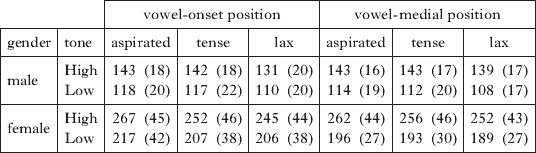
Another possible explanation is that the feature shared between aspirated and tense is higher F0 in the following vowel, which is observed in Seoul and Kyengsang Korean (e.g. Kenstowicz & Park Reference Kenstowicz and Park2006, Silva Reference Silva2006, Lee & Jongman Reference Lee and Jongman2012) and which could thus give rise to an OCP effect on high tones or raised F0 as the factor grouping these two laryngeal classes. We measured F0 values in both vowel-onset position (the second pulse of the vowel following the target stop) and vowel-medial position (the medial position of the entire vowel duration) of the first syllable, based on the data in Appendix A from 14 speakers (7 males, 7 females), taken from citation forms. As seen in Table XXXI, the F0 difference between tense/aspirated and lax is quite small in Yanbian: around 1–20 Hz for vowel-onset position and 4–10 Hz for vowel-medial position. Two linear mixed models were run to test the F0 patterns, using the lmer function in R with item and subject as random factors: for one case, the dependent variable is vowel-onset F0 and for the other case it is vowel-medial F0; in both cases, independent variables are gender (male, female), tone (initial-syllable high, low) and laryngeal class (aspirated, tense, lax). Tukey's multiple comparison test on a linear mixed model with vowel-onset F0 as the dependent variable showed that gender and tone are significant factors (gender: est.=−105·70, SE=17·07, z=−6·19, p<0·0001; tone: est.=−34·41, SE=1·09, z=−31·69, p<0·0001). For laryngeal class, aspirated is significantly higher than lax and tense, and tense is significantly higher than lax (lax vs. aspirated: est.=−13·03, SE=1·32, z=−9·88, p<0·0001; tense vs. aspirated: est.=−7·00, SE=1·33, z=−5·28, p<0·0001; tense vs. lax: est.=6·02, SE=1·33, z=4·53, p<0·0001). In vowel-medial position, gender and tone are again significant factors (gender: est.=−98·92, SE=14·17, z=−6·98, p<0·0001; tone: est.=−47·36, SE=1·28, z=−37·11, p<0·0001). The F0 values of aspirated are significantly higher than lax, while the F0 values of aspirated vs. tense and tense vs. lax are not significantly different (lax vs. aspirated: est.=−6·71, SE=1·55, z=−4·33, p=0·0001; tense vs. aspirated: est.=−3·06, SE=1·56, z=−1·97, p=0·1208; tense vs. lax: est.=3·65, SE=1·56, z=2·34, p=0·0509). As a whole, the effects of gender and tone are much stronger in magnitude than laryngeal class, as shown in the estimates. This is understandable, given the fact that Yanbian has a distinctive pitch accent (i.e. HL and LH are contrastive), which suggests that the relatively small differences of F0 between aspirated, tense and lax are unlikely to override the underlying tones to affect the decision on tensification. Thus an analysis involving the OCP applying to H tones or raised F0 probably does not yield the proper generalisation.
Mean F0 values (in Hz) of each laryngeal category in Yanbian. Standard deviation is given in parentheses.

5 Summary and conclusion
In this paper I have analysed the distribution of compound tensification in Yanbian Korean, and have found that there are several phonological factors which have a statistically significant influence on the sai-sios phenomenon: familiarity ratings, syllable count, WA final-segment type and laryngeal features in WA or WB. I assume that the large amount of variation in the application of tensification in Yanbian compound nouns is due to the interaction of these phonological constraints with faithfulness constraints (RealiseMorpheme, Faith(WB)), as well as to morphological/semantic factors not examined in this paper, all of which are weighted differently.
We also conducted two compound-word wug tests. The results mostly mirrored the generalisations drawn from the lexical data, but a pattern which was apparently not present in the lexicon also emerged (the locality effect). Phonologically implausible interactions between syllable count and compound tensification were not actively incorporated in the wug-test results (‘underlearning’).
In order to identify the causes of the laryngeal OCP effect in Yanbian, a preliminary acoustic analysis of each laryngeal feature was carried out. Based on the results, the feature shared between aspirated and tense was assumed to be [long non-modal voicing], which blocks the co-occurrence of these two marked consonants. Furthermore, the lexical distribution of simplex nouns shows that the co-occurrence restriction between two aspirated consonants was observed in simplex nouns, whereas the co-occurrence of two tense consonants was overrepresented. The co-occurrence between aspirated and tense onsets was also underrepresented, but did not reach statistical significance. The apparent contradiction between the OCP[tense] effect in compound words and the overrepresentation of two tense onsets in initial and peninitial syllables in simplex words is explained as a directionality difference of phonological processes: compound tensification as a progressive process vs. regressive assimilation of the creaky voice of the vowel of the following syllable in simplex words. Thus Yanbian Korean exhibits two co-occurrence patterns in long-distance restrictions on laryngeal features (assimilation and dissimilation), which are based not on the homorganic/heterorganic patterns of the onset pairs, but rather on the presence vs. absence of the environment for the regressive assimilation. It seems that OCP[tense] and OCP[aspirated-tense] in compound nouns are emergent patterns without clear lexical precedents, based on the overrepresentation of the co-occurrence of two tense consonants in simplex nouns, as well as the failure of co-occurrence patterns between aspirated and tense consonants to reach statistical significance.
This paper has provided not only new data for the general phonological typology of co-occurrence restrictions on multiple laryngeally marked segments (aspirated and tense), but also evidence for the emergence of implicit knowledge of typological universals or analytic biases in historical restructuring, as well as in wug tests.
Appendix A: Items recorded for the analysis of VOT, H1–H2 and F0

Some experimental items, mostly with initial aspirated onsets, are true phrases: e.g. /pʰa.rí kil.ta/ ‘arm is long’ (‘arm+nom+be long+inf sentence ender’). These items were included in order to balance the tonal patterns of the targeted syllable, but this may affect the VOT values, since longer VOT values are expected for aspirated stops in phrase-initial position than in word-initial position. However, mean VOT values for /pʰ tʰ kʰ/ in phrase-initial position are more or less the same as in word-initial position: 98 ms, 94 ms and 111 ms respectively for the former, and 97 ms, 94 ms and 103 ms respectively for the latter. Tukey's multiple comparison test on a linear mixed model using the lmer function and the glht function with item and subject as random factors showed no significant differences between phrase-initial and word-initial aspirated (est.=6·43, SE=4·03, z=1·60, p=0·5727), between phrase-initial and word-initial lax (est.=−8·85, SE=5·34, z=−1·66, p=0·531) or between phrase-initial and word-initial tense (est.=−4·74, SE=5·39, z=−0·88, p=0·9447).
Also, although compound data and simplex word data (mentioned in §4.2)
belong to the native vocabulary stratum, the experimental items in
§4.1 are not necessarily confined to native words. Some of them
belong to Sino-Korean and recent loanwords, which were included to obtain the
targeted syllable data: e.g. Sino-Korean /ká.ku/
‘furniture’ and the loanword
/kʰa.na.tá/ ‘Canada’. These
differences also do not affect the VOT values. For example, Tukey's
multiple comparison test on a linear mixed model using the lmer
function and the glht function with item and subject as random
factors showed no significant differences between native aspirated and loan
aspirated (est.=−4·69,
SE=4·40,
z=−1·07,
p=0·972) or between Sino-Korean aspirated
and loan aspirated (est.=−6·87,
SE=4·91,
z=−1·40,
p=0·874).
Finally, the data from 19 of the 61 speakers had been collected earlier, as a pilot study based on a subset of the 54 words above. In these data, laryngeal category and place of articulation are also balanced. Tukey's multiple comparison test on a linear mixed model with a VOT as the dependent variable showed that two groups (one group from the earlier experiment and the other from the next experiment) are not significantly different in each laryngeal category (aspirated: est.=−1·98, SE=3·45, z=−0·58, p=0·9794; lax: est.=−2·82, SE=3·44, z=−0·82, p=0·9195; tense: est.=−1·98, SE=3·47, z=−0·57, p=0·9800). The same is true for the voice-quality data discussed below in §4.2.
Appendix B: Items recorded for the analysis of word-medial VOT and closure duration
In Yanbian, there are two loanwords with the meaning
‘sofa’, one of which (/s*o.pʰa/) is
a loanword from English sofa and the other
(/s*a.pʰa/) is from Mandarin  shāfā.

Appendix C: Items recorded for the analysis of vowel duration

 /ka.ka/;
/səŋ.njaŋ/ ‘matches’
< Sino-Korean
 /sək.ju.hwaŋ/.