Introduction
The purpose of this study is to investigate how bilingualism affects the acquisition of Spanish clitic pronouns and definite articles, and whether these two grammatical structures are equally affected during bilingual development. Bilingual development is characterized by inherent fluctuations in the intensity of experience in a given language, which leads to variability in timing of acquisition of various grammatical aspects (Hurtado, Grüter, Marchman & Fernald, Reference Hurtado, Grüter, Marchman and Fernald2014). A better understanding of bilingual language acquisition is a central step in developing optimal strategies for language assessment and identification (Kohnert, Reference Kohnert2010; Paradis, Reference Paradis2011). In the present study, we explore the acquisition of determiners and object pronouns in Spanish in monolingual and bilingual children's production of clitic pronouns and articles. These two grammatical structures are of theoretical importance given that they have comparable timetables of development in Spanish (Pérez-Leroux, Castilla-Earls & Brunner, Reference Pérez-Leroux, Castilla-Earls and Bruner2012), but might be affected differently in bilingual development (Castilla-Earls, Restrepo, Perez-Leroux, Gray, Holmes, Gail & Chen, Reference Castilla-Earls, Restrepo, Perez-Leroux, Gray, Holmes, Gail and Chen2016; Paradis, Tremblay & Crago, Reference Paradis, Tremblay, Crago, Grüter and Paradis2014). Furthermore, these two structures are both clinical markers of specific language impairment in Spanish-speaking children (Bedore & Leonard, Reference Bedore and Leonard2001, Reference Bedore and Leonard2005) and understanding their developmental patterns may help in distinguishing cases of bilingual typical language development from cases of bilingual children with language impairment.
Bilingual effects
Language development in bilinguals is characterized by alterations in the timing of the acquisition of grammatical structures when compared to monolinguals. This phenomenon is referred to as bilingual effects (Castilla-Earls et al., Reference Castilla-Earls, Restrepo, Perez-Leroux, Gray, Holmes, Gail and Chen2016; Grüter & Paradis, Reference Grüter and Paradis2014; Pirvulescu, Perez-Leroux, Roberge, Strik & Thomas, Reference Pirvulescu, Perez-Leroux, Roberge, Strik and Thomas2014) or quantitative effects (Meisel, Reference Meisel, Cault-Nulton, Kulatilake and Woo2007). Four observations regarding bilingual effects are crucial for this investigation. First, bilingual effects are not general; instead they concentrate in certain domains of grammar (Müller, Reference Müller2003; Paradis et al., Reference Paradis, Tremblay, Crago, Grüter and Paradis2014; Unsworth, Reference Unsworth, Grüter and Paradis2014). Many core syntactic structures are acquired by simultaneous bilinguals with timing and patterns comparable to monolinguals (Paradis & Genesee, Reference Paradis and Genesee1996), at least in their stronger language. Second, bilingual effects are not limited to delays. Bilinguals also present acceleration effects in specific morphosyntactic forms (Gawlitzek-Maiwald & Tracy, Reference Gawlitzek-Maiwald and Tracy1996; Kupisch, Reference Kupisch2007; Müller, Reference Müller2003). Third, bilingual effects may not directly be the result of cross language influence, especially when grammatical elements are not present in both languages. In this case, the bilingual effects may appear only as a lengthened initial development stage resulting from the inherent reduction in exposure time associate with bilingual contexts. Lastly, bilingual effects are not only evident in comparisons between monolingual and bilingual children, but also among bilingual children with different proficiency levels (Castilla-Earls et al., Reference Castilla-Earls, Restrepo, Perez-Leroux, Gray, Holmes, Gail and Chen2016; Pirvulescu et al., Reference Pirvulescu, Perez-Leroux, Roberge, Strik and Thomas2014). This is particularly important in context such as the United States, where most children raised by immigrant parents speaking their home language ended up more proficient in their L2 by their adolescent years (e.g., Fillmore, Reference Fillmore1991; Tran, Reference Tran2010). These children go through a shift in language proficiency from their home language to English due to complex cultural, educational, and sociolinguistics circumstances (Lutz, Reference Lutz2008). Children who are just at the beginning stages of the process of learning English retain more of their home language than those who are more advanced in their English learning. In additive contexts some children might retain high competence in both languages, while in subtractive contexts, such as in the United States, an increase in L2 ability is likely to be associated with a slowdown in L1 development. We start by considering in more detail the various observations concerning the bilingual effects described in the literature in regard to the grammatical structures of interest in this study: clitics and articles. We also describe the bilingual effects previously observed for these two grammatical categories in terms of gender agreement.
Bilingual effects in object pronouns
Object clitic drop has been intensively studied since the influential work on monolingual children by Jakubowicz, Müller, Riemer and Rigaut (Reference Jakubowicz, Müller, Riemer and Rigaut1997), Schaeffer (Reference Schaeffer1997), and bilingual children by Müller and Hulk (Reference Müller and Hulk2001). While monolingual studies focus on what features of clitics are responsible for the observed children's clitic optionality stage (such as configuration and specificity; see Pirvulescu & Roberge, Reference Pirvulescu, Roberge, Gess and Rubin2008), studies of bilinguals attempt to explain the extended clitic omission stage in bilingual children. Hulk and Müller (Reference Hulk and Müller2000) interpret higher rates of clitic omission in bilinguals as the result of influence of German topic drop. Subsequent investigation established that object pronoun omission occurs in both clitic and non-clitic languages (Pérez-Leroux et al., Reference Pérez-Leroux, Pirvulescu and Roberge2018; Mykhaylyk & Sopata, Reference Mykhaylyk and Sopata2016). Even within clitic languages, there is substantial variability in the length of the omission stage, and this holds true within varieties of the same language, as is the case of Spanish (Castilla, Reference Castilla2008; Bedore & Leonard, Reference Bedore and Leonard2001; de la Mora, Paradis, Grinstead, Flores & Cantú, Reference De la Mora, Paradis, Grinstead, Flores and Cantu2004; Gavarro, Torrens & Wexler, Reference Gavarró, Torrens and Wexler2010, Elliot, Reference Elliott2016). There is consistent support for the initial observation that bilingualism extends the clitic omission stage, even in the absence of transfer effects. Bilinguals omit more clitics than monolinguals when their other language is English (Pérez-Leroux, Pirvulescu & Roberge, Reference Pérez-Leroux, Pirvulescu and Roberge2009; Pirvulescu et al., Reference Pirvulescu, Perez-Leroux, Roberge, Strik and Thomas2014), a language lacking topic drop in which children produce object pronouns early (Pérez-Leroux et al., Reference Pérez-Leroux, Pirvulescu and Roberge2018).
One question to consider is whether bilingual children show delays in object pronouns because object pronouns have different configurations in their two languages. For example, French has clitic pronouns, which are left-adjoined to the verb, whereas English object pronouns are full pronouns placed to the right of the verb in the same position as phrasal direct objects. However, a study of bi-dialectal contact between Capeverdean and European Portuguese shows consistent and extensive delays in bilinguals (Costa, Lobo & Pratas, Reference Costa, Lobo and Pratas2016), although the two varieties differ minimally in their pronominal syntax. European Portuguese allows both clitics and null objects, whereas Capeverdean Portuguese only allows clitics.
Several studies on Spanish–English bilinguals offer support for the view that bilingualism delays accuracy with object clitic pronouns. Using an elicited production task, Morgan, Restrepo, and Auza (Reference Morgan, Restrepo and Auza2013) found that bilingual children (mean age 6;0) in the United States produced less correct responses than their monolingual counterparts in Mexico. Other studies contrast different groups of bilingual children growing up in North America, finding dominance-related advantages. For instance, in Castilla-Earls et al. (Reference Castilla-Earls, Restrepo, Perez-Leroux, Gray, Holmes, Gail and Chen2016), bilingual children with limited English proficiency showed an increase in correct clitic productions with age, while balanced bilingual children exhibit a plateau. In Pérez-Leroux, Cuza and Thomas (Reference Pérez-Leroux, Cuza and Thomas2011), English-dominant simultaneous bilinguals produce clitic omissions in a repetition task, unlike Spanish-dominant sequential bilinguals who had virtually no omission errors. In sum, while previous studies concur that bilinguals have an extended clitic omission stage, the evidence is too heterogeneous to support firm inferences about bilingual development. Some studies concentrate on omissions, while others report accuracy rates.
Bilingual effects on articles
Across languages, articles are generally learned early, but the optionality stage differs for different languages. Several studies show that in Romance languages articles are acquired early compared to Germanic languages in both monolingual (Guasti, Gavarró, De Lange & Caprin, Reference Guasti, Gavarró, De Lange and Caprin2008) and bilingual children (Kupisch, Reference Kupisch2007). Article realization is one of the few domains where bilingualism can lead to earlier acquisition of the functional inventory. Paradis and Genesee (Reference Paradis and Genesee1996) found that while verbal inflection emerges at different times, determiner use emerges at the same time. Kupisch (Reference Kupisch2007) compared spontaneous production of determiners in German and Italian monolingual and bilingual children. Monolingual Italian children generally use determiners and protodeterminer fillers earlier than monolingual German children, and article omissions disappear earlier as well. Bilinguals in her study acquired German determiners faster than German monolinguals, but the advantage was only detected for children with strong Italian abilities. In contrast, Castilla-Earls et al.’s (Reference Castilla-Earls, Restrepo, Perez-Leroux, Gray, Holmes, Gail and Chen2016) study with Spanish–English bilinguals showed delays for articles in Spanish. Children's level of English proficiency predicted the accurate production of articles in Spanish. The balanced bilingual group had lower accuracy rates (78%) compared to the children with limited English proficiency (86%), even though the balanced bilinguals were older.
Most available studies of the acquisition of articles focus on gender/number agreement (which will be discussed in the next section), and omission rates are only incidentally reported. The bilingual children in Nicoladis and Marchak (Reference Nicoladis and Marchak2011) did not omit more articles in French than in English. These children lagged behind monolinguals in vocabulary, yet produced determiners at frequencies comparable to those of monolinguals (p. 744). In contrast, Cuza and Pérez-Tattam (Reference Cuza and Pérez-Tattam2016) reported higher rates of article omission in Spanish/English bilinguals compared to Spanish monolinguals. This is also true of Morgan et al. (Reference Morgan, Restrepo and Auza2013), whose Spanish monolingual children from Mexico showed evidence of article omissions (13%), but their bilingual counterparts omitted articles at almost double the rate (23%).
In sum, the previous literature suggests that bilingual effects on the omissions of articles and clitics are not homogeneous. Bilingualism leads to uniform delay in the case of clitic omissions, but the evidence is more complex in the case of article omissions. Kupisch's longitudinal study (Reference Kupisch2007) makes a compelling case for the possibility of acceleration in this domain, but the results of the few available elicitation studies do not yield a coherent picture.
Bilingual effects on noun phrase agreement
Many studies of bilingual production of clitics and articles report accuracy but do not necessarily detail error patterns, which include omissions and morphological substitutions. As agreement in clitics and in determiners are the result of different syntactic processes, they may be differentially affected by bilingual conditions. The standard assumption is that gender in the determiner is the result of local concord within the noun phrase, where the gender feature of the determiner is valued by the gender features of the noun (Camacho, Reference Camacho2017). Grüter (Reference Grüter2006) proposes that the greater structural distance between a pronominal form and its associate can lead to feature decay in working memory, leading to more omission or substitution errors in children's production.
 $$[ {_{{\rm DP}} {\rm \; Det }} [\, [ {_{{\rm NP}} {\rm \; N}] {\rm }\,]}]$$
 $$[ {_{{\rm ClP}} {\rm \; cl\; \ldots \; }} [_{{\rm VP}}{\rm \; V\; DP }[ {{\rm pro}}]$$
We concentrate on accuracy in gender agreement because more data are available, and bilingual effects have clearly been established. Furthermore, across Spanish dialects final /s/ lenition varies widely, which impacts timing of acquisition of grammatical number (Miller, Reference Miller2014). Such variability renders reliable comparisons across the research literature less reliable. In general, mastery of grammatical gender varies widely across languages, depending on robustness and transparency of the morphological paradigm. Children learning a Romance language have a clear advantage in learning gender, in comparison to children learning more opaque languages like German (Eichler, Jansen & Müller, Reference Eichler, Jansen and Müller2013). Spanish gender marking is highly reliable, with a majority of nouns explicitly marking gender. Correct use of gender in articles is mastered early in the spontaneous speech of monolingual Spanish children, with two-year-old children reaching 97-100% target in naturalistic use (Snyder, Senghas & Inman, Reference Snyder, Senghas and Inman2001). Elicitation studies show high but less perfect performance, indicating that children favor masculine assignment, and strongly give primacy to morphophonological cues over semantic cues when making decisions about gender (Pérez-Pereira, Reference Pérez-Pereira1991). Rates of gender error are generally low in monolinguals. Castilla (Reference Castilla2008) and Castilla and Pérez-Leroux (Reference Castilla and Pérez-Leroux2010) report minimal errors for concord between noun and adjectives and noun and articles (1%−2%). Errors with clitics are somewhat higher but still low (3%−4% for gender marking, and around 8% for number marking). Similarly, Bedore and Leonard (Reference Bedore and Leonard2001) found negligible morphological errors on articles (less than 1%), but gender error rates close to 11% (MLU controls, Table 6, p. 915). Morgan, Restrepo, and Auza (2009) found more gender substitutions than number omissions in articles (8% vs 3%), and the opposite for clitics (5% vs. 9%). However, this study only reports a small sample of typically developing children serving as controls for the children with language impairments under study.
The available evidence suggests that bilingualism can disrupt the course of the acquisition of gender in Spanish. Barreña (Reference Barreña, Pérez-Leroux and Glass1997) noted that bilinguals simultaneously acquiring Spanish and Basque, a language that does not mark for gender, had not fully acquired gender by the age of three. Larrañaga and Guijarro-Fuentes (Reference Larrañaga and Guijarro-Fuentes2012) confirmed this observation further comparing Barreña's bilinguals to a monolingual child from the Aguirre (Reference Aguirre2000) corpusFootnote 1. Bilingual effects are similarly detected when both languages grammatically encode gender. German children simultaneously learning a Romance language make more gender errors than their monolingual counterparts (Kupisch, Müller & Cantone, Reference Kupisch, Müller and Cantone2002; Eichler et al., Reference Eichler, Jansen and Müller2013). This is also true for Spanish. The two German-Spanish bilingual children in Eichler et al. (Reference Eichler, Jansen and Müller2013) retained overall error rates of 5% and 3 until the age of four (Figure 6, p. 563).
Amount of input plays a clear role. Mueller-Gathercole (Gathercole, Reference Gathercole, Oller and Eilers2002) reports that children with the greatest amount of input in Spanish have fewer gender errors. Montrul and Potowski's (Reference Montrul and Potowski2007) study of bilinguals with good Spanish maintenance found an effect of language experience with a picture description task, particularly with feminine, the marked case. There were significant differences between Heritage speakers and monolinguals and between simultaneous and sequential bilinguals, in terms of gender accuracy.
It is important to consider that gender agreement has both a lexical and a purely grammatical dimension. Gender assignment is lexical, i.e., it pertains to knowing the gender value of a word (i.e., whether the word pared ‘wall’ is feminine or masculine). Gender concord refers to the knowledge that various elements within a noun phrase must agree, a purely structural phenomenon. Nicoladis and Marchak (Reference Nicoladis and Marchak2011) analyzed rates of correct gender use in elicited NPs in a group of Francophone bilingual children in Edmonton, Canada. Their goal was to test whether bilingual effects were more prominent in domains related to input frequency. In French, gender agreement is not robustly encoded, and children acquire it later than Spanish-speaking children. Nicoladis and Marchak found no significant differences between monolingual and bilinguals in gender concord, i.e., agreement between adjectives and articles. However, the fact that bilinguals were worse at matching gender between nouns and either adjectives or articles reflects problems with gender assignment. When vocabulary scores were controlled for, bilinguals did not differ from monolinguals in gender accuracy with articles. These results suggest that the lexical dimension of gender (assignment) is more sensitive to experience, whereas gender concord, the purely formal component, is less so, and therefore more stable in bilingual contexts.
Cuza and Pérez-Tattam (Reference Cuza and Pérez-Tattam2016) test retention and development of Spanish gender agreement within the noun phrase in children growing up bilingual in the United States. Children in their study are significantly less accurate than monolinguals not only with gender assignment as reflected by noun-adjective agreement (cruz amarillo ‘yellow-masc cross-fem’, i), but also with determiner-adjective concord (una fuente chiquito ‘a-fem small-masc fountain’). Their evidence suggests possible effects of levels of usage and of possible attrition patterns in the group under study.
Like expression of articles and clitics, gender agreement follows distinct patterns of acquisition in bilingual children. To date, only Morgan and colleagues (2009; Reference Morgan, Restrepo and Auza2013) have directly compared gender errors across grammatical categories in bilinguals and monolinguals. From those studies it is not clear whether bilingual vulnerability for gender marking differs between these two structures. Given the different formal mechanism involved in gender in the two categories, this issue is worth investigating with a larger sample.
This study
The present study investigates the hypothesis that articles and clitics in Spanish are vulnerable to bilingual effects in Spanish and explore the possibility that the grammatical structures differ in the vulnerability to bilingual effects. Specifically, we seek to explore how differences in English proficiency, which is the majority language, impacts the developmental patterns of these two basic grammatical categories in Spanish, the minority language. We compare patterns of production in two groups of Spanish-speaking bilingual children living in the United States, asymmetric bilingual children with low English proficiency, vs. symmetrical bilingual children with high English proficiency, and a group of Spanish-speaking monolingual children living in Mexico.
Research questions
1. Are there differences between monolingual children, bilingual children with low English proficiency, and bilingual children with high English proficiency in clitic and article accuracy?
2. Are clitics and articles equally vulnerable to bilingual effects in typically developing Spanish-speaking children with good Spanish maintenance?
3. Are there qualitative differences between monolingual and bilingual children in terms of error patterns?
Methods
Participants
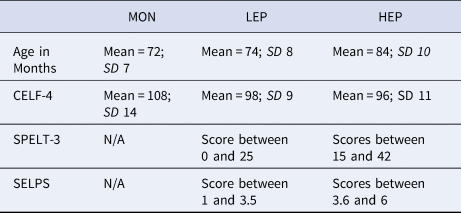
All children in this study spoke Spanish and had typical language skills as evidenced by their Core Language Score on the Clinical Evaluation of Language Fundamental Spanish 4th edition (CELF-S4; Semel, Wiig & Secord, Reference Semel, Wiig and Secord2006). The participants included 30 monolingual Spanish-speaking children who resided in Mexico and 90 Spanish–English bilingual children who resided in the United States. Descriptive information for all participants is presented in Table 1. We recruited bilingual children for this study from English-only public schools in ArizonaFootnote 2. These children were tested as part of a research project developing a Spanish-screening measure to identify Spanish-speaking children with language impairment (Restrepo, Gorin & Gray, Reference Restrepo, Gorin and Gray2013). We selected the bilingual children from one of the three cohorts of the larger study. The cohort for this study included 188 participants. This cohort was chosen among three cohorts because it included Spanish and English language standardized data. Children from the original study were excluded from this study if they failed a cognitive screening (Kaufman Assessment Battery for Children, 2nd Edition: Kaufman & Kaufman, Reference Kaufman and Kaufman2004; score below 80; n = 25), or if their scores on the Core Language Score of the CELF-4S were below 80 (n = 67). The children with lower scores on the Core Language Score of the CELF-4 represented both children with potential language impairments and children with low Spanish skills (e.g., Spanish loss). Therefore, we consider the children included in this study to have good language skills within normal limits and good Spanish maintenance. Children with missing data (any of the data of interest in this study) were also excluded. This selection procedure yielded 90 bilingual children to be included initially in this study.
Descriptive information

Notes: CELF-4 = Clinical Evaluation of Language Fundamentals 4th Edition. SPELT-3 = Structure Photographic Expressive Language Test, 3rd edition. SELPS = Spanish English Language Proficiency Scale. MON = Monolingual group. LEP = Limited English Proficiency group. HEP = High English Proficiency group.
We divided these bilingual children into two English proficiency groups using two language measures: the Spanish English Language Proficiency Scale (SELPS; Smyk, Restrepo, Gorin & Gray, Reference Smyk, Restrepo, Gorin and Gray2013) and the Structure Photographic Expressive Language Test, 3rd edition (SPELT-3; Dawson, Stout & Eyer, Reference Dawson, Stout and Eyer2003). First, we used the SELPS to assign participants to an initial English proficiency group. The SELPS is a criterion reference measure of English oral proficiency validated against language sample measures and teacher's rating of language skills with moderate to high correlations. Children produce a story retell that is rated, using the SELPS, on four language domains: sentence complexity, grammaticality, verbal fluency, and vocabulary diversity. Each domain is scored between 1 and 5 following the scoring protocol. The total score of the SELPS is the average of the domain scores, and ranges from 1 to 5, with 1 being equivalent to low language proficiency and 5 to near-native-proficient language skills. A score of 6 is given to children who perform as native English speakers. We used the scores of the SELPS to divide the bilingual children into two groups using scores between 1 and 3.5 for the low English proficiency (LEP) group and scores between 3.6 and 6 for the high English proficiency (HEP) group.
To verify group membership, we employed the raw scores of the SPELT-3. The SPELT-3 is a standardized language test examining the productive use of various English morphological and syntactic structures. It includes 44 questions testing prepositions, plurals, possessive nouns and pronouns, reflexive pronouns, subject pronouns, direct/indirect objects, present progressive, regular and irregular past, future, copula be, auxiliary be, negative sentences, conjoined sentences, wh-questions, interrogative reversal, negative infinitive phrases, prepositional complements, relative clauses, and front embedded clauses. The raw score of the SPELT-3 was deemed appropriate to further confirm the English language proficiency of these children who are dual language learners as it provides a quantity of correct production of morphosyntax in English. We assumed that children with higher English proficiency would have more correct responses than children with LEP. All bilingual children in this study completed the SPELT-3 (Mean raw score = 20; SD = 10; Range: 0–42). Using the initial SELPS classification we confirmed LEP group membership for those children with lower scores on the SPELT-3 (between 0 and 25Footnote 3), and HEP group membership for those children with higher scores on the SPELT-3 (between 15 and 42). Using this procedure, we confirmed bilingual group membership for 80% of the sample: 36 children in the LEP group and 36 children in the HEP group. Those children with incongruent data (n = 18) (e.g., low score of the SELPS and high score of the SPELT-3) were eliminated for further analyses since we were unable to confirm their group membership.
There was a statistically significant difference in age between the three groups (F(2, 101) = 24.028, p < .001), with a statistically significant difference between the HEP and LEP (t=−1.046, p < .001), and no difference between the LEP and MON groups (t=−.938, p = .351). We also compared the groups on their Core Language standard scores on the CELF-4 (F(2, 101) = 11.325, p < .001), and found that the scores of the MON group were significantly higher than the LEP group (t = 3.776, p < .001), with no differences between the LEP and HEP groups(t = −.702, p = .484).
Measures
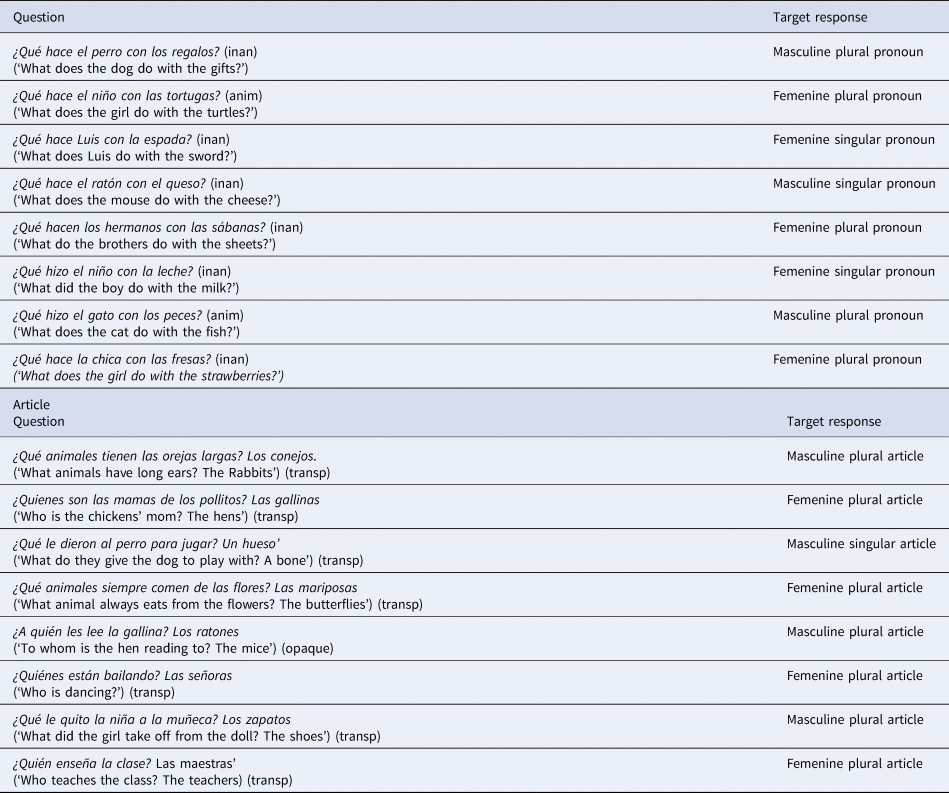
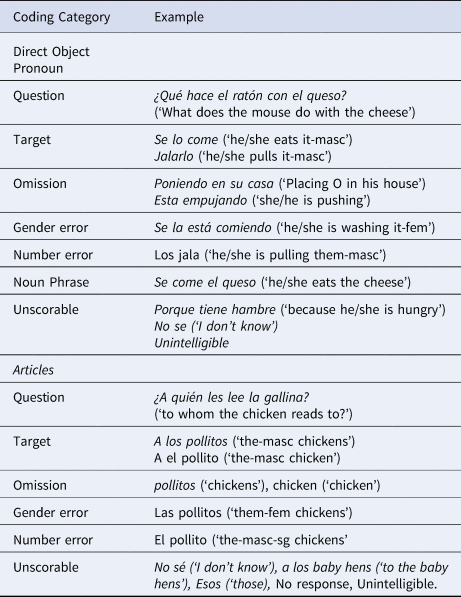
All children completed an elicitation task evaluating the productive use of direct object pronouns and articles. The elicitation task consisted of 8 direct object pronoun tokens and 8 article tokens targeting the singular-feminine, singular-masculine, plural-feminine, and plural masculine forms; all nouns but one were marked with the gender vowel (-a/-o), and the exception (ratón Footnote 4) has predictable gender marking. All items in this task are presented in Table 2. Article responses were coded into five categories: target, omission, gender substitution, number substitution, and unscorable. Responses that used an alternative but acceptable lexical item (such as saying ‘animals’, in lieu of ‘chickens’) were included but coded according to the category of the noun. Direct object responses were coded into six categories: target, omission, gender and number substitutions, noun phrases, and unscorable. Table 3 presents examples of the various responses produced by children with the corresponding coding categories.
Stimuli

Note: transp = transparent; inan = inanimate; anim = animate.
Coding categories and examples for the elicitation task

Note: masc- masculine
Procedures
Research assistants screened children initially for English language proficiency, hearing, and cognition. Then, research assistants administered all testing in Spanish and English separately. Native Spanish speakers did all the testing in Spanish, and no tester did both languages for the same child. Monolingual children from Mexico only received the Spanish testing. All research assistants were trained to 90% procedural and scoring reliability. The total inter rater reliability for the elicitation task was 91%.
Results
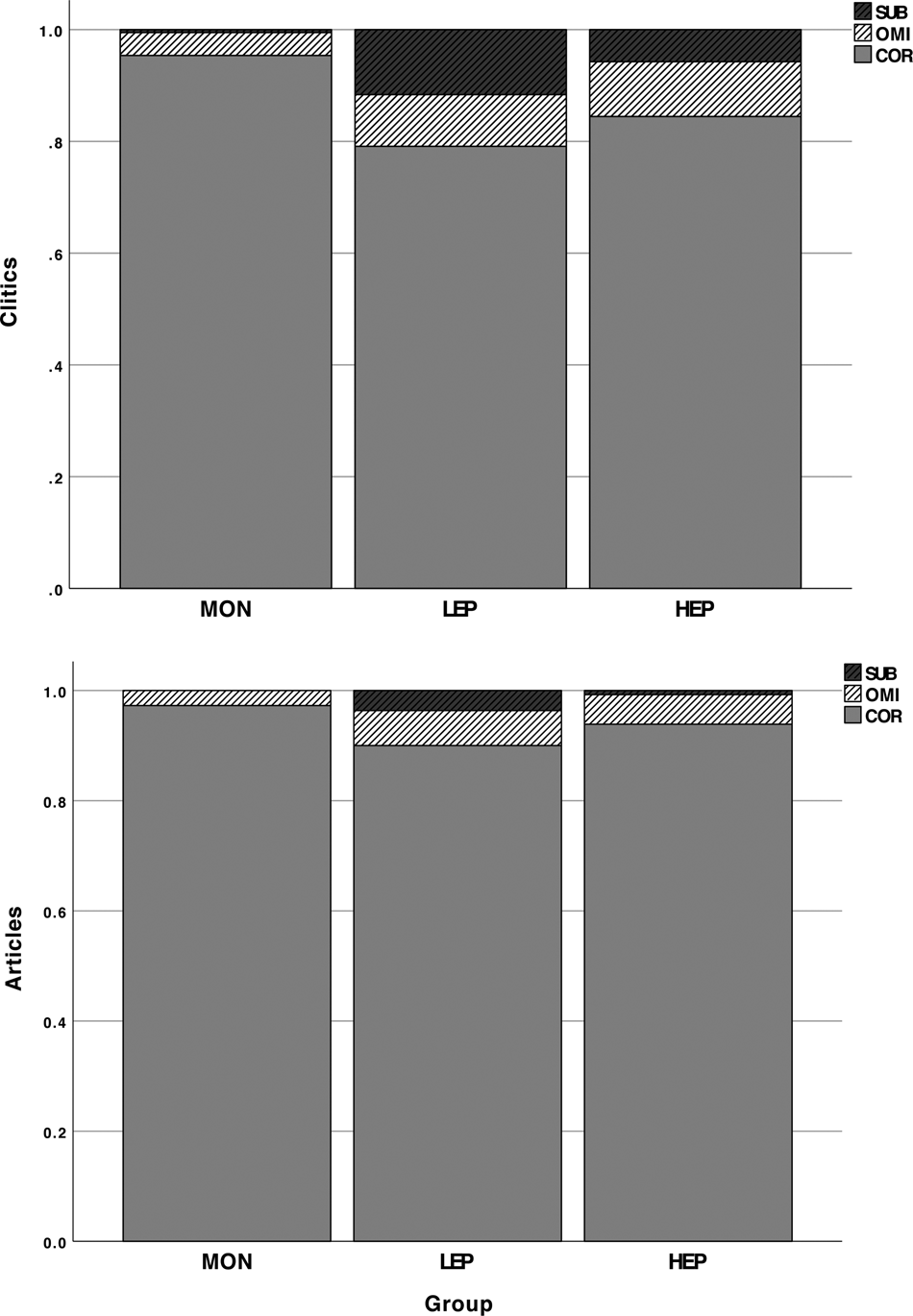
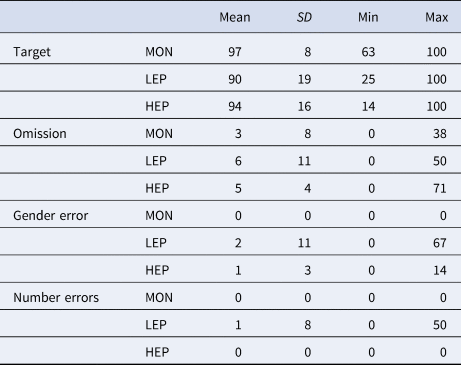
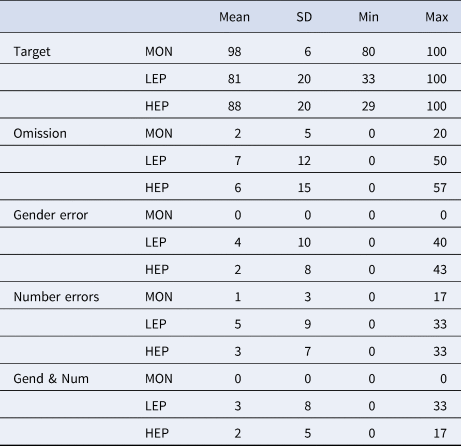
Descriptive statistics for articles and cliticsFootnote 5 in percentages are presented in Table 4 and Table 5, respectively. We include only responses that show either realization or omission of the grammatical structure of interest (e.g., no responses, NPs, or unscorable errors are not included), to focus on the linguistically informative production patterns in these children. Figure 1 illustrates the percentages of target/correct production, omission, and substitution for both articles and clitics by group.
Percentage of correct, substitution and omission responses

Article responses in percentages

Notes: The unscorable category included NR, unintelligible, English responses and other non-related responses. MON = Monolingual group. LEP = Limited English Proficiency group. HEP = High English Proficiency group.
Clitic responses in percentages

Notes: MON = Monolingual group. LEP = Limited English Proficiency group. HEP = High English Proficiency group.
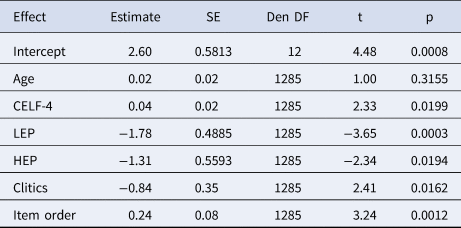
To investigate whether Spanish clitics and articles are vulnerable to bilingual effects in typically developing children with good Spanish maintenance, we fit a generalized linear mixed effects model using the command PROC GLIMMIX in SAS software 9.4 (SAS Institute, 2014). Outcome data in the model are binary and therefore the model was fit with a logistic link function. We selected this statistical approach because it allowed us to model performance at the item level and examined student level effects on item performance. In this model, the dependent variable is the item level accuracy (0 = incorrect, 1 = correct) on both clitics and articles. We fit a random intercept for both child and item (all other model predictors were fixed effects). The outcome data were predicted by group (MON, LEP, HEP), type of grammatical structure (Clitic = 1 vs. Article = 0), and the interaction between group and type of grammatical structure. However, both the LEP by grammatical structure and the HEP by grammatical structure interactions were nonsignificant. Consequently, we removed them from the model and examined a main-effects-only model. Age in months, the presentation order of the items, and the Core Language Standard Score on the CELF-4S were included as covariates in the model, and both were centered on the grand mean (CELF-4S at 100.3 and age at 76.6 months). Parameters were estimated for LEP and HEP with MON being the reference group.
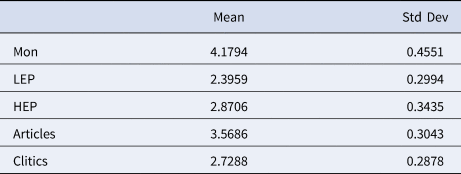
At the child level, we examined whether MON, LEP and HEP children differed in their clitic and article accuracy. We examined the effect of group using two dummy coded vectors for LEP versus non-LEP and HEP versus non-HEP. This coding scheme sets the MON group as the comparison group. We found a significant effect for both LEP and HEP groups (Model parameters can be seen in Table 6). These significant effects indicate that both LEP and HEP groups differ from the MON group. Least squared means can be seen in Table 7. To examine the difference between LEP and HEP group, we ran the same model with HEP as the comparison group. This comparison between LEP and HEP was found to be nonsignificant (t = −1.13, p = .259). Examination of overall parameter estimates (index of accuracy with low numbers indicating that items were more accurate) across both structures revealed that the MON group was more accurate (4.18), followed by the HEP group (2.87) and then the LEP group (2.40).
Multilevel model parameter estimates for item performance predicted by group, and item type

Notes: MON = Monolingual group. LEP = Limited English Proficiency group. HEP = High English Proficiency group. CELF-4 = Clinical Evaluation of Language Fundamentals 4th Edition
Least Squares Means for groups and grammatical structures in log-odds

Notes: MON = Monolingual group. LEP = Limited English Proficiency group. HEP = High English Proficiency group
We also examined the main effect of grammatical structure to investigate whether clitics and articles were equally vulnerable to the bilingual effects seen in the previous analyses. We found a significant effect for grammatical structure. An examination of the parameter estimates shows that Spanish-speaking children produced more accurate articles than clitics by 0.84 log-odds (3.57 versus 2.73). This difference was statistically significant.
Error analyses
In addition to differences in rates of target responses, we observe variation in the distribution of errors. For this analysis, we continue to focus on the linguistically informative types of errors, which include target responses, patterns of omission and patterns of substitutions (including NPs for clitics), and leave aside other errors such as non-responses, unintelligible and unrelated responses. To explore these patterns of errors, we employed Chi-square analyses to examine the distribution of errors between groups. In general, we observe that monolinguals produced virtually no substitutions and very few omissions.
We conducted a frequency analysis to explore group differences in the distribution of responses types, separately for each condition. Since there was little difference between HEP and LEP groups, the two groups were collapsed into a single Bilingual group for these analyses. Table 8 reports the frequency of the 3 relevant response types for monolinguals and bilinguals, for articles and clitics separately. Following the suggestion of a reviewer, we conducted separate frequency comparisons for patterns of omissions from patterns of morphological substitution. First, we consider whether the two groups were different in terms of the frequency of omissions. For this analysis, we contrasted the frequency of omission vs. all realizations (including NPs for clitic pronouns), by collapsing Target and Substitution responses into a single category. The differences in the frequency of omissions for articles is not significant (χ2 = 2.157, df = 1, p = 0.141). For clitics, the difference is significant (χ2 = 7.439, df = 2, p = .006). Second, we turn to the question of group differences in terms of morphological substitutions. For this analysis, we considered targets/correct responses (including NPs for clitic pronouns), vs. substitutions, removing omission responses from the comparison. The difference in the frequency of morphological errors (i.e., substitution) for articles is non-significant (χ2 = 1.537, df = 1, p = 0.215). For clitics, the difference is again significant (χ2 = 6.248, df = 2, p = 0.011). Substitution errors consisted to gender, number, and both gender and number in similar frequencies.
Frequency of target responses and error types in monolinguals and bilinguals

Notes: N/A = not applicable; Sub = Substitution
Discussion
In this study we examined the vulnerability of articles and clitics to bilingual effects in Spanish–English bilinguals with good retention of Spanish abilities. We examined production of these categories in three groups of typically developing children: monolingual children from Mexico with a mean age of six years, low English proficiency bilinguals with the same age as the monolingual children, and high English proficiency bilinguals, who were on average one year older than the other two groups. Partitioning the bilinguals in terms of English proficiency allows us to consider grammatical structures separately for children of different dominance profiles. Two observations about the participants included in this study are crucial to interpret our results. First, we selected the bilingual children for this study from a larger pool of bilingual participants with variable language skills. We chose only those with good Spanish maintenance (approximately 50% of the total sample of participants). Therefore, the results of this study illustrate development in what can be considered the best-case scenario in terms of the retention of Spanish, given the limited support for bilingualism within the Arizona context. Second, the monolingual and bilingual children with LEP were 6 years old on average, while the bilingual children with HEP were older, 7 years old on average. This difference in age between the children with LEP and HEP reflects the longer time spent in English-only education for the HEP children. In the bilingual contexts of the United States age and language profile are intrinsically confounded. We discuss first the differences between structures and then focus on the effects of the bilingual group.
The results of this study show that overall performance on articles was high for all children, which was not surprising given the sample under study. Our results indicate an advantage for articles over clitics with all groups combined, although the difference was small. Article accuracy for all groups was above 90%, with monolinguals reaching 97% accuracy, (90% for LEP and 94% for HEP). These results are within the range of existing clinical studies of typically developing monolinguals, such as in Anderson and Souto (Reference Anderson and Souto2005), Bedore and Leonard (Reference Bedore and Leonard2001), and Morgan et al. (Reference Morgan, Restrepo and Auza2013). Clitic performance was also quite good, although lower than articles. Monolingual children were on average 98% accurate, while bilingual children showed lower accuracy rates (81% for LEP and 88% for HEP). These accuracy rates also fall within the range in existing clinical studies for typically developing monolinguals (Bedore & Leonard, Reference Bedore and Leonard2001: de la Mora et al., Reference De la Mora, Paradis, Grinstead, Flores and Cantu2004; Jacobson & Schwartz, Reference Jacobson and Schwartz2002; Morgan et al., Reference Morgan, Restrepo and Auza2013). The difference between the results of articles and clitics is in agreement with the results of Castilla-Earls et al. (Reference Castilla-Earls, Restrepo, Perez-Leroux, Gray, Holmes, Gail and Chen2016) and Morgan et al. (Reference Morgan, Restrepo and Auza2013) in that correct article production at the item level was significantly higher than clitic production in all groups. This phenomenon might be driven to some extent by the availability of an alternative response (noun phrases) available for object pronoun elicitation (Pérez-Leroux et al., Reference Pérez-Leroux, Pirvulescu and Roberge2018). The more sizeable gap for the younger bilinguals might be driven by the acquisition patterns for these grammatical structures. Although both structures are acquired relatively early in Spanish, and omissions are drastically reduced by the age of 4, articles are inherently less vulnerable to fluctuations in vocabulary development than object pronouns, as shown by work on the dimensionality of grammar and vocabulary in Pérez-Leroux et al. (2012), and thus potentially less vulnerable in bilingual development (Castilla-Earls et al., Reference Castilla-Earls, Restrepo, Perez-Leroux, Gray, Holmes, Gail and Chen2016).
In terms of group difference, our results indicate that MON surpassed both LEP and HEP children on their accuracy with both grammatical structures. Importantly, the results from the CELF-4 suggested that the Spanish skills of these children were in general age appropriate, and no differences were found between the bilingual children in their standard scores. This implies that the general Spanish skills of this group of bilinguals continued to develop according to normative data. In the domain of articles and clitics, such growth was not apparent since the older HEP children were not different from the children in the LEP group. We therefore interpret this data as indicating the possibility of plateau effects in the two grammatical structures under study, as it was previously suggested by Castilla-Earls et al. (Reference Castilla-Earls, Restrepo, Perez-Leroux, Gray, Holmes, Gail and Chen2016).
We did not find a statistically significant interaction of grammatical structure and group, which suggests that the group differences between MON, LEP and HEP children was equal for articles and clitics. It is important to recall that the monolinguals performed equally well in articles and clitics, while we found a discrepancy in the bilingual children favoring articles. Since the interaction was not significant, we don't explore these effects in more detail. These results differ from those of Castilla-Earls et al. (Reference Castilla-Earls, Restrepo, Perez-Leroux, Gray, Holmes, Gail and Chen2016) in that we did not find a statistically significant interaction between group and construction. However, the sample size in Castilla-Earls et al. (Reference Castilla-Earls, Restrepo, Perez-Leroux, Gray, Holmes, Gail and Chen2016) was small for the children with typical development. In this study, the sample size of about 30 children per group is more robust. We therefore interpret the lack of interaction as an indication that both grammatical structures are vulnerable to bilingual effects in similar ways in terms of accuracy. Although bilingual effects are not general for all grammatical structures (Müller, Reference Müller2003; Paradis et al., Reference Paradis, Tremblay, Crago, Grüter and Paradis2014; Unsworth, Reference Unsworth, Grüter and Paradis2014), it seems that object pronouns and noun phrases in Spanish are vulnerable to these effects, although not to the same degree.
In terms of error analyses, both articles and clitics show omissions and morphological errors. The monolingual children produced virtually no substitutions and few omissions. The analysis of error frequencies shows that categorical omission and gender and number substitution errors are more prevalent for clitics than for articles in bilinguals. Clitic omission was not the most prevalent error category in these 6- to 7- year old bilingual children; this is an area where reports vary widely (c.f., Castilla, Reference Castilla2008 and Bedore & Leonard, Reference Bedore and Leonard2001). The frequency of clitic omissions was higher than the frequency of article omission for bilingual children in comparison to the MON group. This finding fits well with what is known about the possible influence of bilingualism. For clitics one would predict omissions on the basis of the general effect of bilingualism in extending the null object construction (Pérez-Leroux, Pirvulescu and Roberge, Reference Pérez-Leroux, Pirvulescu and Roberge2018). Interestingly, the frequency of determiner omission did not differ between monolingual and bilingual children as previously found in other studies with strong evidence of L1 attrition (Cuza & Pérez-Tattam, Reference Cuza and Pérez-Tattam2016). A higher rate of determinerless nouns in English might have influenced rates of determiner omission in Spanish, but this was not the case in this study. This difference between studies might be explained by the fact that children in this study were 6- to 7- years old and had strong maintenance of L1 language skills.
Although most of the items in the elicitation task included inanimate nouns, the rates of clitic omission in this study were relatively low. Characterizations of clitic omission patterns have suggested that omission depends heavily on animacy/inanimacy; animate referents are less likely to show clitic drop across varieties of Spanish (Schwenter, Reference Schwenter, Face and Klee2006). In our study, the same task was administered to all children, therefore, we don't think that the difference in rates of omission between monolingual children and bilingual children can be accounted on the basis of animacy. It is possible that animacy is a factor, as suggested by a reviewer, but the low number of items with animate nouns does not allow to further explore this issue at this time. Further studies should examine the relevance of animacy and bilingual effects.
Bilinguals and monolinguals were qualitatively different in terms of patterns of morphological errors. At this age, morphological errors instead of omissions seem to prevail for clitics. Revisiting Tables 4 and 5 we see that overall a certain percentage of gender and number errors are present for bilinguals but absent in monolinguals. For articles, the number of gender/number errors was fairly small. For clitics, gender and number errors were distributed among the substitution errors present. The low error rates with determiner-noun gender agreement is indicative of the high proficiency of these bilingual groups compared to other studies, including Cuza and Pérez-Tattam (Reference Cuza and Pérez-Tattam2016), or Bedore and Leonard (Reference Bedore and Leonard2001). The asymmetry in morphological errors across the two grammatical structures parallels what has been found for monolinguals, and is well explained by the differences in the grammatical mechanism underlying the expression of gender in the two categories: local concord in the case of determiner and noun, where morphological agreement between the two elements is the result of a structurally local mechanism of feature checking, vs. notional agreement between pronoun and antecedent, where the relevant features are retrieved from a prior discourse antecedent.
The results of the current study can be used to characterize the course of language development of monolingual and bilingual children, with the goal of recruiting such characterization to assist in designing appropriate assessment strategies across bilingual populations. Our results suggest that the language production for 6-year old monolingual children in terms of clitics and articles is highly accurate with few omission errors. Accuracy rates for same age Spanish-speaking children with limited English proficiency are lower. Importantly, 7-year old children with high English proficiency are also different from monolingual children who are a year younger, but no differences were found between the bilingual groups. This finding is important in that is shows that bilingual children's accuracy rates for both articles and clitics are different (lower) from the accuracy rates of monolingual children. In terms of errors patterns, bilingual children differed from monolingual children in that they produced more substitutions than their monolingual counterparts.
Recall that our selection criteria had the aim of excluding potential bilingual children with language disorders. The consequence was that we restricted the study to children with good Spanish, while possibly excluding children undergoing attrition processes. In a sense, the children in the present study represent the best-case scenario for children attending English-only schooling in the United States and can be seen as a fortunate minority. Although many children become fluent speakers of two or more languages with appropriate community support, availability of bilingual schools, high language status, and others (Paradis, Crago, Genesee & Rice, Reference Paradis, Crago, Genesee and Rice2003; Paradis, Reference Paradis2005, Reference Paradis2011), in the United States, societal support of bilingualism is not the norm. Although Spanish seems to be the language with most potential for language maintenance among other immigrant languages in the United States (Alba, Reference Alba2004; Rumbaut, Massey & Bean, Reference Rumbaut, Massey and Bean2006), inter-generational and intra-generational studies show that second generation immigrants (e.g., children born in the United States with at least one immigrant parent, or foreign-born and immigrated as children) are most likely to shift to English proficiency and retain some moderate knowledge of the home language (Alba, Logan, Lutz & Stults, Reference Alba, Logan, Lutz and Stults2002; Rumbaut et al., Reference Rumbaut, Massey and Bean2006). Within such variable context, current assessment practices cannot meet the challenge of describing typical development (Paradis, Reference Paradis2011).
Conclusion
The present study investigated the alterations in the developmental timing of Spanish articles and clitics in monolingual and bilingual children. In our review of the previous literature we found support for differential vulnerability of clitics and articles in bilingual acquisition, and evidence that gender marking is vulnerable to bilingual effects. The results of the current study offer some support for the previous claims of differences between articles and clitics, as well as the presence of systematic effects of bilingualism on both structures, and on the gender realization in these grammatical markers. Bilinguals differed from monolinguals quantitatively (rates of accurate responses between MON and bilingual children) and qualitatively (in the overall error patterns). There were no differences between the bilingual groups separated by English proficiency: bilingual groups were comparable in their accuracy rates for clitics and articles, as well as in the patterns of errors in these structures. Children proficient in English were older on average than the children with limited English proficiency. Despite this age difference, these bilinguals were not different from the children with LEP or monolinguals, who were a year younger. While there is a risk in making developmental inferences from cross sectional data, taken as a group, it appears that these children's first language plateaus in regards of their accuracy in both clitics and articles. Importantly, bilingual children seem to exhibit error patterns which are no longer present in monolingual children in early school age.
Such results have important developmental and potential clinical implications. Both grammatical structures of interest in this study are clinical grammatical markers of language impairments in Spanish-speaking children (Bedore & Leonard, Reference Bedore and Leonard2001). However, as seen in this study, both of these grammatical structures appear vulnerable to bilingualism, even in the best-case scenario of language maintenance represented by the groups we targeted. This underscores the conclusion by Morgan and colleagues (Reference Morgan, Restrepo and Auza2013), that it is important to avoid assessing bilinguals’ performance using monolingual baselines, because the two populations might differ in terms of relevant grammatical markers even while undistinguishable by general test batteries. Language impairment is generally considered an extension of the developmental timetable of language acquisition (Rice & Wexler, Reference Rice and Wexler1996). As a result, it is easy to read structural omissions and grammatical errors as signs of impairment when they might better be understood as indications of normal bilingual development. Evidence of plateau effects in the minority language also adds to the difficulty of identifying bilingual development versus bilingual language impairment.
Acknowledgements
Research reported in this publication was supported by the National Institute on Deafness and Other Communication Disorders of the National Institutes of Health under Award Number R15DC013670 granted to Anny Castilla-Earls. This research was also supported by IES NCSER award number R324A080024 granted to Maria Adelaida Restrepo, Shelley Gray, and Joanna Gorin. The content is solely the responsibility of the authors and does not necessarily represent the official views of the National Institutes of Health