Introduction
Molecular motors utilize chemical fuel or light to do mechanical work in a cyclic process, and therefore can serve as key components of active materials.Reference Schliwa and Woehlke1–Reference Vale5 This article introduces the body of materials science research inspired by this, and provides our perspective on the promises of and challenges for materials incorporating molecular motors.
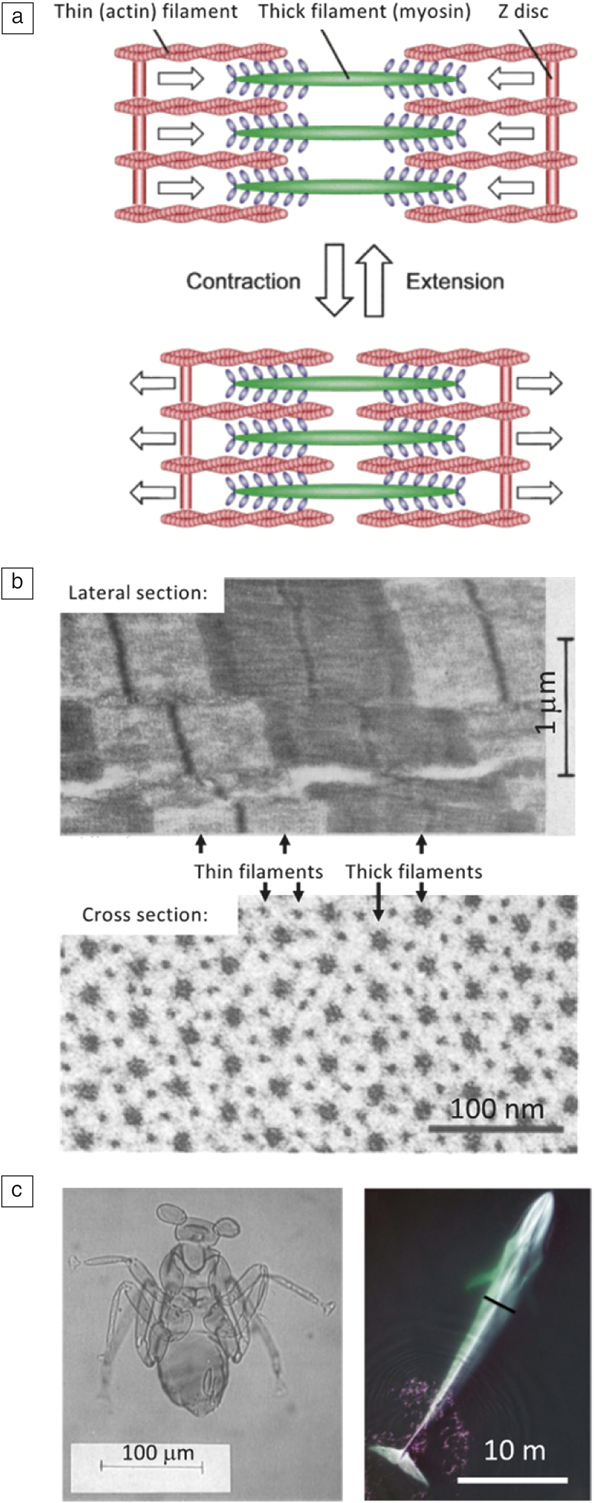
Nature provides the proof of principle for the transformative potential of such materials, in the form of muscle tissue, for instance.Reference Bagshaw6 Muscle hierarchically integrates myosin motor proteins and actin filaments into large-scale arrays that multiply the force and displacement generated by each individual motor proteinReference Huxley and Simmons7 (Figure 1a–b).Reference Liu, Flood, Bonvallett, Vignon, Northrop, Tseng, Jeppesen, Huang, Brough, Baller, Magonov, Solares, Goddard, Ho and Stoddart8–Reference Hawkins and Bennett10 The evolutionary process has solved complex engineering problems related to, for example, the provision of fuel, the control of motor activity, and the maintenance of function.Reference Boateng and Goldspink11
Role of biological motors in nature. (a) In muscles, contraction is initiated when myosin motors attached to the thick filament walk along the thin (actin) filaments of the sarcomere, thus bringing the Z disc closer to the thick filament. Reprinted with permission from Reference Reference Liu, Flood, Bonvallett, Vignon, Northrop, Tseng, Jeppesen, Huang, Brough, Baller, Magonov, Solares, Goddard, Ho and Stoddart8. © 2005 American Chemical Society. (b) Longitudinal (top) and cross-sectional (bottom) electron micrographs. The cross section shows the distribution of thick and thin filaments within the muscle. Reprinted with permission from References Reference Huxley and Peachey9 and Reference Hawkins and Bennett10. © 1961 Wiley and © 1995 Chapman & Hall, respectively. (c) Molecular motors power the locomotion of animals on all scales, ranging from the smallest insect, Dicopomorpha echmepterygis, to the largest whale, balaenoptera musculus. Reprinted with permission from References Reference Mockford12 and Reference Durban, Moore, Chiang, Hickmott, Bocconcelli, Howes, Bahamonde, Perryman and LeRoi13. © 1997 Entomological Society of America and © 2016 Wiley, respectively.

The reward for these engineering accomplishments is maybe best appreciated by a thought experiment where we subtract muscle from the natural world. Animal life from the smallest insectReference Mockford12 to the largest whaleReference Durban, Moore, Chiang, Hickmott, Bocconcelli, Howes, Bahamonde, Perryman and LeRoi13 (Figure 1c) would come to a standstill, because muscle drives the circulation of blood, enables motion, assists digestion, and tunes sensory systems. Notably, skeletal muscle has a “unit cell,” the sarcomere, consisting of a bundle of myosin motors (the “thick filament”) connecting two actin filaments (the “thin filaments”) capable of active contraction, but only passive extension. A hexagonal arrangement of hundreds of thick and thin filaments spaced about 50 nm apart forms the sarcomere with a length between 1.6 μm (contracted) and 2.2 μm (relaxed).Reference Pollack14 The sarcomere can be considered as the fundamental microstructural unit, which is then integrated into multinucleated cells, fibers, and fiber bundles (“fascicles”) as larger structural units capable of exerting contractile stresses on the order of 100 kPa and achieve strain rates on the order of 10 s–1.Reference Squire15–Reference Hill17 Muscle can thus be seen as a soft, active metamaterial—a repeating structure of identical subunits with the ability to reversibly contract against force in one dimension.
In contrast to the linear actuation of muscle, engineered motors often first generate rotary motion, which is subsequently converted into linear motion by a system of gears or hydraulics.Reference Norton18 In nature, rotary motion at the molecular scale exists (e.g., in the F0F1-ATPaseReference Soong, Bachand, Neves, Olkhovets, Craighead and Montemagno19 or the bacterial flagellar motor).Reference Sowa, Rowe, Leake, Yakushi, Homma, Ishijima and Berry20 However, rotors are difficult to couple together, so it is hard—but not impossible as we discuss later—to assemble a force-producing material from rotary subunits.Reference Hess21
Contractile materials can be assembled without molecular motors, with piezoelectric ceramics being one widely used example.Reference Jaffe22 An obvious question is what is the added benefit of employing molecular motors to create active materials? In an engineering world increasingly dominated by electricity, reliance on chemical fuel is rapidly becoming a liability, and the light driving some synthetic molecular motors is often just generated from electricity and delivered to the molecular motor in a rather energy-inefficient process. Molecular motors can multiply Ångström-scale rearrangements in the composition of the fuel molecules into nanometer-scale conformational changes. The cyclic operation of the motor then further amplifies the movement a hundredfold or more. It is this large-scale movement that is difficult to obtain in traditional materials. In addition, each motor is an independent unit that can be activated individually or in small, localized groups allowing for targeted nanoscale rearrangements to produce highly strained/low-entropy microstructures in materials.Reference Lam, VanDelinder, Kabir, Hess, Bachand and Kakugo23,Reference Rao and Feiss24 The directionality of each individual motor also represents a symmetry breaking at the nanoscale, which can be scaled up to a handedness or chirality in the macrostructure of the material.Reference Pohl25
The study of the possibilities created for materials science by the integration of molecular motors has somewhat bifurcated depending on the origin of the molecular motors. The advances of biophysicists and cell biologists—recognized in 2012 with the Lasker award to Sheetz, Spudich, and ValeReference Jackson26—laid the groundwork for the utilization of motor proteins in in vitro systems. The groundbreaking work of organic chemists—recognized in 2016 with the Nobel prize to Feringa, Sauvage, and StoddartReference Astumian27—created synthetic molecular motors and a community working toward their integration with synthetic materials. We highlight some insights of these complementary approaches, starting with the use of biological motors, followed by synthetic motors.
Biological molecular motors in materials
Biology has had over one billion years to perfect its molecular motors and their spatial arrangement into cooperative, large-scale clusters as in muscles. In the process, nature has evolved motors operating close to the fundamental limits with respect to efficiency and force generation per unit mass.Reference Hess and Saper28 Utilizing these biomolecular motors as off-the-shelf components has been a widely pursued idea in nanotechnology, with the creation of mechanically active nanodevices, such as nanoscale transport systems, as the primary goal.Reference Agarwal and Hess29 Only in the last decade has a new focus on the creation and study of “active matter” enabled by biomolecular motors emerged.Reference Ramaswamy30
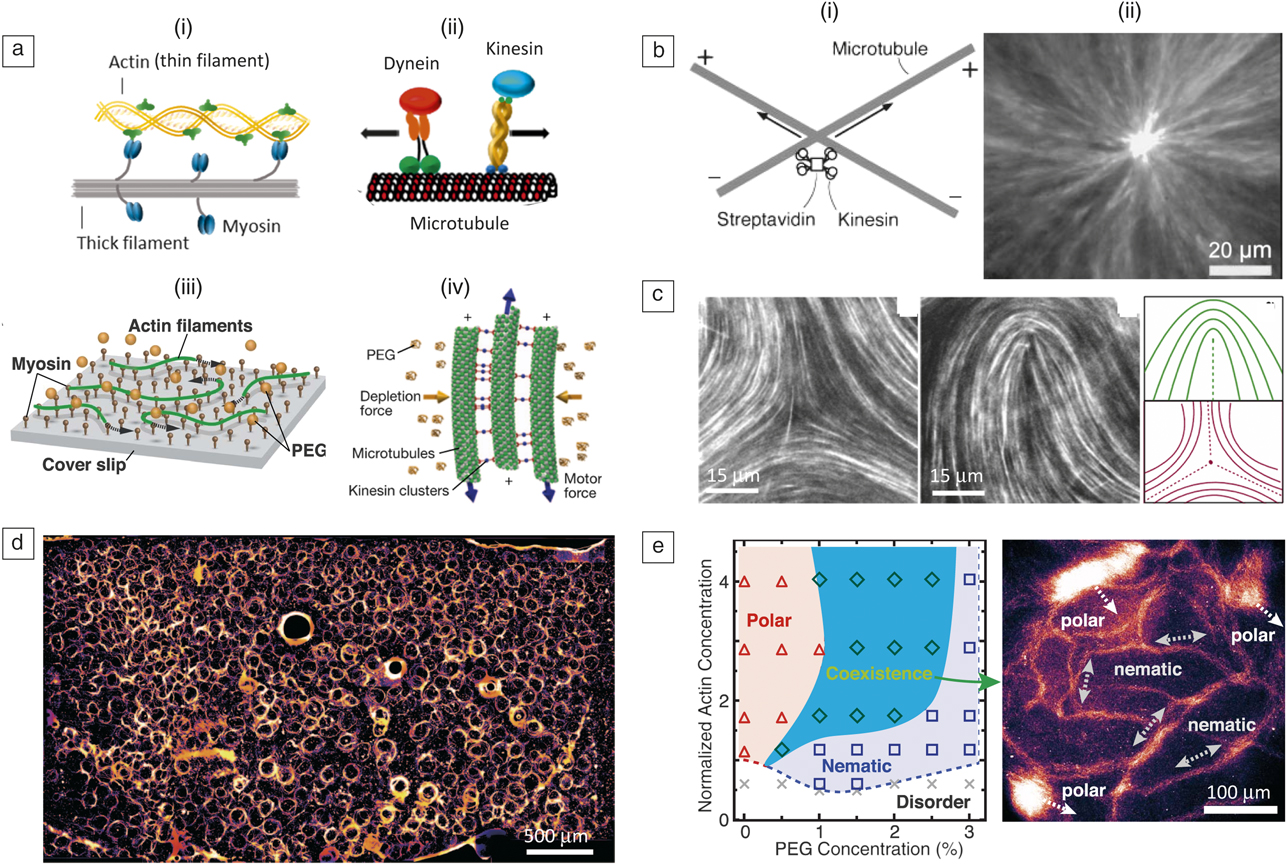
Active-matter systems utilize linear motor proteins, such as kinesin, dynein, and myosin, and their associated filaments (microtubules and actin filaments, respectively) (Figure 2a).Reference Howard31,Reference Riedel-Kruse, Hilfinger, Howard and Jülicher32 In fact, the associated filament is an integral part of the motor functioning, and thereby defines the liquid-crystal-like character of these active-matter systems. Imaging and modeling are greatly simplified in two-dimensional systems, where motors are frequently adhered to a surface and drive filament motion. Three-dimensional systems where motors and filaments interact primarily with each other are also increasingly studied. Initially, this research was motivated by a desire to understand the emergent properties of biological matter, such as the cytoplasm, but increasingly, the emphasis is on the new frontier presented by active matter for the creation of human-made materials.
Biological motors in materials. (a) In cells, myosin motors walk along actin filaments in the presence of adenosine triphosphate (ATP) to assist in cell migration and muscle contraction (i). Reprinted with permission from Reference Reference Hess and Saper28. © 2018 American Chemical Society. Also powered by ATP, kinesin and dynein motors walk in opposite directions along microtubules, assisting in cargo transport and playing crucial roles in mitosis, a process of cell duplication, during which one cell gives rise to two genetically identical daughter cells (ii). Reprinted with permission from Reference Reference Hess and Saper28. © 2018 American Chemical Society. The interaction of motors and filaments is studied using motility assays, where the filaments glide along a motor-covered surface (iii). Reprinted with permission from Reference Reference Huber, Suzuki, Krüger, Frey and Bausch34. © 2018 AAAS. Weak interactions may be introduced between filaments by the addition of a depletion agent, such as poly(ethylene glycol) (PEG) (iv). Reprinted with permission from Reference Reference Sanchez, Chen, DeCamp, Heymann and Dogic39. © 2012 Springer Nature. (b) Multiheaded kinesin constructs held together by biotin-streptavidin bonds cross-link microtubules (i). The motion of the motors results in the formation of microtubule asters (ii). Reprinted with permission from Reference Reference Nedelec, Surrey, Maggs and Leibler33. © 1997 Springer Nature. (c) High concentration microtubules cross-linked by double-headed kinesin motors in a single layer results in active gel-like dynamics with ½ and –½ topological defects. Reprinted with permission from Reference Reference Sanchez, Chen, DeCamp, Heymann and Dogic39. © 2012 Springer Nature. (d) Microtubules gliding on a surface coated by dynein motors align upon collisions, resulting in the formation of large-scale vortex patterns. Reprinted with permission from Reference Reference Sumino, Nagai, Shitaka, Tanaka, Yoshikawa, Chate and Oiwa40. © 2012 Springer Nature. (e) Actin filaments gliding on a myosin-coated surface in the presence of PEG align upon collisions, resulting in large-scale collective behaviors. Depending on actin filament and PEG concentration, the final collective gliding dynamics can be described by either a polar phase, a nematic phase, or a polar-nematic coexistence phase. Reprinted with permission from Reference Reference Huber, Suzuki, Krüger, Frey and Bausch34. © 2018 AAAS.

The work of Nedelec et al. on the emergent properties of microtubule solutions containing kinesin motors capable of dynamically cross-linking the microtubules (Figure 2b) was motivated by a desire to better understand the process of cell division, specifically, how the dynamic spindle apparatus segregating chromosomes is set up and controlled.Reference Nedelec, Surrey, Maggs and Leibler33 This work is foundational to the study of active matter, because it demonstrates the emergence of distinct and long-lasting organizational states determined by the motor activity and also the boundary conditions. More recent work by the Bausch and Frey,Reference Huber, Suzuki, Krüger, Frey and Bausch34 Dogic and Needleman,Reference Needleman and Dogic35 Kakugo,Reference Saito, Farhana, Kabir, Inoue, Konagaya, Sada and Kakugo36 and OiwaReference Torisawa, Taniguchi, Ishihara and Oiwa37 research groups is driven by the appreciation of the interesting properties of these motor-filament systems from a materials science perspective.
Biomolecular motors strongly couple to the filaments that support the simultaneous attachment of hundreds of motors, thereby permitting the emergence of a complex and dynamic network of interactions. The systems are far from thermodynamic equilibrium and the dynamic state of the system is dependent on the continuous conversion of chemical fuel (adenosine triphosphate) into mechanical work. The theoretical investigation of these systems thus often relies on agent-based simulations and theories describing the interaction dynamics.Reference Huber, Suzuki, Krüger, Frey and Bausch34,Reference Hagan and Baskaran38
Due to the rod-like shape of the filaments, the motor-filament systems resemble nematic materials, where local alignment is favored (Figure 2c).Reference Sanchez, Chen, DeCamp, Heymann and Dogic39 However, alignment of filaments can be induced by diverse mechanisms. For example, steric exclusion can drive alignment at high filament densities, cross-linking of filaments by multivalent motors can favor alignment, and the dynamic modification of the motor density on the surface by filaments can give rise to filament–filament interactions.
At a larger scale, organization of the system into localized vortices is seen (Figure 2d),Reference Sumino, Nagai, Shitaka, Tanaka, Yoshikawa, Chate and Oiwa40 and topological defects with distinct dynamics can be observed.Reference Sanchez, Chen, DeCamp, Heymann and Dogic39 The observed coexistence of different ordered states (nematic and polar) demonstrates that active matter has richer phase behavior than systems in thermal equilibrium (Figure 2e).Reference Huber, Suzuki, Krüger, Frey and Bausch34 The system dynamics can be further enriched by time-varying boundary conditions, which can favor the emergence of specific steady states.
In three dimensions, motors and filaments can self-assemble into contractile structures whose temporal dynamics exhibits distinct stagesReference e Silva, Depken, Stuhrmann, Korsten, MacKintosh and Koenderink41 and whose spatial organization is critically dependent on the ratio of the number of motors to filaments.Reference Torisawa, Taniguchi, Ishihara and Oiwa37 Overall, the characterization of the mechanical behavior of motor-filament gels is a topic of great current interest.Reference Needleman and Dogic35,Reference Saw, Xi, Ladoux and Lim42
While the properties of in vitro systems of motor proteins and cytoskeletal filaments are fascinating, the assembled gels fall into the area of “extremely soft matter,” whose primary utility is scientific in that it leads to a better understanding of biological systems and might advance the field of biomaterials for medical applications. However, one would expect that the developed theoretical and simulation tools are transferrable to harder synthetic systems.
Synthetic molecular motors in materials
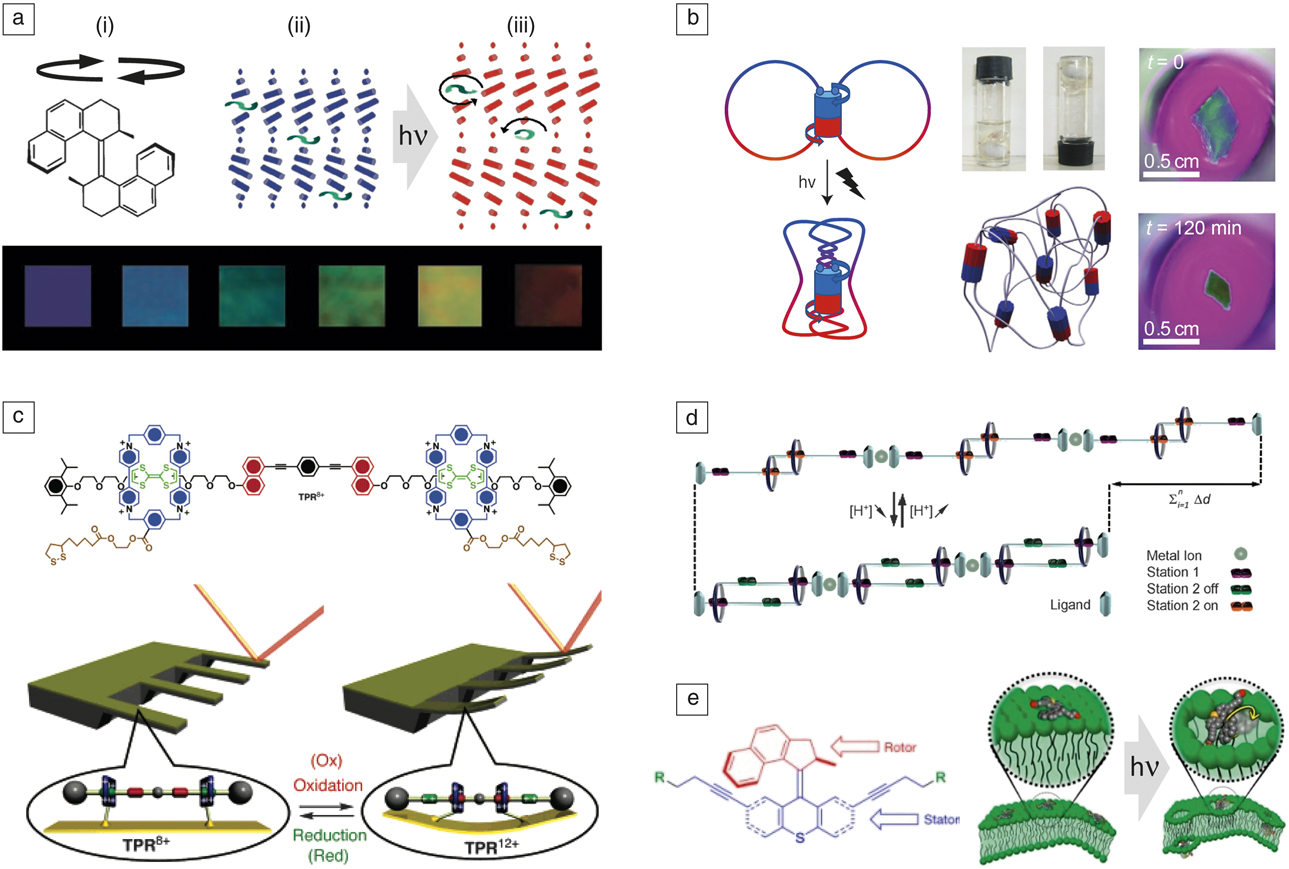
Research into synthetic molecular motors has, in its 30-year history, delivered successful synthesis approaches to create organic molecules exhibiting directed rotary and linear motion. The molecular motors developed by Feringa and others convert chemical fuel or light into rotary motion around a double bond in a small molecule (Figure 3a).Reference Kay, Leigh and Zerbetto43 Initial demonstrations mixed these motors with liquid crystals, where the space occupied by the motor varies as it undergoes rotation, which in turn, affected the nematic order of the liquid crystal and resulted in a macroscopically observable color change (Figure 3a).Reference van Delden, Koumura, Harada and Feringa44 This is, of course, a rather indirect coupling of motor motion to a material property.
Synthetic motors in materials. (a) Light-driven molecular motors (i) can be mixed into a thin film of liquid crystal. Exposure of the doped liquid-crystal film activates the motor, which results in a rearrangement of the liquid-crystal molecules (ii), causing a change in color (iii). Reprinted with permission from Reference Reference van Delden, Koumura, Harada and Feringa44. © 2002 National Academy of Sciences. (b) Light-driven molecular motors incorporated into a gel can cause macroscopic morphological changes, causing the gel to contract. Reprinted with permission from Reference Reference Li, Fuks, Moulin, Maaloum, Rawiso, Kulic, Foy and Giuseppone45. © 2015 Springer Nature. (c) Rotaxane motors (top) contract and expand in response to redox cycles. When attached to a cantilever, the contraction of the motor produced enough force to deflect the cantilever. Reprinted with permission from Reference Reference Liu, Flood, Bonvallett, Vignon, Northrop, Tseng, Jeppesen, Huang, Brough, Baller, Magonov, Solares, Goddard, Ho and Stoddart8. © 2005 American Chemical Society. (d) pH-sensitive daisy-chain rotaxanes are coupled linearly to form long polymer chains to allow for large-scale contractile and translational motion. Reprinted with permission from Reference Reference Du, Moulin, Jouault, Buhler and Giuseppone49. © 2012 Wiley. (e) A UV-activated rotational molecular motor can bind to the plasma membrane of a cell and use its rotary mechanical action to drill holes in it. Reprinted with permission from Reference Reference García-López, Chen, Nilewski, Duret, Aliyan, Kolomeisky, Robinson, Wang, Pal and Tour47. © 2017 Springer Nature.

Li et al. achieved a breakthrough by coupling the rotor and stator of a Feringa-type rotary motor to the respective ends of two polymer chains (5 or 10 kDa poly(ethylene glycol)) (Figure 3b).Reference Li, Fuks, Moulin, Maaloum, Rawiso, Kulic, Foy and Giuseppone45 This figure-eight shaped molecule has a radius of gyration of about 3 nm in the relaxed state, but when the motor is activated, this twists the two polymer chains into a compact configuration. A gel of polymer-cross-linked motors assembled in toluene contracts to 20% of its initial volume when the motors are activated (Figure 3c–d). Contraction of a gel can be readily achieved with stimulus-responsive polymers.Reference Yeghiazarian, Mahajan, Montemagno, Cohen and Wiesner46 However, the energy-conversion efficiency of these polymers is on the order of 10–7, whereas the motor-driven contraction can be several orders of magnitude more efficient.
Ironically, rotary molecular motors can find application not only as building blocks of materials, but also as destructive elements. The Tour group recently demonstrated the capability of rotary motors to “drill” into lipid bilayers when activated, thereby creating a path for the entry of drug molecules into biological cells (Figure 3e).Reference García-López, Chen, Nilewski, Duret, Aliyan, Kolomeisky, Robinson, Wang, Pal and Tour47
The conversion of rotary molecular motion into a linear contraction is of course mechanically complex, with the potential for localized multiaxial stresses, entanglement, and mechanically induced degradation. The need for linear molecular motion is addressed by Stoddart’s rotaxane molecules, where macrocycles are chemically induced to move along a dumbbell-shaped molecule.Reference Bruns and Stoddart48 By coupling the moving parts of rotaxanes to the surface of a microscopic cantilever, Stoddart’s team was able to reversibly induce bending of the cantilever after activating the motor molecules. Goujon et al. recently assembled polymeric gels of daisy-chained rotaxanesReference Du, Moulin, Jouault, Buhler and Giuseppone49 that contract by 50% in volume in response to a change of pH.Reference Goujon, Mariani, Lang, Moulin, Rawiso, Buhler and Giuseppone50
Overall, these demonstrations are exciting developments at the intersection of supramolecular chemistry and polymer science. Molecular motors have been shown to be capable of driving macroscale contractions of ∼40% while generating stresses on the order of 100 kPa,Reference Li, Fuks, Moulin, Maaloum, Rawiso, Kulic, Foy and Giuseppone45 similar in performance to muscle. These synthetic materials have at least the potential to approach the ∼20% energy-conversion efficiency of muscle,Reference Smith, Barclay and Loiselle51 a vast improvement over some other contractile soft materials and a critical requirement for practical applications.Reference Armstrong and Hess52 The biggest gap between the demonstrated systems and muscle is durability. While synthetic motors have been successfully driven for tens of contraction cycles, natural muscle can function reliably in excess of one billion cycles.Reference Hess and Dumont53 Muscle achieves its durability by replacing molecular components on an almost daily basis, and the design of self-renewing materials is a critical challenge, which we are only beginning to address.Reference Lam, Tsitkov, Zhang and Hess54
Summary
The field of active matter is concerned with topics such as the swarming behavior of fish and birds, but also with systems that are more recognizable as materials, such as gels containing biological and synthetic motors. The integration of molecular motors can endow materials with mechanical properties encountered in cells and tissues, such as highly efficient production of force, adaptability of shape and stiffness, and dynamic internal reorganization. These capabilities are qualitatively different from traditional stimulus-responsive materials due to the ability of motors to controllably access large internal or external reservoirs of energy and convert them efficiently. Future challenges include improvements in mechanical properties, efficiencies, lifetimes, and integration with other technologies and materials. Importantly, there are long-term technology trends, such as the trend toward the utilization of increasingly larger numbers of smaller and smaller motors,Reference Armstrong and Hess52 advances in protein engineering targeted toward biomolecular motors,Reference Omabegho, Gurel, Cheng, Kim, Ruijgrok, Das, Alushin and Bryant55 and the emergence of additive manufacturing techniques,Reference Bhushan and Caspers56 which can act as drivers for the integration of molecular motors with materials systems.
Acknowledgments
H.H. and S.T. acknowledge financial support for related work from the National Science Foundation (NSF 1807514). P.K. acknowledges financial support for related work from the Army Research Office (W911NF-17–1-0413). I.H.R.-K. acknowledges financial support for related work from the American Cancer Society (RSG-14–177–01).

Henry Hess is a professor of biomedical engineering at Columbia University and the editor-in-chief of the IEEE Transactions on NanoBioscience. He received his diploma in physics from the Technical University Berlin, Germany, in 1996, and his DrRerNat degree in physics from the Free University Berlin, Germany, in 1999. He previously held appointments in the Department of Bioengineering at the University of Washington, and the Department of Materials Science and Engineering at the University of Florida. His research focuses on solutions to engineering problems at the molecular scale. Hess can be reached by email at hh2374@columbia.edu.

Parag Katira has been an assistant professor in mechanical engineering at San Diego State University since 2015. He received his PhD degree in materials science and engineering from the University of Florida. He completed postdoctoral research at The University of Texas at Austin and was an associate research scientist at Columbia University before joining San Diego State University. His research interests focus on using mathematical modeling techniques to study the dynamics of active matter such as cells, tissues, bacterial biofilms, and synthetic molecular-motor assemblies. Katira can be reached by email at pkatira@sdsu.edu.

Ingmar Riedel-Kruse is an assistant professor of bioengineering at Stanford University. He received his PhD degree from the TU Dresden and the Max Planck Institute of Molecular Cell Biology and Genetics (MPI-CBG), Germany, studying molecular motors and sperm motility. After completing postdoctoral research at MPI-CBG and the California Institute of Technology, he formed his own research group at Stanford. His current research interests focus on pattern formation and programming of multicell systems using approaches from biophysics, synthetic biology, and interactive biotechnology. Riedel-Kruse can be reached by email at ingmar@stanford.edu.

Stanislav Tsitkov is currently a doctoral candidate in the Department of Biomedical Engineering at Columbia University. He received his BSc degree in bioengineering and mathematics from the Massachusetts Institute of Technology in 2015. His research interests include biophysics and mathematical modeling of biological systems. Tsitkov can be reached by email at st2966@columbia.edu.