

INTRODUCTION
The Persian Gulf is a semi-enclosed marginal sea surrounded by landmasses, and it is located in the subtropics north-west of the Indian Ocean. This has imposed a harsh condition on the marine organisms, especially coral reef communities with regard to salinity, temperature and extreme low tides (Fatemi & Shokri, Reference Fatemi and Shokri2001). The Persian Gulf is an important military, economic and political region owing to its oil and gas resources and is one of the busiest waterways in the world (Kämpf & Sadrinasab, Reference Kämpf and Sadrinasab2006). The Persian Gulf extends between 24–30°N and 48–56°E and is L-shaped. It is a shallow semi-enclosed basin (average depth of 35 m) connected to the Oman Sea through the Strait of Hormoz and its general orientation is north-west south-east. The evaporation has lead to higher salinity in comparison with open marine waters (Pous et al., Reference Pous, Carton and Lazure2004).
Corals are believed to live close to fixed upper temperature limits usually considered to be around 30°C and lower limits around 16°C, with little chance of survival outside of this temperature range (Coles, Reference Coles2003). Approximately 60 species of scleractinian corals have been described for the Persian Gulf (Sale et al., Reference Sale, Feary, Burt, Bauman, Cavalcante, Drouillard, Kjerfve, Marquis, Trick, Usseglio and Van Lavieren2011). The coral community of the Persian Gulf is a subset of the great Indo-Pacific tropical fauna (Ghorashi et al., 2008). The average salinity of the Persian Gulf is about 42 ppt and salinity tolerance is a major factor in limiting the diversity of reef corals in this region (Coles, Reference Coles2003). All of these limiting factors have restricted the number and diversity of the coral reef fishes in the Gulf. According to FishBase records 705 fish species have been identified in the Persian Gulf, some of which are coral reef fish (Ghorashi et al., Reference Ghorashi, Fatemi, Amini, Houshmand, Salehi Tabar and Hazaie2008). The Pomacanthidae family is one of the groups of Persian Gulf ornamental fishes that include 10 species in this region. One of the high diversity species of this family in the Persian Gulf is Pomacanthus maculosus (also known by the common name yellow-bar angelfish) and it is one of the members of the angelfish (Pomacanthidae) family (Froese & Pauly, Reference Froese and Pauly2008).
Angelfish (Pomacanthidae) comprise typical species of tropical reef bottoms, widespread in Atlantic, Indian and Pacific Oceans (Allen et al., Reference Allen, Steene and Allen1998). Pomacanthidae includes 9 genera and 74 species in the world (Nelson, Reference Nelson1994). Like many other reef inhabitants, they present an attractive coloration and are easy to maintain in captivity, and are commercially exploited as ornamental fishes (Stratton., Reference Stratton1994; Fenner, Reference Fenner1996; Littlewood et al., Reference Littlewood, McDonald, Gill and Cribb2004). Ten species of these beautiful fishes have been identified in the Persian Gulf, one of which is yellow-bar angelfish (Pomacanthus maculosus). Juveniles of P. maculosus are deep blue with several white vertical bars. The body is surrounded by a metallic blue and it has a bright yellow tail. When the fish matures and grows, a bright vertical bar appears and the white vertical stripes disappear. Adults are violet-blue with a large yellow blotch in the middle of their body. Pomacanthus maculosus is hardy and grows up to a foot in length (http://www.fishbase.org). As a member of the Pomacanthidae family, P. maculosus is hermaphroditic, difficult to breed, and indistinguishable in colour variations from male to female. Pomacanthus maculosus are omnivorous and their diet includes marine algae, quality meaty items and high-quality angelfish preparations containing sponges (Allen et al., Reference Allen, Steene and Allen1998).
The molecular studies on angelfish are scarce all over the world. These studies are mainly focused on taxonomy and evolution of the angelfish based on phylogenetic analysis of nuclear and mitochondrial DNA (mtDNA) (Affonso & Galetti, Reference Affonso and Galetti2007; Alva-Campbell et al., Reference Alva-Campbell, Floeter, Robertson and Bellwood Bernardi2010). There is no molecular and phylogenetic study on P. maculosus. The mtDNA sequences are one of the most widely used molecular tools to assess phylogenetic relationships between similar species, populations of the same species or even between individuals. mtDNA has a large capacity to accumulate mutations that give it a faster rate of evolution than nuclear DNA in higher animals (Aboim, Reference Aboim2005). Cytochrome b is one of the mtDNA genes that play an important role in making ATP in electron transport chain (ETC) in cells. The cytochrome b gene is an appropriate phylogenetic marker in fish (Chen et al., Reference Chen, Bonillo, Lecointre, di Prisco, Pisano and Clarke1998). The aim of this study was to investigate the mtDNA diversity among the P. maculosus angelfish in three regions of the Persian Gulf. The present work is the first study to use the cytochrome b gene sequence to study primitive P. maculosus angelfish.
MATERIALS AND METHODS
Sampling and DNA extraction
Ten samples of Pomacanthus maculosus were collected in January 2011 from 3 locations in the Persian Gulf (Table 1). The geographical locations of the Persian Gulf and sampling regions are shown in Figure 1. A piece of muscle tissue of all samples taken and DNA was extracted using nuclei lysis solution and buffer. For crystallization of DNA, chloroform, Nacl2 and ethanol 100% were added and finally DNA was rinsed with ethanol 70%. The semi-dried extracted DNA was dissolved in 20 µl of H2O and stored at –70°C until use.
The geographical locations of the Persian Gulf and sampling regions: Larak Island, Genaveh Port and Lengeh Port (modified from Pous et al., 2004).

Number, sample code of Pomacanthus maculosus and sampling area descriptions of sampling areas.

DNA AMPLIFICATION AND SEQUENCING
At the time of this study, there were no submitted sequences of P. maculosus. Cytochrome b was available in the GenBank, therefore we used the Universal Primers, GLUDGL and CB3H (Palumbi et al., Reference Palumbi, Martin, Romano, McMillan, Stice and Grabowski1991) (Table 2).
Sequencing and amplification primers used in the study.

The target region of the mtDNA was amplified using the polymerase chain reaction (PCR). PCR amplifications were done on a PCR instrument (Eppendorf) in a 50 µl reaction containing: 32 µl of H2O, 5 µl of 10 × buffer, 3.6 µl MgCl2 (50 mM), 2 µl dNTP (10 mM), 1.7 µl of each primer (250 ng/μl), 3 µl of DNA and 1 µl Taq polymerase (5 U/μl). Cytochrome b regions of mtDNA were amplified using the following thermal cycling profile: denaturation at 94°C for 5 min followed by 30 cycles of 94°C for 50 s, 55°C for 50 s, 72°C for 50 s and final extention at 72°C for 10 min. Amplified products were visualized by running 5 µl of the PCR product on a 1% TBE agarose gel. The expected mtDNA fragment amplified by these primers was 760 base pairs (bp). After that, all the PCR products were sequenced.
Sequence alignment and phylogenetic analysis
The sequences were opened with FinchTV and multiple alignments of sequences were performed using ClustalW software (Thompson et al., Reference Thompson, Higgins and Gibson1994) to denote the nucleotide variations among the individuals. ClustalW is a general purpose global multiple sequence alignment program for DNA or proteins. It produces biologically meaningful multiple sequence alignments of divergent sequences. It calculates the best match for the selected sequences, and lines them up so that the identities, similarities and differences can be seen. Evolutionary relationships can be seen via viewing cladograms or phylograms (www.ebi.ac.uk). Phylogenetic analysis was performed based on sequenced fragments, representing cytochrome b. Finally, phylogenetic trees were drawn with Mega5.05 software (Kumar et al., Reference Kumar, Dudley, Nei and Tamura2008). Sequences were compared together and the tree was drawn, then a phylogenetic tree was drawn based on comparing cytochrome b sequence of P. maculosus with this gene of other species of angelfish that were in the GenBank, and the results were recorded.
RESULTS
The sequence of a 760 bp segment of the cytochrome b was determined for ten individuals of Pomacanthus maculosus submitted to GenBank according to sampling locations. The sample code, sampling location and corresponding accession numbers are listed in Table 1.
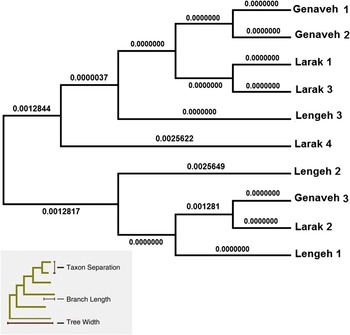
Alignment of the sequences was analysed by ClustalW W software and the results showed that only some nucleotides of LN1, LN3, G3 and L2 were different and these differences do not change their proteins. The phylogenetic tree obtained by analysing cytochrome b sequences of the samples and related partial cytochrome b sequences of P. maculosus is shown in Figure 2. The phylogenetic trees based on cytochrome b of 10 samples of P. maculosus from 3 regions of the Persian Gulf (Larak Island, Genaveh and Lengeh Ports) clearly showed that they were classified in the same group because there were no significant differences between the sequences (Figure 2).
The phylogenetic tree based on analysing 760 base pairs of the cytochrome b sequence of 10 samples of Pomacanthus maculosus. The nucleotide frequencies are: A = 24.17%; T = 30.50%; C = 30.32%; and G = 15.01%. For estimating maximum likelihood values, a user-specified toplogy was used.

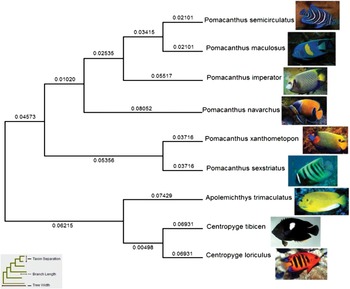
In Figure 2, the evolutionary history was inferred by using the maximum likelihood method based on the Tamura–Nei model (Tamura & Nei, Reference Tamura and Nei1993). The tree with the highest log likelihood (–1040.7264) is shown. An initial tree for the heuristic search was obtained automatically as follows: when the number of common sites was <100 or less than one-quarter of the total number of sites, the maximum parsimony method was used; otherwise BIONJ method with MCL distance matrix was used. The analysis involved 10 nucleotide sequences. Codon positions included were 1st + 2nd + 3rd + Noncoding. All positions containing gaps and missing data were eliminated. There were a total of 760 positions in the final dataset. Evolutionary analyses were conducted in Mega5.05 (Tamura et al., Reference Tamura, Peterson, Peterson, Stecher, Nei and Kumar2011). In Figure 3, the tree with the highest log likelihood (–638.7997) is shown. The analysis involved 10 nucleotide sequences. Codon positions included were 1st + 2nd + 3rd + Noncoding. All positions containing gaps and missing data were eliminated. There were a total of 155 positions in the final dataset.
The phylogenetic tree based on a part of the sequences of cytochrome b of Pomacanthus maculosus and 8 species of angelfishes in GenBank. The nucleotide frequencies are: A = 24.16%; T = 28.75%; C = 29.82%; and G = 17.28% (www.fishebase.com & www.wetwebmedia.com).

Some of the cytochrome b sequences of other species of angelfish were not completely available in GenBank, e.g. 399 bp of cytochrome b gene sequence of Pomacanthus semicirculatus was available. Therefore when sequences of our samples were blasted in GenBank, results showed 86% likelihood with 694 bp sequence of Pomacanthus imperator and 93% with 399 bp sequence of P. semicirculatus.
DISCUSSION
Since angelfishes live on coral reefs; the distribution of their dispersion in every region including the Persian Gulf is mainly influenced by coral reefs. Therefore, in order to study diversity and population in angelfishes, it would be necessary to get a better understanding of factors that might influence the existence of coral reefs in the Persian Gulf. The coral community of the Persian Gulf is a subset of the great Indo-Pacific tropical faunas. The estimates for the Persian Gulf and the Oman Sea indicate that of the 656 species among 109 genera of zooxanthellate corals for the Indo-Pacific (Cairns, Reference Cairns1999), only about 10%, or 68 species among 28 genera, occur in the Persian Gulf (Coles, Reference Coles2003). This situation is the same for the fish species because according to FishBase records 705 fish species have been identified in the Persian Gulf while this number is 5429 for the Indian Ocean. Potential limiting factors include: temperature extremes above or below usual coral tolerance limits, high salinities, macroalgal competition, past and present isolation of this basin from the Indo-Pacific, oil production and pollution (Coles, Reference Coles2003). With only about 10% of Indo-Pacific coral species occurring in the Persian Gulf, some combination of factors has limited the recruitment, settlement, survival and growth of reef corals in the region, eliminating many species and perhaps favouring a few that are adapted to the uniquely harsh conditions of this Gulf (Coles, Reference Coles2003). There are too many coral reefs in the Persian Gulf near the ports and islands and many fish species are living there. Three of them chosen for study were Larak Island, Genaveh Port and Lengeh Port and Pomacanthus maculosus was identified in all these three regions.
According to reports, several species of angel fish are living in the Persian Gulf, two important species of these are Pomacanthus imperator (Emperor Angelfish) and Pomacanthus maculosus (Yellow-bar Angelfish) (Assadi & Dehghani, Reference Assadi and Dehghani1997). The most abundant species of angelfish in the Persian Gulf is Pomacanthus maculosus. These fishes are widely scattered in different parts of the Persian Gulf. Basically, classification of angelfish is based on morphological characteristics (Sadeghi, Reference Sadeghi2002). But now, genetic classification is so much better than old methods because some important differences or likeness are not outward and sometimes two species with the same shape have a different genetic pattern. Specific morphological traits that can be used as the key for showing evolutionary relationships between species are not enough and are not an answer for phylogenetic questions. The results of morphological and molecular studies enable us to move towards understanding the phylogenetic relationship of Persian Gulf angelfish, and it is clear that if these results match together, they will increase our chances of reaching a correct evaluation of this phylogenetic relationship. Therefore, it is essential that the results of studies using morphological and molecular techniques separately are compared together and investigated. However, because the Yellow-bar angelfishes of the Persian Gulf are uniform there are no clear morphological differences (Sadeghi, Reference Sadeghi2002).
Genetic science is progressing very fast and today it has developed new methods in genetic studies. Molecular biology provides new effective and powerful tools for genetic studies. Usually in genes nucleotide alignment in different species, differences can be seen. Even if these differences are small they can still be used as a criterion for evaluation of genetic distance and drawing a phylogenetic tree. The mtDNA sequences are one of the most widely used molecular tools to assess phylogenetic relationships between species (Aboim, Reference Aboim2005).
The relationship of P. maculosus in three regions of the Persian Gulf was discovered and analysed. So a part of mtDNA (cytochrome b gene) was amplified and sequenced. Only some nucleotides of LN1, LN3, G3 and L2 were different and these differences do not change their proteins. It seems these differences are like point mutation that happened during the years for many reasons. Point mutation is change within a gene in which one base pair in the DNA sequence is altered. Point mutations are frequently the result of mistakes made during DNA replication, although modification of DNA, such as through exposure to X-rays or to ultraviolet radiation, also can induce point mutations. But these probable mutations did not cause racial difference among the samples of these three regions. After the sequences alignment the phylogenetic tree was drawn (Figure 2) and the results showed that all 10 species of P. maculosus of the Persian Gulf (Larak Island, Genaveh Port and Lengeh Port) belong to a monophyletic group because there were no significant differences between the sequences. According to pair distance of these samples in Mega5.05 software, it appears that these little differences cannot create a subsidiary group.
On the other hand, if this difference was in the same location, we could say that probably the classification group of each location is different, but now these results show that P. maculosus in three regions of the Persian Gulf are located in a monophyletic group. Sequences of all other species of angelfish in the GenBank were used for genetic comparisons between P. maculosus and other angelfish species. Unfortunately, there were partial cytochrome b sequences of some of angelfishes in GenBank. Hence the partial sequences of all species were compared together and a phylogenetic tree was drawn (Figure 3). According to this tree, P. maculosus is genetically closer to P. semicirculatus and P. imperator than to other species. According to the last study on other mtDNA genes like 12srRNA and 16srRNA it was seen that P. maculosus was close to P. semicirculatus. Hence if longer lengths of nucleotide sequence of cytochrome b of P. semicirculatus were available, our results would be similar to Figure 3 that is based on partial cytochrome b sequences of angelfishes. The phylogenetic tree based on sequences of cytochrome b of P. maculosus and 8 species of angelfish in the GenBank shows that P. maculosus is closer to P. semicirculatus and P. imperator. Other phylogenetic studies based on mtDNA genes have been reported. The angelfish genus Holacanthus including seven species in the tropical Eastern Pacific and Atlantic was analysed and results support a monophyletic Holacanthus. The Indo-Pacific regal angelfish, Pygoplytes diacanthus, was found to be the closest relative to Holacanthus (Alva-Campbell et al., 2010). The phylogenetic relationship between Amphiprion species of the Persian Gulf was studied using the PCR method and amplifying a part of mtDNA. Results show that there is no significant genetic variation among A. clarkii individuals; however, A. sebae individuals from Larak Island were different from other fish of the same species (Gorashi et al., 2008). In this study, finally we may conclude that Pomacanthus maculosus species of Larak Island, Genaveh Port and Lengeh Port in the Persian Gulf, are from a same ancestry and genetically are close to Pomacanthus semicirculatus and Pomacanthus imperator.
At the time of this study, there was no sequence for cytochrome b of P. maculosus available in the GenBank; the sequences that are submitted through this study are the first ones. Ten of our partial nucleotide sequences have been registered with NCBI GenBank and are available at http://www.ncbi.nlm.nih.gov/nuccore. Access codes are shown in Table 1.
Deficiency of the data about these fishes is due to limited number of the individuals in nature and the difficulty of acquiring them and they are not considered as economic fishes, since these small ornamental fishes are not consumed by humans. As a result, funds for studying these fishes are restricted and, therefore, the number of research studies in this field is very limited. To obtain a clearer understanding of angelfishes of the Persian Gulf and their situation and to improve the results, we recommend the use of more samples, wider sampling area, and sequencing of longer regions of mtDNA and genomic DNA.
ACKNOWLEDGEMENT
Thanks are due to Sepideh Dadgar from the Genetic Department of Special Medical Lab who helped us in conducting this project.