Introduction
Despite legislative, clinical, and scientific efforts, suicide rates have gradually increased since the turn of the century, particularly among middle-aged and older adults. About 1 in 25 suicide attempts results in death, and suicide rates are more than 30% higher in middle-aged and older adults than in younger adults (Centers for Disease Control and Prevention, 2012). Identification of observable and modifiable risk factors of suicidal behavior in middle-aged and older adults is critical for suicide prevention efforts.
Depression is the most prevalent psychiatric condition in middle-aged and older adults who die by suicide. On the other hand, only 2–15% of patients with major depressive disorder engage in suicidal behavior (attempted suicide or death by suicide) during their lifetime (Bostwick and Pankratz, Reference Bostwick and Pankratz2000). Thus, depression alone cannot explain the emergence of suicidal behavior. This presents a challenge for clinicians who need to assess suicide risk in patients with depression. To improve specificity, additional clinical markers are needed.
Insomnia, characterized by difficulty initiating or reinitiating sleep, is a readily identifiable and potentially modifiable condition associated with suicide (Turvey et al., Reference Turvey2002; Bernert et al., Reference Bernert, Turvey, Conwell and Joiner2014) and suicide attempts (Li et al., Reference Li, Lam, Yu, Zhang and Wing2010). Insomnia may confer a particularly high risk for suicidal behavior in individuals with depression (Fawcett et al., Reference Fawcett1990; McGirr et al., Reference McGirr2007; Bernert et al., Reference Bernert, Turvey, Conwell and Joiner2014). A better understanding of the insomnia–suicide relationship may be achieved by investigating insomnia differentially at the emergent (i.e. suicidal ideation and planning) and implementation (i.e. suicide attempt) stages of the suicidal process (Wojnar et al., Reference Wojnar2009; Pigeon et al., Reference Pigeon, Pinquart and Conner2012).
The question of whether insomnia is associated with suicidal behavior or more generally with suicidal ideation has not been answered conclusively. While insomnia has been linked to both suicide ideation and attempts (reviewed in Pigeon et al., Reference Pigeon, Pinquart and Conner2012), previous studies have not consistently distinguished between the two. For example, when both behavior and ideation are assessed, 15–56% of participants in studies of insomnia and suicidal ideation may have a suicide attempt history (Bernert et al., Reference Bernert, Joiner, Cukrowicz, Schmidt and Krakow2005; McCall et al., Reference McCall and Black2013). Thus, correlations between suicidal ideation and insomnia may be driven by the direct association of suicidal ideation with suicidal behavior. Further, since suicidal ideation is much more common than suicidal behavior, selective markers of the latter have more utility in suicide prevention. Thus, the aim of the present study was to test for an association between insomnia and suicidal behavior above and beyond the association between insomnia and suicidal ideation.
Insomnia symptoms confer risk for suicidal behavior even when adjusting for depression (Malik et al., Reference Malik2014), while insomnia's association with suicidal ideation appears to be better explained by the presence of depression (Bernert et al., Reference Bernert, Joiner, Cukrowicz, Schmidt and Krakow2005; Nadorff et al., Reference Nadorff, Fiske, Sperry, Petts and Gregg2013; Richardson et al., Reference Richardson, Cyr, Nelson, Elhai and Sareen2014). Accordingly, we hypothesized that depressed adults with a history of a suicide attempt will have greater insomnia severity than either depressed adults with suicidal ideation and no attempt history, or depressed adults with neither suicidal ideation nor attempt history.
Methods
This paper reports data from an ongoing case-control study of cognitive mechanisms of late-life suicide. Methods for the parent project have been detailed previously (Szanto et al., Reference Szanto2014). Briefly, participants were recruited from the University of Pittsburgh Medical Center within two weeks of psychiatric inpatient admission or at the start of outpatient psychiatric treatment. The Clinical Interview for DSM-IV Axis I Disorders–Patient Edition (SCID-I/P) was used to confirm the presence of lifetime unipolar depression. Due to the rarity of suicidal behavior, a case-control design was used. Three groups of participants, all over age 40 with unipolar depression were recruited. The suicide attempt group was the group of interest and included individuals who had current suicidal ideation and a history of suicide attempt (n = 72). The suicidal ideation group included individuals with a specific, current suicide plan, but no history of acting on this plan by attempting suicide (n = 28). The non-suicidal group consisted of individuals with no lifetime history of suicide attempt or suicidal ideation (n = 35). The suicidal ideation and depressed non-suicidal groups were control groups. The total sample size was adequate to identify medium to large effect size group differences in insomnia severity with 80% power (G*Power 3). Suicide attempt was determined by consensus of the research team and defined as a history of a self-injurious act with intent to die. Current and lifetime history of suicidal behavior and ideation were assessed by clinical interview, medical record review, family reports, and questionnaires including the Suicidal Intent Scale (Beck et al., Reference Beck, Morris and Beck1974), the Scale for Suicide Ideation (past week) (Beck et al., Reference Beck, Kovacs and Weissman1979), and the suicidality item on the Hamilton Rating Scale for Depression (HAM-D) (Hamilton, Reference Hamilton1980). All cases were reviewed by a study psychiatrist (A.Y.D. or K.S.). Daily use and dose of benzodiazepines were determined from medical record review, pharmacy records, and self-report. The Mini-Mental State Examination (MMSE), a measure of cognitive impairment, the Cumulative Illness Rating Scale for Geriatrics (CIRS-G), a measure of physical illness burden (Miller et al., Reference Miller1992), the Inventory of Interpersonal Problems (IIP), a self-report measure of interpersonal difficulties (Horowitz et al., Reference Horowitz, Rosenberg, Baer, Ureño and Villaseñor1988), and the Executive Interview (EXIT), a 25-item screening measure of executive dysfunction (Royall et al., Reference Royall, Mahurin and Gray1992) were also administered.
Exclusion criteria for this study were MMSE < 24, severe psychiatric disorder other than depression (e.g. major depressive disorder with psychotic features, bipolar disorder, schizophrenia, schizoaffective disorder), electroconvulsive therapy in the previous 6 months, and neurological disorders (i.e. stroke, epilepsy, brain tumor, or brain injury). We excluded individuals whose suicidal intent was unclear (e.g. unintentional drug overdose) or where hospital records contradicted self-reported account of suicidal behavior. Individuals with suicidal ideation but no specific plan were also excluded from this study. Participants were not excluded for psychotropic medication use.
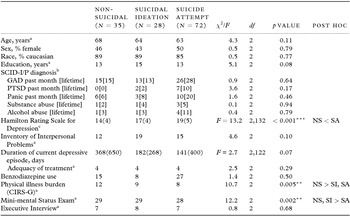
Sample characteristics are presented in Table 1. In brief, our sample was 47% female, and included middle-aged and older adults (M = 66 years old, 44–87) who were well-educated (M = 14 years of education). Groups were well-matched for age, gender, race, and education. All procedures were conducted in accordance with IRB approval.
Sample characteristics

Note: **p < 0.01, ***p < 0.001.
aNon-normally distributed variables values are reported as median.
Categorical variables are reported as a frequency or as a percentile.
Normally distributed variables are reported as mean (standard deviation).
bStatistics for past month are reported, lifetime SCID diagnoses were not significantly different across groups.
GAD = generalized anxiety disorder.
PTSD = post-traumatic stress disorder.
cTotal Hamilton score did not include suicide item.
CIRS-G = Cumulative Illness Rating Scale for Geriatrics.
Analyses
Previously identified factors of the HAM-D (Fleck et al., Reference Fleck2004) were computed by summing each item within respective factors: depressed mood (depressed mood, feelings of guilt, and work and activities), anxiety (agitation, psychic anxiety, somatic anxiety, and hypochondriasis symptoms), and insomnia (onset, maintenance, and early morning symptoms). The insomnia items from the HAM-D have been linked to suicidality (Agargun et al., Reference Agargun2007). The reliability (Fleck et al., Reference Fleck2004) and clinical significance (Périco et al., Reference Périco2005) of the insomnia factor have been demonstrated in previous work. Assumptions of normality (Kolmogorov-Smirnov > 0.05) were assessed for all continuous variables included in this study. Analysis of variance (ANOVA) using post hoc t-tests, Kruskal–Wallis tests using post hoc Mann–Whitney tests, and χ 2 tests were used to compare groups across demographic variables and health features (see Table 1). Bonferroni correction was applied to post hoc comparisons to control for familywise error rate.
A series of analyses of covariance (ANCOVA) was conducted to test whether groups differed in the severity of insomnia measured by the HAM-D. Variables that were different across the groups or that might be associated with insomnia based on the literature were included as covariates: age, gender, education, depressed mood and anxiety factors from the HAM-D, MMSE total score, alcohol dependence, and physical illness burden. Tukey HSD was used to test group differences post hoc. Variables that did not explain significant unique variance were removed to produce the final model. A subset of participants (n = 12) had a history of post-traumatic stress disorder (PTSD), a known risk factor for suicidality. We conducted a sensitivity analysis in which the final ANCOVA model did not include these patients to ensure that our findings were not entirely explained by PTSD.
Exploratory analyses were also conducted. Spearman correlations were used to determine whether insomnia severity was associated with suicidal ideation severity, recency of suicide attempt, number of suicide attempts, and lethality of suicide attempt. Previous studies have linked insomnia to cognitive difficulties, interpersonal problems, and benzodiazepine use (Roth and Ancoli-Israel, Reference Roth and Ancoli-Israel1999). To explore whether an association between insomnia and suicidality might be explained by these variables, we also conducted exploratory correlation analyses in the total sample and within the suicide attempt group. Spearman correlations were used to investigate whether insomnia severity correlated with EXIT total score or IIP total score and an ANOVA was used to investigate if individuals who used benzodiazepines (n = 50) differed from those who did not use benzodiazepines (n = 85) in regards to insomnia severity. All analyses were conducted using IBM SPSS 22 (IBM Corp. 2013).
Results
Table 1 reports group characteristics. Groups were similar in terms of co-morbidities and exposure to antidepressant pharmacotherapy. They differed in current depressive severity, mental status, and physical health burden. Specifically, the non-suicidal group had higher CIRS-G scores than both suicidal groups and lower HAM-D total scores than the suicide attempt group. The groups differed significantly in MMSE score such that the suicide attempt group scored 1 point lower on average than the suicidal ideation and non-suicidal depressed groups.
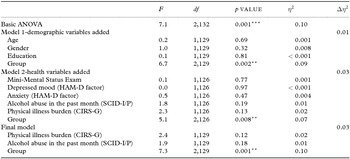
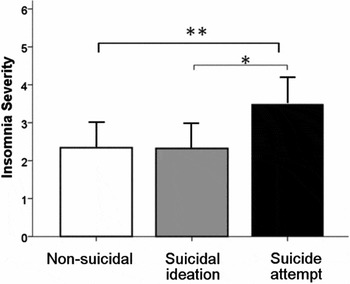
Table 2 and Figure 1 report the group differences in insomnia severity. Insomnia severity scores ranged from 0–6. A basic ANOVA revealed that groups differed significantly in severity of insomnia, suicide attempt group (M = 3.49, SD = 1.82), suicidal ideation group (M = 2.32, SD = 1.72), non-suicidal depressed group (M = 2.34, SD = 1.71), F (2,132) = 7.12, p = 0.001, η2 = 0.097. Post hoc analyses with Bonferroni correction demonstrated that the suicide attempt group had significantly more severe insomnia than the suicidal ideation (p = 0.01) and non-suicidal depressed (p = 0.006) groups. The suicidal ideation group did not have more severe insomnia than the non-suicidal group. Covariates that were considered possible confounding variables were added in two steps. Model 1 included demographic variables: age, gender, and education. Model 2 included mental and physical health variables: depressed mood and anxiety factors from the HAM-D, MMSE, CIRS-G total score, and alcohol dependence in the past month. Covariates that were not significantly correlated with insomnia severity and did not contribute to the final model were removed for each step. No covariate was significantly associated with insomnia in any model. Nevertheless, because alcohol dependence in the past month and CIRS-G contributed to the overall model, they were retained in the final model. In all iterations of the model, group differences remained significant and post hoc Tukey HSD analyses confirmed the suicide attempt group had significantly more severe insomnia than the suicide ideation and non-suicidal groups (p < 0.05 for all). Results were robust to the exclusion of participants with lifetime history of PTSD, p < 0.05.
Steps for building final ANCOVA model for insomnia severity

Note: **p < 0.01, ***p < 0.001. Δη2 = indicates difference compared to the basic ANOVA model, HAM-D = Hamilton Rating Scale for Depression, SCID-I/P = The Clinical Interview for DSM-IV Axis I Disorders–Patient Edition. CIRS-G = Cumulative Illness Rating Scale for Geriatrics.
Exploratory analyses within the suicide attempt group revealed no significant correlations between insomnia and suicidal ideation severity, rs(72) = 0.19, p = 0.12, recency of suicide attempt, rs(72) = 0.03, p = 0.82, number of suicide attempts, rs(72) < –0.01, p = 0.98, lethality of suicide attempt, rs(72) = 0.09, p = 0.47, interpersonal difficulties, rs(135) < 0.01, p = 0.99, or executive functioning, rs(101) = 0.04, p = 0.71. Exploratory analysis in the total sample found no significant correlations between insomnia severity and interpersonal difficulties or executive functioning, (p > 0.10 for all). Exploratory ANOVAs found no significant differences in insomnia severity based on benzodiazepine use (yes vs. no) in the suicide attempt group, F (1,70) = 1.12, p = 0.29, or the total sample, F (1,133) = 0.53, p = 0.47.
Discussion
Our results support the hypothesis that insomnia severity is associated with suicidal behavior in individuals with depression. The observed associations remained after accounting for possible confounders (demographics, cognitive ability, alcohol dependence, severity of depressed mood, anxiety, and physical health burden). Individuals with a suicide attempt had on average one more symptom of insomnia (29% greater insomnia severity) than the non-attempt groups. Thus, the suicide attempt group tended to have more severe insomnia symptoms of a particular type (onset, maintenance, or early morning awakening) and on average had at least two different types of symptoms of insomnia. This study extends the results of a meta-analysis showing that symptoms of insomnia confer increased risk for suicidal behavior in patients with depression (Malik et al., Reference Malik2014).
Results are consistent with a previous study that found that individuals with multiple sleep complaints have a particularly high risk for suicidal behavior (Wojnar et al., Reference Wojnar2009). Also consistent with a previous study (Sjöström et al., Reference Sjöström, Waern and Hetta2007), we did not find a correlation between insomnia severity and other dimensions of suicidality (ideation, recency, frequency, or lethality) within the suicide attempt group. This study does not address whether insomnia is associcated with suicidal ideation severity in depressed individuals without a history of attempt. However, the majority of studies in the literature have failed to find an association between insomnia symptoms and suicidal ideation when controlling for depression (Bernert et al., Reference Bernert, Joiner, Cukrowicz, Schmidt and Krakow2005; Nadorff et al., Reference Nadorff, Nazem and Fiske2011; Reference Nadorff, Fiske, Sperry, Petts and Gregg2013; Richardson et al., Reference Richardson, Cyr, Nelson, Elhai and Sareen2014).
Individuals with current suicidal ideation with a specific plan did not have more severe insomnia symptoms than non-suicidal individuals. This contradicts the findings of Wojnar and colleagues (Wojnar et al., Reference Wojnar2009) who found that insomnia symptom severity was associated with suicide ideation or planning. In that study, however, the retrospective assessment window was limited to 12 months, lifetime history of suicide attempt was not assessed, and the temporal association between variables could not be determined. The added strength of the current study is its case-control design that carefully assessed lifetime history of suicidal behavior and allowed us to study a sample of individuals with suicidal ideation with a specific plan but no lifetime history of suicidal behavior. Our results suggest that insomnia severity may confer risk for suicidal behavior through mechanisms other than suicide planning.
Numerous hypotheses have been put forth to explain the association between insomnia and suicidal behavior (McCall and Black, Reference McCall and Black2013), including insomnia's potential relationships with depression severity, cognitive deficits, or medications. Our results suggest that depression and anxiety severity do not explain the relationship between insomnia and suicidal behavior. Because the anxiety factor of the HAM-D included a measure of agitation, results of this study are not readily explained by general agitation associated with suicidal behavior. In addition, we found no evidence that interpersonal distress, lower-level executive functioning, distress associated psysical health, nor benzodiazepine use might explain the association between insomnia and suicidal behavior. Thus, there is a need to explore other behavioral and biological mechanisms through which insomnia may increase the risk for suicide including dysfunction in cognitive domains (i.e. autobiographical memory, problem-solving, and working memory) (reviewed in Fortier-Brochu et al., Reference Fortier-Brochu, Beaulieu-Bonneau, Ivers and Morin2012) and neural circuitries, including brain regions (i.e. prefrontal cortex, cingulate cortex, precuneus, and medial temporal cortex) (reviewed in Levenson et al., Reference Levenson, Kay and Buysse2015) associated with insomnia.
This study is limited in that insomnia was only measured by the insomnia factor of the HAM-D; however, the items for this factor have been shown to correlate with suicidality in previous studies (Agargun et al., Reference Agargun2007). The results of this study need to be replicated in studies that use diagnostic criteria for insomnia and assess additional dimensions of insomnia. For example, chronicity of insomnia was not assessed by the HAM-D and is an important dimension of insomnia that may be related to suicidality. Although its cross-sectional design is another limitation of the present study, the relatively high prevalence of insomnia and rarity of suicidal behavior make it difficult to assess otherwise. Thus, these results cannot determine temporal or causal relationship between suicidal behavior and insomnia.
Assessing insomnia symptoms, as well as other markers of depression may improve risk assessment for suicidal behavior (McGirr et al., Reference McGirr2007; Li et al., Reference Li, Lam, Yu, Zhang and Wing2010). Our findings support the notion that patients with depression who report having suicidal ideation and insomnia symptoms may have a higher risk for suicidal behavior than depressed individuals who do not have insomnia. Insomnia may also be a treatment target for reducing suicide risk. One study showed that insomnia treatment reduces suicidal ideation (Trockel et al., Reference Trockel, Karlin, Taylor, Brown and Manber2015). Thus, we recommend that clinicians who work with depressed individuals routinely assess and treat sleep disturbances. However, we acknowledge that this recommendation requires further assessment in prospective studies. Management of insomnia complaints in later-life has been reviewed in detail previously (McCrae et al., Reference McCrae, Dzierzewski and Kay2009). A referral for cognitive behavioral therapy for insomnia is the recommended front-line treatment.
In our sample individuals with a history of major depression, the suicide attempt group (n = 72) had significantly more severe symptoms of insomnia than the suicidal ideation (n = 28) or non-suicidal (n = 35) groups, *p < 0.05, **p < 0.01, respectively.

Conflict of interest
None.
Description of authors’ roles
D. Kay conceptualized the study hypotheses, analyzed the data, and wrote the article. A. Dombrovski, D. Buysse, and C. F. Reynolds III contributed to the conceptualization of the paper, statistical design, and writing the article. A. Begley assisted with statistical analyses. K. Szanto carried out the study, supervised data collection and contributed to the conceptualization, statistical design, and writing of the paper.
Acknowledgments
This work was supported by the National Institute of Mental Health (R01 MH085651to K.S., K23 MH086620 and R01 MH100095 to A.Y.D); National Institutes of Health Heart Blood and Lung Institute (HL082610 to D.J.B., P60 MD000207, P30 MH090333, UL1RR024153, and UL1TR000005 to C.F.R.); and the UPMC Endowment in Geriatric Psychiatry (to C.F.R). We thank Joshua Feldmiller for data management.