This stimulating and informative ten-chapter volume is a detailed study of the acquisition of word order by children acquiring the variety of Norwegian spoken in Tromsø. The project is ambitious, but the author successfully develops a micro-parametric model which explains the very early acquisition of a ‘mixed V2 [Verb-Second]’ grammar. In the proposed approach, the acquisition of word order is far more complex than simply setting a parameter, and it is argued that finiteness cannot be the trigger for V2 in Norwegian.
Marit Westergaard begins by laying out her background assumptions in Chapter 1 (‘Preliminaries’). Most important among these is the claim that V2 does not represent a unitary phenomenon. She argues for this on the grounds that so-called V2 languages exhibit a degree of variation which is incompatible with a simple parametric approach to the phenomenon. Usefully, she does not assume that the reader will have any familiarity with the details of Norwegian word order, or indeed the word order of other V2 languages, and so she devotes Chapter 2 (‘Word order variation and the structure of the target language’) to setting out this mixed V2 system in some detail. She explains where V2 is allowed, barred or required, and shows that variation in word order correlates with the illocutionary force of a clause.
Having detailed the complexity of the system which her subjects were acquiring, Westergaard embarks on a syntactic analysis of V2 in Chapter 3 (‘The syntax of V2 and a model of micro-cues’). She adopts a generative syntactic approach similar to that of Rizzi's (Reference Rizzi and Haegeman1997) split Complementiser Phrase (CP) model, together with a modification of Lightfoot's (Reference Lightfoot1999) cue-based approach to language acquisition. V2 is assumed to involve traditional head movement. Westergaard provides a generally sound analysis here, although some issues could have been dealt with in a little more depth. For example, we are not given a clear picture of how negation is represented in the structure until the last chapter of the book; and labels such as InTopP are used without proper introduction or explanation.
In Westergaards's modification of Rizzi's model, Force is represented by a number of distinct heads, notably Declarative (Decl), Interrogative (Int) and Polarity (Pol), which, she argues, appear in declaratives, wh-interrogatives and yes/no-interrogatives, respectively. In my understanding of Westergaard's analysis, micro-parametric variation is captured by allowing each of these heads to bear distinct feature specifications, which either trigger verb movement or not. Syntacticians will undoubtedly interpret this as equating to the view that heads with a particular force have strong V-features while heads with a different force do not. However, on more than one occasion, Westergaard states that the only triggers for verb movement are the micro-cues themselves. At no point does she delve into a discussion of what exactly that means in terms of the kind of grammar that the child has to construct. Indeed, she admits later in the book that ‘the status of the micro-cues in an adult grammar is not completely worked out with respect to the syntactic operations that are triggered by them’ (65). I found the lack of discussion of this point rather frustrating.
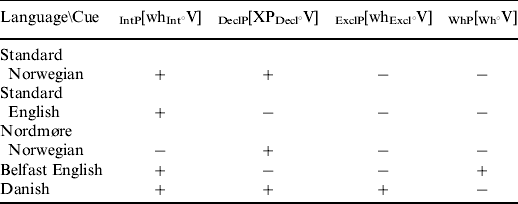
Examples of micro-cues for V2 in a split-CP model
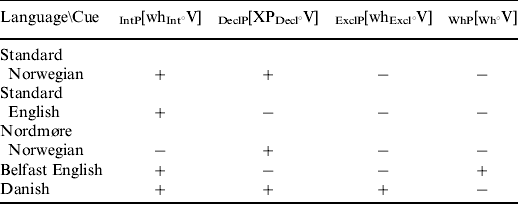
Examples of micro-cues are given in Table 1 (56, Table 3.2), which illustrates how such micro-cues can distinguish between different V2 grammars.
The author refers to heads such as Decl and Int as different ‘flavors’ of Force (38). Although she provides no substantive motivation for treating them as categorially distinct, all the proposed micro-cues characterise them as such, which is a potential problem to which I return below.
Importantly, Westergaard argues that children scan input data for micro-cues, clause type by clause type; that is, they are not seeking to set parameters by looking for global patterns. She further argues that the word order of other clause types does not provide counter-evidence for a micro-cue associated with a different clause type. In some ways, this makes the acquisition process more complex, in that many micro-cues may be required where only one cue would suffice in a more narrowly parametric view. On the other hand, the process is simpler, in the sense that the data scanned will be less ambiguous (at least in a grammar where optionality with respect to V2 does not exist), allowing more straightforward ‘decisions’ about the existence of micro-cues.
Heads lower than Force (e.g. Topic) are argued to be sensitive to information structure, so that cues must somehow be able to contain featural specifications which encode this. Cues for language acquisition are abstract bits of linguistic structure. Lightfoot (Reference Lightfoot1999) treats them as given by Universal Grammar, and they are used by the child to analyse the input she hears. Westergaard's micro-cues, while still being part of I-language, are not part of Universal Grammar but arise from an interaction between Universal Grammar and input; as such, she argues, they are a crucial component in the acquisition process. Her arguments for this conclusion are convincing.
Input frequency of strings that match potential micro-cues is argued to be ‘relatively unimportant’ in most cases. But note that Westergaard's system allows language-specific micro-cues, which can be exceptions to other micro-cues as long as they have a high-frequency in the input. She even allows such exceptions to make reference to particular lexical items, though no explanation is given for why their frequency does not simply lead the child to fail to posit the more general micro-cue.
Superficially, Westergaard's approach to acquisition might seem similar to some constructivist approaches. However, she emphasises that micro-cues are not (generally) surface strings of word combinations. The ten micro-cues which she lists as necessary for the acquisition of Tromsø Norwegian encode hierarchical structure and make reference to ‘linguistically relevant distinctions’. Finally, in this chapter, Westergaard explains that the system predicts no particular order of acquisition for the various micro-cues (even where these are in competition).
Chapter 4 is a short chapter on ‘The input’, which, in the proposed account, children must rely upon heavily in order to acquire word order. The discussion moves first to a comparison of the micro-cue approach to acquisition with both parametric and constructivist views. Subsequently, Westergaard examines the frequency of strings attesting to the ten afore-mentioned micro-cues in a subset of child-directed speech in her corpus.
Westergaard stresses that while input is important, it is not used in isolation, and other factors, including economy, must be taken into account. The proposed approach is thus different from both Yang's (Reference Yang2002) competition model and constructivist theories.
Required levels of input frequency are argued to be ‘considerably lower’ than those assumed by Lightfoot (Reference Lightfoot1999) . Evidence for V2 is provided by just over half of the data overall. Westergaard points out that child-directed speech provides even more robust evidence of V2 than the adult conversational data which Lightfoot used in his calculations. Because child-directed speech contains a large number of questions, and yes/no-questions provide the most robust cue for V2 in this Norwegian dialect, a parametric view might lead us to expect that children would overgeneralise V2 to non-V2 contexts. As later demonstrated, on the whole they do not do this. Westergaard's main point in Chapter 4 is to convince the reader that it is not overall frequencies which are important. When considered clause type by clause type, evidence for V2 in the input is usually categorical. Thus, even if a particular clause type represents a very small percentage of input overall, the cues within it are extremely reliable. If this hypothesis about the way in which children analyse the data is correct, it follows that V2 will not be overgeneralised.
The next five chapters of the book investigate the acquisition of word order in different clause types, beginning with ‘The acquisition of word order in non-subject-initial declaratives’ in Chapter 5. Of the clause types that provide a cue for verb movement to a Force-type projection, non-subject-initial declaratives are the most frequently heard by children, representing circa 14% of the sampled data. Westergaard emphasises the point that the micro-cue for V2 in this context occurs with a frequency some way below the minimal level of robustness (17%), which Lightfoot argued was necessary for the triggering of a (single) V2 parameter. According to the view she defends, it is the clause type of all non-subject-initial declaratives that the child will examine, and of these, 85% provide evidence for the required cue. (But note that the rates given in the text (77) – 88% (286/325) for V2 and 12% (29/325) for non-V2 in sentences with initial kanskje ‘maybe’ – are miscalculated, given that there are in fact 39 non-V2 sentences introduced by kanskje in the corpus.)
V2 orders occur from the outset, and exceptions to it are not numerous. Many are of a single pattern, although not exclusively enough for the pattern to be taken to represent rote learning. The view that finiteness distinctions are acquired prior to the acquisition of verb movement is not contradicted by the data. However, Westergaard ultimately argues for a dissociation between morphological finiteness and the acquisition of V2.
Chapter 5 also contains an interesting discussion of null subjects. Westergaard successfully shows that the patterns of use differ in a meaningful way from the predictions made with respect to null subjects by both the Tense Omission model (Wexler 1999) and the Truncation model (Rizzi 1993/4), and that early null subjects, at least in Norwegian, cannot be attributed (exclusively) to either topic drop or truncation. In this chapter, Westergaard also examines the incidence of Verb-First (V1) structures to show that there is no support in her data for the Dutch pattern which Yang (Reference Yang2002) invoked as support for his variational model of language acquisition. She analyses the small number of V1 structures which she finds as containing null modals.
Chapter 6 discusses ‘The acquisition of word order in subject-initial declaratives’. Subject-initial declaratives are likely to be the most prevalent clause type in the corpus. However, in Westergaard's corpus, only 6.2% of these sentences provide evidence for the position of the verb beyond the information that it is situated below the subject; these are the clauses containing an adverb or negation (and even these are not fully sufficient to provide an unambiguous cue to verb position, as emerges in Chapter 9).
The presentation of data on negative declaratives shows that untensed verbs do not appear in second position, but finite verbs do sometimes remain in situ, as found in earlier work on German. Westergaard concludes from this that verb movement to Decl may not be operational in the early stages. She examines, but finds no clear support for, the view that finiteness may be acquired earlier in negative than in positive sentences.
Chapter 7 tackles the issue of ‘The acquisition of word order in wh-questions’, which are claimed to require three different micro-cues: one for subject questions and two for non-subject wh-questions. A further distinction is made depending on the length of the wh-phrase involved: long wh-phrases require obligatory V2, while in questions with monosyllabic wh-words, it is triggered only when the subject is focussed or new. Westergaard argues that children are sensitive to the given versus new status of the subject from the time when they first produce wh-questions, and that they are not simply relying on a distinction of lexical Determiner Phrase versus pronoun (contra her own previous speculation). An important conclusion from this chapter is that a usage-based or constructivist approach is not consistent with the data. Westergaard convincingly argues that the large number of wh+verb and wh+subject combinations that are exhibited renders such an approach inadequate for explaining the acquisition patterns.
One of the issues Westergaard discusses in Chapter 7 is questions from which some element is missing: questions with the subject omitted, the verb omitted or the wh-phrase omitted. All occur relatively frequently in the early stages; less frequently, both the subject and wh-word are left out. Westergaard has already argued that null subjects in declaratives are problematic for Rizzi's (Reference Rizzi1993/4) Truncation account of null subjects. The cases found in wh-interrogatives that she discusses in this chapter are also problematic for that view, since it requires subjects to be in an initial position in order to be open to deletion. Westergaard suggests that essentially only subjects of unraised verbs are omitted but rejects the idea that this has anything to do with finiteness, since the verbs in both V2 and non-V2 questions are finite. Instead, she attributes the omission of subjects to the fact that omitted subjects are pronouns which, being given information, do not trigger V2.
Despite the fact that yes/no-questions provide the strongest cue for V2 (31% of input), Chapter 8, which looks at ‘The acquisition of word order in yes/no-questions’, turns out to be one of the less interesting chapters in terms of the theoretical claims that Westergaard derives from her data. As with declaratives, the children produce substantial numbers of root non-finite verb forms in these questions, and such examples tell us nothing about whether the children have acquired the micro-cue for V2 in them. (Rather disappointingly, there is no discussion here of why, in the syntactic model that Westergaard adopts, such a contrast in the use of root infinitives should exist between polar questions and wh-questions, where only a very small number of root infinitives were found.) Of the remaining yes/no-questions, 9% could potentially be analysed as involving failure to raise a finite verb. However, 18% of these contained no subject. Cases of (Subject+)Modal+Verb+Object word order cannot be classified as V2, and hence get grouped together with intonation questions. The children are thus taken to be successfully acquiring the V2 cue in polarity questions. Some additional theoretical discussion would have enhanced this claim. For example, why are utterances with missing copulas treated as belonging to a separate category from those containing root infinitives, since the latter are also treated as containing omitted verbs?
Chapter 9 is devoted to ‘The acquisition of word order in non-V2 contexts’, primarily exclamatives, indirect questions and embedded declaratives. The first two of these contexts are rare and embedded declaratives providing clear cues are very sparse. Together, exclamatives, indirect questions and embedded declaratives make up only 2.6% of the input data. Examining them turns out to be important, however. In particular, the few cases of embedded declaratives containing an adverb or negation are critical to the child's acquisition of the correct cues. The apparently target-consistent word order of verb–negation produced by the children in main clause declaratives is compatible with both the proposed cue DeclP[XPDecl°[V]…] and an alternative cue IP[XPI°[V]] for V-to-I(nfl) movement. Westergaard argues that cues which include reference to distinct Force heads are not expected to transfer across clause types, but that cues relating only to the IP-domain are. Unambiguous input containing non-V2 in embedded declaratives is potentially critical: if the child had mistakenly interpreted the matrix data as providing evidence of V-to-I movement, such examples would allow her to retreat from this hypothesis. However, Westergaard's data cannot be taken to be wholly conclusive since there are only 12 relevant examples in the corpus, and two-thirds of these exhibit V2, leading her to conclude that the children do indeed initially misanalyse the matrix data. She argues that this provides evidence that economy governs acquisition so that children move the verb only as high as they are forced to by the data. This suggests then that even a cue represented by only 0.6% of the overall input can ultimately be acquired.
Chapter 10, ‘Micro-cues, information structure, and economy’ summarises the findings and reviews them with regard to the syntactic model adopted. In this chapter the author delves more deeply into theoretical issues of acquisition, particularly economy. The chapter managed to answer some of the questions I had during the reading of earlier parts of the book, but to my mind the reader would have been better satisfied if some of them had been answered earlier.
After reading this book, some questions about the approach remained unanswered for me. For example, if each type of illocutionary force is categorially distinct, why can they not co-occur? It is possible that treating Decl, Int and Pol as distinct heads allows a more elegant formulation of the micro-cues than treating these as features on a single head Force, but elegance cannot be the single motivating factor. The key claim that children examine data of each clause type individually would be difficult to justify if the clauses containing them were all simply characterised as ForcePs. Rather than using the many positive results of her study to argue for the theoretical stance that she takes on this, Westergaard simply presents the heads as categorially distinct and leaves the reader to worry about such issues.
Another worry which remains is the lack of convincing justification for treating non-subject-initial declaratives as a distinct clause type from subject-initial declaratives. Westergaard's model does not assume these to have distinct illocutionary force, but how else would the child know to attend to each of these sub-types of declarative as distinct in order to arrive at two separate micro-cues, one triggering V2 and the other not? A further question that arises is whether there is any drive in the acquisition model for the child to posit as few cues as possible.
Although Westergaard's book has some minor shortcomings (including fairly numerous typographical errors), I found the data extremely thought-provoking, and was on the whole convinced by her argumentation. I very much enjoyed reading the book and would strongly recommend it to acquisitionists and syntacticians alike. Overall, I found the model of micro-cues that Westergaard develops very appealing, and I hope that she will provide us with some of the answers to my remaining questions in her future work, which I look forward to reading.