Introduction
A head bandage, also known as a mastoid pressure dressing, is commonly used following ear surgery. The application of a post-operative pressure dressing is the norm in most centres around the world following myringoplasty, mastoid surgery, tympanoplasty and cochlear implantation. The primary aim of the pressure dressing is to prevent post-operative haematomas and seroma formation.Reference Gurgel and Oghalai1 However, head bandages can be cumbersome, and may cause headache and discomfort.Reference Castelli, Lisi, Marcato, Tavormina, Capellaro and Sartoris2 They can also cause skin irritation in some patients. Day-case surgery patients may have to return the next day for removal of the head bandages. Long-term head bandages used in otological procedures such as pinnaplasty can lead to a delay in the wound review, and there have been reported cases of skin necrosis if these dressings are applied tightly.Reference Demir, Haktanir and Yilmaz3
Even though head bandages are a common post-operative measure, there is no high-level evidence in the literature to support their use. However, there is limited evidence showing increased morbidity associated with pressure dressing use.Reference Rowe-Jones and Leighton4
This systematic review aimed to evaluate the role and effectiveness of head bandage use in routine middle-ear surgery including myringoplasty, mastoidectomy, cochlear implantation and tympanoplasty.
Materials and methods
A comprehensive search was conducted using the Knowledge Network, and databases including Ovid (Medline, Embase), the Ebsco collections (Cumulative Index to Nursing and Allied Health Literature), the Cochrane Library, PubMed (the US National Library of Medicine) and Google Scholar. The key words used were ‘head bandage’, ‘ear surgery’, ‘mastoid surgery’, ‘otoplasty’ and ‘pinnaplasty’. The last date of the final search was 10 July 2013. English and foreign language literature was included in this review. There were no restrictions as to the study design or publication date. The inclusion and exclusion criteria are shown in Table I.
Inclusion and exclusion criteria

RCT = randomised, controlled trial
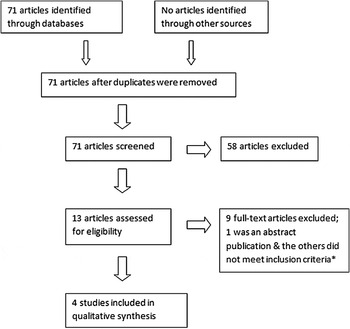
The initial search identified 71 articles (Figure 1). The study abstracts of these articles were reviewed independently by two authors (IK and MS) to check the relevance of the papers. The full text was obtained for 13 relevant articles. The bibliographies of these articles were examined to identify any further studies. All articles that fulfilled the inclusion criteria were appraised using the Critical Appraisal Skills Programme checklists.5 The levels of evidence were based on the levels defined by the Oxford Centre for Evidence-based Medicine.6
Flow chart of article selection based on the Preferred Reporting Items for Systematic Reviews and Meta-Analyses (‘PRISMA’) statement. *See Table I

The data collected from the articles reviewed included patient demographics, interventions, comparisons, study design, length of follow up and outcomes measured, with the corresponding level of evidence, based on the Preferred Reporting Items for Systematic Reviews and Meta-Analyses (‘PRISMA’) statement.Reference Moher, Liberati, Tetzlaff and Altman7 Each paper was examined for quality features, as noted in Table II. The outcome measure of interest for this review was post-operative wound complications, including haematoma, seroma, wound dehiscence and infection, associated with the use or non-use of head bandages in middle-ear surgery (Table II).
Analysis of articles included in systematic review

*Post-operative complications included infection, haematoma and wound dehiscence. Pts = patients; y = years; FU durn = follow-up duration; RCT = randomised, controlled trial
Results
The initial literature search identified 71 articles using the key words individually and in various combinations. After reviewing the abstracts, only 13 articles were deemed to be relevant. Of these 13 articles, 9 did not fulfil the inclusion criteria: in 7 of these the comparison groups and intervention were different, whilst 1 was an abstract publication. Only five studies met the inclusion criteria. There were three randomised, controlled trials (RCTs) investigating the use of head bandages following middle-ear surgery (e.g. myringoplasty and mastoidectomy), one retrospective series examining patients undergoing cochlear implantation and one literature review (which was not included in the systematic review).
The RCT conducted by Castelli et al. in 2001 assessed the rate of post-operative haematoma and wound infection in patients with a head bandage compared to those without.Reference Castelli, Lisi, Marcato, Tavormina, Capellaro and Sartoris2 That study reported on 420 consecutive patients who underwent middle-ear surgery, including myringoplasty, tympanoplasty, ossiculoplasty and mastoidectomy through a postauricular approach. Of these, 212 patients were randomly allocated to have a head bandage applied, whilst the remaining 208 patients did not have a head bandage. Both patient groups had similar demographics. The patients without a head bandage had simple gauze swabs, kept in place with adhesive tapes, without any compression. The wounds were reviewed daily up to day 5, and then 3 weeks after surgery. In the head bandage group, 3 patients had bruising, whilst 70 patients had minor skin erythema; however, there was no bruising or erythema in the patients without a head bandage. There were cases of minor wound dehiscence in both groups, which resolved quickly with local care. There were no cases of post-operative haematoma in either group.
Rowe-Jones and Leighton published an RCT in 1993 that compared patients undergoing middle-ear and mastoid surgery with and without a head bandage.Reference Rowe-Jones and Leighton4 A total of 100 patients were randomised using a closed envelope system in which each study arm had 50 patients. The procedures performed included postaural and endaural approaches. The patients were followed up at 24 hours post-operatively, and between 1 and 3 weeks thereafter. In the head bandage group, nine patients (18 per cent) had post-operative wound complications, including infection, bruising, haematoma and minor dehiscence. One of the patients had an allergic reaction to bismuth iodine paraffin paste. In the group without a head bandage, only four patients (8 per cent) had wound complications.
Ergin et al. conducted an RCT in 1998.Reference Ergin, Dal and Ozluoglu8 This was the only foreign language article (published in German) included in this review. Patients undergoing various middle-ear surgical procedures were randomly allocated to groups with and without a mastoid dressing. There were a total of 67 patients: 32 patients had a mastoid dressing and 35 did not. Both groups included patients undergoing surgery via transaural and postauricular approaches. Initial follow up was at 24 hours post-surgery, and patients were followed up to 1 month post-operatively. In the mastoid dressing group, there were nine cases of post-operative wound complications, which included infection, wound dehiscence, haematoma, leakage and oedema. In the patients without a mastoid dressing, there were 10 cases of wound complications post-operatively; however, there was no haematoma in this group. There was no statistical difference in the post-operative wound results between the two groups (p = 0.74).
In 2009, Luo et al. conducted a retrospective study on a paediatric population undergoing cochlear implantation with and without a pressure dressing.Reference Luo, Chih-Ying and Hwang9 Of 92 consecutive patients, 44 had a mastoid dressing, whilst 48 had a simple gauze dressing without a head bandage. All procedures were performed using a postauricular incision (a minimally invasive incision or an inverted ‘J’-shaped incision). The average follow-up duration for patients was 35 months. Comparison between the two groups, and subgroup analysis for both the J-shaped and minimally invasive incisions, showed no statistically significant differences in wound complications and haematoma formation (p = 0.0634).
Discussion
This systematic review investigated the common practice of head bandage use following middle-ear surgery. This study is constrained by the very limited evidence available on this subject. However, there was adequate evidence provided in the form of three comparable randomised, controlled trials to establish the role of head bandage use after middle-ear surgery.
A 2012 review by Gurgel and Oghalai showed no evidence to support the use of mastoid pressure dressings following middle-ear surgery.Reference Gurgel and Oghalai1 However, it also concluded that there is no literature available showing the potential benefits of ear dressings, such as post-operative drainage absorption and wound protection from trauma; thus, the authors advocated the use of loosely applied head bandages.Reference Gurgel and Oghalai1 Hill et al. measured the pressure applied by head bandages and found that after the first hour the head bandage loses the pressure required to prevent haematoma formation.Reference Hill, Allan, Malhan and Williams10
The application of mastoid pressure dressings has become standard practice since the first use of temporalis fascia grafts in middle-ear surgery, as described by Heerman in 1958 (cited in Rowe-Jones and LeightonReference Rowe-Jones and Leighton4). This common practice aims to prevent wound complications, particularly the risk of haematoma formation. However, with modern haemostatic techniques, the application of pressure dressings following ear surgery may be an extra, unnecessary precaution in an uncomplicated procedure, especially if good haemostasis is achieved.
Conclusion
Current available evidence shows no advantage of head bandage use after middle-ear surgery. This systematic review concludes that head bandages are not required after routine, uncomplicated middle-ear surgery. It can be left to the clinicians' discretion to use a simple gauze dressing if wound protection is a concern.
Acknowledgements
The authors would like to thank Dr Ursula Altmeyer, Mr Joshua Cheyne and Ms Ruth Ross for their help in providing essential data for this systematic review.