Children with developmental dyslexia fail to develop age appropriate reading skills despite normal-range nonverbal intelligence, adequate learning opportunities, and the absence of a frank neurological disorder (Snowling, Reference Snowling2000). Although dyslexia is by definition a reading disorder, there is a strong consensus that spoken language deficits also play a role in reading failure. Specifically, theories suggest that difficulties with phonological processing impair the ability to learn consistencies in the mapping between letters and sounds, which in turn, impacts the ability to efficiently read familiar and novel words (Bradley & Bryant, Reference Bradley and Bryant1983; Stanovich & Siegel, Reference Stanovich and Siegel1994; Wagner, Torgesen, & Rashotte, Reference Wagner, Torgesen and Rashotte1994). Although there is much evidence in support of the strong relationship between phonological deficits and reading failure in children with dyslexia, less attention has been devoted to whether these children also have nonphonological language deficits. It has even been suggested that children with dyslexia have relatively normal nonphonological language skills, which they use to compensate for phonological deficits throughout reading development (Bishop & Snowling, Reference Bishop and Snowling2004). However, language deficits outside the domain of phonology have been observed in children with dyslexia. McArthur, Hogben, Edwards, Heath, and Mengler (Reference McArthur, Hogben, Edwards, Heath and Mengler2000) found that in a sample of 110 children with dyslexia, over half of the children scored at least one standard deviation below the mean across tests of comprehension and production of syntax and vocabulary. There is also evidence that language skills in 2- to 3-year-old children, such as the syntactic complexity and vocabulary size, are significant predictors of later reading accuracy and comprehension (Scarborough, Reference Scarborough1990).
These studies raise the possibility that children with dyslexia have nonphonological language problems in addition to phonological deficits. Consistent with this, dyslexia has been found to overlap moderately with specific language impairment (SLI; Catts, Adolf, Hogan, & Ellis Weismer, Reference Catts, Adolf, Hogan and Ellis Weismer2005; McArthur et al., Reference McArthur, Hogben, Edwards, Heath and Mengler2000). SLI is a distinct disorder from dyslexia in which oral language is impaired, especially with respect to grammatical processing (Bishop, Reference Bishop1997). However, the limited number of direct comparisons made across these groups in the literature makes it difficult to assess whether nonphonological deficits in dyslexia are similar to those observed in children with SLI. Thus, the current study focused on the nature and extent of language deficits in dyslexia, especially with respect to spoken sentence comprehension. Rispens and Been (Reference Rispens and Been2007) examined sentence comprehension in SLI and dyslexic groups, and found that children with dyslexia were poorer than control children, but better than children with SLI. In the current study, we also compared sentence comprehension in children with dyslexia and language impairment (LI), and evaluated the extent to which sentence comprehension problems in either group are grounded in poor syntactic processing over limited verbal working memory (WM).
THE RELATIONSHIPS BETWEEN READING, SYNTAX, AND PHONOLOGY
Spoken sentence comprehension involves storing and processing verbal material. Verbal information tends to be temporarily stored in a phonological code (phonological short-term memory [STM]) to enable further processing in WM (i.e., verbal WM; Just & Carpenter, Reference Just and Carpenter1992). Presumably, if verbal material is not stored adequately, it makes the task of syntactic processing all the more difficult. As noted earlier, phonological deficits are quite prevalent in children with dyslexia (Bradley & Bryant, Reference Bradley and Bryant1983; Stanovich & Siegel, Reference Stanovich and Siegel1994; Wagner et al., Reference Wagner, Torgesen and Rashotte1994). Shankweiler and colleagues (Mann, Shankweiler, & Smith Reference Mann, Shankweiler and Smith1984; Shankweiler et al., Reference Shankweiler, Crain, Katz, Fowler, Liberman and Brady1995; Shankweiler, Smith, & Mann, Reference Shankweiler, Smith and Mann1984; Smith, Macaruso, Crain, & Shankweiler, Reference Smith, Macaruso, Crain and Shankweiler1989) have proposed that apparent syntax deficits in dyslexia are caused by an underlying phonological deficit, which impedes the temporary storage of verbal material. This raises the question of whether children with dyslexia have syntax deficits, or whether problems with syntactic processing can be explained by limitations in verbal WM.
We first review evidence concerning syntactic processing problems in dyslexia, and whether these interact with these children's phonological processing deficits. There is some evidence for a relationship between syntactic deficits and reading failure. Rispens, Roeleven, and Koster (Reference Rispens, Roeleven and Koster2004), found that 8-year-old Dutch-speaking children with dyslexia were less able to detect errors in subject–verb agreement than chronological age (CA)-matched children. Typically, spoken sentence comprehension is measured with a sentence–picture matching task, in which the pictures provide an interpretation of the target and distractor. However, the task demands in the Rispens et al. (Reference Rispens, Roeleven and Koster2004) study were quite high, and children needed to rely on their ability to store the verbal material, without supporting picture context, to make a judgment on the subject–verb agreement in the sentence. Thus, it might be argued that the children with dyslexia in this study performed poorly because of the high storage and processing demands. In a later study that employed a similar task, Rispens and Been (Reference Rispens and Been2007) observed that children with dyslexia were poorer than control children at making subject–verb agreement decisions, but still performed better than SLI children. This finding also raises the possibility that syntax deficits in dyslexia are more subtle than what is observed in SLI.
Studies that have employed sentence–picture matching tasks have usually failed to detect syntax deficits in dyslexia. Smith et al. (Reference Smith, Macaruso, Crain and Shankweiler1989) found that a group of second grade poor readers did not perform differently from a control group on a test of spoken sentence comprehension; both groups found syntactically complex sentences more difficult, but there was no significant interaction with group and sentence complexity. A subsequent study employed a yes/no judgment task in which children needed to decide if a spoken sentence matched a picture. This test also failed to reveal differences between children with dyslexia and control children (Shankweiler et al., Reference Shankweiler, Crain, Katz, Fowler, Liberman and Brady1995).
These findings notwithstanding, there is some support for the idea that syntactic processing is a significant predictor of later reading skills. Botting, Simkin, and Conti-Ramsden (Reference Botting, Simkin and Conti-Ramsden2006) found that in a group of 11-year-old poor readers, the strongest predictor of word recognition and reading comprehension was sentence comprehension at age 7. Sentence comprehension in this study was determined through the Test for the Reception of Grammar (TROG; Bishop, Reference Bishop1989), which tests children's comprehension of sentences that have increasingly complex syntactic structure, while minimizing semantic processing and storage demands. This test was found to be the most significant predictor of word recognition even when a phonology test was entered into the equation. However, the phonology test used in this study was unlike typical phonological processing measures, and carried lexical and semantic demands. Consequently, it is unclear whether a close relationship between sentence comprehension and reading failure would be observed when typical phonological processing abilities are considered.
The relationship among syntax, phonology, and reading skills has also been examined in typically developing children. Tumner (Reference Tumner, Shankweiler and Liberman1989) examined sentence processing and reading longitudinally in a large group of school-aged children and found that syntactic skills in the first grade were a significant predictor of nonword reading accuracy in the second grade, even when typical phonological awareness abilities were controlled. However, in an older group of children, Gottardo, Stanovich, and Siegel (Reference Gottardo, Stanovich and Siegel1996) found that sentence comprehension did not predict unique variance in reading single words, nonwords, or reading comprehension in a large group of third grade children, once phonological processing and verbal WM were controlled. Results like these suggest that syntax deficits observed in dyslexia may be attributed to phonological and verbal WM deficits.
Phonological STM is relied on during spoken sentence comprehension because words and phrases must be temporarily stored to understand the sentence. Children with dyslexia appear to have phonological STM deficits, shown most commonly through poor performance on nonword repetition and also poor sentence repetition (Catts et al., Reference Catts, Adolf, Hogan and Ellis Weismer2005; Mann, Shankweiler, & Smith, Reference Mann, Shankweiler and Smith1984; Shankweiler et al., Reference Shankweiler, Smith and Mann1984). There is also evidence that STM deficits are present in preschool-aged children at risk for dyslexia (de Bree, Rispens, & Gerrits, Reference de Bree, Rispens and Gerrits2007). Moreover, there is support for the theory that phonological STM predicts reading achievement (Mann & Liberman, Reference Mann and Liberman1984). Spoken sentence comprehension involves more than phonological STM because verbal information must also be processed. In particular, the listener must parse its syntactic form and decode the compositional semantics of the sentence. These combined storage and processing components of sentence comprehension are proposed to make up verbal WM (Just & Carpenter, Reference Just and Carpenter1992). On this view, deficits in phonological STM would seem to impede verbal WM required during spoken sentence comprehension, and ultimately interfere with children's ability to process the syntactic information.
One prediction of the processing limitation hypothesis proposed by Shankweiler et al. (Reference Shankweiler, Smith and Mann1984) is that children with dyslexia should process syntax normally when storage and processing demands are minimized. One way to measure phonological STM is through a sentence repetition task. Shankweiler et al. (Reference Shankweiler, Smith and Mann1984) found that children with dyslexia performed more poorly than control children when asked to repeat complex sentences (e.g., The fireman watching the soldier bandaged himself). It was interpreted that phonological deficits made it difficult to adequately store verbal material in children with dyslexia. However, on a separate occasion, these same children with dyslexia were tested for comprehension of these sentences, through a sentence–picture matching task, and they performed no differently from control children. One possible explanation for good sentence comprehension despite poor sentence repetition is that in the sentence comprehension task, children were able to encode the detailed picture context before and during the presentation of the spoken sentence. The picture interpretations of the target may have decreased the storage demands involved in the task, whereas these interpretations were not available during the sentence repetition task. Consequently, the storage demands may have been greater in the sentence repetition task compared to the sentence comprehension task.
The previous studies that failed to reveal syntax deficits in dyslexia also employed procedures that minimized processing demands by providing rich contextual support for sentence processing (Shankweiler et al., Reference Shankweiler, Crain, Katz, Fowler, Liberman and Brady1995; Smith et al., Reference Smith, Macaruso, Crain and Shankweiler1989). Consequently, these designs may not have been sensitive enough to capture the effects of verbal WM demands on syntactic processing. For instance, Mann et al. (Reference Mann, Shankweiler and Smith1984) employed a different procedure to study sentence comprehension in dyslexia, which provided less detailed visual context and thus more strain on WM. Rather than using detailed pictures, toy objects were used to represent the subjects and objects, and were presented just before and during the presentation of the sentence. After hearing the sentence, children needed to act out the sentence with the objects, and show they understood the syntactic relations among the subject, object, and verb. This procedure placed demands on verbal WM, as children needed to retain the information long enough to map out the syntactic structure of the sentence. The objects themselves contained less context than the pictures used in the earlier study, which depicted the actions and relations between the object, subject, and verb. In this task, children with dyslexia did show poorer comprehension compared to control children. Moreover, they also showed poor repetition of these same sentences when tested on a separate occasion. The results of this study suggested that deficits in temporary storage of verbal material could make syntactic processing difficult for children with dyslexia. Overall then, there is evidence that children with dyslexia have problems with spoken sentence comprehension. However, there is some uncertainty as to whether these represent a syntactic impairment, or instead, whether they are grounded in verbal WM constraints.
To summarize, the literature is equivocal on sentence comprehension deficits in dyslexia. The role of verbal WM in sentence comprehension has not been clearly manipulated in previous dyslexic studies. Studies that have imposed apparent WM demands have found syntax deficits in dyslexia (Mann et al., Reference Mann, Shankweiler and Smith1984). In addition, some previous sentence comprehension tests that involved WM demands because of the nature of the task have also revealed syntax problems in dyslexia (Rispens & Been, Reference Rispens and Been2007; Rispens et al., Reference Rispens, Roeleven and Koster2004). In contrast, although studies that have failed to observe syntax problems might have involved relatively weak WM demands (Shankweiler et al., Reference Shankweiler, Crain, Katz, Fowler, Liberman and Brady1995; Smith et al., Reference Smith, Macaruso, Crain and Shankweiler1989). One way to address these mixed results is using a stronger evaluation of sentence comprehension in dyslexia. A clear manipulation of WM within one sentence comprehension study is needed to better evaluate sentence comprehension in dyslexia.
SPOKEN SENTENCE COMPREHENSION IN CHILDREN WITH SLI
One way to evaluate spoken sentence comprehension difficulties in children with dyslexia is to directly compare their performance to that of children with a frank LI. Children with SLI characteristically show impaired spoken sentence comprehension. As in the dyslexia literature, there is some debate concerning the nature of these deficits and whether they represent a syntactic deficit versus verbal WM limitations (Montgomery, Reference Montgomery1995; van der Lely & Harris, Reference van der Lely and Harris1990). Children with SLI have poor syntactic skills in both sentence comprehension and sentence production (Johnston & Kamhi, Reference Johnston and Kamhi1984; van der Lely, Reference van der Lely1996; van der Lely & Harris, Reference van der Lely and Harris1990; van der Lely & Stollwerck, Reference van der Lely and Stollwerck1997). For instance, the TROG (Bishop, Reference Bishop1989) is commonly used for SLI classification (Bishop et al., Reference Bishop, Bishop, Bright, James, Delaney and Tallal1999; Gathercole & Baddeley, Reference Gathercole and Baddeley1990; Montgomery, Reference Montgomery1995; Norbury, Bishop, & Briscoe, Reference Norbury, Bishop and Briscoe2001), and it measures children's ability to process a wide range of increasingly complex syntactic information.
Children with SLI tend to have the most difficulty with sentences that use complex word order. For instance, a canonical sentence that follows a typical word order, in which the subject precedes the object, tends to be less of a problem for children with SLI (e.g., The man is pointing at the boy) than noncanonical sentences that follow atypical word order, such that the object precedes the subject (e.g., The boy is pointed at by the man; van der Lely, Reference van der Lely1994, Reference van der Lely1996; van der Lely & Harris, Reference van der Lely and Harris1990). Van der Lely and colleagues suggest that sentence comprehension deficits in children with SLI are only evident when they must employ knowledge of syntactic constraints and cannot depend on semantics or pragmatics. For example, children with SLI can use context to help parse the sentence, The mouse is chased by the cat, because this sentence reflects a typical situation, whereas the reverse is less likely to be true. According to van der Lely, this suggests poor sentence comprehension in children with SLI is grounded in an underlying syntactic deficit (van der Lely, Reference van der Lely1994, Reference van der Lely1996; van der Lely & Harris, Reference van der Lely and Harris1990; van der Lely & Stollwerck, Reference van der Lely and Stollwerck1997).
COULD A PHONOLOGICAL DEFICIT INFLUENCE SENTENCE COMPREHENSION IN SLI?
As mentioned earlier, spoken sentence comprehension involves both the storage and processing of verbal material, and so it is possible that impairment in phonological STM could explain sentence comprehension difficulties. In keeping with this, there is a great deal of evidence that children with SLI have phonological STM deficits (Archibald & Gathercole, Reference Archibald and Gathercole2006; Bishop, North, & Donlan, Reference Bishop, North and Donlan1996; Botting & Conti-Ramsden, Reference Botting and Conti-Ramsden2001; de Bree et al., Reference de Bree, Rispens and Gerrits2007; Dollaghan & Campbell, Reference Dollaghan and Campbell1998; Gathercole and Baddeley, Reference Gathercole and Baddeley1990); indeed, such difficulties have been argued to be a diagnostic marker of the disorder (Bishop et al., Reference Bishop, North and Donlan1996; Conti-Ramsden, Botting, & Faragher, Reference Conti-Ramsden, Botting and Faragher2001). Because spoken sentence comprehension requires phonological STM, it seems important to examine the relationship between syntactic processing and verbal WM in children with SLI.
Montgomery (Reference Montgomery1995) examined the relationship between phonological STM and syntax in children with SLI. In this study, children with SLI showed poorer performance on a spoken-sentence–picture matching task compared to younger control children matched on language level. Notably, however, group differences were only observed for long sentences (e.g., The girl who is smiling is pushing the boy); there was no group difference on short sentences (The girl smiling is pushing the boy). In the same study there was also a significant correlation between phonological STM measured by nonword repetition and overall performance on the sentence comprehension task. Montgomery concluded that poor phonological STM in children with SLI impairs their sentence comprehension when sentences are long, because there is more verbal material to store when processing longer sentences. On the other hand, the sentences used in the Montgomery study were typically active voice sentences rather than passives or object relatives generally used to detect deficits in SLI (e.g., The boy is pushed by the girl who is smiling; This is the boy who is pushed by the girl who is smiling). Although these sentences offer a manipulation of WM demands, they do not clearly manipulate syntactic difficulty. In this respect, the sentences may not have been sensitive enough to reveal a syntactic deficit in SLI.
THE CURRENT STUDY
Overall, the severity and nature of syntax deficits in dyslexia are unclear. One way to evaluate this issue is to compare children with dyslexia to control children and to a group of children with LI, who are well known for sentence comprehension deficits but whose deficit is also controversial with respect to the influence of verbal WM on syntactic processing. The current study also sought to examine the contribution of syntactic complexity and verbal WM demands during sentence comprehension. Of interest was performance on canonical versus noncanonical sentences, which helped to determine if children had specific problems with processing a sentence's syntactic form. Sentence production and comprehension entails a broad range of syntactic operations, and consequently, various syntactic structures have been used as manipulations across studies of LI and dyslexia, for instance, subject–verb agreement and constructions with subject or object-relative embedded clauses (Mann et al., Reference Mann, Shankweiler and Smith1984; Montgomery, Reference Montgomery1995; Rispens & Been, Reference Rispens and Been2007; Rispens et al., Reference Rispens, Roeleven and Koster2004; Shankweiler et al. Reference Shankweiler, Crain, Katz, Fowler, Liberman and Brady1995). The word order manipulation used here builds on prior studies finding that children with LI have well-known difficulties in processing the noncanonical form in English, and therefore represent a useful starting point for comparing sentence comprehension in dyslexia.
The role of verbal WM in spoken sentence comprehension has also received attention in both dyslexia and LI studies, although the extent to which sentence comprehension problems are grounded in syntactic deficits over poor verbal WM is less clear. The current study examined this more closely by assessing the extent to which syntactic processing was influenced by verbal WM demands in both reading and LI. Three different sentence comprehension tests, each with increasing WM loads, were administered to examine sentence comprehension under increased storage and processing demands. The different WM loads were based on the delay between the presentation of the spoken sentence and the picture context. In addition, we employed a sentence-length manipulation, whereby each WM load contained both short and long sentences. The short and long sentences were similar in overall structure, but the long sentences contained additional detail in relation to either the subject or object, which was necessary for accurate interpretation of the sentence. The longer sentences were expected to place heavier demands on phonological STM (and ultimately verbal WM) than the shorter sentences. Finally, a separate measure of phonological STM, nonword repetition, was employed to assess phonological storage in both reading and LI, allowing us to examine whether the two groups differed in this respect.
In summary, the current study evaluates spoken sentence comprehension in dyslexia by comparing them to children with LI, and to same-age and younger control children. Moreover, we examine whether syntactic processing problems (marked by poorer performance on noncanonical compared to canonical sentences) in dyslexia are only observed when verbal WM demands are high. The relationship between syntax deficits and verbal WM problems in oral LIs is somewhat more exploratory. Children with LI have characteristic syntax deficits, often in the absence of apparently high WM demands; but there is growing evidence that phonological STM deficits are common in these children, which could, in turn, influence syntactic processing. The current study measured how syntactic processing in language-impaired children is influenced by increasing verbal WM demands and whether this pattern is similar or different to what is observed in dyslexia. Finally, we will also investigate whether a significant relationship exists between children's phonological STM, measured by nonword repetition, and sentence comprehension accuracy and whether this relationship becomes stronger as the WM loads during sentence comprehension increase.
METHOD
Procedures were approved by the University of Western Ontario Nonmedical Research Ethics Board. Measures were administered in two separate sessions, with a fixed order across all participants. Each of the testing sessions lasted 30–45 min. The first session was completed in local schools, and included the standardized reading, receptive grammar, vocabulary, and nonverbal IQ tests described below. The second session took place in the Language, Reading, and Cognitive Neuroscience Laboratory at the University of Western Ontario and included the sentence comprehension tasks and phonological STM task. A short break was given halfway through the laboratory session. Children received a small gift (books, colored pencils) to thank them for participating.
Participants
A total of 56 children were recruited from London, Ontario, area schools, where they were enrolled in first to fifth grade classes. Inclusion in the present study was based on standard tests of language, reading, and cognitive achievement described below. Children were excluded if they did not speak English as a first language, if they had a frank neurological disorder, pervasive developmental deficits, or significant hearing impairment (based on parental report), or if they had an average scaled score lower than 7 or higher than 13 on block design and picture completion subtasks of either Wechsler Intelligence Scale for Children, Third Edition (WISC-III; n = 46; Wechsler, Reference Wechsler1992) or WISC-IV (n = 10; Wechsler, Reference Wechsler2003).
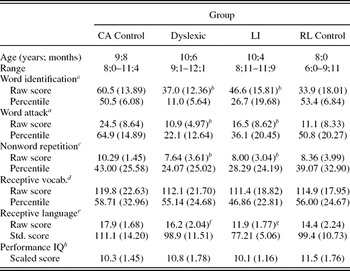
Participant groups are described in Table 1. Classification into each group was based on performance on standardized tests of reading and receptive language. Reading ability was assessed using the word identification and word attack subtests of the Woodcock Reading Mastery Tests—Revised (WRMT-R; Woodcock, Reference Woodcock1989). These tests involve reading common words or nonwords aloud. Receptive grammar was assessed using the TROG (Bishop, Reference Bishop1989). This is a broad measure of receptive language abilities including morphological and syntactic relationships, and involves listening to sentences and pointing to one of four pictures that corresponds to that sentence. Receptive vocabulary was measured using the Peabody Picture Vocabulary Test, Third Edition (PPVT; Dunn & Dunn, Reference Dunn and Dunn1997), and involves listening to words and pointing to one of four pictures corresponding to that word.
Group performance on language, reading, and cognitive measures

Note: Mean (standard deviation) raw scores are reported for standardized tests to permit comparison across age groups. CA, chronological age; LI, language impairment; RL, reading and language.
aWoodcock Reading Mastery Test, Revised (Woodcock, Reference Woodcock1989).
bLower than CA control group (p < .05 or lower).
cComprehensive Test of Phonological Processing (Wagner et al., Reference Wagner, Torgesen and Rashotte1999).
dPeabody Picture Vocabulary Test, Third Edition (Dunn & Dunn, Reference Dunn and Dunn1987).
eTest for the Reception of Grammar (Bishop, Reference Bishop1989).
fLower than CA control group and higher than LI group (p < .05 for both).
gLower than CA control, RL control, and dyslexic group (p < .05).
hMean scaled score on two performance subtests of the Wechsler Intelligence Scale for Children, Third Edition (Wechsler, Reference Wechsler1992) or Wechsler Intelligence Scale for Children, Fourth Edition (Wechsler, Reference Wechsler2003).
The dyslexic group consisted of 14 children (M = 10 years, 6 months [10;6]) who scored below the 15th percentile rank on word identification, but who had standard scores above 87 on the TROG as well as normal-range nonverbal IQ. This scheme is consistent with how previous studies have classified dyslexia as a severe delay in word reading ability that precludes a more general LI and/or general cognitive delay (Joanisse, Manis, Keating, & Seidenberg, Reference Joanisse, Manis, Keating and Seidenberg2000; Kamhi & Catts, Reference Kamhi and Catts1986; Shankweiler et al. Reference Shankweiler, Crain, Katz, Fowler, Liberman and Brady1995; Werker & Tees, Reference Werker and Tees1987).
The LI group consisted of 14 children (M = 10;4) who had a standard score of 83 or less on TROG (i.e., at least 1 SD below the mean), but whose average standard score on the performance IQ measures was between 7 and 13. This sample differed from the broader definition of SLI used elsewhere (Bishop et al., Reference Bishop, Bishop, Bright, James, Delaney and Tallal1999; Gathercole & Baddeley, Reference Gathercole and Baddeley1990; Montgomery, Reference Montgomery1995; Norbury et al., Reference Norbury, Bishop and Briscoe2001), as they were only required to show marked deficits on a grammatical comprehension test. Notably, we did not preclude children from the LI group based on concomitant reading impairments, given that doing so would have significantly limited the sample size and likely make the sample less comparable to previous studies (Catts et al., Reference Catts, Adolf, Hogan and Ellis Weismer2005; Goulandris, Snowling, & Walker, Reference Goulandris, Snowling and Walker2000; Joanisse et al., Reference Joanisse, Manis, Keating and Seidenberg2000; McArthur et al., Reference McArthur, Hogben, Edwards, Heath and Mengler2000; Snowling, Bishop, & Stothard, Reference Snowling, Bishop and Stothard2000). As a result, 4 of the 14 children in the LI group met the classification criteria for dyslexia, marked by a percentile rank below 15 on the Word Identification subtest of the WRMT-R.
Both control groups consisted of children who scored in normal ranges on reading and receptive language tests (40th–60th percentile on word identification and a standard score above 90 on TROG), and with average performance IQ standard scores between 7 and 13. The CA group consisted of 14 children matched for age with the LI and dyslexic groups, t (26) = .817, ns; t (26) = 1.42, ns, respectively. The reading and language (RL) control group consisted of 14 children who were on average 2 years younger (M = 8;0) than the LI, t (26) = 6.21, p < .001; dyslexic, t (26) = 6.63, p < .001; and CA control children, t (26) = 5.14, p < .001. The RL control group was also matched to the dyslexic group with respect to WRMT word identification, t (26) = 0.526, p = .603; and word attack scores, t (26) = 0.055, p = .956. The RL control group was also matched to the LI group with respect to PPVT receptive vocabulary raw scores, t (26) = 0.503, p = .619.
Sentence comprehension
Stimuli. In each of the three sentence comprehension tests (WM Loads 1, 2, and 3), there were a total of 24 spoken sentences used to measure sentence comprehension. There were 12 canonical sentences with 6 actives and 6 subject relatives collapsed and 12 noncanonical sentences with 6 passives and 6 object relatives collapsed. Sentence length was varied by adding adjectival information (e.g., The man is pointed at by the boy, became The man in the dark grey shirt is pointed at by the boy in the bright red pants). For each test, there were 4 short canonical, 4 short noncanonical, 8 long canonical, and 8 long noncanonical sentences. A larger number of long sentences were used to make the test more sensitive to reveal syntax problems. See Appendix A for the items used in the study.
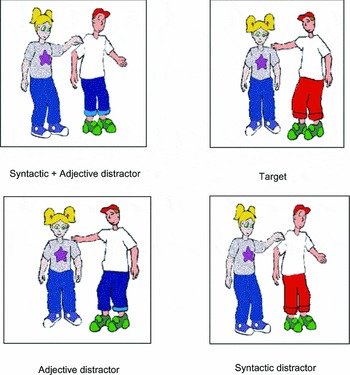
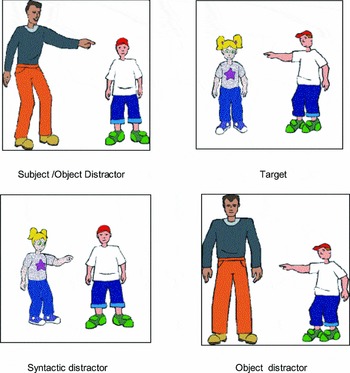
Each spoken sentence was matched to four possible pictures: one target and three distractors. In all sentences, the action was held constant across the four pictures, and in long sentences the two characters involved were also constant. For the long sentences, there was a syntax distractor in which the subject and object were reversed, an adjective distractor in which the syntactic properties were correct, but the adjective qualifying the subject or object was changed (e.g., blue pants instead of red pants), and finally a syntax + adjective distractor in which both the word order and adjective were incorrect (Appendix B, Fig. B.1). The short sentence trials also contained a syntactic distractor, like the long sentences. Because the short sentences did not have adjectives describing the subject and object, the structure of two of the distractors were different in theses trials; one involved a character that was the incorrect subject, and the second involved an incorrect object and subject (Appendix B, Fig. B.2).
Procedures. Sentences were presented binaurally via headphones in a sound-attenuated booth on a PC desktop computer (children were asked to set the volume to a comfortable level during the practice trials), in random order. Children were instructed to point to the picture that depicted the sentence they heard. The experimenter coded responses by pressing the appropriate key. Children were told before the test trials that they could only hear the sentence one time and that they should listen carefully. If a child asked the experimenter to repeat the sentence during the test trials, it was coded as incorrect (for the purpose of error analyses, these were coded as “repetition” errors).
Children were tested on three different sentence comprehension tests, with increasing WM loads in each. Each WM load had four practice trials, presented with feedback. In WM Load 1, children viewed the four pictures on a computer screen while listening to the sentence; the pictures were presented for 2000 ms before the onset of the sentence, and remained on the screen for the entire duration of the sentence. In WM Load 2, memory load was increased by presenting the entire sentence before the picture array appeared (0-ms delay). In WM Load 3, there was a 3000-ms delay between the offset of the sentence and the pictures stimuli, which was intended to further increase WM demands. One CA control participant declined participation in the WM Load 3 test.
Phonological STM
Phonological STM was tested using the nonword repetition subtest of the Comprehensive Test of Phonological Processing (Wagner, Torgesen, & Rashotte, Reference Wagner, Torgesen and Rashotte1999), which required children to listen to and repeat nonsense words presented on tape. The items ranged from monosyllabic nonwords to nonwords with seven syllables. An item was marked as incorrect if one phoneme was repeated incorrectly. The stop rule in this test was to discontinue if a child failed three consecutive items.
RESULTS
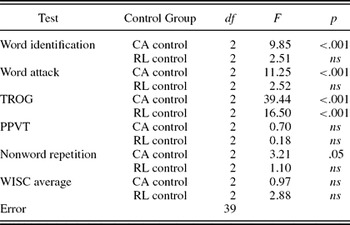
A series of one-way analyses of variance (ANOVAs) were first conducted to verify group differences on the classification measures (Table 2). In the first set, the CA control group was compared to the dyslexic and LI groups, and significant group effects were followed with Tukey post hoc comparisons. A second set of ANOVAs was conducted to examine differences between the RL control, dyslexic, and LI groups. Two sets of ANOVAs were conducted for each control group because we intended first to examine whether children with dyslexia and/or LI showed impairments relative to the age-matched controls, and second, whether their performance was similar or different to younger controls. Raw scores were used throughout, because these are more appropriate for comparing overall performance in the younger control group to that of the dyslexic and LI groups (Table 1).
Results from one-way ANOVAs of group effects on language, reading, and cognitive measures

Note: ANOVA, analysis of variance; CA, chronological age; RL, reading and language; TROG, Test for the Reception of Grammar (Bishop, Reference Bishop1989); PPVT, Peabody Picture Vocabulary Test, Third Edition (Dunn & Dunn, Reference Dunn and Dunn1987); WISC, Wechsler Intelligence Scale for Children, Third Edition (Wechsler, Reference Wechsler1992). In all cases, the control groups are compared to the dyslexic and LI groups. The ANOVAs are based on raw scores, with the exception of the average WISC score, which is scaled.
Comparisons of the LI, dyslexic and CA control groups showed an effect for word identification raw scores. The dyslexic and LI groups scored significantly lower than the CA control group (p < .001 and p < .05, respectively) but did not differ from each other (p > .05). A similar effect was found for word attack, with post hoc tests showing both the dyslexic and LI groups had lower scores the CA control group (p < .001 and p < .05, respectively), but did not differ from each other (ns). For TROG raw scores, we observed a significant group effect, and lower scores in the LI group compared to both the CA control group and the dyslexic group (p < .001 for both); the dyslexic group also had significantly lower scores than the CA control group (p < .05). In contrast, no effect was found for PPVT raw scores or WISC scaled scores.
The second set of ANOVAs examined group differences between the RL control, dyslexic, and LI groups. In this case there were no significant group effects on either the word identification or word attack raw scores. There was a significant group effect on TROG, with post hoc tests revealing lower scores in the LI group compared to the RL control group (p < .01). There were no group differences on PPVT raw scores or average WISC scores.
We also examined group differences on the nonword repetition test. The first analysis examined the dyslexic, LI, and CA control groups, and revealed a marginally significant group effect. Planned comparison two-tailed independent t tests revealed that the CA control group had higher scores than the dyslexic, t (26) = 2.35, p < .05, and LI groups, t (26) = 2.29, p < .05, which did not differ from each other, t (26) = 0.28, ns. No effect was found for a similar ANOVA comparing the dyslexic, LI, and CA control groups.
Sentence comprehension accuracy
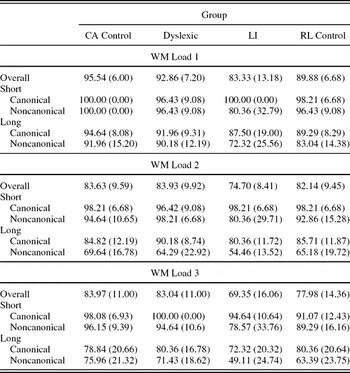
The group means for each sentence comprehension test (WM Loads 1, 2, and 3) are provided in Table 3. Means are illustrated for overall performance, as well as performance on each sentence type. Mixed ANOVAs were conducted to examine effects of group, sentence type (canonical vs. noncanonical), and length (short vs. long) separately for each WM load. Significant main effects of group were followed with Tukey post hoc comparisons. Interactions were followed up with planned comparisons (paired t tests). In the first set of ANOVAs, the CA control group was compared to the dyslexic and LI groups. The second set compared the RL control, dyslexic, and LI groups.
Group percentages on sentence comprehension tests

Note: CA, chronological age; LI, language impairment; RL, reading and language; WM, working memory. There were four types of each short sentence and eight types of each long sentence in each WM load.
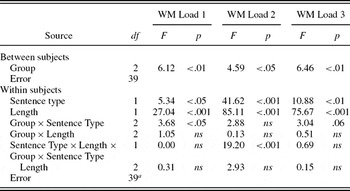
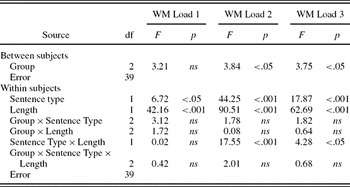
The results of the CA control group mixed ANOVAs for the three WM loads are illustrated in Table 4. In WM Load 1, there was a significant main effect of group and Tukey post hoc tests revealed that the LI group had lower scores than the CA control group (p < .01) and the dyslexic group (p < .05), and there were no differences between the CA control and dyslexic groups (ns). There were also significant main effects of sentence type and length. The significant Group × Sentence Type interaction was followed up by separately examining mean scores within groups. Planned comparisons revealed that only the LI group performed more poorly on noncanonical sentences compared to canonical sentences, t (13) = 2.02, p < .05; the CA, t (13) = 0.49, ns, and dyslexic groups, t (13) = 0.61, ns, did not differ on the two sentence types. No other interactions were significant.
Results of mixed ANOVA for sentence comprehension accuracy: Group (CA Control × Dyslexic × LI) × Sentence Type × Length

Note: ANOVA, analysis of variance; CA, chronological age; LI, language impairment; WM, working memory.
aWM Load 3 df = 38.
In WM Load 2, there was a significant main effect of group, and Tukey post hoc tests revealed that the LI group had lower scores than the CA control group and the dyslexic group (p < .05 for both), and there were no differences between the CA control group and the dyslexic group (ns). There were also significant main effects of sentence type and length. There was a significant interaction between sentence type and length. Planned comparisons revealed the effect of sentence type was stronger in long sentences, t (41) = 7.77, p < .001, compared to short sentences, t (41) = 2.13, p < .05. No other interactions were significant.
In WM Load 3, there was a significant main effect of group, and Tukey post hoc tests revealed that the LI group had lower scores than the CA control group and the dyslexic group (p < .01 and p < .05, respectively), and there were no differences between the CA control group and the dyslexic group (ns). There were also significant main effects of sentence type and length. There was a marginally significant interaction between group and sentence type. Planned comparison paired t tests conducted in each group separately revealed that both the LI, t (13) = 3.45, p < .01, and dyslexic groups, t (13) = 2.12, p < .05, showed poorer performance on noncanonical sentences compared to canonical sentences, but the CA control group showed no difference between the two sentence types, t (12) = 0.44, ns. No other interactions were significant.
A second set of ANOVAs was conducted to examine group differences among the LI, dyslexic, and RL control group in each of the three WM loads (Table 5). In WM Load 1, the main effect of group was not significant. There were significant main effects of sentence type and length, and there were no significant interactions.
Results of mixed ANOVA for sentence comprehension accuracy: Group (RL Control × Dyslexic × LI) × Sentence Type × Length

Note: ANOVA, analysis of variance; RL, reading and language; LI, language impairment; WM, working memory.
In WM Load 2, there was a significant main effect of group. However, Tukey post hoc tests revealed again that the LI group performed more poorly than the dyslexic group (p < .05), and the RL control group did not differ from either the LI or dyslexic groups (ns for both). Again, there were significant main effects of sentence type and length. There was a significant interaction between sentence type and length. Planned comparisons revealed the effect of sentence type was stronger in long sentences, t (41) = 7.47, p < .001, compared to short sentences, t (41) = 2.30, p < .05. No other interactions were significant.
In WM Load 3, there was a significant main effect of group. However, Tukey post hoc tests again revealed that the LI group only performed more poorly than the dyslexic group (p < .05) and the RL control group did not differ from either the LI or dyslexic groups (ns for both). There were significant main effects of sentence type and length and a significant interaction between sentence type and length. Planned comparisons revealed there was an effect of sentence type in long sentences, t (41) = 5.21, p < .01, but not in short sentences, t (41) = 1.96, ns. No other interactions were significant.
Correlations between nonword repetition and sentence comprehension
We also examined the relationship between phonological STM and sentence comprehension performance. We computed bivariate Pearson correlations between raw nonword repetition scores and overall accuracy in each of the three WM loads, across all participants in all groups. Significant correlations were observed for Loads 2 and 3, but not for Load 1 (WM Load 1: r = .25, ns; WM Load 2: r = .29, p < .05; WM Load 3: r = .28, p < .05). The same pattern of results were obtained when we employed the nonparametric Spearman correlations (WM Load 1: r = .168, ns; WM Load 2: r = .205, p < .05; WM Load 3: r = .208, p < .05).
Distribution of sentence comprehension errors
We next examined the types of errors observed in each group. Analyses were restricted to long noncanonical sentences collapsed across WM Loads 2 and 3 (WM Load 1 was excluded because of the very small error rates in the control and dyslexic groups in those trials). We focused on long sentences to take advantage of a critical structural differences among the distractors: these sentences contained relevant adjectival information (e.g., man in the grey shirt vs. man in the brown shirt) and as such errors could be based on a failure to process only propositional information (e.g., the identity of the agent or patient of a sentence), syntactic information (the reversal of the subject and object), or the combination of the two (see Appendix B, Fig. B.1). In contrast, distractors in the short sentences were structurally different in this respect, and thus errors on these items were less informative about children's response strategies (see Appendix B, Fig. B.2).
A nonparametric Wilcoxon signed ranks test was conducted within each group to determine whether children made more syntax errors than adjective errors. This test compared the number of participants who made more syntax errors than adjective errors to the number of participants who made more adjective errors than syntax errors. A greater number of syntax versus adjective errors would indicate that difficulty in sentence processing is grounded in syntactic processing above and beyond storage demands. If there were no such differences between the number of syntax and adjective errors, this would suggest that sentence processing was affected by storage demands.
Error data are listed in Table 6. Notably, the majority of errors across all participants were either syntactic or adjective (39.44% and 49.81%, respectively) and few syntax plus adjective or repetition errors were made (10.44% and 1.31%, respectively). The LI group showed a marginally significant effect (z = 1.93, p = .053), marked by a greater number of children showing more syntax errors than adjective errors than vice versa. No significant effects were found for the dyslexic (z = 0.55, ns), CA control (z = 0.91, ns), and RL control (z = 0.53, ns) groups.
Distribution of syntax versus adjective errors in long noncanonical sentences collapsed across working memory loads 2 and 3

Note: CA, chronological age; LI, language impairment; RL, reading and language.
DISCUSSION
The goal of this study was to examine the extent and the nature of sentence comprehension deficits in dyslexia by comparing them to what is observed in children with LI. A sentence–picture matching task was used in which sentence type was manipulated by using canonical versus noncanonical word order, and sentence length was manipulated by using short and long sentences. Sentence comprehension was tested under three different WM loads, by varying the delay between the presentation of the sentence and the pictures. Evidence for the presence of syntax deficits in dyslexia has been equivocal in previous studies. The current study addressed the ambiguity in a number of ways. We compared sentence comprehension in the dyslexic group not only to that of control children but also to children with LI, who show characteristic syntax deficits. In addition, we employed clear manipulations of syntactic difficulty and verbal WM to evaluate the extent to which sentence comprehension problems in dyslexia and LI were grounded in syntactic processing over verbal WM limitations.
In WM Load 1, pictures and the spoken sentences were presented simultaneously. This allowed children to refer to different pictures as they heard the sentence. In this case, we failed to observe appreciable sentence comprehension difficulties in the dyslexic group, regardless of syntactic complexity or length. In contrast, the LI group showed impaired performance on this task, marked by lower scores compared to both the CA control and dyslexic groups. In particular, they showed specific difficulty processing noncanonical sentences, suggesting their deficit was localized to processing the form of sentences. This was not surprising, given that classification of LI was based on extremely poor performance on a comprehension test of morphosyntax. In addition, numerous other studies have observed similar difficulties in language-impaired children (van der Lely, Reference van der Lely1994, Reference van der Lely1996; van der Lely & Harris, Reference van der Lely and Harris1990). Notwithstanding, few studies have examined how verbal WM interacts with syntactic processing in SLI, despite the two large bodies of literature on syntax deficits and phonological STM deficits in this group. Our study indicates that language-impaired children show syntax deficits even when verbal WM is minimized.
In WM Load 2, we manipulated the delay between the auditory sentence and the onset of the visual probe. The manipulation builds on the observation in some studies that sentence comprehension difficulties in dyslexia will tend to be more pronounced in the case of stronger WM constraints (e.g., Mann et al., Reference Mann, Shankweiler and Smith1984; Rispens et al., Reference Rispens, Roeleven and Koster2004) compared to others that have not (e.g., Shankweiler et al., Reference Shankweiler, Crain, Katz, Fowler, Liberman and Brady1995). In this case, children in all groups showed a decrement in performance, especially on the noncanonical sentences. This pattern suggested that syntactic processing difficulties can be induced by increasing storage and processing demands, similar to what has been shown in prior studies of adults and children (Dick et al., Reference Dick, Bates, Wulfeck, Gernsbacher, Utman and Dronkers2001; Leech, Aydelott, Symons, Carnevale, & Dick, Reference Leech, Aydelott, Symons, Carnevale and Dick2007).
When WM demands were further increased by placing a 3-s delay between the spoken sentence and the pictures (WM Load 3), a somewhat different pattern emerged. The LI, dyslexic, and RL control groups showed poorer performance on noncanonical compared to canonical sentences; however, this effect was not apparent in the CA control group. Overall, our pattern of results is similar to the pattern observed by Rispens and Been (Reference Rispens and Been2007); we observed that the dyslexic group showed better syntactic processing than the LI group. Moreover, we have some evidence that syntactic processing in the dyslexic group was more influenced by verbal WM demands than what was shown in the CA control group.
One explanation for why the CA control group was less influenced by syntactic complexity in the longest delay test is that these children were actually using the additional time to rehearse the spoken sentence before responding, which facilitated processing. Because the CA control group had generally higher phonological STM scores compared to the other groups, it seems possible that they were using their strong storage skills during these 3 s. In this respect, the shorter delay (WM Load 2) may not have provided enough time even for control children to rehearse the material. In contrast, the dyslexic, LI, and RL control groups all had similar phonological STM scores, and these three groups also performed more poorly on noncanonical sentences, compared to canonical sentences, in the 3-s delay condition. The CA control group's stronger storage could have facilitated the syntactic parsing of the utterance during the 3-s delay.
Although the dyslexic and CA control groups did not differ significantly on overall accuracy in WM Load 3, the dyslexic group did show an effect of sentence type whereas the CA control group did not. This points to the possibility that dyslexic children's syntactic processing was more likely to be influenced by verbal WM demands than their same-age peers. This seems consistent with earlier findings of sentence comprehension difficulties in dyslexia, especially under tasks that appear to impose greater WM loads (Mann et al., Reference Mann, Shankweiler and Smith1984; Shankweiler et al., Reference Shankweiler, Smith and Mann1984). For instance, in the Shankweiler et al. (Reference Shankweiler, Smith and Mann1984) study, children were asked to first listen to a sentence and then manipulate objects in accordance with it. Note that other studies (e.g., Shankweiler et al., Reference Shankweiler, Crain, Katz, Fowler, Liberman and Brady1995), have failed to find a syntactic deficit in dyslexia, although in those cases children made judgments for auditory sentences concurrently with the exact pictorial representation among distractor pictures, similar to what was done in WM Load 1 in the present study.
The present study also manipulated the length of sentences. This did have an effect on overall comprehension of the sentence, such that long sentences were consistently harder to process than short sentences. Notably, there was also evidence that length interacted with syntactic complexity, such that only noncanonical sentences were more difficult to process in the long versus short condition. The longer sentences not only contained more words than the shorter sentences, but the extra words contained important adjectival information that needed to be encoded to correctly interpret the target. These heavier storage demands influenced sentence comprehension in all groups of children. However, the length manipulation did not interact with group in any of the three WM loads, suggesting that it influenced children from all groups equally. This pattern is different from what Montgomery (Reference Montgomery1995) observed in an earlier study; length influenced sentence comprehension accuracy in SLI, but not in controls. However, the syntactic and length manipulations in the current study appeared to be more difficult than those in the Montgomery study, and perhaps more sensitive to changes in sentence comprehension accuracy even in typically developing children.
The distribution of syntactic versus adjective errors in the long noncanonical sentences also revealed interesting differences across groups. We observed important differences in how children in the LI group were performing on this task, compared to the dyslexic and control groups. Specifically, language-impaired children were more likely to commit syntactic reversal errors (e.g., reversing the subject and object of a sentence), which suggests that they had difficulty representing or maintaining the configural aspects of a sentence. We interpret this error pattern as evidence that these children tend to fall back on the default English subject–verb–object word order as sentence complexity increases. However, it is also possible that they were trying to represent both the adjectives and word order correctly, but that word order was more difficult for them and resulted in a greater number of errors. In contrast, children in the control and dyslexic groups showed a more even distribution of syntactic and adjective errors. This suggests they recognized that both adjective and word order information were critical to the task, especially for the long sentences. If these children aimed to correctly represent both the sentence's propositional and syntactic forms, it is reasonable to assume that they would make errors on both types of information.
The younger control group had similar reading levels as the dyslexic group and similar vocabulary levels as the LI group. The purpose of this group was to help determine whether any observed syntactic processing difficulties were based on a delay that could potentially be explained by limited reading and vocabulary experience. The dyslexic and LI groups tended to score at about the same level as the RL controls, raising the possibility that sentence comprehension performance might be influenced by experience. However, the LI group showed proportionately more syntax-level errors compared to the RL control group, suggesting this may be a key difference between the dyslexic and LI groups.
The present data suggest it may also be interesting to compare language-impaired children with younger controls scoring similarly on tests of grammatical ability. Such a design would allow us to more fully assess whether the error patterns observed in the LI group represent a point of departure from the typical developmental pattern. Likewise, this study only examined sentence comprehension with respect to a word order manipulation. It remains an open question whether observed differences between dyslexic, language-impaired, and typically developing children will persist with respect to other types of syntactic manipulations as well.
Can STM or WM explain sentence comprehension deficits?
Phonological STM, measured with nonword repetition, was significantly correlated with sentence comprehension accuracy. The data suggest that accurate storage of phonological information contributes to how children understand auditory sentences, in particular, when processing demands are increased. On one account, phonological STM is a subsystem of WM that acts as a slave module for a central executive system responsible for actual processing (Baddeley, Reference Baddeley1981); however, other views see storage and processing as more closely related, such that phonological STM capacity plays a more central role in actual WM for sentence processing (Just & Carpenter, Reference Just and Carpenter1992).
The present data also reflect the fact that spoken sentence comprehension ultimately requires processing beyond the storage of verbal material. Although phonological STM did correlate with sentence comprehension, not all children with poor STM scores scored equally poorly on sentence comprehension. Even though both the dyslexic and LI groups showed deficits on nonword repetition, the LI group showed much more severe sentence comprehension difficulties. Thus, STM alone cannot account for the syntactic difficulties we observed here.
There are two possible explanations. The first is that the occurrence of an STM and sentence comprehension deficit in SLI is purely coincidental, such that the two are not closely related (Bishop, Adams, & Norbury, Reference Bishop, Adams and Norbury2006; van der Lely & Harris, Reference van der Lely and Harris1990). On this view, it is argued that language-impaired children showed a qualitatively different pattern of performance given that they were the only group that showed a specific difficulty in the minimal WM load condition, and the only group that tended to make errors primarily based on syntax. The alternative is that the locus of the impairment in SLI is one of verbal WM, which incorporates both storage and processing, rather than being localized to STM (i.e., storage only). On this theory, language-impaired children have difficulty with syntactic processing because of a limitation in the ability to manipulate verbal information as it is held in a short-term store (Gathercole & Baddeley Reference Gathercole and Baddeley1990; Montgomery, Reference Montgomery1995). The results of the present study seem consistent with this. Children with LI did show a decrement in processing sentences as WM load was increased; likewise, the dyslexic and control children showed an LI-like pattern of deficit when a load was imposed. This is also consistent with the theory that WM limitations tend to impact sentence processing, especially as it relates to structurally complex sentences (Just & Carpenter, Reference Just and Carpenter1992; MacDonald & Christiansen, Reference MacDonald and Christiansen2002).
CONCLUSION
The purpose of this study was to examine the extent and the nature of sentence comprehension deficits in dyslexia by comparing them to children with LI. Of interest, we observed different patterns of impairment in the two groups. Overall, the dyslexic group showed better sentence comprehension than the LI group. However, there was also evidence that syntactic processing problems under demanding verbal WM loads were more pronounced in dyslexia and LI than in same-age control children. In addition, both dyslexic and LI groups showed poor phonological STM outside the domain of sentence comprehension. The finding that phonological STM was significantly correlated with sentence comprehension accuracy under demanding storage and processing conditions suggests good storage skills facilitate spoken sentence comprehension, and that this may be why sentence comprehension was mildly impaired in dyslexia. In contrast, the LI group showed significant difficulty with syntactic processing even when WM load was minimized. These results support the idea that nonphonological language processing is generally better in children with dyslexia than in children with oral LIs (Bishop & Snowling, Reference Bishop and Snowling2004). However, they also suggest that syntactic processing in all children can be influenced by task demands and by individual differences in phonological STM capacity. Thus, the data suggest that both dyslexic and language-impaired children are susceptible to difficulties in syntactic processing, and although the groups clearly differed in terms of degree of impairment, increased WM load does tend to draw out difficulties that were not apparent when WM load is minimized.
APPENDIX A
Short sentences
1. Canonical, active
The man is pointing at the boy.
The doctor pinches the girl.
2. Canonical, subject relative
This is the boy that points at the man.
This is the girl that pinches the doctor.
3. Noncanonical, passive
The boy is tapped by the girl.
The man is pointed at by the boy.
4. Noncanonical, object relative
This is the boy that is pointed at by the man.
This is the man that is pointed at by the boy.
Long sentences
1. Canonical, active
The doctor with the short blue hair is pinching the girl with the nice blond hair.
The boy in the dark blue pants waves at the man in the dark gray shirt.
The mother with the long brown hair washes the girl with the nice blond hair.
The boy in the dark blue pants taps the girl with the nice black hair.
2. Canonical, subject relative
This is the girl with the nice blond hair that washes the mother with the long brown hair.
This is the boy in the dark blue pants that taps the girl with the nice blond hair.
This is the doctor with the short red hair that pinches the girl with the nice blond hair.
This is the man in the dark gray shirt that waves at the boy in the dark blue pants.
3. Noncanonical, passive
The boy in the dark blue pants is tapped by the girl with the nice blond hair.
The doctor with the short red hair is pinched by the girl with the nice blond hair.
The girl with the nice blond hair is washed by the mother with the short brown hair.
The boy in the dark blue pants is waved at by the man in the dark gray shirt.
4. Noncanonical, object relative
This is the man in the light brown shirt that is waved at by the boy in the dark blue pants.
This is the girl with the nice blond hair that the boy in the dark blue pants taps.
This is the boy in the dark blue pants that the man in the dark gray shirt waves at.
This is the girl with the nice blond hair that the mother with the long brown hair washes.
APPENDIX B
Examples of picture targets and distractors in long sentences. The display for the long sentence is the following: This is the boy in the bright red pants that taps the girl with the nice blond hair. [A color version of this figure can be viewed online at journals.cambridge.org/aps]

Examples of picture targets and distractors in short sentences. The display for the short sentence is the following: This is the boy that points at the girl. [A color version of this figure can be viewed online at journals.cambridge.org/aps]