


1. INTRODUCTION
1.1 The objectives of the study
This paper addresses the semantics of constructions coding the ability to be perceived. The focus is on constructions involving the Finnish verb of phenomenon-based perception kuulua ‘to be perceptible (through hearing)’. The subject of these types of verbs codes the stimulus giving rise to a potential perception, while the experiencer of the perception remains implicit (on the types of phenomenon-based perception verbs, see Viberg Reference Viberg2015:99–101). When considering verbs expressing emotional, cognitive, perceptual and bodily experiences in general, the experiencer is inherently an animate, conscious being. The stimulus role, on the other hand, can be occupied by various types of animate or inanimate entities, whose position in regard to the experiential situation can be construed in different ways (Verhoeven Reference Verhoeven2014:130).
As a verb of perceptibility, kuulua can refer to the potentiality of being heard or to the (in)ability of being perceived through unspecified sensory input. When it comes to auditory perceptibility, kuulua ‘to be audible, to sound’ (hereafter kuulua PERC) leaves the agent of the process implicit and is considered to be incompatible with a human subject (VISK Reference = Auli Hakulinen, Vilkuna, Korhonen, Koivisto and Alho2004:§1321; von Waldenfels Reference Von Waldenfels, Leino and von Waldenfels2012:215) (see the examples in (1)). In a negative clause, kuulua can code not only inaudibility but also the non-appearance of an entity in a given location: ‘to be imperceptible (through unspecified sensory input)’ (hereafter, kuulua APP). This latter type of construction, seen in (2) below, has been regarded to be reserved mostly for animate reference (Huumo Reference Huumo2010: 91–92).Footnote 1
(1)
Footnote 2
(2)


Clauses with kuulua PERC referring to a quantitatively indefinite entity can be classified as existentials (Huumo Reference Huumo2010:91).Footnote 3 The clause in (3) displays the typical features of Finnish existential sentences.
(3)

Their word order is AVS, with A being a locative adverbial (in (3), kaikkialta ‘from everywhere’). This makes them different from non-existential intransitive clauses, which follow the SVA pattern. In existential clauses, the verb is in the third person singular regardless of the person and number of the syntactic subject, whereas most non-existential clause types display subject–verb agreement. In positive existential clauses, the subject referring to a count referent is in the nominative case when in singular form and in the partitive case when in plural (in (3), huuto-j-a ‘shout-pl-part’). The non-count subject is in the partitive (in (3), nauru-a ‘laughter-part’, kirkuna-a ‘screaming-part’). This variation in subject case marking distinguishes existential clauses from other clause types.
In negative existentials, the singular subject with countable reference is also in the partitive. In this sense, the clauses with kuulua APP can likewise be regarded as a type of existential use of kuulua (see example (2) above).Footnote 4
The present paper investigates the grammatical differences and overlaps between the uses of the Finnish verb kuulua as a verb of auditory perceptibility and as a verb of non-appearance and proposes an explanation for the link between the meanings of kuulua and the degree of animacy of the subject referent, existentiality and negation. In so doing, the paper sheds light on the semantic anatomy of perceptibility and the different types of conceptualization of the relationship between the experiencer and the experienced. It shows that an expression of perceptibility can perform functions both on the level of objective conceptualization, where the construal of the situation by the subject of conceptualization (hereafter, SoC) is profiled, and on the level of intersubjective conceptualization, where the cognitive coordination between SoCs is foregrounded (see Verhagen Reference Verhagen2005:16–19). The main outcome of the analysis is that kuulua PERC codes the SoC's experience of the appearance of an auditory signal, in other words, the relationship between the experiencer and the world, whereas kuulua APP indicates the intersubjective experience of the non-appearance of an interactional (conversational, behavioural) move, that is, the cognitive coordination between SoCs.
The remainder of the paper is organized as follows: Section 1.2 presents the data and Section 1.3 gives an overall picture of the polysemy and the morphological structure of the verb kuulua. In Section 2, I introduce the most important semantic and syntactic concepts involved in the study. In Section 2.1, I discuss linguistic animacy as a gradual category in connection with other prominence scales, such as individuality and agency. I also note the link between animacy and the potential to be part of the cognitive coordination between SoCs. In Section 2.2, I look at the meaning of perceptibility through the notions of dynamic modality and fictive motion and discuss perceptibility in relation to the general typology of expressions of perception. In Section 2.3, I consider the grammatical and semantic properties of existential sentences and the dynamics between existentiality and perceptibility. In Section 3, I analyse the syntax and semantics of the kuulua perc and kuulua app constructions in the data according to the degree of subject animacy and with regard to the negative existential meaning. In Section 3.1, I look at the auditory perceptibility denoted by kuulua perc constructions and the variation between existential and non-existential constructions within kuulua perc utterances, and in Section 3.2, I explore the connection between animacy, the meaning of non-appearance and existential predication. Finally, I discuss the outcomes of the analysis in Section 4 in terms of intersubjective meaning construal.
1.2 Data
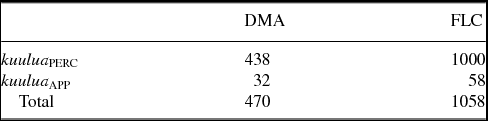
The data is composed of two subsets. One was extracted from the Digital Morphology Archives (hereafter, DMA) comprising spoken dialect data.Footnote 5 The other was drawn from the Corpus of Finnish Literary Classics (FLC) comprising mainly prose and drama but also poetry and aphorisms from the 1880s until the 1930s. The search was carried out in all dialect groups in the DMA and in all literary productions present in the FLC. All occurrences of kuulua perc and kuulua app were collected (for the constructions excluded from the data, see Section 1.3). References for the corpora can be found at the end of the paper. The data contained 1,528 occurrences of kuulua. Table 1 presents the occurrences in the two subsets of the data according to the meaning of kuulua.
Kuulua in the dialect data (DMA corpus) and the literary data (FLC corpus).

The main reasons for selecting these two corpora was their vastness (as occurrences of kuulua app were predicted to be of a relatively low frequency) and the possibility of running searches by using the different flexional forms of kuulua as keywords. Using the FLC corpus also allowed me to investigate kuulua in prose dialogues, which make use of the characteristics of everyday conversations (see Nykänen & Koivisto Reference Nykänen and Koivisto2016) and in which participants’ expectations are often more or less explicitly presented. Moreover, I was able to analyse long stretches of text and thus take into account the complexity of the contextual factors contributing to the interpretation of kuulua.
While the DMA represents non-standard variants of Finnish spoken by informants born at the end of the 19th and the beginning of the 20th centuries, the FLC reflects language use in the decades when standard Finnish was emerging. The fact that both corpora consist of relatively old language use meant there was a possibility that uses of kuulua perc and kuulua app unknown to the contemporary standard Finnish could occur. However, drawing on the author's judgment as a native speaker, the occurrences of kuulua perc and kuulua app in the two subsets of the data displayed no significant differences from contemporary uses of these verbs.
1.3 The structure and polysemy of kuulua
Kuulua (vowel stem kuulu-) is derived, with a general intransitivizing affix -U-, from the verb kuulla (vowel stem kuule-, consonant stem kuul-), denoting auditory experience (‘to hear’) (for the system of perception verbs in Finnish, see Huumo Reference Huumo2010:52–54). There are other existential verbs in Finnish constructed with the affix -U- and entailing an implicit experiencer (e.g. näk-y-ä ‘to be visible’, löyt-y-ä ‘to be found’) (see Duvallon Reference Duvallon2009:85–87).
The so-called derivational passive constructions (VISK Reference = Auli Hakulinen, Vilkuna, Korhonen, Koivisto and Alho2004:§1344–1346) are also formed with the affix -U- (e.g. Puut kaat-u-i-vat ‘The trees make.fall-u-pret-3pl’ > ‘The trees fell’). The link between perceptibility verbs and the passive voice is explicitly manifested in languages where source-based auditory perception is coded by the passive form derived from the experiencer-based perception verb ‘hear’. This is the case in Swedish where all perceptibility verbs are marked with the morphological passive marker, for example, höra-s ‘hear-pass’ > ‘to be audible’ (see Viberg Reference Viberg2015:100; for an illustration in Dongolawi, see Jakobi & El-Guzuuli Reference Jakobi and El-Guzuuli2013:207). The link with the passive voice is understandable because expressions of perceptibility background the actual experiencer, code the stimulus as their grammatical subject and entail that the stimulus can potentially be perceived by anyone who should find themselves in the position of the experiencer.
In Finnish, the semantics of derivational passives and kuulua constructions are, however, fundamentally different. Unlike perception, the process coded by a derivational passive entails a change in the state of the subject referent. Moreover, Finnish derivational passives could actually be considered as a type of anticausative constructions (see Huumo Reference Huumo2010:54). They produce a reflexive and automative meaning and do not include an animate participant (either implicitly or explicitly) that is comparable to the experiencer in constructions with kuulua (see Hakulinen Reference Hakulinen1979:269–271; VISK Reference = Auli Hakulinen, Vilkuna, Korhonen, Koivisto and Alho2004:§334–336, 1344–1346).
When used as a verb of perceptibility, kuulua takes either a NP, as in (1)–(3), or a finite complement clause (4) as subject. It can also form a construction with a participial form (5).
(4)
(5)


When associated with a perception verb, complement clauses and non-finite constructions are susceptible to coding meanings other than the actual event or object of perception (see Dik & Hengeveld Reference Dik and Hengeveld1991, Boye Reference Boye2010).Footnote 6 A salient example of this is the evidential use of the verb kuulua to mark information as hearsay (as in (4) above) (VISK Reference = Auli Hakulinen, Vilkuna, Korhonen, Koivisto and Alho2004:§1493).Footnote 7 Occurrences of kuulua with a complement clause or a non-finite construction were therefore excluded from the data, in order to focus attention on the so-called immediate perception, as opposed to knowledge acquired.
For the same reason, occurrences of kuulua expressing the impression evoked by the perception, such as comparison (‘sound like’) or speaker's evaluation (‘sound adjective’, see (6)), were also excluded from the data (see Huumo Reference Huumo2010:53).
(6)

These constructions comprise a complement in ablative or allative (in (6), kaonii-lle ‘beautiful-all’). In contemporary standard Finnish, another derived form kuulostaa ‘sound (like)’ is used in these contexts.
Apart from its uses as a verb of perceptibility, kuulua can convey the meaning ‘belonging to someone or something’:
(7)
(8)


This is considered to be a relatively recent meaning extension, possibly motivated by the uses of gehören in German and (till)höra in Swedish (Hakulinen Reference Hakulinen1979:483; Häkkinen Reference Häkkinen1987; see also Viberg Reference Viberg, de los Ángeles Gómez González, Mackenzie and Álvarez2008:152–153). As these occurrences of kuulua do not display the meaning of (immediate) perception, they were not included in the data.
2. THEORETICAL PREMISES
2.1 Animacy, individuality and intersubjectivity
There is no one-to-one equivalence between the linguistic concept of animacy and the biological meaning of the term that distinguishes entities that are alive from those that are not. Yamamoto (Reference Yamamoto1999) calls this latter animacy as such. Linguistic animacy, or inferred animacy (ibid.), is a gradient category that interacts with other semantic properties and contextual factors (see also Kittilä, Västi & Ylikoski Reference Kittilä, Västi, Ylikoski, Kittilä, Västi and Ylikoski2011:5–6).
In the Animacy hierarchy, the highest position is occupied by the most animate entities (the speech act participants) and the lowest by the most inanimate (abstract entities) (see Silverstein Reference Silverstein and Dixon1976; for a discussion, see Yamamoto Reference Yamamoto1999:24–36; Lockwood & Macaulay Reference Lockwood and Macaulay2012). The order of entities on the animacy scale is based on properties other than the actual degree of ‘being alive’. The speech act participants’ viewpoint, ranking highest on the scale, is the most accessible to the speaker, whereas the other animate beings (referred to using third person forms) do not necessarily share the same spatiotemporal setting with the interlocutors (see Langacker Reference Langacker1991:307). Following on from this, as emphasized by Langacker (Reference Langacker1991:306–307) (see 9), the entities ranking high on the animacy scale are more likely to produce an empathic response in the speaker than those ranking low (Kuno & Kaburaki Reference Kuno and Kaburaki1977:653).
(9) speaker > hearer > human > animal > physical object > abstract entity (Langacker Reference Langacker1991:307)
Animacy also correlates with individuality, that is, the property of being independent of others, directly identifiable and persistent through time (Fraurud Reference Fraurud1996; Dahl Reference Dahl2008:147–148). Singular entities that we know the most about and which resemble us are most likely to become individuated (see Fraurud Reference Fraurud1996:79–80). This also explains the position of abstract entities at the lowest level of the scale. Theoretical, non-material entities are not likely to be conceptualized as individuals.
Dahl's (Reference Dahl2008) cognitive scale, in (10), reflects the grammatical animacy hierarchy and takes into account the role of individuation.
(10) self – other animate individuals – inanimate objects
It places self (the speaker as an individual different from others) as the starting point of the hierarchy that describes the order in which we treat individuals cognitively. It shows the central role played by animacy in our approach to entities other than ourselves but stops short of making further distinctions between different types of animates and inanimates.
In this paper, the notion of animacy is considered on three fronts. First, the implicit perceiver of a kuulua clause is a being who is capable of receiving an auditory signal and giving meaning to it. Second, animacy is linked with the notions of agency and subjecthood. In contrast to inanimate entities, the most animate beings have the capacity to ‘volitionally initiate physical activity’ (Langacker Reference Langacker1991:285; see also Van Valin & Wilkins's (Reference Van Valin, Wilkins, Shibatani and Thompson1996:314–315) typology of agentive properties).Footnote 8 In terms of semantic roles, sentience makes animate beings the most typical experiencers. When combined with volition, it also makes them the most typical agents (Dowty Reference Dowty1991:577; Dahl Reference Dahl2008:145; see also Kittilä et al. Reference Kittilä, Västi, Ylikoski, Kittilä, Västi and Ylikoski2011:11–13) and, on a syntactic level, the most typical subject referents (Dahl & Fraurud Reference Fraurud1996). The different types of perception verbs are characterized by different degrees of animacy and agency of the participants (see Section 2.2).
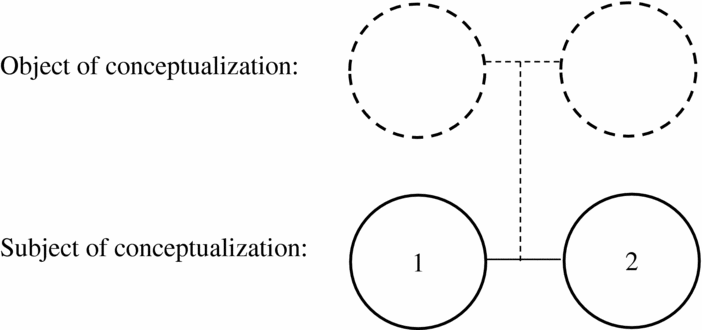
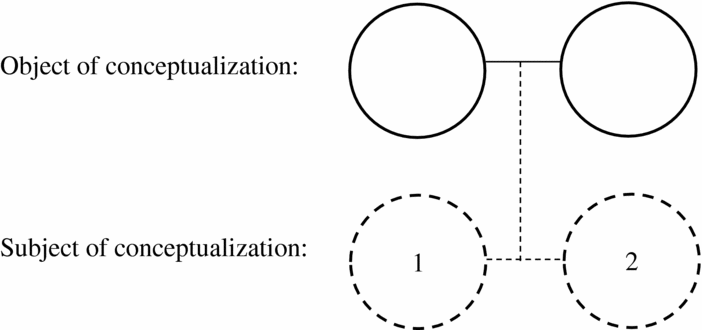
Third, animacy, sentience and agency are the attributes of beings included in the intersubjective community that makes interaction and the sharing of experiences possible (see e.g. Zlatev et al. Reference Zlatev, Racine, Sinha and Itkonen2008a). The positions occupied by animate beings in situations are such that they allow the speaker to adopt the viewpoint of the other being (see the discussion on empathy above) and therefore provide certain expectations as to what might be the next adequate discursive move at each stage within the interaction (Verhagen Reference Verhagen2008:327).Footnote 9 In this paper, intersubjectivity is considered as a dimension of linguistic meaning, where two SoCs enter into this kind of relationship of cognitive coordination (Verhagen Reference Verhagen2005, Reference Verhagen2008). Some linguistic constructions foreground the intersubjective dimension, i. e. the participants (the ‘other minds’) and the immediate context of the communicative event (Figure 1), while others profile the object of conceptualization, e.g. in a situation of labeling objects (Figure 2) (see Verhagen Reference Verhagen2005:6, 16–18).Footnote 10 The differences in profiling between intersubjective and objective poles are gradual and can be conceived of as forming a continuum.Footnote 11
Construal of the intersubjective dimension of conceptualization.

Construal of the object of conceptualization.

It seemed essential to take the intersubjective dimension into account when distinguishing the meanings of kuulua perc and kuulua app. In this analysis, the intersubjective relationship does not just involve the speaker and the interlocutor but also, on another level, the perceiver and the subject referent in the situation of appearance. As for objective conceptualization, the term does not appear in this paper with reference to ‘pure cases’ of objectivity, such as labeling objects (see Verhagen Reference Verhagen2005:16–17) but to situations where the relationship between the SoC and the object of conceptualization is profiled, instead of the relationship between SoCs.
2.2 Perceptibility in the typology of expressions of perception
The verb kuulua can be included in the heterogeneous category of lexical perception verbs, which, from a typological perspective, do not really form a sharply defined class (see e.g. the contributions in Aikhenvald & Storch Reference Aikhenvald and Storch2013b). In contemporary Finnish, perception verbs can, however, be organized following Viberg's (Reference Viberg1984, Reference Viberg2015) classical paradigm. Each sense modality (sight, hearing, touch, taste and smell) is covered by three basic verbs of perception, and these verbs can be further arranged according to the type of event they denote: (i) transitive verbs coding activity controlled by an agent, (ii) transitive verbs coding uncontrolled experience and (iii) intransitive verbs coding perceptibility.Footnote 12 Verbs belonging to the first two subcategories are considered to be experiencer-based, as they take the experiencer of the perception as their subject. The third type of verbs is source-based, as their subject refers to the entity perceived. For example, in the field of audition, the corresponding verbs in Finnish are (i) kuunnella ‘to listen’, (ii) kuulla ‘to hear’ and (iii) kuulua ‘to be audible’.Footnote 13
In Viberg's model, the different types of perception verbs are distinguished by the degree of animacy and agency of their subject. The activity verbs and the experience verbs can take the referents that rank highest on the animacy scale as their subject, whereas the perceptibility verbs cannot, for example, (i) minä kuuntelen ‘I listen’ and (ii) minä kuulen ‘I hear’ but (iii) *minä kuulun ‘I am audible’.Footnote 14 When looking at languages in general, however, it becomes clear that the degree of control and, accordingly, the degree of animacy are sensitive to the meaning that emerges from the construction in which the perception verb is used (see Aikhenvald & Storch Reference Aikhenvald and Storch2013a:19–20).Footnote 15 This dynamics is of interest in the present study as we observe two different types of kuulua constructions.
In perceptibility verbs, the experiencer is implicit and generic since the stimulus can potentially be perceived by anyone in the given situation (Huumo Reference Huumo2010:55). As with the experiencer coded by the subject of the experiencer-based verbs, the implicit experiencer in constructions with perceptibility verbs is also an animate entity capable of sensory perception. When it comes to agency, the fact that the experiencer is not coded by the subject reflects the feeble degree of control exercised by the experiencer over the situation (Schneider-Blum & Dimmendaal Reference Schneider-Blum and Dimmendaal2013:235). The status of the experiencer is further weakened by the physiological particularities of the auditory process. Hearing does not depend on the physical activity of the perceiver to the same extent as seeing (cf. moving and closing one's eyes). Furthermore, ‘being audible’ entails producing a sound signal, whereas ‘being visible’ is the result of being present in the perceiver's field of view. In this sense, an auditory signal is more autonomous of the perceiving experiencer than a visual signal (see Enghels Reference Enghels2007:28–32; Huumo Reference Huumo2010:87–88).Footnote 16
In kuulua constructions, the presence of an animate experiencer is connected to the capacity to perceive. Perceptibility verbs do not refer to actualized processes or perceptions but to the ability of the stimulus to potentially be perceived. They thus imply the position of the experiencer in regard to the perception, namely their ability to potentially perceive the stimulus. Semantically, perceptibility thus belongs to the domain of dynamic modality, which covers meanings of personal capacity, ability and need as well as possibilities and constraints caused by the circumstances (see e.g. Palmer Reference Palmer2001). In a sense, dynamic modality is present in all expressions of perception, as they entail an experiencer or an agent capable of perceiving plus, in constructions coding uncontrolled processes, circumstances that allow for the perception to take place, for example, I hear your voice ‘I can hear your voice’. In kuulua clauses, due to the generic experiencer, the modal meaning is set to the fore since the signal can be perceived in the given situation by anyone with the ability to perceive. In some languages, perceptibility is in fact coded by experiencer-based perception verbs that are associated with a potential marker (see e.g. Schneider-Blum & Dimmendaal Reference Schneider-Blum and Dimmendaal2013:231).
In expressions of perception, the relationship between the perceived entity and the experiencer can be conceptualized as directional in the sense that there is a fictive motion of a signal between the two in one direction or the other (Talmy Reference Talmy2000:115–116). On the one hand, perception can represent a situation of the ‘Experienced as Source’ type, where the experienced entity sends out a signal towards the experiencer. On the other, the experiencer can be conceived of as the instigator of the process who emits ‘a probe that moves from the Experiencer to the Experienced and detects it upon encounter with it’ (ibid.:115). This sensory path is of the ‘Experiencer as Source’ type.
In Finnish, fictive motion is coded by the system of directional and static locative marking associated with the spatial position of the stimulus or the experiencer. Processes described by clauses with the verb kuulua are conceptualized as following a sensory path of the ‘Experienced as Source’ type (Huumo Reference Huumo2010). In other words, the audible signal moves from the perceivable entity towards the unspecific, potential experiencer. In examples (11) and (12), this path is viewed from two different viewpoints:
(11)
(12)


In terms of the conceptual structuring of language, the two examples represent different ways of distributing attention. In (11), the window of attention is placed on the initial part of the path describing the motion of the sound. The elative case (‘from’) marks the point of origin of the signal, that is, the spatial location of the animals emitting the sound. In (12), the conceptual endpoint of the sensory path is foregrounded, as the locative adverb kaua-s ‘far-lat’ codes the location where the experiencer is situated (see Talmy Reference Talmy2000:Chapter 4).
2.3 Existentiality and perception
From a typological perspective, existential predication has been defined as an alternative way of encoding prototypical figure–ground relationships (The dog is under the tree vs. There is a dog [under the tree]) (Creissels Reference Creissels2014). In an existential predication, the figure (the existential S-argument) does not represent the central point from which the situation is viewed. The ground (the location of the entity) is taken as the perspectival centre and, in view of the information structure, most often as the default topic (see Huumo Reference Huumo2003:463, Partee & Borschev Reference Partee, Borschev and Young2004, Creissels Reference Creissels2014). In line with cross-linguistic perspectival analysis, Huumo (Reference Huumo2003) has argued that Finnish existential sentences produce a holistic view over the event and downgrade the individual activities involved in the situation.Footnote 17
In terms of analysing the existential meaning in constructions with kuulua, it is important to note that existential predication does not necessarily involve actual existence but rather the presence of an entity at a location (see the discussion and etymology of the verb exist in Creissels Reference Creissels2014). The same can also be said for negative existentials. According to Veselinova (Reference Veselinova2013), negative existentials form a functional domain of their own cross-linguistically, which is in interaction with but grammatically and conceptually separate from the domains of existence and negation. In semantics terms, existential predications display special strategies for negation that make it possible to distinguish between absolute negation (non-existence) and relative negation (non-presence).
In what follows, kuulua PERC and kuulua app will appear to vary in the way they code the non-existence and non-presence of an entity. This is due to the fact that, even in existential constructions, verbs of perceptibility encode first and foremost the (in)ability to perceive. The localization coincides with the perspective of the experiencer and the situation is viewed with regard to the experiencer's expectations. The meaning of (non-)existence is then inferred from the presence or absence of the stimulus. What is perceived exists – it becomes existent to the experiencer through perception – but what is not perceived may or may not exist.
3. FROM THE MOVEMENT OF A SOUND TO AN UNEXPECTED PHYSICAL AND INTERACTIONAL ABSENCE
3.1 Perceptible auditory signals
The first part of this analysis concerns subject selection and the negative existential use of kuulua when the verb refers to auditory perception. Syntactically, in constructions with kuulua PERC, the sound can be coded by an onomatopoeic interjection (Jääskeläinen Reference Jääskeläinen2013:155), as in (13), or a sequence of direct speech, as in (14) (VISK Reference = Auli Hakulinen, Vilkuna, Korhonen, Koivisto and Alho2004:§1478).
(13)
(14)


Most constructions, however, include a subject NP that does not present the stimulus as if it was reproduced in its exact, original form, through imitation and other forms of direct quotation, but instead describes the nature or source of the sound. I will now move on to analysing the semantics of the kuulua PERC subject NPs.Footnote 18
3.1.1 The degree of animacy of the subject referent in kuulua perc constructions
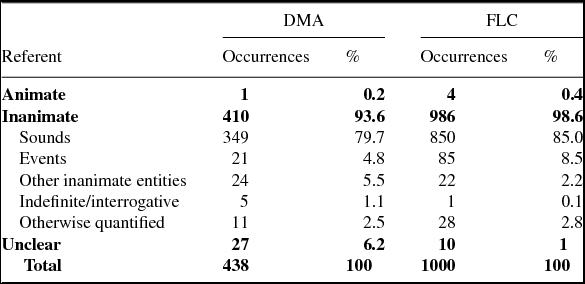
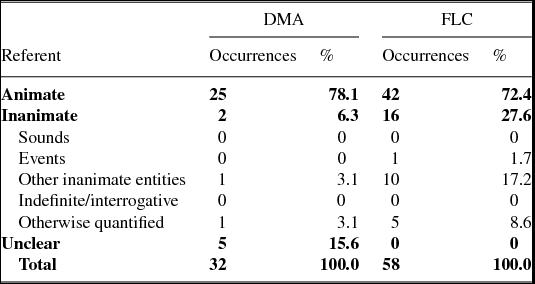
Table 2 below shows the distributions of subject constituents of kuulua perc according to their reference in the two subsets of the data. The subject referents have been divided into two main categories, namely animate and inanimate referents. Due to the high number of occurrences of the inanimate subject NPs, they have been further separated into five subcategories:
(i) NPs and demonstrative pronouns referring to sounds
(ii) NPs and demonstrative pronouns referring to events
(iii) NPs and demonstrative pronouns referring to other inanimate entities (objects, mental states)
(iv) indefinite/interrogativeFootnote 19 pronouns
(v) other quantifying pronouns
The category of unclear cases includes kuulua utterances in which it is difficult to determine the referent of the subject. This is mostly due to the fact that there is only a reduced amount of context available in the DMA corpus. In some cases, there is ambiguity between reference to a sound and reference to an event producing the sound.
Subject referents of kuulua PERC in the dialect data (DMA corpus) and the literary data (FLC corpus).
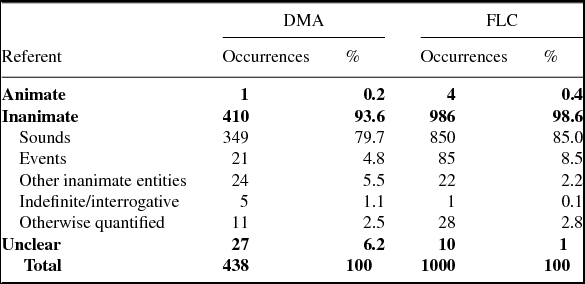
In both subsets of the data, the majority of the subjects of kuulua PERC refer to the sound emitted. These subjects are NPs derived from a descriptive verb specifying the quality of the signal, as in (15), or simply coding an unspecified auditory production, as in (16).
(15)
(16)


The source of the sound is most often expressed by a genitive modifier referring to an animate being (15) or an inanimate entity (16).
The category Event includes subject NPs formed with a deverbal noun, whose lexical meaning does not foreground a sound but an action (17), as well as subjects referring to a proposition (18).
(17)
(18)


The quantifying pronoun in kuulua PERC clauses is mostly the negative polarity pronoun mitään (19), but universal quantification in a positive context is also possible (20).
(19)
(20)


As for indefinite and interrogative pronouns as subject NPs, it is important to note that all occurrences are partitive forms of the pronouns jokin (indefinite) and mikä (interrogative), which in principle entail a non-human referent (see VISK Reference = Auli Hakulinen, Vilkuna, Korhonen, Koivisto and Alho2004:§713), as in (21), with jotaki, and (22), with mitä.
(21)
(22)


As regards the subject nouns referring to inanimate entities other than a sound or an event, it is possible for kuulua PERC to appear with an abstract noun denoting an emotional state that is likely to give rise to an audible expression, as in (23).
(23)

In most cases, however, these nouns refer to concrete objects, whose most central function is to produce a sound, such as different types of bells exemplified in (24) and instruments in (25) as well as devices used for receiving signals in order to produce sounds, as in (26). Natural phenomena perceived primarily through audition is also possible, as seen in (27).
(24)
(25)
(26)
Footnote 20(27)


In the literary data, there were some occurrences of kuulua PERC subjects where the referent was an inanimate natural element a priori perceivable through vision. In (28) and (29), the subject referent entails continuous movement of water. This type of visual signal is expected to be associated with a sound. In (29), perception through vision only (i.e. excluding audition) is explicitly stated.
(28)
(29)


There were only five occurrences of animate subject referents in kuulua PERC constructions in the data, and these involved not just humans but other animate beings too (cf. VISK Reference = Auli Hakulinen, Vilkuna, Korhonen, Koivisto and Alho2004:§1321; von Waldenfels Reference Von Waldenfels, Leino and von Waldenfels2012:215).Footnote 21 Because of the small number of occurrences, no generalizations can be made on the conditions that permit the animate subject to appear. The subject NP presented in example (30), however, gives an idea of the semantic factors that could come into play when an animate entity exceptionally takes the position of the stimulus.
(30)

The subject NP refers to a human collective whose primary function is to produce a sound (orkesteri ‘orchestra’). Furthermore, the subject referent is a relatively unagentive entity, since an individual's control over the situation is remarkably reduced. Given the author's intuition as a native speaker, the clause would not be acceptable with a subject NP referring to an individual animate being (e.g. lapsi ‘child’) whose function is not primarily to produce a sound.
In this section, the data have shown that the subject NP of kuulua PERC, in the rare cases where it does not directly refer to a sound, denotes an inanimate abstract or concrete entity or, very marginally, an animate collective entity, whose inherent property is to produce a sound. This observation is in line with Enghels’ (Reference Enghels2007:29–30, 133–135) description of the particularities of auditory perception: to hear is to perceive the event of something or someone producing a sound signal, not to perceive the object or the animate being as such (cf. visual perception). Utterances with kuulua PERC code the potential movement of the sound towards the experiencer.
3.1.2 Variation between existential and non-existential predication in negative kuulua PERC constructions
In principle, negative kuulua PERC constructions allow us to differentiate between prototypical existential predication, where the subject is in the partitive case, and non-existential predication, where the subject is in the nominative. In the case of prototypical existential predication, the viewpoint is on the location, and the non-presence of the subject referent in that location is foregrounded with no suggestion as to whether this non-presence is absolute non-existence of a non-specific entity or relative non-presence of a specific existent entity. In the case of non-existential predication, the existential presupposition is maintained. The entity is viewed as being absent in a given location, but its existence, for example, in another location, is not denied (see Huumo & Lindström Reference Huumo, Lindström and Luraghi2014). Examples (31), including a partitive subject (hiiskahdustakaan), and (32), including a nominative subject (huutonsa), illustrate this:
(31)
(32)


In (31), the existential clause does not tell us whether there has been a sound emitted in the fortress as such. In contrast, the clause in (32) implies the scream has taken place (regardless of the presence or absence of the possessive suffix, which, as such, produces a specific reading). Only its perception is denied.
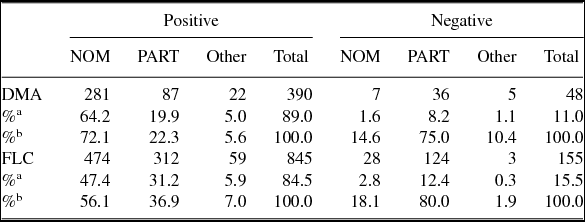
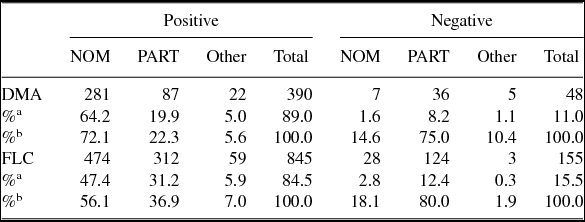
Occurrences of the nominative subject in negative kuulua PERC utterances are, however, relatively rare in the data. Table 3 shows the distribution of subject NPs of positive and negative kuulua PERC utterances according to case. The category ‘Other’ includes, primarily, unclear cases but also some genitive forms motivated by the use of modal verbs or infinitive conjugation.
Subject case marking in kuulua PERC utterances in the dialect data (DMA corpus) and the literary data (FLC corpus).
a The proportion of all kuulua PERC occurrences in the data.
b The proportion of positive/negative kuulua PERC occurrences in the data.
The frequency of the partitive case in negative kuulua PERC utterances is remarkably high in both subsets of the data. In the DMA data, 75% of negative kuulua PERC utterances take a partitive subject, as compared with 16% that take a nominative subject. In the FLC data, 80% of negative kuulua PERC utterances have a partitive subject and 18% a nominative subject.
It also appears from the data that a nominative subject does not necessarily refer to an existent unperceived sound. It can also occur in a context where the sound is absolutely nonexistent, as in (33).
(33) Sitten nukutaan Putkinotkon kesäisellä pihalla. Siellä on hiljaista, nurmikolla ja kallioilla, kerrankin. Ei kuulu huutoja eikä itkua, ei kirkunaa, ei rinnanpohjasta tulevia ja etäälle kantavia toitotuksia. Ei laulua, ei rallatusta, ei putkien soittoa, ei räkätystä. Ei lehmien ja pässien äänten matkimista tai karjan kotiin huutamista, vingutusta, karhun tai koiran äänten jäljittelyä, peltisten onkimato-purkkien rämistelyä vastatusten, niin että vuori pihan toisessa kupeessa räikkyisi. Ei kuulu koiran haukunta, sillä Hurjakin makaa portaittensa alla, josta sen valkea pää näkyy, tavoitellen silloin tällöin kärpäsiä.
‘Then everyone sleeps in the summery yard of Putkinotko. There is silence on the lawn and on the rocks for once. [cannot be heard >] You cannot hear shouts-part nor crying-part, no screaming-part, no hollering-part coming deep from the chest and reaching far. No singing-part, no trolling-part, no playing-part pipes, no chattering-part. No imitation-part of the sounds of cows and rams or calling-part the cattle back home, fiddling-part, reproducing-part the sounds of a bear or a dog, tin cans of fishing worms rattling-part together, so that the hill across the yard resonates. [Cannot be heard >] You cannot hear the dog barking-nom, for even Hurja is lying under the stairs, showing his white head, reaching for a fly every now and then.’
(FLC, lehtonen_putkino:p1762)
In this extract, I have underlined all the subject NPs of the two negative kuulua PERC utterances. Apart from koiran haukunta ‘dog's barking’, the subject NP of the second utterance, they are all in partitive case (see the marking part). Both kuulua PERC utterances, however, encode absolute non-existence. The latter utterance is not about not being able to hear while the dog is barking but about the dog not emitting a sound, since the animal is described as being otherwise engaged. The reason for the use of the nominative here is likely to be the degree of specificity of the entity not emitting the sound. The description of the non-audible sounds moves from a general to a more specific level with the NP koiran haukunta ‘dog's barking’. There is no genitive modifier coding an animate source for the other sounds. The barking is the only sound that is associated with a spatiotemporal reference point, concretized in the actual living being, while the other sounds are only viewed from the point of view of the state of affairs ‘not being audible’ (on the subject case selection and the individuation of the referent in Finnish, see Duvallon, forthcoming). The transition is also reflected by the fact that the verb ei kuulu ‘cannot be heard’ is reiterated at this stage.
3.2 The non-appearance of a physical and interactional movement
3.2.1 The degree of animacy of the subject referent in kuulua app constructions
The second part of the analysis concerned the use of kuulua as a verb of appearance. This category contains verbs that describe the becoming-perceptible of an entity. Levin (Reference Levin1993:258–259) included in this category verbs whose meaning of appearance results from an extended, figurative use. This is also likely to be the case for kuulua (see Section 4).
Table 4 below shows the distribution of the subject NPs of kuulua app according to the nature of the referent in the two subsets of the data.
Subject referents of kuulua app in the dialect data (DMA corpus) and the literary data (FLC corpus).
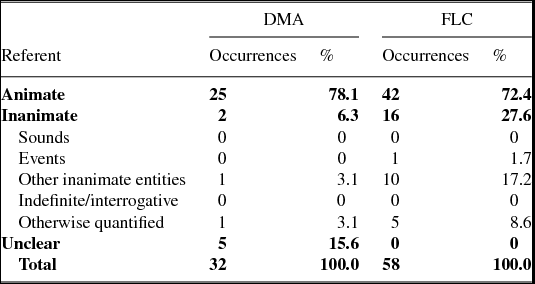
The occurrence of kuulua APP is considerably less frequent in the data than the occurrence of kuulua PERC (compare Table 2 above). This is probably due to the fact that kuulua APP is used only in a very particular situation, whereas kuulua PERC denotes one of the basic sensory-perceptual processes.
As expected, the two uses of kuulua are not alike in terms of subject reference. The kuulua APP occurrences support Huumo's (Reference Huumo2010:91–92) view, which states that there is a strong tendency for animate subjects to occur with kuulua APP. Example (34) sums up the properties of kuulua APP utterances.
(34)

The clause is negative and, as is typical of existential clauses, the subject NP takes the partitive form. The utterance encodes the physical absence of an animate being. In terms of motion, there is non-movement of the subject referent towards the experiencer, in other words the utterance implies a movement that does not take place. The mode of perception is unspecified, but the location where the subject referent should have appeared is overtly expressed (koti-ok ‘home-ill’), and the expectations concerning his arrival are manifest as motivating the emotional reaction from the other participants when he fails to turn up.
In what follows, I explore the interface between negative kuulua PERC and kuulua APP clauses, aiming to explain why the properties identified in example (34), namely animacy of the subject referent, unspecified mode of perception and the idea of deviating from discursive expectations, are associated with the meaning of appearance in kuulua APP clauses. As the focus is on cases where the difference between the two meanings is subtle, the analysis mostly concerns clauses where the subject is inanimate. The presence of negation and existentiality in kuulua APP clauses will be dealt with in Section 3.2.2.
It should, first, be noted that the state of affairs described also runs contrary to expectations in negative clauses with kuulua PERC. Negating a perception implies that the perception was expected to take place.Footnote 22 In example (35), the sound of thunder is expected.
(35)

The discordance with an expected meaning is displayed by the two occurrences of the contrastive conjunction mut(ta) ‘but’. The act of ‘going’ is expected to result in the perception ‘hearing the thunder’, on the one hand, and seeing (and possibly hearing) lightning is expected to co-occur with the auditory perception of thunder, on the other.
Moreover, even in the case of kuulua APP, the fact that one person might be expecting another to appear does not necessarily entail that the appearance of the subject referent is favourable to or wanted by the person that expects. This is illustrated by example (36), where the non-appearance of the subject referent is advantageous to the other two participants.
(36)

As I now move on to investigating the occurrences of kuulua PERC and kuulua APP clauses from the other two perspectives, namely the specificity of mode of perception and animacy, the expectations arising from the context will, in fact, appear different in clauses with kuulua APP as compared with those with kuulua PERC.
When it comes to the presence or absence of auditory perception, the line between kuulua PERC and kuulua APP is somewhat blurred in certain contexts. As we have seen, kuulua PERC can appear with a subject NP that does not foreground the sound (see (17) above, where the subject NP refers to ‘the displacement of tables’). The meaning of auditory perception is inferred by relying on knowledge of the world (i.e. moving tables makes a sound). However, some kuulua clauses are ambiguous in regard to the presence or absence of auditory perception.Footnote 23 This is the case when the clause refers to a communicative act that may or may not be audible and which, contrary to expectations, does not take place. The first example of this type of context is presented in (37), where the subject NP refers to a potentially audible interactional reaction (vastaus ‘response’).
(37)

The clause with kuulua in (37) can be interpreted with reference to the non-appearance of an expected reaction. However, this reaction is a priori audible. Consequently, the two meanings are similarly present. The fact that the experiencer cannot draw on visual perception at the point at which the reaction of the interlocutor is expected to come (as her eyes are not yet used to the dark) could be seen as an argument in favour of interpreting kuulua as referring to auditory perceptibility.
Example (38) presents, for comparison purposes, an extract in which the same noun (vastaus ‘response’) is used unambiguously to refer to an inaudible communicative act (a letter of response; note the verb kirjoittaa ‘to write’, in the preceding clause). The reading as kuulua APP thus prevails.
(38)

Example (39) provides a further example of kuulua utterances with a subject NP referring to a potentially audible reaction (lines 5 and 11).
(39)

As the first of the mother's expected reactions (approval) is potentially verbal, two alternative interpretations of the kuulua clause on line 5 emerge: (i) ‘mother's approving words could not be heard’, (ii) ‘mother's approval (words or gesture, such as touching) did not take place’. The second clause with kuulua (line 11) also gives rise to a double interpretation: (i) ‘nothing could be heard’, (ii) ‘nothing (i.e. no reaction from the mother) took place’. The participant corresponding to the experiencer of the two kuulua clauses keeps his eyes closed during the situation described (see line 6). This excludes the possibility of any visual perception of the mother's gestures and potentially foregrounds the reading as kuulua PERC. However, the mother's reaction, anticipated by the child at this point, is described as tactile (lines 9–10). This can be regarded as prioritizing the interpretation of the second kuulua occurrence as a kuulua APP.
In addition to clauses with a subject NP referring to a potentially audible reaction, another context likely to produce ambiguity between kuulua PERC and kuulua APP are zero subject clauses. These are illustrated in (40), where a servant (Anni) and the mother (rouva ‘mistress’) are calling out to a child (Vesa). The utterances presented on lines 3 and 9 contain instances of zero subject.
(40)

The ambiguity is produced, on the one hand, by the fact that, the participants who are waiting for the missing child to arrive are addressing him verbally (see lines 1, 4–5, 7, 9) and thus expecting a response perceivable through hearing, the absence of which is coded by the zero subject clauses, and, on the other, by the fact that it is possible to interpret the zero subject clauses as referring to the non-appearance of the child. The kuulua utterance on line 6 is, indeed, unambiguously a kuulua APP occurrence, since the overt partitive subject refers to an animate being, namely the child.
Examples (37)–(40) above have shown that the semantics of kuulua PERC and kuulua APP come together in contexts where the kuulua clause describes the absence of an expected reaction that could potentially be verbal. As already mentioned, both meanings of kuulua imply a contrast in regard to discourse expectations. In negative clauses with kuulua PERC, these expectations are based on the causal relation ‘state of affairs p → perception of the signal q’.
Clauses with kuulua APP, on the other hand, involve a situation where the state or the action of the experiencer is on some level dependent on or otherwise connected to the potential appearance of the subject referent. The non-appearance is therefore not (only) a perceivable consequence of some state of affairs but essentially an intersubjective act. In many cases, it is conceived as a response to what the experiencer has said or done (see examples (37)–(40)). This accounts for the high degree of animacy of the subject referents of kuulua APP. Only conscious, agentive beings can be included in the intersubjective sharing of experience. In the light of the kuulua clauses in the present data, non-human animate agents are also included in the intersubjective community, as in (41), where the pronominal subject refers to a cat (kissa).
(41)

The subject referent of kuulua APP is thus in most cases either an animate being who is expected to share the same location with the experiencer at a given time or an abstract inanimate entity conceived of as the reaction of another being to something that the experiencer has said or done (e.g. vastaus ‘response’). In the rare cases where the subject refers to a concrete inanimate entity (see Table 4), the subject referent is viewed as a constitutive element in the interaction between animate beings. Consider the following examples:
(42)
(43)


In (42), the subject NP refers to a written communication (kirje ‘letter’) that one of the participants (Hanna) expects from the other (Salmela). In (43), the subject referent (water) appears to be the focal point of the interaction between the participants. More importantly, the social legitimacy of one of the parties is dependent on the appearance of the subject referent.
In this section, I have analysed the interface between utterances with kuulua PERC and kuulua APP. The aim was to account for the high degree of animacy of the subject NPs in kuulua APP utterances and to show the difference between the nature of discursive expectations in the case of kuulua PERC and kuulua APP. In the next section, I will discuss the role of the case marking of the subject argument and the meaning of existentiality in kuulua APP clauses
3.2.2 The negative existential meaning and an animate subject referent
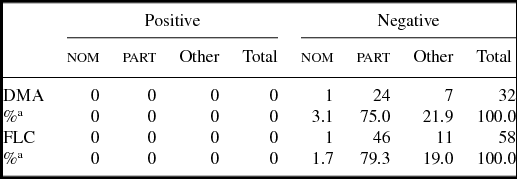
The data from this study indicated a strong link between the meaning of appearance and negation in kuulua app constructions. No occurrences in positive clauses were detected, as shown in Table 5.Footnote 24
Subject case marking in kuulua APP utterances in the dialect data (DMA corpus) and the literary data (FLC corpus).

a The proportion of all kuulua APP occurrences in the data.
As was the case for negative kuulua perc utterances, the nominative case was also rare in the subject NPs of utterances with kuulua app. There was thus no interplay between the partitive, producing the meaning of absolute non-existence, and the nominative, expressing relative non-presence. Nevertheless, most utterances with kuulua app did not produce the meaning of absolute non-existence, as the majority of subject NPs in partitive form referred to specific entities. There were 26 specific and five non-specific entities in the DMA, and 40 specific and 17 non-specific entities in the FLC. In general, the very existence of the specific animate being was not at stake but merely its presence at a given location. Examples (44) (repeated from (37) above) and (45) display the contrast between the specific and non-specific readings of the partitive subject NP in kuulua app utterances.
(44)
(45)


In (44), the absolute existential meaning emerges. The description of the situation (line 3) and the mother's reaction to the absence of response (line 4) show that no response whatsoever has been given. In (45), however, it is not the actual existence of the subject referent (Rissalan isäntä ‘Mr Rissala’) that is at issue but his non-(re)appearance at the expected location.
In view of the relatively high number of co-occurrences of specific reference and the partitive form in the subject NPs of utterances with kuulua app in the data, it can be assumed that the partitive case is not just triggered by the negation, but also forms an important part of the kuulua app construction. Rather than coding the existentiality, the partitive case is one of the units in the construction that convey the particular meaning of non-appearance in the expected location. The grammatical status and the possible evolution of kuulua app are discussed in the following section.
4. DISCUSSION AND CONCLUSION
In this paper, I have examined the polysemy of the verb kuulua ‘to be perceptible (through audition/unspecified sensory input)’ in the light of the degree of animacy of the participants involved and the existential status of the predication. The focus was on the syntactic and semantic differences and the overlaps between the two constructions, that is, those including kuulua as a verb of auditory perceptibility and those where kuulua codes the non-appearance of an entity in a given location.
The semantic core of the verb kuulua involves the meaning of motion of an entity towards the perceiver. Constructions with kuulua PERC and kuulua APP differ in terms of the type of motion and the degree of animacy of the moving entity.Footnote 25
In kuulua PERC utterances, the meaning of perceptibility is conceived of as a potential fictive motion of a sound towards the experiencer. Accordingly, in most cases, the subject of kuulua PERC constructions refers to the perceptible sound. When the subject referent is some other inanimate abstract or concrete entity, the clause is likely to be understood as referring metonymically to the sound emitted by the entity (see Panther & Thornburg Reference Panther, Thornburg and Barcelona2003:225–226; Huumo Reference Huumo2010:91).
The sounds of individual animate beings are understood as at least having the potential to be meaningful, as they indicate the mental state or communicative aim of the subject referent. This explains why the metonymic figure observable in kuulua PERC utterances with an inanimate subject referent was not found in the data in utterances where the subject referred to an animate being.Footnote 26 In this construction, an animate being cannot be reduced to its sound, because perceiving the sound intrinsically involves considering the producer of the sound not only as the source of the stimulus but as a participant in the interaction, whose presence and intentions demand to be interpreted.Footnote 27 The data suggest that in the rare cases where an animate subject is involved in a kuulua PERC construction the subject referent displays a low degree of individuality and individual control over the situation (e.g. orkesteri ‘orchestre’ in (30)), in other words, the referent ranks relatively low among animate entities on the animacy scale.
Accordingly, in kuulua APP constructions, it is not the sound that is at issue but the (lack of) fictive or physical motion of another individual engaged in a relationship of cognitive coordination. In this sense, the meaning of (im)perceptibility can involve not only the (in)ability to be perceived but also the potential of being interpreted and understood in the context of the intersubjective construal of meaning.
The fact that the specialized function assumed by the kuulua APP construction emerges in non-affirmative, mainly negative contexts can also be viewed in the light of the intersubjective dimension of meaning construal. Indeed, Verhagen (Reference Verhagen2005: 42–43) argued that negation is, specifically, a type of linguistic construction that operates on an intersubjective level. In kuulua APP utterances, the relationship between the subject referent and the experiencer is viewed in the context of an interaction entailing communicational expectations around the subsequent verbal or behavioural moves. The implied fictive or physical movement of the subject referent is thus also a move on the intersubjective level. In discourse, interactional expectations become manifest when something goes against them. The negative expression opens another mental space in the communicative situation (Verhagen Reference Verhagen2005:29–30). The negative kuulua APP construction is the linguistic realization of an absence, which implies the unrealized possibility of an interactional move (see Nahajec Reference Nahajec, Chapman and Clark2014).
While the evolution of the different meanings of kuulua was not the focus of this study, we may assume that kuulua APP is the result of a grammaticalization process from a more specific lexical meaning (‘being perceptible through audition’) to one that is more general (‘being (im)perceptible through unspecified sensory input’). As a result of the semantic extension, not only has the mode of perception expressed by the verb kuulua become unspecified, but the construction carrying the new meaning has also lost the alternation between nominative and partitive subjects, and its use has become limited to negative contexts involving mostly an animate subject. The path from the meaning of kuulua PERC to that of kuulua APP could have passed through the so-called bridging contexts, such as those presented in examples (37)–(40) in Section 3.2.1, where the two meanings intersect (see Evans & Wilkins Reference Evans and Wilkins2000:549–550). In these cases, the meaning of auditory perceptibility occurs in a context where the perceptible sound is viewed as an expected communicative movement. Over time, the absence of an auditory response could have been conceived of as the absence of any perceptible communicative movement towards the experiencer.
The fixed partitive form and the restriction to non-affirmative (mainly negative) contexts indicate the specialized functions of kuulua APP utterances. These latter can be considered as a case of formal idioms involving partially fixed lexical units (see Fillmore, Kay & O'Connor Reference Fillmore, Kay and O'Connor1988:505; Michaelis Reference Michaelis2017; see also Huumo Reference Huumo2010:91–92). The kuulua APP construction is a lexico-grammatical syntactic pattern that moves the semantics of perceptibility away from the vertical dimension of objective meaning construal to the horizontal link between SoCs.
The grammaticalization path from ‘being audible’ to ‘being (im)perceptible through unspecified sensory input’ does not seem to be an areally or genetically widespread phenomenon. For example, the verbs of auditory perceptibility in Swedish (höras) and in Estonian (kuulduma, kostma)Footnote 28 have not undergone such evolution, while they are relatively similar to kuulua by their form and their semantics.Footnote 29 On the other hand, the Karelian verb kuuluo is used to encode absence in negative sentences (Koissa poikua vuotetah; ei kuulu ‘The boy is awaited at home; [he] does not appear’, KKS 2009, s. v. kuuluo).
Among perception verbs, those coding perceptibility have so far received the least attention. This may be due to the internal heterogeneity characterizing this category of verbs as well as the somewhat fuzzy nature of the borders delimiting it. The classification used by Viberg (Reference Viberg2015) for presenting the system of perception verbs in Swedish indicates points of contact between perceptibility verbs, sensory copulas (e.g. ‘sound like’) and sensory verbs (e.g. ‘shine’). The present analysis of kuulua constructions, moreover, suggests that perceptibility is a complex semantic category that lies at the intersection of meanings of perception, modality, existentiality and apparition. Finally, it suggests that the perception of stimuli coming from an inanimate source is not conceptualized in the same way as the perception of stimuli produced by animate, individual beings.
ACKNOWLEDGEMENTS
I would like to thank the three anonymous NJL reviewers for their valuable and constructive comments. I am also grateful to Outi Duvallon for her helpful suggestions on an earlier version of this paper.
DATA SOURCES
DMA, Digital Morphology Archives. Department of Finnish, Finno-Ugrian and Scandinavian Studies at the University of Helsinki and CSC – IT Center for Science. http://urn.fi/urn:nbn:fi:lb-201403261
FLC, Finnish Literary Classics. Institute for the Languages of Finland. http://kaino.kotus.fi/korpus/klassikot/meta/klassikot_coll_rdf.xml