


Introduction
The second half of the 20th century was characterized by an enhanced melt of mountain-valley glaciers, attributed to the rapid climatic warming (Reference DyurgerovDyurgerov, 2003; Reference OerlemansOerlemans, 2005). Projections of future climate indicate that this trend will continue (Reference Raper and BraithwaiteRaper and Braithwaite, 2006). The observed and projected reduction in the extent of glacier ice has implications for global sea-level rise (Reference Raper and BraithwaiteRaper and Braithwaite, 2006) and regional water availability (Reference DyurgerovDyurgerov, 2003). Changes in glacier mass balance (and, subsequently, in spatial extent and volume of ice) are controlled by climatic processes acting at different spatial and temporal scales: global or hemispheric (distant forcing), regional (synoptic forcing) and local. The large-scale anomalies in atmospheric circulation force variability in the components of glacier mass balance in the maritime regions (e.g. Reference Francou, Vuille, Mendoza and SicartFrancou and others, 2003). Synoptic-scale anomalies and changing frequencies of weather types control both interannual and intra-seasonal variability in glacier accumulation, melt and runoff (Reference Hodson, Gurnell, Washington, Tranter, Clark and HagenHodson and others, 1998; Reference Hannah, Gurnell and McGregorHannah and others, 2000). Changes in the characteristics of glacier surface are a critical element in glacier dynamics, and particularly glacier melt which is sensitive to variations in the components of radiation balance (Reference HockHock, 2005).
This paper investigates the long-term (1967–2003) trends in the components of mass balance of Djankuat glacier and the sensitivity of glacial melt to climatic processes at different spatial scales. Djankuat is a small (3km2), north-facing valley glacier located at 43˚12' N, 42˚46' E in the central section of the Glavny (Main) ridge of the Greater Caucasus between 2700 and 3900m above mean sea level (a.m.s.l.). Regular mass-balance measurements began in 1967, and currently Djankuat is monitored by the World Glacier Monitoring Service as one of the world’s ten representative glaciers. Despite the well-established mass-balance monitoring programme, meteorological measurements were not established on Djankuat until 2005, and analyzing links between atmospheric processes and glacier mass balance was problematic.
Preliminary analysis of mass-balance records for Djan-kuat glacier has shown that the main Northern Hemisphere teleconnection patterns exert a limited control over glacier melt and accumulation, while regional climatic conditions are of greater importance for glacier dynamics (Reference Shahgedanova, Stokes, Gurney and PopovninShahgedanova and others, 2005). This paper builds on the previous findings linking the interannual variations in the components of mass balance of Djankuat to the large-scale anomalies in atmospheric circulations. The intra-seasonal variations in glacier melt are examined using synoptic climatological analysis relating components of the radiation budget and daily ablation rates to different synoptic types.
Data, Monitoring Methods and Analytical Techniques
Mass-balance measurements, reported as mm of water equivalent (mmw.e.), refer to the mass-balance year, which begins in October and ends in September of the following calendar year. October–May accumulation and June–September ablation are reported. Accumulation is estimated as a product of snow depth (about 200 stakes) and snow density (five pits taken in the same position each year) measured at the end of the accumulation season. The snow-depth measurements are interpolated on a digital elevation model using the kriging interpolation method. Accumulation values for different altitudinal zones and the glacier as a whole are derived from the constructed maps. Ablation is measured using the traditional stake method, with 80–100 stakes being used each year, and these are interpolated in a similar way to accumulation. The errors vary between years and altitudinal zones, but for the glacier as a whole they are estimated as 3–7% of seasonal accumulation and 3–5% of seasonal ablation. Details of mass-balance measurement and estimation techniques are reported in Reference PopovninPopovnin (2000) and Reference Shahgedanova, Stokes, Gurney and PopovninShahgedanova and others (2005). In addition, daily ablation measurements are conducted at an altitude of 2960m at 0600 h local time (0300 h GMT). A 20 m long metal string is set up over a relatively flat part of the glacier. Distance between the wire and the surface is measured at 1 m step to account for the effects of microtopography, recorded to the nearest 1 mm, and averaged to represent daily (0600–1800 h local time) ablation rate in mmw.e. Sonic ranger measurements were started in 2006 to replace this system.
Meteorological observations were conducted at two sites. A regular weather station (Terskol) is located 16km northwest of the glacier at 2141 ma.m.s.l. and has been supplying data on air temperature and precipitation since 1951. An automatic weather station (AWS) was installed on Djankuat in June 2005 at 2960ma.m.s.l. in the upper part of the ablation zone on a homogeneous part of the glacier with a relatively small inclination of 4˚. The AWS stood freely on the snow/ice surface and sank with the melting surface. It was visited every 2–3 days to level the radiometers. The tilt of the radiation sensors was therefore negligible throughout the season and no corrections have been applied to the radiation data. The AWS was equipped with a Campbell pressure sensor, Vaisala temperature and relative humidity (RH) probe, Young anemometer and vane, Skye up- and down-facing pyranometers, and Kipp & Zonen NRLite net radiometer. Incoming and reflected shortwave radiation allowed direct, continuous monitoring of surface albedo. The station operated between 16 June and 6 October 2005. Data were sampled at 30 s intervals from which 15 min averages have been derived and stored. There were no significant gaps in the data. In addition, half-daily precipitation was measured at an altitude of 2650 m.
In order to examine relationships between the components of Djankuat mass balance and the larger-scale atmospheric circulation, anomaly and composite maps have been constructed, linking accumulation and ablation data on Djankuat with the gridded atmospheric US National Centers for Environmental Prediction/US National Center for Atmospheric Research (NCEP/NCAR) re-analyses fields with 2.5˚ resolution (Reference KalnayKalnay and others, 1996). These data were obtained from the US National Oceanic and Atmospheric Administration/Cooperative Institute for Research in Environmental Sciences (NOAA/CIRES) Climate Diagnostics Centre (http://www.cdc.noaa.gov/cdc/data.ncep.reanaly-sis.html). Correlation coefficients between the time series of ablation and accumulation and seasonal indices of the main Northern Hemisphere teleconnection patterns (Barn-ston and Livezey, 1987) have been calculated. The indices have been obtained from the Climate Prediction Center (http://www.cpc.noaa.gov/data/teledoc/telecontents.shtml).
The links between glacier radiation budget and ablation, and synoptic-scale processes have been characterized using an objective synoptic typing approach. A detailed description of the method is given in Reference YarnalYarnal (1992). In brief, meteorological data for the summer of 2005 have been classified into distinct categories of days with similar weather conditions using the P-mode Varimax-rotated principal component analysis (RPCA) and Ward’s cluster analysis (Reference WilksWilks, 1995). RPCA replaces each of the original variables by a combination of principal components, which are uncorrelated and ordered by the amount of variance they explain. The original dataset is replaced by two datasets: component loadings and component scores. Correlations between the original variables and the components are expressed as component loadings, while component scores are values for daily meteorological observations based on principal components dependent on the magnitude of original meteorological variables. Thus, days with similar meteorological conditions exhibit proximate component scores, and cluster analysis is used to group days with similar component scores. The truncation point in clustering procedure specifies a number of synoptic types in the synoptic index. Each day is assigned to a cluster which represents a meteorologically homogeneous subset of the data. Truncation point has been determined by the inspection of a dendrogram, a plot showing distances between merged clusters as a function of stage in cluster analysis. The stage at which distances between merged clusters increased markedly, showing that very different observations were merged together, was taken as the truncation point (Reference WilksWilks, 1995).
Results and Discussion
Inter-seasonal variations in the components of mass balance (1967–2003) and links with the large-scale atmospheric anomalies
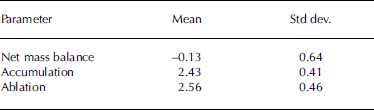
The time series of net mass balance and its components are shown in Figure 1, and average values of mass-balance characteristics are given in Table 1. Neither time series exhibits statistically significant linear trends between the 1966/67 and 2002/03 mass-balance years, athough all three time series exhibit strong interannual variability. Between 1993/94 and 2000/01, the net mass balance was predominantly negative, while prior to 1993 it was seldom negative for more than 1 year. Inspection of the ablation time series shows that melting has increased between the 1987/88 and 1999/2000 mass-balance years (Fig. 1c). A positive linear trend in the ablation time series explained 46% of variance in the time series during this period. While ablation in the lower part of the glacier (2800–2900 m) has been significantly increasing since the 1970s, the increase in ablation in the late 1980s affected the middle part of the glacier, spreading to the whole of the glacier in 1991. At the same time, there have been no systematic changes in accumulation between the 1987/88 and 1999/2000 mass-balance years. Accumulation was exceptionally high on Djankuat in the 1986/87 and 1992/93 seasons, when its total values reached 4000 and 3180 mmw.e. respectively (Fig. 1b). These peaks in accumulation allowed for a partial recovery of the net and cumulative mass balance, but they did not reverse the negative trend in mass balance of Djankuat, which continued to decline due to the increasing summer temperatures (Fig. 2a) and summer melt (Fig. 1c). The highest seasonal ablation value (3630mmw.e.) on record was registered in the summer of 2000.
Average statistics (mw.e.) of mass-balance components of Djankuat glacier, 1966/67–2002/03
Time series of net mass balance (a), accumulation (b) and ablation (c) of Djankuat glacier. Units are mmw.e. Horizontal solid lines refer to zero mass balance ablation (a) and the mean values of accumulation (b) and ablation (c).

Time series of June–August temperature averages (˚C) (a) and October–April precipitation totals (mm) (b) for Terskol. Solid horizontal lines show the long-term averages.

The summer of 2003 was unusually hot in Europe, causing unprecedented glacier melt in the European Alps (Reference Zemp, Frauenfelder, Haeberli and HoelzleZemp and others, 2005). Climatic conditions in the Caucasus Mountains at the beginning of the 21st century contrast sharply with those in the Alps. Thus, the mass years of 2001/02 and 2002/03 favoured recovery of mass balance of Djankuat. Accumulation was the third highest on record in the 2001/02 mass-balance year (2900mmw.e.). The highest precipitation total on record, exceeding the longterm average by more than two standard deviations, was registered in the accumulation season (October–April) of 2004/05 (Fig. 2b). A positive trend is now emerging in the accumulation season precipitation time series. Thus a positive linear trend in the October–April precipitation measured at Terskol explains 34% of total variance in the time series between 1983 and 2005. By contrast, the temperature record from Terskol (Fig. 2a) indicates that the June–August (JJA) temperatures have been below average since 2002. Ablation on Djankuat was below average in the summers of 2002 and 2003 (Fig. 1c).
Figure 3 illustrates anomalies in the atmospheric circulation and regional temperatures observed in August 2003. From May through to the end of August 2003, western and southern Europe experienced exceptionally warm and dry conditions, culminating in August when monthly temperature anomalies in western Europe exceeded 4˚C (Fig. 3a). The anomalous conditions were caused by a marked northward displacement of the Azores high which extended from the northern Atlantic to southeastern Europe, giving rise to a wave train of geopotential height anomalies extending across Europe and Russia to the Pacific coast (Fig. 3b). The identified anomalies in geopotential height were notable at both low- and mid-tropospheric levels, indicating an equivalent barotropic structure characteristic of Rossby waves. Negative geopotential height anomaly developed over western Russia (Fig. 3b) as a part of the Rossby pattern, reaching the northern Caucasus on the daily timescale. Associated with this anomaly were below-average summer temperatures in the central Greater Caucasus (Fig. 2a) and the sixth-highest JJA precipitation total on record since 1951. Analysis of the stream-function anomalies by Reference Black, Blackburn, Harrison, Hoskins and MethvenBlack and others (2004) has shown that the Rossby pattern originated in the southern Caribbean and equatorial Pacific at about 10˚ N, 60–90˚W. Therefore, the anomalous atmospheric circulation that originated on the tropical ocean–atmosphere interface forced low ablation on Djankuat in the summer of 2003, providing an example of local response to the remotely forced large-scale circulation anomalies.
(a) The 850 hPa temperature anomaly map and (b) the 500 hPa geopotential height anomaly map (departures from the mean 1948– 2002 fields) for August 2003. Contour intervals are 2 decametres (dam) and 2˚C. The main features are a wave train of geopotential height anomalies extending across Eurasia from the North Atlantic. A strong positive anomaly in geopotential height and the associated strong positive anomaly in air temperature dominate over western Europe and the Alps but do not affect the Caucasus Mountains.

While distant forcing propagating through the atmosphere as quasi-stationary Rossby waves affected glacial melt in 2003, the main Northern Hemisphere teleconnection patterns (Reference Barnston and LivezeyBarnston and Livezey, 1987) have a limited influence on glacier dynamics in the Caucasus. Thus only the November indices of the North Atlantic Oscillation (NAO) and the Scandinavian pattern (originally named Eurasian type 1 pattern by Reference Barnston and LivezeyBarnston and Livezey, 1987), whose positive phase is characterized by the development of a high-pressure centre over Scandinavia and northwestern Russia, correlate with seasonal accumulation totals with correlation coefficients of 0.38 and –0.40 respectively. These correlations, however, are significant at the 90% confidence level after the adjustment for autocorrelation in the time series (Reference Zwiers and von StorchZwiers and von Storch, 1995).
Intra-seasonal variations in meteorological characteristics and ablation during the ablation season of 2005 and links with the synoptic-scale processes
The relationships between ablation on Djankuat glacier and synoptic-scale meteorological conditions have been investigated using synoptic climatological analysis. The following variables (hourly means for 1200 and 0000 h GMT) recorded by the AWS between June and October 2005 were used to construct the index: atmospheric pressure (hPa), air temperature (˚C), relative humidity (%) and incoming solar radiation (Wm–2). In addition, daily means of zonal and meridional components of wind (m s–1) at 700 hPa surface derived from the NCEP/NCAR daily reanalysis datasets (http://www.cdc.noaa.gov/cdc/data.ncep.reanalysis.html) averaged over the 40–50˚ N, 30– 50˚ E domain have been used. The AWS wind-direction measurements clearly identified katabatic wind drainage. The spatially averaged zonal and meridional wind scalars are therefore more representative of the synoptic weather conditions than local wind affected by the glacier itself. In all, 110 days with meteorological observations have been used.
Five synoptic types have been identified following the application of RPCA andWard’s cluster analysis to a 110 day meteorological dataset. Meteorological characteristics of the identified synoptic types and average ablation values are given in Table 2. Composite maps of 700 hPa geopotential height, characterizing the type-averaged synoptic conditions, are presented in Figure 4.
Composite 700 hPa geopotential height (dam) maps for the identified synoptic types.

Meteorological and radiation budget characteristics of the identified synoptic types and type-averaged values of ablation. The first lines show values for 0000 h GMT; the second lines show values for 1200 h GMT

Days assigned to the identified synoptic types were evenly distributed throughout the ablation season. This is important because seasonal variations in air temperature, precipitation and surface albedo can potentially introduce bias into the interpretation of results of synoptic analysis. In particular, there is a close correlation (r = –0.58) between daily ablation rates and the albedo of the snow-covered surface. The relationship between daily ablation and the albedo of the ice is much weaker (r = –0.28) and is not statistically significant after the adjustment of the time series for autocorrelation. Albedo of the glacier surface changed markedly at the beginning of August from an average of 0.54 (snow-covered surface) to 0.27 (ice). Potentially, this change in surface albedo could have produced a stronger impact on daily ablation rates than synoptic-scale variability. However, an even distribution of the synoptic types throughout the ablation season has ensured that meteorological characteristics and melt rates averaged over the synoptic types have not been affected by either seasonal cycle or the transition from snow to ice.
Analysis-of-variance (ANOVA) and multiple t tests conducted on daily ablation data have confirmed that ablation rates assigned to types 2 and 4 are significantly different from those observed in types 1, 3 and 5 at the 95% confidence level. Similarly, there is a statistically significant difference between daily ablation rates associated with types 1 and 3.
Type 1, the most frequently occurring type, is characterized by the development of a low-pressure system over the northeastern Atlantic or northern Russia propagating in the eastern or southeastern direction (Fig. 4a). A strong westerly flow develops over the Caucasus Mountains, resulting in net radiation and temperatures that are close to the June–September averages (Table 2). There was no precipitation on the majority of days assigned to this type, but, when precipitation did occur, it yielded 18–25mmd–1. The seasonal average daily ablation was 47 mmw.e., and the daily ablation rate in this category was close to the seasonal average.
Type 2 is characterized by the extension of a trough of low pressure towards the Caucasus Mountains from the north or northeast (Fig. 4b), resulting in overcast conditions and daily precipitation of 2–10mm (predominantly rainfall). Incoming solar radiation, daytime net radiation and air temperature are lower than the June–September averages, resulting in ablation rates which are half the value of the seasonal average.
Type 3 is characterized by the northeastward extension of the Azores high (Fig. 4c) and strongly positive daily NAO indices (obtained from http://www.cpc.noaa.gov). Typical of this category are clear-sky conditions, above-average air temperatures, the highest values of incoming solar and daytime net radiation, and the highest daily ablation rates. Precipitation is infrequent in this type, and daily rainfall exceeded 10mm on only a single day. Féhn events are associated almost exclusively with this category, and the highest daily ablation value of 210mmw.e. is associated with a féhn event. A weak positive correlation between the JJA NAO index and seasonal ablation estimated using the 1968–2003 time series did not pass the significance test at the 95% confidence level. By contrast, the synoptic-scale analysis confirms a link between the summer NAO and glacial melt in the central Caucasus whereby strongly positive NAO results in enhanced glacial melt on a daily timescale.
Type 4 is characterized by a deep trough of low pressure extending towards the Caucasus Mountains from the north (Fig. 4d). Typical of this category are low temperatures and precipitation which occur predominantly as snowfall above 2650 m, substantially increasing the albedo of the glacier surface. Although net radiation is above average throughout the day, daily ablation rates are close to zero, and the average of 5.7 mmw.e. d–1 results from a relatively strong melt registered on a single day. Turbulent heat fluxes have not been measured or estimated for the 2005 ablation season. It may be suggested, however, that they are limited by the near-freezing air temperatures (Reference HockHock, 2005). In addition, the sub-zero temperatures registered on a number of nights were likely to result in meltwater refreezing and would require more energy to achieve surface melt.
Type 5 represents the low-pressure-gradient fields or extensions of a high-pressure ridge from Asia Minor to the Caspian Sea and an area of low pressure centred over the Black Sea (Fig. 4e). The isentropic back trajectories (not shown) calculated using the British Atmospheric Data Centre (BADC)/European Centre for Medium-Range Weather Forecasts (ECMWF) model (available at http://badc.nerc.ac.uk) have confirmed strong advection of warm and humid air from the Black Sea, resulting in overcast conditions with low net radiation but above-average air temperatures and, frequently, heavy rainfall whose daily totals ranged between 10 and 35 mm. The daily ablation rates are above average, and, despite the strong difference in net radiation between categories 5 and 3, daily ablation rates are not significantly different. The advective heat flux and heat supplied by rainfall are the likely contributors to the high melt rates associated with this synoptic type.
These results show that there is a clear separation of incoming solar radiation, net radiation, air temperature and the daily melt rates between the identified synoptic types. Correlation between daily melt and air temperature, particularly for the snow-covered surface, and the association of the highest melt rates with the warmest synoptic types indicate that air temperature is the main control over glacier melt. Net radiation is the dominant energy source. Thus, the highest daily ablation values are associated with the synoptic type 3 representing the extension of the Azores high towards the Caucasus Mountains (positive NAO days), which is characterized by the highest values of incoming solar radiation and net radiation. For the whole period of observations, however, correlation between daily and daytime (0400–1600 h GMT) mean net radiation and daily ablation was moderate (r = 0.39), indicating a considerably smaller contribution of net radiation to glacier ablation than suggested by earlier studies for the European Alps (Reference HockHock, 2005). The weather type 5, representing advection of warm, humid air from the Black Sea and heavy rainfall, is characterized by the second highest melt rates, irrespective of low values of incoming solar and net radiation. These two factors (synoptic-scale advection of heat and short-term heat supply by warm and heavy precipitation) have been noted by Reference Hay and FitzharrisHay and Fitzharris (1988) and Reference Ishikawa, Owens and SturmanIshikawa and others (1992) for the glaciers of New Zealand. However, they are seldom included in the energy-balance studies of glaciers. Days assigned to this type accounted for 18% of all days in the ablation season, indicating that the synoptic-scale advection of heat and warm rainfall are important factors in glacial melt in the central Greater Caucasus.
Conclusions
In this paper, we have examined the long-term trends, interannual and intra-seasonal variability in glacier mass balance of Djankuat glacier and their links with atmospheric processes acting at different spatial scales. Our main conclusions are as follows:
A strong summer warming observed in the central Greater Caucasus in the last two decades of the 20th century has resulted in an unprecedented increase in melt and decline in the net mass balance of Djankuat glacier. This trend is reflected in glacier retreat observed in the Caucasus between 1985 and 2000 (Reference Stokes, Gurney, Shahgedanova and PopovninStokes and others, 2006).
Summer temperatures and ablation were below average in the first years of the 21st century. By contrast, the accumulation season precipitation has increased, with a dramatic maximum in the 2004/05 mass-balance year, leading to a partial recovery of net mass balance of Djankuat.
The main Northern Hemisphere teleconnection patterns have a weak control over interannual variability in the components of mass balance. The NAO and Scandinavian teleconnection pattern indices only are correlated with the accumulation time series for Djankuat.
Synoptic-scale variability in atmospheric circulation exerts a strong control over changes in ablation on the daily timescale. Days associated with strongly positive NAO exhibit the highest melt rates.
Air temperature and net radiation are the most important controls over glacier melt, especially during the first part of the ablation season when the glacier surface is covered in snow.
Warm advection from the Black Sea and associated heavy and warm rainfall contribute to the enhanced glacier melt.
Acknowledgements
This work was supported by the Royal Society International Project grant (2005/R2-JP/H3088300). The ongoing field monitoring of the mass balance of Djankuat glacier is supported by the Russian Foundation for Fundamental Research grant (06-05-64094a). The authors are grateful to the reviewers and editors for their helpful comments.



