Introduction
Otosclerosis is a well-known otic capsule disease in which bony remodelling leads to stapes fixation. It is responsible for conductive hearing loss in the early stage of the disease. The prevalence of otosclerosis is about 0.2–0.5 per cent in Caucasian populations. It typically affects young adults, with female predominance. In more advanced cases, the inner ear can be involved, leading to tinnitus, vertigo and sensorineural hearing loss.Reference Menger and Tange1
Otosclerosis can be managed conservatively with watchful waiting or hearing aids. Alternatively, surgery can be offered.Reference Crompton, Cadge, Ziff, Mowat, Nash and Lavy2 Stapes surgery in otosclerosis is highly effective with a success rate usually greater than 90 per cent.Reference Crompton, Cadge, Ziff, Mowat, Nash and Lavy2 However, good pre-operative counselling is paramount. Stapes surgery is associated with immediate complications (sensorineural hearing loss, vertigo, tinnitus) but also, in some cases, delayed complications.Reference Crompton, Cadge, Ziff, Mowat, Nash and Lavy2 Patients with initially good audiological results may re-present years after their initial surgery with recurrent conductive or mixed hearing loss. In this instance, revision surgery may be indicated, with a higher risk of complications and lower success rate.
Although there have been multiple studies to determine which surgical factors (technique, type of prosthesis) are associated with a higher revision rate, there have been no studies, to our knowledge, looking at patients’ demographic data and characteristics as prognostic factors of stapes surgery outcomes. Therefore, the aim of this study was to investigate factors that are predictive of the need for revision surgery in otosclerosis, in order to better select surgical cases and counsel patients.
Materials and methods
Population and data collection
This was a retrospective, multicentre study, conducted in four tertiary referral centres in France. Patients who underwent stapes surgery were screened. Patients who underwent a revision stapes surgery were included in the revision group. We included patients who underwent a primary stapes surgery (without revision) over the same period in the control group.
Inclusion criteria were as follows: the ‘revision’ group comprised patients who needed revision stapes surgery between 1 January 2009 and 31 December 2019, and the ‘control’ group comprised patients who underwent stapes surgery in the same period as the primary procedure, with random selection to obtain similar-sized groups.
This study was approved by the local ethics committee (Groupe Nantais d'Ethique dans le Domaine de la Santé).
Data
All data were collected retrospectively from patients’ charts. Audiology data were collected using Noah (version 4) audiology software (Himsa, Minneapolis, USA).
In each centre, the collected data were as follows: (1) patients’ demographic data including sex, age at first stapes surgery, cardiovascular risk factors (smoking status, diabetes, high blood pressure, dyslipidaemia); (2) at initial stapes surgery, pre-operative and post-operative pure tone audiometry, surgical technique, piston characteristics (material, length); (3) surgical complications including persistence of conductive hearing loss, delayed conductive hearing loss, sensorineural hearing loss and/or tinnitus and/or vertigo, and lysis of the long process of the incus; and (4) hearing outcomes using post-operative air–bone gap and speech discrimination results.
Pure-tone audiometry average was defined as the average air-conduction threshold over 4 frequencies: 500, 1000, 2000 and 4000 Hz. Air–bone gap in decibels was defined as the difference between the average air- and bone-conduction thresholds at 500, 1000, 2000 and 4000 Hz.
Objectives
The main objective was to investigate for factors predictive of the need for revision stapes surgery. The secondary objective was to look at audiological outcomes using air–bone gap and speech audiometry.
Follow up
Patients were included up until December 2019, with a minimum follow up of two years post-operatively. Follow up was similar in both groups, with main hearing outcome measured at two months post-operatively.
Statistical analysis
Data were collected anonymously in an Excel® spreadsheet. Groups were compared using Student's t-tests, chi-square or Fisher's exact tests if the conditions for a chi-square test were not fulfilled. Patients’ characteristics were studied with multivariate analysis. A p-value of less than 0.05 was assigned for significance.
Results
From January 2009 to December 2019, 145 patients were included in the ‘revision’ group, and 143 patients were included in the ‘control’ group.
Main outcome
Of the 145 patients included in the ‘revision group’, 54 were male (37 per cent) and 91 were female (63 per cent). Of the 143 patients included in the ‘control’ group, 59 were male (41 per cent) and 84 were female (59 per cent).
Patients were significantly younger in the ‘revision’ group (40.9 ± 12.8 years) than in the ‘control’ group (46.3 ± 11.2 years; p < 0.001).
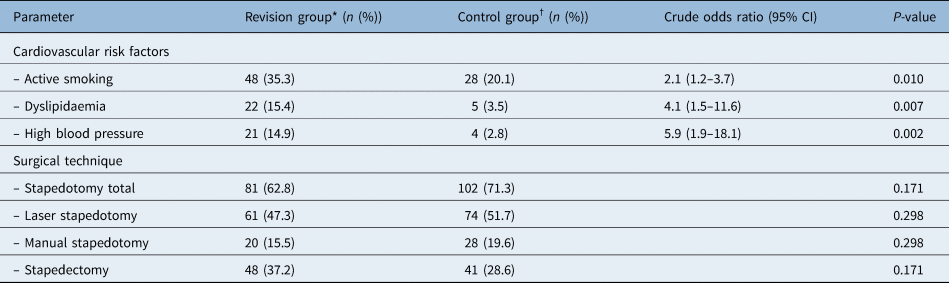
There were significantly more active smokers in the ‘revision group’ in multivariate analysis (p = 0.010; Table 1). Additionally, patients who required revision surgery had significantly higher rates of high blood pressure and dyslipidaemia (p = 0.002 and p = 0.007, respectively).
Patient demographic data, cardiovascular risk factors and stapes surgery technique between revision stapes surgery group and control group

n = 145; n = 143. CI = confidence interval
Technique used at the time of initial surgery
There were more stapedectomy procedures in the ‘revision’ group (37.2 vs 28.6 per cent in the ‘control’ group, but the difference was not statistically significant (p = 0.171); Table 1). There was also no statistically significant difference in stapedotomy technique (laser vs manual) between the ‘revision’ group and the ‘control’ group (p = 0.298).
Reconstruction and type of prosthesis
Three types of stapes prosthesis were used: fluoroplastic (Teflon™), titanium and platinum-fluoroplastic. There was no statistically significant difference in the types of prosthesis used between the two groups (revision group: fluoroplastic, 50.3 per cent; titanium, 20 per cent; platinum-fluoroplastic, 2.7 per cent; control group: fluoroplastic, 45.5 per cent; titanium, 39.8 per cent; platinum-fluoroplastic, 8.4 per cent).
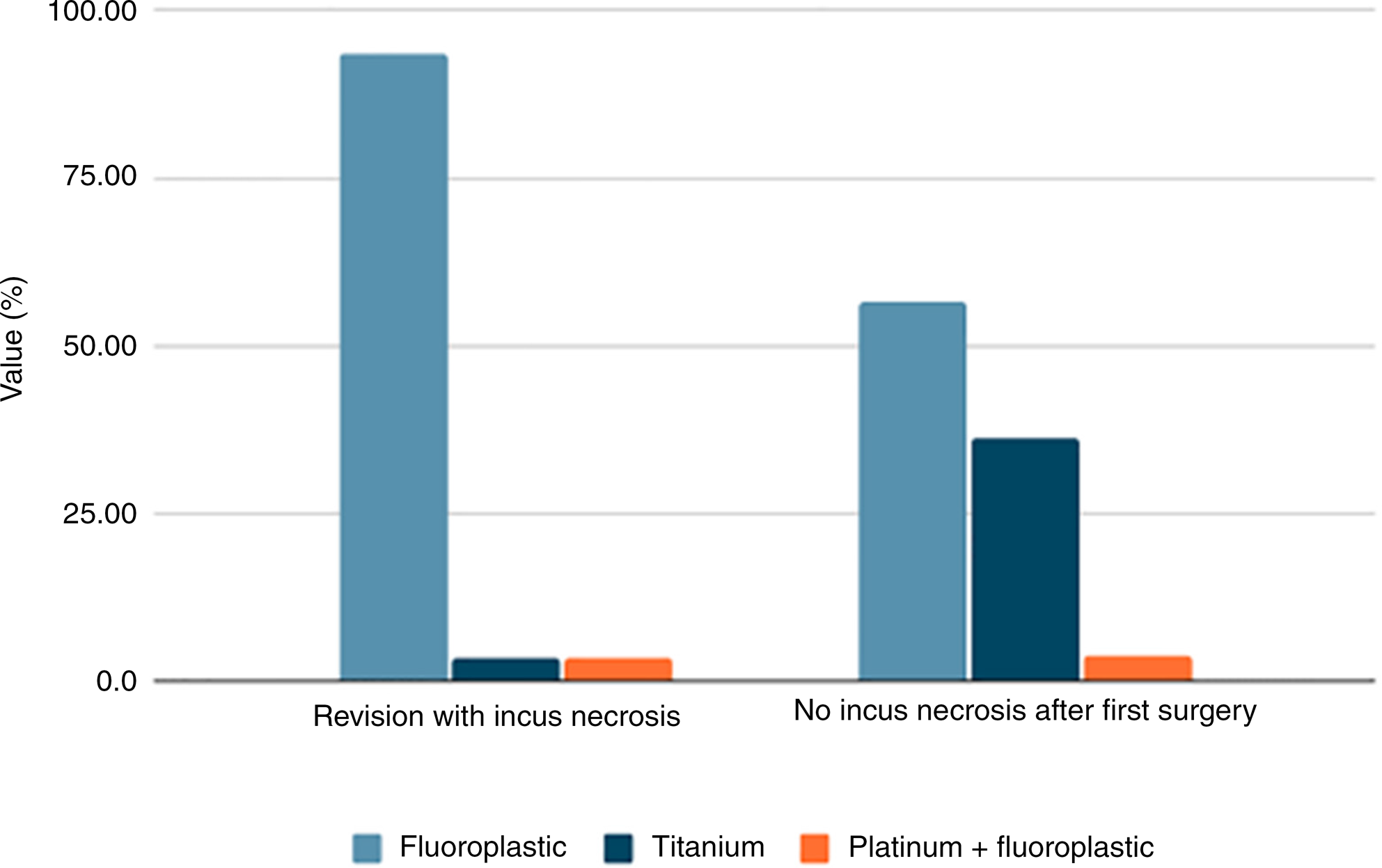
We compared the type of piston used at primary surgery when a lysis of the long process of the incus was noted at revision surgery. There was significantly more fluoroplastic piston in the revision group when lysis of the long process of the incus was present (p = 0.02) (Figure 1).
Incus necrosis at revision surgery and type of piston used at primary surgery.

Secondary outcomes
After primary surgery, there was no difference in the air–bone gap post-operatively in the control group versus the revision group (13.84 dB vs 13.73 dB, respectively; p = 0.935).
For patients undergoing revision surgery, worse audiometric results were obtained after the revision surgery compared with primary surgery. Air–bone gap was 14.40 dB post-operatively after primary surgery versus 33.42 dB after revision surgery (p < 0.001). Speech audiometry was 44.6 dB after primary surgery versus 64.95 dB after revision surgery (p < 0.001).
Discussion
Demographically, our studied population seems representative of the general population, with a higher proportion of women, which is expected in this condition where female predominance is well established.Reference Ayache, El Kihel, Betsch, Bou Malhab and Elbaz3,Reference Bakhos, Lescanne, Charretier and Robier4 Causes for revision surgery found in our study are in keeping with the existing literature, with a predominance of fibrosis and piston malposition, mainly caused by necrosis of the incus.Reference Farrior and Sutherland5
Regarding patients’ age, our study confirms that older patients are as likely to benefit from surgery as younger patients.Reference Meyer and Lambert6 Interestingly, we observed that the age at primary surgery was significantly lower in the revision surgery group than in the control group. We can hypothesise that there is more risk associated with the piston over a lifetime. This might be considered when counselling younger patients about surgery.
In our study, we found several other risk factors associated with the need for revision surgery. Smoking is a well-known risk factor for wound healing disorders and increased post-operative infection rate. In the field of otology, Kay et al. showed a significant association between post-operative complications and smoking in patients undergoing tympanoplasty.Reference Kay-Rivest, Mascarella, Sewitch, Cloutier and Mijovic7 Another study, although not performed in patients with otosclerosis, suggests a role of diabetes in the occurrence of ossicular necrosis.Reference Tüz, Doğru, Yasan, Döner and Yariktaş8 With the existing literature, we suspect that smoking may have an impact on ossicular and middle-ear vascularisation.
More specifically, it has been previously shown that lysis of the long process of the incus is caused by devascularisation around the lenticular process.Reference Enghag, Strömbäck, Li, Rohani, Ladak and Rask-Andersen9 Based on these findings, we can suspect that active smoking might be a contributing factor. Patients should be offered smoking cessation advice ahead of stapes surgery.
Other cardiovascular risk factors (dyslipidaemia and high blood pressure) seem to be associated with an increased rate for the need for revision surgery. To our knowledge, these results have not been reported previously in the literature. Along with smoking cessation, patients considered for primary stapes surgery may benefit from multidisciplinary input and better control of cardiovascular risk factors prior to surgery.
There are extensive publications regarding surgical technique. In recent years, laser stapedotomy procedures have become the mainstay of surgical technique in most centres.Reference Wegner, Vincent, Derks, Rauh, Heymans and Stegeman10,Reference Fang, Lin, Zhang and Tan11 Although there is evidence for a lower rate of complications with laser,Reference Wegner, Vincent, Derks, Rauh, Heymans and Stegeman10–Reference Singh, Datta, Prasad, Nilakantan, Rajguru and Kanzhuly13 it is also widely accepted that the best technique is the one that the operating surgeon is most accustomed to.Reference Wegner, Kamalski, Tange, Vincent, Stegeman and Van der Heijden14–Reference Brar, Passey and Agarwal16 There is no evidence in our study that one technique was superior to another in terms of the risk for revision surgery.
• There are currently no known risk factors to predict the need for revision stapes surgery
• There is no statistically significant difference in terms of surgical technique used during primary stapes surgery regarding hearing outcomes and need for revision surgery
• This study showed that younger age, dyslipidaemia, high blood pressure and active smoking status are risk factors associated with the need for revision stapes surgery
• A holistic evaluation of patients who are candidates for stapes surgery is recommended
• The results of this study can be used for better counselling and risk information for stapes surgery candidates
Difference in piston materials can be a confounding factor when comparing outcomes. Generally, it is accepted that there is no difference in terms of short-term hearing outcomes between the different existing pistons.Reference Faramarzi, Gilanifar and Roosta17,Reference De La Cruz and Fayad18,Reference Bast, Weikert and Schrom19,Reference Wegner, Swartz, Bance and Grolman20 Our study is in keeping with these results.
However, there is less emphasis on long-term results and the possible association between certain prostheses and lysis of the incus. In the study by Schimanski et al., Teflon-platinum alloy is suspected to promote incus lysis. Consequently, they recommend titanium prostheses.Reference Schimanski, Schimanski and Berthold21 Our results support the existing literature. In our series, in the revision cases, lysis of the long process of the incus was overwhelmingly associated with fluoroplastic prosthesis.
Finally, in our study, worse audiometric results were achieved after revision surgery in comparison with primary stapes surgery. This has also been demonstrated previously and is important for patient counselling prior to re-intervention.Reference Farrior and Sutherland5,Reference Meyer and Lambert6
Conclusion
In conclusion, although stapedotomy has a high success and a low complication rate, our study emphasises the importance of a holistic and multidisciplinary assessment prior to surgery. Revision surgery is associated with poorer results and higher risk. It would be beneficial for better counselling to identify patients who are at higher risk of needing revision surgery at some stage.
We showed that patients with active smoking status, dyslipidaemia and high blood pressure are at higher risk of needing revision surgery. Our study also confirmed the existing evidence that surgical technique is not directly associated with outcomes. We also confirmed that fluoroplastic pistons have often been used when lysis of the incus is found at revision surgery.
Acknowledgements
The authors would like to thank Maxime Leroy for his help in the statistical analysis, and Pauline Coutelle for her help with collecting data in Angers.
Competing interests
None declared