Introduction: the formation of exhibition publics
Public museums, temporary exhibitions and World's Fairs were important sites in the production and communication of knowledge during the second half of the nineteenth century. Institutions of this kind have been much studied in the scholarship of the last couple of decades, but I would argue that the involvement of the public in ‘the exhibitionary complex’ begs further exploration. A central theme in much of the literature has been the politics of representation – for example, the stabilization of cultural categories such as ‘civilization’, ‘race’ or ‘nation’ – analyses in which the visitors have been understood in terms of rather passive audiences.Footnote 1 Several important studies have emphasized how exhibitions were planned as didactic and normative social spaces, but the same studies have paid less attention to how displays were designed to activate visitors.Footnote 2 Science and technology exhibits have been identified as early instances of a more interactive pedagogic ideal, but in general such exhibitions have been analysed as part of the distributive genre of ‘popular science’.Footnote 3 Thus while there has been a shift towards exploring the social composition, interaction and reactions of visitors in recent scholarship, very few studies have been dedicated to the ways particular kinds of publics were formed at exhibitions.
In this paper, I will discuss a new mode of involving exhibition audiences established in Europe during the late nineteenth century. Its particular form of address is characterized by an ambition to transform the visitors' self-understanding by engaging them with various techniques of scientific observation and representation of social issues. While it is not possible to locate the specific onset of this practice, exhibitions of this type were rare before 1880, at least in light of the fact that they had become a distinct genre by 1900, when a large number of temporary and permanent exhibitions on themes such as health, demography and social economy were being arranged in this manner. By then, these rather diverse initiatives were often referred to as social exhibitions or social museums. The objective of representing everyday aspects of contemporary society at a social museum was not just to inform visitors, but also to engage them in the transformation and improvement of the same. The intent was to teach exhibition-goers how to deal with the abstractions of life and society and expose them to new perspectives on everyday habits and social practices. Most of all, however, they were meant to learn how to turn observation back on themselves and scrutinize their own way of life.Footnote 4 Similarly, the objective of this essay is not merely to describe the politics of representation at exhibitions of this kind, but to contribute to an analysis of the politics of participation in action.Footnote 5
The empirical focal point of this study is the ‘Anthropometric Laboratory’, planned and installed by Francis Galton at the International Health Exhibition held at London's South Kensington exhibition complex in 1884. This exhibit represents an early example of a design encouraging visitors to engage in activities aimed at changing their perception of themselves. Since the success of Galton's eugenic project, coined as such in 1883, depended on convincing large segments of the population to make certain choices in life, this didactic problem proves to be a recurrent theme in his work at the time, although one hitherto little studied.Footnote 6 I will thus also draw on some of Galton's related projects, primarily his ‘composite photography’, in order to discuss how the process of measurement was intended to inform participants. In the literature, the Anthropometric Laboratory is primarily known for providing the empirical basis to his theory of correlation, what his biographer Karl Pearson characterized as a ‘new view of the universe, both organic and inorganic, which provides all branches of science with a novum organum, far wider-reaching in its effects than that of Bacon’.Footnote 7 The less grandiose claim would be that the exhibit was an important site of development for anthropometric science and popular eugenics.
In the present analysis, these aspects comprise contexts of the inventive pedagogical moment under scrutiny rather than primary themes of inquiry. Although public anthropometric and eugenic activities have thus far been little researched, it is clear that the pedagogic rationale of similar manifestations and demonstrations can vary.Footnote 8 When one anthropometric laboratory – under the direction of Harvard anthropologists at the apogee of American scientific idealism and technocratic visionary enthusiasm – measured members of the public in the Hall of Social Science at Chicago's A Century of Progress in 1933–1934, the visitors were addressed and involved in ways that differed from those of London half a century earlier.Footnote 9 The politics of participation is not an effect of the techniques of measurement and testing apparatus deployed, but rather the rationale of how the public was to be involved in complex processes of describing the world and prescribing ways of acting in it.
It comes, perhaps, as no surprise to learn that the laboratory at the Health Exhibition and other related initiatives were part of a historically specific moment in efforts to involve members of the general public. Galton is almost a caricature of Victorian scientific naturalism, and, as Steven Shapin argues, scientific naturalism reduced the moral and political scope of public debate on science and thus became ‘a vehicle for establishing and validating important modern social and cultural boundaries between science and the public’. But Shapin characterizes this shift as the end of ‘an era of public interest in the constitution of scientific knowledge’ that began with the new natural philosophy of the seventeenth century. He describes it as a closure of the previously unsettled question of who could claim authority in scientific matters.Footnote 10 I would suggest that this period also could be described as the beginning of an era of public enrolment, involvement and participation that coincided with the institutionalization of the modern social or human sciences.Footnote 11 The relationship between the social sciences and specific audiences was particularly important in establishing authority on knowledge of public matters, not least by defining the characteristics of the general public.
Social exhibitions could thus be described as one feature in this new landscape of publications, public manifestations and research activities where the general public was represented or addressed, or participated. And although the broad complex of the Health Exhibition – the popular shorthand of the time being the ‘healtheries’ – defies clear-cut categorization, it does display most of the characteristics of what later would be called a social exhibition. It was understood as addressing ‘social problems’ and contributing to their solution by informing the public of a new body of knowledge and concurrent ways of living. The vast variety of authoritative knowledge on offer was most often described collectively as ‘sanitary science’ or, in broader terms, as ‘social science’.Footnote 12 Thus study of the Anthropometric Laboratory of 1884, as well as other projects undertaken by Galton, makes it possible to discern the ways in which a new sort of active public could be imagined and planned for in this particular field, for example by deploying new techniques and media. Several questions are of particular concern here. What problems were the new techniques intended to solve? What were the means of simultaneously attracting and reforming the public? Who was supposed to participate in this self-assessment and in what way?
Assembling reformatory attractions: the International Health Exhibition of 1884
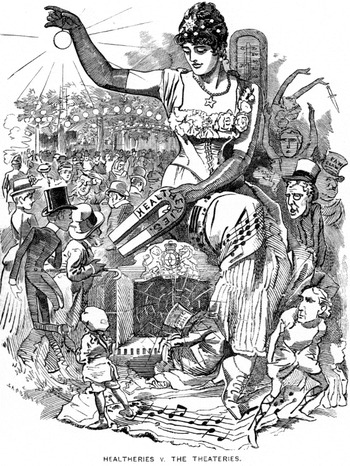
The things exhibited, offered and performed for visitors to the International Health Exhibition lent the concept ‘health’ a remarkably broad meaning.Footnote 13 This was partly a result of the organizers' explicit strategy to draw crowds – the public was also provided with an array of recreational opportunities and popular diversions, not to mention an impressive range of restaurants and bars – so that the exhibits and their lessons could be brought ‘under the eyes of the million[s]’.Footnote 14 The wide variety of exhibits and demonstrations was, according to The Lancet, intended ‘to suit all tastes and to interest everybody, from the philosopher to the village housewife’.Footnote 15 Choosing the familiar concept of ‘health’ instead of the more specific and technical ‘hygiene’ was one way of attracting as large a segment of the prospective audience as possible (see Figure 1).Footnote 16 But the variety and scope of the exhibition was also a result of the interpretation of the subject matter; the exhibition showed that almost all aspects of daily life and behaviour affected the health of the individual and, as a consequence, the development of society as a whole.Footnote 17
The modern Hygeia, attracting the audiences of traditional entertainment in the city to the exhibition grounds. Punch, 26 July 1883, p. 39.

The tension between instruction and entertainment that was a perennial theme at the large exhibitions of the late nineteenth century seems not to have been much of an issue here.Footnote 18 In fact, reviewers explicitly commended this successful strategy of attracting visitors who otherwise might never have attended a health exhibition.Footnote 19 Some of the attractions were explicitly designed and presented as pure entertainment. The highlight of the evenings was a novel visual spectacle where a crew of operators projected light and images onto a huge complex of fountains, creating an ever-shifting cascade of colours and figures. When described in positive terms, such attractions were not characterized as a necessary trade-off where the ends justified the means, but rather the excitement and stimulation they aroused were part of realizing the overall aim of the exhibition, to promote interest and attention among ‘the mass of the public’.Footnote 20 The unprecedented theme of a major exhibition combined with the abundance of entertainment and refreshment on offer also generated plenty of satire in the press, where the sensory stimuli and general overindulgence were poked fun at. The more serious discussion concerned the very nature of the initiative. If almost everything concerned health, as the exhibition stated, then why not call it a World's Fair? The organizers were willing to concede this point, but only if the distinct didactic qualities of this exhibition were acknowledged. ‘[I]t is a World Fair resting on the solid foundation of Scientific Knowledge practically applied, and good for instructed and uninstructed alike’. In total, the exhibition attracted more than four million visitors and was almost universally hailed as a triumph – the most successful in the country since the Great Exhibition of 1851, concisely summed up as ‘an epoch in Popular Education’.Footnote 21
The self-celebratory nature of the official reports aside, the Health Exhibition represents a broad shift of pedagogical rationale of large exhibitions. The overarching ambition at the Crystal Palace in 1851, to literally bring all human efforts together and provide an overview of the world for the comparative and investigating gaze of the visitor, was still very much present in later decades.Footnote 22 But the most celebrated tendency at the 1884 exhibition was the manifest effort – some commentators described it as unprecedented – of displaying and stimulating scientific activities, together with the customary arrays of exemplary merchandise, cultural artefacts and appliances. Apart from Galton's exhibit, fully functional bacteriological and physiological laboratories were constructed on-site, alongside full-scale residential environments. The latter included so-called ‘sanitary’ and ‘unsanitary’ homes, with cross-section parts included to allow the public to examine and compare them.Footnote 23 One of the major attractions was a full-scale interactive streetscape of seventeenth-century London, providing both an immersive experience in itself and a pedagogic contrast to all the sanitary information on offer. Inviting the visitor to be an observer as well as the subject of scientific study was one of many ways in which the didactics of involvement were pursued. In fact, it could be described as the distinguishing feature of the exhibition.Footnote 24
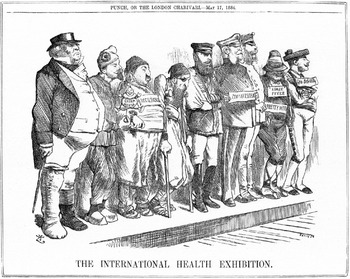
Since social exhibitions were intimately associated with the conditions, choices and habits of everyday life, the public was perceived as being part of the exhibition. The artefacts on display were often mundane articles rather than awe-inspiring showpieces, which meant that the comparative perspective need not be restricted to the exhibits themselves, but also included the visitors and their daily lives. This was also a pedagogy that organizers utilized in many different ways. The ‘unsanitary house’ exhibit was deliberately constructed first to give the visitor the impression of familiarity, tidiness and comfort, only then to expose and explain the dangers of this deceptive environment.Footnote 25 The positive model thus served not only as a contrast between healthy and unhealthy living environments, but also as a way to demonstrate to the visitors their lack of knowledge, judgement and skills of differentiation. Every visitor was provided ample opportunity to take into account his habits and behaviour with the help of the abundance of comparative material related to health, in what amounted to an assessment of himself as the potential object of sanitary inquiry and evaluation. In the humour magazine Punch, allusions to the visitor being examined, categorized and diagnosed on-site appeared even before the opening and continued throughout the season of the exhibition (Figure 2).Footnote 26
The Health Exhibition embodied – typologies of the public on display. Punch, 17 May 1883, p. 235.

A lesson in self-observation: Francis Galton's Anthropometric Laboratory
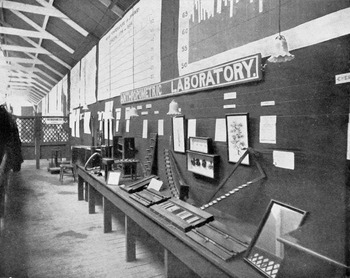
So what kind of exhibit was the Anthropometric Laboratory? At the most basic level, it invited the general public to measure their physical and mental characteristics in seventeen different ways, a procedure that took each participant half an hour to complete. Every visitor undertaking this assisted self-examination paid a fee of threepence and walked away with a record of his results, a copy of which the organizers also kept. Since the participants, two at a time, had to be guided through each station by the officer in charge of the laboratory, only about a hundred people a day could go through the procedure. Due to the meticulous instructions needed to guarantee precision, there was an almost constant queue at the entrance.Footnote 27 The people waiting in line or passing by the display could look and listen through the open lattice separating them from the procedures performed inside, the diagrams exhibited on the wall, and the different objects on display. A small brochure had also been printed where the general significance of the project and the details of each measurement were described.Footnote 28 Galton considered the exhibit a complete success: ‘the laboratory worked with astonishing smoothness, and its popularity was extraordinary’. More than nine thousand visitors participated and many more had had the chance to contemplate its implications (Figure 3).Footnote 29
The Anthropometric Laboratory at the International Health Exhibition, 1884. Karl Pearson, The Life, Letters and Labours of Francis Galton, Cambridge: Cambridge University Press, 3 vols., 1914–1930, vol. 2, Plate L.

The public's interest and enthusiasm was a breakthrough for Galton's anthropometric research.Footnote 30 He had been involved in the planning of large-scale anthropometric investigations in Great Britain since the mid-1870s, but these efforts had produced few results. This was due to a set of interdependent problems. From Galton's eugenicist point of view, the primary problem was the lack of a proper scientific foundation from which to promote responsible choices and actions.Footnote 31 Several modes of investigation to collect the necessary amount of anthropometric data had been proposed and tried by a committee set up by the British Association for the Advancement of Science, with Galton as a very influential member. In other European countries huge surveys of schoolchildren and soldiers were being made, and the group had suggested similar modes of investigation in Britain, but with few results. When the committee summarized its eight years of work in 1883, the report included a lot of aggregated data, but also a number of expressions of disappointment in the scope and quality of the results. In fact, the committee had not even been able to agree upon a standard set of measurements to be taken or methods to use.Footnote 32
The laboratory was the result of Galton's efforts to solve these combined problems. He evaluated available anthropometric instruments and also designed several new devices. The exhibition was thus intended to serve as a testing ground for a comprehensive set of standardized anthropometric equipment. But the main function of the laboratory was to remedy the consequences of not carrying out large-scale anthropometric surveys in Britain: the twin problems of a lack of public attention to the questions at stake and the need for authoritative arguments as to their importance.Footnote 33 Since the survey was dependent on volunteers, the crucial point (and the one most relevant to the present analysis) was to motivate public participation. But collecting data was just the start for Galton, whose ultimate goal was much more far-reaching. He wanted to make continuous self-assessment a popular, lifelong practice.Footnote 34 So in what ways was the public's necessary involvement in the project being encouraged, nurtured and fashioned through this exhibit?
Galton took for granted that anyone and everyone would be interested in being evaluated and compared with his fellow man or, to be more precise, that each individual desired ‘to know his rank among the rest’.Footnote 35 Although he never made the explicit comparison, the Anthropometric Laboratory obviously had similarities with contemporary fairground attractions testing one's strength, reaction time and sundry other abilities. Reviewers described the display as successfully stimulating visitor curiosity (‘most interesting and amusing’), and acknowledged its value as an attraction: ‘this “laboratory” may become rather a favourite resort for visitors to the exhibition’.Footnote 36 The competitive aspect was certainly part of its appeal and was also something that had to be carefully managed. Results were collected anonymously, parents were separated from their children to avoid time-consuming retesting if the former scored lower, and the standard fairground practice of posting the highest results was not adopted.Footnote 37 The long, narrow construction of the exhibit – where the public ‘easily’ could ‘see through the lattice work, while they are prevented from crowding too close’ – gave the examination the character of a public performance; the instructions to the participants, the testing procedure and the participants' reactions could all be observed at close range at each station.Footnote 38 The various diagrams on display were placed high on the wall and were big enough to be readable from the other side of the partition. As Galton later described it, the display was designed as an attraction in itself: ‘I have always noticed that people seem much interested in looking on.’Footnote 39
The very existence of such a novel exhibit was obviously an argument in favour of the value and importance to society of being measured. Galton maintained that the assessment procedure should be seen as a natural part of life by comparing it to school exams, medical examinations of children and entrance tests for certain professions, analogies echoed in commentary and reviews. Included in the exhibit were also specific proofs of the importance and the value of seemingly marginal particulars about individuals. Galton especially highlighted the results of an investigation commissioned by the War Office during the American Civil War on the medical significance of hair colour. According to this study, diseases comparatively much more afflicted ‘light-haired’ men than ‘dark-haired’ ones. Galton argued that if something as seemingly trivial as hair colour had a decisive impact on the health of the individual (the statistics presented on a large diagram on display at the exhibit), then ‘much more may we feel assured that obviously important personal data deserve measurement and registration’.Footnote 40 Though often couched in individualistic terms, the real importance of anthropometrics was expressed in statistical collectives. The procedure in the laboratory was a mechanism not only to produce anthropometric data, but also to include individuals in definite singular collectives, such as ‘the general public’ or ‘the population’. The completed form, the summary appraisal of each participant, was a token of the visitor's contribution to science as well as a proof of having stood up and been counted, of being represented in an imperative new statistical aggregate.Footnote 41
Several of the projects Galton had been working on in previous years came together in the Anthropometric Laboratory. It also provided him the opportunity of evaluating instruments and procedures, a number of which had to be adjusted when they did not work as planned, and Galton considered this to be one of the most important benefits of the laboratory. While the exhibit certainly served as a means to assess public interest in the field, it was also a platform for trying out different ways of making the procedures accessible and, in the best possible scenario, popular. Several of the procedures were designed to include material and actions that were as familiar to the average citizen as possible, in order to keep the instructions as straightforward as possible and stimulate further interest. Galton argued that the advantage of creating tests featuring items available in any household was to provide the public an opportunity ‘to repeat the identical experiment at home with friends’.Footnote 42 The visitor to the Anthropometric Laboratory not only left the exhibit with a list of seventeen measurements on a personalized card but, having been informed about anthropometric science and its value, was also encouraged to consider other tests and comparisons outside the exhibition. Most of all, however, he or she was encouraged to think about what the assessment meant and the implications it had.
New media and techniques for fostering self-assessment
Galton was not very specific about how he envisioned the Anthropometric Laboratory as a vehicle for promoting self-knowledge. That said, the display at the Health Exhibition was the culmination of years of effort at developing methods of anthropometric measurement and the means with which to make them widely accepted, which provides a richer empirical basis for analysis. When discussing anthropometric and physiological measurement in 1884, he concluded that ‘the statistics of each man's conduct in small every-day affairs’ would provide ‘the most precise measure of his character’.Footnote 43 While continuing to consider other options, he linked two projects in particular to the assessment techniques and learning practices brought together at the exhibition in London – his efforts to establish and promote the method of ‘composite’ photographs and his campaign to encourage the public to keep books of personal medical records.Footnote 44 Both of these projects involved designing techniques for producing knowledge among non-specialists, directing their interest toward assessing themselves, as did the whole assemblage of techniques at the Anthropometric Laboratory.Footnote 45
The project dealing with the compilation of medical records was pursued in cooperation with leading medical experts, and early in 1884 Galton published two sets of forms for collecting and organizing particulars such as anthropometric measurements, photographic portraits and medical histories. One was a highly detailed biographic register for individuals, the Life History Album,Footnote 46 and the other a tool to accumulate more abstract accounts of entire families, the Record of Family Faculties.Footnote 47 The publication of the latter was launched with a public competition featuring large cash prizes for the most complete copies submitted, in an effort to stimulate ‘a custom of keeping family records’.Footnote 48 Self-assessment was essentially a habit of mind to be learned, and Galton's two books were devised as vehicles for learning the procedure of selecting and documenting particulars as well as understanding their value. The instructions and layout of the publications were designed to teach interested laymen to identify relevant facts and register them in a precise manner. Though the initial plan restricted entries to the Record of Family Faculties contest to the medical profession, he soon abandoned this constraint and invited the general public to participate.Footnote 49 Several commentators were initially sceptical about the use of observers without scientific training, but it was eventually described as an ingenious and effective scheme. Science praised the effort at making the registration of individual and family characteristics a ‘duty’ and commended them as ‘the most important books of the year’.Footnote 50 Other reviewers stressed their quality as a ‘new and instructive recreation’, attracting many who ‘would be very likely to decline if they were asked to take part in a serious scientific activity’.Footnote 51
Anthropometric discussions do indeed seem to have had some public appeal at the time. While Galton himself was less than satisfied with the results of the Anthropometric Committee of the British Association, its final report at the 1883 meeting was met with enthusiastic reviews in the press. It was cited as a good example, ‘almost irresistible in its force’, of how seemingly monotonous research yielded ‘fascinating’ results, and was described as the primary evidence of the entire association's merit.Footnote 52 Another reviewer used the report – ‘calculated to cause men to think for themselves’ – to defend the conference against the common criticisms of endless ‘talk, excursions, and soirees’ and give proof of ‘the good done to the community at large’ at these meetings.Footnote 53 But if anthropometry as a science was considered both interesting and important to the general public, it did not necessarily mean that the general public was motivated to contribute particulars about themselves. An earlier effort by the committee in 1878, then represented by William Farr, to use life assurance companies to collect data was ridiculed in the press. The proposal had ‘thrown all the insurance managers … into fits either of dignified propriety or of explosive laughter’, since it was deemed impossible to find ‘the policyholder who will agree to be made a subject of experiment before he can assure his life’.Footnote 54 Galton's new methods of gathering data can be understood as ways of transforming such suspicion into curiosity.
Galton was preoccupied with measurement and calculation and constantly conceived new devices to serve his ends. But he also wanted others to appreciate quantification as a universal cultural value that would set the standards for future public discourse. When he first described his public anthropometric project in more detail in 1882, he began by posing the question ‘when shall we have anthropometric laboratories?’ Among the answers he gave, one can be singled out as particularly crucial – when there is ‘a desire among many persons to have themselves and their children accurately appraised’.Footnote 55 By framing the core problem this way, it came to consist of two equal components: the benefits of the discipline of anthropometry were underrated and accuracy in such matters was not clearly understood by the public at large. Both matters needed to be remedied.
One way to achieve this was to design techniques that drew on familiar procedures and popular forms of observation. Galton discussed this approach just a few days before the laboratory opened at the Health Exhibition, when he gave the Rede Lecture at the University of Cambridge. The alleged resistance to being gauged and measured would be negated, he argued, if the manifest natural curiosity of the general public were mobilised.
I mention these details [about common experiences] to show how little average people are shy being weighed and measured. On the contrary, they like it. Nothing interests them more than particulars about themselves. The plainest people look at their own faces in the glass without displeasure.Footnote 56
This putative interest in studying the characteristics and appearances of one's self and others was something that Galton had exploited in years previous when he developed, explained and promoted his technique of composite photography.
Although in recent decades Galton's composite photographs have become almost a formula for characterizing late nineteenth-century human sciences, there has been less actual analysis of the various uses, contexts and interpretations of the technique.Footnote 57 In fact, the method was very well known at least in Britain and the United States by the mid-1880s, and continued to be a relevant and useful cultural reference for decades. It was, for example, cited by Sigmund Freud to explain the process of dream interpretation around 1900 and by Ludwig Wittgenstein to frame the theoretical problem of ‘family resemblance’ in the late 1920s.Footnote 58 But, as will be shown, from the beginning Galton's explanation and practice of composite photography was not confined to technical considerations. Its invention was part of his ambition to advance a popular ideal of quantification and precision, especially when it came to everyday phenomena and commonplace presumptions; such pedagogical elements were, for example, very much present when he proved the reliability of the technique.
The composite photograph was conceived in the mid-1870s when Galton was a member of the Anthropometric Committee.Footnote 59 Part of its work was to collect representative photographs of the British population, of what in the visual culture of anthropology at this time was described as examples of British ‘types’. As was always the case in gathering visual data, there was no generally acknowledged methodology for choosing samples, which in cases of disagreement could make the process arduously argumentative and the results unclear.Footnote 60 Galton's invention – though not adopted by the committee – was a statistical solution to this problem, transforming the qualitative process of specimen selection to what could be described as simply a matter of quantitative accumulation. By superimposing any number of photographs into one aggregate image where all components were of equal value, the result was deemed a pictorial average as well as a generalization describing the underlying ‘type’ of a particular group of individuals.Footnote 61 Among the many innovative aspects of this technique, the one most closely connected to the practices of the Anthropometric Laboratory was the way Galton induced his audience to reflect on their self-understanding and ability to make correct judgements.
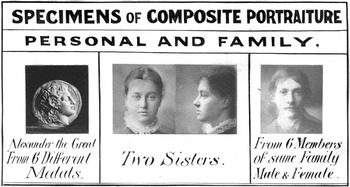
When Galton arranged a major demonstration of the new method for non-specialists at the Royal Institution in London, he used a number of visual media intended to make the members of his audience contemplate the specific qualities of the technique. He first attempted to prove the accuracy of his method by screening two versions of the same composite side by side. The first was produced on the spot with magic lanterns, superimposing three photographs into one composite. The second was a composite image produced in the darkroom prior to the demonstration in accordance with his method and using the very same images. He also related the composite principle to existing popular visual media, particularly to the familiar viewing technique of the stereoscope, and encouraged the audience to experiment on their own albums of photographic portraits. A standard stereoscopic viewer could be used to superimpose any two chosen portraits and Galton suggested that it was especially rewarding to combine family members (Figure 4).
Composite photography as a technique for surveying the family album. Frontispiece (detail), in Francis Galton, Inquiries into Human Faculty and Its Development, London: J.M. Dent, 1883.

But one of the most important lessons offered by the composite method was the unreliability and inadequacy of commonplace assumptions and ideas. By juxtaposing three projected images before superimposing them on the screen, he proved the impossibility of achieving generalization without technical aids. This, Galton argued, also showed the impossibility of reliably combining any visual impressions. The composite method thus offered an opportunity to contemplate this fact while also advancing the skill to control the attention given to the spectacular: ‘in our general impressions, far too great weight is attached to what is strange and marvellous, and experience shows that the minds of children, savages, and uneducated persons have always had that tendency’.Footnote 62
According to Galton, composite photography was the perfect anthropometric medium. The feasibility of the technique – the existence of types ‘sufficiently similar in their mental characters or in their physiognomy, or in both, to admit of classification’ – was shored up with examples from physiological and psychological experiments. Individuals had different innate perceptual capacities, and the concept of ‘personal equation’ borrowed from astronomy was presented as the best evidence of this. In astronomy it was used as a way to standardize data culled by different observers, but Galton used it as proof of a ‘persistent characteristic of each individual, however practised in the art of making observations or however attentive he might be’, and thus a ‘very fundamental peculiarity of his constitution’. He explained his new technique as part of an ambition to correlate groups of individuals with similar mental qualities with ‘more obvious physical characteristics’.Footnote 63 But, as mentioned above, references to the measurement of mental characteristics not only justified the alleged possibility of identifying and charting natural types. Composite photography could also teach anyone how the mind of the observer worked. Galton claimed that the composite was an analogy to the mental operation of combining observations. With reference to experiments conducted by Ernst Weber and Gustav Fechner, he argued that since the technique gave equal weight to each specimen, it exposed the inadequacy of everyday mental images. The moral lesson of understanding composite photography could not be more straightforward: ‘General impressions are never to be trusted.’Footnote 64
Consequently, the composite image was to Galton also a tool for creating observant subjects, aware of their cognitive limitations and eager (since they were not children, savages or ignoramuses) for the opportunity to correct generally held, though flawed, beliefs. The technique certainly fits the historical shift to ‘mechanical objectivity’ and its imperative observational mode of ‘self-elimination’ that Lorraine Daston and Peter Galison have analysed.Footnote 65 However, as they point out, self-elimination can also be understood as ‘the zenith of self-cultivation’, since the far-reaching problematization of the observing subject made it something that constantly had to be cared for, cultivated and controlled.Footnote 66 The changing observational ideals and truth claims regarding different modes of representation have been prominent subjects in much recent literature, but significantly less attention has been given the pedagogical ideals and the productive consumption connected with these modes of representation. The ideal of mechanical objectivity was not just about circumventing the subjectivity of the observer in the production of knowledge, but was also part and parcel of innumerable pedagogical projects. In the case of Galton's composite photography, this self-cultivation was not even primarily about the production of non-subjective facts. It was a political vision of turning observation back on the studying subject in order to be involved in self-observation, self-assessment and evaluative comparison as a natural part of a responsible life.Footnote 67 Thus the composite photograph was not only a device for gathering knowledge to control the groups surveyed, as, for example, Carlo Ginzburg characterizes it. The technique was supposed to activate the public, to make it consider the implications of this mode of observation.Footnote 68
Galton's cross-references between composite photography, the medical-records project and the anthropometric laboratory link them as parts of his eugenic project. But it is clear that they also share a common didactic: they were designed to promote self-assessment as well as to underpin new frameworks and standards for societal analysis. The composite method, for example, provided the public with the means to comprehend the nature and value of statistics. Galton claimed that the selected photographic specimens were the perfect equivalent of numerical values arranged in a table and the process of combining them ‘one of pictorial statistics’. But in comparison to the statistical aggregation of numbers into averages, composites were far richer: ‘They are real generalisations, because they include the whole of the material under consideration.’Footnote 69 Reviewers accepted this assertion and some were willing to champion Galton's most general claim – that the technique demonstrated the ‘truth in all statistical conclusions’.Footnote 70 In the early 1880s, he encouraged amateur photographers to pursue the technique, even inviting them to send him pictures of family members and get a composite in return.Footnote 71 In this way, the composite photograph was also an educational tool with the potential to be pursued by many, just like the anthropometric techniques exhibited at the Health Exhibition. When the Anthropometric Laboratory was included in the permanent science exhibit at the South Kensington museum in 1888, composite pictures were an integral part of the exhibit.Footnote 72 The composite method and the medical registers can thus both be understood as components in Galton's efforts at the laboratory to improve social and cultural standards: they had the capacity to promote ‘accuracy of ideas and language’.Footnote 73
The politics of participation: making civic selves
The voluntary participation of the general public was absolutely essential to Galton's anthropometric project and the goal for this involvement was to effect positive change in the behaviour and self-understanding of the participants through the knowledge produced. This latter was a prerequisite for making any progress with his eugenic project. The media and techniques he designed were intended not only to both stimulate public participation and encourage curiosity, but also to entice the general populace to commit to an ongoing project of observation, record-keeping and consideration of conclusions.
So in what ways is it possible to describe Galton's anthropometric project as part of a shift in the pedagogy and politics of public knowledge? I argue that it is distinctive due to the way in which an audience was fashioned and involved and because of the purpose, rationale and consequences this involvement entailed. Of course it is difficult to specify the direct effects of Galton's project. Neither the particular investigative and educative techniques he invented nor his model of self-assessment succeeded in capturing the popular imagination in the way he predicted.Footnote 74 Family registers did not become part of every household, nor did anthropometric laboratories become indispensible sources of local civic pride. But as Kurt Danziger has argued, Galton's laboratory did bring about a new mode of inquiry in experimental psychological practice: measuring the distribution of abilities in a population.Footnote 75 What is suggested here is another formative moment: the making of a certain politics of participation in expository science, a mode of activity that required a specific type of civic selfhood.
Although already existing procedures of acquiring self-knowledge seem not to have been mentioned or even implied, Galton's Anthropometric Laboratory can be situated within a longer tradition of practices, with phrenology as the foremost example. But there are also significant differences. Participation in a phrenological lecture or assessment did not follow the same rationale as Galton's project. Guidance in making important life choices was certainly part of the appeal of charting the human character, but in phrenological examinations neither was the individual invited to become a member of a statistical collective nor could his or her participation be proclaimed a component in the production of new knowledge. Furthermore, the methods of observation, the techniques and the media promoted by Galton were designed as moral lessons on the participant's ability to observe, understand and discuss everyday phenomena.Footnote 76 This focus on self-observation also sets his project apart from other ideals of popular participation in scientific culture at this time. The influential self-help literature of Samuel Smiles, for example, did offer countless templates of scientist's life histories as ideal types of character and responsibility. But Smiles advocated a culture of selfhood through scientific pursuit: self-assessment played no significant part in the development of his ideal characters.
In contrast, public participation was a built-in requirement in almost every aspect of Galton's project. This constraint went well beyond the need for ‘popular science’ to compete for attention in the marketplace of consumer culture, or to settle issues of authority between rival bodies of knowledge. From the production of new knowledge to the implementation of policy, the project depended on winning the support of people willing to become actively involved and ideally even advocating the cause. The mode of public address was always inclusive, explicitly seeking the involvement of men and women, gentry and workers, scientists and amateurs, and much was made of the range of social groups who partook. The techniques and procedures were explicitly designed to make it possible to participate without formal training, and whenever specific methods proved difficult to pursue on one's own, as in the case of composite photography, Galton provided opportunities to overcome these obstacles. Making the anthropometric mode of self-assessment popular depended on offering accessible ways to practise it, not just in order to master the procedures, but to understand its significance and recognize its value.
It might seem somewhat heedless to have used the term ‘participation’ throughout this essay, since it has generally been reserved for later developments in scientific communication. Indeed, there were hardly any emancipatory or democratic elements in Galton's project. He did not perceive teaching observational skills and habits as the foundation of a well-organized political culture, as did his disciple Karl Pearson a few years later.Footnote 77 Furthermore, the conclusions to be reached as well as the lessons to be learned were controlled in ways that made few choices possible that went against the rationale of the undertaking, firmly founded in scientific authority. At the same time, the political rationality of the project, as it entirely depended on the production of new knowledge and voluntary action, could in broad terms be characterized as liberal. The normative aspects of participation, as the concept has often been used, appear to have been given too little critical attention. Participation is always structured by the way the interaction is organized, and it seems pointless to use normative standards for investigating the politics of public involvement and participation and understand them as historical phenomena. What are the criteria to be used in discerning one form of real, authentic participation from other possible forms?
An aspect of participation often discussed in the literature on science and the public is the degree of access or openness: who is allowed or encouraged to take part? In the case of Galton's anthropometry the answer is easy: as many as possible. To involve a large and, at least to some extent, representative sample of the population was necessary for obtaining scientifically legitimate results, but once these results were established the desired social change depended on as comprehensive participation in the project as possible. Participation was prerequisite to the credibility of the project, as well as being the only means to achieve its goals. Participation thus served as a means of self-responsibilization, and Galton's project had a near-perfect fit with the sanitary movement. This is no coincidence, as he had used popular interest in sanitary science as a model as early as 1873, when discussing the possibility of establishing the principles of hereditary improvement as ‘a living belief which becomes ingrained … into the character’.Footnote 78 The sanitary movement provided ample opportunity to think about ways of pursuing public participation, even in well-established genres of popular scientific practice. Public sanitary lectures delivered in the 1870s aimed at changing the public's relationship with itself, to transform each and every member of the audience into what lecturers called ‘his own medical officer of health’.Footnote 79
These efforts at creating a culture of self-knowledge and responsibility envisaged a specific audience, a collective of informed, thoughtful and thus reliable individuals. Intention and effort were the criteria for being part of this new social entity, this moral collective of civic-minded persons. When Galton named the award-winning entries in the Record of Family Faculties competition, each had been chosen for its meticulously researched data, not for displaying exemplary individual characteristics, as in later eugenic campaigns. Taking part was, in other words, an end in itself. Choosing to participate meant recognizing the need to be highly individualized, through a set of data, and included in the statistical collective, in order to understand the true significance of said data. The politics of participation thus involved identifying the problem, understanding the task and vowing to take personal responsibility, in order to be included in a collective of reliable citizens. The civic selfhood of this project – although drawing on the same type of investigative practices that Daston and Galison have identified as mechanical objectivity and the efforts to produce a scientific self ‘actively willing its own passivity’ – was about getting actively involved, committed to learning the lessons of the new methods and knowledge.Footnote 80
It is easy to point out the politics of representation at work in Galton's public anthropometric project. The Anthropometric Laboratory was no neutral platform for debating the tension between nature and nurture, and the choice of subjects for composite photography further stabilized some of the preoccupations of late nineteenth-century human sciences. But the process in which these representations were involved is much more complex than much of the current literature would have us believe. The exhibit at the International Health Exhibition was not simply a theoretical lesson to be learned and internalized, a hierarchy of values to recognize, but was part of a complex set of practices that were to be extended in space and time. Participation was in this case not an open-ended process, but rather a sophisticated technique to enrol individuals to constantly search for a particular type of new knowledge upon which to base their lives.