Introduction
Recent global demographic reports have demonstrated a bulge in the proportion of young people aged 15–24 years in comparison to the total population. Specifically, sub-Saharan African countries have the highest populations of young people in the world, and the figures keeps growing (Haub, Reference Haub2013). Young people constitute an important human resource base in developing countries. They are the future citizens, a productive work force and potential leaders of nations (Fawcett et al., Reference Fawcett, Hartwell and Israel2010).
Besides being a fight for personal control and independence, the transition period to adulthood is characterized by high-risk sexual interactions (Fatusi & Hindin, Reference Fatusi and Hindin2010; Epstein et al., Reference Epstein, Bailey, Manhart, Hill and Hawkins2014). The traditional norm in African countries, including Nigeria, is to forbid premarital sex until entry into marital union, but the norm seems to have fizzled out in most Nigerian societies (Okonofua, Reference Okonofua2000; Ogunjuyigbe & Adepoju, Reference Ogunjuyigbe and Adepoju2014). The reason may be that traditional family and community support is no longer available or unable to cope with rapidly changing societal realities (Ogunjuyigbe & Adepoju, Reference Ogunjuyigbe and Adepoju2014). Invariably, there has been a gradual extinction of family connectedness and/or parental disapproval of premarital sex.
Previous studies in Ethiopia and China have shown that a sub-set of young people may be more predisposed to increased sexual activity and risky sexual behavior than others (Taffa et al., Reference Taffa, Bjune, Sundby, Gaustad and Alestrøm2002; Kebede et al., Reference Kebede, Alem, Mitike, Enquselassie, Berhane and Abebe2005). It has been argued that young people who have dropped out of school/college have more opportunities to engage in sexual activity as their social life exists in an environment that is more relaxed: no lectures to attend, no assignments and no pending examinations (Wang et al., Reference Wang, Li, Stanton, Kamali, Naar-King, Shah and Thomas2007). Incidentally, this group has not received appropriate research attention in Nigerian society as most studies have focused on in-school youths.
Key to the future course of the HIV pandemic are young people. Those between the ages of 15 and 24 years account for 42% of new infections in people aged 15 and older, and nearly 80% of young people affected by HIV live in sub-Saharan Africa (USAID, 2012). A careful understanding of the sexual behavioural dynamics among the more vulnerable school/college drop-out subset in Nigeria is therefore essential. This may lead to better-targeted reproductive health programmes that can positively impact on curbing sexually transmitted infections (STIs), including HIV/AIDS, and prevent unwanted pregnancies. Therefore, this study aimed to characterize the prevalence of premarital sex, associated contraceptive use and contributing family upbringing factors among school and college drop-outs in a defined Nigerian population.
Methods
This cross-sectional, community-based survey was carried out in Ado-Ekiti, south-west Nigeria, in April 2015. Ado Ekiti is the capital city of Ekiti State; it covers an area of 293 km2 and has a population of 313,690 based on the 2006 census. The inhabitants are mostly of the Yoruba ethnic group and about 55% of them are engaged in trading or farming. The target group were young people who had dropped out of school or college. Since in Nigeria ‘youth’ are defined as persons between the ages of 15 and 35 years, based on the African Youth Charter definition (African Union Commission, 2006), the study targeted young people between the ages of 15 and 35 years who had at some point dropped out of school/college and who were still unmarried. Those engaged in formal commercial sex work were excluded from the study.
A multistage sampling method was used. Ado Ekiti has thirteen political wards; three wards were selected by balloting. A national immunization template of streets, houses and household listings for the selected wards were obtained with the assistance of the local government. For each of these three wards four streets were selected by balloting. The houses/shops in the selected streets were listed and sampled using a simple random sampling technique. All eligible, consenting young people who resided in the selected houses/shops were interviewed. Interview were conducted privately, ensuring no other adult was present, and that none could overhear the interview conversation.
The research instrument used for data collection was a pre-tested semi-structured questionnaire that elicited information on the socio-demographic characteristics of the respondents, their family structure and upbringing factors, sexual experience and contraceptive practices. A face-to-face interview was conducted to obtain the needed information by trained interviewers stratified by gender after the informed consent of the respondents had been obtained. The trained interviewers explained each question in the questionnaire to the respondents before they gave anonymous responses. A daily review of the administered questionnaires was done by the authors to ensure internal consistency and accuracy until data collection was completed.
The collected data were entered into, and analysed using, statistical software SPSS 17 (SPSS Inc., Chicago, USA). Univariate, bivariate and logistic regression analyses were employed as appropriate for descriptive statistics and to test association between the variables of interest. The level of significance was set at p<0.05. Ethical clearance for the study was obtained from the Ekiti State University Teaching Hospital Ethics Committee.
Results
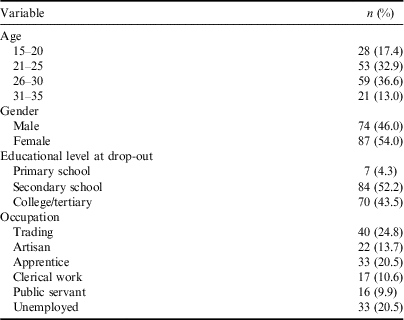
Of the 208 eligible young people approached in the selected streets, 48 declined to participate. A total of 161 respondents were therefore successfully sampled, giving a response rate of 77.4%, and analysis was based on these. As shown in Table 1, 28 (17.4%) of the respondents were between the ages of 15 and 20 years. Fifty-three (32.9%) were 21- to 25-years-old while 59 (36.6%) were aged 26–30 years. Eighty-seven (54.0%) were female and 74 (46.0%) were male. The majority (84, 52.2%) had dropped out of secondary school/college, while 70 (43.5%) had not completed their college/tertiary education. Thirty-three (20.5%) were unemployed. About a quarter (40, 24.8%) were engaged in the trading business, 22 (13.7%) were artisans and 33 (20.5%) were undergoing apprenticeships. Sixteen (9.9%) had a public service job.
Socio-demographic characteristics of respondents, Ado-Ekiti, south-west Nigeria, 2015, N=161
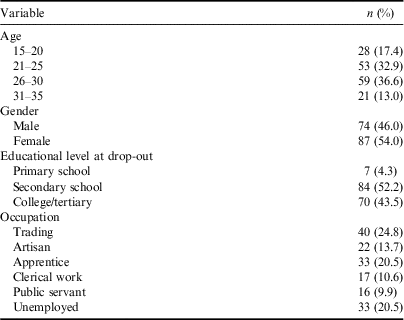
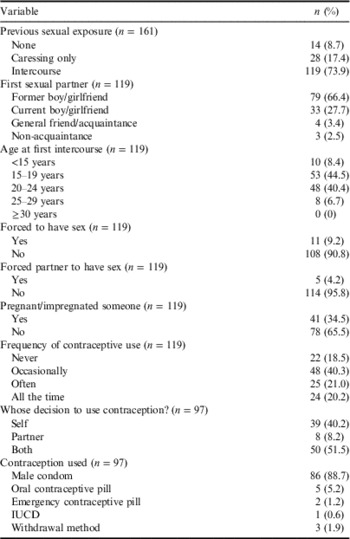
Table 2 gives a summary of the sexual activity and contraceptive practices of the respondents. Only fourteen (8.7%) had not had any sexual experience. Twenty-eight (17.4%) had only caressed, but 119 (73.9%) had had full sexual intercourse. Among those with coital experience, 79 (66.4%) had first intercourse with a previous boy/girlfriend, while 33 (27.7%) had it in their current relationship. For three (2.5%) respondents first intercourse was with a stranger.
Sexual activity and contraceptive use among respondents

Mean age at sexual debut was 19.08±3.5 years. Sexual debut was before the age 15 years for ten (8.4%) of the respondents. The majority (53, 44.5%) had their sexual debut between the ages of 15 and 19 years. All respondents with coital experience had had their sexual debut before the age of 29. More males had had premarital sex than females (81.1% versus 67.8%).
Consensual sex had occurred in 108 (90.6%) participants, but eleven (9.2%) had had ‘forced’ intercourse. Five (4.2%) respondents admitted to having forced their partner into sex. One hundred and three (86.5%) were still sexually active (had had sex within the 12 months before the survey). Forty-one (34.5%) had been pregnant or had impregnated someone.
A review of contraceptive practices among the sexually active respondents shows a contraceptive prevalence rate of 81.5% (percentage of respondents who had used at least one method of contraceptives before). Forty-eight (40.3%) were occasional contraceptive users, 25 (21.0%) used often and 24 (20.2%) were all-time users. In most instances the decision to use contraceptives was mutually agreed by both parties. The dominant contraceptive method employed was the male condom, used by 86 (88.7%). Following at a distance was the use of the oral contraceptive pill, which was used by five (5.2%) and the withdrawal method, which was used by three (1.9%) of the young people.
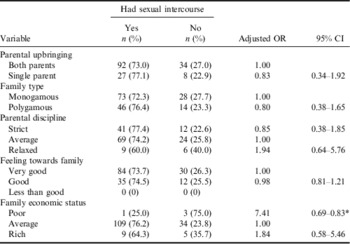
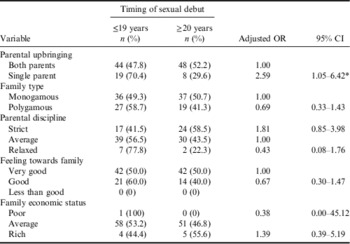
Analysis of the family structure and upbringing of the respondents showed that 126 (78.3%) grew up with both co-habiting parents; 35 (21.7%) were raised by a single parent. Most participants (101, 62.7%) were from monogamous family settings, but 60 (37.3%) were raised in a polygamous family (Table 3). Based on personal assessment by respondents, 53 (32.9%) categorized their parental discipline as strict, 93 (57.8%) said it was average while fifteen (9.3%) classified it as relaxed. More than two-thirds (70.8%) felt very good about their family; others considered their feeling as ‘good’. None felt ‘less than good’ towards his/her family. From the view point of family economic status, whereas four (2.5%) indicated that their family was poor, the bulk of respondents (143, 88.8%) regarded their family economic situation as average. Logistic regression analysis was done to determine the family factors that influence respondents’ involvement in premarital sex and their timing of sexual debut. The results are shown in Tables 3 and 4, respectively. Respondents from poor families were more than seven times more likely to be involved in premarital sex compared with those from average-income families (AOR: 7.41; 95% CI: 0.69–0.83) (Table 3). The timing of sexual debut was also found to be influenced by family upbringing. Unlike youths who were brought up by both parents, those with single parents had statistically significant higher chances of having sexual debut on or before the age of 19 years than those brought up in a two-parent family (AOR: 2.59; 95% CI: 1.05–6.42) (Table 4).
Relationship between family factors and having had premarital sex

*p<0.05.
Family factors influencing the timing of sexual debut

*p<0.05.
Discussion
This study found the prevalence of sexual intercourse among unmarried young people who had dropped out of school or college in this area of south-west Nigeria to be 74%. This is markedly higher than previous observations in Nigeria of 34% and 48.2%, respectively, among in-school secondary and university students (Slap et al., Reference Slap, Lot, Huang, Daniyam, Zink and Succop2003; Bello et al., Reference Bello, Olayemi, Fawole, Ogunbode, Sobukunola and Adesina2009). This may be because they are in a more relaxed environment with less demand on their time and focus. More male respondents were found to have had premarital sex than their female counterparts (81.1% versus 67.8%). This is in consonance with documentations from Ethiopia, Kenya and China that male youths have more sexual encounters than females (Lema, Reference Lema1990; Taffa et al., Reference Taffa, Bjune, Sundby, Gaustad and Alestrøm2002; Ma et al., Reference Ma, Ono-Kihara, Cong, Xu, Zamani, Ravari and Kihara2006). However, it contradicts the observation by Wang et al. (Reference Wang, Li, Stanton, Kamali, Naar-King, Shah and Thomas2007) that there was no gender difference in the rates of premarital sexual intercourse among out-of-school youth in China (Wang et al., Reference Wang, Li, Stanton, Kamali, Naar-King, Shah and Thomas2007).
The finding that two-thirds of the unmarried young people had had their first intercourse in a former relationship raises an important reproductive health concern. It gives an impression of instability in love relationships, with a tendency to have serial sexual partners and recurrent failed relationships. Such a trend may not be confined to Nigeria, as there is evidence from elsewhere that young people seem to frequently change sexual partners (Hoque, Reference Hoque2011; Morrison-Beedy et al., Reference Morrison-Beedy, Carey, Crean and Jones2011). This has attending health risks, especially in situations where sexual contact is unprotected (Monascha & Mahyb, Reference Monascha and Mahyb2006). Also, the finding that 2.5% of sexually exposed respondents had had intercourse with a stranger, and the 4.2% prevalence of forced intercourse, heighten the health concern. Since about 42% of HIV new infections occur in those between the ages of 15 and 24 years among people aged 15 and older, and the majority of these infections occur in sub-Saharan Africa (USAID, 2012), a targeted preventive and control programme aimed at young people not in school or employment could lead to changes in their sex behaviour and have a significant impact on the spread of HIV.
In mitigating the unwanted effects of premarital sexual experimentation, use of contraception takes centre stage. Although 80% of the sexually active respondents had ever used a contraceptive method, mainly the male condom, fewer than a quarter were consistent users. High contraceptive awareness among young people has often been demonstrated in south-west Nigeria (Atere et al., Reference Atere, Wahab, Ajiboye, Shokoya, Akinwale and Oyenuga2010). However, the dominance of the male condom could pose a challenge of power imbalance in contraceptive negotiation, especially when the male partner declines usage. Other contraceptive methods that gives the female partner options in case the man declines to use a condom should therefore be promoted. To this end, more efforts should be deployed towards promoting acceptance and use of female-centred barrier contraception.
Secondly, more important than prevalence is consistence in the use of barrier contraception for prevention of STIs, including HIV. For example, Morrison-Beedy et al. (Reference Morrison-Beedy, Carey, Crean and Jones2011) observed that 39% of adolescent girls in New York had had STIs where condom use was poor. Young people need to be aware that only correct use of barrier contraception at every sexual intercourse protects against STIs and HIV (Burazin et al., Reference Burazin, Kožul, Miškulin, Dijanić, Medić and Jurčev-Savičević2014). Also, the observed situation in which a third of those who were sexually active had either been pregnant or impregnated a partner shows that the high contraceptive prevalence did not match up to effective pregnancy prevention. Though the male condom is cheap and readily available in the study area, there is a need for continuous education on its consistent and correct use. But apart from the possibility of contraceptive failure, the use of withdrawal methods, which are known to be ineffective in preventing pregnancy, by some of the respondents can also be a contributor to the high unintended pregnancy rates.
Family economic status appeared to be the only upbringing factor that statistically influenced the propensity for premarital sexual experimentation among the respondents. Also a greater tendency for sexual debut to occur as a teenager was found among respondents raised by a single parent compared with those raised by two parents. This could be because, in the face of poverty, the likelihood of premarital sexual exploration is high. This is especially true of unmarried female youths, who could be cajoled into sexual relationships in order to meet basic needs (Gorgen et al., Reference Gorgen, Yansané, Marx and Millimounou1998).
Family context has been shown to have consistent and strong effects on the timing of sexual debut. Studies have shown that adolescents living in single-parent families initiate sexual activity earlier than those in two-parent families (Sweeting et al., Reference Sweeting, West and Richards1998; Manlove et al., Reference Manlove, Ryan and Franzetta2007). The present findings corroborate this. Strengthening of the family institution and the eradication of poverty and hunger would therefore play contributory roles in decreasing risky sexual activity among young people.
Most existing local and regional studies have defined ‘youths’ as those aged 15–24 years, but in this study youths were defined according to the African Youth Charter (African Union Commission, 2006). Indeed, the reality is that due to poverty and lack of early schooling opportunities, many Nigerian youths start their education late. A chunk are therefore still actively ‘schooled’ up to the age of 35 years, and some unfortunately have to drop out of school/college within the age bracket 25–35 years for various reasons. Inclusion of those within that age bracket is both important and correct to have a holistic perception of out-of-school/college young people in a typical African setting. This study is possibly the first to make such consideration.
The research is not without its limitations. The challenge of under-reporting is common in sexual surveys. Biased responses to satisfy the curiosity of the investigator (social desirability) is also inherent in sexual survey studies. These limitations were, however, minimized by gender matching of interviewers to promote openness. Apart from the assumption of relaxed environments, there are possibilities of unknown cofounders that could account for the higher sexual activity among the respondents that it was not possible to explore.
In conclusion, there is evidently a high level of premarital sexual activity among young people who have dropped out of school or college in this Nigerian population. Although use of the male condom was common, the majority were not ‘all-time’ users. This probably accounts for the respondents’ high unintended pregnancy rate and, by proxy, raises concerns about how well they have been using condoms. Single-parenting and family economic status was found to impact early sexual debut and premarital sexual experimentation. These observations bring to the fore the need for reproductive health workers and policymakers to pay closer attention to sex education and reinforcement of consistent condom use among young people who have dropped out of school/college in Nigeria. The promotion of female barrier contraceptive methods is also essential to protect females in situations where a power imbalance exists and/or the male partner declines to use a male condom. Further still, economic empowerment and strengthened family institutions may help young people reduce sexual experimentation or sex for commercial gain. The observations in this study form a good pedestal for a national sexual survey among school/college drop-outs. Future research should probe the prevalence of STIs, including HIV/AIDS, among school/college drop-outs in Nigeria.
Acknowledgments
The research was self-funded. The authors declare that they have no competing interest.