Healthcare-associated infections (HAIs) are a worldwide health issue that result in huge costs to the health system.Reference Al-Tawfiq and Tambyah 1 , Reference Khan, Baig and Mehboob 2 The World Health Organization (WHO) states that 7% of hospitalized patients in developed countries and 10% of hospitalized patients in developing countries will acquire an HAI. 3 In November 2016, the WHO released guidelines for prevention of HAI worldwide, emphasizing control strategies to prevent pathogen transmission. 4
Dancer et al 4 emphasized the role of environmental cleaning in controlling HAI. However, hospital cleaning aloneReference Dancer 5 fails to prevent the transfer of pathogens.Reference Claro, Galvin, Cahill, Fitzgerald-Hughes, Daniels and Humphreys 6 , Reference Otter, Yezli, Salkeld and French 7 Pathogens shed from infected patients can survive up to 7 monthsReference Kramer, Schwebke and Kampf 8 on dry hospital surfaces, whereas bacteria incorporated into dry surface biofilm (DSB) (ie, bacteria surrounded by extracellular polymeric substances [EPS]) can survive more than 12 months.Reference Hu, Johani and Gosbell 9 Environmental contamination is thought to be responsible for new occupants in rooms previously occupied by patients suffering from vancomycin-resistant Enterococcus (VRE), methicillin-resistant Staphylococcus aureus (MRSA), or Clostridium difficile being at higher risk of acquiring these pathogens.Reference Nseir, Blazejewski, Lubret, Wallet, Courcol and Durocher 10 , Reference Boyce 12 The presence of biofilms on 93% of ICU furnishings suggests that biofilms formed on dry surfaces escape current cleaning and disinfection protocols and may contribute to nosocomial infection by providing a niche for bacterial persistence and release of free-floating bacteria into the environment.Reference Hu, Johani and Gosbell 9
The most important route of transmission of HAI pathogens is the contaminated hands of healthcare personnel (HCP).Reference Bhalla, Pultz and Gries 13 Consequently, hand hygiene is accepted as the most significant intervention in the preventing HAI.Reference Hygiene 14 Compliance with hand hygiene is often poor, especially when it comes to hand hygiene following touching items such as bed rails and chairs in the patient surroundings.Reference Kwok, Juergens and McLaws 15 Recently, our group successfully demonstrated high transmission rates of DSB bacteria via bare hands before and after wetting with 5% neutral detergent.Reference Chowdhary, Tahir and Legge 16 Infection control guidelines recommend the use of gloves as a practical means of preventing transmission of infective pathogens and decreasing transient contamination of HCP hands. 17 , 18 The transmission of pathogens is reduced with gloves compared to bare hands, but it is not eliminated. Improper use of gloves, such as failure to remove gloves after performing aseptic procedures, is associated with poor hand hygiene compliance.Reference Girou, SHT and Oppein 19 , Reference Wilson and Loveday 20 An observational study found the rate of improper glove use to be as high as 64.4% among HCP, resulting in possible microbial transmission almost 20% of the time.Reference Girou, Chai and Oppein 21
One of the most common pathogens causing HAI, Staphylococcus aureus, and has been shown to be incorporated in >50% of ICU DSB samples obtained from hospitals in Australia and Great Britain.Reference Hu, Johani and Gosbell 9 The transmission rate of planktonic S. aureus varies between glove typesReference Moore, Dunnill and Wilson 22 and was least with nitrile gloves when compared to vinyl and latex gloves. In this study, we used our model of DSBReference Almatroudi, Hu and Deva 23 to determine whether biofilm cells can be transferred from one surface to another and whether glove composition affects transmission rate.
Materials and Methods
Test gloves
We used 3 types of gloves to determine the transmission rate of biofilm bacteria: (1) Nitrile gloves, which are latex-free, single-use, examination gloves (Promed, Tanawha, Australia), (2) 100% latex gloves (Thermo Fisher Scientific, Scoresby, Australia), and (3) sterile surgical, nonlatex, neoprene (synthetic rubber) gloves (Ansell Gammex PF DermaPrene Glove, Richmond, Australia).
The nonsterile nitrile and latex gloves were sanitized by rubbing with 70% w/v ethanol until dry. To confirm sterility, both the gloved thumb and fore finger were pressed onto the surface of a blood agar plate (Edwards Group, Narellan, New South Wales, Australia) and incubated at 37°C overnight.
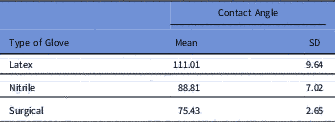
The hydrophobicity of each glove material was determined 3 times using contact angle measurements. Briefly, a 10-µL drop of water was placed on each glove and photographed using a side-mounted camera. The contact angle was then measured using, Microsoft Visio professional software (2013, Microsoft, Redmond, WA).
Preparation of Staphylococcus aureus dry surface biofilm
Staphylococcus aureus ATCC 29352 DSB was grown on polycarbonate and glass coupons in the Centers for Disease Control biofilm reactor (BioSurface Technologies, Bozeman, MT) over a period of 12 days as previously described by Almatroudi et al.Reference Almatroudi, Hu and Deva 23 In brief, biofilm was grown for 48 hours in 5% tryptone soya broth. Biofilm bacteria were then adapted to low water availability by an initial 48 hours of dehydration followed by 3 cycles of 6 hours of hydration interspersed with dehydration periods between 42 and 66 hours long. The resulting biofilm contained ~107 colony-forming units (CFU) and mimicked hospital DSB particularly, with very thick EPS.Reference Almatroudi, Hu and Deva 23 Quantitative polymerase chain reaction (qPCR) measuring the number of culturable and nonculturable bacteria in DSB and have found 106–107 CFU/cm2 contaminating hospital surfaces in Australia and Saudi Arabia.Reference Hu, Johani and Gosbell 9 , Reference Johani, Abualsaud and Costa 24 The biofilm-covered coupons were washed 3 times with PBS, while still in the rods to remove planktonic and loosely attached bacteria.
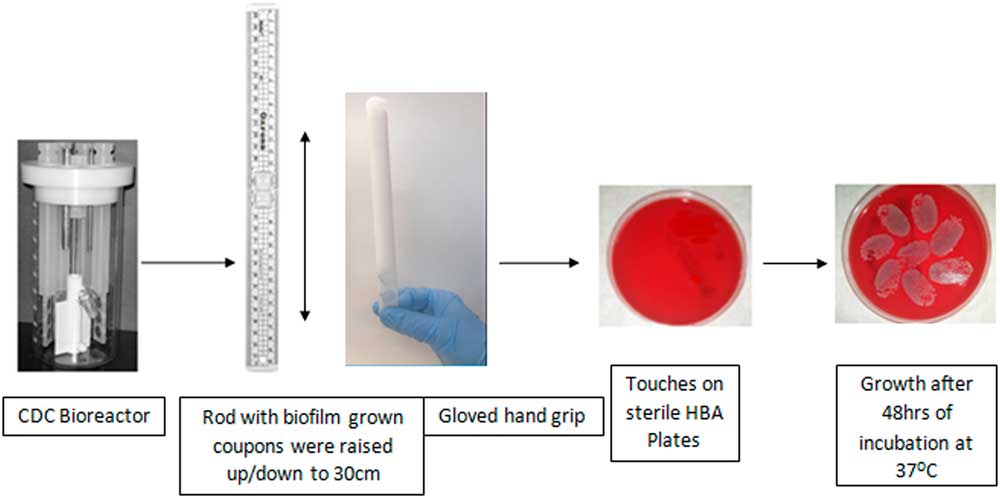
DSB transfer test protocol
The test coupon was lightly gripped between gloved thumb and index finger tip and the rod was elevated to a height of 30 cm and returned to the start position (Fig. 1). The same operator or investigator performed the grip action and all of the serial presses for all experiments to consistently replicate the amount of pressure. The contaminated finger and thumb tips were then serially pressed, up to 19 times, onto the surface of sterile horse blood agar (HBA) plates. The plates incubated aerobically for 48 hours. We tested DSB transfer for 12 coupons per glove type.
Diagramatic representation of the experimental procedure of testing dry-surface biofilm (DSB) transmission.

Effect of wetting DSB with neutral detergent on the transfer of bacteria
We tested the effect of neutral detergent on the transmissibility of DSB by wetting biofilm covered coupons for 5 seconds with neutral detergent containing 10% ethoxylated Nonylphenol (Lemax, Whiteley Medical, Tomago, Australia). This was thought to mimic general wetting of surfaces during routine cleaning in the healthcare environment.
Excess detergent was drained before the test procedure detailed above was repeated
(12 tests per glove type).
Statistical analysis
The number of bacterial cells transferred was determined by counting CFU directly from HBA plates. Contact/agar plates have been previously used for environmental sampling in numerous scientific studies (as reviewed by Galvin et alReference Galvin, Dolan, Cahill, Daniels and Humphreys 25 ). This method provides a reasonable estimate of bacterial numbers and is comparable in accuracy to swab techniques.Reference Galvin, Dolan, Cahill, Daniels and Humphreys 25 Initial control CFU/cm2 of dry surface biofilm and total CFU/cm2 transferred via each glove type separately were used to calculate the transfer rateReference Pérez-Rodríguez, Valero, Carrasco, García and Zurera 26 according to the following formula: TR=100 × CFU blood agar/CFU on the coupon.
Data were analyzed using Microsoft Excel (2013, Microsoft, Redmond WA) and SPSS statistical software (IBM, Armonk, NY). One-way analysis of variance (ANOVA) was performed on the data obtained, followed by post hoc Tukey test for comparison within 2 main groups: detergent treated and untreated. The data were then split into both detergents treated and untreated group subsets to assess the transfer by each glove type.
Results
The readings obtained for contact angles of the 3 types of gloves tested for hydrophobicity are presented in Table 1. The greater the contact angle, the more hydrophobic the material is. Hence, latex gloves were the most hydrophobic, followed by nitrile gloves, and surgical gloves were the least hydrophobic.
Contact Angles for 3 Types of Gloves With a Mean of 3 Replicates

Note. SD, standard deviation.
Transfer rate of S. aureus dry surface biofilm bacteria to microbiological media using 3 types of disposable gloves
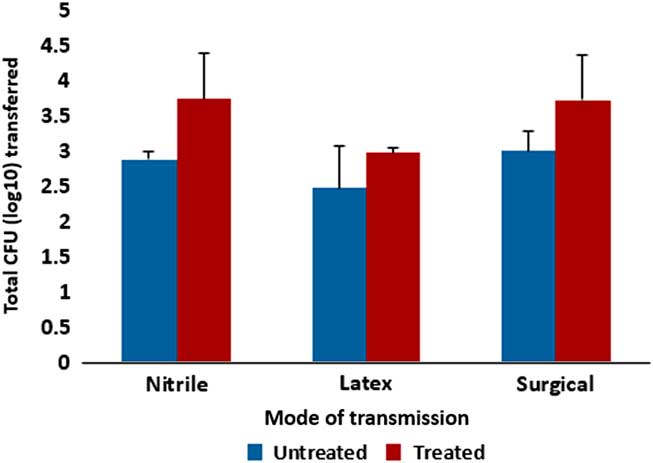
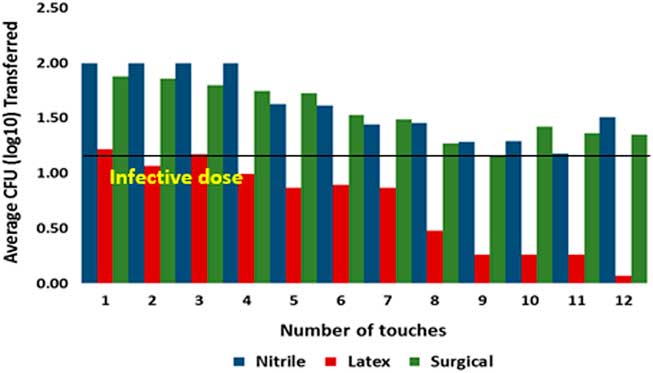
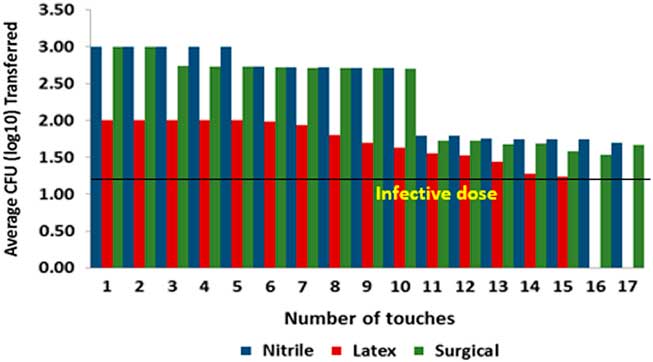
Touching DSB once and up to 19 consecutive times was sufficient contact to transfer the biofilm bacteria from the coupon to the glove and then to microbiological media by all 3 types of gloves tested (Fig. 2). Latex gloves transferred significantly less bacteria than nitrile gloves, which transferred significantly less bacteria than surgical gloves (P<.01) (Table 2). The “number” of touches were a significant factor affecting bacterial transfer (P<.01). Significantly less bacteria were transferred per touch as the number of times the fingers touched the agar plate increased (P<.01) (Fig. 3). For nitrile gloves, and to a lesser extent for surgical gloves, a very high number of bacteria were transferred during the first 5 touches (Figs. 3 and 4).
Mean number of colony-forming units (CFU) of S. aureus dry-surface biofilm (DSB) cells transmitted via nitrile, latex and surgical gloves before (untreated) and after treatment (treated) with 5% neutral detergent for 5 seconds. Starting number of biofilm bacteria 107 S. aureus per coupon.

Number of colony-forming units (CFU) of bacterial cells transmitted from untreated S. aureus dry-surface biofilm (DSB) per touch. Black horizontal line in the graph indicates the infective dose (15 cells/cm2 or 1.18 logs/cm2).

Number of colony-forming units (CFU) of dry-surface biofilm (DSB) bacterial cells transmitted from treated Staphylococcus aureus DSB with the number of touches. The infective dose is 15 cells/cm2 1.18 logs/cm2.

Mean Number of Staphylococcus aureus Dry Surface Biofilm Cells Transferred During 19 Touches, by 3 Types of Commonly Used Gloves (n=12 gloves per type)

Note. CFU, colony-forming units; SD, standard deviation.
Effect of wetting with neutral detergent on transmission
Wetting the DSB-covered coupon with 5% detergent for 5 seconds significantly increased the number of bacteria transferred by 3 times on latex gloves, by 5 times on nitrile gloves, and by 7 times on surgical gloves (P<.01) (Fig. 2). Latex gloves transferred significantly less bacteria from detergent-treated DSB than either nitrile or surgical gloves (P<.01) (Table 2 and Fig. 4). In contrast to results obtained with untreated DSB, nitrile and surgical gloves transferred similar numbers of bacteria. Significantly more bacteria were initially transferred per touch, but as the “number” of times the fingers were touched on the agar plate increased, less bacteria were transferred per touch (P<.01). After the tenth touch, the average bacterial cell count transferred dropped drastically with all glove types (Fig. 4).
Discussion
Older scientific studies suggested that the hospital environment contributed negligibly to the acquisition of HAI.Reference Maki, Alvarado, Hassemer and Zilz 27 , Reference Mallison and Haley 28 This resulted in the frequency of hospital environmental sampling to decline and eventually becoming restricted to endemic outbreaks.Reference Sehulster and Chinn 29 However, over the past 20 years, the role of contaminated hospital surfaces in spreading HAIs has been reassessed.Reference Otter, Yezli, Salkeld and French 7
The existence of DSB containing viable, multidrug-resistant and -sensitive organisms on high-touch surfaces in the healthcare environment has been confirmed.Reference Hu, Johani and Gosbell 9 , Reference Russotto, Cortegiani, Raineri and Giarratano 30 Biofilms on dry hospital surfaces are composed of multiple species, and more than 50% contain S. aureus, one of the most common pathogens causing HAI.Reference Hu, Johani and Gosbell 9 Extensive literature shows that traditional hydrated biofilm is more tolerant to biocidal action, including disinfection (see Otter et alReference Otter, Vickery and Walker 31 for a recent review). We have also shown that DSB is even more tolerant to biocidal action.Reference Almatroudi, Gosbell and Hu 32
A number of scientific studies indicate poor hand compliance (55%–89%)Reference Wilson and Loveday 20 , Reference Randle, Arthur and Vaughan 33 by HCPs.Reference Kramer, Schwebke and Kampf 8 , Reference Smiddy, O’Connell and Creedon 34 , Reference Luangasanatip, Hongsuwan and Limmathurotsakul 35 Pathogens from hospital surfaces surrounding infected patient, such as bed rails, trolleys’ and bed surfaces, are potential source of HAI.Reference Huslage, Rutala, Gergen, Sickbert-Bennett and Weber 36 , Reference Almatroudi 37 Hayden et alReference Hayden, Blom, Lyle, Moore and Weinstein 38 observed that 52% of HCPs entering with sterile hands contaminated them after touching the environment of VRE-infected patients.
Our current study confirms that viable bacterial cells from DSB are easily transferred to other surfaces via gloved hands with 1 touch up to 19 touches. The estimated infective dose for S. aureus is 15 cells per square centimeter (1.18 logs/cm2) and is thought to be sufficient to cause infections in lesions.Reference Foster and MSR 39 The minimum number of bacterial cells transferred by each touch is far more than the minimum infective dose required for initiating HAI for all 3 types of gloves. Wetting the DSB with neutral detergent increased the transfer rate by 3- to 7-fold.
The adhesive forces between bacterial cells and contact surfaces mainly determine the bacterial transmission where detachment of cells from the donor is followed by these cells sticking to the recipient surface.Reference PBJ, van der Mei, Busscher, JMM and Bruinsma 40 Surface factors such as hydrophobicity and roughness affect adhesion and hence the attachment/transmission of bacteria. Hydrophilic bacterial cells attach more efficiently to hydrophilic surfaces and vice versa. Staphylococcus aureus being hydrophilic attaches readily to hydrophilic surfaces compared to hydrophobic surfaces.Reference Knobben, van der Mei, van Horn and Busscher 41
The 3 glove types, namely nitrile, latex, and surgical gloves, were nonporous and had smooth surfaces visually. The surgical glove was the most hydrophilic of the 3 gloves and transferred the greatest number of bacteria from the DSB to the microbiological media. In contrast, latex gloves, being the most hydrophobic transmitted the least number of bacteria from DSB irrespective of whether the DSB had been touched dry or treated with detergent. Hence latex gloves are the most suitable for use in the hospital environment from an infection control point of view, due to their low transfer rate of pathogens, but latex allergy limits their use. The restricted use of latex gloves in the healthcare environment limits the current study. Further work is needed to develop allergy-free latex gloves (or similar material) for reduced transmission of pathogens without allergy. Our results for latex gloves are consistent with the study by Moore et al,Reference Moore, Dunnill and Wilson 22 in which transmission of planktonic MRSA by various types of gloves was measured. Latex gloves transmitted the least number of MRSA from and to fomites.
In the present study, DSB was treated with 5% neutral detergent for 5 seconds to mimic wetting of surfaces during hospital cleaning. We hypothesized that surfactants within the detergent ensure that moisture is readily absorbed into the biofilm structure, which changes the semi-dried biofilm’s physiochemical properties to a hydrated type, increasing cell detachment and resulting in a high transfer rate.
The use of 5% neutral detergent to mimic basic hospital cleaning without disinfectants and scrubbing action is also a study limitation, although many hospital surfaces worldwide are not routinely disinfected. Hospital cleaning using detergent with and without disinfectants is debatable due to their potential chemical health hazards. Recent studies have shown that the DSB is even more tolerant to biocide action. Hence, we mimicked the ‘basic’ hospital cleaning protocol of 5% detergent soak in our study, excluding scrubbing because all surfaces are not scrubbed while cleaning. However, further scientific studies can be designed using common disinfectants or single-wipe action with detergent/disinfectant wipesReference Rogusz, Stewart and Hunter 42 to test bacterial transmission after absolute effective biofilm cleaning.
In conclusion, although the bacteria incorporated into DSB are attached to a surface and each other, they are readily transferred to new surfaces by gloved hands. The number of bacteria transferred increases when the DSB is exposed to detergent, even for a short time. This finding suggests that removal of DSB as well as planktonic environmental contamination need to be addressed to ensure a safe hospital environment.
Acknowledgments
This study was funded by an Australian Research Council Linkage Projects Scheme LP130100572 in conjunction with Whiteley Corporation. Karen Vickery was in receipt of a Macquarie University Vice Chancellor Innovation Fellowship. Dr Shamaila Tahir was in receipt of Australian Postgraduate Award.
Financial support
This study was funded by an Australian Research Council Linkage Projects Scheme (grant no. LP130100572) in conjunction with Whiteley Corporation. Karen Vickery received a Macquarie University Vice Chancellor Innovation Fellowship. Durdana Chowdhury received a Macquarie University International Postgraduate Scholarship.
Conflicts of interest
Greg Whiteley is the Managing Director and Trevor Glasbey is the Research and Development Manager of Whiteley Corporation, a manufacturer of disinfectants and detergents for use in healthcare. Their roles did not lead to any bias in formulating, executing, analyzing, or reporting the research. All other authors declare no competing interests relevant to this article.