Introduction
The increasing incidence of opioid misuse is a global public health concern. 1 The prevalence of opioid misuse in Canada has risen dramatically and fatal overdoses involving both prescription and non-prescription opioids in Ontario have increased from 366 in 2003 to 865 in 2016. 2 This epidemic includes pregnant women, with the number of infants born to opioid-dependent women in Ontario increasing from 46 in 2002 to almost 800 in 2014 of a total of 4336 deliveries by opioid-dependent mothers in the 12-year period.Reference Brogly 3 Data on prevalence of opioid exposure during pregnancy in urban Ontario cohorts are lacking, however, prevalence in northern and rural Ontario has been reported to be as high as 27.8%. In the above-cited study, information on maternal drug use was collected using a standard case report form, and further characterized using urine drug screen results.Reference Jumah, Edwards and Balfour-Boehm 4
The Society of Obstetricians and Gynaecologists of Canada (SOGC) currently recommends opioid replacement therapy for opioid-dependent women in pregnancy and cites benefits, including improved prenatal care, higher birth weight, longer gestation, and more infants being discharged home earlier in the care of their mothers. 5 An early study in 1977 investigated a cohort of 230 mother–infant dyads of which 89 were on methadone replacement and 66 were exposed to illicit heroin (the remainder included mixed substance groups and controls). They found a significant difference in the amount of prenatal visits, specifically the likelihood of seven or more visits, and a higher birth weight (mean birth weight=2936±77 in the methadone group v. 2490±87 in the heroin group). In addition, 80 out of 86 infants of mothers in the methadone group were discharged from hospital in the care of their parent v. only 42 of 59 in the heroin group (with the remaining children discharged in the care of alternate providers).Reference Kandall, Albin and Gartner 6 Another study of an urban cohort in Texas followed a total of 75 women including 29 with untreated opioid use, 39 on methadone replacement and 57 controls and found significant social benefits of methadone maintenance therapy; at 1 year follow-up, 80% of methadone infants were living with their parents whereas, in contrast, 48% of the untreated drug-dependent women were no longer together with their children.Reference Wilson, Desmond and Wait 7
Furthermore, mothers on opioid replacement therapy experience less withdrawal, engage in less illicit substance use, and have less need to engage in high risk behaviors in order to obtain illicit drugs. 5 It has been shown that methadone replacement prevents high peaks and valleys of opioid levels associated with illicit substance use thus sparing the infant from exposure to alternating toxicity and withdrawal.Reference Jones, Martin and Heil 8
The gold standard for the management of opioid dependence during pregnancy is methadone maintenance therapy, however, other options exist, including buprenorphine and buprenorphine plus naloxone. 5 Due to the numerous physiological changes that occur in pregnancy, and consequent changes in the pharmacokinetics of the opioid, opioid replacement requires complex dose adjustments in order to ensure maintenance concentrations similar to the pre-pregnancy state.Reference Pond, Kreek, Tong, Raghunath and Benowitz 9
While opioid replacement therapy is the mainstay of treatment for opioid dependence, it is not without potential risks. Neonatal abstinence syndrome (NAS) is a frequent neonatal complication of opioid exposure (both illicit opioids and replacement therapy) during pregnancy, and occurs due to placental transmission of opioids.Reference Kandall, Albin and Gartner 6 The incidence of NAS in Canada has tripled between 2003 and 2014, with an incidence of 5.4 per 1000 births in 2014.Reference Filteau, Coo and Dow 10 The presentation of NAS varies widely and includes signs and symptoms of central nervous system hyperirritability, autonomic nervous system dysfunction and gastrointestinal disturbances.Reference Jones, Kaltenbach and Heil 11
In one prior study neonatal withdrawal severity and length was shown to be associated with higher placental pathology scores, based on anatomopathological analysis, in women using both illegal and legal drugs.Reference Domenici, Cuttano and Nardini 12 An unpublished case presented by Dr Robert Bendon at a 2015 Society for Pediatric Pathology meeting (perinatal section) suggested a delayed villous maturation (DVM) pattern in women exposed to buprenorphine during pregnancy. A single published study, on the other hand, found a DVM pattern in placentas of women exposed to methadone during pregnancy, and not in those exposed to buprenorphine.Reference Serra, Lemon and Mokhtari 13 Data on placental pathology in opioid-replaced pregnant women is therefore conflicting and requires further study.
Opioid replacement therapy in pregnancy represents one of many risk reduction strategies in the treatment of opioid abuse and dependency. The goal of healthcare providers is to develop personalized strategies for each individual pregnant woman while offsetting as much risk as possible. In pregnant women, opioid misuse has been associated with multiple health comorbidities and socio-economic challenges, including increased rates of infectious disease, exposure to violence and stress, and nutritional scarcity.Reference Unger, Metz and Fischer 14 These factors can have an adverse effect on fetal development, including intrauterine growth restriction (IUGR) and vertical transmission of infection, both of which may influence the future health and well-being of the child.Reference Unger, Metz and Fischer 14
Currently, there is a paucity of urban Canadian data focusing on the fetal effects of maternal opioid use in pregnancy and the potential comorbidities and risk factors with which they are associated. Our objective was to describe a cohort of urban Canadian women receiving opioid replacement therapy during pregnancy and to evaluate potential developmental effects on the fetus and the placenta.
Methods
Subjects who had been referred for opioid replacement therapy to the Maternal Fetal Medicine (MFM) service at The Ottawa Hospital were identified from the Ottawa Hospital MFM Database. A retrospective chart review of women receiving opioid replacement therapy and their infants who delivered at The Ottawa Hospital General and Civic campuses between January 1, 2013 and March 24, 2017 was conducted. Cases of stillbirth and fetal demise due to extreme prematurity were initially recorded during chart review, however, this data was ultimately excluded from the summary statistics given our focus on developmental outcomes such as NAS, growth restriction, and non-lethal birth defects.
Maternal data collected included maternal demographics (age, gravidity, term births, preterm births, abortions, live children), pre-existing maternal medical conditions, pregnancy complications and opioid replacement regimen (drug, duration of treatment, and dose). Gestational hypertension was defined according to the SOGC clinical practice guidelines as systolic blood pressure ⩾140 mmHg and/or diastolic blood pressure ⩾90 mmHg based on the average of two measurements, taken at least 15 min apart in the same arm, occurring after the 20th week of gestation where there is no pre-existing hypertension.Reference Magee, Helewa and Rey 15 Peripartum data collected included intrapartum maternal infection, intrapartum complications, mode of delivery, duration of rupture of membranes, need for neonatal resuscitation and APGAR scores at 1 and 5 min. Resuscitation was defined as any life-prolonging measures in addition to standard of care and orotracheal suction. Samples for testing for maternal infections are collected in hospital or clinic, sent to the Ontario Public Health Laboratory, and results are documented on the Ontario Antenatal Record and/or the birth record.
Neonatal data collected included gestational age at delivery, birth weight and percentile, and neonatal complications, such as congenital anomalies, small for gestational age (SGA) and asphyxia. Information regarding congenital anomalies was obtained from the data box for ‘birth defects’ on our institutional standard birth record. SGA was defined as a birth weight below the 10th percentile. 16 Asphyxia was defined in the local clinical practice as having two of: (i) APGAR under 5 at 10 min of age, (ii) continued need for ventilation at 10 min of age and/or (iii) umbilical cord gas pH (or arterial gas <1 h) under 7.0 or base deficit >6 mmol/l.
Neonatal data collected also included measures of NAS. The severity of NAS is conventionally measured using the Modified Finnegan Scoring system, which quantifies the number of symptoms of neonatal withdrawal that an infant exhibits over time.Reference Hudak and Tan 17 A standard protocol for consultation and assessment of neonates at risk of NAS exists at the Ottawa Hospital (at both campuses) and has not been modified since 2012. Using this protocol, infants with three consecutive Finnegan scores over or equal to 8 or with an average of two scores or scores for two consecutive intervals over or equal to 12 will receive treatment. For this study, however, the presence of NAS symptoms was defined as a Finnegan score equal to or above 7. Clinical experience among expert neonatologists at our institution acknowledges an early or mild presentation of NAS at Finnegan scores of equal to or above 7, in which infants are monitored closely without pharmacological intervention. Due to the gravity of the treatment for NAS, a slightly higher threshold is set for intervention, which requires sustained symptoms. Information on neonatal treatment with morphine and neonatal treatment with adjuvant clonidine or phenobarbital was also included.
For each pregnancy, corresponding archival placental pathology specimens were analyzed by one of the authors of the study (D.G.), a placental pathologist at the Children’s Hospital of Eastern Ontario. The assessor was blinded to the identity of the patient. An evidence-based placental pathology scoring sheet that complies with the recently released Amsterdam Consensus Statement was used to grade placental pathology. These criteria include maternal vascular malperfusion (MVM), vessel and stromal structural alterations and features of acute infection.Reference Khong, Mooney and Ariel 18
Descriptive statistics are used to present the results. In cases where data was missing, both the numerator and the denominator were adjusted accordingly.
Ethics approval for the project was obtained by The Ottawa Health Sciences Network Research Ethics Board (OHSN-REB) and The Children’s Hospital of Eastern Ontario Research Ethics Board (CHEO-REB).
Results
Maternal demographics and treatment regimens
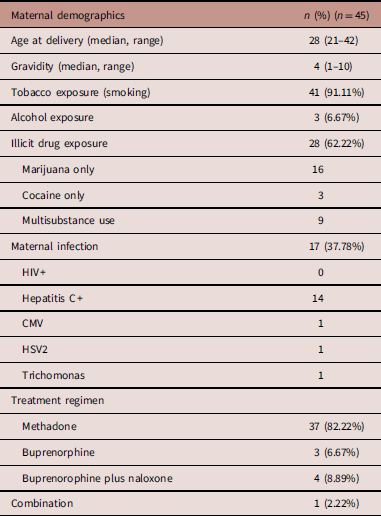
In total, 47 women–infant dyads were identified. One case of stillbirth and one case of neonatal death from prematurity at 24+2 weeks were excluded from the analysis. Median maternal age at delivery was 28 years of age (range: 21–42), with five women being age 35 or older (11.1%). Complete maternal demographics are shown in Table 1. Out of the 28 mothers that admitted to using illicit substances throughout pregnancy, 16 reportedly used marijuana only.
Baseline characteristics and comorbidites of all opioid-exposed women in the cohort

Of the 45 women identified, 37 were treated with methadone, three were treated with buprenorphine and four were treated with buprenorphine plus naloxone. One woman was exposed to buprenorphine plus naloxone until 29 weeks of gestation, at which time she was switched to a buprenorphine regimen until delivery.
Pregnancy outcomes
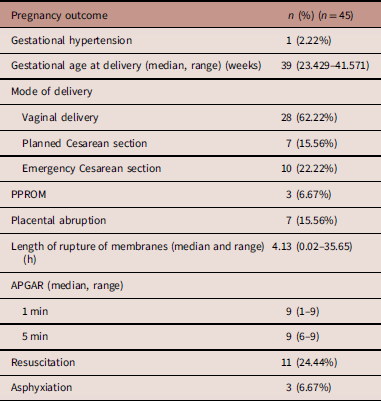
Pregnancy outcomes are summarized in Table 2. Out of the 45 pregnancies in the sample, 28 (62.22%) were delivered vaginally, seven (15.56%) were delivered via planned C-section and 10 (22.22%) were delivered via emergency C-section. There were three cases of premature rupture of membranes (PROM) and 3 cases of preterm premature rupture of membranes (PPROM). There were seven (15.56%) cases of placental abruption, which was defined as either a definite or probable abruption according to the treating obstetric physician’s note on the birth record. The median length of rupture of membranes for those neonates that were delivered vaginally was 4.13 h, with a range of 0.02–35.65 h. The median 1- and 5-min APGAR scores were 9 (range: 1–9) and 9 (range: 6–9), respectively. There were 11 (24.44%) neonates that required resuscitation at birth.
Pregnancy outcome data

Neonatal outcomes
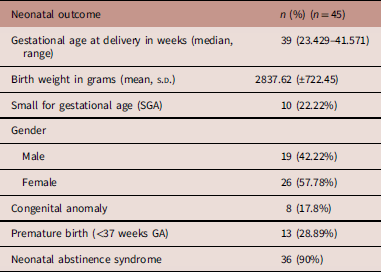
Neonatal outcomes are summarized in Table 3. The incidence of congenital anomalies in this population of neonates was 17.8%. Congenital anomalies included two cases of bilateral hydroceles, and one case each of: tetralogy of Fallot, right-hand malformation, hypospadias, ankyloglossia, undescended testes on the right side, and combined patent foramen ovale, ventricular septal defect, and patent ductus arteriosus. In only one case of congenital anomaly (tetralogy of Fallot) was there documented alcohol consumption in the pregnancy.
Neonatal outcome data

NAS
Of the 45 neonates, data on NAS was available for 40. Of these, 36 exhibited symptoms of NAS (Finnegan score of ⩾7). The mean day of life on which symptoms of NAS first presented was 1.2, with a median of 1 (range: 0–3 days). In total, 28 neonates received treatment for NAS with morphine. One neonate received adjuvant therapy with phenobarbital and two neonates received adjuvant therapy with clonidine.
Postpartum care
Out of the 41 mother–infant dyads in which information on skin-to-skin contact could be gathered, skin-to-skin contact was initiated at birth in 23 pairs (56.10%). Birth records indicate that 72.09% of mothers intended to breastfeed their infants.
Placental pathology
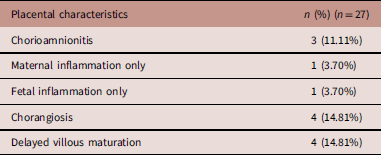
Of the 45 total mother–infant dyads included in the study, 27 archival placental pathology specimens were available. A summary of placental pathology characteristics is shown in Table 4. Three placentas exhibited chorioamnionitis (features of both maternal and fetal inflammation), one placenta exhibited only maternal inflammation, and one placenta exhibited only fetal inflammation. Chorangiosis (hypercapillarised terminal villi) was found in four placentas and DVM was found in four placentas.
Placental pathology data

Discussion
Our results show a high rate of tobacco exposure and illicit substance use amongst our population compared with baseline Canadian population in pregnancy. 5 Data on co-use of other illicit drugs was limited by the retrospective nature of the study; data were collected from clinic charts rather than a formal addiction center data collection form. Furthermore, the fear of custodial loss, coupled with the protective instincts of parents with the intention of child-rearing, may also have limited the disclosure of illicit substance use. For these reasons, drug use might be underestimated. Maternal infection, in particular Hepatitis C infection, was common in this cohort of women, which may be a consequence of needle sharing.Reference Unger, Metz and Fischer 14
Compared to a 1% baseline rate of placental abruption in the general population, our cohort demonstrated a much higher rate of 15.56%.Reference Ananth, Keyes and Hamilton 19 , Reference Ruiter, Ravelli and de Graaf 20 Increased risk for placental abruption is associated with illicit drug use, in particular cocaine, as well as tobacco use.Reference Hoskins, Friedman and Frieden 21 – Reference Kaminsky, Ananth and Prasad 23 Physical trauma in the prenatal period has also been linked to a significantly increased risk of placental abruption.Reference Leone, Lane and Koumans 24 While accidental injury should be excluded as an etiology of physical trauma, intimate partner violence may also underlie the increased rate of abruption in our cohort. Disclosure of such violence when parents fear custodial loss may be limited.
We note that the SGA rate in our cohort (22.22%) is greater than double the rate of neonates that are SGA reported by Statistics Canada (8.7%). 25 SGA is defined conventionally as a birth weight less than the 10th percentile for gestational age. 16 This in itself is not an adverse neonatal outcome as many infants with SGA achieve their full growth potential, otherwise referred to as ‘constitutionally small.’ Approximately 50–70% of infants that are SGA are simply constitutionally small, while around 30–50% have IUGR. 16 In this study, SGA was used as a surrogate indicator of IUGR for several reasons. First, comparison Canadian data are more readily available for SGA than IUGR and, second, the definition of IUGR is controversial and variable criteria are applied. In our clinical cohort, there was insufficient information in hospital charts (such as serial ultrasounds or Doppler studies) to definitively determine which SGA neonates were constitutionally small and which demonstrated IUGR.
Despite the high rate of SGA (and thus, by extrapolation, IUGR) in our cohort compared with baseline Canadian population, the placentas of these pregnancies did not show many features of maternal vascular under-perfusion. It is possible that the IUGR profile in this context may be different than IUGR in the general population. The latter is more often due to a spiral artery remodeling defect, leading to MVM,Reference Toal, Chan and Fallah 26 , Reference Pijnenborg, Vercruysse and Hanssens 27 whereas, in our series, we speculate that pre-placental maternal factors may be more involved. This could have theoretical and developmental consequences; IUGR due to maternal deprivation or blood-borne infection could imprint differently on a fetus than IUGR due to MVM. Further studies are required to explore this hypothesis, as the lack of multivariate regression analyses in our study limits the ability to draw conclusions about the etiology of SGA in this population.
Our cohort also exhibited a high rate of congenital anomalies (17.78%) when compared with the Canadian population baseline rate of 2–3% of births.Reference Harper 28 It has been suggested in literature that the high rate of congenital anomalies seen in neonates exposed to opioids during pregnancy is best explained by the action of opioid growth factor (OGF), an opioid peptide, on the OGF receptor. Via this receptor, endogenous opioids (and likely exogenous opioids) can cause delayed cell growth and migration during embryogenesis, resulting in higher risk of fetal dysmorphology.Reference Broussard, Rasmussen and Reefhuis 29
OGF may not, however, be the sole cause for an increase in congenital anomalies. Numerous reports have shown that women on opioid replacement therapies demonstrate overall poorer nutritional status than controls.Reference Shrestha, Jiminez and Garrison 30 – Reference Zador, Lyons Wall and Webseter 33 Importantly, multiple studies have shown lower folate levels in opioid-replaced women.Reference Shrestha, Jiminez and Garrison 30 , Reference Tomedi, Bogen and Hanusa 31 Folate, also known as Vitamin B9, is known to reduce the risk of neural tube defects as well as other birth defects.Reference Cheschier 34 Therefore, the high rate of congenital anomalies observed in our cohort may be explained by a complex interaction of biochemical factors, nutritional insecurity and socio-economic determinants. The latter two factors may also play important roles in the discrepancy between mean birth weight and prematurity rates in our cohort as compared with the general population. The mean birth weight reported in our population was ~500 g lower than the reported average 35 and the prematurity rate in our cohort was almost four times that of the national average. 36 The high prematurity rate also accounts for some of the reduction in mean birth weight.
Limitations of our study include small cohort size, which confined us to descriptive statistics. Our sample size was not large enough or adequately powered for population generalizations and additional studies are warranted to further investigate our results. Furthermore, this study was a case series with no control or comparator group, and as such, it was not possible to draw concrete associations or conclusions between risk factors and specific outcomes. In addition, lack of access to detailed maternal medication records prevented collection of data regarding medications aside from opioid replacement, some of which (benzodiazepines, selective serotonin reuptake inhibitors) can impact opioid withdrawal symptoms in neonates. We also note that many comparisons made in the discussion between our population and the baseline Canadian population would be more appropriately made between a cohort of women of similar socio-economic status. However, paucity of data restricted these comparisons.
In addition, some neonates were transferred from a high level neonatal intensive care unit (NICU) to community NICUs once shown to be stable. This hampered collection of longer-term outcomes, such as weight gain in the second week of life, length of time on morphine treatment and, in some cases, Finnegan scoring. Lastly, we did not collect data on prenatal care or food and housing insecurity; however, this would be an important topic for future study.
Our cohort illustrates the presence of multiple health comorbidities and socio-economic challenges in a Canadian urban cohort of mothers receiving opioid replacement in pregnancy. Concerning characteristics described in our cohort include blood-borne infectious disease, use of other illicit or harmful substances, and the suggestion of maternal malnutrition and increased stress. These factors are known to act synergistically on fetal development through developmental programming via epigenetic and other mechanisms.Reference Lee 37 – Reference Palma-Gudiel, Cordova-Palomera and Eixarch 39 Social injustice and inequality often underlie the co-aggregation of risk factors in a vulnerable population.Reference Wallack and Thornburg 40 Further longitudinal studies are needed to assess outcomes later in life of cohorts of patients exposed to opioids in utero. These should include neurodevelopmental outcomes in addition to general health, mortality and morbidity. Vulnerable and marginalized populations differ in their comorbidities and studies such as ours will help inform the development of targeted risk reduction strategies.
Conclusion
Our results reflect a unique profile of comorbidities and risk factors seen in an urban cohort of Canadian women receiving opioid replacement therapy in pregnancy. Significant risk factors in our cohort included tobacco use, illicit substance abuse and maternal infection. Presence of such risk factors, likely combined with comorbidities seen in similar populations including nutritional scarcity and maternal stress translated into high rates of adverse pregnancy and neonatal outcomes. These included placental abruption, prematurity, small birth weight for gestational age and congenital anomalies. Our results provide important information on urban Canadian women undergoing opioid replacement therapy and as such may aid in guiding the development of novel risk reduction strategies.
Acknowledgments
The authors wish to acknowledge the participating students and teachers for their time and investment in this study.
Financial Support
There was no funding for this study.
Conflicts of Interest
There are no conflicts of interest to declare.
Ethical Standards
This study was approved by The Ottawa Health Sciences Network Research Ethics Board (OHSN-REB) and The Children's Hospital of Eastern Ontario Research Ethics Board (CHEO-REB).