The introduction of new medicines and other health technologies places considerable pressure on health budgets and governments in developed countries (Reference Wonder and Dunlop1). Health technology assessment is increasingly used to assess the cost-effectiveness and comparative clinical effectiveness of new medicines and to help facilitate the efficient use of public resources (Reference Wonder and Dunlop1).
Australia was the first country to require formal cost-effectiveness analysis of medicines, implementing this process in 1993. In Australia, the Pharmaceutical Benefits Scheme (PBS), which currently lists over 4,000 medicines, aims to provide timely, reliable, and affordable access to medications for all Australians (2;Reference Lopert and Viney3). The primary role of the Pharmaceutical Benefits Advisory Committee (PBAC), an expert body consisting of doctors, health professionals, health economists, and consumer representatives, is to recommend medicines to the Minister for Health for listing on the PBS (2). The committee considers in its deliberation of submissions the clinical need, affordability, the scope for use beyond the practical restriction, the incremental cost-effectiveness, the anticipated utilization, and financial impact to the PBS (Reference Lopert and Viney3–5). Cost-effectiveness evaluation is not intended as a mechanism of cost containment, but rather, a means of ensuring value for money and maximizing health outcomes for expenditure (Reference Lopert and Viney3;Reference Sansom6).
It is well known that efficacy, cost-effectiveness, severity of illness, and burden of disease play a role in PBAC decision making (Reference Niezen, de Bont, Busschbach, Cohen and Stolk7–Reference Cohen, Stolk and Niezen9). A study by Mauskopf et al. (2013) indicated that the financial impact was also an important predictor of whether a new medicine was recommended by the PBAC for decisions made between July 2005 and November 2009 (Reference Mauskopf, Walter and Birt10). Health economists argue that considering budget impact undermines cost-effective allocations; however, increasing pressure on health resources mean that policy makers need to know the financial impact of a new technology and what resources would be needed to implement a decision (Reference Niezen, de Bont, Busschbach, Cohen and Stolk7).
The aims of this study are to examine whether the estimated budget impact of listing a new medicine influences the chance of a PBAC recommendation and to assess whether the financial and utilization predictions provided in submissions are reliable.
METHODS
For all medicines considered by the PBAC from 2012 through 2014, we extracted information from public summary documents published by the Department of Health. We extracted from these documents the type of submission (major or minor), how many times the medicine had been considered by the PBAC previously, the nominated comparator, whether the medication was approved for use by the Australian Therapeutic Goods Administration, whether the medicine was provided under S100 of the PBS (highly specialized medicines, injectable chemotherapies, and other medicines supplied under alternative arrangements), whether the clinical evidence was accepted, the type of economic evaluation, predicted utilization and financial impact, and the PBAC outcome (recommended, deferred, or rejected). The sponsor predicted the utilization and financial impact values, and these are published in predefined ranges. While some public summary documents provided the estimated number of prescriptions for the proposed medicine, the majority of the public summary documents provided the estimated number of patients likely to be treated with the proposed medicine.
We used three methods to analyze medicine use and budget impact. First, for recommended, deferred, and rejected major submissions, the predicted total cost was calculated for the fifth year of listing, as this is generally the only annual cost estimate provided in the public summary documents. To estimate the total predicted cost and the mean predicted cost in year 5 for the recommended, deferred, and rejected submissions, we assigned a mid-point estimate to each financial range reported, and estimated 95 percent confidence intervals around these point estimates. The cost is expressed in Australian dollars (AUD) and Euros (EUR), using the June 2014 conversion rate of 1: 0.689.
Second, we performed a probit multivariate analysis using STATA/SE 13.0 to ascertain whether there was an association between the predicted financial impact of listing a medicine and the PBAC outcome after controlling for other covariates. The financial impact was considered in the probit model as a categorical variable with “savings” as the base. Covariates used in the model were whether Section 100 listing was requested, whether the medicine was registered by the Therapeutic Goods Administration (TGA), whether it was a cost-minimization analysis, whether the clinical evidence was accepted, and the year the submission was considered.
Third, an estimate approach was used to compare the predicted use and budget impact of recommended medicines with observed use and PBS expenditure. This analysis only included medicines that were positively appraised or deferred by the PBAC in 2012 and were listed on the PBS by 1 January 2014, and for which data on use and financial estimates were available.
For the predicted use, the public summary document provided the estimated number of patients or prescriptions in the fifth year of listing only. We defined the use for each medication as the number of prescriptions per year. Where only the predicted number of patients was provided, the predicted number of prescriptions was based on the PBS restriction and Australian Product Information. For medications intended for chronic use, we assumed that patients would use ten prescriptions per year. For some of the medications considered in this analysis, the Drug Utilization Sub-Committee published Outcome Statements (2). Where available, the predicted number of patients, prescriptions, and cost were extracted. The observed or actual use of the medication was based on the number of prescriptions in 2014 from the PBS Statistics Web site (11). If the PBAC recommended a change in listing of an already listed medicine, the comparison of utilization was based on the use of the already listed item in 2014 less the utilization in the 12 months before the listing change.
The observed or actual expenditure in the first or second year of listing of the new medicine was extracted from the PBS Statistics Web site for 2014 (11). The same data were extracted for 2013 and 2014 for the nominated comparator of the newly listed item as described in the public summary documents to assess any change in expenditure of the nominated comparator. If expenditure on the nominated comparator decreased following the addition of the PBAC recommended item, the net cost of the newly listed medicine was based on the cost of the newly listed medicine in 2014, the cost of the nominated comparator in 2014, less the cost of the nominated comparator in the year before listing. If the PBAC recommendation resulted in a listing change of a medicine already listed on the PBS, the net cost of that medicine was based on the changes to the cost of the item before and after listing.
RESULTS
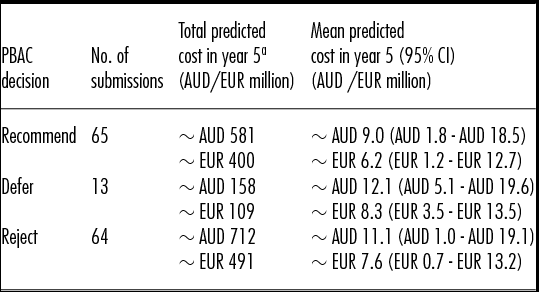
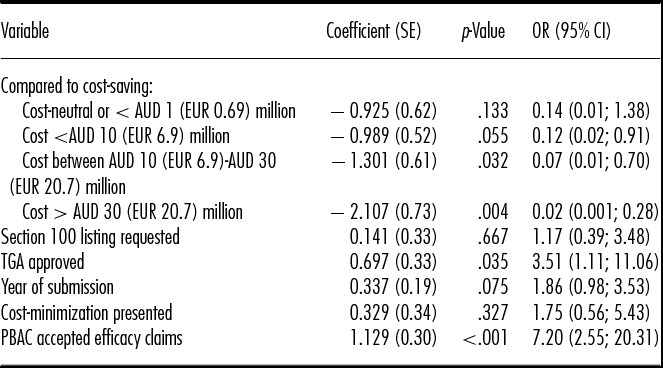
In 2012 to 2014, the PBAC assessed 318 major and minor submissions. Of the 235 major submissions, 93 were considered by the PBAC more than once, resulting in 142 unique submissions. Of the unique items considered, sixty-five were recommended, thirteen deferred, and sixty-four rejected (Table 1). The total predicted net cost to the PBS in year 5 of the recommended items was approximately AUD 581 (EUR 400) million, while the predicted cost for deferred or rejected items was approximately AUD 870 (EUR 600) million. The results of the probit multivariable analysis are presented in Table 2.
PBAC Decisions for Items Reviewed in 2012, 2013, and 2014 and the Associated Predicted Costs

a If an item was predicted to be cost saving, a saving of AUD 2 (EUR 1.4) million was assumed. If an item was predicted to have a cost of above AUD 100 (EUR 68.9) million, a cost of AUD 150 (EUR 103.3) million was assumed.
CI, confidence interval; PBAC, Pharmaceutical Benefits Advisory Committee; AUD, Australian dollar; EUR, Euro.
Results of the Probit Multivariable Analysis of Major Submissions Considered by the PBAC from January 2012 to December 2014 (n = 113)

Note. The number of major submissions was lower, as not all submission reported all the covariates. Of the 142 unique major submissions, 21 did not report the financial impact in year 5. Of the remaining 121 submissions, 8 did not report the TGA status of the drug. Of the remaining 113 submissions, there were 14 with cost-savings, 14 with cost-neutral or costs <AUD 1 (EUR 0.7) million, 55 with cost <AUD 10 (EUR 6.9) million, 18 with cost between AUD 10 (EUR 6.9) -AUD 30 (EUR 20.7) million, 12 with costs > AUD 30 (EUR 20.7) million. The variable “financial impact” was included as a categorical variable with “savings” as the base. The variables “Section 100 listing requested,” “TGA approved,” “Cost-minimization presented,” “PBAC accepted efficacy claims” were dichotomous variables (=1 if yes, =0 otherwise). The variable “year of submission” represented the year the submission was considered by the PBAC. The Log likelihood of this model was -53.77, and the likelihood ratio Chi-square test was 48.67.
CI, confidence interval; OR, odds ratio; AUD, Australian dollar; EUR, Euro; PBAC, Pharmaceutical Benefits Advisory Committee; SE, standard error; TGA, Therapeutic Goods Administration.
The analysis was conducted on unique major submissions that reported all included covariates (n = 111). The analysis suggested that the estimated financial impact was a statistically significant factor for predicting whether an item would be recommended or rejected. Submissions with predicted cost above AUD 10 (EUR 6.9) million in year 5 of listing were less likely to be listed (p = .032 for items between AUD 10 (EUR 6.9) and AUD 30 (EUR 20.7) million and p = .004 for items with a cost above AUD 30 (EUR 20.7) million). In addition, whether the medication was approved by the Therapeutic Goods Administration and whether the PBAC accepted the efficacy claim were significant factors for predicting if an item would be recommended.
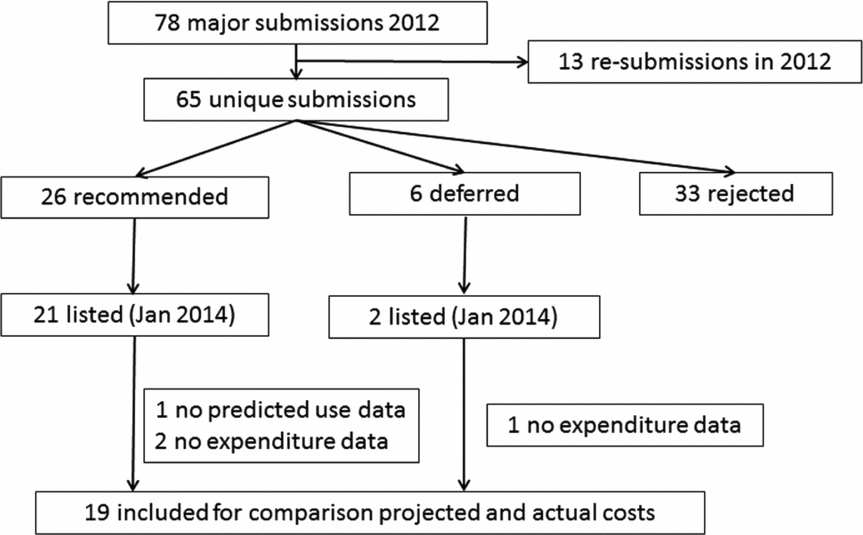
The comparative analysis of predicted versus observed use and cost to the PBS was based on major submissions considered by the PBAC in 2012. The PBAC considered seventy-eight major submissions in 2012, of which sixty-five were unique and thirteen were re-submissions (Figure 1). The PBAC recommended twenty-six items, deferred six and rejected thirty-three items.
Flow chart of all major submissions considered by PBAC in 2012; PBAC, Pharmaceutical Benefits Advisory Committee.

Of the twenty-six recommended items and six deferred items, twenty-three items were listed on the PBS by 1 January 2014 and nineteen were included in the analysis (Figure 1). Three items (everolimus, strontium, and telaprevir) were excluded as change in expenditure data were unavailable, and one item (dorzolamide) was excluded as the public summary document did not provide the predicted use.
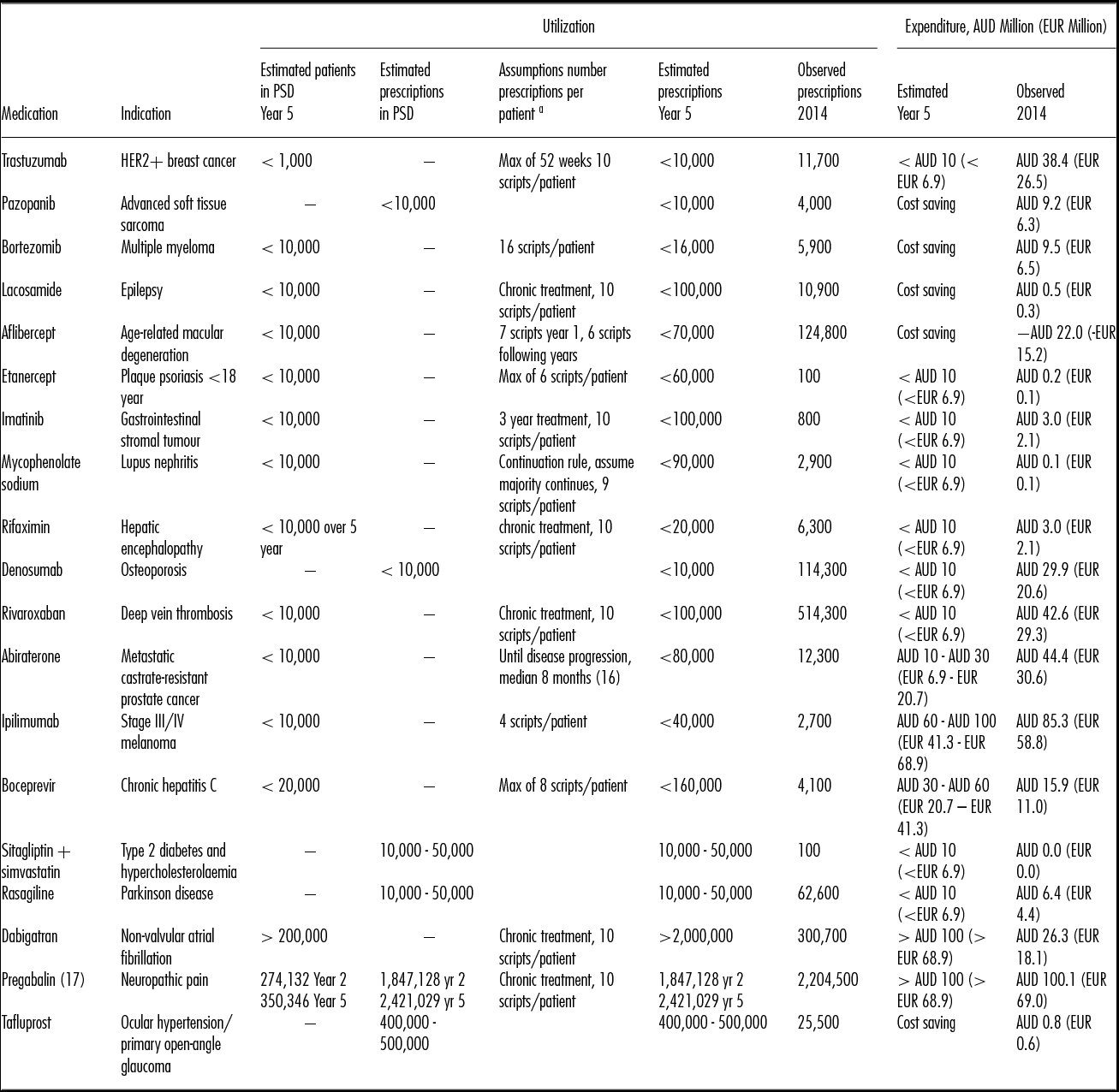
The majority of the public summary documents provided the predicted patient numbers (Table 3). Using assumptions about the number of prescriptions per patient, we compared the predicted number of prescriptions in year 5 with the observed number of PBS “services” (or prescriptions) in 2014, which corresponded to year 1 or 2 of PBS listing. The observed number of services provided was greater than the predicted number for five medications; for the remaining medications, the number of observed services was within the estimated bracket. The actual use of etanercept, imatinib, mycophenolate sodium, ipilimumab, boceprevir, sitagliptin plus simvastatin, and dabigatran was at least ten times lower than the numeric value of the lowest range (e.g., less than 10,000). While the actual number of prescriptions for pazopanib was within the predicted bracket, the Drug Utilization Sub-Committee stated in its postlisting analysis that the actual number of prescriptions were approximately triple that predicted (12).
Estimated and Observed Utilization and Expenditure Data for Items Considered by the PBAC in 2012

a The assumptions were based on the Pharmaceutical Benefits Scheme listing and / or the Australian Product Information. It was assumed that for chronic treatment a patient would receive 10 scripts per year.
PBAC = Pharmaceutical Benefits Advisory Committee; PSD = public summary document.
There was no clear pattern between predicted and observed cost to the PBS, with ten items (53 percent) having observed costs outside their predicted budgets. Eight medications had higher expenditure than predicted, with trastuzumab, denosumab, and rivaroxaban underestimating PBS costs by at least a factor of three. Two items, boceprivir and dabigatran, had a lower than predicted expenditure.
DISCUSSION
In 2012 to 2014, the PBAC considered 142 unique submissions and recommended 65 items for listing on the PBS at an estimated cost of approximately AUD 581 (EUR 400) million per year. Over the same period, sixty-four items were rejected; if these medications were listed they potentially could have had a yearly impact of AUD 712 (EUR 490) million. A probit analysis showed that predicted financial impact was a significant indicator of whether an item would be recommended by the PBAC or not, with submissions having a higher financial estimate being less likely to be recommended for listing. Previous studies of PBAC submissions by Harris (Reference Harris, Hill, Chin, Li and Walkom13) (which considered all major submissions from 1994 to 2004), Chim et al. (Reference Chim, Kelly, Salkeld and Stockler14) (major submissions from July 2005 to March 2008), and Mauskopf et al. (Reference Mauskopf, Chirila and Masaquel15) (submissions from July 2005 to November 2009) concur with our findings of the relationship between the predicted financial impact of a new medicine and the chance of recommendation when using multivariable logistic analyses. In addition to factors identified in previous studies, such as cost-effectiveness and whether the clinical claim was accepted, our study indicates that PBAC decision-making processes may be influenced by budget impact.
The reliability of use and financial estimates provided in the submissions was considered for all items recommended by the PBAC in 2012 and listed on the PBS by 1 January 2014. Overall, the data provided in the public summary documents were limited with regards to the predicted and actual utilization of those medications listed. Specifically, the estimate of less than 10,000 patients per year, which was the lowest threshold reported in the public summary documents, was too broad and did not enable a reliable comparison of predicted and actual use. The analysis showed that when individual comparisons were made, the observed use of PBAC recommended medicines was higher than predicted for 25 percent of the medicines and substantially lower for 35 percent of the medicines. Similar differences were found previously in the United Kingdom (16). A comparison of estimated and observed use of 18 NICE appraised medicines in 2012 found that five of eighteen items (28 percent) had higher than predicted use, one (6 percent) had lower, nine (50 percent) had approximately equal use to what was expected and for three items usage was unknown (16).
According to the NICE report, the variation in the predicted and observed use of medicines may be due to several factors, several of which are applicable to the Australian situation. First, there may be multiple indications for a single medicine, which may inflate observed usage data (16). The PBS does attempt, where applicable, to separate indications for medicines with multiple uses into unique item numbers; however, some items numbers are for all indications for which the medication is reimbursed, whereas other numbers may have more than one associated indication. It was difficult to accurately calculate the change in use for submissions that resulted in changes to an items’ indications for which the medicine is reimbursed, particularly for denosumab, lacosamide, and trastuzumab, due to the multiple indications. It should be noted that, even with this limitation, both denosumab and trastuzumab resulted in actual use above the predicted use.
A second reason for differences between predicted and actual use is that assumptions are often based on peer reviewed literature, data sources, or expert opinions that might not accurately reflect the local circumstances (16). In addition, local practice or circumstances of use may differ from the assumptions used to predict the number of patients likely to be treated. As the Australian market is comparatively small, use of the local population in clinical trials and studies is limited. In addition, estimates are made from data with varying degrees of certainty, which introduces significant variation.
Some patients may not follow the expected care pathways or may use alternative products (16). Patients may also fail therapies or decline or withdraw from treatments. The addition of new therapies to the PBS can greatly and suddenly influence the utilization. For example, the uptake of dabigatran for non-valvular atrial fibrillation was substantially lower than predicted. This could be due to the listing of rivabixoran and apixaban for this condition around the same time (2) or due to safety concerns with dabigatran (Reference Mauskopf, Chirila and Masaquel15).
The market penetration may be lower than predicted (16). For example, sitagliptin with simvastatin was predicted to have between 10,000 and 50,000 prescriptions in year 5. In actuality, 126 prescriptions were dispensed between January and July 2014 and the item was removed from the PBS. Lower effectiveness than anticipated may also have affected lower uptake rates, for example, tafluprost eye drops for the treatment of ocular hypertension and glaucoma (Reference Lin, Zhao and Chew17).
The actual costs for two medications (dabigatran and bocepravir) were lower than the predicted costs due to lower than expected prescription numbers. Four medications (trastuzumab, denosumab, rivaroxaban, and abiraterone) had higher actual than predicted costs. The Australian Government previously subsidized trastuzumab for HER2 positive breast cancer outside the PBS budget due to an unacceptably high cost-effectiveness ratio. Cost savings from this different budget (Herceptin Program) were not publicly available and were excluded in our analysis. Denosumab and rivaroxaban had higher than predicted prescription numbers resulting in higher costs. For abiraterone, it was unclear why the cost was higher, but it could potentially be due to longer duration of treatment in clinical practice than predicted.
There are several limitations with this study. First, the public summary documents provide only limited financial and use information, which is in the form of broad ranges for both patient and prescription numbers. Most concerning was the broad range used for the lower threshold (less than 10,000 patients). For diseases with small patient numbers, for example, plaque psoriasis in children under the age of 18 years (etanercept), lupus nephritis (mycophenolate sodium) or gastrointestinal stromal tumor (imatinib) the impact was difficult to assess. The use of broad ranges limits the transparency of the PBAC decision-making process as it provides too limited information on the number of patients potentially benefitting from new medications.
Second, the analysis only included medicines recommended by the PBAC in 2012 and compared the predicted year 5 values with observed utilization and cost from 2014, which corresponded to year 1 or 2 of listing. Although it would be more accurate to compare predicted year 5 data with actual year 5 data, changes to restrictions, additional recommendations, and emerging safety issues mean the PBS environment is continually evolving and obtaining meaningful longer-term data is difficult.
Third, the use of the nominated comparator in the calculation of observed cost for some of the items may not reflect the actual cost. In our analyses, we considered only substitution with the nominated comparator, rather than the whole therapy group. A further limitation was that the observed expenditure (using PBS data) may not reflect total government spending due to special pricing arrangements such as risk sharing arrangements. Risk sharing arrangements can be negotiated between the Department of Health and the sponsor after recommendation by the PBAC. These arrangements help maintain the appropriateness and cost-effectiveness of a listed medicine, and may involve a price volume agreement, whereby the sponsor agrees to reduce the price of a medicine by a certain percentage once utilization has reached an agreed limit (2). This occurs by means of a rebate process, with rebates not captured in the PBS data (2).
Additionally, another limitation was that the cost per quality-adjusted life-year (QALY) was not included in the probit model. The cost per QALY has been shown to be an important factor for PBAC decision making (Reference Chim, Kelly, Salkeld and Stockler14;Reference Mauskopf, Chirila and Masaquel15). Furthermore, there may be a correlation between a higher cost per QALY and higher estimated financial impacts, and this correlation may have confounded the association observed between the estimated financial impact and the PBAC decision.
CONCLUSIONS
We showed that a higher predicted financial impact is associated with a lower rate of PBAC recommendation, which might indicate that PBAC decision making is influenced by this factor. While the predicted financial impact might influence the likelihood of a recommendation, the predicted use may not reflect actual prescribing. This is a concern, especially when the PBAC includes the financial estimates to make recommendations regarding reimbursement. For other jurisdictions, e.g., lower or middle income countries, who may not have access to cost-effectiveness information, this may be of an even larger concern as the decision-making process would rely primarily on the predicted financial impact.
A concern with the publicly available data is that the data are categorized in such a way that the comparison between predicted and actual utilization is not overly informative. However, the available data do raise concerns about differences between the predicted and actual use and cost of newly listed medications. It is essential that the manner in which the predicted use of medicines is calculated is as robust as possible, and provided in the public arena so that the general public can validate the number of patients likely to benefit from the new treatments recommended by the PBAC.
CONFLICTS OF INTEREST
Drs. Turkstra, Bettington, Donohue, Mervin report that they are involved in the evaluation of submissions made to the Pharmaceutical Benefits Advisory Committee.