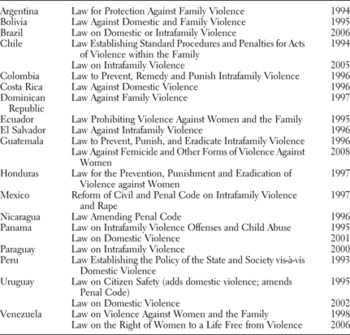
Between 1993 and 2000, nearly every democracy in Latin America passed a law prohibiting domestic violence. Between 2001 and 2006, five countries strengthened their legislation, and Brazil passed its first law (see Table 1). At first glance, the adoption of key international norms on women's rights suggests that Latin American governments became hotbeds of feminist policymaking in the 1990s, before the regional turn to the political Left. But a closer look reveals crucial differences between international ideas about women's rights and the translation of these ideas into national policy. Instead of offering a challenge to gender hierarchies, the first wave of domestic violence legislation in some ways reinscribed them; this has prompted what may become a wave of reforms.
National legislation on domestic violence in Latin America

Sources: Alméras et al. Reference Alméras, Bravo, Milosavljevic, Motaño and María2004; Espina Reference Espina2007; Global Legal Information Network 2008; IACHR 2007, n. 332; ISIS Internacional/UNIFEM 2006.
What explains these advances with respect to women's rights – and their contested nature? A majority of the research on achieving Latin American women's rights focuses on state actors, political parties, and civil society organizations (Baldez Reference Baldez2004; Blofeld and Haas Reference Blofeld and Haas2005; Bruhn Reference Bruhn2003; Krook Reference Krook2006). Other scholars insist on the centrality of international human rights norms and movements in promoting women's rights at the national level (Friedman Reference Friedman2003; Hawkins and Humes Reference Hawkins and Humes2002; Keck and Sikkink Reference Keck and Sikkink1998; Zwingel Reference Zwingel2005). Yet to be explored is the relevance of an intermediate level: the regional.Footnote 1
Two major obstacles, one empirical and the other theoretical, stand in the way of regional, particularly institutional, analysis. The deep-seated problems of the inter-American system of governance, the Organization of American States (OAS), seem to preclude its role as a significant actor in the diffusion of rights. Thus, there is almost no theory on the role of regional institutions in promoting women's rights.Footnote 2
This study begins to overcome these obstacles. It finds that the two women's rights units of the OAS have been active in both establishing regional norms on violence against women and promoting their national adoption and implementation. While this suggests that regional governance can advance women's social rights, there is no automatic institutionalization of these norms at the national level. As case studies demonstrate, national contexts mediate norm translation in ways that subvert, as well as uphold, regional understandings.
To conceptualize regional dynamics, this article first reviews literature on the European Union's impact on national gender-related policy. It then discusses the relevant inter-American bodies to explain the context of and possibilities for regional intervention on women's rights in Latin America. These frameworks illuminate how OAS units have participated in the establishment, adoption, and implementation of norms on violence against women, taking into account Latin American states' institutionalization processes. As illustrations of how regional norms and institutions interact with national policy processes, the article profiles a leader in policy adoption, Chile, and the most recent adopter, Brazil.
This study uses the approach of “feminist institutionalism,” which “understands institutional analysis as fundamentally concerned with the interaction between institutions and actors and accepts that different institutions will present actors with different opportunities and challenges,” but distinguishes institutional from social change (Waylen Reference Waylen, Rai and Waylen2008, 257). The primary empirical focus is on elements of the inter-American system and the actors with whom they interact, but it also includes the institutional contexts of the two countries under examination. The article thus draws on primary and secondary literature on the OAS system: profiles, histories, and reports from the two units under examination, the Inter-American Commission of Women and the Inter-American Commission on Human Rights' Rapporteurship on the Rights of Women; and secondary literature on antiviolence policy development at regional and national levels, particularly in Chile and Brazil.
UNDERSTANDING THE ROLE OF THE REGION
Given the scant analysis of the inter-American system's impact on women's rights, the literature on the European Union, a regional organization that has achieved results in this area, is a useful place to look for theoretical approaches. Although the EU functions in some ways as a supranational federal organization, with clear demarcations of policymaking channels at each level, analysts have conceptualized the contemporary interactions resulting in domestic policy as “multilevel governance.” This concept refers to authoritative decision making with numerous jurisdictions, intended to be “flexible” and “task-specific” and to work at many “territorial scales” (Marks and Hooghe Reference Marks, Hooghe, Bache and Flinders2005, 20).
Multilevel governance calls for “multiscalar analysis,” which takes regional and national spaces as “overlapping arenas of policy, norms, values, power relations, and social interactions” (Macrae Reference Macrae2006, 528). This analysis acknowledges the agency of the different actors involved in complex interactions, who seek arenas most open to their demands (p. 530). New regional arenas provide opportunities for policy creation that may be closed at the national level, because the organizations are less institutionalized and eager for allies to promote their agendas or establish their legitimacy (van der Vleuten Reference van der Vleuten2007; Zippel Reference Zippel2004, 58). Among these opportunities is the potential for supranational monitoring of state noncompliance with regional statutes (van der Vleuten Reference van der Vleuten2005, 468).
Engaging in supranational action to achieve national change could invoke the oft-cited “boomerang” effect of activists who appeal to transnational advocacy networks to bring pressure on their home states (Keck and Sikkink Reference Keck and Sikkink1998). Analysts of EU gender policy instead highlight the complex interactions of advocates located outside and inside of different EU units. Anna van der Vleuten (Reference van der Vleuten2007, 25–27) describes how the European Commission's “gender unit”—a Directorate General under the Commissioner for Employment and Social Affairs—coordinates legal experts and civil society organizations in order to apply “pincers” on national governments to carry out gender-related policy. The European Court also uses pincer action when national courts ask for interpretations of EU legislation. Kathrin Zippel (Reference Zippel2006), on the other hand, focuses on the repeated interactions of the European Parliament and Commission with a transnational action network they helped to develop. She describes this ongoing relationship as a game of “ping-pong” between regional and national levels, which established soft and then hard law on sexual harassment. Johanna Kantola (Reference Kantola2006, 144–45) offers a specific analysis of the actors, discourses, and organizations involved in EU (nonbinding) policy on violence against women, noting the importance of both the 3,000 organization–strong European Women's Lobby in introducing the issue and the female EU members of Parliament and commissioners who championed it.
Such work makes clear that EU conceptualizations of women's rights are not static. While the economic foundation of the organization meant that women's rights were initially interpreted in light of their economic or employment status, there has been change over time (see Walby Reference Walby2004). With the adoption of human rights–oriented treaties, such as the European Charter of Fundamental Rights in 2000, there has been more room to articulate a human rights discourse within the EU. For example, the 2001 Framework Strategy on Gender Equality integrated violence against women as a women's rights issue (Kantola Reference Kantola2006, 149). In sum, multiscalar analysis specifies which institutions are involved (judicial, executive, or legislative), the actors with whom they interact (experts, activists, policymakers), and the discourses used.
As EU analysts insist, fluid policymaking within imbricated “scales” does not erase the state's role. National “gender regimes” – constructed through state preferences, values, institutions, and political dynamics – can have a significant impact on compliance with regional-level statutes (Macrae Reference Macrae2006, 529; van der Vleuten Reference van der Vleuten2007; Zippel Reference Zippel2006).Footnote 3 The complexity of national contexts and the ideological reframing required by feminist demands make policies challenging gender relations difficult to achieve (van der Vleuten Reference van der Vleuten2005). As Maria Stratigaki explains: “The meanings of key concepts initially introduced by feminists and originally grounded in feminist ideas [may be] conceptually transformed … resulting in the loss of their potential for changing gender relations” (Reference Stratigaki2004, 31). For example, Zippel (Reference Zippel2006, 113) notes how national consensus building on sexual harassment undermined the feminist perspective of EU measures.
Are these insights useful when turning to Latin America, given the differences between the regions' institutional environments? While bound by multilevel governance, the EU has supreme authority on issues within its jurisdiction, whereas the OAS is a weak interstate organization. Their structures are correspondingly distinct. Moreover, the OAS is a well-established organization; thus, the entrenched interests and norms characteristic of such organizations are more likely to be at issue (Chappell Reference Chappell, Rai and Waylen2008, 179). The obstacles the OAS presents might seem insuperable. But as with other international organizations, the OAS may prove not to be “homogeneous and monolithic,” but made up of “complex and sometimes contradictory structures” that defy attempts at generalizing—and may well be open to gender-based demands (Waylen Reference Waylen, Rai and Waylen2008, 256). As the next section shows, there are units of the OAS that successfully promote human rights in general, and women's rights in particular: the human rights mechanisms and the Inter-American Commission of Women.
LATIN AMERICAN RE(GION)ALITY
The OAS is an unlikely candidate for human rights promotion. It is notoriously ineffective, due to “rivals,” such as the North American Free Trade Agreement and the Southern Common Market (Mace and Thérien Reference Mace, Thérien, Mace, Thérien and Haslam2007, 36) and the geopolitical strains inherent in its makeup. The United States uses the OAS to accomplish its global and regional goals; some Latin American governments see the OAS as a venue to engage with the hemispheric hegemon, while others want to use the organization to restrain it (Scheman Reference Scheman, Mace, Thérien and Haslam2007, 23). The branches of the OAS “have very limited autonomy. … As norm implementers, they have limited monitoring and enforcement authority” (Abbott Reference Abbott, Mace, Thérien and Haslam2007, 250). The state-oriented OAS marginalizes civil society advocates, as illustrated in the Summit of the Americas processes (Smith and Korzeniewicz Reference Smith, Korzeniewicz, Mace, Thérien and Haslam2007). This marginalization is undemocratic and is an obstacle to the realization of human rights (Mace and Thérien Reference Mace, Thérien, Mace, Thérien and Haslam2007, 42–47).Footnote 4
One exception to the bleak evaluation of inter-American action is the work of the human rights mechanisms. The Inter-American Commission on Human Rights (IACHR) and the Inter-American Court of Human Rights (referred to as the Court) are responsible for upholding the 1948 American Declaration of the Rights and Duties of Man and the 1969 American Convention on Human Rights. Since their founding in 1959 and 1979, these mechanisms have established principles against state impunity in cases of human rights violation under armed conflict and terrorism, as well as civil rights violations in democracies (Duhaime Reference Duhaime, Mace, Thérien and Haslam2007, 134–41).
In dramatic contrast to the general sovereignty-preserving nature of the OAS, these mechanisms were established to supervise the actions of states and uphold the rights of individuals (Dykmann Reference Dykmann2004, 67; Medina Reference Medina, Castermans-Holleman, van Hoof and Smith1998, 126). The IACHR, in particular, has been able to persuade even “repressive regimes to concede to compromises on behalf of human rights” (Dykmann Reference Dykmann2004, 434). Besides promoting regional statutes and monitoring human rights, it is empowered to receive petitions from individuals who have found national authorities unresponsive to their demands for rights protection. If the IACHR finds the petitions “admissible,” it can investigate and make recommendations to states, and, in urgent cases, adopt protective measures. Finally, if states do not respond, it can forward cases to the Court.Footnote 5 The Court can issue advisory opinions on regional human rights statutes, including the compatibility of national laws, and also adopt measures to protect those in immediate danger. Its judgments are binding under international law (Duhaime Reference Duhaime, Mace, Thérien and Haslam2007, 133).
The human rights bodies of the Americas were modeled on their European counterparts, but with a distinct challenge in operation, given widespread governmental violation of constitutional provisions protecting human rights. Whereas European models reinforced preexisting national constraints on government power, the IACHR “attempt[ed] to impose on governments restraints without domestic parallel” (Farer Reference Farer1997, 513). The IACHR came into its own as authoritarian rule deepened across the region in the 1970s and 1980s. Educated middle-class Chileans appealed to it following the coup against Salvador Allende in 1973, as did organizations representing poorer victims of human rights abuses (Dykmann Reference Dykmann2004, 107).
U.S. President Jimmy Carter (1976–80), more concerned with human rights than his predecessors (and successor), increased funding for the IACHR (Dykmann Reference Dykmann2004, 179). But funding did not determine its relevance. Commissioners, recognizing that authoritarianism made domestic remedy impossible, found most petitions admissible. They also created country reports to mobilize regional opinion. Such strategies proved successful: For example, the Nicaraguan dictator Anastasio Somoza called the IACHR's “Report on the Situation of Human Rights in Nicaragua” (OEA/Ser.L/V/II.45) “one of the decisive forces driving him to resign” in 1979 (Farer Reference Farer1997). With the move to political democracy in the last decades, the IACHR is busier than ever, demonstrating its continued relevance.Footnote 6
Thus, the puzzle of the IACHR and the Court's effectiveness within the weak institutional context of the OAS is solved by the nature of their mandate and those upholding it. As part of a judicial, rather than a political, branch of the OAS, the IACHR “operates in a highly independent fashion. The judges of the Inter-American Court of Human Rights also serve in their individual capacities” (Abbott Reference Abbott, Mace, Thérien and Haslam2007, 252; also see Duhaime Reference Duhaime, Mace, Thérien and Haslam2007; Farer Reference Farer1997; Scheman Reference Scheman, Mace, Thérien and Haslam2007). As adjudicators, the seven IACHR commissioners elected by the OAS General Assembly do not serve in a representational capacity for their countries of origin. Moreover, they seek interaction with civil society organizations: “[H]uman rights norms protect and empower [them], and the inter-American system incorporates them to a remarkable degree,” relying on them for information essential to carrying out judicial processes (Abbott Reference Abbott, Mace, Thérien and Haslam2007, 252). The IACHR's accessibility and hands-on evaluation, the interpretive power of the Court, and the expansion in petition numbers attest to the development of an inter-American “citizenship regime” or “social contract.” In other words, the mechanisms participate “in the defining and implementation of the rights and responsibilities that apply to the entirety of the citizens of the hemisphere” (Cooper and Thérien Reference Cooper and Thérien2004, 733, 734).
In 1994, the IACHR extended its “regime” to cover women's human rights, with the inception of the Special Rapporteurship on the Rights of Women. Its inception was spurred by regional mobilization on women's rights and the UN's World Conference on Human Rights (in Vienna 1993), whose Programme of Action called for “integrated system-wide approaches to addressing the status and human rights of women” (IACHR 1998, 15). Then-Commissioner Claudio Grossman, noting the IACHR's need to address women's rights, advocated for a Rapporteurship, which he headed for its first six years.Footnote 7 Its first mandate was to analyze whether national statutes and practices complied with regional documents supporting equality and nondiscrimination (Medina Reference Medina, Castermans-Holleman, van Hoof and Smith1998). The Rapporteurship now provides analysis of petitions that allege “human rights violations with gender specific causes and consequences.” It also uses the IACHR's resources to draw attention to the violation of women's human rights and offer recommendations to end them (IACHR n.d.).
The efficacy of OAS human rights bodies, augmented by the Rapporteurship, offered a favorable scenario for juridical intervention on gender-related issues by the mid-1990s. But OAS policy work on women's rights predated it considerably. The Inter-American Commission of Women (known by its Spanish acronym, CIM) is one of the specialized agencies of the OAS. Despite these agencies' political nature (and small budgets), they are able to set their own agendas and advance them through national delegates.
The CIM is responsible for hemispheric policy on women's rights and gender-related issues. The first—and only—regional intergovernmental agency created with this mandate, it was established in 1928 in response to pressure from women's rights activists, who sought to have the OAS's predecessor, the Pan American Conference, take up issues such as suffrage. The CIM's first president emphasized “the necessity of action through the Pan American Conference, not by separate countries, in obtaining equal rights for women in all the American republics” (CIM n.d.). On the basis of its research into the civil and political status of American women, it drafted the First Inter-American Convention on the Nationality of Women (1933) and the Inter-American Convention on the Granting of Political Rights to Women and another Granting Civil Rights (1948). These were “designed to force governments to bring national laws into compliance with what were intended to be new, progressive international commitments” (Meyer Reference Meyer, Meyer and Prgül1999, 63). And comply they did: Twice as many governments granted women suffrage after adopting the Convention on Political Rights than before (Meyer Reference Meyer, Meyer and Prgül1999). Despite budgetary constraints, throughout the twentieth century, the CIM continued to work on such issues as women's education and role in development.
Unlike the IACHR and its Rapporteurship, the CIM is a political body: Its Assembly of Delegates includes representatives of OAS member states, who, according to the most recent statutes, are the women who head the highest-level agency with responsibility over women's and gender issues (CIM 2007). The Assembly meets every two years to establish CIM policy; its members are expected to promote them nationally. Run by an elected seven-member Executive Committee, it relies on a small staff at OAS headquarters in Washington, DC.
Although the different mandates of the IACHR and its Rapporteurship (adjudication) and the CIM (policymaking) preclude a strongly institutionalized relationship, linkages exists. In the most relevant example, the CIM-sponsored convention against violence against women described in the following section uses the IACHR as its “court of appeal.” Resolutions of the CIM's Assembly of Delegates, as well as current staff members, attest to efforts at ongoing coordination and information sharing (CIM 1998, 2000).Footnote 8
The two mechanisms have played central roles in promoting women's human rights at the national level, in conjunction with national and regional feminist organizations and legal experts. Thus in Latin America, conditions exist for the kinds of pincer or ping-pong effects identified by EU analysts, through a somewhat different configuration of institutions and actors. As an “autonomous institute” of the OAS, the CIM develops policy by working with the national actors responsible for promoting it, and with civil society organizations. The IACHR's Rapporteurship, a newer mechanism under the judicial arm of the OAS, has its own resources for targeting rights violations, and is also open to civil society representatives.
In focusing on women's human rights, these organizations face quite a challenge. As in the EU, social rights are among the most difficult to achieve within the “citizenship regime” established by the OAS human rights mechanisms (Cooper and Thérien Reference Cooper and Thérien2004, 741; Duhaime Reference Duhaime, Mace, Thérien and Haslam2007, 146). The case of violence against women in Latin America offers a stark example. The problems are severe—between 38% and 68% of women experience psychological abuse, and between 9% and 52% suffer physical violence, at the hands of their partners (CEPAL 2009)—but states began to take concerted action only in the 1990s. Because states use gender policy to assert sovereign prerogatives (Friedman, Hochstetler, and Clark Reference Friedman, Hochstetler and Clark2005), the interplay between regional norms on violence against women and their national application offers a demonstration of the “changing position of supranational institutions vis-à-vis states and their influence on national policymaking” (Ellina Reference Ellina2003, 18).
ESTABLISHING, ADOPTING, AND IMPLEMENTING NORMS OPPOSING VIOLENCE AGAINST WOMEN IN LATIN AMERICA: RE(GION)ALIZING WOMEN'S HUMAN RIGHTS?
There are parallels between the ways in which Latin American and European advocates have used regional institutions to bring about national change on women's rights—as well as the resistance they have experienced. Using a three-phase analysis, this section explores the fruitful collaboration of “sympathetic insiders” (Waylen Reference Waylen, Rai and Waylen2008, 257) in regional organizations and civil society “outsiders” in the struggle to institutionalize norms opposing violence against women in Latin America. In first establishing these norms, women's movements inspired the CIM to create pathbreaking feminist hard law: the Inter-American Convention on the Prevention, Punishment, and Eradication of Violence Against Women. Then the strategies outlined by EU analysts came into play. In the second phase, advocates in regional bodies worked with civil society to apply pincer pressure on states to adopt regional-level norms through legislation. Although domestic violence laws spread across the region, they did not initially reflect these norms: Unfavorable national gender regimes resulted in privileging family unity over women's rights. Shifts in the regimes were necessary for further institutionalization of the original norms. Unsatisfied with the widespread failure of states to fully institutionalize the norms through word or deed, advocates and regional organizations have continued to a third stage. To press for implementation of their norms, regional organizations have begun ping-pong efforts, as well as continuing to apply pincers.
Establishing Norms
Feminist activists and organizations began to coordinate opposition to violence against women at the regional level in the 1980s. At the very first Latin American and Caribbean Feminist “Encuentro” (a regional meeting of activists) in 1982, participants discussed the issue, drawing from their experiences carrying out research, campaigns, and service provision. Soon after its founding in 1987, the Latin American and Caribbean Committee for the Defense of Women's Rights (CLADEM), a network of legal specialists and rights organizations, collaborated on a regional evaluation of national legislation (Guerrero Caviedes Reference Guerrero Caviedes2002, 38). In 1987, the fourth Encuentro in Taxco, Mexico, declared an International Day Against Violence Against Women to be celebrated on November 25, formalizing a commemoration begun in the early 1980s; it is now observed worldwide. Participants chose the date as a tribute to the Mirabal sisters, who were killed on that day in 1965 for their opposition to the Dominican dictatorship of Rafael Trujillo. This tribute illustrates the connection that feminists made between violence against women perpetrated by the state and by private actors, a connection that continued to inform their advocacy. At the fifth Encuentro in 1990, the Latin American and Caribbean Feminist Network Against Domestic and Sexual Violence was formed to foster regional collaboration (Guerrero Caviedes Reference Guerrero Caviedes2002, 39).
The CIM leadership responded to the considerable activism across the region—and the limited governmental recognition it received. In 1986, the CIM, under Executive Secretary Linda J. Poole (1986–96), presented to its Assembly of Delegates a plan of action entitled “Full and Equal Participation by the Year 2000.” It included the issue of violence as an “Area of Special Concern.” Among its recommendations were that governments “affirm the dignity of women, as a priority action to counteract gender-specific violence”; encourage changes in gender role socialization; “eliminate degrading images and representations for women [and] establish or strengthen measures to combat violence and to assist the victims of violence” (“Women and Violence” 1991). The Assembly approved the Plan during its twenty-third session.
In July 1990, the CIM executive committee convoked an “Inter-American Consultation on Women and Violence,” which was “the first of its kind and opened new diplomatic space to this closeted topic” (Meyer Reference Meyer, Meyer and Prgül1999, 66). CIM President Milagro Azcunaga de Melendez from El Salvador (1988–90) opened the session by noting that, despite the ratification of other international women's rights conventions, “we have to admit that where violence against women is concerned, little or nothing has been done. … Hence, we have to consider the possibility of an inter-American convention on violence against women” (CIM 1999, 532). Adopting the recommendations of this Consultation, the next meeting of the Assembly of Delegates in October 1990 called for the drafting of a regional convention.Footnote 9 The CIM then held two Meetings of Experts (in August 1991 and April 1993), which included a broad range of professionals (“Reports from around the World: Americas” 1993). After revisions that took into account the comments of 16 governments,Footnote 10 the IACHR's Executive Secretariat, the UN Division for the Advancement of Women, and women's rights organizations including CLADEM, the OAS General Assembly adopted the Inter-American Convention on the Prevention, Punishment, and Eradication of Violence Against Women on June 6, 1994, in Belém do Pará, Brazil (CIM 1999, 549). It became known as the “Convention of Belém do Pará.”
The CIM's consultation and drafting period overlapped with a key international development on violence against women: the organizing around the 1993 UN Conference on Human Rights. In part inspired by the insight of Latin American feminists into the connections between public and private oppression of women, a transnational women's human rights movement grew around the conference preparatory process. United across differences under its banner “women's rights are human rights,” the movement succeeded in having the conference recognize violence against women as a violation of their human rights (Friedman Reference Friedman, Peters and Wolper1995).
As the foregoing shows, it was in the Latin American region that this recognition had its most concrete and powerful expression. When the UN General Assembly adopted the Declaration on the Elimination of Violence against Women (A/RES/48/104) in December 1993, drafting for the Convention of Belém do Pará was nearing completion. Although there are notable overlaps in language, the impact of the Convention was intended to be much stronger: Instead of a declaration, the CIM had developed feminist “hard law.”
The Convention takes a feminist perspective from its opening definition of violence against women, drawing attention to violence that women experience “based on their gender,” reflecting what the preamble calls “the historically unequal power relations between women and men” (OAS 1994). Moreover, the insistence that violence against women must be eradicated no matter where it takes place—in any interpersonal relationship, in the community, or “perpetrated or condoned by the state or its agents” (OAS 1994)—also stems from a feminist perspective on social relations. In focusing on the role of the state, the Convention concretizes violence against women as “a violation of their human rights” (OAS 1994), which the state has the responsibility to prevent.
The Convention is unprecedented, not only in its feminist interpretation of the problem but also in its legal character. As a convention, it is considered “hard” international law. Unlike “soft” law, hard law is legally binding; if ratified, it prescribes action that states must take. The articles of the third chapter—the “Duties of the States”—“create the pathbreaking international human rights norm of state responsibility in the prevention, punishment, and elimination of violence against women” (Meyer Reference Meyer, Meyer and Prgül1999, 69). In the language of the Convention (111:h), states must “adopt such legislative or other measures as may be necessary to give effect to this Convention.” Beyond the states' reporting requirement to the CIM, the ability of individuals or organizations to bring petitions to the IACHR for alleged violations of states' responsibilities under the Convention (Article 7) is a mechanism of accountability superior to the Optional Protocol of the international women's rights treaty, the UN Convention on the Elimination of All Forms of Discrimination Against Women (CEDAW).Footnote 11 There is no other such regional or international law, making the Convention an unrivaled regional institutionalization of feminist norms.
Adopting Policies
The CIM's work on the Convention of Belém do Pará joined ongoing efforts at the national level to pressure governments to adopt legislation, resulting in a pincer effect: “Pressed from above and below, the states of the Americas [were] being held accountable for taking steps to combat the widespread problem of violence against women” (Meyer Reference Meyer, Meyer and Prgül1999, 59). In the months after ratification of the Convention, the CIM “started a process to inform the countries, with seminars in member countries to let people know what the convention was—because if you don't promote it, nobody knows about it.”Footnote 12 Other regional bodies complemented their efforts. The Pan American Health Organization, formulating violence against women as a health issue, funded studies of it in Central America, supporting civil society organizations and influencing governmental action. The Inter-American Development Bank funded its own studies of the impact of domestic violence on economic development and underwrote training and awareness programs. UNIFEM also funded region-wide domestic violence initiatives. The Regional Action Plan for the UN Fourth World Conference on Women (in 1995) prioritized the elimination of violence. This priority was reinforced at the 2000 Regional Conference on Women in Latin America and the Caribbean, where government representatives insisted on the necessity of paying attention to all forms of violence based on gender and its causes (Alméras et al. Reference Alméras, Bravo, Milosavljevic, Motaño and María2004). Once the Convention was in place, regional organizations interpreting violence within their own frameworks continued to reinforce its message.
Pincer efforts by regional institutions working with national advocates paid off. By the end of the 1990s, the Convention was ratified by every Latin American government, and nearly all passed domestic violence legislation. Early action came in Peru and Chile, where activists took advantage of national political opportunities that overlapped with the Convention's drafting process. The majority of countries that followed were motivated by what has been called a norm “cascade”—when “a large number of states … implement the norm in similar ways in a relatively short time span” (Hawkins and Humes Reference Hawkins and Humes2002, 242).
If the move from the regional to the national level was a cascade, it was not of the regional norms on violence against women. There were two requirements for national legislation to reflect the norms of the Convention of Belém do Pará: “first, a serious commitment to eradicating violence against women, and second, that violence against women constitutes a crime ” (Chiarotti Reference Chiarotti1998; emphasis in the original). But national gender regimes resulted in legislation upholding the patriarchal family rather than women's right to a life free from violence, and the legislation did not sanction such violence criminally.
As Table 1 shows, the majority of legislation prohibited “intrafamily” violence; only five laws mentioned women (and two of those concern “women and the family”). This legislation, and the reasoning on which it is based, “underplays the gendered aspects of the violence” in implying that all family members are “equally likely to be perpetrators and victims” (Craske Reference Craske, Chant and Craske2003, 37). Moreover, most laws did not take into account violence outside the family (IACHR 2007, 89).
Under these laws, the legal sanction for intrafamilial violence was usually not criminal. Most countries prosecuted offenders in civil or family courts and insisted on “reconciliation” or “mediation” as a first step in legal proceedings (Macaulay Reference Macaulay2006, 104). While this measure helped circumvent overburdened criminal justice systems, it privileged the “well-being of the family unit” over the rights of abused women and renaturalized “domestic violence by implying that a couple can, or should, be reconciled even when one systematically abuses the other” (Macaulay Reference Macaulay2006, 110; see also IACHR 2007, 90). Internationally, such measures are not recommended (IACHR 2007, 67).
The case of Chile, a regional leader, offers an example of how such outcomes resulted at the national level despite considerable regional mobilization. Under the dictatorship of General Augusto Pinochet (1973–88), exiled middle-class feminists returning from Europe brought with them new understandings of women's rights. They found allies among working-class women fighting against human rights abuses in Chile. Although the two groups disagreed over the relative saliency of gender or class as an organizing principle, they came together to confront violence as a problem affecting all women. Feminists seized the opportunity of the democratization of the late 1980s to press their demands, influenced by the new Latin American and Caribbean Feminist Network Against Domestic and Sexual Violence. Chilean advocates established their own network as they solidified regional ties (Araujo, Guzmán, and Mauro Reference Araujo, Guzmán and Mauro2000, 145).
An institutional opportunity opened in the new national women's machinery, the National Women's Service (SERNAM), which set up the “Interministerial Commission on Intra-Family Violence.” Simultaneously, feminist legislators proposed a bill that “included all family members in its definition of domestic violence, but the details of the bill were specifically focused on the physical and psychological abuse of women by their husbands or partners, which constituted the majority of cases of family violence”; SERNAM was convinced to support their efforts and increased their access to relevant committees (Haas Reference Haas2006, 213–14).
Executive support resulted in a shift of the nature of the legislation, however. At this time, the Christian Democrats held the presidency and were the largest party in congress; a Christian Democrat also directed SERNAM. To avoid conflict with the Catholic Church, the party engaged in “role-based” framing of women's rights, which “does not threaten a woman's role as wife and mother in a traditional conception of the family” (Blofeld and Haas Reference Blofeld and Haas2005, 37). As conservative politicians weighed in, a focus on the family emerged in the antiviolence legislation: “[T]he arguments in support of it made abundant reference to the consequences of violence in the home but did not refer to women as a subject of law” (Araujo, Guzmán, and Mauro Reference Araujo, Guzmán and Mauro2000, 149). Despite being the Chilean CIM delegate during the Convention of Belém do Pará's drafting—and as such “responsible for the national consultation process” on it (Poole Reference Poole and Kerr1993, 136)—the head of SERNAM followed her party's lead in brokering a moderate version of the national bill. Left parties and some feminists, responding to the political weight of the church and executive branch, as well as the demands of coalition politics, also moderated their demands to appeal to conservative decision makers.
From its title to its contents, the final legislation, emerging the same year as the regional Convention, nevertheless prioritized family unity over the rights of women. Addressing “Acts of Violence within the Family,” it reduced the punishment for offenders from the original bill and gave judges wide discretion over removing them from the home. Some initial supporters wondered if the final version was “worse than nothing” (Blofeld and Haas Reference Blofeld and Haas2005, 48). It also did not have a budget, resulting in its classification as a “legitimacy-building” (or “window dressing”) endeavor, rather than policy with political will behind it (Franceschet Reference Franceschet2008; Guerrero Caviedes Reference Guerrero Caviedes2002).
This was not the final word on domestic violence in Chile, however; a shift in national gender regime resulted in more responsiveness to the norms embedded in the Convention of Belém do Pará, as Chile now bucked the trend of other countries' legislation. When Socialists came to power in 2000, they offered less support for the church and more for feminist demands, including ending violence against women. In 1999, two feminist deputies introduced reforms to strengthen existing legislation; under new leadership, SERNAM undertook studies of current policy that were used by advocates and covered in the media (Franceschet Reference Franceschet2008, 26). When the revised Intrafamily Violence Law passed in 2005, it criminalized domestic violence, expanded sanctions, and made it easier to remove the abuser from the home (Franceschet Reference Franceschet2008, 13; Haas Reference Haas2006, 216). That same year, Family Tribunals were established to ensure more effective prosecution. Finally, President Michele Bachelet increased SERNAM's budget by 30% in order to fund shelters, making it possible for 900 women to use them each year (Franceschet Reference Franceschet2008, 24, 28). To call attention to its achievements, the government requested a hearing before the IACHR in mid-2007 to inform it of its progress, and the women's Rapporteurship staff took the opportunity to encourage the government to continue and deepen its efforts (“Domestic Violence in Chile” 2007).
The importance of national contexts, and their interaction with regional organizations, is evident again in the lengthy process of legislative change in Brazil. Feminists became active on the issue of violence against women in the 1980s, in conjunction with regional networks. As in Chile, they used a democratization opportunity, the 1986–88 constitutional reform process, to successfully advocate for an article obliging the state to create “mechanisms to deter violence in the framework of the relationships among … family members” (Article 226, par. 8). However, when the Brazilian women's machinery became less open to feminist demands in the 1990s, advocates turned to making change in individual Brazilian states (Santos Reference Santos2007).
In 1998, Brazilian advocates, CLADEM, and the Center for Justice and International Law sought to use the accountability mechanism of the Convention of Belém do Pará to put pincer pressure on the Brazilian state, by then a confirmed laggard in antiviolence legislation. The Convention allows individuals or organizations to present petitions to the IACHR alleging violations of Article 7 (the duties of the state signatories), once they have exhausted domestic remedies. By the end of the 1990s, the IACHR was well positioned to receive such petitions; in 1994 it had established its Rapporteurship on Women, which had made violence a priority from its inception. Rapporteur Claudio Grossman considered this appropriate because “while we have a lot of problems of discrimination against women, the most outrageous form is domestic violence.”Footnote 13 Echoing regional feminist conceptualizations, he believed that opposing violence against women advanced democracy, since male aggression against women reinforced authoritarianism at the most intimate level. His advisors agreed: In a meeting of experts convened in 1997 for a study on the status of women in the Americas, participants suggested that scarce resources meant that the Rapporteurship should prioritize violence against women (IACHR 1998, 18). This was an “unequivocal, consensus answer” on the part of participants, demonstrating the issue's resonance.Footnote 14
The regional coalition filed a complaint on behalf of Maria da Penha Maia Fernandes. Maria da Penha, left a paraplegic due to her former husband's violent attacks (including a murder attempt), accused the Brazilian state of condoning her treatment, since the judicial system had not protected her after she had filed charges and two trials had failed to imprison her husband. The IACHR, relying on the work of the Rapporteurship, found the petition admissible, and contacted the Brazilian state several times for its response. After three years with no official reply, it published a report finding that the Brazilian state had violated da Penha's rights, and Article 7, with its general failure to protect Brazilian women from violence. The IACHR asked for a full investigation into her case, compensation, and “the adoption of measures at the national level to eliminate tolerance by the State of domestic violence against women” (as quoted in Santos Reference Santos2007, 46). This, thus, became a precedent-setting case, the first time the IACHR applied the Convention of Belém do Pará to find a state responsible for preventing and punishing domestic violence. Da Penha's case was prosecuted in Brazil the following year.
Pincer pressure was insufficient to achieve national legislation, however. That would require a shift of the gender regime in Brazil. With the election of Luis Ignacio “Lula” da Silva, the four-time candidate of the socialist Workers' Party, as president in 2002, Brazilian feminists found new receptivity in the executive branch. They still had to lobby, but found an ally in the reconstituted national women's machinery, the Special Secretariat on Women. Under this pressure, the executive proposed its first specific domestic violence legislation with criminal sanction. Called “The Maria da Penha Law,” indicating the impact of the IACHR's ruling, it passed in 2006.
Implementing Policies
Despite eventual successes in Chile and Brazil, the regional entities were aware of the widespread subversion of the Convention of Belém do Pará's intent at the national level. In 2002, a CIM-sponsored study on Convention implementation found that “legislation adopted to date does not protect specifically and fully women's right to live free of violence in all areas. The application of the Convention of Belém do Pará has been limited and the spirit of the Convention, which is to protect women's human rights, has been altered” (CIM 2002, 11). Moreover, laws on domestic violence were not being enforced (CIM/OAS, ICCLR, and ILANUD 2001, 89, 90–93). As the CIM's current executive secretary characterized the conclusions, the “starting point turned out to be the endpoint; there was a huge gap between the multilateral level and the service provider level.”Footnote 15 But the CIM, and its juridical sister the IACHR's Rapporteur, are not content to end where they began. Instead, they have initiated ping-pong and are continuing pincer actions to press states to fulfill their obligations under the pathbreaking feminist law.
In response to their 2002 findings, the CIM crafted a “Mechanism to Follow-up on Implementation of the Inter-American Convention on the Prevention, Punishment and Eradication of Violence Against Women, ‘Convention of Belém do Pará’” (MESECVI), adopted by the OAS General Assembly in 2004.Footnote 16 Under MESECVI, the CIM routinely sends each state a questionnaire regarding relevant laws, regulations, national plans, access to justice, budgets, and other data. The MESECVI Committee of Experts reviews the answers and writes national reports on the status of antiviolence efforts (to which states can reply). The coordinator of the Committee of Experts explained how the recently implemented process serves to put pressure on states to comply with the Convention:
We are giving political directives by saying to the states: “You have to have a genuine and specific budget line for violence against women. You have to keep statistics, which show us the dimension of the problem; without adequate statistics no one can design policies to eradicate it.” Therefore, beyond measuring how the convention is being applied, it is important that this first questionnaire and these first reports are something like a baseline study that will tell us: here we are, and from here there must be progress. The countries must have an adequate judicial framework, the women must have access to justice, the countries must give the necessary funds so that this problem might be addressed. … Thus this is a journey that is starting that will be very rich, interesting, very promising.Footnote 17
On its “journey,” MESECVI creates a game of ping-pong. The CIM, through civil society experts, seeks and analyzes national information that is then shared with governments and nongovernmental organizations. Because reports point to problems as well as compliance with regional norms, national advocates can use them to promote the original intent of the Convention of Belém do Pará, much as civil society organizations have become mobilized by the reporting requirement of CEDAW. Despite a lack of funding, the CIM's work on the Convention continues; MESECVI has completed its first round of evaluation, with implementation of its findings next on the agenda.
The IACHR's Rapporteurship has also begun a ping-pong effort to press states to implement antiviolence statutes in accordance with feminist principles. In 2007, it released the report Access to Justice for Women Victims of Violence in the Americas to explore why “the vast majority of [crimes against women] are never punished and neither the victimized women nor their rights are protected” (IACHR 2007, vii). The report takes the definition of violence against women from the Convention and analyzes information from the IACHR and Rapporteurship, the CIM, and civil society organizations including CLADEM, as well as government sources. It concludes, like the CIM's earlier study, that while states have formally prioritized ending violence against women, judicial responses have fallen far short of the problem's severity and prevalence (IACHR 2007, 6). The report then offers a series of recommendations. Although the report is addressed to states, it clearly draws from and provides resources to civil society.
The Rapporteurship has continued its use of pincers to focus on another area where states have not upheld the Convention of Belém do Pará: protecting women against violence outside the home. In 2002, responding to the requests of hundreds of civil society representatives, the Rapporteurship made its first on-site visit, to Ciudad Juárez, Mexico. In this notorious border town, hundreds of young, female assembly-plant workers and students have been sexually brutalized and murdered in the last decade. After years of frustration with state inaction, if not cover-up, civil society organizations sought regional intervention. After her visit, then-Rapporteur Marta Altolaguirre coordinated a set of follow-up hearings. Her published report (IACHR 2003) refers to the Convention's recognition that violence can be caused by traditional gender relations: “[A]s the … ‘Convention of Belém do Pará’ makes clear, violence against women is a manifestation of the historically unequal power relations between men and women. Violence based on gender originates in and perpetuates those negative power imbalances.”
The report then insists “that the gender specific causes and consequences of violence against women are understood, and that the gender dimensions of these killings are taken into account in efforts to resolve them.” Such on-site visits continued with Rapporteur Susan Villarán's trip to Colombia in June 2005, to investigate the impact of armed conflict on women, also followed by a report (IACHR 2006b).
The Inter-American Court of Justice has joined the IACHR in its focus on violence against women outside the home. In the 2006 case of Miguel Castro-Castro Prison v. Peru, violations of the Convention of Belém do Pará were invoked for the first time by the judges. The Court described the ways in which women suffered gender-specific psychological and physical harm, including sexual violence (Miguel Castro-Castro Prison v. Peru 2006, 102–6). Two judges used their individual opinions to justify the Court's use of the Convention. Thus, the human rights mechanisms of the OAS, alongside the CIM, continue to hold governments accountable to the regional norms that many have tried to subvert. Instead of focusing on the family, these institutions seek to uphold women's human rights.
WOMEN'S HUMAN RIGHTS, RE(GION)ALIZED
Alberto Llera Camargo, Secretary General of the OAS in the mid-1950s, recognized what the CIM's founding mothers were well aware of: the oversight role that the CIM, despite (or because of) the desires of regional governments, might well need to play:
In principle, it appears to be a juridical contradiction for governments to create an international agency designed to require them to promote fair and equitable laws for women. With that characteristic subtlety of the feminine mind, the authors of this extraordinary legal invention realized that they needed to be empowered with official international authority in order to lobby governments (CIM 1999, 299).
The CIM has used its authority to create the only international feminist hard law regarding violence against women, the Convention of Belém do Pará. In response to state attempts to vitiate regional norms at the national level, the CIM's “feminine minds” have developed ways to follow up on governmental commitments. Going beyond instances of pincer pressure, the CIM has begun a ping-pong relationship with advocates using the MESECVI.
As the policy body moves forward, its juridical sister is working in tandem. The Rapporteurship on the Rights of Women uses its various resources to support the adoption and implementation of the Convention at the national level. Like the CIM, it also relies on national advocates when exerting pincer pressure and following up with ping-pong efforts.
A comparison with developments from the EU reveals that the nature of collaborative action at the regional level varies. Unlike the involvement of the European Court, the Inter-American Court has only recently become involved with the issue at hand; most work is channeled through the IACHR, Rapporteurship, and the policy-oriented CIM. Instead of a coordinated strategy of pincer action directed by regional bodies, there has been a conjunction of national and regional efforts to put pressure on governments to adopt and implement the regional statute. Sometimes, however, coordination is clearer: Advocates sought to use the IACHR and the Rapporteurship to force Brazil to take action on domestic violence, relying on the Convention's stipulation of the IACHR as the mediating body for unfulfilled demands. Finally, whereas in the European Union ping-pong was played to transform soft into hard law, in the Latin American cases, regional mechanisms have initiated ping-pong efforts to press for hard law implementation at the national level.
Affirming findings from the EU, this study reveals the continuing influence of national decision makers on women's rights policy. Conservative gender regimes were not transformed through pressure from above and below, but intervened in the process of policy development. Yet this study also shows that such regimes are far from static. A change of executive can open doors and shift understandings, if not guarantee the transformation of gender relations. Chile's reform may predict a trend in legislative efforts that moves closer to the original intent of the Convention of Belém do Pará. In the most recent example, Guatemala has replaced its 1996 Law to Prevent, Punish and Eradicate Intrafamily Violence, whose very title, mirroring that of the Convention except for the substitution of “intrafamily violence” for “violence against women,” illustrated the surge of family-oriented legislation in the 1990s. In 2008, the country passed the Law against Femicide and Other Forms of Violence Against Women.
Beyond its contributions to the study of Latin American women's rights, this article makes a substantial claim for the centrality of regional institutions in setting norms. Drawing on insights from European Union analysts, it affirms the need to carefully disaggregate how such institutions operate. Blanket assessments of institutional weakness, for example, may well hide pockets of effectiveness, such as the operating of the IACHR, Court, and CIM within the much-maligned OAS. Moreover, institutions cannot be understood in isolation; their effectiveness depends on their interactions with networks of allies in national and/or regional civil society, particularly in putting pressure on national decision makers.
In focusing on the role of regional institutions in norm creation and diffusion, this article does not claim that the regional level is the most important of those involved in “multilevel governance.” Clearly, the national context is crucial in mediating the institutionalization of new norms. But judging by the innovative Convention of Belém do Pará and the actions of the CIM, the IACHR's Rapporteurship, and lately even the Inter-American Court, the regional level is a potent source of ongoing promotion and defense of human rights.