1. PHILANTHROPY AS A TOPICAL ISSUE
At the dawn of the twenty-first century, philanthropy is fashionable, just as it was in the Dutch Golden Age (1680–1800).Footnote 1 With the reduction in scope of many welfare states, philanthropy has come to the fore again as a way of financing present-day welfare, and so it is once more topical to ask what induced people in the past to be charitable. This special issue therefore focuses on charitable giving: voluntary giving without the expectation of a direct reward, to beneficiaries who might have been known to the givers or at least lived nearby, but who were often completely unknown.
This issue reports on a research programme investigating charity in the early modern Dutch Republic, considering charity not as referring to great philanthropists and their works, not as a method for capitalists to control a workforce, nor otherwise as an instrument of social control, not even as the decor of the survival strategies of the poor, and certainly not as the introduction of the welfare state. Instead it looks at the act of giving itself. The charitable impulse was obviously important to the needy – sometimes a very large proportion of the populace – and to charitable institutions, and for the givers themselves. Likewise it was conducive to the building and sustaining of communities.
Dutch philanthropy in the seventeenth and eighteenth centuries was legendary. From countries near and far travellers came to admire the almshouses, orphanages and old people's homes. Modern scholarship agrees with contemporary opinion: nowhere in the Europe of that time, and possibly in the world, was the level of charitable expenditure as great as it was in the Netherlands.Footnote 2 In his contribution to this issue, Marco van Leeuwen calculates that the total charitable income of the four largest Amsterdam charities rose from 430,000 guilders in 1687 to circa 1 million guilders per year in 1783. Henk Looijesteijn shows that at the end of the eighteenth century in Leiden, a textile-manufacturing town at the core of Holland's urban heartland, 9 per cent of the inhabitants aged over 50 years were living rent-free in small houses around secluded courtyards, while many more elderly inhabitants received support in other ways. As the contributions to this volume of essays make clear, the lion's share of this charitable expenditure in most towns during much of the early modern period came from voluntary gifts.
2. THE ORGANISATION OF CHARITY IN THE DUTCH REPUBLIC
In medieval and early modern Europe, philanthropy was organised almost exclusively at the community or parish level. Funds to support the needy in villages or towns were raised locally, and charities were run by local dignitaries; in fact, legal frameworks for income transfer to the poor at the provincial or national level were rare. The English Poor Law is the most powerful example of a national framework, but at the same time the most exceptional.Footnote 3
In most parts of Europe a mixed system of welfare prevailed. Local churches helped the poor of their own congregations, while local authorities assisted those, or at least some of those, whom the Church would not or could not help. There were also charitable institutions functioning outside the structures of the Church or the authorities. In that kind of ‘mixed welfare’ regime, the distinction between different forms of philanthropy was sometimes unclear, and the Dutch Republic was a prime example of mixed welfare.Footnote 4 It is no great exaggeration to say that the Republic was home to every strand of religious belief known in Europe, and although the Calvinist or Reformed Church was the ‘public’ church and had the largest number of adherents, many other denominations were tolerated. The second largest nationwide, and the largest in the southern regions of the country, was the Catholic Church, but there were Lutherans, Ashkenazi Jews, Sephardic Jews and a host of smaller Protestant groups such as the Mennonites. Many of them organised charity within their own religious communities.
Within the Republic, poor relief agencies in almost every town and city, as well as in many villages, had to appeal to the generosity of the public. In Amsterdam, the case study in Marco van Leeuwen's contribution, almost all religious denominations maintained a special agency to provide for the ‘ordinary’ poor, while many had almshouses too for their elderly parishioners, and orphanages. Alongside the religious charitable efforts there were two municipal poor relief agencies, as well as separate orphanages for orphans of citizens and non-citizens. Finally, Amsterdam had a number of almshouses founded and, in many cases, managed by private individuals. The poor relief system was thus fragmented across religious and secular authorities, with a further distinction according to social and legal status and religious denomination.Footnote 5 While the latter observation holds true for many towns, the institutional situation at the same time differed from town to town. Not only did towns differ in wealth and in the denominational composition of their population, there were also different methods of organising poor relief and gradations in the centralisation and ‘confessionalisation’ of charity.Footnote 6
Charitable giving was voluntary, but well organised. Collecting boxes were strategically placed at busy locations such as inns, post offices and ferries. Churches held collections during services, and frequent door-to-door collections were organised; this was done to fund municipal poor relief too. Collections were authorised by the municipal council and subject to a roster, but although they ensured that collections were properly organised and checked the annual accounts at least superficially, the authorities were reluctant to involve themselves much further.
In the Dutch Republic an accommodation was reached between Church and Town: both exercised global supervision over charitable giving, but no more and no less. Part of the responsibility felt by local government for the welfare of its poor was delegated, as it were, to the churches and to the municipal boards of administrators, often formally independent bodies. This is what we call corporatism today, with government responsibilities delegated to semi-autonomous agencies in which members can participate.Footnote 7 Co-religionists could influence church-based poor relief, citizens could administer urban poor relief and, moreover, by petitioning the town council they could complain about mismanagement. In the Netherlands, the distribution of charitable responsibilities among church, state and citizen survived essentially until the introduction of the Algemene Bijstandswet (Social Security Act) in 1965.
How important was fundraising for charities? There were, after all, other sources of income apart from collections and testamentary dispositions, such as rents from the leasing of land or houses and income from the levy of certain duties. In the town of ‘s-Hertogenbosch, for example, poor relief institutions were not generally dependent on contemporary public generosity. They survived on income from their assets, results of the generosity of past generations. Elsewhere, the situation was typically quite different, and charity boards had to do their best to persuade the public to give generously. As the contributions by Elise van Nederveen Meerkerk and Daniëlle Teeuwen show, this was true too in Leiden, Delft, Utrecht and Zwolle.
3. HISTORIOGRAPHY AND SOURCES
In recent decades, poor relief has been researched from different viewpoints. Since the work of Michel Vovelle in France and of Wilbur Kitchener Jordan in England, there has been scholarly interest in the person of the giver, and in the rhetoric and culture of giving. With the wave of democratisation of the 1960s came the idea of ‘history from below’, which led historians to consider more closely the links between poor relief and broad social ‘systems’ such as capitalism and the nascent surveillance state. The poor themselves also began to feature. The same development in scholarship occurred in the Netherlands too, and we have made contributions to it.Footnote 8 The new studies have increased our knowledge of the circumstances in which the poor lived, as well as of the objectives of social policy. With the more recent shift to cultural history, attention has increasingly been refocused on the benefactors, with questions such as ‘what are individuals willing to give voluntarily, without the tax authorities having to compel them?’ and ‘why do they give, and under what conditions?’.
The shift in scholarly approach is related to wider societal processes. With the retreat of the state there has been, if not increased respect, at least greater tolerance of the Maecenases of art and culture and their counterparts in other good causes. At the same time, people increasingly realise that the good work of an enormous range of present-day social movements, such as Amnesty International, Greenpeace and the World Wide Fund for Nature, is possible only because of the time and money provided by countless individual citizens. Some scholars, including Robert Putnam, argue that to function properly societies need such associations of citizens, which lie neither in the domain of the state nor in that of the market.Footnote 9
Our research programme builds on three traditions of prior scholarly enquiry into charitable giving, which are partly based on different kinds of sources. The first tradition analysed the financial records of poor relief institutions and the regulations for organising collections to enquire into the financing of poor relief and the ‘structure of giving’.Footnote 10 The second tradition focused on the social background of benefactors.Footnote 11 The third tradition targeted the motives for giving.Footnote 12 Wills are useful source material for studies rooted in the second and third traditions, for they provide data on the social background of benefactors, and the motives behind charitable giving are often apparent from them.Footnote 13 Almshouse foundations offer even more material, as the large gifts associated with them were relatively well documented.
4. THE PROGRAMME ‘GIVING IN THE GOLDEN AGE’
We have used all the sources suggested in the literature to answer our basic questions, which are in fact quite simple, and aimed at the ‘system’ of charitable giving and the factors that made it effective. How many people gave? Who gave, and who did not? What, where and when did they give? Why did they give; what motivated their beneficence? How could benefactors, for instance, be sure that their gifts would be used properly?
We aim to answer those questions from a social science perspective, and this is detailed in section 6 below. We studied the entire range of gifts, from large to small, from anonymous donations to well-publicised acts of individual generosity, using a variety of sources. Taken together, our sources cover the range of giving not only at the macro level; for some types of donations the sources also contain micro-level information on the characteristics of individual donors, on their motives for giving and the nature of their gifts. Sources were explored both qualitatively and quantitatively, including, for example, sermons and other exhortations to give, and laudatory verse and prose in recognition of donors, as well as data on the funds set aside for charity in last wills and almshouse foundations.
During church services the clergy exhorted their congregations to charity. Civic administrators did so too, at least in times of need. Charity administrators wrote pamphlets outlining the needs of the time, and held out the prospect of a kind of immortality. Insofar as written sermons related to charitable giving, an analysis of those that have survived, and especially of the pamphlets written by charity administrators, illuminates in two respects the rich tradition of charitable giving during the Republic. The analysis shows first how charity administrators tried to present their own good cause – what arguments they believed legitimate in exhorting potential benefactors; and potentially it informs us about the benefactors themselves, certainly when we can combine it with data on the proceeds of collections.
Collections were anonymous, but the exhortations to give had to echo the views of potential donors if they were to be effective. Religion played a prominent part in charitable giving, and sermons were important in transmitting religious teachings. A systematic analysis of sermons could well reveal much about the role of the Church in encouraging charitable giving, but they have not been studied yet, and what little we do know seems contradictory. There are indications, though, that clergymen were indeed successful in exhorting people to give to the poor. In 1778, for instance, the Amsterdam Reformed Charity objected to experienced ministers arranging to be substituted by inexperienced ones on Sundays because of the deleterious effect this had on the offertory. On the other hand, apparently successful sermons had a reputation for being very long and dull, and often for being incomprehensible to the congregation because of the long passages they contained in Hebrew and Greek. Moreover, the sermons were not intended to be topical, with ‘no single encouraging or consoling word for people [...] down on their luck’ and with ‘nothing, not even an allusion to [...] an important event of the time’.Footnote 14
To grasp the different aspects of giving, we studied donations of different sizes. Thus, the research programme is divided into three projects: one on the foundation of almshouses as an example of large-scale giving; one on testamentary dispositions to encompass mostly middle-sized gifts; and a third one on collections in churches and on the streets, in order to examine small-scale giving. This special issue offers three articles that are the fruit of those three separate projects, while a fourth article, on the local culture of giving in Amsterdam, deals with all three types of giving.Footnote 15
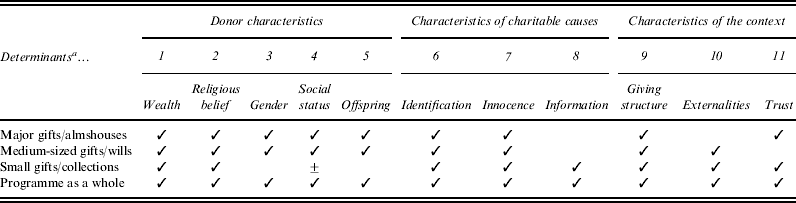
The decision to study those three scales of gift was taken not only to cover different types of donation, but also because the different sources give us insights into different aspects of giving. From the literature on charity, we have derived 11 determinants of giving, which are discussed more extensively below. To decide on some of them, for example, whether the absence of children led to larger donations, we need data on individual donors, such as can be determined as far as donations through wills are concerned. Whether, to present another example, information about the destitute played a role when deciding what, if anything, to give can be answered best from data on collections. In combination, the three types of donation studied in the three projects cover all determinants suggested in the literature, as is shown in Table 1.
Structure of the Giving in the Golden Age (GIGA) programme
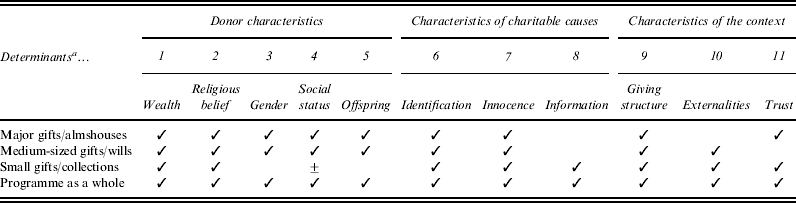
✓, Covered; ±, covered to a certain extent.
a The numbers refer to the discussion of the determinants in section 6.
5. THE SEPARATE ARTICLES AND THEIR CONTRIBUTIONS TO THIS ISSUE
5.1 Major gifts: almshouses
Our research into major gifts focuses on almshouses (hofjes). Almshouses offered accommodation to a number of elderly persons, some of whom were supported in other ways too. In the Netherlands, almshouses typically took the form of a number of small houses surrounding a courtyard, although they existed in other forms too. Hofjes granted their elderly inhabitants a considerable amount of privacy, compared with contemporary ‘hospitals’, where the elderly slept in communal dormitories and had no more private space than their bed, or a cubicle which could be closed off by a curtain.
Almshouses were the jewels in the crown of charitable giving. Foreigners marvelled at the number of such buildings for elderly men and women, and at the comfortable standard of living they provided compared with the situation in England, France or Germany, for instance. Almshouses offered a lasting boost to the status of their benefactors and benefactors' families, and were the subjects of notary transactions and regulation. Naming them could cause problems, but they also inspired works of art such as paintings and laudatory poems.
Generous as the benefactors were, they did impose conditions, such as on where the establishment was to be sited, for whom it was intended, what the residents were allowed to do – and what they were not allowed to do. Moreover, they decided on the names of the almshouses. We know a relatively large amount about almshouses, since they were public gifts enshrined in stone, meant to make a lasting impression both on earth and in heaven.
In this special issue Henk Looijesteijn reports on the almshouses, using a database containing information on 563 of them. The database lists the site of every known almshouse in the Northern Netherlands, the date of its foundation, its capacity, entry rules (some were, for example, restricted to retired Protestant sailors or Catholic widows aged older than 50 years), the name(s) of the benefactor(s), their social position and – if known – the size of their gift. In very many cases there is abundant additional historical information on the benefactors, including their social backgrounds and intentions, and the laudatory prose and verse read on the occasion of the founding of the almshouses.
Looijesteijn focuses on almshouses in Holland's largest industrial town, Leiden. He discusses religious and status motives for founding such highly visible institutions, but draws our attention to the fact that almshouses were also a way of providing for elderly people close to the founders, including their families, servants and more distant kin. Looijesteijn concludes that in Leiden after the Reformation almshouse founders did not belong to the patrician elite, but came from the social layer just below this, or belonged to the elite of denominations other than the Calvinist Church, whose faith excluded them from any position in the city government. Was the establishment of an almshouse a final attempt to attain elite status?
5.2 Medium-sized gifts: wills
Wills have been drawn up since as early as the Middle Ages and they have survived relatively well because of their legal importance. Quite a number of people made charitable bequests in their last wills. Of such benefactors, we know more than simply where they lived and when they died, for wills often provide information on religion, gender, marital status and whether benefactors had any relatives. Wills frequently inform us about individual wealth, health, occupation or, in the cases of married women, that of their husbands. Testators sometimes expounded on the reasons for their decisions to make, or not to make, bequests to particular individuals or good causes. There was every reason to do so: ‘the will is the written proof in which the pious dispositions through which one could insure against the risks of the afterlife were set down’.Footnote 16
In her article, Elise van Nederveen Meerkerk analyses wills containing information on a range of donors, from the modest to the significant. She has collected wills from three towns: Leiden, Utrecht and Zwolle. For each town 100 wills were selected at random from the archives of notaries (het notarieel) or judicial records (schepenbank), deposited in four benchmark years: 1600, 1670, 1740 and 1800. The resulting database of 1,200 wills provides us with our window on medium-sized gifts. Before analysing the wills, however, van Nederveen Meerkerk gives an overview of the different sources of income of the charitable institutions, and concludes that gifts through wills did matter, if not as much as collections. The share in total revenue declined between the last two benchmark years.
In the seventeenth century middle-income groups donated relatively large sums by way of their last wills, which van Nederveen Meerkerk explains as an effort by those classes to build up local communities. In the eighteenth century, as the Dutch economy stagnated, the share of donations through wills of the middle-income groups declined as that of the elite rose. By that time the number of possible recipients had increased: there were more charitable institutions as a consequence of denominational specialisation.
5.3 Small gifts: collections
Finally, we deal with anonymous and semi-anonymous small-scale giving through public collections and church offertories. The authorities organising collections had a number of policy decisions to make, which could influence the yields of collections. First, they had to decide on the frequency and method of collections other than those made during church services. Were they to be done door-to-door, by visiting the houses of all citizens or fellow believers? Were they to be with closed collection boxes, open boxes or lists of subscribers stating names and amounts given by benefactors? Or would fixed boxes be placed in the hope that people would give anonymously? How were the collections to be scheduled to maximise revenues?
For this special issue, collections have been studied by Daniëlle Teeuwen. She focused her research on collections in the seventeenth and eighteenth centuries in the towns of Delft, Utrecht, Zwolle and 's-Hertogenbosch. As mentioned above, 's-Hertogenbosch charities were exceptional in the sense that they were extremely well endowed with capital and thus less dependent on collections, a felicitous inheritance from a rich medieval era to a town which was stagnating economically. In most other towns, for most of the period studied here, collections were the largest individual source of income for charities, and to that end the authorities sought to maximise income, expecting and receiving contributions from all but the very poorest inhabitants. All were formally free to give or not, and most collections were anonymous, but collectors and neighbours, both in the pews and in the streets, must have had an impression of who gave and who did not, and doubtless those who systematically gave less than was expected of them were considered misers. Teeuwen shows that there was a great deal of habit involved in donating to collections. She notes regularity in the numbers and kinds of coins collected, and in the proceeds from different neighbourhoods, churches and social layers. That even the lower classes had coins to hand to give when it was expected of them points to the high degree of monetisation in Dutch seventeenth- and eighteenth-century society.
5.4 Synthesis for Amsterdam
When the final results of the investigation of large, medium-sized and small gifts become available, we shall be able to come to some overall conclusions about charitable giving in the Dutch Republic. Here, Marco van Leeuwen will offer a preview of such a synthesis by focusing on Amsterdam, the largest city in the Netherlands and the central hub of its financial and mercantile power. For Amsterdam, van Leeuwen studied almshouses, using the laudatory prose and verse he found to reveal implied motives for making donations, testamentary giving and collections. Combining the material allows us to provide answers to questions about the characters of the benefactors, their motives, the extent of their benefactions and responses to their beneficence and trust.
Apart from other considerations such as status, van Leeuwen's contribution, more than the other three essays, stresses the religious foundations of charitable giving and religion's role as stimulus to giving for all classes, from the richest to the poorest. The broad communal support for charity was one consequence of its firm roots in religion, and that of course was not limited to just one section of society. Donations were made primarily to charities which shared the religion and locality of the benefactor. The idea of earning a reward in heaven was expressed by Catholic, Reformed, Lutheran and Mennonite charities, and people who gave funds to set up almshouses had the same idea. Incidentally, van Leeuwen shows too the growth in the number of charitable institutions and the amount of money they received, and points to a problematic period at the end of the eighteenth century when, for the first time, charitable income fell well below the level of what was necessary to support the poor at the customary level.
6. DETERMINANTS OF GIVING
The historical and sociological literature on philanthropy suggests a range of determinants of giving behaviour, but those determinants are seldom compared systematically.Footnote 17 They can be subdivided into three groups: the characteristics of donors, the characteristics of the good cause and the characteristics of the social environment within which giving takes place.
6.1 Characteristics of donors
Regarding donors, the first determinant mentioned in the literature is wealth (number 1 in Table 1). Wealth, or at least a degree of wealth, is an obvious precondition of giving to charity. There were extremely large fortunes in the Netherlands during the Golden Age, and some of the ‘robber baron capitalists’ gave considerable sums to charity.Footnote 18 The examples quoted by Looijesteijn suggest that the capital needed to found a hofje amounted to anything from 10,000 to 50,000 guilders.Footnote 19 This was a considerable sum and even a cursory glance at one of the more magnificent of the almshouses still standing suggests that its founding did indeed involve a considerable fortune.
However, research on present-day giving behaviour shows that the lowest-income groups give most as a proportion of their income.Footnote 20 The efforts made by welfare institutions in the Dutch Golden Age to collect among broad segments of society indicate that things were no different then, and Teeuwen shows in various ways that all classes except perhaps the very poorest certainly contributed to collections. In Leiden the top rank of the urban elite, who monopolised local government, were involved in the administration of existing, older almshouses, but in the seventeenth and eighteenth centuries elites were not especially eager to found new ones. Van Leeuwen stresses that the whole social gamut was reached by charities, not only via elite giving in the forms of wills of large benefactions for almshouses, but also by many middle-class expressions of charity, and by gifts from the lower social classes, not only via collections, but on occasion even via a will. Van Nederveen Meerkerk shows that for a long time the middle classes bequeathed relatively more to charitable organisations, although that depended on a given town's economic structure. In relatively wealthier Utrecht, for example, the rich made larger bequests. Moreover, in the eighteenth century, when the economic downturn meant that the charities were more in need of support, the contributions by the rich rose, a process which van Nederveen Meerkerk dubs ‘elitisation’.
In the older literature, there was much speculation about the role of religious belief (number 2 in Table 1), and not without reason. Different Christian denominations held different views on the importance of charitable gifts. Salvation through ‘good works’ and the possibility that the living might be able to earn salvation for the deceased are Catholic doctrines, not Calvinist or Lutheran. Nonetheless, our research suggests that, in practice, there was actually little difference in the giving behaviour of Catholics and Protestants. Looijesteijn shows that when any almshouse was set up as a bedehouse, the inhabitants were expected to pray for the soul of the benefactor. From about the 1560s Protestants and Catholics alike in Leiden seem to have lost interest in the idea that the inhabitants of almshouses might pray for the benefactors, for stipulations of that nature disappear from the wills of almshouse founders. On the other hand, van Leeuwen, in his contribution on Amsterdam, gives examples of donors and charities well into the eighteenth century, including Protestant ones, who clearly still invoked heavenly interest as a motive for donations. Therefore it seems likely that societal trends or fashions were more influential than formal doctrinal distinction. Catholics, whose creed suggested that the prayers of the almshouse inhabitants would mediate for the founders' entrance to heaven, no longer asked for such prayers in a society where Protestant founders did not ask for it.Footnote 21 All denominations, however, suggested a heavenly motive behind donations, an idea that Protestant doctrines could accommodate only in a roundabout way, as discussed in the contribution by van Leeuwen.
In another way too, perhaps, the Reformation led not so much to different giving behaviour among the denominations, as to the establishment of a new giving structure. After the Reformation charities were taken out of the orbit of the Catholic Church and in many cases became the administrative responsibility of civic officials. Also, in the wake of the Reformation and the consequent confiscation of property that had formerly belonged to the Catholic Church, towns reorganised poor relief. However, city almoners who tried to collect funds were seen as too Calvinist to act as credible overseers of charity to beneficiaries from other denominations. It might also have been the case that a town such as Amsterdam was perceived as simply so rich that citizens saw no need to bequeath money to it, or, more likely, that individuals preferred to give to the poor of their own denominations. Equally decisive was the fact that as urban charities failed to raise enough money to meet the increasing demand for relief, town after town decided to ask each denomination to shoulder the burden of care for their own poor. Whereas after the Reformation Catholics were initially often formally prohibited from organising poor relief among themselves, in most towns from about 1650 they were urgently requested to establish their own organisations, to relieve the city's coffers. This led to a proliferation of charitable organisations based on religious denomination.
Gender (number 3 in Table 1) too was important. Again, some present-day studies suggest that women tend to give more to charity than do men.Footnote 22 Van Leeuwen shows that for Amsterdam, in comparison with men, more women bequeathed money to charities. During the Republic, women had fewer opportunities to play a public role, but it was acceptable for them to administer orphanages and old women's homes, and they could give financial support to the institutions they administered.Footnote 23 In 1780, for instance, Maria van der Graas left a considerable legacy to the orphanage of the Flemish and Waterland (Mennonite) community, of which she had been a regent.Footnote 24 Looijesteijn and van Leeuwen give the examples of Elisabeth van der Hiel and Johanna Blesen, who left 20,000 and 15,000 guilders, respectively, to orphanages, to the regents' boards to which they had belonged.
Social status (number 4 in Table 1) was another important determinant. On 15 May 1772 Maria Le Seutre died, the widow of the former mayor of Amsterdam, Cornelis Trip. The Amsterdam civil servant Jacob Bicker Raije noted in his diary that rumour had it that she had died because she believed – erroneously – that her grandchildren had been in the city theatre when it caught fire. He also noted that she ‘was a good God-fearing and very generous rich woman’, whose death was a loss to many destitute and poor people.Footnote 25 In other words, a well-informed citizen, even in a large town like Amsterdam, recognised a fellow citizen's private charitable behaviour. This highlights how public generosity added to the social status either of the donors themselves or of their families. Donating to charity was seen as a religious and civic duty, the bare fulfilling of which was necessary to protect one's social status; doing so liberally could enhance it. Van Leeuwen notes that in Amsterdam Lutheran and Sephardic Jewish donors appreciated that their organisations collected money using lists, so that the names of benefactors and the sums given were more or less public. Almshouses offered an excellent opportunity to leave one's mark as founder, from portraits inside the house to family coats of arms on public display at the gatehouse. Families proudly publicised their link to almshouse founders for centuries after their actual foundation, all of which shows how charitable activity could enhance their status, even up to the present.
The absence of offspring (number 5 in Table 1), or other close or beloved relatives as heirs, also played a role. Looking after one's own family was as much a duty as was giving to charity. In normal circumstances, surviving close kin would be the main heirs, even if some money were left to charity, but individuals without obvious heirs were in a position to give to charitable causes without risking the neglect of their duties to their families. Van Nederveen Meerkerk has shown that testators with no surviving issue left to charity in greater numbers than those with surviving heirs,Footnote 26 while Looijesteijn notes that of 36 Leiden almshouse founders only 6 had healthy children. Van Leeuwen adds that leaving money to charities was a way of keeping it out of the hands of family members whose conduct the testator found disagreeable.
6.2 Characteristics of good causes
When it comes to characteristics of good causes, the determinants include the scope for identification with those affected (number 6 in Table 1), based on a sense of empathy or shared fate. Both symbolic distance and actual distance seem to play a role in that, as people tended to give more to neighbouring co-religionists than to co-religionists elsewhere, and even less to others, whether, for example, foreign co-religionists, or non-co-religionists.Footnote 27
We have already seen that the different religious denominations looked after their own poor. Van Nederveen Meerkerk shows that when this happened in Leiden, Utrecht and Zwolle, the mean donations increased, which suggests that donors were more generous to co-religionists than to fellow inhabitants in general. Teeuwen points out that in Catholic ‘s-Hertogenbosch, after a Catholic orphanage had been founded in 1779 collections for the Catholic orphanage brought in more money than those for the civic one.
In general, those nearest home were thought of first, both in wills and in donations by the living. This principle is clearly discernible in the admittance rules for almshouses, for instance, which often specified that family members and servants of the founders were to take precedence for places, thus extending the social obligations of the founders after their deaths. Looijesteijn shows that this was no dead letter: the regents of the Stevenshofje admitted a kinsman of the founder in 1783, almost three centuries after its foundation in 1487. A charity might even receive a donation intended for the care of a specific relative. Van Nederveen Meerkerk shows that another way of rewarding neighbourliness was by making a legacy to the orphanage where one had lived as a child, or to charities in the town where one had grown up.
A further determinant was the degree of the perceived ‘innocence’ (number 7 in Table 1) of the victims and thus their worthiness to receive charity. The elderly and children were regarded almost by definition as innocent, while the situation was somewhat more complicated when it applied to the sick and unemployed. The latter had to be ‘really’ ill, or to have become unemployed without having caused their condition through their own reprehensible behaviour. Teeuwen mentions as a case in point the collections for poor prisoners in ‘s-Hertogenbosch, which yielded almost nothing because the prisoners were not regarded as ‘deserving’. In normal circumstances, too, healthy adults were expected to be able to provide for themselves and their families.Footnote 28
Van Nederveen Meerkerk and Van Leeuwen note that the question is connected with the previous one: believers thought their co-religionists more deserving of relief than those who adhered to other faiths. They also quote testators who referred to the righteousness of the poor to whom they were leaving money, or who made righteousness a condition of their bequest. Poor relief administrators went to considerable lengths to establish that the poor they supported were indeed deserving, visiting them at their homes and checking on possible other sources of income.Footnote 29
Linked to this is the next determinant: information about destitution (number 8 in Table 1). Donors preferred to have guarantees that the receivers of charity really were in need. Since people lived in close proximity to each another and information was intensively disseminated, gathering information about the needs of charity recipients was quite feasible in the Republic.Footnote 30 As a factor in the willingness of the Dutch urban middle classes to contribute to poor relief, their physical proximity to the poor made the former more aware of the latter's plight. But information about distress further away was also available. Teeuwen gives examples of collections in Delft to support victims of fires in Asperen or Giessendam, both about 70 kilometres away. When collections were held for causes further away, ample information was distributed beforehand. Archangelsk or Philadelphia were not too far from Amsterdam for collections to be held for the building of churches there, nor were Syria or Lithuania too far away for the Christians there to be supported – at least in the first half of the eighteenth century. However, with the downturn in the economy after 1760 collection revenues fell and charitable causes became less religious, more Dutch and closer to home.Footnote 31
6.3 Characteristics of the context
For the social environment, one determinant is the giving structure (number 9 in Table 1), by which we mean here the scope for giving – for example during church collections – and for exerting moral pressure to encourage giving. Modern sociological research shows that religion is an important factor not so much because of its intrinsic motivation to philanthropic giving as because during and after church services churchgoers are put under pressure to give.Footnote 32 Believers not attending church give much less, and this was clearly a factor in the Dutch Republic. Teeuwen points out that people were accustomed to giving set amounts of coins to specific collections, but that the particular officiating minister had a huge influence on the funds collected, which in turn implies that popular ministers drew larger congregations, who then acted as a larger catchment for the collections. Other elements such as collecting in many places or using open plates also increased the amount received, but Teeuwen's research suggests that such tactics had their limitations. It seems that combining the most lucrative elements of a giving structure all the time involved the risk of those elements losing their effect. Another example of a favourable giving structure is offered by the town of Zwolle, where wills were registered by the aldermen, which, as van Nederveen Meerkerk shows, probably resulted in the higher percentage of charitable bequests to the city poor there than was seen in Utrecht and Leiden, where wills were drawn up by private notaries.
Another determinant consists of externalities (number 10 in Table 1); that is, the dangers of the consequences of not giving, for example, the problems generated by beggars or social unrest. It is likely that people gave more where there were many beggars and in times of greater unrest. Van Nederveen Meerkerk invokes this as one of the reasons for specifically middle-class groups to contribute to charitable causes in the seventeenth century; their shops were highly vulnerable to looting. Eighteenth-century elites too had good reasons to fear the mob. Between 1695 and 1795, in the province of Holland, apart from a number of religiously and politically motivated disturbances, 23 food riots and 55 tax revolts took place, with a concentration in the 1740s. In a food riot, shops and market stalls might have been at risk, but in a full-scale tax riot tax farmers and the regents who governed Dutch towns and institutions could expect to see their houses looted.Footnote 33 Contemporaries saw a clear connection between high prices and rioting, and may well have feared that the urban crowd would turn to looting if the level of poor relief declined below what was considered their established right.Footnote 34
Our last determinant is trust (number 11 in Table 1) that the money would be used wisely. Present-day research shows that more is collected when philanthropic organisations are known and have a good reputation that they would be reluctant to lose. Charities that do not spend their revenues on good causes, but build large reserves or use a large share of the donations to finance their organisations, lose credibility, and it is likely that in the past the same thing was a factor.Footnote 35 Teeuwen and van Leeuwen give examples of how city authorities supervised private charities and audited their accounts, thus increasing trust in the way the charity was administered. The supervision was made visible when officials took up the collection duties. Testators who founded almshouses could decide for themselves how and by whom their foundation should be administered.
As these examples illustrate, the historical record allows for a social scientific approach to the history of philanthropy. It is possible to test the most common hypotheses on the determinants of charitable giving with the historical information about large, medium-sized and small gifts in the Dutch Republic. Anonymous collections might tell us little about the individual characteristics of donors, but they are serial events, and inform us about the influence of economic prosperity, of external threats or the influence on giving of ministers and their sermons. Wills too, as van Nederveen Meerkerk shows here, can be analysed as a serial source. Information on donors is much richer when we look at wills or the foundation of almshouses, which in many cases involved a will. Taking these three types of giving together and looking at the variety of source material, we can study the full gamut of charitable donations. Table 1 presents a global overview of the determinants mentioned above, indicates which of them we studied by looking at small, medium-sized or large gifts and demonstrates that all are covered by the combination.
7. CONCLUSION
Charitable giving during the time of the Republic was considerable, long term and remarkably well organised. The four articles in this special issue show the importance of private and voluntary giving in a period before the existence of the welfare state. The fact that the Dutch Republic in its time was a highly urbanised and strongly monetised society, in which a large proportion of the population depended on wage income, provides a highly relevant context for its charitable culture. As we made clear above, many determinants that researchers find decisive for present-day charity, or for past charity elsewhere, were similarly relevant in the Dutch Republic. Wealth, religion, gender, social status, offspring, identification, innocence, information, giving structure, externalities and trust all mattered.
The four articles also offer other, overarching insights. Van Leeuwen, Teeuwen and van Nederveen Meerkerk address the important role of middle-class groups in charitable giving.Footnote 36 Teeuwen shows how almost all social groups contributed to collections. In their different ways, all four papers also point to the role of charity in strengthening community ties.Footnote 37 For the early modern Dutch, charity began at home, but when their families had been looked after, Dutch citizens keenly realised that they belonged to religious, civic and national communities, and they were willing to share their wealth, small or large, with other members of those communities, or even with those born elsewhere.Footnote 38 Their beneficence even outlasted their own lives and times, for some of the charities to which they gave in the Golden Age, discussed in this special issue, are still in existence today and continue to dispense significant sums to philanthropic causes.Footnote 39 They continue to shore up the civic community in the way their founders envisaged.
ACKNOWLEDGEMENTS
The research programme ‘Giving in the Golden Age’ is financed by the Netherlands Organisation for Scientific Research (NWO) and runs from 2008 to 2013. We thank our fellow project members and two anonymous referees for comments on an earlier version of this introduction. We are also grateful to the audiences at our sessions on the 34th Social Science History Association (SSHA) Annual Conference at Long Beach, California, in 2009 and at the European Social Science History Conference (ESSHC) in Ghent, Belgium, in 2010, as well as to the discussants at these sessions: Thomas M. Adams, Larry Frohman, Julie Marfany, Anne McCants, Nada Moumtaz and Joanna Handlin Smith. We would also like to thank Chris Gordon, who edited this introduction. All remaining errors are ours.