After Barack Obama’s election as President of the United States, incoming chief of staff Rahm Emanuel remarked: “You never want a serious crisis to go to waste… This [economic] crisis provides the opportunity for us to do things that you could not do before.”Footnote 1 Emanuel’s comments indicated a belief that the public would support measures during a deepening recession that would be less palatable in more normal times. More broadly, Emanuel’s remarks describe a malleable public willing to revise its beliefs when the context calls for it.
When and to what extent do major crises and events induce political attitude change? Carmines and Stimson (Reference Carmines and Stimson1989, 160) theorize that mass popular opinion on an issue may be transformed by “critical moments” which “[set] the stage for an evolutionary change that follows.” Kingdon (Reference Kingdon1995) uses similar language to describe how “focusing events” provide opportunities for policy changes that may not otherwise exist. Crises or disasters “call attention to a problem” (Carmines and Stimson Reference Carmines and Stimson1989, 95), leading citizens to attach powerful symbols to these events and personalize their consequences. The salience of these events coupled with the problems they highlight set into motion the conditions for attitude change (Zaller Reference Zaller1992). Given changes in public opinion attributable to influences such as framing and priming (e.g., Chong and Druckman Reference Chong and Druckman2007), and events that are somewhat less salient, such as Supreme Court rulings (e.g., Christenson and Glick Reference Christenson and Glick2015), it would be surprising if critical moments did not affect public opinion. Indeed, such events have been credited with producing attitude change across a range of domains, including foreign policy (Mueller Reference Mueller1973), civil liberties (Davis and Silver Reference Davis and Silver2004), gay rights (Brewer Reference Brewer2003), and climate change (Krosnick et al. Reference Krosnick, Holbrook, Lowe and Visser2006).
In this paper, we study attitude change toward gun control in response to the mass shooting at Sandy Hook Elementary School in Newtown, Connecticut, which generated international attention and renewed public calls for more restrictive gun control measures. Few events in the United States in recent years have attracted greater national and international media coverage than mass shootings in places including Virginia Tech, Fort Hood (Texas), Aurora (Colorado), San Bernandino (California), Orlando (Florida), Las Vegas (Nevada), and Parkland (Florida). Using data from a nationally representative panel survey of US adults, our results are mostly null. Across both cross-sectional and within-subject analyses, we find no evidence that Americans granted greater support for gun control after the Sandy Hook shooting. These results persist across a range of political and demographic groups. We also find no evidence of attitude polarization as a result of Sandy Hook. Our results suggest that elite polarization in a particular issue area leads citizens to employ motivated reasoning when interpreting critical events. Under these conditions, preexisting attitudes are reinforced, thereby reducing the capacity for attitude change. Our findings further suggest important limits to the potential for major events to reshape public support for public policies.
CRITICAL EVENTS AND ATTITUDE CHANGE
While prominent theories of public opinion posit that arbitrary and conflicting attitudes contribute to high levels of opinion instability (e.g., Converse Reference Converse1964; Zaller Reference Zaller1992), other research has long suggested that macro- and micro-level changes in opinion are systematically connected to major political events (Page and Shapiro Reference Page and Shapiro1992; Erikson, MacKuen and Stimson Reference Erikson, Michael and Stimson2002). Major events may lead citizens to update their opinions based on their proximity to the event or through interpretations provided by political elites and through mass media (Page and Shapiro Reference Page and Shapiro1992, 321). Political elites and the media contextualize and frame events to provide a sense of the need for potential policy changes. Citizens receive these messages and decide whether to update their attitudes. Attitude change in response to major events is not guaranteed, however. Political predispositions can influence how citizens respond to major events (e.g., Feldman and Conover Reference Feldman and Conover1983). For instance, whatever new information an individual encounters through an event, she could respond by rationalizing the consequences through her partisanship so as to reaffirm her predispositions about the relevant issue. Thus, major events may not necessarily reshape attitudes toward relevant policies, but instead could strengthen them in line with preexisting positions.
We argue that attitude change following critical events depends upon the degree of elite conflict in the relevant policy domain. Elite polarization increases citizens’ use of motivated reasoning (Druckman, Peterson and Slothuus Reference Druckman, Peterson and Slothuus2013), which structures how individuals perceive critical events and affects their willingness to revisit their preexisting attitudes. Elite conflict produces competing frames in how individuals attribute or explain major events, and motivated reasoning leads citizens to choose a frame that is consistent with their partisan and ideological beliefs. Thus, critical events may be unlikely to produce opinion change involving issues on which there is high elite polarization.
We study attitude change in response to the December 14, 2012 mass shooting at Sandy Hook Elementary School in Newtown, Connecticut. One gunman killed 27 victims, 20 of whom were students. Mass shootings may serve as focusing events for American public opinion. School shootings receive especially high levels of media coverage and public visibility, and the everyday context of the shooting enables citizens to relate to the event and form an opinion on the relevant policy issue.Footnote 2 Existing scholarship provides little direct evidence of individual-level attitude change in response to the events, due largely to the absence of data that allow researchers to compare post-event attitudes with those provided before the event. In the context of mass shootings, previous research documents strong support for gun control after shootings (Barry et al. Reference Barry, McGinty, Vernick and Webster2013) and shows that views on gun control respond to media frames (Haider-Markel and Joslyn Reference Haider-Markel and Joslyn2001), but does not directly investigate attitude change.
DATA
We examine the effect of the Sandy Hook shooting on attitudes toward gun control using data collected as part of The American Panel Survey (TAPS), a monthly panel survey completed online from a national probability sample of approximately 2000 US adults.Footnote 3 We measure attitudes toward gun control with responses to the question: “Federal law should ban the possession of handguns except by law enforcement personnel,” which closely matches an item asked by Gallup since at least 1959.Footnote 4 Though this question may not be ideal in the context of Sandy Hook, it has the virtue of being asked in both December 2012 and January 2013 and is highly correlated with related questions asked on later TAPS surveys, including whether respondents supported bans on semi-automatic weapons (r=0.62).Footnote 5 Responses were provided along a five-point scale, ranging from “strongly disagree” (1) to “strongly agree” (5).
We conduct two sets of analyses. First, in cross-sectional analyses we leverage variation in the date on which TAPS panelists completed the December 2012 wave of the survey. The survey is fielded at the beginning of the month and panelists answer the survey questions at a time of their choosing. We distinguished respondents who answered the gun control question prior to Sandy Hook from those who answered the question later in the month. Approximately 1700 panelists completed the December 2012 wave of the survey, with 64.6 percent of respondents answering the survey before Sandy Hook and the remaining 35.4 percent answering the survey after Sandy Hook. If Sandy Hook increased support for gun control, we expect to observe higher levels of agreement with the survey question among respondents who completed the survey after the shooting. This cross-sectional comparison provides leverage for us to answer this question to the extent that the timing of respondents’ survey completion is plausibly random.
Second, we use repeated measures of respondents’ answers to the gun control question. Our within-respondent analysis focused on the 1066 individuals who completed the December 2012 wave prior to Sandy Hook and also completed the January 2013 survey. The panel analysis allows us to hold constant attributes of respondents (observed or otherwise) that are associated with increased propensity to support gun control measures.
In addition to comparing aggregate opinion change in response to the Sandy Hook shooting, we consider how the shooting’s effects vary across a range of individual characteristics. Thus, we also evaluated attitude change among politically and demographically relevant groups based on partisanship, ideology, sex, parenthood, geographic proximity to Newtown, and membership in the National Rifle Association (NRA).Footnote 6
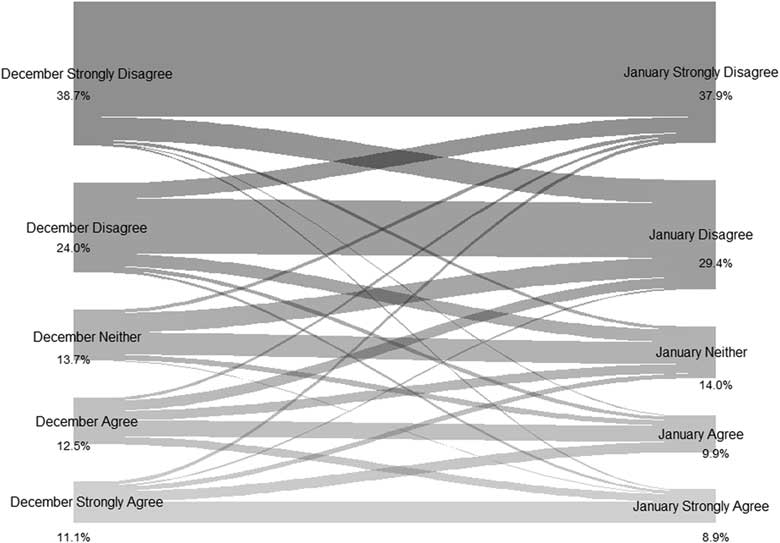
As mentioned above, our data allow us examine opinion change at both the aggregate and individual levels. Figure 1 offers a preliminary investigation of how Sandy Hook may have affected aggregate gun control attitudes and displays the distribution of support for gun control in December 2012 and January 2013 among those panelists who completed the December survey before the Sandy Hook shooting occurred. The thickness of the lines is proportional to the percentages of respondents that used each response category in each wave of the study. Figure 1 shows three main findings. First, in the aggregate, attitudes toward gun control are fairly consistent across the two waves of the survey, with relatively low support for our gun control measure. Second, all the “ribbons” are fairly thin, which indicates that a relatively small percentage of respondents reported changes in gun control attitudes between December and January. To the extent any attitude change is observed, it occurs between one response category and the next (e.g., from “strongly disagree” to “disagree”) which could reflect measurement error rather than qualitative changes in underlying support for gun control. And third, among those individuals who do report attitude change, it does not occur in a systematic direction as we might expect if the Sandy Hook shooting produced an aggregate swell in support for gun control measures. Overall, therefore, the raw data provide little evidence that the shooting affected attitudes toward gun control.
Changes in support for gun control, December 2012 to January 2013 Note: Plots show changes in attitudes toward gun control among respondents who completed the survey before the Sandy Hook shooting on December 14, 2012 and also responded to the gun control question on the January 2013 wave of the survey. The width of each block is proportional to the percentage of respondents providing that response.

RESULTS
We performed our main analyses by comparing the proportions of respondents who supported gun control before and after the Sandy Hook shooting using our cross-sectional and within-respondent approaches.Footnote 7 For simplicity, we report results when collapsing the five-point response variable to distinguish respondents who “strongly” or “somewhat” agreed with banning handguns from those who disagreed or chose the middle (neutral) response option, but note that we find identical patterns of results when using the full five-point scale.
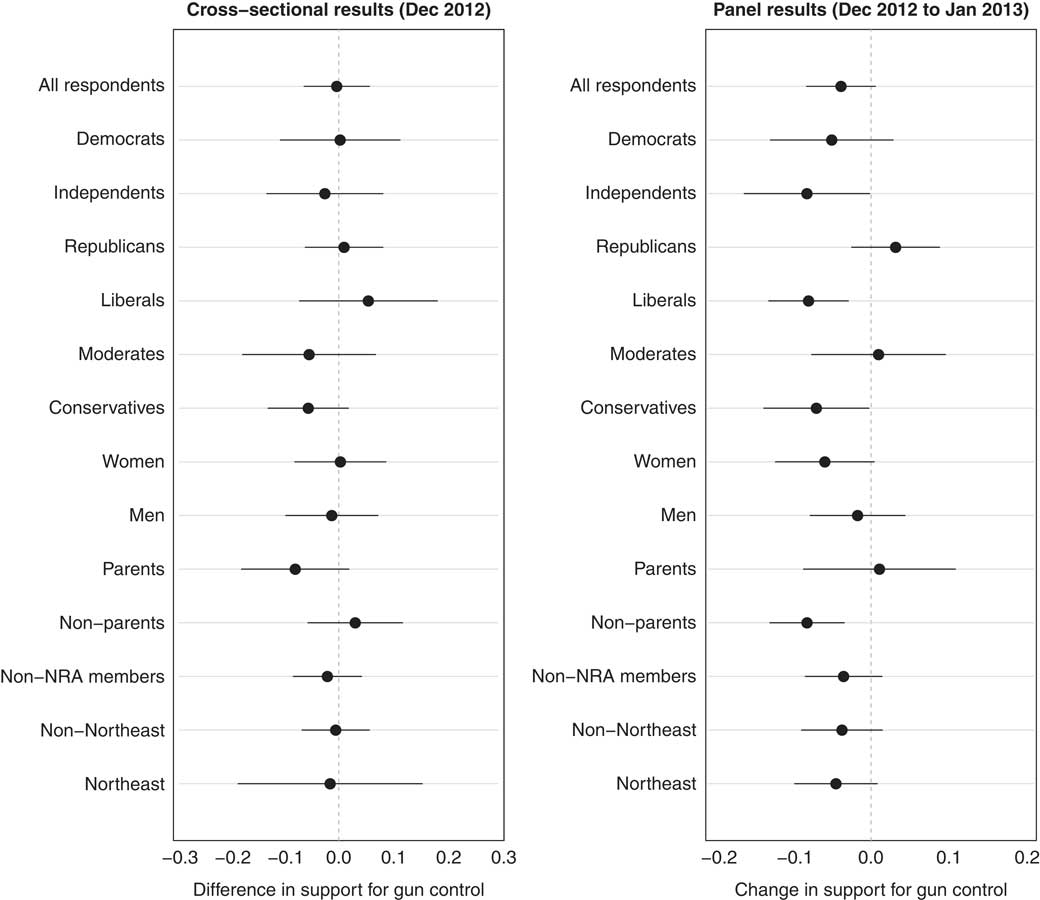
Our primary results are displayed in Figure 2. The plot on the left shows the differences in the proportion of respondents who supported gun control measures based on whether they completed the December 2012 survey before or after Sandy Hook. Positive (negative) values along the x-axis indicate increased (decreased) support for gun control among respondents who answered after the Sandy Hook shooting. The horizontal lines are the 95 percent confidence intervals and the dashed line at zero represents the null hypothesis of no opinion change.
The effect of Sandy Hook on support for gun control Note: Plots show the differences in the proportions of respondents who supported gun control before and after the Sandy Hook shooting on December 14, 2012. Positive (negative) values indicate increased (decreased) support for gun control after Sandy Hook. The left plot shows between-respondent differences based on whether respondents answered the December 2012 survey before or after the shooting. The right plot shows within-respondent differences using respondents who answered the December survey prior to the shooting. The horizontal lines are the 95 percent confidence intervals and the dashed vertical line indicates the null hypothesis of no difference in support.

We find little evidence that the Sandy Hook shooting was associated with increased support for gun control: 22.0 percent of respondents who completed the survey prior to December 14 and 21.6 percent respondents who answered the survey later in the month supported a handgun ban. The plotted point at the top of the left panel indicates the difference (0.4 percentage points with a standard error of 3.3) between these levels of support. Among respondents who completed the survey after Sandy Hook, support for a handgun ban was somewhat higher among liberals, women, and respondents without children, and was somewhat lower among moderates, conservatives, men, and parents. None of these differences, however, is statistically or substantively significant.
We also find little evidence that Sandy Hook increased support for gun control when examining within-respondent changes from December 2012 to January 2013, as the right plot in Figure 2 shows. Overall support for gun control among this sample decreased from 21.9 percent prior to Sandy Hook in December 2012 to 18.0 percent in January 2013. Support increased modestly among Republicans but the difference is not statistically significant. Interestingly, support for gun control significantly decreased among Independents, liberals, conservatives, and respondents without children.
Across both cross-sectional and panel analyses, we uncover no evidence that the Sandy Hook shooting increased Americans’ support for restrictive gun control measures. These largely null effects persist across partisan, ideology, and demographic groups, some of whom may have been more likely to undergo attitude change in response to the tragedy. To the extent our analyses identify any statistically significant patterns, moreover, we find that support for gun control decreased in the aftermath of the shooting.
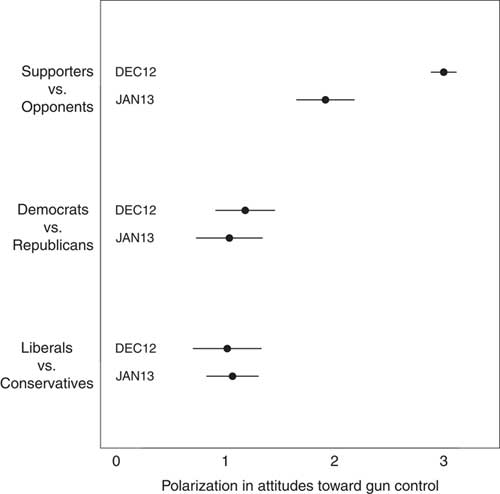
We further explore whether attitudes toward gun control polarized after Sandy Hook. The comparisons shown at the top of each plot in Figure 2 show little aggregate change in gun control attitudes but could obscure individual-level change, particularly if attitudes among individuals who already supported (opposed) gun control became more strongly in favor of (opposition to) gun control after Sandy Hook. We evaluated attitudinal polarization by making use of the full five-point response scale to our gun control question. We include the respondents who participated in the December survey prior to Sandy Hook and also completed the January 2013 survey and study attitudes among three groups of individuals: respondents who initially supported or opposed gun control (and thus did not choose the middle response option), identified as Democrats or Republicans in December, and identified as liberals or conservatives in December. For each of these three groups, we compare the absolute differences in mean placement on the five-point scale. If events such as Sandy Hook produce attitudinal polarization, we would expect to observe larger mean differences in attitudes after Sandy Hook.
The results are displayed in Figure 3. The plotted points show the differences in means for each pair of subgroups along the five-point scale. The horizontal lines are the 95 percent confidence intervals of the differences. The top set of results compares polarization among gun control supporters and opponents in the December wave of the survey. The difference in means between supporters and opponents of gun control in December was 3.1 points, while the difference in means in January between respondents who had supported and opposed gun control in the December wave of the survey was 2.0 points. Far from producing attitudinal polarization, this comparison reveals substantially less polarization in attitudes after the Sandy Hook shooting among respondents who had previously supported or opposed gun control. The plot also displays differences in mean placements between Democrats and Republicans, and liberals and conservatives. The differences were virtually identical in both the December and January waves of the survey and are not statistically distinguishable. Democrats and Republicans reported about the same level of disagreement in attitudes toward gun control in January as they did in December, and the same is true for differences in support for gun control between self-identified liberals and conservatives in December and January. The results shown in Figure 3 thus provide no evidence that gun control attitudes polarized after Sandy Hook, and attitudinal polarization does not provide a compelling explanation for the null results documented above.
Sandy Hook and attitudinal polarization Note: Plots show the differences in mean attitudes along the five-point scale for each of the comparisons shown along the y-axis, and larger values along the x-axis indicate greater differences in mean placements. DEC12 indicates polarization levels before Sandy Hook and JAN13 indicates polarization levels after Sandy Hook. The horizontal lines are the 95 percent confidence intervals of the mean differences.

CONCLUSION
On January 16, 2013, President Obama and Vice President Biden announced a series of executive actions on gun control. Biden described a shifting landscape of public opinion on this issue: “I also have never seen the nation’s conscience so shaken by what happened at Sandy Hook. The world has changed, and it’s demanding action.”Footnote 8 In Biden’s telling, public opinion had demanded increased restrictions on gun ownership in response to the Sandy Hook tragedy.
Using the strongest possible research design possible short of random assignment, our results suggest that, in contrast to the hopes of Obama and Biden, the Sandy Hook shooting had little effect on public support for gun control. To be sure, we believe Americans were deeply sympathetic to the victims and their families. But not only do we find no aggregate effects, we also find no evidence among subgroups that may be expected to experience especially large attitude changes in response to such events. We further find no evidence of attitudinal polarization after Sandy Hook. Instead, American public opinion on gun control appears to be deeply entrenched.
The findings shown here indicate that not all major events are created equally nor do they all have the same predictable impact on public opinion. Instead, as our argument suggested, major events may not lead to significant changes in public opinion when political elites are highly polarized on the relevant issue area. These conditions would appear to characterize gun control, a publicly salient issue in recent decades and on which Democratic and Republican elites have clearly distinct positions.Footnote 9 Under these circumstances, processes of motivated reasoning may cement public opinion in response to major events, no matter how personally compelling. If the victimization of more than 20 children and their teachers by mass gun violence does not produce attitude change on gun control, other instances of mass shootings may similarly fail to do so. As this article goes to press, however, students from Marjory Stoneman Douglas High School in Parkland, Florida have managed to capture the nation’s attention after 17 of their classmates and teachers were shot and killed in February 2018. It remains to be seen whether their activism will generate sustained public mobilization in support for gun reform, but further points to the importance of identifying the conditions under which significant events reshape public opinion and the possibilities for policy change.