INTRODUCTION
Deep brain stimulation (DBS) of the subthalamic nucleus (STN) and globus pallidus internus (GPi) is an effective treatment for the motor symptoms of idiopathic Parkinson's disease (Koller et al., 1999; Krack et al., 2003; Kumar et al., 1998; Limousin et al., 1998; Pahwa et al., 1997). Questions remain about the effects of DBS on neuropsychological functioning and differences in motor and neurobehavioral outcomes related to surgical target. Most research on the neuropsychological effects of DBS has focused on bilateral treatment at the STN target and has generally suggested mild decrements following treatment (Alegret et al., 2001; Burchiel et al., 1999; Dujardin et al., 2001; Funkiewiez et al., 2004; Gironell et al., 2003; Gomez et al., 2003; Krack et al., 2003; Limousin et al., 1998; Lopiano et al., 2001; Moretti et al., 2003; Morrison et al., 2004, Perozzo et al., 2001; Saint-Cyr et al., 2000; Woods et al., 2002); see also reviews by Woods et al. (2002), Rodriguez-Oroz et al. (2005), and Temel et al., (2005), most notably a decrease in verbal associative fluency (Alegret et al., 2001; Ardouin et al., 1999; Saint-Cyr et al., 2000; Trepanier et al., 2000). Declines in working memory and mental flexibility have also been reported. Some studies have identified small improvements (Ardouin et al., 1999; Jahanshahi et al., 2000). The few available studies of GPi DBS likewise suggest only minimal neurocognitive decline (Fields et al., 1999; Volkmann et al., 2001). Similar to the findings after STN treatment, performance on measures of verbal fluency declines most consistently (reviewed by (Rodriguez-Oroz et al., 2005). Reductions in self-ratings of depression have also been observed by many investigators after DBS (Alegret et al., 2001; Ardouin et al., 1999; Burchiel et al., 1999; Gomez et al., 2003; Pillon et al., 2000; Saint-Cyr et al., 2000; Volkmann et al., 2001).
Factors hypothesized to account for neuropsychological declines after DBS include cortical or subcortical microtrauma resulting from surgery (Pillon et al., 2000; Saint-Cyr et al., 2000), disruption or enhancement of fronto-striatal neuronal activation secondary to the DBS (Jahanshahi et al., 2000), and changes in level of neuronal activation secondary to the reduced dopaminergic treatment that frequently occurs after surgery (Funkiewiez et al., 2004). Other variables that have been considered to contribute to greater adverse neuropsychological outcome after DBS include advanced age and lower levels of cognitive reserve at baseline (Hariz et al., 2000; Morrison et al., 2000; Trepanier et al., 2000; Vingerhoets et al., 1999).
STN versus GPi
Few studies have directly compared neuropsychological outcomes of STN versus GPi DBS. Trepanier (Trepanier et al., 2000) examined neuropsychological outcomes following bilateral DBS of either the GPi or the STN. Small sample sizes precluded direct statistical comparison of outcomes after the surgery at the two brain targets. Pillon (Pillon et al., 2000) found no difference when contrasting the effects of the two DBS targets after 3 and 12 months, with the exception of the Initiation/Perseveration subtest of the Mattis Dementia Rating scale (DRS; (Mattis, 2001), on which participants in the GPi, but not the STN group, showed improvement following surgery. Burchiel et al. (Burchiel et al., 1999) reported no post-operative changes on neuropsychological testing, nor any differences as a function of surgical target in 10 patients randomized to either STN or GPi DBS and higher rates of adverse events involving cognitive decline after STN have been found in several studies (Anderson et al., 2005; Rodriguez-Oroz et al., 2005; Volkmann et al., 2001), and some have hypothesized that that smaller size of the STN makes activation of non-motor regions within or adjacent to the nucleus more likely in DBS, which may contribute to these more frequent complications (Walter & Vitek, 2004).
Unilateral versus Bilateral DBS
Although some research suggests unilateral DBS can provide solid clinical benefit and could be a better tolerated intervention for some patients (Germano et al., 2004; Linazasoro et al., 2003), few studies have reported neuropsychological data following unilateral DBS surgery, and none have specifically focused on neuropsychological outcome of unilateral STN DBS. Troster et al. (Troster et al., 1997) reported minor decrements in verbal fluency three months after unilateral GPi DBS surgery that did not attain statistical significance. Other studies have also failed to find significant change in neuropsychological test performance one to three months after unilateral GPi DBS (Merello et al., 1999) One study (Fields et al., 1999) found improvement on several measures of memory and executive functioning in 6 patients undergoing unilateral GPi DBS as part of a staged bilateral surgery protocol. Declines in verbal associative fluency were noted in the majority of cases. The authors concluded that there was little evidence that bilateral DBS in the GPi represents greater risk than unilateral stimulation.
Because most of studies have focused on outcomes after bilateral DBS, questions also remain concerning differences between left- and right-sided treatment. Research suggests that left-sided pallidotomy may have greater adverse effect on language-mediated functions (Obwegeser et al., 2000; Trepanier et al., 1998; Troster et al., 2003). The possibility of similar lateralization effects in DBS remains to be explored. One study noted that 6 of 13 patients that had undergone unilateral left-sided GPi DBS surgery showed trends in the direction of cognitive decline, whereas none of the seven patients who had right-sided treatment showed a decline (Vingerhoets et al., 1999). In another early investigation of effects of unilateral and bilateral DBS at the GPi (Fields et al., 1999), five of six patients first underwent left sided treatment, and four showed decline in semantic fluency. In contrast, only one patient showed evidence of a further decline after the second, contralateral surgery.
Study Aims
The purpose of this study is to compare the neuropychological functioning of PD patients after unilateral and subsequent contralateral STN or GPi DBS surgery. Objectives of the study included (a) evaluation of the potential adverse impact of DBS on working memory, processing speed, verbal fluency, and executive functioning; (b) direct comparison of neuropsychological outcomes following GPi versus STN DBS; and (c) evaluation of potential additive effects of unilateral versus bilateral DBS. We hypothesized that patients would display small reductions in verbal associative fluency and other aspects of working memory, processing speed, learning efficiency, and executive function after DBS. We further hypothesized that the reductions in verbal associative fluency would be greater for left-sided DBS. Finally, we also hypothesized that older participants and those showing higher baseline frontal-executive functioning would show smaller reductions in cognitive functioning after DBS.
METHODS
Participants
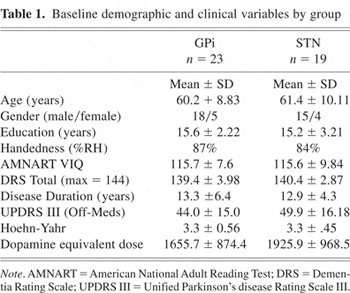
Forty-two (33 male, 9 female) individuals with a clinical diagnosis of PD participated in the first phase of the study. Eligible patients had levodopa-responsive idiopathic PD producing disabling motor symptoms despite optimized pharmacotherapy. Other inclusion criteria included stable anti-parkinsonian medication for at least one month prior to enrollment, moderate level of disability defined as Hoehn-Yahr Stage 3 or 4 and supported by Unified Parkinson's Disease Rating Scale III (UPDRS) Motor Scale rating, no significant brain atrophy on brain MRI or CT, and no major psychiatric disorder or dementia that would interfere with their ability to comply with follow-up for stimulator programming and assessment. Mattis DRS (Mattis, 2001) was used to assess for more prominent neurocognitive deficits suggestive of dementia. Demographic and clinical data are presented in Table 1. Mean age of study participants was 60.7 years (SD = 9.33, range 46–80). DRS Total score ranged from 130–144 (the maximum) correct. Thirty-five of the patients were right-handed, three were left-handed, three reported being ambidextrous, and the handedness of one patient was unknown. Mean years of education was 15.39 (SD = 2.75, range 8–20). All patients were identified as having severe and disabling PD. Within each DBS target group 74% of the patients were in Hoehn-Yahr stage 3. UPDRS-III assessments were performed both off and on medication before and after surgery. UPDRS-III off-medication scores at baseline ranged from 18 to 90 (mean = 46.7, SD = 15.62 for the combined sample).
Baseline demographic and clinical variables by group

Participants came from two affiliated medical centers, the San Francisco Veterans Affairs Medical Center (SFVAMC) and the University of California, San Francisco (UCSF) Medical Center. Participants from the two study sites were comparable in age, but those from UCSF were more educated [t (39) = 2.23, p = 0.032], displayed slightly higher estimated baseline verbal intellectual ability as assessed using the American National Adult Reading Test (AMNART; Grober & Sliwinski, 1991; [t (35) = 2.15, p = 0.039]), and had lower baseline Hoehn-Yahr scores [t (40) = −2.25, p = 0.030] and off-medication UPDRS-III scores [t (40) = −4.50, p < 0.001]. Differences in other domains of baseline neuropsychological performance did not reach statistical significance.
Participants were randomized to receive DBS lead implantation into either the GPi (n = 23) or STN (n = 19). The decision about side of initial treatment was determined by clinical findings of lateralized symptom severity and manual dominance. Patients with significant asymmetry of motor signs received their first DBS lead implant contralateral to the most affected side of the body, whereas those without such asymmetry or with severe motor impairment bilaterally had the first DBS lead implanted opposite their dominant hand. Using these criteria, left-sided DBS implant was chosen as the initial target for 14 (61%) of those randomized to the GPi, and 13 (68%) of those randomized to the STN target. No statistically significant differences were noted in baseline clinical or demographic or neuropsychological measures between participants assigned to GPi versus STN, DBS, or those assigned to receive initial treatment to the left versus right side.
All patients in the study were on levodopa therapy. Sixteen were also taking pramipexole (8 STN, 8 GPi), and 13 pergolide (5 STN, 8 GPi). Other medications were less commonly used, generally by fewer than three patients in each group. There were no significant group differences in dopamine-equivalent dosage at baseline, as calculated using the following formula derived from relative approximate potencies: 100 mg standard levodopa equals 125 mg controlled-release levodopa, 10 mg bromocriptine, 1 mg pergolide, 1 mg pramipexole, 3 mg ropinirole, 100 mg amantadine, 2 mg trihexyphenidyl, 6.67 mg seligiline, and 2 mg benztropine (see Table 1).
Of the 42 participants who completed the first study phase, 29 underwent a second surgery to treat the contralateral side, followed by another neuropsychological evaluation. Of the other 13 participants, 7 never received a second surgery. There were four deaths prior to being scheduled for the second surgery, another patient declined the second surgery citing only modest benefit from the first, for another patient it was decided to defer the second DBS implant because of the excellent motor benefit obtained from unilateral treatment, and the seventh patient had a second DBS conducted outside of the study protocol, at another hospital, and was not reevaluated a second time. Six other participants underwent a second DBS surgery but did not complete a third evaluation. Two had died in the 15-month interval between their second surgery and third scheduled follow-up evaluation, and four others did not receive a third evaluation for miscellaneous reasons related to scheduling and travel difficulties. Twelve of the 13 patients that failed to complete the bilateral protocol (92%) were from the UCSF study site. There were no significant differences in baseline demographic and clinical variables between those who did and did not complete the bilateral phase of the study, apart from the higher baseline verbal intellectual ability noted in those who did not, a pattern common to the UCSF sample as a whole.
Surgical Procedure
DBS leads were implanted by a single surgeon (PAS) following the procedures described by Starr (2002) and Starr et al., (2002). Patients held their dopaminergic medication the morning of surgery to allow intra-operative evaluation of motor signs. A stereotactic localizing frame was attached to the patient's head using local anesthesia, and a stereotactic MRI scan was used to determine the target coordinates. Targets were determined using an axial scan that passed through both the anterior and posterior commissures. Microelectrode recording was used in the awake patient to characterize the physiology of the neuronal environment and confirm and refine the target localization. After the sensorimotor area of the STN or GPi was determined, the DBS lead was implanted and test stimulated. Following the lead implantation the patient was placed under general anesthesia, and the pulse generator was implanted (Starr, 2002). Lead location was confirmed using post-operative MRI (Starr, 2002; Starr et al., 2002). The mean number of instrument passes during the initial surgery was 4.53 (SD = .77) for the STN group and 4.24 (SD = .44) for the GPi group (n.s.), and the number of penetrations ranged from 2–8 in the sample as a whole.
Unilateral DBS stimulation parameters for the STN group were: frequency = 185 Hz, pulse width = 60 microseconds, and mean voltage = 2.6 V (range = 1.8–4.5). For the GPi group the parameters were: frequency =185 Hz, pulse width 92.3 microseconds (range = 90–120), and amplitude of 3.3 V (range = 1.8–4.5). Stimulation parameters for those receiving right-sided DBS were frequency = 185 Hz, pulse width = 60 microseconds, and mean amplitude = 3.0 V, with 9 having unipolar settings and 6 having bipolar settings. For those with left-sided DBS, the mean frequency was 185 Hz, pulse width = 60 microseconds, and mean amplitude = 2.9 V, with 17 set in unipolar mode and 10 in bipolar mode. For contralateral DBS the initial stimulation settings in the STN group included a mean frequency = 182.9 Hz (range = 145–185), pulse width = 65.6 microseconds (range = 60–90), and amplitude = 2.6 V (range = 2.0–3.6), and in the GPi group the frequency = 185 Hz, pulse width = 95.0 microseconds (range = 90–120), and amplitude 3.5 V (range = 2.8–3.6). Mean stimulation parameters for right-sided DBS were as follows: frequency = 185.0 Hz, pulse width = 79.1 microseconds, and amplitude = 2.7 V, with 3 set in unipolar mode and 4 in bipolar mode. Left-sided mean stimulation parameters were frequency = 183.5 Hz, pulse width = 82.2 microseconds, and amplitude = 3.1 V, with 15 set in unipolar mode and 8 set in bipolar mode.
Neuropsychological Assessment
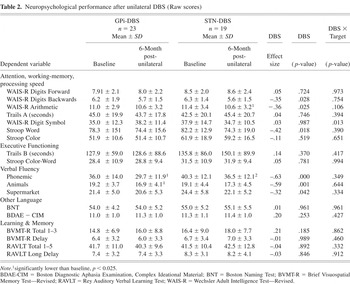
The neuropsychological assessment battery was designed to assess functions that had been reported to be affected by DBS in early studies, including of attention, auditory working memory, processing speed, verbal fluency, executive functioning, and verbal and visuospatial learning and memory. The battery also included measures believed to be sensitivity to lateralized cerebral dysfunction that may arise after unilateral DBS. Several measures, including tests to assess naming to confrontation and auditory comprehension, were intended to help screen for any cases of more global cognitive impairment at baseline or developing over the course of long-term follow-up (Alegret et al., 2001; Jahanshahi et al., 2000). The specific tests utilized in this study are listed in Table 2.
Neuropsychological performance after unilateral DBS (Raw scores)

UCSF patients completed either the CFL or PRW form of the Controlled Oral Word Association Test (COWAT; (Benton, 1968; Benton & Hamsher, 1978) with versions counterbalanced across assessment. At the SFVAMC, the FAS format was used at each assessment. Adjusting for group differences in verbal intellectual ability across study sites, there were no statistically significant differences in baseline performance for these alternate forms.
Patients were administered one of five alternate forms of the Rey Auditory Verbal Learning Test (RAVLT) in counterbalanced order to lower the risk of significant practice effects related to previous exposure to list content. We used the original RAVLT learning stimuli, along with the alternate forms previously described by Shapiro and Harrison (1990) and Crawford et al., (1989) and as cited in Lezak (1995). The equivalence of the lists over learning and recall trials has been reported on by Ryan et al., (1986) and Shapiro and Harrison (1990), and our own analyses of baseline performance suggests no statistically significant difference related to test form. Alternate forms of the Brief Visuospatial Memory Test—Revised (Benedict, 1997) were also used at each evaluation. Mood symptoms were assessed by patient self-report using the Beck Depression Inventory (Beck et al., 1961) and the Spielberger State-Trait Anxiety Inventory (Spielberger, 1983).
Study Design
Neuropsychological assessment was performed an average of 13 days before the first surgery (SD = 16.5 days, range = 1–69 days) and repeated an average of six months (SD = 2.85, range = 3–12) after the surgery. There were no significant group differences in the intervals between baseline evaluation, surgery, and follow-up assessment (p > 0.10). The second surgery took place an average of seven months after the first surgery (SD = 3.44, range = 3–15), and the third neuropsychological evaluation was completed an average of 15 months (SD = 5.4, range = 7–27) after the second surgery.
Neuropsychological evaluations were completed with stimulator on and while the patients were taking their usual anti-parkinsonian medication. Every attempt was made to ensure that patients were in their best “on” state during testing. Patients were given an opportunity to complete portions of the neuropsychological test battery at a later time if they developed signs of immobility or complained of freezing during testing. Approximate time to complete the battery was two hours. The study was completed in accordance with the guidelines of the Helsinki Declaration and received approval by the Institutional Review Board of the San Francisco VA Medical Center and UCSF. All subjects gave informed, written consent.
RESULTS
Unilateral DBS
To assess differences in neuropsychological outcome related to surgical target, raw scores from each of the neuropsychological tests were initially subjected to a repeated measures Analysis of Variance (ANOVA), with brain target (GPi vs. STN) as a between-subjects factor and surgical status (baseline vs. post-surgical follow-up) and as the within-subjects factor (α = 0.025). Pre- and post-surgical neuropsychological test scores are shown in Table 2, along with effect size for the main analysis comparing pre and post-surgical performance across all patients and levels of statistical significance for main effects and interactions. Effect size was calculated for each test by taking the average difference between raw score at baseline and after unilateral DBS, divided by the standard deviation of the difference (Morris & DeShon, 2002).
A statistically significant interaction was noted between surgical status (baseline vs. follow-up) and brain target for the WAIS-R Digit Symbol test [F(1,37) = 6.793, p = 0.013]. None of the other interactions approached statistical significance. In light of the generally comparable effects of DBS at the STN and GPi targets, further analyses were carried out on the combined sample. Compared to baseline, performance after unilateral DBS was lower on measures of Animal Naming, [F(1,38) = 13.47, p = 0.001]. Twenty-five percent of the patients displayed a decline of more than 1 SD after unilateral DBS and 2% displayed improvement greater than 1 SD. Thirty-six percent earned scores in the mildly impaired range (T < 40) after unilateral DBS, compared with only 13% at baseline (p < 0.01, Fisher exact test).
Reductions were also noted in phonemic fluency after DBS [F(1,40) = 16.25, p < 0.001]. Among the patients receiving the same form each session (VA patients) 25% displayed a decline of more than 1 SD, 6% declined by 2 SD, and 6% improved by 1 SD. The reduction in phonemic fluency was unrelated to test format [F(1,39) < 1, n.s]. Performance on the Word trial of the Stroop test also declined after DBS [F(1,34) = 6.15, p = 0.018]. Declines equal to or greater than 1 SD were observed in 17% (six patients), and greater than 2SD in 3%. Improvement of more than 1 SD was noted in 3%.
Bilateral DBS
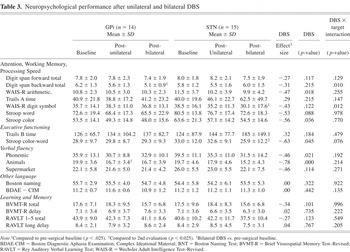
Neuropsychological test performance for patients undergoing staged bilateral DBS is shown in Table 3. A repeated measures ANOVA with 3 levels of the within-subjects factor (baseline, post-unilateral DBS, post-bilateral DBS) and 2 levels of the between-subjects factor (GPi vs. STN) revealed two statistically significant differences in the effect of staged bilateral DBS associated with treatment target. The first DBS by target interaction again involved the Digit Symbol subtest [F(2,25) = 5.358, p = 0.012]. Among those receiving STN DBS surgery, there was a significant decrease in Digit Symbol performance [F(2,12) = 8.903, p = 0.004], whereas the difference in the GPi group was not significant [F(2,12) = 2.126, p = 0.162]. The other interaction involved the WAIS-R Digit Span Backwards score [F(2,26) = 5.544, p = 0.010]. On this task the GPi group showed a significant overall reduction [F(2,12) = 8.760, p = 0.005], whereas the STN group did not [F(2,13) = 0.981, p = 0.401]. In the combined sample a statistically significant reduction was found for animal fluency [F(2,27) = 10.964, p > 0.001], phonemic fluency [F(2,27) = 4.450, p = 0.021], and WAIS-R arithmetic [F(2,24) = 4.761, p = 0.018].
Neuropsychological performance after unilateral and bilateral DBS

The possibility of significant additive effects of the second unilateral DBS intervention was further examined with paired t-tests contrasting performance at the second and third evaluations. None of these pairwise comparisons reached statistical significance in the combined sample. However, within the STN group, significantly lower scores were observed on the Stroop Color-Word reading trial (see Table 3). Although change after bilateral DBS was not statistically significant, comparison of effect sizes for unilateral and bilateral DBS (Tables 2 and 3) reveals greater overall effect of bilateral DBS compared to baseline performance. The mean effect size of bilateral DBS with reference to pre-surgical baseline was 0.51, slightly larger than the effect of unilateral DBS.
UPDRS–III scores following unilateral and bilateral DBS
Significant improvements in UPDRS-III score were observed in the combined sample of STN and GPi patients at the follow-up examinations coinciding most closely with the neuropsychological evaluations after unilateral and bilateral DBS (p < 0.001). Although the values do not necessarily reflect complete optimization of DBS parameters for best motor response, mean reductions in the on-stimulation/off-medication condition were 29% and 37% respectively compared to off-medication score at baseline. DBS by brain target interactions were not significant.
Side of Surgery
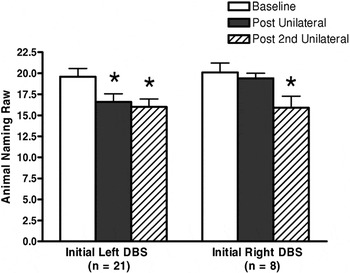
Including side of surgery as a covariate in repeated measures ANOVA, no significant differences were observed in the neuropsychological outcome after unilateral DBS. However, the smaller number of patients first undergoing right-sided DBS surgery limited our power to detect such an effect. The group undergoing left-sided DBS did show a larger effect size than the right-sided group for Animal Naming fluency (−0.79 vs. −0.29). Furthermore, the effect of unilateral DBS on Animal Naming fluency was mediated largely by significant reduction only in the left-sided DBS group ([F(1,25) = 16.218, p < 0.001], see Fig. 1). In contrast, the group that initially received right-sided treatment displayed a significant reduction in Animal Naming fluency only after left-sided surgery [F(1,7) = 11.30, p = 0.012]. For phonemic fluency the effect of unilateral DBS was also significant only for the patients treated on the left side [F(1,21) = 6.04, p=.023]. However, effect sizes were comparable for right and left-sided treatment, and the effect of the second DBS treatment was not significant for either group.

Animal naming at baseline and after staged unilateral DBS surgery as a function of side of treatment (* p < .025 compared to baseline)
Mood Ratings
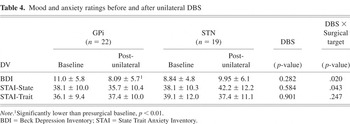
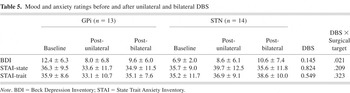
Means and standard deviations for the scales assessing mood and anxiety are displayed in Tables 4 and 5. There was a significant interaction between DBS and brain target affecting BDI score [F(1,39) = 5.891, p = 0.02]. The GPi group showed significantly decreased BDI scores after DBS [F(1,21) = 8.358, p = 0.009], whereas the STN group showed no significant change [F(1,18) = 0.674, p = 0.422]. Bilateral DBS showed a similar interaction with brain target in affecting BDI scores [F(2,24) = 4.56, p = 0.021]. The GPi group showed a non-significant trend in the direction of improvement [F(2,11) = 4.857, p = 0.031], whereas the STN group did not [F(2,12) = 2.382, p = 0.135]. There were no statistically significant effects of DBS on anxiety scores, and no interactions of DBS and target.
Mood and anxiety ratings before and after unilateral DBS

Mood and anxiety ratings before and after unilateral and bilateral DBS

Supplementary Analyses
Alterations in dopaminergic medication
Reduction in dopamine equivalent dosage after unilateral DBS lead implantation was greater for the STN group (mean = 457.5 milligrams, SD = 528.8) than the GPi group (mean = 84.4 milligrams, SD = 504.3, p < 0.05). Change in dopamine equivalent dosage was not correlated with any of the measures of neuropsychological or mood change following DBS in either group or the sample as a whole. However, the interaction between DBS and surgical target for Digit Symbol performance was no longer statistically significant after adjusting for reductions in dopaminergic medication using ANCOVA.
Age and duration of follow-up interval
The age distribution of the participants in the current study was bi-modal with one peak approximately age 55 and another at approximately age 70. Comparing those 65 years of age and older (mean age = 70.1, SD = 4.0; n = 18) with those less than 65 years old (mean age = 53.7, SD = 4.9 n = 24) in a 2 × 2 mixed ANOVA analysis with one between-groups factor (Hariz et al.) and one within-subjects factor (unilateral DBS), there were no significant age by DBS interaction for any of the main neuropsychological outcomes, and regression analyses identified no significant associations between age and changes in any of the primary neuropsychological outcome measures. Age was likewise uncorrelated with change in neuropsychological test scores after bilateral DBS. There were no statistically significant correlations between the length of the follow-up interval and change in test performance after unilateral or bilateral DBS.
Baseline neuropsychological functioning
Correlations between baseline scores and performance changes after DBS were also analyzed for the tasks showing an effect of unilateral DBS. Contrary to our hypotheses, higher baseline phonemic fluency was correlated with a greater absolute decrement in performance after DBS (r = 0.41, n = 35, p = 0.015). Higher score on baseline Digit Span backwards was also correlated with greater absolute decline (r = −0.60, n = 42, p < 0.001) as well as greater percentage decline after DBS.
DISCUSSION
The results of this study suggest that DBS is associated with small reductions in speeded information processing and working memory. These findings are similar to deficits found to be associated with DBS in previous studies (Burchiel et al., 1999; Fields et al., 1999; Funkiewiez et al., 2004; Rodriguez-Oroz et al., 2005; Temel et al., 2005), and suggest that DBS may have a small adverse effect on neuropsychological domains sensitive to frontal-subcortical dysfunction. The current finding of larger effect sizes after bilateral DBS suggests a small incremental neuropsychological burden associated with bilateral DBS compared to unilateral treatment. The overall findings must be considered in the context of statistically significant improvements in motor function bestowed on patients who receive this treatment, beneficial effects that in many instances are dramatic and life-altering.
GPi versus STN
This study is the first to present detailed analyses of neuropsychological outcomes in patients randomized to receive DBS at either STN or GPi. The results suggest that the neuropsychological effects of DBS surgery are mostly comparable for the two brain targets, but also suggest small differences in domains of auditory working memory and speeded visuomotor functioning. Differences in the effects of GPi and STN DBS are noted after unilateral and bilateral DBS.
Digit Symbol performance declined after DBS treatment at the STN relative to treatment at the GPi target. Trends were noted in the direction of greater decline in arithmetic and Stroop Test performance only after STN DBS. Digit Symbol performance has not been previously evaluated in relation to DBS surgery at STN and GPi targets. This task requires visuomotor coordination and fine manual dexter ity. Previous studies have suggested that dopaminergic medication and stimulation parameters may have different effects on distinct cognitive and movement parameters, and that there may be greater beneficial effects from levodopa on distal appendicular muscle groups involved in fine motor control and from STN DBS on proximal and axial muscles (Garcia Ruiz et al., 2005; Wenzelburger et al., 2003). The importance of manual dexterity for performance on the Digit Symbol Task is supported by the finding of a significant correlation between the declines on the latter task and on the Grooved Pegboard Task in a subgroup of patients in our study (r = −0.62, n = 23, p = 0.002). Speculation regarding the potential role of levodopa is further supported by the finding that group differences in the effects of DBS on Digit Symbol were no longer significant after also adjusting for reduction in dopaminergic medication.
In contrast, backwards Digit Span, a measure of auditory working memory, declined more in the GPi than in the STN group. A previously published report on a case of pronounced dysexecutive syndrome arising after GPi DBS documented declines on Digit Span backwards (Dujardin et al., 2000). A trend in the direction of decline in Digit Span backwards was also reportedly found in small samples of GPi and STN DBS patients three to six months after bilateral DBS (Trepanier et al., 2000). Other investigations have found no change after STN DBS(Gironell et al., 2003; Moretti et al., 2003; Morrison et al., 2004) or GPi (Merello et al., 1999). Limited sample size hampers the interpretation of these discrepant findings. Further research is needed to confirm the present findings of differential effect of pallidal versus STN DBS in auditory working memory.
The current findings also suggest differences in self-rated symptoms of depression after DBS that differ depending on the target, with indications of improved self-ratings of depression in GPi, but not STN DBS. The greater possibility of suboptimal placement within the smaller STN target and the associated potential for stimulation of nearby fiber pathways subserving limbic or other non-motor functions has been cited as one potential reason for the higher incidence of mood disturbance reported after STN DBS (Okun et al., 2003). Further research is needed to examine specific mood parameters as a function of DBS target and explore the relation of mood changes to other clinical parameters after DBS.
Side of Surgery
The association of declines in semantic verbal associative fluency with left-lateralized DBS is consistent with previous reports of higher rate of cognitive decline after left-sided pallidal DBS (Merello et al., 1999). The finding suggests that lateralized changes contribute to at least some of the neuropsychological decrements seen after unilateral DBS. Further research is needed to examine the question of lateralized versus generalized effects of DBS with larger samples of patients randomized to side of treatment, and using measures that are also sensitive to right-lateralized frontal-striatal dysfunction, such as the Tower of London (Cheesman et al., 2005) and other measures of visuospatial working memory.
Other Potential Mediating Factors
Dopaminergic therapy
Changes in pharmacotherapy were not associated with the neuropsychological changes seen after DBS in this study. No direct association was found between the greater reductions in dopaminergic medication and the greater decrements in visuomotor speed in the STN group after DBS.
Age
The current findings argue against a significant association between age and decrement in the neuropsychological outcome after DBS. Previous reports on DBS outcome noted isolated cases of significant cognitive decline after DBS in elderly patients but generally comparable rates of worsening test performance (Saint-Cyr et al., 2000). One study found significant correlations between age and decline in executive functioning 3 years after STN DBS (Funkiewiez et al., 2004), suggesting greater cognitive decline in elderly patients with treatment. Incident dementia and normal age-related learning and memory decrements in elderly patients may contribute to differences in the pre- and post-surgical neuropsychological test performance in younger and older patients.
Premorbid neurocognitive vulnerability
Contrary to our hypothesis, higher baseline neuropsychological performance was associated with greater decline after DBS in measures of working memory and executive functioning. This may reflect a process analogous to the one noted in studies examining neuropsychological outcomes after temporal lobectomy (Hermann et al., 1995; White et al., 2002), where higher baseline memory functioning has been found to be a risk factor for greater post-surgical declines.
Although the current findings suggest that those patients with least pronounced cognitive difficulties at baseline demonstrate greater reductions in some measures, this may be true only for a relatively high functioning cohort of patients with advanced PD, a cohort screened to exclude patients with dementia at baseline. The present findings should not be used as evidence to invalidate current practice standards that dictate exclusion of patients with more pronounced pre-operative cognitive impairment.
Limitations and Directions for Future Research
The lack of a non-surgical control group is a major limitation of the current study. Furthermore, research involving patients with lower levels of educational attainment and baseline neuropsychological test scores will be needed to assess the generalizability of these findings to a wider sample of clinically affected patients with PD. Further randomized trials with larger sample size and longer follow-up intervals are needed to confirm the present findings and increase our understanding of potential differences in the neurobehavioral effects of DBS at STN versus Gpi, and to determine how long-term effects may relate to disease progression interacting with DBS at these two brain targets. Additional insight into the specific mechanisms whereby DBS impacts neurobehavioral functioning may come from further detailed neuropsychological investigations of executive functioning and working memory, together with investigations of the influence of lead location and stimulator settings on performance and functional neuroimaging studies.
Finally, the relationship of the changes in neuropsychological test performance after DBS to performance in activities of daily living, caregiver burden, and on other measures of quality of life after DBS also warrants further exploration. Even subtle decrements in speeded information processing and working memory may impact performance in complex real-world tasks (Uc et al., 2005). A multicenter randomized trial of bilateral DBS of the GPi versus STN is currently underway (Follett et al., 2005) which is expected to directly address many important questions concerning differences in outcomes of DBS at these two brain targets.
ACKNOWLEDGMENTS
The information in this manuscript and the manuscript itself is new and original, is not currently under review by any other publication, and has never been published either electronically or in print. The authors hold no financial interest in or other relationships with any institution or corporate entity that could be interpreted as contributing to a conflict of interest affecting this manuscript.