INTRODUCTION
During the last half of the 20th Century the Mediterranean has been enriched by exotic fish species, both of Atlantic and Indo-Pacific origin (Golani et al., Reference Golani, Orsi Relini, Massuti, Quignard and Briand2002 and on-line updating). In their native range these species frequently belong to warm water coastal assemblages and their appearance in the Mediterranean may be, at least in part, related to global warming.
Species of the family Kyphosidae are subtropical and tropical herbivorous medium-sized fish (up to 75 cm), with an oval, moderately compressed body, small head, short snout and very peculiar incisor like teeth. Two species live in the Atlantic, both on the eastern and western coasts: Kyphosus sectator (Linnaeus, 1758) and K. incisor (Cuvier, Reference Cuvier, Cuvier and Valenciennes1831). The former species, thanks to old records of a few individuals at Trieste, Palermo and Genoa, during the period 1846–1903 (Doderlein, Reference Doderlein1884; Ariola, Reference Ariola1904; Soljan, Reference Soljan1975), was listed in the Italian and Mediterranean fish fauna (Tortonese, Reference Tortonese1975, Reference Tortonese, Whitehead, Bauchot, Hureau, Nielsen and Tortonese1986).
The present note describes the first record of the species Kyphosus incisor in the Mediterranean and briefly discusses possible ecological inferences.
MATERIALS AND METHODS
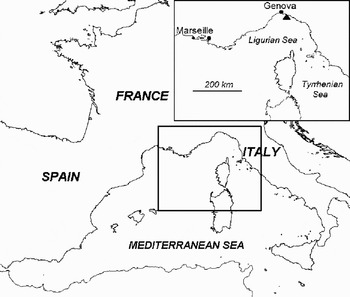
On 23 July 2009 two specimens of sea chub were caught at Camogli (eastern Ligurian Riviera; Figure 1) by an artisanal gear—the ‘mugginara’—which is a small net trap fixed to the rocks that form the south-western corner of the Portofino promontory. The gear, of very ancient use in that position (Cattaneo-Vietti & Bava, Reference Cattaneo-Vietti and Bava2009), in the period April to September, intercepts fish migrating along the coast such as Mugilidae (giving the name to the trap), Sparidae, Carangidae, Scombridae, Sphyraenidae etc. Fishermen, who know the local fish fauna very well, gave the two new fish a provisional nickname—‘salpatanuta’, which recalls similarities with Sparidae—and decided to send one of them to the market and to preserve the other for studies.
Map showing the record location.

RESULTS
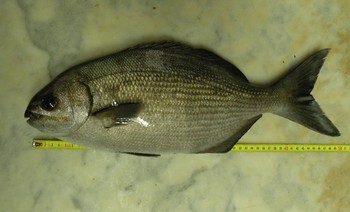
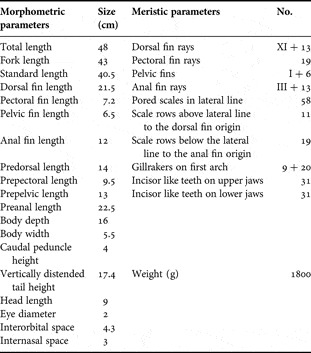
The studied specimen (Figure 2) has the morphometric and meristic data listed in Table 1.
Kyphosus incisor, total length 48 cm, Camogli (July 2009).

Morphometric and meristic data of the Camogli specimen.

Colour: dorsally grey to silvery on the belly. A series of ten yellow-golden longitudinal lines. Two golden bands on the head separated by a silver stripe under the eye. Fins and opercular membrane dark.
These characteristics are in agreement with the description of Kyphosus incisor (Sgano, Reference Sgano, Fisher, Bianchi and Scott1981; Carpenter, Reference Carpenter and Carpenter2002).
The anal rim was showing a faecal mass, green in colour, formed by minutely chopped algal materials. A small ventral incision allowed seeing a large gut, stuffed with the same mass and very small gonads. At the dissecting microscope, a testis was recognized, with a pink parenchyma and white vasa in the rete testis.
DISCUSSION
Records of exotic fish occurring in Italian waters during the last fifty years, from a total of 27 case studies, have recently been used to establish different categories of findings, with the aim to separate casual events from those which have ecological significance (Orsi Relini, Reference Orsi Relini, Golani and Golani-Appelbaum2009). The categories were: (a) vagrant fish, mainly represented by large pelagic species; (b) ship transported fish; (c) drift fish of difficult interpretation and classification; (d) Atlantic species enlarging their distribution northward including Mediterranean colonizers; and (e) Red Sea colonizers. While the first two categories generally had no impact in Italian waters, the last two categories are those of relevant ecological interest, because they may be related to global warming.
On the basis of such a cautious approach (see also Arvedlund, Reference Arvedlund2009) the so called ‘tropicalization’ of the Italian seas was considered certain when the settlement of tropical fish species was observed. In the Italian seas, i.e. the central Mediterranean, few species have become established in a restricted area: Seriola fasciata, S. carpenteri and Sphoeroides pachygaster are the recent Atlantic colonizers, while Siganus luridus and Fistularia commersonii are the erythraean ones; other possible cases require confirmation. The concerned area is located in the Sicily Strait (Orsi Relini, Reference Orsi Relini, Golani and Golani-Appelbaum2009).
Fish of the genus Kyphosus are relatively large and easily identified, so we can assume they were properly monitored in the Mediterranean. Their records span a time period of about 160 years, so they may represent categories which have evolved with time.
Kyphosus sectator is certainly better known than K. incisor, with there being twice as much literature on the topic (Froese & Pauly, Reference Froese and Pauly2009). However, the two species present common distribution and ethology, so studies about K. sectator can help to understand the biological and ecological aspects of the present record. Both species inhabit shallow waters in the adult phase, while juveniles are associated with floating algae and other flotsam (Froese & Pauly, Reference Froese and Pauly2009). Since the time of sail navigation, young fish were also observed around ships in subtropical waters, waiting for the dumping of garbage (Cuvier, Reference Cuvier, Cuvier and Valenciennes1831); their habitual position near the ship's rudder, has given them the name ‘rudder’ fish. The shift from pelagic to demersal life involves a change in feeding habits: from omnivory to the grazing of algae.
The oldest records at Trieste, Palermo and Genoa have already been mentioned: such locations near large Mediterranean ports suggest the category ‘ship transported fish’: in particular the specimen described by Ariola (Reference Ariola1904), 22.5 cm total length (TL), was caught in the harbour.
About 100 years later, three recent records of K. sectator occurred in the Mediterranean (Merella et al., Reference Merella, Massuti and Deudero1998; Hemida et al., Reference Hemida, Kanoun, Golani, Ben Souissi, Guelorget and Capapè2004; Francour & Mouine, Reference Francour and Mouine2008) and three in the adjacent Atlantic waters (Banon, Reference Banon2004; Canas et al., Reference Canas, Vasconcelos, Lino and Santos2005; Quero, personal communication in Francour & Mouine, Reference Francour and Mouine2008). These records include both the case of a juvenile (TL 21.6 cm) with a stomach content of pelagic crustaceans and gelatinous macroplankton (Merella et al., Reference Merella, Massuti and Deudero1998) and a large adult fish (52.3 cm TL) with a stomach content of more than 100 g of Ulva spp. (Canas et al., Reference Canas, Vasconcelos, Lino and Santos2005). Some records were completed with underwater observations suggesting, possibly, a stabilization of the species (Banon, Reference Banon2004). The most important is the Algerian case (Hemida et al., Reference Hemida, Kanoun, Golani, Ben Souissi, Guelorget and Capapè2004), because it mentions a plurality of specimens, suggesting the existence of a population unit in Annaba.
The present specimen of K. incisor had apparently reached the fully herbivorous phase. On the basis of the preliminary macro-anatomical inspection of gonads, it can be considered an adult male in a spent-recovering stage. The gut fullness and the appearance in pair, suggest an optimal adaptation to the Mediterranean environment, in particular to living inside the photophilic algal community of the Portofino rocks. In spite of the fact that the fish was observed for the first time in a new area, it appears to correlate with the modern records of the sister species K. sectator.
In conclusion, all information recently gathered about Kyphosidae approximately in the latitudinal range 35°–45° indicate wider distribution of the species, and in the Mediterranean, the possible arrival of new Atlantic colonizers. The monitoring of these species will clarify if they are able to become the western Mediterranean counterpart of the eastern Mediterranean lessepsian rabbit fish Siganus luridus and S. rivulatus.
ACKNOWLEDGEMENTS
The authors are very grateful to the fishermen of Camogli and in particular to Mr Adriano Andreis for his consideration for the research requirements; to Dr Fulvio Garibaldi and Dr Luca Lanteri for help in the preparation of the text and search for literature; to Dr A. Pulsford for help in final adjustments of the language.