Introduction
Late-life depression is a major healthcare problem that causes great personal suffering, disability, and high costs for the society (Alexopoulos, Reference Alexopoulos2005). Depression in old age can bring about negative psychosocial and neurobiological changes that are able to deviate an individual's health trajectory. Longitudinal studies have clearly shown that it worsens the outcomes of physical illnesses, increases the risk of dementia (Butters et al., Reference Butters2008; Cherbuin et al., Reference Cherbuin, Kim and Anstey2015), and the likelihood of frailty in old age (Vaughan et al., Reference Vaughan, Corbin and Goveas2015). Thus, it may represent the hallmark of global clinical deterioration.
Late-life depression is often accompanied by cognitive impairment, either subtle or clinically manifest; the relationship between these aspects is particularly relevant for older individuals, given the potential impact on everyday functioning and its long-term adverse consequences (Butters et al., Reference Butters2008; Morimoto and Alexopoulos, Reference Morimoto and Alexopoulos2013; Cherbuin et al., Reference Cherbuin, Kim and Anstey2015). Cognitive deficits can involve one or multiple cognitive domains, such as memory, attention, visuospatial abilities, verbal fluency, and executive functions. They are likely due to heterogeneous mechanisms (Butters et al., Reference Butters2008) and are characterized by different clinical courses, which at present is difficult to predict in advance. In some cases, they partly improve with the remission of depression (the so-called pseudodementia); others go on to develop dementia (Morimoto and Alexopoulos, Reference Morimoto and Alexopoulos2013), while another subset of patients tend to display stable associations between depressive symptoms and cognitive impairment, such as executive dysfunctions. The latter are generally characterized by greater levels of disability and poor response to antidepressant drugs (Morimoto and Alexopoulos, Reference Morimoto and Alexopoulos2013).
Given these premises, it is not surprising that antidepressant treatment is less effective among older depressed individuals than they are among younger patients (Alexopoulos, Reference Alexopoulos2005). After a first-line treatment course, several patients are often left with significant residual depressive symptoms, as well as anxiety and sleep disturbances (Dombrovski et al., Reference Dombrovski2007), Similarly, cognitive impairments such as executive dysfunction, and working memory deficits often persist after successful treatment (Morimoto and Alexopoulos, Reference Morimoto and Alexopoulos2013). This can negatively impact on disability and quality of life, either by limiting individual functioning or increasing the risk for depressive recurrences (Dombrovski et al., Reference Dombrovski2007; Morimoto and Alexopoulos, Reference Morimoto and Alexopoulos2013). Moreover, despite being generally safe, antidepressant drugs in elderly individuals may still provoke notable adverse effects, such as hyponatraemia or gastrointestinal bleeding, or interact with other drugs (e.g. with antiplatelets agents). Thus, it is paramount to develop and test novel interventions that reduce individual suffering and prevent further deterioration.
In a recent study on late life depression, we showed that adding physical exercise to antidepressant drug therapy led to better clinical outcomes compared with drug therapy alone. Both non-aerobic and aerobic structured, group-based exercise led to greater remission rates (Belvederi Murri et al., Reference Belvederi Murri2015) and reduced cardiovascular risk (Toni et al., Reference Toni2016) in patients recruited from primary care (Zanetidou et al., Reference Zanetidou2017). Physical exercise exerts positive effects on cognition (Muscari et al., Reference Muscari2010) and improves physical disability in older patients (de Vries et al., Reference de Vries, van Ravensberg, Hobbelen, Olde Rikkert, Staal and Nijhuis-van der Sanden2012). However, to the best of our knowledge, these effects have not been studied among older patients with major depression. Hence, the aim of this study was to examine whether exercise plus antidepressants led to improvements of disability and cognition, compared with antidepressant drug therapy alone, in patients with late life depression.
Methods
The Safety and Efficacy of Exercise for Depression in Seniors study was a single-blind, randomized study that included 121 patients from four centers in the region of Emilia Romagna, Italy (Bologna East, Bologna West, Parma and Modena-Correggio). Detailed information on the study protocol and participants’ characteristics has been reported elsewhere (Belvederi Murri et al., Reference Belvederi Murri2015).
Briefly, recruitment was based on a regional liaison program between the Mental Health and Primary Care Departments. Inclusion criteria were verified during the selection visit by research-oriented psychiatrists after selection of participants by Primary Care Physicians: age between 65 and 85 years, suffering from Major Depressive Disorder, a score of 18 or higher at the 17-item Hamilton Depression Rating Scale (HAM-D) and being sedentary. Exclusion criteria were the following: presence of another axis I diagnoses (according to DSM-IV TR criteria), substance or alcohol abuse, severe or unstable physical illness that would prevent from exercising, and cognitive impairment, defined as a Mini-Mental State Examination (MMSE) of less than 24. The study was conducted in accordance with the principles of the Declaration of Helsinki; eligible patients provided written informed consent before participating. Participants were randomly assigned to (1) sertraline (S; n=42); (2) sertraline plus supervised group non-progressive exercise (S+NPE; n=37), and (3) sertraline plus supervised group progressive aerobic exercise (S+PAE; n=42).
Patients in the S group were prescribed sertraline at the standard dosage of 50 mg. The dosage could be further increased based on participant response and side effects. Participants in the S+NPE arm received sertraline as in the S group. Furthermore, they attended three S+NPE sessions per week for 24 weeks in groups of 3–6 participants (60-minute duration). Exercise in the S+NPE sessions aimed at improving participant strength and balance, respiration, and motor coordination comprising both mat work and instrumental exercises. Patients in the S+NPE group exercised under cardiac monitoring and were assigned to work out at heart rate ranges designed not to exceed 70% of the peak heart rate. If a participant exceeded his/her established peak heart rate, the instructor asked him/her to reduce the intensity of the exercise until the heart rate recovered. Patients in the S+PAE received sertraline as in the S arm. The schedule of PA sessions was similar to that of NP (three sessions per week for 24 weeks, lasting 60 minutes, in groups of 3–6 participants), but exercises were based on exercise bicycles and brief sessions of interval training. The PA protocol was designed to improve participants’ cardiopulmonary training: workout intensity was based on a test of aerobic capacity and increased along the sessions. Participants’ attendance to all exercise sessions was recorded.
Participants’ physical and mental status was assessed using the Mini International Neuropsychiatric Interview (Sheehan et al., Reference Sheehan1998), the Cumulative Illness Rating Scale (CIRS) (Miller et al., Reference Miller1992). The severity of depressive symptoms was measured using the HAM-D at baseline, 4, 8, 12, and 24 weeks; remission from depression was defined as reaching an HAM-D score of 10 or lower.
After screening with the MMSE, cognitive abilities were tested at baseline and study end, using the Italian version of the Montreal Cognitive Assessment (MOCA) (Santangelo et al., Reference Santangelo2014). Total scores range from 0 to 30 and are adjusted for education by adding one point for participants with less than 12 years of schooling. Scores for cognitive domains include: (1) Visuospatial/Executive: clock-drawing task, three-dimensional cube copy and trail-making B task (5 points); (2) Naming: identification of three low-familiarity animals (lion, camel, rhinoceros; three points); (3) Attention/Concentration: digits forward and backward, sustained attention task (target detection using tapping), and serial subtraction task (six points); (4) Language: repetition of two syntactically complex sentences and phonemic fluency task (three points); (5) Abstraction: two-item verbal abstraction task (two points); (6) Delayed recall: two learning trials of five nouns and delayed recall after approximately 5 minutes; (7) Orientation in time and place (six points).
Consistent with inclusion criteria, the population was not characterized by major impairments of the activities of daily living, thus disability was assessed using the Brief Disability Questionnaire (BDQ) (Berardi et al., Reference Berardi, Menchetti, De, Rucci, Leggieri and Ferrari2002), at baseline and at the end of trial. This scale evaluates the restrictions in everyday activities due to depression, including physical activities (e.g. climbing stairs, bending, carrying groceries), hobbies, daily routines, lack of motivation, and efficiency for home, school or work activities. Total scores range from 0 to 24, with greater scores indicating higher levels of disability.
If a participant refused to undertake any further assessment after baseline, he/she was considered a dropout.
Statistical analysis
Participants baseline characteristics were compared by treatment arms using χ 2or ANOVA tests for categorical and continuous variables, respectively. To examine changes in cognition and disability scores (baseline to 24 weeks), we employed Generalized Linear Models, contrasting the combined intervention groups (S+NPE and S+PAE) with the antidepressant drug treatment group (S). MOCA and BDQ total scores at study end were used as the dependent variable, while baseline scores and group assignment were the predictors. Moreover, we examined MOCA subdomain scores in an additional exploratory analysis. The baseline-observation-carried forward (BOCF) method was used to impute missing data in the intention-to-treat population. For the main analyses, the alpha level was set at p<0.05. For the analyses of MOCA subdomain scores, the significance level was adjusted according to Benjamini–Hochberg False Discovery Rate correction to reduce the risk of type I error. For significant results we provide a measure of the effect size associated with the intervention. This was calculated as the difference between the effect sizes in the experimental group and that of the control group. Each term is the ratio of the mean score change divided by the baseline standard deviation of the parameter (Feingold, Reference Feingold2009). A positive value indicates a greater increase of the parameter in the experimental group relative to the control group.
Further exploratory analyses were carried out to identify the correlates of disability and cognitive scores: Pearson's correlation and Multiple Linear Regression analyses were carried out in the entire baseline sample. At last, we examined if changes in disability and cognitive performance from baseline to study end were associated with changes in other relevant factors (depressive symptoms, peak aerobic capacity, and number of attended exercise sessions). All analyses were performed using SPSS version 15.0.
Results
Recruitment and baseline characteristics
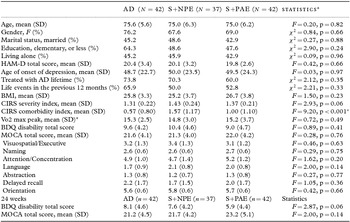
One hundred twenty one participants were randomized to the three treatments: 42 in the S group, 37 in the S+NPE and 42 in the S+PAE groups. Participants’ demographic and clinical characteristics are reported in Table 1: the mean age was 75 years (SD=6), the majority were female and with elementary or lower educational level. The mean HAM-D score for the whole sample was 20.1 ± 3.1, indicating the presence of mild to moderate depressive symptomatology, while the mean MOCA score was 21.6 ± 4.1, compatible with mild cognitive impairment.
Baseline characteristics of participants in the intervention groups

S+PAE, antidepressant drug plus progressive physical activity; S+NPE Antidepressant drug plus non-progressive physical activity a. df=2.
*p < 0.05.
At study end, data on cognitive measures was available for 101 participants (missing eight participants from the S group, eight from S+NPE, and four from S+PAE), data on disability for 106 (missing six participants from the S group, five from S+NPE, and four from S+PAE). Two participants left the study due to incidents while performing exercise, one due to the need of higher care for depression and the remainder due to lack of time/willingness to continue.
Changes in cognitive abilities and disability
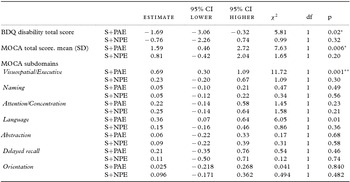
Table 2 reports the results of generalized linear models examining the effect of group assignment on disability and cognition. From baseline to study end, there were greater declines in BDQ scores in the S+PAE group compared with the S only group (p=0.02; effect size = −0.31), whereas changes in the S+NPE group were not significantly greater than those in the S group (p=0.32). The mean difference in BDQ scores were 1.5 points in the S group, 2.8 points in the S+NPE group and 3.1 for the S+PAE group.
Effect of exercise plus antidepressants on depression-related disability and cognition

Analyses are based on Generalized Linear Models, using scores at study end as the outcome. Group is used as the predictor, coded as two dummy variables (S+PAE and S+NPE, with the S group as comparator). Models are adjusted for baseline scores and CIRS comorbidity scores. Abbreviations: CI, confidence interval, df, degrees of freedom.
*p<0.05.
**p<0.00625.
p values relative to the analyses of subdomain scores were adjusted for the Benjamini–Hochberg False Discovery Rate correction.
The S+PAE group was also associated with greater improvements of MOCA total scores than the S group (p=0.006, effect size=0.37). Exploratory analyses on subdomain scores revealed significant changes in the Visuospatial/Executive domain (p=0.001, effect size=0.13). Instead, changes in the Language domain (p=0.01) did not reach the predefined level of significance after correction for the False Discovery Rate (p<0.00625). The S+NPE group did not show significant changes in total MOCA scores or specific cognitive subdomains.
Correlates of disability and cognition
In the total sample, baseline BDQ total scores correlated positively with the severity of depression (r=0.48, p<0.001), with CIRS severity index (CIRS SEV r=0.25, p=0.007) and, negatively, with MOCA total scores (r=−0.28, p=0.002). BDQ total also showed a statistical trend for a negative association with peak Vo2 levels (r=−0.19, p=0.06), while it did not correlate with CIRS comorbidity index (r=0.10, p=0.27) or age (r=0.12, p=0.20). Entering these factors in a regression model, disability was still associated with the severity of depression (beta=0.62, 95% CI 0.39–0.85, p<0.001), and, only at trend level, with CIRS severity index (beta=3.1, 95%CI −0.12–6.27, p=0.06) and MOCA scores (B=−0.17, 95%CI −0.35–0.01, p=0.07). The model explained 28% of the variance of baseline BDQ scores (F=15.5, df=1, p<0.001).
The decrease in BDQ scores correlated with the decrease of HAM-D scores (r=0.32, p<0.001), with the number of attended sessions (r=−0.27, p=0.004), but not with changes in MOCA scores or with the difference in peak aerobic capacity (both p > 0.10). However, data on peak aerobic capacity were only available for 73 participants. After adjusting for the changes in depressive symptoms, the number of attended sessions was associated with changes in BDQ changes only at the statistical trend level (p=0.09).
Changes in total MOCA scores were not associated with changes in depressive symptoms (r=0.004, p=0.97), the number of attended sessions or changes in peak aerobic capacity (all p > 0.10), whereas changes in executive function scores had a trend-level association with the number of attended sessions (r=0.16, p=0.09).
Discussion
This study showed that the association of aerobic physical exercise and sertraline led to greater improvements of disability and cognition compared with sertraline alone, among elderly patients with major depression. These findings extend previous results showing that integrated treatments based on exercise and antidepressant drugs are effective against symptoms of late-life depression (Belvederi Murri et al., Reference Belvederi Murri2015; Toni et al., Reference Toni2016). Given the high prevalence of cognitive impairment and disability among older depressed patients, the current results may add further elements in the support of exercise in the management of this condition.
There is a wealth of evidence supporting the benefits of exercise on disability (Chou et al., Reference Chou, Hwang and Wu2012; de Vries et al., Reference de Vries, van Ravensberg, Hobbelen, Olde Rikkert, Staal and Nijhuis-van der Sanden2012) and cognition among older adults (Kelly et al., Reference Kelly, Loughrey, Lawlor, Robertson, Walsh and Brennan2014; Zheng et al., Reference Zheng, Xia, Zhou, Tao and Chen2016), particularly in the domain of executive functions (Erickson et al., Reference Erickson, Leckie and Weinstein2014). However, to our knowledge, no study had tested such hypothesis among elderly patients suffering from major depression, especially integrating exercise with antidepressant drug therapy. Moreover, only few studies examined the effects of exercise on cognition among younger depressed patients. Consistent with our results, Greer et al. (Reference Greer, Grannemann, Chansard, Karim and Trivedi2015) found improvements in executive and working memory among patients who were randomized to thrice-weekly, progressive-intensity aerobic exercise. On the contrary, another study failed to demonstrate improvements in cognitive performance after four months of either supervised or home-based exercise, compared with sertraline or with placebo (Hoffman et al., Reference Hoffman2008). Some differences in the study design may explain this inconsistency: First, exercise was not associated with antidepressant drugs, whereas we administered sertraline to all participants. Antidepressants can improve cognitive functions, in particular, psychomotor speed and delayed recall (Rosenblat et al., Reference Rosenblat, Kakar and McIntyre2015), but also executive functions (Royall et al., Reference Royall2009). Although such effects could be less pronounced among the elderly (Han et al., Reference Han, McCusker, Cole, Capek and Abrahamowicz2011; Culang-Reinlieb et al., Reference Culang-Reinlieb, Sneed, Keilp and Roose2012; Morimoto and Alexopoulos, Reference Morimoto and Alexopoulos2013), they may interact with those of exercise, yielding a greater efficacy. Unfortunately, the absence of an exercise-only condition in our study makes it impossible to disentangle the potential interactions between each component of the combined interventions. Second, participants in the study by Hoffman et al. (Reference Hoffman2008) were younger than those in our sample (mean age of 50 as opposed to 75 in our study): In fact previous studies suggest that exercise may be more effective on cognition among individuals who are older and more cognitively impaired than among the younger and healthier, encompassing a possible “ceiling effect” (Kelly et al., Reference Kelly, Loughrey, Lawlor, Robertson, Walsh and Brennan2014). Other differences that may have produced a greater effect on cognition in our study are a slightly longer exercise protocol (6 months instead of 4), lower dropout rates and lower dosages of sertraline in the control group (Belvederi Murri et al., Reference Belvederi Murri2015).
The cognitive benefits of exercise may depend on various psychosocial and biological mechanisms. The latter include CNS structural and functional changes (Erickson et al., Reference Erickson, Leckie and Weinstein2014), immune system or endocrine modulation (Schuch et al., Reference Schuch, Deslandes, Stubbs, Gosmann, Silva and Fleck2016). We deem it unlikely that socialization played a major role improving cognition, as suggested by some (Shankar et al., Reference Shankar, Hamer, McMunn and Steptoe2013), given the fact we did not observe significant cognitive improvements in the non-progressive exercise group that had a similar schedule and degree of social interactions between participants. Moreover, we did not detect significant correlations in the whole sample between changes in MOCA and HAM-D scores, also suggesting that cognitive and mood effects of exercise could be partly independent. Previous studies showed that exercise, particularly of the aerobic type, can increase prefrontal, hippocampal and striatal volumes even in old age, in parallel to improvements of executive functions (Erickson et al., Reference Erickson, Leckie and Weinstein2014). Moreover, exercise could improve task-related brain efficiency within prefrontal and other cortical and subcortical networks (Nishiguchi et al., Reference Nishiguchi2015). These changes may be of particular clinical relevance given that executive dysfunction associated with depression is a negative prognostic marker, associated with greater disability and poorer response to antidepressant drugs (Morimoto and Alexopoulos, Reference Morimoto and Alexopoulos2013; Pimontel et al., Reference Pimontel, Rindskopf, Rutherford, Brown, Roose and Sneed2016). It must be acknowledged, however, that participants in our study suffered from mild to moderate depression and did not present with severe cognitive impairment. Further studies are necessary to examine such patient populations and to investigate the underlying neurobiological mechanisms (Schuch et al., Reference Schuch, Deslandes, Stubbs, Gosmann, Silva and Fleck2016).
Participants receiving sertraline plus aerobic exercise also displayed significant improvements of depression-related disability, that is, they reported having engaged in more leisure and physical activities during the study period. Improvements of disability were correlated with those of depression severity, but not with changes in cognition or executive functions. Again, this was not evident in the non-progressive exercise group, possibly because of a slightly smaller antidepressant efficacy (Belvederi Murri et al., Reference Belvederi Murri2015). Moreover, it is possible that aerobic exercise is more effective against depressive symptoms such as apathy or anhedonia, that seem more closely related to disability (Leventhal, Reference Leventhal2012; Yuen et al., Reference Yuen2015). Also, we cannot exclude that cognitive changes may have covertly played a role improving disability. In fact, “real world” disability is often correlated with behavioural measures of dysexecutive behaviour, rather than with executive dysfunction as is measured by neuropsychological tasks (Gansler et al., Reference Gansler, Suvak, Arean and Alexopoulos2015). In fact, the MOCA may have not been sensible enough to detect cognitive changes that might affect disability.
The study results must be viewed in light of several limitations. First, cognitive abilities were assessed using the MOCA that, despite good psychometric characteristics (Krishnan et al., Reference Krishnan2016), is less reliable than complete neuropsychological batteries and does not encompass different retest versions to avoid training effects. Second, the sample size was relatively small, thus possibly underpowered to detect subtle differences. Third, the exclusion of individuals with severe physical or cognitive impairments may also limit the generalizability of the findings. Fourth, we cannot exclude that the part of the effect on cognitive functions might have occurred due to increased socialization between participants (Shankar et al., Reference Shankar, Hamer, McMunn and Steptoe2013). This, however, may be still considered part of the effectiveness of the intervention in the real world.
In conclusion, our study was the first to show that exercise plus antidepressants can exert positive effects on cognition and disability among patients with late life depression, beyond those due to standard antidepressant drug therapy. These findings may have direct relevance for clinical practice, since late-life depression is frequently accompanied by cognitive dysfunctions and high levels of disability (Morimoto and Alexopoulos, Reference Morimoto and Alexopoulos2013). Exercise-based interventions could be translated into the primary care setting, where most patients with late-life depression are seen and treated (Zanetidou et al., Reference Zanetidou2017). Preliminary evidence suggest they may be cost-effective (Windle et al., Reference Windle, Hughes, Linck, Russell and Woods2010) and have the advantage of preventing further cognitive deterioration (Blondell et al., Reference Blondell, Hammersley-Mather and Veerman2014), besides improving individual quality of life and overall health.
Conflict of interest
All authors declare that they have no conflicts of interest.
Description of authors’ roles
F. Neviani designed the study, collected clinical data and wrote the article. M. Belvederi Murri designed the study, supervised data collection, performed statistical analyses and wrote the article. M. Neri, S. Zanetidou, M. Amore, G. Toni, M. Menchetti, S. Squatrito and G. Neri designed the study, supervised data collection and wrote the article. F. Tripi, S. Ferrari, G. Ceresini, A. Cremonini, E. Simoncini and M. Bertolotti participated in data collection and assisted with writing the article.
Acknowledgments
Other members of the Safety and Efficacy of Exercise for Depression in Seniors (SEEDS) Study Group were involved at various titles in the study design, clinical assessment of patients, organization, management and delivery of the study interventions. Bologna Centers: Francesco Ripa di Meana, MD, Maria L. Marcaccio, MD, Paola Argnani, MD, Angelo Fioritti, MD, Mara Morini, MD, Fausto Trevisani, MD, Roberto Senaldi, MD, Giovanni De Girolamo, MD, PhD, Danilo Di Diodoro, MD, Giovanni Neri, MD, Matteo Cerri MD, PhD, Marco BL Rocchi PhD, Serena Ferrara PsyD, Giuliano Ermini, MD, Piero Casarini, MD, Donato Zocchi MD, Luigi Bagnoli MD, Carlo Spezia, MD, Monica Magagnoli, MD, Claudia Luciano, MD, Federica Casini, PsyD, Angela Buffa MD, Pier Vittorio Bardazzi, MD, Alessandro Piras, PhD, Giuliana Tola, Roberto Rizzo, Lorenzo De Bei, Davide Comastri. Modena-Correggio Center: Ferdinando Tripi, MD, Massimo Mannina, MD; Massimo Piepoli, MD, PhD, Sandro Zoboli, Gabriele Torcianti, Niccolò Colombini, MD, PhD, Guido Federzoni, MD, Morena Pellati, MD, Veronica Barbanti Silva, MD, Agnese Cepelli, Elena Francia PsyD, Roberto Chiesa, MD, Anna Grazia Frignani, MD. Parma Centre: Cristina Montegano, MD, PhD, Arianna Montali, MD, Aderville Cabassi, MD, PhD, Mattia Masotti, MD, PhD, Maria Lidia Gerra, MD. The authors would also like to thank Prof. George S. Alexopoulos for his kind mentoring and precious support.