

1 Introduction
Technological change is central to the study of economic history. Strong and sustained technological progress is the key characteristic of modern economic growth that distinguished the post-Industrial Revolution world from earlier times and is the fundamental force that has raised living standards over the past 250 years. As Paul Romer said, «Our knowledge of economic history, of what production looked like 100 years ago, and of current events convinces us beyond any doubt that discovery, invention and innovation are of overwhelming importance in economic growth» (Reference Romer1993, p. 562).
Accordingly, quantitative economic historians have devoted a great deal of effort to the analysis of technological change. This has resulted in a large body of evidence that in some ways complements that which can be drawn from the economics literature and which, to an extent, suggests that the conventional wisdom of economists needs to be modified. The difference in perspective stems from the range of experience, which is provided by economic history and from a focus on explaining the evolution of economies over time. This paper highlights some findings that are well-known to those economic historians who study long-run economic growth but deserve a wider audience.
The exposition is organized by addressing two questions that relate, respectively, to what are sometimes called the «proximate» and the «ultimate» sources of economic growth. These questions are:
• What have we learnt from historical growth accounting about the role of total factor productivity (TFP) growth?
• When do countries exploit well the opportunities of new technology?
A review of some results from growth accounting and how to interpret them is highly appropriate since this represents the most important technique for quantifying the impact of new technology on productivity. A look at what Abramovitz and David (Reference Abramovitz and David1996) called «social capability» and «technological congruence» allows an emphasis on some of the distinctive flavour of what economic history has to say about success and failure in growth performance, perhaps the most important topic in the discipline.
2 Lessons From Historical Growth Accounting
Growth accounting typically starts by supposing a Cobb–Douglas production function and then makes the distinction between moves along and shifts of this production function in accounting for changes in labour productivity. So

where Y is output, K is capital, L is labour and A is TFP, while α and (1 − α) are the elasticities of output with respect to capital and labour, respectively. Under conventional (neoclassical) assumptions, α and (1 − α) are factor-share weights in income, profits and wages, respectively. The basic growth-accounting formula is:

This formula was first made famous by Solow (Reference Solow1957) and ΔlnA is, of course, also known as Solow’s Residual. While it was clear to Solow that the residual would capture any kind of shift in the production function, the concluding summary of his paper said that 7/8ths of the growth in American labour productivity between 1909 and 1949 was attributable to technical change (Solow Reference Solow1957, p. 320).
This approach is quite flexible and can be adapted to embrace different specifications of the production function either in terms of changing the functional form (e.g. translog) or incorporating additional factors of production (e.g. human capital) or distinguishing between different types of physical capital (e.g. ICT capital vs. non-ICT capital).
2.1 How Important is Crude TFP in Accounting for Labour Productivity Growth?
Crude TFP growth is the original Solow’s Residual, namely, the estimate that is obtained from the basic growth-accounting formula set out above which does not allow for any contribution to labour productivity growth other than that of physical capital. The first issue to consider is whether Solow’s 7/8ths result generalizes to the wide experience of modern economic growth in what are now high-income countries, as Kuznets (Reference Kuznets1971), writing before historical growth accounting had produced any results, thought that it probably would.
Solow’s finding that 7/8ths of US labour productivity growth during 1909-1949 was accounted for by TFP growth (where no separate allowance is made for educational quality of the labour force) is still pretty much what would be obtained applying his method to today’s data. This does not, however, mean that this result has also been found by economic historians consistently for other periods and different countries.
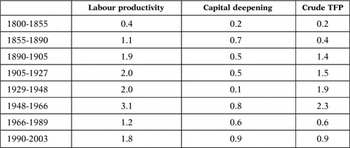
Table 1 reports that on the basis of conventional growth accounting for the United States over the long run, the picture is one of dominance of crude TFP from the late 19th century till the end of the post-World War II boom in the late 1960s. However, Table 1 also shows that before 1890 and after 1966 crude TFP contributes at best only 50 per cent of labour productivity growth.
SOURCES OF US LABOUR PRODUCTIVITY GROWTH OVER THE LONG RUN (PER CENT PER YEAR)

Notes: TFP: total factor productivity.
These estimates are obtained by the various authors on the basis of equations using the specification of equation [2].
Sources: Abramovitz and David (Reference Abramovitz and David2001) except for final period from Bosworth and Collins (Reference Bosworth and Collins2003), updated by authors.
In fact, at face value, given that TFP growth is below 0.5 per cent per year before 1890, the estimates in Table 1 invite the conclusion that technical change was insignificant in the American economy for much of the 19th century and only came to prominence with the rise of the science-based industries and R & D in the so-called second Industrial Revolution. However, this runs counter to standard historical discussions and is certainly not the interpretation in Abramovitz and David (Reference Abramovitz and David2001). If, as they suggest, the 19th century US economy was characterized by a low elasticity of substitution between factors together with capital-using technical change, then TFP growth may have been considerably stronger than shown in Table 1, which assumes that σ = 1. Whereas the crude TFP growth estimates give a rate of 0.24 per cent per year for 1835-1890, if, instead, estimates are obtained using the assumption of an aggregate production function with the properties that Abramovitz and David believe that the evidence supports, this would generate a revised estimate for TFP growth of 0.9 per cent per year and thus restore it to a dominant roleFootnote 1.
For the late-20th century slowdown, it is also likely that the impression given by Table 1 is misleading. Here, the main issue relates to the measurement of output growth. Boskin et al. (Reference Boskin, Dulberger, Gordon, Griliches and Jorgenson1996) thought that, for a variety of reasons, inflation had been overestimated (and thus real GDP and TFP growth had been underestimated by a similar amount) in the national accounts and that the correction required was of the order of 0.6 per cent per year. Again, this would raise the contribution of crude TFP growth well above that of capital deepening without quite reaching the 7/8ths markFootnote 2.
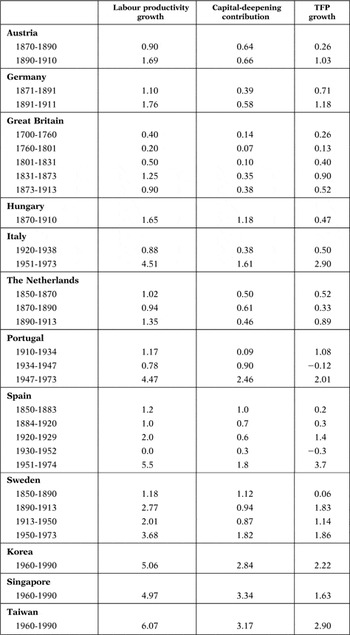
For other countries, the story is different. In Tables 2 and 3, the picture of modern economic growth in Europe through the 1970s is set out. The estimates reported in the former table show only two cases (Great Britain in 1801-1831 and Portugal in 1910-1934) where the TFP contribution to labour productivity growth is as much as 80 per cent. A distinctive aspect of Table 2 is that as modern economic growth spread across 19th century Europe TFP growth was initially quite modest and any tendency for TFP growth to dominate capital deepening is generally a post-1890 or post-take-off phenomenon. Looking at the top of Table 3, crude TFP growth does dominate capital deepening but even so the proportion accounted for is almost always less than 7/8ths.
SOURCES OF LABOUR PRODUCTIVITY GROWTH IN INDUSTRIALIZING ECONOMIES (PER CENT PER YEAR)

Notes: TFP: total factor productivity.
All estimates based on standard neoclassical formula and are re-calibrated with α = 0.35; Great Britain is UK after 1831.
Sources: Derived from data presented in the following original growth-accounting studies: Austria and Hungary: Schulze (Reference Schulze2007); Germany: Broadberry (Reference Broadberry1998); Great Britain: Crafts (Reference Crafts1995) and Matthews et al. (Reference Matthews, Feinstein and Odling-Smee1982); Italy: Rossi et al. (Reference Rossi, Sorgato and Toniolo1992); The Netherlands: Albers and Groote (Reference Albers and Groote1996); Portugal: Lains (Reference Lains2003); Spain: Prados de la Escosura and Roses (Reference Prados de la Escosura and Roses2009); Sweden: Krantz and Schon (Reference Krantz and Schon2007) and Schon (Reference Schon2004); Korea, Singapore and Taiwan: Bosworth and Collins (Reference Bosworth and Collins2003).
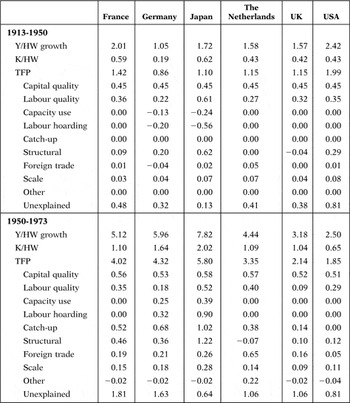
ACCOUNTING FOR GROWTH IN MADDISON’S SIX-COUNTRY STUDY (PER CENT PER YEAR)

Note: HW: hours worked, TFP: total factor productivity, Y: GDP.
Source: Derived from Maddison (Reference Maddison1987).
As Krugman (Reference Krugman1994) highlighted, and, as economic historians in the Gerschenkronian tradition might have predicted, rapid catch-up growth in the East Asian developmental states looks rather different from the earlier OECD experienceFootnote 3. In Korea, Singapore and Taiwan, the contribution of capital deepening has been formidable and exceeded that of TFP growth in the period 1960-1990Footnote 4. There is a strong contrast with the well-known cases of Italy, Japan and Spain in the Golden AgeFootnote 5.
In sum, it appears that the US growth record that Solow (Reference Solow1957) analysed was far from typical of the experience of other industrialized economies in the two centuries since the Industrial Revolution. Generally speaking, even without the refinements suggested by subsequent authors, which tend to downsize the role of TFP, the contribution of TFP growth to labour productivity growth is well below 7/8ths. Had Solow’s first growth-accounting estimate been made in the 1950s for Spain, the results would have been far less sensational.
2.2 TFP Growth does not equal the Rate of Technical Change
While Solow (Reference Solow1957) put the growth economics into growth accounting and showed that the residual could be interpreted as a measure of the rate of technical change, in practice, this is generally not the case. Indeed, the estimated rate of TFP growth can be either an under- or an overestimate of the contribution of technological change to labour productivity growth.
There are two important cases where it will be an underestimate. First, as noted in the previous section, if technological change is labour saving and the elasticity of substitution is less than one, then the rate of TFP growth obtained by imposing standard assumptions of a Cobb–Douglas production function with neutral technological change is too low. Second, if technological change is embodied in new types of capital goods, as economic historians often suggest and is common in endogenous-growth economics, then the technological change contribution would subsume both TFP and part of what is normally counted as capital-deepening (Barro Reference Barro1999).
On the other hand, especially when TFP growth is rapid, as in famous cases of catch-up growth, it is likely that there is a substantial component from reductions in inefficiency, both allocative and productive. For example, Maddison (Reference Maddison1987), like Denison (Reference Denison1967), concluded that much of the Solow residual was typically attributable to some combination of labour quality, improved allocation of resources, changes in the utilization of factors of production, reductions in technology gaps and economies of scale leaving only a modest share «unexplained» — and perhaps reflecting disembodied technical change (cf. Table 3).
Maddison’s list of the components of rapid TFP growth in the European Golden Age is broadly in line with conventional economic histories but precise quantification is, of course, very difficult and there is no consensus on the detailsFootnote 6. Maddison himself acknowledged that his exercise was rather speculative and papers in the empirical-growth literature cast doubt on its reliability without, however, amounting to an alternative decomposition. For example, Broadberry (Reference Broadberry1998) proposes a different calculation for the effect of structural change, which would increase its magnitude considerably; Badinger (Reference Badinger2005) offers an econometric estimation of the productivity implications of economic integration, which suggests that foreign trade was more important than Maddison suggests. Nevertheless, these are issues about the detail, not the principle.
It should be noted that the various components of TFP growth differ in relative importance over time while it is generally believed that the factor-saving bias of technological change has also varied, as indeed new growth economics suggests should be the case (Acemoglu Reference Acemoglu1998). This means that differences in the rate of TFP growth between periods may not be a good guide to comparative rates of technological change. This point is accentuated when it is recognized that growth-accounting estimates sometimes indicate negative TFP growth over lengthy periods, for example, as in much of Africa over the last decades of the 20th century (Bosworth and Collins Reference Bosworth and Collins2003). This seems much more plausibly interpreted as reflecting problems of inefficiency and capacity utilization rather then technological decline.
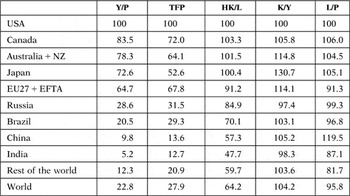
When growth accounting is used to compare levels of labour productivity across countries, it is now generally agreed that TFP gaps account a large part of the difference between rich and poor countries. Table 4 reports results from a recent study by Duval and de la Maisonneuve (Reference Duval and de la Maisonneuve2009), which show this and which confirm the basic findings in the much-cited paper by Hall and Jones (Reference Hall and Jones1999), which also notes that the TFP gaps seem to be strongly correlated with low levels of institutional quality.
DECOMPOSITION OF CROSS-COUNTRY DIFFERENCES IN GDP PER PERSON, 2005. (USA = 100)

Notes: TFP: total factor productivity, HK: human capital, P: population, NZ: New Zealand, EU27: the group of 27 countries that currently comprise the European Union, EFTA: European Free Trade Area, Y/P is measured at PPP.
Estimates derived by imposing the production function Y = Kα(AhL)1 − α where h is human capital per worker; Y is output, K is capital and L is labour.
This can be re-written as Y/L = (K/Y)α/(1 − α)Ah so that Y/P = (K/Y)α/(1 − α)Ah(L/P), which is the formula used for the decomposition.
Source: Duval and de la Maisonneuve (Reference Duval and de la Maisonneuve2009).
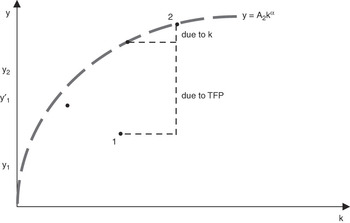
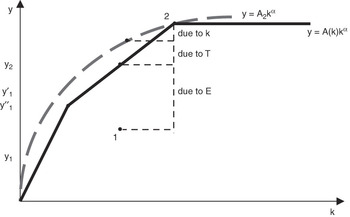
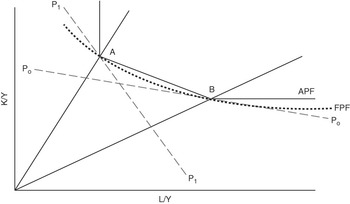
What explains low TFP levels in poor countries? This could represent inefficient use of factor inputs. But, it could also result from «inappropriate technology» in the sense that the technological advances in rich countries improve the production function at their factor endowments but not at those prevailing in poor countries contrary to the conventional neoclassical assumption that the production function improves proportionately at all factor intensities. So, the conventional decomposition of labour productivity differences into a component from TFP and a component from the capital to labour ratio, as in Figure 1A, is modified to allow for discontinuities in the production function as in Figure 1B. This allows TFP to be decomposed into a technology component and an inefficiency component.
Decomposition of Output Difference between Countries 1 and 2 under Appropriate Technology
Source: Jerzmanowski (Reference Jerzmanowski2007).

Decomposition of Output Difference between Countries 1 and 2 under Inappropriate Technology
Source: Jerzmanowski (Reference Jerzmanowski2007).

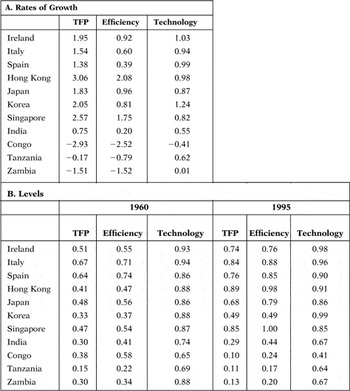
Jerzmanowski (Reference Jerzmanowski2007) implemented an analysis of this kind and some of his results are summarized in Table 5. These give some support to both hypotheses, though very low levels of TFP do seem to be primarily due to low efficiency, and suggest that negative TFP growth in Africa should be interpreted as due to reductions in efficiency rather than technological declineFootnote 7. Catch-up growth in East Asia and in Europe has resulted both from bridging the technology gap and from improvements in efficiency, albeit in quite different proportions in various countries. More generally though, the point that emerges is that TFP growth in excess of 1.5 per cent per year is generally to be interpreted as resulting from considerable improvements in efficiency as well as technology. Transferring labour out of agriculture is typically part of this but so is improving the management of firmsFootnote 8.
TECHNOLOGY AND EFFICIENCY AS SOURCES OF TFP GROWTH, 1960-1995 (PER CENT PER YEAR)

Notes: TFP: total factor productivity. The decomposition is based on assuming a production function yi = Aiki αhi 1 − α, Ai = TiEi and T(ki, hi) as in Figure 1B. α is assumed to be 0.33 and efficiency, Ei, is calculated from a data envelopment analysis. Then, technology, Ti, is backed out from = Ai/Ei where all variables are measured relative to the United States = 1.
Source: Derived from Jerzmanowski (Reference Jerzmanowski2007); additional observations kindly provided by author.
2.3 What Have General Purpose Technologies (GPTs) Meant for Productivity Growth?
The Solow Productivity Paradox was announced in 1987 with the comment that «You can see the computer age everywhere except in the productivity statistics». Subsequently, a great deal of effort was devoted to explaining this (Triplett Reference Triplett1999), and it was an important trigger for the literature on GPTs which developed models that had negligible or even negative impacts on productivity performance in their first phase, but substantial positive effects later. Indeed, a GPT can be defined as «a technology that initially has much scope for improvement and eventually comes to be widely used, to have many uses and to have many Hicksian and technological complementarities» (Lipsey et al. Reference Lipsey, Bekar and Carlaw1998, p. 43).
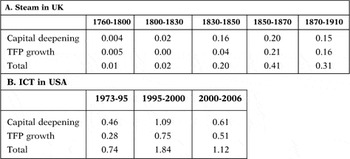
Table 6 compares the impact of two GPTs, namely, steam and ICT, in the leading economies of the time. These were indeed technologies in which the potential was not well understood in the early days. Thus, the pioneers of steam power did not realize its implications for transport over both land and sea and the early developers of microchips did not foresee the mobile phone and the Internet. While the improvement in microchip technology was forecast early on (Moore’s Law), the advantages of high pressure over low pressure steam only became clear many years after James Watt’s (1769) patent. Technological progress led to a dramatic fall of about 50 per cent per year in the cost of computing between 1950 and 2005 (Nordhaus Reference Nordhaus2007). By contrast, the cost of steam power fell by only about 7/8ths in total between 1760 and 1910 (Crafts Reference Crafts2004).
STEAM AND ICT CONTRIBUTIONS TO LABOUR PRODUCTIVITY GROWTH (PER CENT PER YEAR)

Notes: TFP: total factor productivity. «steam» includes stationary steam engines, railways and steam ships; «ICT» includes semi-conductors, computer hardware and software and telecommunications equipment.
Estimates based on a growth-accounting formula that distinguishes between information communication technology (ICT) or steam capital deepening and other capital deepening with appropriate factor-share weights and, using Domar weights, between TFP growth in ICT or steam power production and other TFP growth.
Sources: Crafts (Reference Crafts2004); Oliner et al. (Reference Oliner, Sichel and Stiroh2007)
Two points stand out from Table 6. First, it was a very long time after James Watt’s invention that steam had any significant effect on labour productivity growth. The long lag reflected the time it took to improve the technology so that it consumed less coal and became cost-effective — only about 165,000 horsepower were in use as late as 1830 (Kanefsky Reference Kanefsky1979). Second, the impact of ICT on the rate of productivity growth throughout 1973-2006 exceeded that of steam in any period and was already close to twice the maximum impact of steam in the late 1980s. Indeed, these estimates suggest that the cumulative impact of ICT on labour productivity by 2006 was about the same as that of steam over the whole 150-year period, 1760-1910.
The arithmetic of growth accounting immediately reveals why the initial impact of a GPT is relatively modest. Despite rapid growth in the use and productivity of the new technology, it has only a small weight in the economy as a whole. To an economic historian, the true paradox is that Solow’s ICT paradox was regarded as such, given that by earlier standards the contribution of ICT in the late 1980s was already stunning. A plausible inference seems to be that society is getting better at exploiting the opportunities presented by new GPTs; that may reflect a number of factors including more investment in human capital, superior scientific knowledge, improved capital markets and greater support for R & D by public policy.
2.4 User Benefits of New Technologies
One of the most famous episodes in cliometrics concerned the contribution of the railroads to 19th-century American economic growth. The best-known study was by Fogel (Reference Fogel1964) who pioneered the technique of social savings (SS) as a methodology. This is based on estimating the cost-savings of the new technology compared with the next best alternative. A contribution from railroad capital deepening is not included as it is assumed that this earned a normal profit equal to its opportunity cost so, in the absence of railroads, another investment would deliver an equal returnFootnote 9. The saving in resource costs was also taken to be equal to the gain in real national income (Fogel Reference Fogel1979, p. 3). This is valid if the rest of the economy is perfectly competitive with constant returns to scale (Jara-Diaz Reference Jara-Diaz1986). Imperfect competition or benefits from internal or external economies of scale in the transport-using sector will mean that the economic benefits exceed the transport benefits. The new economic geography suggests that we should take these seriously and this is an important agenda for future research; in growth-accounting terms this would amount to looking for TFP spillovers.
For railways the amount of SS was calculated as

where P T0 is the price of the alternative transport mode, water, P T1 is the price of rail transport and T 1 is the quantity transported by rail. Fogel deliberately intended this to be an upper-bound measure, constructed as if demand for transport was perfectly price inelastic, to compensate for omitted gains in the transport-using sector.
The natural interpretation of the gain in real income obtained from reducing resource costs in transportation is as an increase in TFP. Harberger (Reference Harberger1998) reminded us that TFP growth can be interpreted as real cost reduction and the price dual measure of TFP confirms that the rate of fall over time in the real cost of railroad transport under competitive conditions is also equal to TFP growth. Since railroads will only be introduced at the point where they can offer transport at the same cost as water transportation, if expressed as a contribution to the annual growth rate, the SS measure should equate to the own TFP growth contribution. Indeed, this equivalence is exactly how Foreman-Peck (Reference Foreman-Peck1991) extended the social saving estimate for British railways made by Hawke (Reference Hawke1970) for 1865-1890.
The price dual measure of TFP growth equivalent to equation [2] is

where r is the profit rate, w is the wage rate and p is output price. Thus, when input prices are constant, TFP growth equals the rate of nominal price decline.
Using this result, the rail SS in year t compared with the year of introduction, t − 1, expressed as a fraction of rail revenue is

or expressed as a fraction of GDP is

Rail SS as a proportion of GDP are revealed to be the percentage change in TFP in the rail industry multiplied by the ratio of rail output to GDP. The social saving approach is then equivalent to taking only the TFP and not the embodied capital contribution of an innovation.
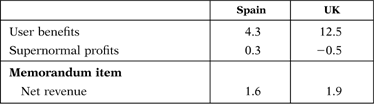
A major advantage of the social-saving methodology is that it focuses attention on the distribution of the benefits from a new technology together with how well these benefits are measured. In the case of railways, in both Spain and the United Kingdom, the evidence is that users got the lion’s share of the benefits in terms of cheaper and faster transport and that there were few supernormal profits, as Table 7 reports. This would not be a surprise to Nordhaus (Reference Nordhaus2004) who estimated that 98 per cent of the social gains from new technology went to the users and only 2 per cent to supernormal profits in the United States in the second half of the 20th century.
SOCIAL GAINS FROM RAILWAYS, 1912 (%GDP)
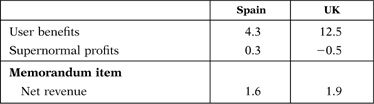
Sources: Herranz-Loncan (Reference Herranz-Loncan2006); Mitchell et al. (Reference Mitchell, Chambers and Crafts2009).
This discussion has been conducted entirely in terms of a closed economy. However, in an open economy, the users and producers of new technologies may be in different countries. Since the products of the new technology will experience falling prices, the impact of its production on real GDP will be greater that on real national income. History tells us that this consideration can be serious. The best example is probably cotton textiles during the British Industrial Revolution. Harley (Reference Harley1999) concluded that the welfare gain from the growth of cotton textiles during the Industrial Revolution was a little above 11 per cent of 1841 income, whereas valuing output of the sector without making a terms of trade correction would have shown a gain of 25 per cent. The social saving methodology by valuing gains from domestic use of new technology is a better guide to welfare benefits than the usual growth-accounting estimate.
Finally, it should be recognized that technological change may provide «new goods» that have previously unavailable characteristics and are imperfect substitutes for the old. This type of benefit, which reflects consumers’ willingness to pay for the new attribute, is ignored in conventional growth accounting, although it may be large as Hausman (Reference Hausman1997) showed when comparing mobile with landline telephones. For railways, the new characteristic was the speed of passenger travel. Indeed, time savings account for about half the SS in the United Kingdom in 1912 reported in Table 7. Implications for time use deserve to be taken seriously in the context of other technologies, most obviously ICT, as is suggested in an innovative paper by Goolsbee and Klenow (Reference Goolsbee and Klenow2006). They estimated that taking into account the opportunity cost of time saved, the consumer gains from the Internet in the United States in 2005 were $2500 per person rather than the $50 that resulted from a conventional consumer-surplus calculation.
3 Taking Advantage Of The Opportunities Of New Technology
Economic historians are fascinated by success and failure in long-run growth. They have always been inclined to believe that institutions and policies, that is, incentive structures, matter in this context even when mainstream economics claimed that they could only have levels rather than growth-rate effects. With the advent of endogenous growth theory and explicit analysis of the determinants of innovation, there is now much more common ground between economics and economic history, although significant differences of emphasis remain. Some of these stem from the explicitly internationally comparative nature of much work in economic history, and some from the perspective that results from looking at the process of adjusting to change as technology evolves and diffuses.
3.1 Appropriate Technology
As noted earlier, there has been considerable interest among economists recently in the hypothesis that technologies developed for the factor endowments and cost conditions of advanced countries may not improve the production function for poor countries (cf. Figure 1B). This idea looms larger in work by economic historians on the development and adoption of new technology, notably, with regard to the divergence between American and British technology during the 19th and early 20th centuries and also to the reasons why the Industrial Revolution happened first in Britain.
Habakkuk (Reference Habakkuk1962) famously claimed that land abundance and labour scarcity in the United States promoted rapid, labour-saving technological change. New economic historians spent quite a long time trying to pin down these arguments. Eventually, it was found that the United States was able to exploit complementarities between capital and natural resources to economize on the use of skilled labour in an important subset of American manufacturing (James and Skinner Reference James and Skinner1985) and that scale economies and technological change biased in favour of capital and materials-using were pervasive in manufacturing (Cain and Paterson Reference Cain and Paterson1986).
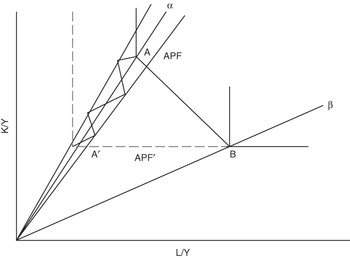
Following the lead of David (Reference David1975), Broadberry (Reference Broadberry1994) used Figures 2A and 2B to locate this as a situation of localized technological progress in the two economies, down the α and β rays rather than a universal inwards shift of a smooth isoquant. Although eventually the α technology might develop far enough to dominate at both sets of relative factor prices, it might remain inappropriate for the country starting from point B for a long time. Acemoglu (Reference Acemoglu2009) provides a model in the endogenous-innovation tradition that predicts an outcome like Figure 2B of faster technological change under conditions of labour scarcity if, as may well be the case for the 19th century, technology is biased in the direction of being strongly labour saving.


Looking at late-Victorian Britain, the flip side of this story is that innovations that were made in the United States were frequently inappropriate on the other side of the Atlantic because they were not cost-effective at British relative factor prices and/or market size; had they been profit-maximizing, competition in product markets would have ensured rapid adoption (Magee Reference Magee2004). Thus, allegations that «entrepreneurial failure» was to blame for the neglect of American technology made by writers such as Landes (Reference Landes1969) were misplaced and British business was exonerated. The implication is that lower TFP in British industry was unavoidable. Unlike the inappropriate-technology literature in economics, however, this is about the development of North–North rather than North–South technology.
Allen (Reference Allen2009) takes a global perspective on the first Industrial Revolution and argues that it happened in Britain because of the unique relative factor–price configuration there, in particular, the combination of very expensive labour and very cheap energy. He points to the success of famous innovations, for example, in textiles and metals, in changing factor proportions by using coal and saving labour — maybe this is best seen as induced factor substitution making available a new point on the available process frontier (APF) in Figure 2A.
Allen stresses that the new technologies of the Industrial Revolution were very expensive to develop and, since they were not profitable to adopt in other countries, the only place where it was rational to do the R & D was BritainFootnote 10. Eventually, as the Industrial Revolution technologies advanced, they became profitable to adopt in other countries with different factor prices and Britain’s advantage proved transient. Again, an endogenous innovation approach can help make this argument work in theory as well as in practice. The model of directed technical change in Acemoglu (Reference Acemoglu1998), in which profits to innovation are proportional to market size because of fixed costs of developing new technology, would be a possibility.
3.2 Social Capability and Schumpeterian Growth
For almost all countries including those which do substantial amounts of R & D such as France, Germany and United Kingdom, the main source of technological advance is technology transfer from abroad (Eaton and Kornum Reference Eaton and Kornum1999). This places a premium on the ability effectively to assimilate imported technology both in terms of speed of its diffusion and realization of its productivity potential. In a very influential paper, Abramovitz (Reference Abramovitz1986) phasized that catch-up by follower countries was by no means automatic but depended on «social capability», that is, having incentive structures based on institutions and policies that were conducive to the necessary investment and innovation.
The claim that institutions matter is, of course, characteristic of economic historians’ work on economic growth and development, most famously identified with North (Reference North1990). Here, since the mid-1990s, there has been a convergence between work on catch-up growth by economists and economic historians. Following the pioneering paper by Knack and Keefer (Reference Knack and Keefer1995), it quickly became routine to include a measure of the quality of formal institutions in growth regressions and to find that it is economically and statistically important (Bleaney and Nishiyama Reference Bleaney and Nishiyama2002). Similarly, since Hall and Jones (Reference Hall and Jones1999), it has become widely accepted that low TFP levels in poor countries is to a considerable extent due to inefficiency that persists in the context of bad institutions.
Clearly, there are important differences as well as similarities between these two literatures. In particular, there are features of the economic history work that have not yet been fully reflected in that of the economists. First, it is important to note the influential argument of Gerschenkron (Reference Gerschenkron1962) that at an early stage of development the institutions (and policies), which are appropriate, might differ from those desirable at more advanced stages of development. This entailed a more proactive role for the state, wider boundaries for the firm and greater reliance on relationship banking given the importance of co-ordination problems, inadequacy of the formal legal system and a premium on dealing with capital market failures. It is also relevant to note that reform to achieve a more orthodox stance once take-off has been achieved will probably be desirable but possibly difficult as proved to be the case in East Asia (Crafts Reference Crafts1999).
Second, the new institutional economic history stresses both the persistence of institutions and also the absence of any general tendency for good institutions to replace bad ones; a lot of weight is put on path dependence in institutional change (North Reference North2005). Once in place, institutional arrangements can develop network externalities and the support of the interest groups that they spawn. Informal as well as formal institutions matter but they are not readily amenable to «top-down» reform. Thus, «bad» or outmoded institutions, which arose through choices made long ago in different circumstances, may survive.
This suggests that many economists are over-optimistic about the prospects for catch-up and convergence in poor countries. If institutions matter and need continual reform to achieve full catch-up, it is very possible that countries either get stuck in a low-level equilibrium (much of Sub-Saharan Africa) or find catch-up easy to start but difficult to complete (e.g. Japan). Thus, the neoclassical prediction of future convergence of incomes appears to be very optimistic even though enthusiasts argue that, now that it is understood which institutions and policies are conducive to growth, in a globalized world rapid catch-up growth financed by capital inflows should be much easier to achieve (Lucas Reference Lucas2000). Similarly, the projections of future catch-up by the so-called Brazil, Russia, India and China (BRICs) economies that have been popularized by Goldman Sachs (Wilson and Purushothaman Reference Wilson and Purushothaman2003) have a mechanistic flavour which abstracts from the political economy of development.
It is useful to link the discussion of social capability to modern growth theory. The obvious way to do this is to consider the endogenous-innovation model proposed by Aghion and Howitt (Reference Aghion and Howitt2006) in which technological progress occurs through quality-improving innovations that render old products obsolete and which they describe as «Schumpeterian» because it entails creative destruction. This model can be simply captured by the following equations:

where y is output per worker and A is labour-augmenting technological progress.

where μ n and μ m are the frequencies with which, respectively, «leading-edge» and «catch-up» innovations occur, (A* − A) is the technology gap with the leader and γ is the multiple by which technology improves with a leading-edge innovation. Growth is increased by institutions and policies that increase μ n and/or μ m. Countries which are close to (far from) the frontier need to concentrate on developing a configuration that is good for μ n (μ m).
It should be noted that institutions and policies which are conducive to leading-edge innovations may be less effective or even adverse for catch-up innovations. Strong product-market competition policy may be a case in point, according to Aghion and Howitt (Reference Aghion and Howitt2006). For close-to-frontier situations encouraging entry threats stimulates innovation which will allow the domestic firm to survive whereas in far-from-frontier cases entry will lead to exit of the domestic firm whether it has innovated or not. As I explore below, a permutation on this idea with salience for economic history is that the institutions and policies that are good for one technological era (say, Fordism) are less appropriate for another era (say, ICT). The parallel with the Gerschenkronian perspective is readily apparent. It will be desirable to reform and for institutions and policies to evolve as countries progress through a process of catch-up. This may not be easy.
3.3 The Golden Age of European Economic Growth, 1950-1973
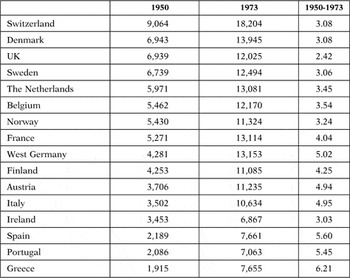
The Golden Age of European economic growth was an episode of strong β-convergence, as Table 8 suggests. Abramovitz and David (Reference Abramovitz and David1996) explained this in terms of increased «social capability» and «technological congruence» compared with the period after World War IFootnote 11. With regard to the former, an important aspect was the corporatist capitalism, highlighted by Eichengreen (Reference Eichengreen1996), that underwrote an investment boom. With regard to the latter, the point is that by now American technology was more appropriate for Europe as factor–price differences narrowed and European markets became more integrated (Nelson and Wright Reference Nelson and Wright1992)Footnote 12. The strengthening of competition together with trade liberalization also underpinned rapid TFP growth based on reductions in inefficiency (cf. Table 3).
LEVELS AND RATES OF GROWTH OF REAL GDP PER PERSON IN WESTERN EUROPEAN COUNTRIES ($1990GK AND PER CENT PER YEAR)

Source: Maddison (Reference Maddison2003).
The most striking hypothesis to explain enhanced social capability in postwar Europe is that of Eichengreen (Reference Eichengreen1996) who argued that the high investment rates which allowed successful exploitation of catch-up opportunities were facilitated by social contracts which sustained wage moderation by workers in return for high investment by firms. These «corporatist» arrangements provided institutions to monitor capitalists’ compliance and co-ordinated wage bargaining that protected high-investment firms and prevented free-riding by subsets of workersFootnote 13. In addition, the state provided «bonds» that would be jeopardized if labour defected on the agreements in the form of an expanded welfare state. Not all countries succeeded in achieving the co-operative equilibrium; West Germany did but the United Kingdom did not. Co-ordinated wage bargaining can be shown to have promoted investment and growth up to 1975 but not thereafter (Gilmore Reference Gilmore2009). The central foundation of a high-investment/wage moderation equilibrium is that both sides are willing to wait for jam tomorrow. By the 1970s, there were good reasons for patience to be much lower, including the greater mobility of capital and the productivity slowdown (Cameron and Wallace Reference Cameron and Wallace2002).
Although all countries grew rapidly by their own historical standards, some seized the opportunities of the Golden Age better than others. Table 8 suggests that West Germany outperformed and the United Kingdom under-performed relative to the predictions of an unconditional convergence regression; Table 3 points to weaker TFP growth in the United Kingdom as a key aspect. This reflects differences in social capability.
First, it is clear that West Germany was much more successful in human and physical capital accumulation. In 1973, capital per hour worked in West Germany was 35 per cent above the United Kingdom level and in 1978/9 only 34.5 per cent of West German workers were low skill compared with 72.8 per cent in the United Kingdom (O’Mahony Reference O’Mahony1999). This strong record of accumulation was based on corporatist institutions and an «insider» financial system that fostered relationship-specific long-term investments (Carlin Reference Carlin1996). Second, there was a major difference between the two countries in terms of industrial relations; whereas West Germany established a system of industrial unions, multiple unionism was quite prevalent in the United Kingdom. Multiple unionism makes the «hold-up problem» for investments in fixed capital much more serious and encourages free-riding by unions; Bean and Crafts (Reference Bean and Crafts1996) show that this exerted a significant penalty in terms of productivity growth for the United Kingdom. Third, there was weaker competition in the United Kingdom partly because of slower liberalization of external trade and partly because competition policy was a low priority and badly designed. Price–cost margins were much higher and supernormal profits more persistent in the United Kingdom than in West Germany (Crafts and Mills Reference Crafts and Mills2005; Geroski and Jacquemin Reference Geroski and Jacquemin1988). This mattered because United Kingdom firms suffered more from the agency problems that arise where shareholders are weak and for which competition is the antidoteFootnote 14. The United Kingdom evidence is that weak competition in the absence of a dominant external shareholder was associated with markedly inferior productivity performance (Nickell et al. Reference Nickell, Nicolitsas and Dryden1997).
Two points should be taken from this discussion. First, incentive structures do matter for the effective assimilation of new technology and for productivity growth and these have varied significantly across advanced European countries in the recent past. Second, the United Kingdom had problems in the areas of corporate governance with an extreme degree of separation of ownership and control which allowed bad management to continue and in industrial relations with a tradition of craft control of effort bargains. Both these historical legacies were sustained by weak competition and were serious handicaps to the effective assimilation of American technology in the United Kingdom but policymakers were unwilling to address these issues.
3.4 A Historical Perspective on the ICT Era
It is well-known that the United States has enjoyed a labour productivity growth revival since the mid-1990s and that, for the first time in the postwar period, this has outpaced average western European performance. About the same time, it became very clear that the Solow Productivity Paradox no longer applied as the ICT contribution to American productivity growth increased. A standard American perspective on recent European growth is that it has been handicapped by too much taxation, too much regulation and too little competition (Baily and Kirkegaard Reference Baily and Kirkegaard2004). It is clear that this is an accurate description of the average of European countries compared with the United States; it was, however, equally true for the 20 years or so before 1995 during which productivity growth in Europe was well above that in America and the European productivity catch-up continued (Crafts and Toniolo Reference Crafts and Toniolo2008).
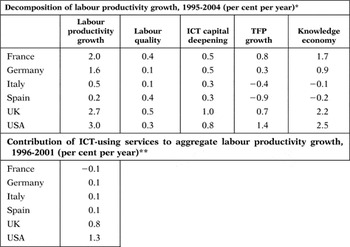
ICT has played a big part in the recent discrepancy between European and American productivity performance, as is reflected in Table 9. Both ICT-capital deepening and TFP growth were much stronger in the United States than in the large continental European economies, as was the contribution made by service sectors that use ICT intensively (such as retailing) to labour productivity growth. Investment in ICT capital also has a strong lagged effect on TFP growth in the same sector in the United States (Basu and Fernald Reference Basu and Fernald2007). This seems to reflect re-organization of production, workforce training and learning-by-using within firms (Brynjolfsson and Hitt Reference Brynjolfsson and Hitt2003)Footnote 15.
ICT AND POST-1995 EUROPEAN PRODUCTIVITY GROWTH

*Notes: TFP: total factor productivity. Estimates are for market sector and knowledge economy is sum of labour quality, information communication technology (ICT) capital deepening and TFP.
*Source: van Ark et al. (Reference van Ark, O’Mahony and Timmer2008)
**Note: ICT-using services include financial services and distribution.
**Source: Nicoletti and Scarpetta (Reference Nicoletti and Scarpetta2005).
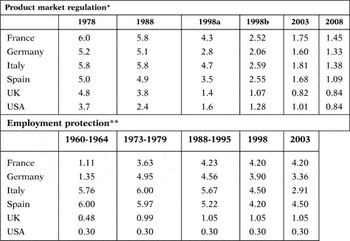
Recent research has found that the adverse effects of regulation on productivity performance are strongest in the face of new technological opportunities and have impacted strongly on the diffusion of ICT. Cross-country regression evidence shows that employment protection deters investment in ICT equipment (Gust and Marquez Reference Gust and Marquez2004) because re-organizing working practices and upgrading the labour force, which are central to realizing ICT’s productivity potential, are made more expensive. Restrictive product market regulation has deterred investment in ICT capital directly (Conway et al. Reference Conway, De Rosa, Nicoletti and Steiner2006) and the indirect effect of regulation through raising costs has been relatively pronounced in sectors that use ICT intensively. There has been a strong correlation between product market regulation and the contribution of ICT-using services (notably in distribution) to overall productivity growth (Nicoletti and Scarpetta Reference Nicoletti and Scarpetta2005). Stronger competition in close-to-frontier economies would have been beneficial in the recent past, as Aghion and Howitt (Reference Aghion and Howitt2006) argued, but perhaps the strongest reason for this would have been favourable effects on implementing technology transfer rather than creating leading-edge innovations.
Table 10 shows that regulation has been more tight in Europe than in the United States. At the same time, the picture is one of moves towards de-regulation in Europe in the last 20 years or so. Thus, the story is not that regulation has become more stringent but rather that existing regulation has become more costly in the context of a new technological era based on ICT. The United Kingdom has experienced a relatively strong contribution to productivity growth from the regulation-sensitive ICT-using services sector and ICT capital deepening has been above the EU average. As a lightly regulated economy characterized by strong competition, since the Thatcher reforms the United Kingdom has been better positioned than the other big European economies to prosper in the ICT era. This has been reflected in TFP growth and relatively strong contributions to productivity growth from both ICT-using services and ICT capital deepening. In a sense, this can be seen as an unexpected bonus from the failure to establish a successful corporatist model in an earlier generation. By the same token, the downside of success based on corporate capitalism in the Golden Age is also apparent.
REGULATION INDICES (0-6)

*Notes: The years 1978 through 2008 are each on a comparable basis; product market regulation is conceptualized as regulation that inhibits competition. A higher score indicates more regulation.
*Sources: Conway and Nicoletti (Reference Conway and Nicoletti2006); Wolfl et al. (Reference Wolfl, Wanner, Kozluk and Nicoletti2009).
**Notes: «Employment protection» is conceptualized as equivalent to a tax on labour force adjustment. A higher score indicates more employment protection.
**Source: Nickell (Reference Nickell2005).
4 Conclusions
Growth accounting has been widely used by economic historians and some important findings have emerged from the research of the past three decades. First, it is clear that it is not generally the case that 7/8ths of labour productivity growth comes from technical change and this famous result in Solow (Reference Solow1957) now appears to be a bit of an outlier. Across other countries and in other time periods, capital deepening accounts for rather more than 1/8th of labour productivity growth. Moreover, particularly when Solow’s residual is big, technical change only accounts for part of TFP growth while reductions in inefficiency play an important part. Second, we now know that even really important new technologies only have a small impact on productivity growth in the early days. This was the message as long ago as the study of railroads by Fogel (Reference Fogel1964), but the weighting scheme inherent in growth accounting clarifies why this is the case. ICT is historically remarkable and the Solow productivity paradox was a mirage. Third, it is well worth considering to whom and how the benefits of new technology accrue. This draws attention to the point that, in the medium term, the users are typically the big gainers and that some of their consumer surplus comes from the «new-good» attributes of the technology.
Economic historians have been right to emphasize the importance of what Abramovitz and David (Reference Abramovitz and David1996) called «social capability» and «technological congruence» in understanding when countries are able to benefit from new technology. Incentive structures are clearly central to understanding the development and, much more importantly, the diffusion and effective assimilation of new technologies. Given that the development of new technology is concentrated in relatively few countries and is influenced by its expected profitability in the home market, it is perhaps not surprising that this technology is sometimes «inappropriate» in other parts of the world. This is important for the understanding of episodes both of falling behind and of rapidly catching up. Moreover, the effective use of new technologies depends on institutions and it must be acknowledged that the requirements of different technological eras are not the same. As the post-war economic history of Europe shows, the policy implications of this are important but not easy to address.