Introduction
It is well known that depression and coronary heart disease (CHD) often overlap and both behavioural and biological explanations have been proposed (McCaffery et al. Reference McCaffery, Frasure-Smith, Dube, Theroux, Rouleau, Duan and Lesperance2006). Among the latter, systemic low-grade inflammation has been identified as a common pathophysiological marker for both depression and CHD (Skala et al. Reference Skala, Freedland and Carney2006). The causal and temporal mechanisms underpinning these interrelations, however, have not been fully elucidated. Nevertheless, evidence is emerging that depression and CHD share genetic vulnerability, mainly mediated by disturbed regulation of inflammatory processes and serotonin metabolism (McCaffery et al. Reference McCaffery, Frasure-Smith, Dube, Theroux, Rouleau, Duan and Lesperance2006).
The evidence of a connection between CHD and inflammation is strong (Lesperance et al. Reference Lesperance, Frasure-Smith, Theroux and Irwin2004; Miller et al. Reference Miller, Freedland, Duntley and Carney2005; McCaffery et al. Reference McCaffery, Frasure-Smith, Dube, Theroux, Rouleau, Duan and Lesperance2006) and a temporal relationship of early inflammation leading to endothelial dysfunction and prothrombotic factors has been suggested. Also, there is increasing interest in endothelial dysfunction as a link between depression and CHD in clinical patient samples (Rajagopalan et al. Reference Rajagopalan, Brook, Rubenfire, Pitt, Young and Pitt2001; Broadley et al. Reference Broadley, Korszun, Jones and Frenneaux2002). In support of this, the SADHART Study (Serebruany et al. Reference Serebruany, Glassman, Malinin, Sane, Finkel, Krishnan, Atar, Lekht and O'Connor2003) and a study by Lesperance et al. (Reference Lesperance, Frasure-Smith, Theroux and Irwin2004) confirmed that both endothelial activation and inflammatory markers were higher in the depressed compared with the non-depressed patients recovering from acute CHD.
Population studies have reported a cross-sectional association of depression with elevated inflammation parameters in young and middle-aged men (Danner et al. Reference Danner, Kasl, Abramson and Vaccarino2003; Empana et al. Reference Empana, Sykes, Luc, Juhan-Vague, Arveiler, Ferrieres, Amouyel, Bingham, Montaye, Ruidavets, Haas, Evans, Jouven and Ducimetiere2005; Liukkonen et al. Reference Liukkonen, Silvennoinen-Kassinen, Jokelainen, Rasanen, Leinonen, Meyer-Rochow and Timonen2006), whereas this connection has not been firmly established in women (Danner et al. Reference Danner, Kasl, Abramson and Vaccarino2003; Empana et al. Reference Empana, Sykes, Luc, Juhan-Vague, Arveiler, Ferrieres, Amouyel, Bingham, Montaye, Ruidavets, Haas, Evans, Jouven and Ducimetiere2005; De et al. Reference De, Campanella, Gambi, La, Carano, Conti, Sivestrini, Serroni, Piersanti, Di, Moschetta, Cotellessa, Fulcheri, Salerno and Ferro2006; Liukkonen et al. Reference Liukkonen, Silvennoinen-Kassinen, Jokelainen, Rasanen, Leinonen, Meyer-Rochow and Timonen2006). A recent Australian population study of 5438 elderly men, however, suggests that frailty and co-morbid physical illnesses explained the association of depression with elevated C-reactive protein (CRP) in their sample (Tiemeier et al. Reference Tiemeier, Hofman, van Tuijl, Kiliaan, Meijer and Breteler2003; Almeida et al. Reference Almeida, Norman, Hankey, Jamrozik and Flicker2007). The largest review of the relationship between inflammatory markers and depression to date (Howren et al. Reference Howren, Lamkin and Suls2009) suggests that associations are stronger in clinical patient samples than in community-based samples and more so when diagnosis of depression was confirmed by clinical interviews compared with self-report. While BMI was found to be a mediating factor between inflammation and depression in the same meta-analysis, associations were inconsistent with regard to age, medication and gender.
We therefore investigated these associations in 9258 women and men of all ages from the general population who participated in the Nord-Trøndelag Health Study (HUNT 2, 1995–97). CRP levels were compared across four groups: healthy controls; participants with current depression; participants with previous myocardial infarction (MI); or both. Depression symptoms were self-reported using the Hospital Anxiety and Depression Scale (HADS).
Method
Study sample
All residents of Nord-Trøndelag County in Norway aged ⩾20 years were invited to participate in HUNT 2, which included a physical examination and self-completed questionnaires. Specially trained nurses assessed height and weight, measured blood pressure and drew blood samples from all participants (Holmen et al. Reference Holmen, Midthjell, Kruger, Langhammer, Holmen, Bratberg, Vatten and Lund-Larsen2003). High-sensitive CRP (hs-CRP) was measured in a random sample of 10 030 participants aged 20–94 years from HUNT 2. Of these, 9258 (95%) subjects who had CRP values <10 mg/l and also had valid HADS scores for anxiety and depression were included in this study. Subjects with CRP values ⩾10 mg/l were excluded to avoid inclusion of participants with possible major ongoing infections or inflammatory processes influencing CRP level. This was done for both cases and controls. In the study group, 920 subjects (9.9%) reached caseness for depression, 214 reported previous MI (2.3%) and 50 (0.5%) reported both conditions. The reference group, 8074 people (87.2%), had none of these conditions.
Measures
HADS
The HADS is a widely used self-rating scale especially designed to detect anxiety and depression in CHD patients (Snaith & Zigmond, Reference Snaith and Zigmond1986). It has shown good psychometric properties across various patient samples and settings (Bjelland et al. Reference Bjelland, Dahl, Haug and Neckelmann2002). HADS consists of seven items for depression (HADS-D) and seven for anxiety (HADS-A), each with a 4-point ordinal scale to describe symptom severity: from 0 (not present) to 3 points (strongly present). HADS-D covers mainly anhedonia and loss of interest, which are core depressive symptoms. As recommended in the literature, cut-off for HADS-D score was set at ⩾8 points (Bjelland et al. Reference Bjelland, Dahl, Haug and Neckelmann2002).
hs-CRP
Blood samples were collected when the subjects attended the physical examination in HUNT 2, where they also filled in the questionnaires. Serum was stored at −80°C and CRP levels were measured approximately 2 years after the serum was collected. The analysis was performed at an accredited, biomedical laboratory using their standard assay for CRP analysis, the CRP (Latex) US (Hoffman-La Roche AG, Switzerland). The assay provider (Hitachi/Roche) has tested the assay reproducibility both within run [% coefficient of variation (CV) 0.43–1.34] and between days (% CV 2.51–5.70) as well as a method comparison (r=0.996). The tested sample concentrations were between 0.11 and 18.63 mg/l. A systematic literature review (Kuo et al. Reference Kuo, Yen, Chang, Kuo, Chen and Sorond2005) showed that there is no consensus regarding the cut-off for elevated levels of hs-CRP. Previous studies of CRP levels in depression and vascular diseases have applied cut-off values ranging from 1 mg/l to 10 mg/l (Kuo et al. Reference Kuo, Yen, Chang, Kuo, Chen and Sorond2005), yet the most commonly used cut-off levels are between 2.0 mg/l and 3.0 mg/l (Ridker et al. Reference Ridker, Buring, Cook and Rifai2003; Ford & Erlinger, Reference Ford and Erlinger2004; Elovainio et al. Reference Elovainio, Keltikangas-Jarvinen, Pulkki-Raback, Kivimaki, Puttonen, Viikari, Rasanen, Mansikkaniemi, Viikari and Raitakari2006; Kojima et al. Reference Kojima, Kojima, Suzuki, Oguchi, Oba, Tsuchiya, Sugiura, Kanayama, Furukawa, Tokudome and Ishiguro2009). Further, many studies have chosen to compare the highest with the lowest quartile on CRP. In this study, elevated hs-CRP was defined as values >2.2 mg/l, which represents the highest quartile in the HUNT cohort. In line with some previous studies, we chose to exclude subjects with CRP values ⩾10 mg/l to avoid inclusion of participants with ongoing infections or other major physical conditions that influence CRP level (Rodriguez-Moran & Guerrero-Romero, Reference Rodriguez-Moran and Guerrero-Romero1999; Ajani et al. Reference Ajani, Ford and Mokdad2004).
Other variables and confounding factors
Information on age, place of residence and marital status was obtained from the National Population Registry. The other variables were self-reported. University level of education was defined as ⩾4 years at a university or college. Students and people who did not receive any kind of financial support from social services or from a pension were classified as employed. The smoker group consisted of daily cigarette smokers. High alcohol intake was defined as alcohol consumption more than five times per month. The presence of one or more of the following conditions was defined as ‘chronic physical illness’: self-report of diagnosis of asthma; MI; angina pectoris; stroke; diabetes; or cancer.
Statistics/analysis
SPSS version 15.0 was used for data analysis (SPSS Inc., USA). Univariate analysis of variance was used for estimation of differences between group means while differences between group frequencies were examined with χ2 tests in Table 1. Cut-off for depression was set to HADS-D ⩾8. Those who filled in only five or six items on HADS-A and HADS-D were included in the study; missing scores were substituted based on the sum of completed items multiplied by 7/5 or 7/6, respectively. A binary logistic model was used to quantify associations of depression, MI or both with elevated hs-CRP levels. The values of hs-CRP levels are skewed and we could only observe weak linear relationships between the dependent variable and the covariates. Log values for hs-CRP were less skewed than the observed values, but neither distribution was normal. In Table 2, binary logistic regression analyses were used to quantify associations of depression, MI, or both, with elevated CRP levels. Adjustment was first made for age and gender and then blockwise cumulative adjustment for all relevant confounding or mediating factors was performed. Continuous variables, age and BMI, were tested for linearity through the CRP-quartiles where BMI proved to be linear but age was not. The upper quartile of age was associated with elevated CRP levels, and age was dichotomized at the upper quartile (63 years). In the last step of the analysis (final model), variables not contributing to the association of depression with CRP level were removed from the model and we then tested for possible biological interactions of age, gender or BMI with depression on CRP. Results are presented as odds ratios (OR). To test for a possible dose–response relationship, different cut-off levels for HADS-D were tested in the fully adjusted model. Two-sided tests were used where applicable.
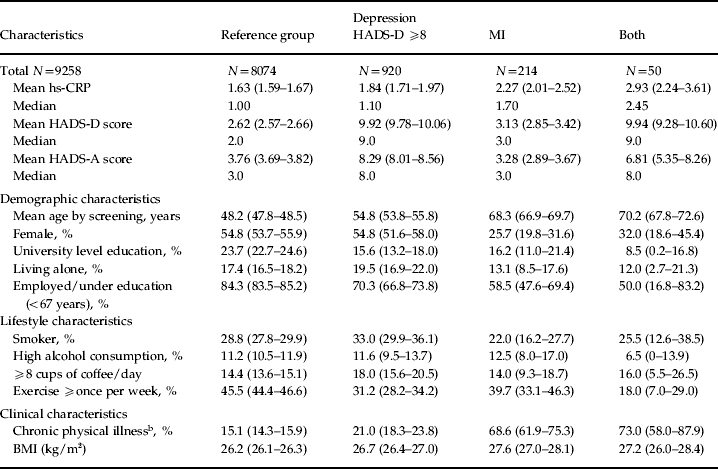
Sample characteristics in HUNT 2 (1995–97)Footnote a for participants with depression, MI, both and the reference group (neither MI nor depression)

MI, Myocardial infarction; HADS-D, Hospital Anxiety and Depression Scale – Depression; hs-CRP, high sensitive C-reactive protein; HADS-A, Hospital Anxiety and Depression Scale – Anxiety.
95% confidence intervals are shown in parentheses for each estimate.
a See Holmen et al. (Reference Holmen, Midthjell, Kruger, Langhammer, Holmen, Bratberg, Vatten and Lund-Larsen2003).
b One or more of the following conditions: asthma; angina pectoris; stroke; diabetes; cancer.
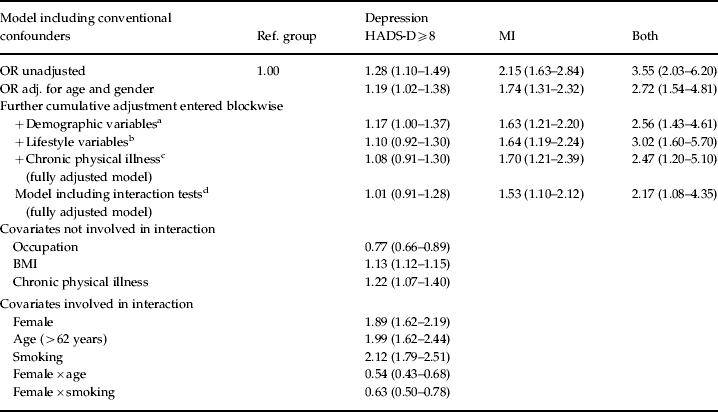
Multivariate logistic regression model

HADS-D, Hospital Anxiety and Depression Scale – Depression;
Odds ratios (OR) and 95% confidence intervals for elevated C-reactive protein (CRP) >2.2 mg/l in subjects with depression, myocardial infarction (MI) or both, compared with reference group.
a Educational level, occupation and cohabitation status.
b BMI, exercise, smoking habits, coffee and alcohol consumption.
c Asthma, angina pectoris, stroke, diabetes and cancer.
d This model includes the statistically significant variables from the first model and the two significant interaction terms that were identified (p<0.05).
Ethics
The Norwegian Data Inspectorate, the Regional Committee for Ethics in Medical Research and the HUNT Publication Review Board approved the protocols for HUNT 2 and for this study. All participating subjects in this study provided written consent.
Results
Mean hs-CRP values and HADS-D score were higher in all three study groups compared with the reference group (Table 1). While 54% of the reference group and the depression group were female, only 25% and 32% were female in the MI and co-morbid groups, respectively. Mean age increased through the four groups. There were important sociodemographic differences between the four groups; the most prominent were lower educational level, lower degree of employment, and less frequent exercising among the depressed, the MI group and the co-morbid group.
Table 2 shows that there was a crude association of depression with elevated CRP (OR 1.28, p=0.001), yet this effect was mostly explained by confounding factors and the OR was attenuated towards the null in the fully adjusted model (OR 1.08, p=0.388). Risk for increased CRP levels was elevated in the MI group and co-morbid group with OR of 1.70 (p=0.002) and 2.47 (p=0.014) respectively in the fully adjusted models. Other factors positively associated with risk for increased CRP were female gender (OR 1.34, p<0.001), age >62 years (OR=1.41, p<0.001), smoking (OR 1.69, p<0.001), other chronic diseases (OR 1.23, p=0.004) and BMI (OR 1.13, p<0.001). Both employment (OR 0.77, p=0.001) and high coffee consumption (OR 0.86, p=0.052) were associated with lower CRP levels. In contrast, educational level (p=0.299), cohabitation status (p=0.330), exercise (p=0.133) and alcohol intake (p=0.639) showed no strong association with CRP level in multivariable analysis. We found no clear evidence of a dose–response relationship in the association of depression with elevated CRP. In the fully adjusted model, the OR were 1.15 (p=0.33) and 1.39 (p=0.15) when applying HADS-D cut-off levels of 11 and 13, respectively. Interaction effects were found for age×female gender (OR 0.54, p<0.001) and smoking×female gender (OR 0.63, p<0.001) on risk for elevated CRP in the three study groups, indicating a reduced effect of age and smoking, respectively, on elevated CRP for females compared with males.
Discussion
In line with recent well-designed studies (De et al. Reference De, Campanella, Gambi, La, Carano, Conti, Sivestrini, Serroni, Piersanti, Di, Moschetta, Cotellessa, Fulcheri, Salerno and Ferro2006; Howren et al. Reference Howren, Lamkin and Suls2009), our overall findings indicate that the association of raised CRP with depression in the general population is weak and seems to be confounded by age, gender, smoking, physical illness and BMI. Further, our results suggest that a possible explanation for gender-specific patterns might be a lower effect of smoking and old age on CRP level in women compared with men. CRP levels were raised in the MI group, and the highest risk for raised CRP levels occurred in the elderly with co-morbid MI and depression.
Strengths and weaknesses
This study has some advantages compared with earlier studies. First, the sample size is large and both cases and controls come from a representative sample of the general population. Second, while many previous studies have been restricted to depression or MI and have often investigated males within certain age groups, our sample included both depression and MI in both genders across the adult lifespan. Third, a large range of confounding variables, often lacking in previous studies, were available in HUNT 2.
However, important limitations need to be addressed. This is a cross-sectional analysis and therefore reverse causality cannot be ruled out. Further, although CRP levels were increased in two of the study groups, we cannot exclude the possibility of residual confounding accounts for this effect. Depression was self-reported in the HADS, while previous studies have often used either diagnostic interviews or other self-report instruments. Results might therefore not be directly comparable between these studies. Finally, self-report of MI makes misclassification possible, yet there is good evidence that this method is valid and reliable (Okura et al. Reference Okura, Urban, Mahoney, Jacobsen and Rodeheffer2004).
Association of CRP with depression
Almeida et al. (Reference Almeida, Norman, Hankey, Jamrozik and Flicker2007) recently demonstrated a modest association of CRP with depression in an elderly, male population sample. Nevertheless, the effect was mostly explained by physical health and other confounding factors. Two Dutch population studies of large, elderly samples suggest that relationships between depression and other markers of inflammation might be different. The Longitudinal Aging Study of Amsterdam (Bremmer et al. Reference Bremmer, Beekman, Deeg, Penninx, Dik, Hack and Hoogendijk2008) and a study of 3884 adults aged ⩾60 years in Rotterdam (Tiemeier et al. Reference Tiemeier, Hofman, van Tuijl, Kiliaan, Meijer and Breteler2003) showed evidence of association of interleukin (IL)−6, but not CRP, with depression in both genders. Population studies that have reported a cross-sectional association of depression with elevated inflammation parameters in men aged <40 years (Danner et al. Reference Danner, Kasl, Abramson and Vaccarino2003; Liukkonen et al. Reference Liukkonen, Silvennoinen-Kassinen, Jokelainen, Rasanen, Leinonen, Meyer-Rochow and Timonen2006) might not have adequately adjusted for physical illness. However, the relatively low incidence of chronic physical illness in this age group may make adjustment unnecessary. Our findings support the notion that old age, life-style and chronic illness explain the association of elevated CRP with depression, yet patterns of CRP response in depression in regard to age remain somewhat conflicting (Howren et al. Reference Howren, Lamkin and Suls2009).
Interestingly, the largest meta-analysis on the connection between CRP, IL-1 and IL-6 and depression ever performed (Howren et al. Reference Howren, Lamkin and Suls2009) concludes that IL-6 and CRP response might show opposite directions in females and males; while IL-6 was more strongly related to depression in females, but not males, the opposite was seen for CRP. Results from our interaction test model suggest that divergent findings regarding age and gender can be explained by a lower effect of smoking and old age, two major confounders in the association of depression with inflammation, on CRP level in women compared with men.
A study by Miller et al. (Reference Miller, Freedland, Carney, Stetler and Banks2003) investigated the interrelationships between adiposity, depression and inflammatory markers in 50 depressed and 50 non-depressed otherwise healthy adults. Their results supported the hypothesis that weight gain in the depressed activates inflammatory response and identified two pathways to IL-6 upregulation: one mediated by expanded adipose tissue; the other by leptin-induced release of IL-6 by white blood cells. Theoretically, depressive symptoms might also emerge as a consequence of weight gain and inflammatory response, yet the same study did not find any support for this. In line with these observations, and the findings in our study, two recent reviews (De et al. Reference De, Campanella, Gambi, La, Carano, Conti, Sivestrini, Serroni, Piersanti, Di, Moschetta, Cotellessa, Fulcheri, Salerno and Ferro2006; Howren et al. Reference Howren, Lamkin and Suls2009) concluded that BMI is an important mediating or moderating factor in both clinical and population samples.
Of note, elevated CRP levels were positively associated with severity of depressive illness in young men in the Northern Finland 1966 Birth Cohort Study (Liukkonen et al. Reference Liukkonen, Silvennoinen-Kassinen, Jokelainen, Rasanen, Leinonen, Meyer-Rochow and Timonen2006). We could not replicate this in our study. The cut-off limit for elevated CRP varied from 1.0 mg/l to 3.2 mg/l in the above-mentioned studies, which, along with several other differences in sampling and methods, could, at least in part, explain the divergent findings.
Association of CRP with MI and co-morbid MI and depression
IL-6 and CRP are known as predictors for CHD (Miller et al. Reference Miller, Freedland, Carney, Stetler and Banks2003), yet the mechanisms linking inflammation, depression and heart disease are far from resolved. In our study, we confirm the cross-sectional association of CRP with MI, as found in previous studies. In addition, our findings indicate that co-morbid depression in established CHD, in particular in the elderly, strongly increases risk for elevated CRP levels. Along the same lines, the SADHART Study (Serebruany et al. Reference Serebruany, Glassman, Malinin, Sane, Finkel, Krishnan, Atar, Lekht and O'Connor2003) found that endothelial activation was higher in association with co-morbid CHD and depression than in CHD alone. Further, Lesperance et al. (Reference Lesperance, Frasure-Smith, Theroux and Irwin2004) studied 841 subjects recovering from acute CHD and confirmed that both endothelial activation and inflammatory markers were higher in the depressed compared with the non-depressed. In support of this, the large meta-analysis by Howren et al. (Reference Howren, Lamkin and Suls2009) linked depression to elevated CRP and IL-6 levels in patients with cardiac disease or cancer.
There may be several pathways that contribute to our observations. For instance, IL-6, often elevated in depression, is a promoter for the synthesis of CRP in the liver (Kiecolt-Glaser & Glaser, Reference Kiecolt-Glaser and Glaser2002). Further, IL-6 and CRP are both predictors of CHD and MI, which, in turn, increase risk for depression. Therefore, the high CRP levels observed in the co-morbid group might be explained by separate, cumulative effects related to both depression and MI. Alternatively, depression might serve as a marker for more severe CHD.
In contrast, in a study of 984 out-patients with established CHD, current depression was associated with significantly lower levels of CRP, IL-6 and fibrinogen (Whooley et al. Reference Whooley, Caska, Hendrickson, Rourke, Ho and Ali2007). The authors discuss both as a possible decrease in IL-6-secreting monocytes in the depressed and a ceiling effect in which depression cannot further increase inflammation in this relatively old and co-morbid patient sample. Interestingly, Lawlor et al. (Reference Lawlor, Smith, Rumley, Lowe and Ebrahim2005) found that socio-economic adversities and other confounding factors entirely explained the association of fibrinogen and CRP with prevalent and incident CHD. Their sample, however, was limited to women aged 60–79 years and did not investigate co-morbid depression.
In sum, it is plausible that the connection between depression and inflammation is bidirectional, although the meta-analysis by Howren et al. (Reference Howren, Lamkin and Suls2009) does not resolve this particular question. Fortunately, one of the latest studies in this field (Gimeno et al. Reference Gimeno, Kivimaki, Brunner, Elovainio, De, Steptoe, Kumari, Lowe, Rumley, Marmot and Ferrie2009) managed to shed important light on these mechanisms. In a 12-year follow-up study of more than 3000 British civil servants, both CRP and IL-6 levels at baseline predicted cognitive symptoms of depression at follow-up, whereas the same depressive symptoms at baseline did not predict change in inflammatory markers at follow-up.
Depression and psychological stress have the potential to cause inflammation through sympathetic and parasympathetic response or enhanced endothelial cell activation (Hestad et al. Reference Hestad, Aukrust, Tonseth and Reitan2009) and immunoactivation per se, which has been shown in both animal studies (Lestage et al. Reference Lestage, Verrier, Palin and Dantzer2002) and in the context of medical treatment (Capuron et al. Reference Capuron, Ravaud, Gualde, Bosmans, Dantzer, Maes and Neveu2001). In the latter study, IL-based treatment induced a ‘sickness behaviour’ characterized by lethargy, lowered mood, cognitive disturbance and altered sleep. CRP levels could be acting as a marker of such immunoactivation (Raison et al. Reference Raison, Capuron and Miller2006; Hestad et al. Reference Hestad, Aukrust, Tonseth and Reitan2009).
Conclusion
The literature indicates that there is a differential association of raised CRP levels with depression between the genders and across the adult lifespan and our findings suggest that this could be due to a lower effect of smoking and old age on CRP levels in women compared with men. These findings require confirmation in future studies as they have no clear-cut explanation and were not postulated a priori. Further, the clinical relevance and the neurobiological mechanisms explaining the link between inflammation and depression, including different subtypes of depression, should be further investigated to examine whether targeting pro-inflammatory cytokines and their signalling pathways might be a novel strategy for treatment of these conditions.
As many cytokines possess both pro- and anti-inflammatory properties, depending on context (Hestad et al. Reference Hestad, Aukrust, Tonseth and Reitan2009), we suggest that future studies include measurements and genetic markers related to a wider range of inflammation markers and thrombogenetic factors in order to answer many of the remaining questions.
Acknowledgements
Nord-Trøndelag Health Study (The HUNT Study) is a collaboration between HUNT Research Centre, Faculty of Medicine at the Norwegian University of Science and Technology (NTNU, Verdal), Norwegian Institute of Public Health and Nord-Trøndelag County Council. The study was partly funded by the Health Trust Nord-Trøndelag Research Foundation.
Declaration of Interest
None.