Introduction
Informal carers are usually the relatives or friends of those suffering from illness or disability. Carers often deal with a wide range of difficulties, sometimes over many years, including supervision of patients' medical care and self-care, responsibility for domestic chores and financial burdens, disruption of their social relationships and worries about the health of the patient. There is a growing literature documenting that carers of patients with mental illness show high levels of distress, anxiety and depression (Chakrabarti et al. Reference Chakrabarti, Kulhara and Verma1992; van Wijngaarden et al. Reference van Wijngaarden, Schene and Koeter2004).
It has been postulated that disruption of the hypothalamo–pituitary–adrenal (HPA) axis is a physiological mechanism by which environmental stress can lead to mental illness, such as depression (Nemeroff & Vale, Reference Nemeroff and Vale2005), and physical illness, such as infections (Dyck et al. Reference Dyck, Short and Vitaliano1999). This may therefore account for the fact that carers are more likely to develop depression than non-carers, and show attenuated immune responses (Vedhara et al. Reference Vedhara, Cox, Wilcock, Perks, Hunt, Anderson, Lightman and Shanks1999). Such physiological disruption has been studied primarily in carers of patients with dementia. These studies have found several HPA axis changes: raised cortisol levels (Vedhara et al. Reference Vedhara, Cox, Wilcock, Perks, Hunt, Anderson, Lightman and Shanks1999; Bauer et al. Reference Bauer, Vedhara, Perks, Wilcock, Lightman and Shanks2000; Da Roza Davis & Cowen, Reference Da Roza Davis and Cowen2001; de Vugt et al. Reference de Vugt, Nicolson, Aalten, Lousberg, Jolle and Verhey2005; Gallagher-Thompson et al. Reference Gallagher-Thompson, Shurgot, Rider, Gray, McKibbin, Kraemer, Sephton and Thompson2006), with blunting of the axis in response to stress (de Vugt et al. Reference de Vugt, Nicolson, Aalten, Lousberg, Jolle and Verhey2005) and flattening of the diurnal cortisol profile (Gallagher-Thompson et al. Reference Gallagher-Thompson, Shurgot, Rider, Gray, McKibbin, Kraemer, Sephton and Thompson2006). However, these studies are limited by inadequate control of confounding factors and the use of individual rather than repeat cortisol measures, which are subject to high variability.
Few studies have looked at carers of patients with depression, and those that are available have assessed depressive disorders as a heterogeneous group. These have shown substantial burden and psychological distress (Chakrabarti et al. Reference Chakrabarti, Kulhara and Verma1992; van Wijngaarden et al. Reference van Wijngaarden, Schene and Koeter2004). However, the consequences of the most severe and persistent presentations, that is of treatment-resistant depression (TRD) for carers, have not yet been evaluated. TRD is common, affecting up to 30% of those with depression (Greden, Reference Greden2001), and by extension their carers, and given its chronicity and severity, the consequences for carers are likely to be more severe. Thus, the overall burden may be comparable to illnesses such as dementia and schizophrenia. Furthermore, carer burden is a crucial public health issue as it may affect not only the health of carers but also the long-term outcome of patients. There is evidence from cross-sectional (Perlick et al. Reference Perlick, Stastny, Mattis and Teresi1992), longitudinal (Perlick et al. Reference Perlick, Rosenheck, Clarkin, Maciejewski, Sirey, Struening and Link2004) and interventional (Magliano et al. Reference Magliano, Fiorillo, Malangone, De Rosa and Maj2006) studies that carer stress is associated with poor outcome in patients with schizophrenia and bipolar disorder, but this has not yet been studied in the carers of patients with depression or TRD.
In this study, we had three main aims: (1) to assess the extent of psychological burden among carers of patients with TRD, (2) to assess HPA-axis activity in these carers, and (3) to determine whether HPA-axis change in carers is associated with poor outcome in patients. HPA-axis activity was assessed by measuring post-awakening cortisol output in carers. Awakening acts as a naturally occurring stimulus to the HPA axis, so that cortisol levels rise and peak within 20–45 min of awakening before falling again. The post-awakening cortisol rise is a distinct phenomenon superimposed on the ultradian rhythm of cortisol secretion during the circadian cycle (Wilhelm et al. Reference Wilhelm, Born, Kudielka, Schlotz and Wust2007), and twin studies show a genetic influence on post-awakening cortisol distinct from the heritability of cortisol levels during the rest of the day (Kupper et al. Reference Kupper, de Geus, van den Berg, Kirschbaum, Boomsma and Willemsen2005). To determine post-awakening cortisol, repeat cortisol levels are taken and this overcomes the difficulty of accurately sampling cortisol due to its pulsatile release (Chida & Steptoe, Reference Chida and Steptoe2009). We measured two distinct indicators of cortisol change following awakening: the overall cortisol secretory activity, measured by calculating the area under the curve with respect to ground (AUCg), and the change in cortisol concentration from awakening to peak levels, measured by calculating the area under the curve with respect to increase (AUCi) (Pruessner et al. Reference Pruessner, Kirschbaum, Meinlschmid and Hellhammer2003). AUCg, but not AUCi, correlates strongly with diurnal cortisol output and an argument has been made to examine both aspects of post-awakening cortisol as these may be differentially associated with stress and illness (Clow et al. Reference Clow, Thorn, Evans and Hucklebridge2004).
Method
Participants and procedures
This was a case–control study where carers and controls were matched for sociodemographic factors and other important clinical variables. The base patient population comprised those who had been discharged from a tertiary in-patient service specializing in the management of treatment-resistant mood disorders. As in other studies (Emanuel et al. Reference Emanuel, Fairclough, Slutsman, Alpert, Baldwin and Emanuel1999), ‘carer’ was defined by the patient as the person providing them with the most assistance. We approached 82 patients discharged between March 2001 and August 2007 who were part of an ongoing follow-up study; of these, 71 patients consented to their carers taking part, and 51 patients and carers were finally enrolled in the study following consent from carers.
All participating patients had been admitted with a depressive illness that was resistant to at least two prior antidepressants of adequate dose and duration. The overall level of resistance in the sample was high, with a median number of six previous antidepressant trials. The mean duration of illness was 22 years, the mean number of previous hospital admissions was six, and 53% had previously attempted suicide. According to formal diagnosis (WHO, 1992) during admission, 34 had unipolar and 13 bipolar depression, and four patients were diagnosed with a refractory depression secondary to another primary or co-morbid diagnosis (in two patients the depressive pole of a schizo-affective disorder, in one patient obsessive compulsive disorder, and in one patient body dysmorphic disorder). Thirty-three controls were recruited from a volunteer database. Controls were included if, upon questioning, it was determined that they were not informal carers.
After a complete description of the study to the patients, carers and controls, written informed consent was obtained. A standardized study pack was sent to all participants: this contained detailed instructions, questionnaires and kit for collecting saliva samples. All participants were recruited between July 2008 and November 2008. The procedures in the study were approved by the local research ethics committee.
Clinical and social data
The following information was collected from all participants to record factors that have been shown to affect the post-awakening cortisol (Fries et al. Reference Fries, Dettenborn and Kirschbaum2009b ): age; gender; weight and height (to obtain body mass index, BMI); smoking; depression; medical illness; family history of mental illness; chronic stress; net income; employment; education (socio-economic status); and medication. Medication was further subdivided into four groups: physical, inhaled steroids, psychotropics and hormonal, such as the oral contraceptive pill (OCP) and hormone replacement therapy (HRT). Information on oral and dental problems was also obtained, as this has been shown to affect salivary cortisol assays.
Carer burden was measured using the Involvement Evaluation Questionnaire – European Version (IEQ-EU), a self-rated questionnaire containing 81 individual items that focus on a range of explicit carer tasks over a 4-week period. It is a well-validated instrument with good reliability (van Wijngaarden & Schene, Reference van Wijngaarden and Schene1997). IEQ items were scored on the dichotomized scale 0-0-1-1-1-1 (van Wijngaarden et al. Reference van Wijngaarden, Koeter, Knapp, Tansella, Thornicroft, Vazquez-Barquero and Schene2009). The total IEQ score was calculated by adding the relevant individual items, then converting to a percentage as described previously (van Wijngaarden et al. Reference van Wijngaarden, Koeter, Knapp, Tansella, Thornicroft, Vazquez-Barquero and Schene2009). The IEQ includes the General Health Questionnaire-12 (GHQ-12), a standard screening measure used for detecting individuals with a diagnosable mental disorder. This has been widely validated and shown to have good reliability; the bimodal (0-0-1-1) method of scoring was used (Rush et al. Reference Rush, First and Blacker2008). Social support available for carers and controls was measured using the Oslo-3 Support Scale (OSS; Dalgard et al. Reference Dalgard, Dowrick, Lehtinen, Vazquez-Barquero, Casey, Wilkinson, Ayuso-Mateos, Page and Dunn2006).
Salivary cortisol collection and analysis
Participants were given detailed instructions on how to collect saliva samples. Samples were collected at home, on any weekday except Monday, and subjects were instructed not to carry out the collection if they were unwell or in pain. Although some have suggested that post-awakening cortisol is best collected on at least 2 consecutive days (Hellhammer et al. Reference Hellhammer, Fries, Schweisthal, Schlotz, Stone and Hagemann2007), there is evidence to show that the intra-individual post-awakening cortisol does not vary significantly over consecutive days provided that all samples are collected either on weekdays or weekend days (Thorn et al. Reference Thorn, Hucklebridge, Evans and Clow2006). Therefore, we collected specimens on a single weekday, taking precautions as follows to minimize potential confounds. Women were requested to collect the samples during the first 10 days of their menstrual cycle. Participants were instructed to be at rest, and not to eat, drink, smoke or brush their teeth during the collection procedure. They were asked to record the exact time of awakening, sample collection and what they were doing at each point so as to allow later scrutiny and ensure adherence to the protocol. Six samples were obtained for each subject using plain cotton Salivettes (Sarsedt, Germany). Samples were collected immediately on waking, and at 15, 30, 45, 60 and 90 min. After collection, samples were kept in the refrigerator overnight and sent back by post the next morning. On arrival at the laboratory, samples were stored at −20°C until analysis.
Salivary cortisol concentration was measured using an automated chemiluminescence assay (Immulite, DPC, www.diagnostics.siemens.com). The plasma cortisol assay (LKCO1) of the Immulite was suitably modified and validated for salivary analysis. The analytical sensitivity was 0.2 nmol/l, the mean recovery of cortisol 106.1% (over range 5–65 nmol/l) and the inter/intra-assay coefficients of variance (CVs) were <10% (over range 5–25 nmol/l).
Patient outcome
Long-term outcome data on patients' post-discharge state was obtained by two psychiatrists with at least 4 years experience in the specialty (K.M. and A.F.). The time period from discharge to follow-up varied from 1 to 7 years, with a median duration of 3 years. In accordance with our a priori hypothesis, patient outcome was dichotomized, with poor outcome defined as failure to achieve remission. Non-remission was further defined as recommended elsewhere (Kearns et al. Reference Kearns, Cruickshank, McGuigan, Riley, Shaw and Snaith1982) as a score of ⩾8 on the 17-item Hamilton Depression Rating Scale (HAMD-17). To ensure reliability of ratings, the two raters underwent training using standardized cases, and also used a semistructured interview format for the HAMD (SIGH-D; Williams, Reference Williams1988). Inter-rater reliability was found to be excellent (κ=0.81, Spearman's ρ=0.867, p<0.001) with a maximum discrepancy between raters of 1 point on the HAMD.
Data analyses
As the measurement of post-awakening cortisol is crucially dependent on accurate timing of specimens, we took a conservative approach and excluded from the analysis those participants who mistimed specimens by ⩾15 min or did not provide times of saliva collection. On scrutiny of the saliva collection forms, no participant had violated the protocol in any other way. Sixteen carers and 10 controls were excluded for this reason, giving a final sample size for analysis of 35 carers and 23 controls. The excluded subjects did not differ significantly from the rest of the study sample in terms of important variables including age, sex, BMI, IEQ or GHQ score, and the patients they cared for did not differ significantly in HAMD score at follow-up.
Carer and control characteristics were compared using χ2 tests for categorical variables and independent t tests for normally distributed continuous variables, and the Mann–Whitney U test was used for the ranked variable net income. Two measures of post-awakening cortisol secretion were computed as described earlier: AUCg and AUCi using the trapezoidal method (Pruessner et al. Reference Pruessner, Kirschbaum, Meinlschmid and Hellhammer2003). A linear regression analysis was then used to determine whether carer status was associated with AUCg or AUCi. Additional variables potentially affecting post-awakening cortisol, namely: age; BMI; gender; ethnicity; smoking; waking time; psychotropic medication use; reported chronic stress; medical illness in the subject; employment; education; family history of mental illness; history of depression; psychological distress (GHQ) and social support (Fries et al. Reference Fries, Dettenborn and Kirschbaum2009a ) were also entered into a univariate linear regression with AUCg or AUCi as the dependent variable. A liberal α of 0.2 was used to determine variables for inclusion in the multivariate model. The assumptions of linear regression were checked by examining the distribution of the residuals and calculating influence and collinearity statistics, and these were satisfied.
The final analysis was a univariate linear regression to determine the association between carer cortisol output and a range of variables within the carer group only, including: patient outcome; months since discharge; carer burden; carer psychological distress; weekly contact; spousal relationship; household member; and family history of depression in the carer.
All tests were two-tailed, 95% confidence intervals are presented where available. SPSS version 15.0 (SPSS Inc., USA) was used for all analyses.
Results
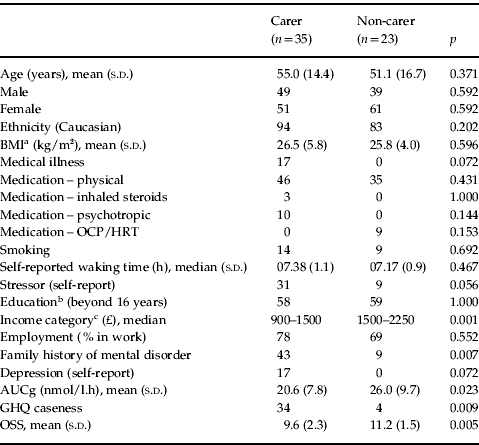
Description of carer and patient characteristics (Table 1)
Approximately half the carers were female (51%, n=18), with a mean age of 55 years (s.d.=14.4), 69% (n=24) lived with those they were caring for, and 57% (n=20) were in a spousal relationship. For 51% (n=18) of carers, weekly contact was in the highest category >32 h/week. A total of 69% (n=24) of patients were female, mean age 56 years (s.d.=13.1), and mean duration of illness was 22 years (s.d.=15.1). Carers experienced high levels of carer burden with a mean total IEQ of 28% (s.d.=18.3).
Baseline and clinical characteristics of carer and non-carer groups

BMI, Body mass index; OCP, oral contraceptive pill; HRT, hormone replacement therapy; s.d., standard deviation; AUCg, area under the curve with respect to ground; GHQ, General Health Questionnaire; OSS, Oslo-3 Support Scale.
Values given as percentages unless stated otherwise.
a 34 carers, 22 controls; b 34 carers; c 33 carers, 21 controls.
Sociodemographic and clinical characteristics of carer and non-carer groups
There was no significant difference between carers and controls for most sociodemographic and clinical variables, except for net monthly income, psychiatric caseness and reported depression (Table 1). A total of 34% (n=12) of carers met criteria for psychiatric caseness on the GHQ, defined conservatively using the threshold 2/3, compared to 4% (n=1) of controls (χ2=7.2, p=0.009). Furthermore, carers reported lower levels of social support on the OSS (t=3.0, p=0.005).
AUCg and AUCi in carers and controls
Carers showed reduced post-awakening cortisol as indicated by their lower AUCg (20.6 nmol/l.h, s.d.=7.8) than controls (26.0 nmol/l.h, s.d.=9.7, t=2.34, df=56, p=0.023). There was no significant difference in AUCi between carers and controls.
Dynamics of post-awakening cortisol response curves
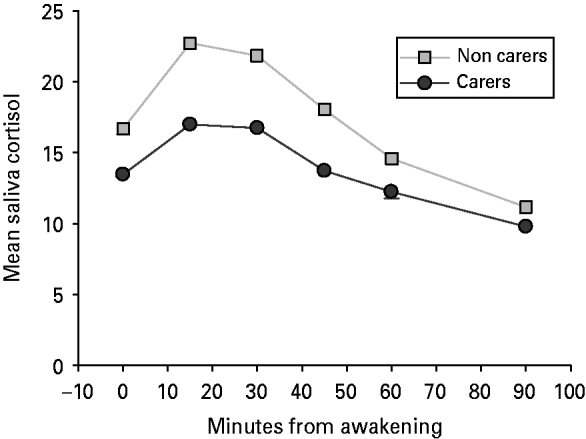
Figure 1 shows the post-awakening cortisol response curves for carers and controls. Further analysis revealed a strong trend for reduced cortisol levels in carers compared to controls at baseline, t=0 min (13.5 nmol/l, s.d.=5.8 v. 16.7 nmol/l, s.d.=6.4, t=1.95, p=0.056), and significantly reduced cortisol levels at t=15 min (17.0 nmol/l, s.d.=6.8 v. 22.7 nmol/l, s.d.=8.2, t=2.89, p=0.005), t=30 min (16.7 nmol/l, s.d.=7.5 v. 21.8 nmol/l, s.d.=10.3, t=0.16, p=0.033) and t=45 min (13.7 nmol/l, s.d.=6.7 v. 18.0 nmol/l, s.d.=8.4, t=2.2, p=0.035). A ‘response’ to awakening (⩾2.5 nmol/l over baseline) was shown by 78% (n=18) of controls, consistent with the figure of 75% reported previously (Wust et al. Reference Wust, Wolf, Hellhammer, Federenko, Schommer and Kirschbaum2000), whereas 63% (n=22) of carers showed a response.
Saliva cortisol (nmol/l) in 35 carers and 23 non-carers. Significant difference (p<0.05) between groups at 15, 30 and 45 min post-awakening. Area under the curve (AUC) (mean ± s.d.): carers 20.6±9.7 nmol/l.h, non-carers 26.0±9.7; t=2.34, df=56, p=0.023.

Predictors of AUCg and association with patient outcome
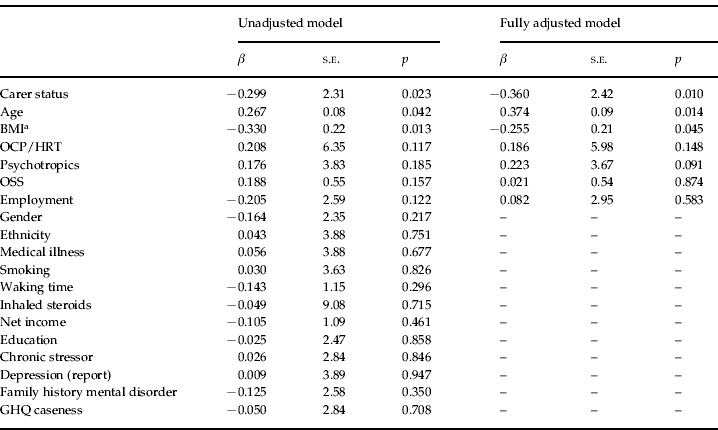
In the univariate linear regression analysis (Table 2), carer status, age and BMI were significant predictors of AUCg. Carer status (β=−0.299, p=0.023) and BMI (β=−0.330, p=0.013) were negatively associated with AUCg whereas age (β=0.267, p=0.042) was positively associated with AUCg. In the multivariate model (Table 2), only carer status (β=−0.360, s.e.=2.4, p=0.010), age and BMI remained significant predictors of the AUCg; this model predicted 34% of the observed variance (R 2=0.34, F=3.51, p=0.004).
Clinical and demographic predictors of cortisol output, AUCg (n=58, df=57)

AUCg, area under the curve with respect to ground; df, degrees of freedom; BMI, body mass index; OCP, oral contraceptive pill; HRT, hormone replacement therapy; GHQ, General Health Questionnaire; s.e., standard error.
a n=57, df=56.
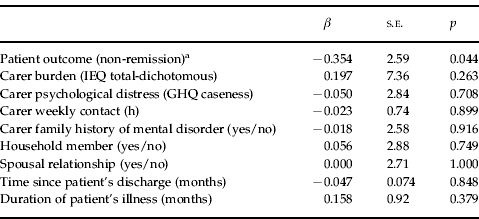
The only factor predicting AUCg in a linear regression analysis among the carers (Table 3) was non-remission of TRD in patients (β=−0.354, s.e.=2.59, p=0.044).
Univariate linear regression results of predictors of cortisol output, AUCg within carer group (n=35, df=34)

AUCg, area under the curve with respect to ground; df, degrees of freedom; IEQ, Involvement Evaluation Questionnaire; GHQ, General Health Questionnaire; s.e., standard error.
a n=33, df=32.
Discussion
To our knowledge, this is the first study investigating the physiological correlates of caring for patients with TRD. These carers have a disrupted HPA axis as measured by the post-awakening salivary cortisol. The main finding was of a reduced cortisol output post-awakening in carers compared with non-caring controls. Furthermore, carer status was independently associated with reduced post-awakening cortisol after controlling for age, BMI, hormonal and psychotropic medication use, and social support. A family history of mental disorder has been shown to be negatively associated with cortisol output (Peeters et al. Reference Peeters, Nicholson and Berkhof2003); however, this was not a significant predictor of post-awakening cortisol within our analysis.
Although it is difficult to compare levels of carer burden between different studies, as different instruments are often used, our results suggest that carers of patients with TRD experience higher levels of burden than carers of patients with non-resistant depression. Thus, a previous study of depressed out-patients found a total mean IEQ score of 17% (van Wijngaarden et al. Reference van Wijngaarden, Koeter, Knapp, Tansella, Thornicroft, Vazquez-Barquero and Schene2009) whereas in our study this was 28%. Of note, the study by van Wijngaarden et al. (Reference van Wijngaarden, Koeter, Knapp, Tansella, Thornicroft, Vazquez-Barquero and Schene2009) also found that the mean IEQ score in carers of patients with schizophrenia was 18%, and our findings further challenge the widely held assumption that caring for someone with severe depression is less stressful than caring for someone with schizophrenia or dementia.
Factors involved in the development of hypocortisolism
In our study, TRD carers showed the phenomenon of reduced cortisol levels in the form of a reduced AUCg and a trend towards a reduced basal (time=0) cortisol level. AUCi was not significantly affected, suggesting that the dynamic aspect of the cortisol awakening response was intact. This is consistent with hypocortisolism (Fries et al. Reference Fries, Hesse, Hellhammer and Hellhammer2005), although we have only demonstrated this in the morning and it would be important to ascertain whether evening cortisol levels are similarly lowered. Furthermore, it would also be interesting to investigate whether aberrant negative feedback mediated by overactive glucocorticoid and/or mineralocorticoid receptors might underlie the hypocortisolism, using appropriate suppression tests to distinguish this (Pariante et al. Reference Pariante, Papadopoulos, Poon, Checkley, English, Kerwin and Lightman2002; Jerjes et al. Reference Jerjes, Taylor, Wood and Cleare2007; Juruena et al. Reference Juruena, Pariante, Papadopoulos, Poon, Lightman and Cleare2009). Hypocortisolism is a finding potentially at odds with the literature on dementia carers showing high cortisol levels (Da Roza Davis & Cowen, Reference Da Roza Davis and Cowen2001; de Vugt et al. Reference de Vugt, Nicolson, Aalten, Lousberg, Jolle and Verhey2005; Gallagher-Thompson et al. Reference Gallagher-Thompson, Shurgot, Rider, Gray, McKibbin, Kraemer, Sephton and Thompson2006), although direct comparisons are problematic because of methodological differences in assessing the HPA axis, as discussed earlier. However, our results are consistent with a study of carers of patients with multiple sclerosis (Vedhara et al. Reference Vedhara, McDermott, Evans, Treanor, Plummer, Tallon, Cruttenden and Schifitto2002) and a wider body of literature showing that chronic stress can be associated with hypocortisolism (Vedhara et al. Reference Vedhara, McDermott, Evans, Treanor, Plummer, Tallon, Cruttenden and Schifitto2002; Nemeroff &Vale, Reference Nemeroff and Vale2005). Support for our findings also comes from a meta-analysis (Miller et al. Reference Miller, Chen and Zhou2007) that found that chronic stress was initially associated with HPA-axis hyperactivity, followed by a rebound of cortisol secretion below normal as time passes. A prospective study by Putnam (Reference Putnam2007) found that the initial hypercortisolism of sexually abused children relative to controls changed to hypocortisolism at around 15 years, reaching significance at 18–20 years. The duration of caring, then, may in part explain the discrepancy between our results and those of other studies, given the chronic nature of TRD, with a mean duration of illness of 22 years in our study. Within our carer sample, the duration of patient illness did not correlate with post-awakening cortisol, but this might be because all patients had a relatively long duration of illness.
In terms of the characteristics of the TRD carers, there was one important difference with the dementia carers studied previously. The mean age of the carers in our study, 55 years, was significantly lower than the mean age of carers with dementia and closer to the mean age of multiple sclerosis carers (Vedhara et al. Reference Vedhara, McDermott, Evans, Treanor, Plummer, Tallon, Cruttenden and Schifitto2002), who also showed hypocortisolism, as shown by reduced diurnal cortisol output. Younger carers, then, may be more likely to develop hypocortisolism in response to stress. This is further supported by our regression analysis of AUCg showing that carer age is a positive predictor for cortisol output (Table 3).
Hypocortisolism in carers and patient outcome
In confirmation of our a priori hypothesis, patient outcome was a significant predictor of AUCg, with lower post-awakening cortisol levels in carers associated with non-remission in patients after specialist treatment. Longitudinal studies are required to confirm the direction of the association between patient non-remission and carer stress reflected by the reduced post-awakening cortisol. It may be that poor patient outcome drives the disrupted HPA-axis function in carers. Nevertheless, it is also possible that carers with lower cortisol levels contribute to non-remission in patients, perhaps because they are more detached and disengaged in the caring role (Mausbach et al. Reference Mausbach, Aschbacher, Patterson, Ancoli-Israel, von Kanel, Mills, Dimsdale and Grant2006). This would fit with evidence that, following chronic stress and a reduction in HPA activity, a collection of withdrawal and disengagement behaviors emerge (Mason et al. Reference Mason, Wang, Yehuda, Riney, Charney and Southwick2001). A two-way interaction between carers and patients is also possible, in which poor outcome (to treatment in patients and in terms of physiological changes in carers) is mutually reinforced.
Hypocortisolism and psychiatric symptomatology
Carers showed significantly higher levels of psychiatric caseness than controls on the GHQ (34% v. 4%) and high levels of carer burden on the IEQ. However, these measures were not significantly correlated with cortisol output. This may be because the GHQ and IEQ are unsuitable for detecting symptoms associated with hypocortisolism. As self-report instruments, they reflect the individual's perception of burden and symptomatology and may not necessarily correspond to objective measures. Furthermore, it may be that the relationship between carer burden and cortisol is non-linear, and that consequences of caring such as ill health in the form of atypical depression or ‘burnout’ mediate change to the HPA axis. Atypical depression and burnout are known to be associated with hypocortisolism (Pruessner et al. Reference Pruessner, Hellhammer and Kirschbaum1999; Gold & Chrousos, Reference Gold and Chrousos2002; Levitan et al. Reference Levitan, Vaccarino, Brown and Kennedy2002) and are characterized by rejection sensitivity, hypersomnia and increased appetite, symptoms not captured by the GHQ.
Another explanation for the reduced post-awakening cortisol in carers is pre-existing HPA-axis change caused by childhood trauma (Meinlschmidt & Heim, Reference Meinlschmidt and Heim2005), which may be increased in carers relative to controls due to the phenomenon of assortative mating, as has been argued previously (van Wijngaarden et al. Reference van Wijngaarden, Koeter, Knapp, Tansella, Thornicroft, Vazquez-Barquero and Schene2009).
Finally, we acknowledge some limitations of the study. We relied on the use of self-report measures rather than electronic devices to monitor compliance with the sampling protocol, which may overestimate true compliance. Nevertheless, we included only those with documented compliance with all aspects of the protocol. We also acknowledge that the direction of causation of some of the associations we have found is unclear, and requires longitudinal data to unravel.
Conclusions
We found that carers of patients with TRD experience high levels of psychological distress and carer burden, and that their exposure to this chronic stress is reflected biologically by a reduced cortisol output on awakening. Reduced post-awakening cortisol in carers is associated with patient non-remission after specialist treatment. Longitudinal studies are required to confirm the direction of this association, but if carer stress, reflected by reduced post-awakening cortisol, does indeed influence patient outcome in TRD, then interventions to reduce carer stress could be important in the long-term management of TRD. In any event, given the potential longer-term manifestations of hypocortisolism, such interventions may also benefit the carers themselves and should be the subject of future research.
Acknowledgments
This study was supported by the National Institute for Health Research (NIHR) Biomedical Research Centre at the South London and Maudsley National Health Service (NHS) Trust and Institute of Psychiatry (King's College London), and the Institute of Social Psychiatry.
Declaration of Interest
None.