




No CrossRef data available.
Developmental trajectories and ecological transitions: A two-step procedure to aid in the choice of prevention and promotion interventions
Published online by Cambridge University Press: 01 December 2004
Abstract
The confluence of two different types of transitional processes is explored: human development and normative ecological transitions. There are periods of greater vulnerability than others in the developmental life course as well as particular normative ecological transitions that are more disruptive than others. When there is a confluence of developmental vulnerability and a disruptive ecological transition, a “turning point” in development may ensue. This can take the form of an opportunity for growth and development or a developmental mismatch. Consequently, such turning points may represent opportune times and places at which to launch prevention/promotion programs. A two-step analytic procedure, nomothetic analyses followed by idiographic analyses, is described and illustrated to test the utility of this framework. First, these issues are illustrated using the self-esteem trajectories of low-income, urban public school students making a normative school transition to a junior and senior high school. Second, new data are presented on the early adolescent self-esteem trajectories and their association with long-term psychopathology. Third, the significance of this two-step procedure is discussed in regard to several normative ecological transitions that are common when older adolescents make the developmental transition into adulthood (e.g., into full-time employment, marriage).Work on this article was supported in part by grants from the National Institute of Mental Health (MH43084) and the Carnegie Corporation (B4850) awarded to Edward Seidman, J. Lawrence Aber, LaRue Allen, and Christina Mitchell. We express appreciation to the adolescents and schools whose cooperation made this study possible.
Information
- Type
- Research Article
- Information
- Copyright
- © 2004 Cambridge University Press
How do we understand and examine the outcomes and mechanisms of transitions? Are these transitions developmental or ecological in nature? Or, is the confluence of individual development and ecological transitions more salient? Under what conditions (e.g., when, how) could this confluence of development and ecological transitions facilitate positive or negative developmental trajectories? How can this knowledge inform preventive and promotive interventions? This article seeks to address these questions, with particular emphasis on the implications of these notions for the transition to adulthood.
First, we briefly discuss the transitional aspects of individual development and its implications for preventive and promotive interventions. Second, we briefly discuss ecological transitions, risky situations (Price, 1980), and their implications for preventive and promotive interventions. Third, we turn to a discussion of the confluence of individual development and ecological transitions, where we underscore both the importance of the developmental mismatch hypothesis (Eccles & Midgley, 1989) and the developmental opportunity hypothesis. Fourth, we address the question of how to identify mismatches between individual development and risky normative ecological transitions. We describe a two-step procedure, nomothetic analyses followed by idiographic analyses, to identify turning-point situations and the differential implications for intervention. Nomothetic analyses address the questions of what is the nature of the change for the “average” individual, and whether the magnitude of that average change is substantially greater at one transition point than at another. If there is substantial discontinuity in the average individual's developmental trajectory, the idiographic analyses ask how well or poorly the mean level discontinuity trajectory represents the array of potentially unique trajectories. The differential implications of each approach for intervention are described.
In the next section, we illustrate the utility of this approach with a multiwave study of low-income, urban adolescents. The nature and utility of trajectories of self-esteem across the early and middle adolescent school transitions to junior and senior high school, respectively, are described. The results of both nomothetic and idiographic analyses are presented. Next, we present new data on the long-term associations of the early adolescent self-esteem trajectories with psychopathology. Last, we discuss the implications of this approach for both understanding transitions to adulthood and implications for intervention.
Social scientists and philosophers have described transitions in many different ways over the last century (for reviews, see Connell & Furman, 1984; Ruble & Seidman, 1996). Some definitions emphasize the phenomenological aspects of transitions, whereas others focus upon the transition as a “crisis” (Caplan, 1964) or developmental. Conceptually, Caplan (1964) viewed the crisis as an opportunity for growth as well as for decline. The Merriam–Webster Dictionary (2003) defines transition as
a passage from one state, stage, subject, or place to another: change; or
b a movement, development, or evolution from one form, stage, or style to another
As these definitions suggest, transitions can be either discrete and clear cut, as in the passage from one state or place to another (e.g., marriage, entrance into a new school or job, death of a parent), or slow and gradual, as in development or evolution from one form or stage to another (e.g., adolescence, the phase of development between childhood and adulthood). As we will see below, inherent in the preceding definitions of transition are both the meanings of an ecological transition and an individual developmental transition, respectively. More generally, transitions in life represent a time of potential transformation in self-definition and interpersonal relationships, which may in turn have a long-term impact on psychological well-being. They offer a unique opportunity for positive and constructive versus negative and destructive growth, maturation, and development.
Individual development
Connell and Furman (1984, p. 154) have described transition as “the occurrence of relatively greater change in a characteristic or set of characteristics of an individual, or of a group of individuals.” Individual development takes place in numerous domains. Illustratively, among adolescents, development is noteworthy in biological, cognitive, self, and identity processes, as well as in the areas of social reasoning and judgment. All development can be seen as a transition or evolution. Individually and collectively these processes have different rates of change over time, at times gradual and at other times quite rapid. For example, development of social reasoning or identity is a gradual evolutionary process dependent on individual developmental history, variability, and the particular social contexts in which the individual is embedded. In contrast, development can appear as a step function when a new stage has been reached, for example, when a young girl begins to menstruate. Most developmental transitions are rarely that abrupt, or discrete and steplike. Nevertheless, in each circumstance, there is a great deal of individual variability.
It is precisely this variability in individual development that makes it exceedingly difficult to identify the optimal time to launch universal or selective prevention or promotion programs. Thus, a precise and equally meaningful point in development to intervene for a group of individuals is more problematic. To find the optimal time for an intervention for an individual requires individual assessment of risk or adaptation difficulties. However, when individuals, per se, are screened for risk, we move out of the arena of primary prevention or promotion and into the arena of secondary prevention (Cowen, 1980; Seidman, 1987).
Universal intervention programs are offered to everyone in a setting or population. As such, they offer the greatest potential to affect the largest number of individuals in terms of primary prevention or the promotion of well-being (Cowen, 1994; Gordon, 1987). If the setting or population is viewed as at increased risk, the intervention is referred to as selective. In these selected intervention programs, however, it is a population or setting attribute that represents the risk or protective factor that helps in targeting the selective intervention program. For example, a low-income population of high school students about to enter college may be at greater risk for a variety of maladaptive outcomes than those from other populations or settings, and thus warrant a more cost-effective selective program, instead of a universal intervention program.
Ecological transitions
Other theorists describe transitions as ecological. Among them, Bronfenbrenner (1979, p. 26) states that, “An ecological transition occurs whenever a person's position in the ecological environment is altered as a result of a change in role, setting, or both.” In a similar vein, ecological transitions can be seen as a disruption in social regularities. That is, as “a disturbance in one or more aspects of the constancy of relations or transactions between an individual and one or more aspects of the context” (Seidman, 1988).
As the reader can see, Bronfenbrenner's definition of an ecological transition is remarkably similar to the first dictionary definition of a transition. A change in role, setting, or both is an abrupt and discontinuous transition in contrast to most individual developmental transitions that, more often, are more gradual and evolutionary.
There are many distinguishing features of different kinds of transitions (Connell & Furman, 1984; Ruble & Seidman, 1996). The most common differentiating feature of an ecological transition is whether it is normative or nonnormative. Whether or not a transition is normative or nonnormative depends on how commonly experienced the transition is in the culture. Normative school transitions are expected and scheduled, and are often made by large cohorts of individuals, for example, the transition from elementary school to a middle grades school. On the other hand, an unexpected and unscheduled change of schools in the middle of an academic year, perhaps, because a parent's employer suddenly transferred her to a new state, is a nonnormative transition. Clearly, when a child moves from one school to another school, for whatever reason or circumstance, she experiences both a change in setting and in her role relationships with students, teacher(s), and family. Because the students and teachers are different, and she is developing, she needs to negotiate new sets of role relationships. Another illustration of a normative transition is the transition into full employment, higher education, the military, or marriage for an “emerging adult” (Arnett, 2000). Each of these transitions imposes a new set of role relationships and responsibilities on the individual or newlyweds. Most often, these transitions into emerging adulthood also signify a change in physical location or residence.
Both nonnormative and normative ecological transitions present, even to the most resourceful adolescent or emerging adult, challenging new roles and settings to be negotiated. Identifying a group or population of individuals facing a nonnormative transition is difficult, if not impossible; thus, the possibility of universal or selected interventions is unlikely. On the other hand, although normative ecological transitions present individuals with similarly difficult challenges, they also represent a distinct time in development and discrete place for intervention, as in normative transitions into new schools and places of employment.
In 1980, Price described an intriguing concept that he labeled “risky situations”; it refers to a situation or environment that has the potential to place its inhabitants at either or both increased likelihood for maladaptive or adaptive developmental outcomes. One type of risky situation is represented by a risky normative ecological transition, where people move from one familiar setting into a less familiar setting with different actors, norms, routines, and social regularities. Such risky normative ecological transitions present individuals making these transitions with many challenges to their continued development.
Another common distinguishing feature of a transition is its timing, that is, exactly when it occurs in the life cycle of an individual or setting. Illustrative of the importance of timing are several key questions. Is the timing of a particular transition to a middle grades school optimal for academic and psychological development, or is the timing of marriage optimal for social and emotional development? Or does each one occur too early or too late? What are the consequences of each particular normative transition and its timing for development and well-being?
Ecological transitions have also been conceptualized, like crises (Caplan, 1964), as “turning points” that provide a critical opportunity for growth or decline (Rutter, 1987). More specifically, ecological transitions provide the opportunity for taking on new roles that can alter life trajectories, for better or worse. At such turning points, individuals have the opportunity of constricting or expanding their “possible selves” (Markus & Nurius, 1986). The impact on the self-system and future development can be quite powerful. For example, in the transition to middle school, students may be afforded the opportunity to see themselves as learners for the first time (Clements & Seidman, 2002). Or in the transition to parenthood, young adults may be afforded the opportunity to see themselves in an entirely new light as socially responsible. Unfortunately, the opposite is equally possible.
In sum, normative ecological transitions are of particular interest for several reasons. First, they are expected and predictable in the developmental life course. Second, they represent an abrupt discontinuity in role, setting, or both. Third, ecologically they represent potential turning points. Fourth, as turning points, they can dramatically affect psychological development, including psychopathology, and future life opportunities.
Individual development and ecological transitions
Although change is the sine qua non of both developmental processes and ecological transitions, more often than not ecological transitions are far more abrupt. They represent a point of change in the pattern of social relations between the individual and context. Consequently, we explicitly refer to them as turning points. As such, they represent invaluable loci for preventive and promotive interventions.
Building on person–environment interaction notions of Lewin (1935), Murray (1938), Hunt (1975), and others, Eccles and Midgley (1989) describe a rich and exciting framework with which to think about the confluence of individual development and ecological transitions; it is known as the “developmental mismatch hypothesis.” Person–environment interaction notions attempt to understand beliefs and behaviors as a function of the interaction of person-centered characteristics and attributes of the environment. From these notions the concept of person–environment fit arose. Hunt (1975) added a developmental perspective to person–environment interaction notions. Nevertheless, many of these early notions, despite talking about person–environment interaction, placed the onus on individuals to adapt to the particular environment or to fit the individual to the “appropriate” environment.
In the developmental mismatch hypothesis, the interaction per se was more explicitly given central status, whereas equal accord was placed on both the environment and the individual. The developmental mismatch hypothesis was anchored in the data and experiences of youth making the transition from elementary school to middle school or junior high school. As Hamburg stated back in 1974: “It has been clear for some time that the entry into junior high school probably represents the most abrupt and demanding transition of an individual's entire educational career. This is a crisis period that has important educational as well as personal consequences.”
Eccles and Midgley (1989) extend the rationale for the ways in which this normative school transition represents a developmental mismatch underscoring both the nature of the environmental change and its timing. At a time when early adolescents are struggling with biological, cognitive, and social changes, they are required to move from a setting in which they have one primary teacher, who knows their strengths and weaknesses, and the same set of classmates, to a new physical setting and location in which they often encounter a new teacher and set of classmates every 45 min. This is often a time when youth are struggling to seek out more decision-making opportunities, yet the organizational arrangement of the new setting hampers those desires. Early adolescents are also struggling for some autonomy from their parents, yet still need adult guidance. As nonrelated adults, teachers could be this critical adult resource. Here again, the organizational arrangements of most junior high schools preclude that possibility. In part because teachers have to deal with a new set of 35 students every 45 min, they simply cannot get to know individual students in this way, and in fact, often come to view junior high school students as unmotivated “monsters,” strikingly different from the way they were viewed by their elementary school teacher just a few months earlier. Thus, the confluence of the developmental needs of an early adolescent and the transition into a typical junior high school with a dramatically different set of organizational arrangements and regularities increases the likelihood of a developmental mismatch (Seidman, Aber, & French, 2004).
If, however, this or any other ecological transition represents a turning point, as we have argued, for some individuals it may represent an opportunity for growth and positive development. Imagine an elementary school child who has been stigmatized and isolated as a mathematical genius and nerd, but upon entrance to junior high school, he is placed in an accelerated math class where he is revered by his classmates and held up as a model by his teacher. Or imagine the new parent, who was always treated by his peers and family as irresponsible, but suddenly is thrust into a new role and seizes the developmental opportunity to grow.
Normative ecological transitions that confront individuals with dramatic discontinuities in their roles and settings that do not match their evolving developmental needs present the greatest risk for a developmental mismatch. At the same time, they provide a unique opportunity for prevention and promotion interventions. All normative ecological transitions do not, in their own right, provoke a mismatch; instead, a mismatch only occurs when the developmental needs of an individual or group clash with the demands and expectations of the new environment. As the reader will see, in the illustration below we address the question of whether the transition into junior high school or into senior high school confronts students with a greater developmental mismatch.
The transition into adulthood often confronts the emerging adult with several ecological transitions that represent dramatic shifts in the setting and role(s) that she is expected to play. For example, the transition into college or full-time employment or marriage or parenthood challenges the emerging adult to adapt and take on new roles in new settings. In each instance, there are two key questions in experiencing a normative ecological transition. (a) For the average individual, is her developmental status appropriately matched or mismatched with the role and demand characteristics of the new organizational setting she enters? (b) Is the response of the average individual prototypical, or are there a variety of different and meaningful responses to these normative ecological transitions? To examine these questions, we examine developmental trajectories across two normative ecological school transitions.
Identifying mismatches and opportunities between development and ecological transitions: A two-step procedure
The crucial issue in identifying potential matches or mismatches between development and normative ecological transitions is to determine whether the transition represents a turning point, for better or worse. A turning point is one in which the average developmental trajectory is disrupted in a positive or negative fashion. Thus, more specifically, we need to ask whether the ecological transition significantly alters the average developmental trajectory, or alternatively, does it represent a crucial turning point or discontinuity that positively or adversely affects the average developmental trajectory (Rutter, 1987).
According to Price (1980), the identification of risky situations or transitions allows us to design social interventions that prevent maladjustment and/or promote positive development, and as such, are a transactional antidote to the selection of high-risk samples. The identification of risky situations provides us with several different strategies for intervention. None of these intervention strategies focus on the affected individual. In this way, they help to avoid the iatrogenic effects that often accompany “blaming the victim” (Ryan, 1971) type interventions. The identification of risky situations enables us to intervene by (a) selecting lower risk situations, (b) altering the characteristics of risky situations to either minimize risk and/or promote psychological well-being, (c) plan new settings that either minimize the risk of psychological disturbance and/or enhance the likelihood of promoting positive development (Price, 1980), and (d) develop inoculation programs to be administered to a population of individuals before or shortly after they encounter a risky transition (Seidman & French, 1997).
Methodologically, what we have been suggesting to this point is the assessment of a discontinuity in the average developmental trajectory that coincides with a normative ecological transition. Hence, it is a critical turning point (i.e., an opportunity for decline and/or growth) and it can represent a developmental match or mismatch between the average individual's developmental needs and the transition. Such a nomothetic assessment is what we most often find in the psychological literature and practice. However, one could, and should, ask whether this transition, which is on the average risky, is risky for everyone. It is vital to know whether the average trajectory is representative of most people or obscures a variety of different developmental trajectories that might lead to different or complementary strategies of intervention. Here, we enter the realm of idiographic approaches to help identify for whom ecological transitions are most risky or beneficial.
The two-step procedure begins with a nomothetic analysis of the developmental trajectory across a normative ecological transition on a salient psychological dimension: self-esteem. Low self-esteem has been shown to be a precursor, and associated with, depression and suicidal ideation in children and adolescents (e.g., Orvaschel, Beeferman, & Kabacoff, 1997; Pelkonen, Marttunen, & Aro, 2003), as well as some behavior problems. Thus, examining the developmental trajectory of self-esteem is salient for developmental psychopathology. Is there a discontinuity in the development of this salient variable that coincides (or precedes or lags in a consistent and meaningful fashion) with the normative ecological transition? If so, it is suggested that idiographic temporal analyses be employed to determine whether both the nomothetic pattern is truly representative and/or whether there are more fine-grained trajectories that are theoretically meaningful and suggestive of differential intervention implications. Discovery of a robust average discontinuity alone leads to universal prevention/promotion intervention implications, whereas idiographic profiles alone would suggest selective strategies of intervention. The combination of robust nomothetic and idiographic findings may suggest complementary use of universal and selective strategies of intervention. In the next section, we illustrate this two-step procedure in the context of the self-esteem of low-income, urban adolescents making the normative school transition into either junior high school or senior high school.
Illustration: The Normative School Transitions of Adolescence
Beginning with the classic Milwaukee study during the 1970s (Blyth, Simmons, & Busch, 1978; Blyth, Simmons, & Carlton–Ford, 1983; Simmons & Blyth, 1987), the transition from elementary school to middle grades school has become a topic of both scholarly interest and great practical import (Eccles, Midgley, Wigfield, Buchanan, Reuman, Flanagan, & Mac Iver, 1993; Jackson & Davis, 2000). One central psychological dimension examined in most studies is self-esteem. Self-esteem is often viewed as a salient person-centered dimension central to an adolescent's psychological well-being as well as disengagement from school and other normalizing social systems that may ensue with the transition to junior high school. Thus, a central question addressed in many school transition studies is whether self-esteem declines across the transition from elementary school to middle school or junior high school.
Quite often, but not always, declines in self-esteem and increases in dimensions of psychological distress are associated with this early adolescent normative school transition (for a recent review, see Seidman et al., 2004). In the transition into middle/junior high schools, declines in self-esteem are consistent across studies of urban and large heterogeneous suburban school districts. Declines in self-esteem are less universal in studies conducted among primarily White, suburban middle-class or small communities. Despite the failure to detect declines in self-esteem in the latter group of studies, several studies did uncover appreciable increases in psychological distress or depression across this early adolescent school transition in smaller communities. In the instances where declines in self-esteem and/or increases in psychological distress were not found, these studies were usually carried out in middle or junior high schools where “true” middle school pedagogy appeared to be practiced. Schools in which middle school pedagogy is practiced employ a small number of core teachers who in collaboration provide a more integrated core curriculum to a cohort of students who stay together through the bulk of their day. Not only is the student academic learning of central importance, but so too is their social and emotional learning and development (Greenberg, Weissberg, O'Brien, Zins, Fredericks, Resnik, & Elias, 2003).
The media, foundations, government agencies, and the public, however, have often viewed the transition into high school as more problematic than the transition into junior high school because it coincides with (a) precipitous declines in academic achievement and attendance, and an exponential rise in the rates of school dropout (e.g., National Center for Educational Statistics, 1992); (b) a peak in serious delinquency offenses (Moffitt, 1993); (c) a peak in reports of alcohol and marijuana use (Blum, Beuhring, & Rinehart, 2000; Blum, Beuhring, Shew, Bearing, Sieving, & Resnick, 2000; O'Malley, Johnston, & Bachman, 1998); (d) a dramatic rise in the rates of teenage pregnancy (Alan Guttmacher Institute, 1994); and (e) an increase in the occurrences of first episodes of depressive disorders and reports of suicidal ideation peak (Gould, 2003; Lewinsohn, Clarke, Seeley, & Rohde, 1994). Nevertheless, less attention has been paid to the impact of the transition to high school on self-esteem. When it has been assessed, no significant decline in self-esteem has been observed (Gillock & Reyes, 1996; Seidman, Aber, Allen, & French, 1996). Because there is not a linear increase or decrease in self-esteem across the life span except for a substantial decrease upon entry into early adolescence (Robins, Trzesniewski, Tracy, Gosling, & Potter, 2002), the failure to detect a decrease in self-esteem across the transition to high school, on the average, is not surprising. It is conceivable that engagement in “sex, drugs, and rock ‘n’ roll” peaks at this critical juncture in time, in part, because youth perceive these activities as means by which they can gain the respect of their peers thus buffering their self-esteem. This period is nevertheless marked by many other signs of disengagement from schooling and other normalizing social systems.
In the illustration that follows, we examine both the transitions from elementary to junior high schools and from junior high schools to senior high schools in New York City, Washington, DC, and Baltimore, MD, using data from the Adolescent Pathways Project (APP; Seidman, 1991). All schools are public schools with high concentrations of children living in or near poverty. The study consists of two cohorts: an early adolescent cohort and a middle adolescent cohort. The early adolescent cohort was assessed in their last year of elementary school before the transition into junior high school (pretransition year) and then again, during the spring of the two following years (transition and posttransition years, respectively). The assessment design and methods for the middle adolescent cohort were identical, but the study began in their last year of junior high school before the transition into senior high school.
First, we describe the findings of our nomothetic analyses for self-esteem across the first three waves of data for the early adolescent cohort (Seidman, Allen, Aber, Mitchell, & Feinman, 1994; Seidman, Clements, Aber, & Allen, 2004). Second, we describe the results of previous nomothetic analyses for self-esteem across the first three waves of data for the middle adolescent cohort (Seidman et al., 1996; French, Seidman, Allen, & Aber, 2004). For the nomothetic analyses in each cohort, we addressed the question of whether, on the average, there was a change in self-esteem across the transition and beyond. We were also interested in whether, on the average, such changes were moderated by gender, race/ethnicity, or the particular grade at which the normative transition was made. Third, we describe the findings of our recent idiographic analyses for self-esteem across these same three waves of data for both the early adolescent cohort (Seidman, French, Aber, Younes, Allen, & Hsueh, 2004) and the middle adolescent cohort. Fourth, in the following section, we present new and original data that examines the long-term association of the early adolescent trajectories of self-esteem with psychopathology.
The Early Adolescent Cohort Nomothetic Study
The early adolescent cohort experienced virtually similar and classic organizational structures regardless of whether they entered intermediate school at sixth grade or junior high school at seventh grade, that is, changing classes continuously each with a new teacher and set of peers. The grade structure of the Baltimore schools was K–5 and 6–8, whereas in Washington it was K–6 and 7–9. To avoid confounding grade sequence with city, both grade sequences were sampled in New York City. Across cities, these students came from 24 elementary schools in the pretransition year and had moved to 40 intermediate and junior high schools in the transition year. The Gender (2) × Race/Ethnicity (3) × Grade of Transition (2) × Time (3) analysis of variance (ANOVA) for self-esteem revealed only one significant within subject main effect for time and no significant two- or three-way interaction effects with time (Seidman, Clements, et al., 2004). Self-esteem declined across the school transition, but stabilized by the end of the second year of junior high school.
The Middle Adolescent Cohort Nomothetic Study
The middle adolescent cohort was also assessed in group settings during the spring of the last year of junior high school, that is, in either eighth or ninth grade, and then again, during the spring of the 2 following years. The same ANOVA was conducted for the middle adolescent cohort as for the early adolescent cohort (French et al., 2004). Here, however, the repeated measures self-esteem effect for time was not significant, that is, no decline was evident across the transition to high school and beyond. The two-way interaction of time and grade at transition, however, was significant, and the polynomial contrasts indicated that self-esteem increased from the pretransition assessment to the posttransition assessment for the students who made the transition after eighth grade and decreased for those making the transition after ninth grade. This divergent pattern of grade of transition change in self-esteem did not appear to be immediately precipitated by the school transition, per se, because the polynomial contrast for the pretransition to transition years was not significant. Again, there were no other significant gender or race/ethnicity interaction effects with time.
In sum, the nomothetic analyses suggest that, on the average, those making a transition from elementary school to junior high school decline in self-esteem as a function of the transition, and then stabilize their level of self-esteem in the following year at this lowered level. On the other hand, the transition from junior high school to senior high school does not seem to provoke a reliable change in the pattern of self-esteem.
Idiographic studies
In turning from the nomothetic to idiographic analyses, we moved from asking the question of what was the pattern of change over time in self-esteem, averaged across all participants, to were there multiple and meaningful unique individual trajectories of change in self-esteem? In addition, did this average pattern of change actually represent a meaningful number of individuals or did it obscure the varying trajectories of self-esteem? Did these different analytic strategies provide complementary or differential intervention implications?
To elucidate the trajectories of change in self-esteem across the transition into junior high school and 1 year beyond, Seidman, French, et al. (2004) employed cluster analyses (Bergman & El-Khouri, 1998). Seven very different trajectories were revealed, as can be seen in Table 1. Four trajectories all began high in self-esteem, that is, ∼3.5 on a 4-point scale of global self-worth (Harter, 1987). The trajectory labeled as High Stable started high and remained high, that is, above 3.5. Members of the Delayed Decline trajectory experienced a very modest decline across the transition year and then declined rapidly, that is, nearly a full-scale point. The Immediate Decline trajectory plummeted more than one and a half full scale points from 3.46 to 1.88 across the junior high school transition and then stabilized at less than 2.00. Members of the Bounce Back trajectory started high and plummeted over a full-scale point by the end of the transition year, yet fully bounced back to their initial level of self-esteem at the end of the posttransition year. The dramatic declines across the transition year for both the Immediate Decline and Bounce Back trajectories suggested that the individuals constituting these two trajectories were most directly and negatively affected by the normative school transition to junior high school.
Trajectories of self-esteem: Means and standard deviations by transition year

The remaining three self-esteem trajectories began at moderate or low levels of self-esteem. The Low Stable trajectory began relatively low and remained low across time. The Medium Stable trajectory began with moderate self-esteem and essentially remained that way across all three assessments. Last, the Immediate Increase trajectory also started with modest self-esteem, but then rose rapidly across the transition year by almost a full-scale point to ∼3.50 and stabilized at this high level of self-esteem. It should be noted that there were no significant differences among the seven trajectories of self-esteem with regard to gender, race/ethnicity, or grade at which students made the transition into junior high school (sixth vs. seventh).
The four trajectories that began high and the two that began moderate in self-esteem were of interest, in particular, because they differed in their subsequent patterns of response to the normative school transition even though they were similar in their starting points. For these four trajectories that began high in self-esteem, two trajectories seemed to have been immediately and adversely affected, with one bouncing back (Bounce Back) a year later and the other remaining low in self-esteem (Immediate Decline). For the youth constituting these two self-esteem trajectories, the transition to junior high school seemed to have represented a turning point that resulted in a mismatch between individual development and the normative ecological transition. Thus, a major contrast was between the High Stable and Delayed Decline trajectories and the Bounce Back and Immediate Decline trajectories (Contrast #1). Second, we expected differences between the High Stable and the Delayed Decline trajectories because they diverged in the year after the transition (Contrast #2). More importantly, the Bounce Back and Immediate Decline trajectories (Contrast #3) were expected to differ because not bouncing back from such precipitous declines in self-esteem were expected to be much more consequential for these individuals psychological well-being. That is, the confluence of development and the normative transition resulted in an even greater mismatch for members of the Immediate Decline trajectory than for members of the Bounce Back trajectory. Fourth, we examined the contrast between the Immediate Increase and the Medium Stable trajectories because they also began at the same level but one increased and the other remained stable in self-esteem (Contrast #4). This suggested that for members of the Immediate Increase trajectory, this turning point provided an opportunity for growth.
We tested these four hypotheses or contrasts, first, with regard to a wide array of possible life events, self-evaluative processes, academic performance and interpersonal behaviors, and perceived family, peer, school, and neighborhood transactions (daily hassles, social support, involvement) at the pretransition year or earlier. Structural measures of family/household and neighborhood poverty were also included. Second, we examined these contrasts with regard to changes in self-evaluative processes, academic and interpersonal behaviors, and perceived family, peer, school, and neighborhood transactions across the transition year. Changes in life events and structural measures of family/household and neighborhood were excluded because they were extremely unlikely to have changed during less than a year's time. Rarely did we find significant effects for contrast 2; consequently, here we only focus on the findings for contrasts 1, 3, and 4.
Contrast effects: Before the transition
In terms of the first and most salient contrast, a comparison of those who were adversely affected across the transition year (Bounce Back and Immediate Decline trajectories) with those who were not (High Stable and Delayed Decline trajectories) failed to reveal any significant differences in life events, self-evaluative processes, interpersonal behavior and academic performance, and perceived peer transactions in the last year of elementary school before the transition into junior high school or previously. This contrast did, however, reveal dramatic differences for perceived and structural family and neighborhood processes, and an important difference in perceived academic hassles in school.
Perceived family transactions between the two sets of trajectories differed significantly on two of four dimensions. Before they made the transition, youth in the Bounce Back and Immediate Decline trajectories reported experiencing more daily hassles with parents and hassles over limited resources than did members of the High Stable and Delayed Decline trajectories. Not surprisingly, these “transition vulnerable” youth are more likely to come from households that had a high ratio of children to adults and had higher rates of underemployment of the primary caregivers than did those in the High Stable and Delayed Decline trajectories. In terms of the structure of the neighborhood, members of the High Stable and Delayed Decline trajectories resided in residentially more stable neighborhoods than did members of the Immediate Decline and Bounce Back trajectories. In a similar vein, members of the High Stable and Delayed Decline trajectories perceived less crime and deterioration in their neighborhoods than did those in the Immediate Decline and Bounce Back trajectories. Finally, members of the Bounce Back and Immediate Decline trajectories reported more academic hassles in their last year of elementary school than did those in the High Stable and Delayed Decline trajectories.
For the third contrast, fewer significant findings were evident, although these findings did help to fill in the picture. The only personality or behavioral dimensions that differed for any of the contrasts in any of the analyses indicated that members of the Bounce Back trajectory were less prepared for class in the year before the transition than members of the Immediate Decline trajectory. Yet, in terms of both the perceived school and family dimensions, members of the Bounce Back trajectory reported more social support from school and family than did members of the Immediate Decline trajectory. For neighborhood structure, members of the Immediate Decline trajectory were more likely to reside in neighborhoods that were crowded with higher proportions of young people than did those in the Bounce Back trajectory. There were no differences for the third contrast on the perceived peer and neighborhood dimensions. Last, for the fourth contrast (Medium Stable vs. Immediate Increase) there were no significant planned contrasts on any of the preexisting or initial differences.
Contrast effects: Change across the school transition
Here, we first addressed the differential changes that were experienced by members of the four trajectories that started high in self-esteem across the transition year from elementary to junior high school among the psychological and behavioral dimensions as well as among the perceived family, peer, school, and neighborhood dimensions. For both the first and third contrasts, significant differences lay primarily in the perceived family, school, and neighborhood microsystems, and to a minimal extent in the peer domain.
For the first contrast, the significant differences occurred in the family, school, and neighborhood domains. Members of the Bounce Back and Immediate Decline trajectories, on the average, remained the same or increased in hassles with parents and resource hassles in contrast to members of the High Stable and Delayed Decline trajectories that declined. As expected, members of the Bounce Back and Immediate Decline trajectories increased in their experience of academic hassles, whereas members of the High Stable and Delayed Decline trajectories remained stable. Members of the High Stable and Delayed Decline trajectories perceived their neighborhood as remaining stable, whereas those in the Immediate Decline trajectory perceived their neighborhood as increasing in crime and deterioration.
For the third contrast, members of the Immediate Decline trajectory experienced an increase in family hassles and resource hassles in comparison to those in the Bounce Back trajectory who remained the same in hassles and decreased in resource hassles. In addition, those in the Immediate Decline trajectory decreased dramatically in family involvement in contrast to those in the Bounce Back trajectory. Members of the Immediate Decline trajectory decreased their participation with peers, but those in the Bounce Back trajectory increased their engagement with peers. As suggested above, members of the Bounce Back trajectory perceived an improvement in the quality of their neighborhood whereas members of the Immediate Decline perceived increased crime and deterioration of their neighborhood. Last, there was one inexplicable effect: Members of the Immediate Decline trajectory, in contrast to members of the Bounce Back trajectory, experienced an increase in the number of school protective life events (e.g., skipping a grade in school, taking an honors class) across the transition year into middle grades schools.
The fourth contrast revealed a number of significant changes across the school transition year. In terms of performance, members of the Immediate Increase trajectory were increasingly prepared for class and improved in their standardized reading scores in contrast to members of the Medium Stable trajectory. Members of the Immediate Increase versus Medium Stable trajectories also reported less increase in resource hassles and academic hassles. At the same time, members of the Immediate Increase trajectory reported more social involvement in their neighborhoods.
For the middle adolescent cohort making the transition into high school, cluster analyses revealed three parallel or relatively stable high, medium, and low trajectories of self-esteem. Thus, no incremental information was provided above and beyond what was provided by the nomothetic analysis.
Summary
Our analyses of self-esteem for the early adolescent cohort suggested that the transition to junior high school represented a critical turning point. This was true on the basis of both the nomothetic and idiographic analyses. On the other hand, both nomothetic and idiographic analyses of self-esteem for the middle adolescent cohort failed to reveal that the transition to senior high school was a critical turning point.
For the early adolescent cohort, the nomothetic results suggested that, on the average, the transition to junior high school is a deleterious experience. However, as the idiographic analyses revealed very few individuals, if any, were adequately represented by the average trajectory. In fact, across the year of transition to junior high school, only three of the seven self-esteem trajectories demonstrated dramatic changes in slope. Two of these were negative, highlighting the risky and deleterious effects of the turning point (Bounce Back and Immediate Decline) and one was positive, highlighting the opportunity for growth provided by the turning point (Immediate Increase). Three of the remaining trajectories were unaffected by the transition or individual development, in that they remained stable across the three assessments.
It also appeared that the Immediate Decline and Bounce Back trajectories were at greater risk to the deleterious effects of the school transition before it even commenced (in comparison to High Stable and Delayed Decline), at least in part, because of the limited resources of, and more stressful experiences with, their households, schools, and neighborhoods. Perhaps, members of the Bounce Back trajectory bounced back but the Immediate Decline did not as a result of the greater support from family and school experienced by members of the Bounce Back trajectory before the transition commenced and the stronger neighborhoods in which they resided. However, the turning point per se also made a difference. Across the actual transition year, stressful experiences increased for the two vulnerable trajectories and more so for members of the Immediate Decline trajectory. Before the transition commenced there were no apparent explanations for the eventual growth in members of the Immediate Increase trajectory. However, they experienced fewer increases in resource and academic hassles and performed better academically across the transition year than did members of the Medium Stable trajectory. The turning point did seem to facilitate growth.
In the next section, we present new data on the question of whether these different early adolescent trajectories of self-esteem, at least partially in response to this turning point, have longer term consequences for adaptive and maladaptive outcomes. The early adolescent cohort is followed-up 5 years after they entered the study in their last year of elementary school.
Long-Term Follow-Up Study of Early Adolescent Self-Esteem Trajectories
Two previous investigations have examined the long-term effects of declines in feelings about the self after the transition to middle/junior high school. Both of these investigations employed nomothetic analyses. Students in suburban, southeastern Michigan schools who experienced declines in self-esteem across the transition to junior high were most likely to report the lowest self-esteem and highest depression when assessed in 10th and 12th grades (Eccles, Lord, Roeser, Barber, & Jozefowicz, 1997). Similarly, in the classic Milwaukee study, youths whose self-esteem and grade point average declined between the 6th- and 7th-grade transition were more likely to experience further declines by the time they reached 10th grade (Simmons & Blyth, 1987). In the current investigation, we go beyond looking at whether a simple median split with regard to change in self-esteem across the transition year predicts future difficulties to examine how the unique trajectories we uncovered affect future adaptive and maladaptive developmental outcomes, in terms of self-esteem, depression, aggression, and delinquency.
Method
Sample and procedures
For the early adolescent cohort, a follow-up wave of data was collected from the New York City and Washington, DC, subsamples, where the sample sizes were quite large, that is, they constituted 95% of the original three-city sample. The follow-up data were collected on 65% of the original pretransition sample from New York City and Washington, DC. The follow-up assessment was individually administered to youth 3 years after the posttransition wave of data collection, that is, 5 years after their initial assessment. Interviews took place in the respective city's project office or in a community setting; interviews were conducted by trained female graduate students.
Pretransition, transition, and posttransition self-esteem data was available on 500 youth (Black: n = 141, 28.5%; White: n = 115, 23%; Latino: n = 194, 38.5%; other: n = 50, 10%; female: n = 284, 57%; male: n = 216, 43%). Because data were collected from relatively fewer students of Asian and other race/ethnicity backgrounds, these youth were not included in the current analyses (N = 450). The follow-up subsample did not differ significantly in demographics from the pretransition year subsample. The average ages of youths at the time of the pretransition, transition, posttransition, and follow-up assessment were 11.4 (SD = 0.92), 12.3 (0.92), 13.2 (0.83), and 16.6 (1.00), respectively.
Measures
For this study, we describe the measure used to tap self-esteem upon which the previously described self-esteem trajectories were based as well as the follow-up assessment of self-esteem, employed as a positive developmental outcome. In addition, we describe three indices of maladaptation: depression, aggression, and delinquency.
Self-esteem
Self-esteem was assessed with the five-item global self-worth subscale of the Self-Perception Profile for Adolescents (Harter, 1987). Using a “structured alternative format,” youth were asked to “pick the item that best describes you” from two opposite alternatives (e.g., “Some teenagers are very happy being the way they are” vs. “Some teenagers wish they were different”) and then indicate if the selected item was “sort of true” or “really true” of them. Items were scored on a 4-point scale (1–4; M = 2.75, SD = 0.070; α = .75).
Depression and aggression
Items from the Youth Self-Report (Achenbach & Edelbrock, 1987) were selected and adapted for use in the APP. Fourteen and 15 items constituted internally reliable depression and aggression subscales with standardized α values of .86 and .81, respectively. Respondents were asked to identify the items that describe how they feel or act, “now or in the past 6 months” on a 3-point scale from not true (0), somewhat or sometimes true (1), to very true or often true (2). The depression items include unhappy, worthless, lonely, worry, confused, nervous, unloved, self-conscious, and think suicide and the aggression items include steal outside of home, disobey at school, disobey parents, steal at home, skip school, destroy others' things, threaten, and destroy own things. The means for depression and aggression were 1.67 (SD = 0.39) and 1.45 (SD = 0.22), respectively.
Delinquency seriousness
Participants were asked whether or not they had been involved in a range of delinquent behaviors in the past. The instrument was an adaptation of Elliot's National Youth Survey (Elliot, Huizinga, & Ageton, 1985). Items included “intentionally damaged or destroyed property not belonging to you,” “used force to steal something,” and “attacked or hit an adult.” The scale was then subjected to a “seriousness” rating score based on the work of Loeber, Farrington, Stouthamer–Loeber, and Van Kammern (1998). This index assigned antisocial behaviors to one of four levels, consistent with the most serious act she or he had ever committed. If the participant reported having never engaged in any of the behaviors, he or she was assigned a score of 1. If the participant reported having engaged in at least one Level 2 activity (damaged property, stolen vehicle or gone joyriding, stolen something else, attacked or hit someone, caught shoplifting, questioned by the police), the youth was assigned a score of 2. If the participant endorsed at least one Level 3 activity (placed on probation, bought, sold, or kept stolen goods, involved in gang fights, carried a weapon), the youth was assigned a score of 3. If the participant affirmed at least one Level 4 activity (broke into a building, sold drugs, paid for sex, had sex against someone's will, set fire to other's property), the youth was assigned a score of 4 (M = 2.13, SD = 1.09).
Results
Self-esteem, depression, aggression, and delinquency seriousness are examined at the follow-up assessment, nearly 5 years after the transition to junior high school (Table 2). ANOVA or analysis of covariance (ANCOVA) and multivariate ANCOVA (MANCOVA) appropriate to the dependent variable of interest are employed along with the same set of four planned contrasts described earlier (Seidman, French, et al., 2004).
Follow-up means and standard deviations of self-esteem, depression, aggression, and delinquency for self-esteem trajectories

Self-esteem
The relationship of the early adolescent self-esteem trajectories to self-esteem in middle adolescence, that is, at follow-up, are examined using an ANOVA model that controls for gender, two race/ethnicity contrasts (majority vs. minority and Black vs. Latino), and grade of transition (fifth to sixth vs. sixth to seventh) and tests the four planned contrasts described earlier. The first, third, and fourth, but not the second, contrasts are significant. The first contrast (C1) indicates that at follow-up, High Stable and Delayed Decline trajectories continue to manifest higher self-esteem than the Immediate Decline and Bounce Back trajectories (C1 = .41, SE = 0.20, p < .05). The third contrast (C3) indicates that Bounce Back does indeed bounce back (M = 3.41, SD = 0.57), but the Immediate Decline trajectory does not fully recover (M = 2.83, SD = 0.76) nearly 5 years after the transition to junior high school (C3 = −.59, SE = 0.17, p < .001). The fourth contrast (C4) indicates that the Immediate Increase trajectory maintained the increase in self-esteem, which was still higher than the Medium Stable trajectory (C4 = .36, SE = 0.13, p < .01).
Depression and aggression
Self-reported psychopathology (depression and aggression) are examined at the follow-up assessment using a MANCOVA model that controls for gender, the two race/ethnicity contrasts, and grade of transition, as well as the pretransition dependent variable scores, and again tests for the four planned contrasts. Here, only the third contrast is significant for depression (C3 = .14, SE = 0.06, p < .05). Consistent with the self-esteem findings, members of the Bounce Back trajectory report far less depression than the Immediate Decline trajectory (M = 1.33, SD = 0.34 vs. M = 1.48, SD = 0.34, respectively).
Seriousness of delinquency
Delinquency is examined at the follow-up assessment using an ANCOVA model that controls for gender, the two race/ethnicity contrasts, and grade of transition, as well as the pretransition, abbreviated scale of weighted delinquency, and again tests the four planned contrasts. Only the first contrast is significant (C1 = −.71, SE = 0.31, p < .05). This contrast indicates that at follow-up, members of the High Stable (M = 2.12, SD = 1.02) and Delayed Decline trajectories (M = 1.93, SD = 0.95) report significantly lower incidence of serious delinquent offenses than those who constitute the Immediate Decline (M = 2.42, SD = 1.03) and Bounce Back trajectories (M = 2.31, SD = 1.44).
Integrative Discussion
The first nomothetic step of the two-step procedure suggested that the normative transition from elementary to junior high school was risky in terms of the average youth's trajectory of self-esteem (Seidman et al., 1994; Seidman, Clements, et al., 2004), whereas the transition from junior high school to senior high school did not manifest a parallel discontinuity in self-esteem concurrent with this middle adolescent transition (French et al., 2004). Even the interaction of the grade of transition with time for the middle adolescent cohort failed to reveal a discontinuity across year of transition. Thus, in terms of self-esteem, on average, the transition to junior high school appears to be a riskier normative ecological transition than the transition into senior high school.
The second step of idiographic analyses asks whether the average self-esteem trajectories of the transitions into both junior and senior high schools and beyond, discovered in step one, are representative, or do they obscure critical individual variation? For the transition into high school during middle adolescence, the cluster analyses of self-esteem trajectories provide no additional information: youths vary in their level of self-esteem, but the variation in trajectories is parallel across time. On the other hand, seven intriguing trajectories were discovered across the early adolescent transition into junior high school (Seidman, French, et al., 2004).
Two of the seven trajectories (Immediate Decline and Bounce Back) were adversely affected by this early adolescent transition. Fortunately, these two trajectories only represent 19% of the population. Nevertheless, this is a significant number of children. The results of the subsequent analyses seem to indicate that members of these vulnerable or developmentally mismatched trajectories differ from youth who have equivalent levels of self-esteem (High Stable and Delayed Decline) only in perceived and structural family and neighborhood processes, and perceived academic hassles in school during their last year of elementary school. In other words, members of these transition-vulnerable trajectories were more likely to reside in underresourced households and neighborhoods and experience their families, neighborhoods, and schools as more stressful even before they commence the transition to a middle grades school. Moreover, across the transition year, members of these developmentally mismatched trajectories perceived increased stress with their families (daily hassles and resource hassles), schools (academic hassles), and neighborhoods (crime and deterioration) compared to the High Stable and Delayed Decline trajectories.
Many fewer differences existed in the last year of elementary school to discriminate among the two transition vulnerable trajectories, and the findings were somewhat counterintuitive. Although members of the Immediate Decline trajectory were more prepared for school, they reported less family and school social support and resided in more crowded neighborhoods than members of the Bounce Back trajectory during their last year of elementary school. However, across the transition year the effects help to paint a clear portrait. Members of the Immediate Decline trajectory experience increased family hassles, resource hassles, and neighborhood deterioration as well as decreased involvement from both family and peers compared to members of the Bounce Back trajectory. Members of the Immediate Decline trajectory experience the transition year as one of increased stress and disengagement across microsystems; the mismatch is quite evident
Members of the Immediate Increase, in contrast to the Medium Stable, trajectory dramatically rose in their levels of self-esteem across the transition year, despite the fact that members of both trajectories reported similar moderate levels of self-esteem during their last year of elementary school. These two trajectories did not appear to differ in psychological or ecological attributes at the outset, but the Immediate Increase trajectory became more engaged and performed better in school and experienced fewer adverse changes in academic and resource hassles across the school transition. Thus, we can conclude that for the Immediate Increase trajectory, in contrast to the Medium Stable trajectory, the turning point of the transition to junior high school was a developmental opportunity for growth.
The new data presented in the current study revealed that nearly 5 years after the transition to junior high school, those in the vulnerable or mismatched trajectories, most dramatically, continued to report lower levels of self-esteem and an increased likelihood of engaging in more serious delinquent behaviors. In terms of self-esteem and depression, members of the Immediate Decline trajectory were more maladaptive than were the members of the Bounce Back trajectory. In addition, the developmental opportunity for growth in self-esteem experienced by members of the Immediate Increase trajectory was found to be maintained at the follow-up assessment.
These findings, in particular, add credence to the greater utility of the idiographic, long-term follow-up analyses as contrasted with earlier studies that simply examined negative versus positive change across the transition year (Eccles et al., 1997; Simmons & Blyth, 1987). The Immediate Decline and Bounce Back trajectories both declined dramatically across the transition year, but in the long run, the Bounce Back Trajectory does indeed appear to bounce back. On the other hand, the Immediate Decline trajectory consistently remains a cause for alarm. At follow-up, members of this trajectory report elevated levels of psychopathology, including the most serious delinquent offenses, the second highest level of depression, and next to the lowest level of self-esteem, among all seven trajectories. Without idiographic analyses, these salient findings would have not been uncovered.
Although the idiographic analyses for the middle adolescent cohort fail to suggest additional information regarding trajectories of self-esteem, the normative school transition for the early adolescent cohort continues to represent a time of greater developmental mismatch for these youth. However, it is not a negative experience for all early adolescents, just under one-fifth experience declines. Unfortunately, these declines persist for as long as 5 years.
These results suggest the utility of universal prevention/promotion interventions for the risky transition to junior high school. Following Price's (1980) recommendations, we recommend K–8 organized schools as potentially the lowest risk school setting for early adolescents. It is the most likely structure to decrease the likelihood of early adolescents experiencing a developmental mismatch with the organization of schooling (Seidman et al., 2004). Next, restructuring the organization of junior high schools along the lines of the “schools-within schools” model with a fully implemented middle school pedagogy is also likely to reduce the risk of making a normative school transition into a typical middle grades school that commences at either sixth or seventh grade. In addition, one could develop and implement an inoculation program for all students in their last year of elementary school or their first year of junior high school. The goal of the inoculation program would be to prepare youth for the changes and to enable them to cope with the transition more effectively, as many of the socioemotional learning programs do (Greenberg et al., 2003).
For prevention and promotion interventions, it is the trajectories of these 20% of early adolescents whose circumstances “cry out” the loudest for prophylactic intervention. It appears that the families and neighborhoods of these youths have the least material and psychological resources to aid these children through a difficult early adolescent school transition. Perhaps the universal programs suggested above will be sufficient to enhance the well-being of these more vulnerable youth. Our data also suggest increased provision of material and psychosocial resources for these poor families living in underresourced neighborhoods, or a selective prevention strategy. Obviously, the ideal would be the provision of both universal and selective strategies of intervention.
Using the Two-Step Procedure in the Study of the Transition to Adulthood
Our illustration followed youth through normative school transitions roughly from ages 11 to 17, just short of the meaningful transition into adulthood. But the importance and analytic methods by which to identify salient developmental mismatches between development and normative ecological transitions does not end with late adolescence. The organism continues to develop and face new challenges as they change settings, roles, and expectations.
Consequently, we are suggesting the intensive study of developmental trajectories of key psychological and performance dimensions as late adolescents make the normative ecological transition into college, full employment, marriage, and/or parenthood. Indeed, each of these normative ecological transitions is a potential turning point, for better or worse. As such, they represent opportune times for prevention and/or promotion interventions. There is a body of literature that suggests the transition into college is just such a situation in terms of psychological problems and academic performance (Tinto, 1993). The critical transition into marriage has lead some into developing interpersonal communication prevention programs prior to marriage (Stanley, Markman, Prado, Olmos–Gallo, Tonelli, St. Peters, Leber, Bobulinski, Cordova, & Whitton, 2001). However, in these risky transitions, as in the other normative ecological transitions into adulthood, there is a need for more prospective studies of the developmental trajectories that surround these transitions.
We need to search for the discontinuities that coincide with these transitions. Here, examining trajectories using nomothetic methods is useful. When such discontinuous trajectories are discovered and have long-term maladaptive consequences, the need for universal prevention and/or promotion interventions is suggested. In some instances, subsequent idiographic analyses might reveal no incremental information, and in that case, the average trajectory is indeed representative of most individuals. Thus, intervention implications are exhausted. On the other hand, idiographic analyses, as in the early adolescent example detailed above, can indicate unique developmental trajectories that also suggest the need for selective interventions as well.
References
REFERENCES
Achenbach, T. M., &
Edelbrock, C.
(1987).
Manual for the Youth Self-Report and Profile.
Burlington, VT:
University of Vermont Department of Psychiatry.
Alan Guttmacher Institute.
(1994).
Sex and America's teenagers.
New York:
Alan Guttmacher Institute.
Arnett, J. J.
(2000).
Emerging adulthood: A theory of development from the late teens
through the twenties.
American Psychologist
55,
469–480.Google Scholar
Bergman, L. R., &
El-Khouri, B. M.
(1998).
SLEIPNER: A statistical package for pattern-oriented analysis
(Version 2.0).
Stockholm:
University of Stockholm, Department of Psychology.
Blum, R. W.,
Beuhring, T., &
Rinehart, P. M.
(2000).
Protecting teens: Beyond race, income and family structure.
Minneapolis, MN:
University of Minnesota, Center for Adolescent Health.
Blum, R. W.,
Beuhring, T.,
Shew, M. L.,
Bearing, L. H.,
Sieving, R. E., &
Resnick, M. D.
(2000).
The effects of race/ethnicity, income and family structure on
adolescent risk behaviors.
American Journal of Public Health
90,
1879–1884.Google Scholar
Blyth, D. A.,
Simmons, R. G., &
Busch, D. M.
(1978).
The transition into early adolescence: A longitudinal comparison of
youth in two educational contexts.
Sociology of Education
51,
149–162.Google Scholar
Blyth, D. A.,
Simmons, R. G., &
Carlton–Ford, S.
(1983).
The adjustment to early adolescent school transitions.
Journal of Early Adolescence
3,
105–120.Google Scholar
Bronfenbrenner, U.
(1979).
The ecology of human development: Experiments by nature and by
design.
Cambridge:
Harvard University Press.
Caplan, S.
(1964).
Principles of preventive psychiatry.
New York:
Basic Books.
Clements, M., &
Seidman, E.
(2002).
The ecology of middle grades schools and possible selves: Theory,
research, and action. In
T. M. Brinthaupt &
R. P. Lipka (Eds.),
Understanding early adolescent self and identity: Applications and
interventions (pp.
133–164).
Albany, NY:
State University of New York Press.
Connell, J., &
Furman, W.
(1984).
The study of transitions: Conceptual and ethnological issues. In
R. Emde &
R. Harmon (Eds.),
Continuities and discontinuities in development (pp.
153–173).
New York:
Plenum Press.
Cowen, E.L.
(1980).
The wooing of primary prevention.
American Journal of Community Psychology
8,
258–284.Google Scholar
Cowen, E. L.
(1994).
The enhancement of psychological wellness: Challenges and
opportunities.
American Journal of Community Psychology
22,
149–179.Google Scholar
Eccles, J. S.,
Lord, S. E.,
Roeser, R. W.,
Barber, B. L., &
Jozefowicz, D. M. H.
(1997).
The association of school transition in early adolescence with
developmental trajectories through high school. In
J. Schulenberg,
J. L. Maggs, &
K. Hurrelmann (Eds.),
Health risks and developmental transitions during adolescence (pp.
283–320).
New York:
Cambridge University Press.
Eccles, J. S., &
Midgley, C.
(1989).
Stage/environment fit: Developmentally appropriate classrooms
for young adolescents. In
R. E. Ames &
C. Ames (Eds.),
Research on motivation in education
(Vol. 3, pp.
139–186).
New York:
Academic Press.
Eccles, J. S.,
Midgley, C.,
Wigfield, A.,
Buchanan, C. M.,
Reuman, D.,
Flanagan, C., &
Mac Iver, D.
(1993).
Development during adolescence: The impact of stage-environment fit
on young adolescents' experiences in schools and in families.
American Psychologist
48,
90–101.Google Scholar
Elliot, D. S.,
Huizinga, D., &
Ageton, S. S.
(1985).
Explaining delinquency and drug use.
Beverly Hills, CA:
Sage.
French, S. E.,
Seidman, E.,
Allen, L., &
Aber, J. L.
(2004).
The transition into low-income urban high schools two years later.
Unpublished manuscript,
New York University.
Gillock, K. L., &
Reyes, O.
(1996).
High school transition-related changes in urban minority
students' academic performance and perceptions of self and school
environment.
Journal of Community Psychology
24,
245–261.Google Scholar
Greenberg, M. T.,
Weissberg, R. P.,
O'Brien, M.,
Zins, J. E.,
Fredericks, L.,
Resnik, H., &
Elias, M. J.
(2003).
Enhancing school-based prevention and youth development through
coordinated social, emotional, and academic learning.
American Psychologist
58,
466–474.Google Scholar
Gordon, R.
(1987).
An operational classification of disease prevention. In
J. A. Steinberg &
M. M. Silverman (Eds.),
Preventing mental disorders: A research perspective (pp.
20–26).
Washington, DC:
US Government Printing Office.
Gould, M. S.
(2003).
Suicide risk among adolescents. In
D. Romer (Ed.),
Reducing adolescent risk: Toward an integrated approach (pp.
303–320).
Thousand Oaks, CA:
Sage.
Harter, S.
(1987).
The perceived competence scale for adolescents.
Unpublished manuscript,
University of Denver.
Hamburg, D. A.
(1974).
Early adolescence: A specific and stressful stage of the life
cycle. In
G. V. Coelho,
B. A. Hamburg, &
J. E. Adams (Eds.),
Coping and adaptation.
New York:
Basic Books.
Hunt, D. E.
(1975).
Person–environment interaction: A challenge found wanting
before it was tried.
Review of Educational Research
45,
209–230.Google Scholar
Jackson, A. W., &
Davis, G. A.
(2000).
Turning points 2000: Educating adolescents in the 21st century.
New York:
Teachers College Press.
Lewin, K.
(1935).
A dynamic theory of personality.
New York:
McGraw–Hill.
Lewinsohn, P. M.,
Clarke, G. N.,
Seeley, J. R., &
Rohde, P.
(1994).
Major depression in community adolescents: Age at onset, episode
duration, and time to recurrence.
Journal of the American Academy of Child & Adolescent
Psychiatry
33,
809–818.Google Scholar
Loeber, R.,
Farrington, D. P.,
Stouthamer–Loeber, M., &
Van Kammern, W. B.
(1998).
Antisocial behavior and mental health problems: Explanatory factors
in childhood and adolescence.
London:
Erlbaum.
Merriam–Webster.
(2003).
Merriam–Webster dictionary unabridged online.
Retrieved from http:
//www.m-w.com/cgi-bin/dictionary.
Moffitt, T. E.
(1993).
“Life-course persistent” vs.
“adolescence-limited” antisocial behavior: A developmental
taxonomy.
Psychological Review
100,
674–701.Google Scholar
Murray, H. A.
(1938).
Explorations in personality.
New York:
Oxford University Press.
National Center for Educational Statistics.
(1992).
Transitions experienced by 1988 eight graders: Statistics in brief
(NCES 92-023).
Washington, DC:
US Department of Education Office of Educational Research and
Improvement.
O'Malley, P. M.,
Johnston, L. D., &
Bachman, J. G.
(1998).
Alcohol use among adolescents.
Alcohol Health & Research World
22,
85–93.Google Scholar
Orvaschel, H.,
Beeferman, D., &
Kabacoff, R.
(1997).
Depression, self-esteem, sex, and age in a child and adolescent
clinical sample.
Journal of Clinical Child Psychology
26,
285–289.Google Scholar
Pelkonen, M.,
Marttunen, M., &
Aro, H.
(2003).
Risk for depression: A 6-year follow-up of Finnish adolescents.
Journal of Affective Disorders
77,
41–51.Google Scholar
Price, R. H.
(1980).
Risky situations. In
D. Magnusson (Ed.),
Toward a psychology of situations: An interactional perspective (pp.
103–112).
Hillsdale, NJ:
Erlbaum.
Robins, R. W.,
Trzesniewski, K. H.,
Tracy, J. L.,
Gosling, S. D., &
Potter, J.
(2002).
Global self-esteem across the life span.
Psychology & Aging
17,
423–434.Google Scholar
Ruble, D. N., &
Seidman, E.
(1996).
Social transition: Windows into social psychological
transactions. In
E. T. Higgins &
A. W. Kruglanski (Eds.),
Social psychology: Handbook of basic principles (pp.
830–856).
New York:
Guilford Press.
Rutter, M.
(1987).
Psychosocial resilience and protective mechanisms.
American Journal of Orthopsychiatry
57,
316–331.Google Scholar
Ryan, W.
(1971).
Blaming the victim.
New York:
Random House.
Seidman, E.
(1987).
Toward a framework for primary prevention research. In
J. Steinberg &
M. Silverman (Eds.),
Preventing mental disorders: A research perspective (pp.
2–19).
Washington, DC:
US Government Printing Office.
Seidman, E.
(1988).
Back to the future, community psychology: Unfolding a theory of
social intervention.
American Journal of Community Psychology
16,
3–21.Google Scholar
Seidman, E.
(1991).
Growing up the hard way: Pathways of urban adolescents.
American Journal of Community Psychology
19,
173–205.Google Scholar
Seidman, E.,
Aber, J. L.,
Allen, L., &
French, S. E.
(1996).
The impact of the transition to high school on the self-system and
perceived social context of poor urban youth.
American Journal of Community Psychology
24,
489–515.Google Scholar
Seidman, E.,
Aber, J. L., &
French, S. E.
(2004).
The organization of schooling and adolescent development. In
K. Maton,
C. Schellenbach,
B. Leadbeater, &
A. Solarz (Eds.),
Investing in children, youth, families, and communities:
Strengths-based research and policy (pp.
233–250).
Washington, DC:
American Psychological Association.
Seidman, E.,
Allen, L.,
Aber, J. L.,
Mitchell, C., &
Feinman, J.
(1994).
The impact of school transitions in early adolescence on the
self-system and perceived social context of poor urban youth.
Child Development
65,
507–522.Google Scholar
Seidman, E.,
Clements, M.,
Aber, L. J., &
Allen, L.
(2004).
Do urban adolescents “bounce back” from the negative
impact of the transition into junior high school?
Manuscript submitted for publication.
Seidman, E., &
French, S. E.
(1997).
Normative school transitions among urban adolescents: When, where,
and how to intervene. In
H. J. Walberg,
O. Reyes, &
R. P. Weissberg (Eds.),
Children and youth: Interdisciplinary perspectives
(Vol. 7, pp.
166–189).
Thousand Oaks, CA:
Sage.
Seidman, E.,
French, S. E.,
Aber, L. J.,
Younes, M.,
Allen, L., &
Hsueh, J.
(2004).
Early adolescent self-esteem trajectories among urban youth.
Manuscript submitted for publication.
Simmons, R. G., &
Blyth, D. A.
(1987).
Moving into adolescence: The impact of pubertal change and school
context.
Hawthorn, NY:
Aldine de Gruyler.
Stanley, S. M.,
Markman, H. J.,
Prado, L. M.,
Olmos–Gallo, P. A.,
Tonelli, L.,
St. Peters, M.,
Leber, B. D.,
Bobulinski, M.,
Cordova, A., &
Whitton, S. W.
(2001).
Community-based premarital prevention: Clergy and lay leaders on
the front lines.
Family Relations: Journal of Applied Family & Child Studies
50,
67–76.Google Scholar
Tinto, V.
(1993).
Leaving college: Rethinking the causes and cures of student
attrition
(2nd ed.).
Chicago:
University of Chicago Press.
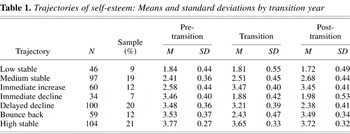
Trajectories of self-esteem: Means and standard deviations by transition year
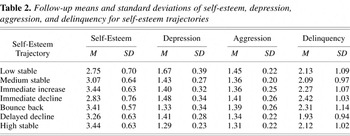
Follow-up means and standard deviations of self-esteem, depression, aggression, and delinquency for self-esteem trajectories
 You have
Access
- 56
- Cited by