Introduction
Unemployment insurance (UI) is traditionally considered the major safety net programme in the United States protecting against lost income incurred during unemployment. Existing literature, however, generally finds that less-skilled workers and disadvantaged families find it particularly difficult to access programme benefits (Vroman, Reference Vroman1998; Wenger, Reference Wenger and Gleason2006). Understanding the sources of these difficulties, however, proves complex. To access UI, workers must meet state-specific monetary eligibility requirements (based on prior earnings), meet non-monetary requirements (based on the nature of an employment separation and availability for future work) and navigate complex state bureaucracies.
This article explores the specific barriers to access of UI faced by certain groups of disadvantaged workers in the United States. This study is particularly timely in light of the severe US recession that began in December 2007, and recent UI-related provisions included in the American Recovery and Reinvestment Act (ARRA), discussed in more detail later on. Analyses use the 2001 Panel of the Survey of Income and Program Participation (SIPP), a nationally representative, longitudinal survey administered by the United States Census Bureau. Results suggest that a large majority of disadvantaged workers in the United States already meet UI earnings (monetary) requirements, and that barriers to access are more often the result of disadvantaged workers (1) wrongly assuming they are ineligible, or (2) not meeting non-monetary eligibility requirements because they voluntarily left their job or were terminated for cause. Much of the focus in policy debates in the United States remains on reforming UI earnings requirements. If results presented in this article are correct, increasing UI access among disadvantaged workers will further require increasing rates of application through expanded knowledge about the programme among disadvantaged workers, and expanding (non-monetary) eligibility for job leavers.
Background
The United States unemployment insurance programme consists of a complicated state-federal partnership in which eligibility and benefit levels are determined by the states, leading to wide variations in state programmes. In 2004, the maximum weekly benefit varied from US $210 in Mississippi and Alabama to $508 in Massachusetts. The United States UI programme is similar in some respects to unemployment compensation programmes in the six Group of Eight (G-8) nations that provide the best cross-national comparison: Canada, France, Germany, Italy, Japan and the United Kingdom. (Russia is excluded because its programme is relatively new and has recently experienced significant financing problems; Vroman and Brusentsev, Reference Vroman and Brusentsev2005.) All seven nations have compulsory programmes that cover the large majority of workers and are financed mostly with payroll taxes. The US scores low on most measures of programme generosity, relative to these nations (Vroman and Brusentsev, Reference Vroman and Brusentsev2005). The US system is exceptional among this group in its delegation of authority regarding most rules (including eligibility) to the states and its utilisation of experience-rating: taxation rates that vary based on each firm's past unemployment costs (Storey and Neisner, Reference Storey, Neisner, O'Leary and Wandner1997). Experience-rating creates an economic incentive for firms to avoid formal lay-offs that make workers eligible for UI and may raise the firm's UI tax rates (Levine, Reference Levine, Blank, Danziger and Schoeni2006).
Eligibility for UI varies considerably across the US states and is often complicated. Much of the existing research concludes that disadvantaged workers – especially former welfare recipients – find it difficult to access UI (Vroman, Reference Vroman1998), although some studies find that some groups of disadvantaged workers have accessed the programme in greater numbers in recent years (Isaacs, Reference Isaacs2005). There are three components that are important for understanding the programmatic barriers to UI access faced by disadvantaged workers: (1) monetary eligibility, (2) non-monetary eligibility and (3) rates of application (Bassi and McMurrer, Reference Bassi, McMurrer, O'Leary and Wandner1997; Wenger, Reference Wenger and Gleason2006; Levine, Reference Levine, Blank, Danziger and Schoeni2006).
Monetary eligibility
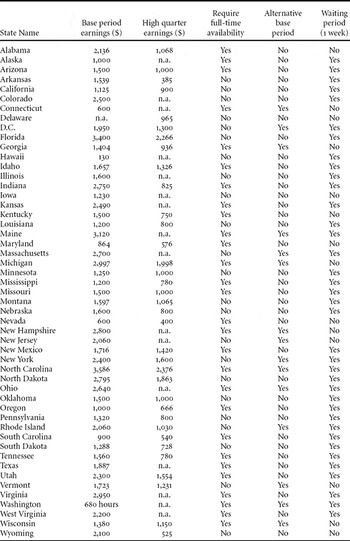
Monetary eligibility varies significantly by state but generally requires a state-specific minimum of earnings from any qualifying employer in the first four of the previous five completed quarters. This can mean that monetary eligibility is based on earnings from a period that ended as much as six months prior to job separation. Monetary requirements as of January 2003 are listed in Table 1. States vary in base period requirements, but generally fall between $1,000 and $3,000 earned over four three-month quarters. Most states also have a high quarter requirement, with a minimum requirement within a single quarter. As of January 2003, these high quarter requirements ranged from $400 in Nevada to $2,266 in Florida. Monetary eligibility rates in the US are low relative to the comparable G-8 nations. Italy has the strictest requirements, requiring covered work in 52 weeks of the previous two years.
State unemployment insurance policies as of January 2003

Note: Author's analysis of the US Department of Labor's ‘Comparison of State Unemployment Laws’, January 2003. From www.workforcesecurity.doleta.gov/unemploy/uilawcompar/2003/comparison2003.asp.
Much of the existing research and policy recommendations by analysts in this area have focused on reforming monetary eligibility, and a key policy proposal has been for more states to adopt alternative base periods (ABPs), which were used by 14 states (plus the District of Columbia) as of 2003 (and had been adopted by 30 states as of August 2009 in response to incentives provided by the recent economic stimulus, described below). ABPs typically allow workers to count earnings from their most recent completed quarter in their eligibility calculation (Coven and Stone, Reference Coven and Stone2009; Boushey and Wenger, Reference Boushey and Wenger2006; Wenger, Reference Wenger and Gleason2006; Holzer, Reference Holzer2000). ABP advocates argue that low-wage workers are disadvantaged by standard base periods because they often have less work history and shorter job tenures. By allowing workers to count more recent earnings, ABPs increase the chances that low-wage workers will meet monetary eligibility requirements. Some policy analysts have called the alternative base period the ‘single most important reform that would bring more low-wage workers into the UI system’ (National Employment Law Project, n.d.: 1).
Non-monetary eligibility
Most non-monetary requirements relate to the circumstances surrounding the employment separation, including the reason for job loss and availability for future employment. These requirements also differ by state, but most have some common elements. To be eligible, workers must have left employment due to layoff, plant closing, or some other involuntary reason without cause. They cannot have been terminated for performance issues or have voluntarily quit. In a few states, workers who do not initially meet these requirements may later become eligible and so sometimes they are referred to as ‘initial’ non-monetary requirements. Further, some states have provisions that allow workers who voluntarily quit for good causes (such as to care for a family member, child care difficulties, spouse's employment relocation and domestic violence provisions) to maintain eligibility. However, these address only a limited number of personal circumstances.
Some existing research suggests that non-monetary requirements may be the key barrier to accessing UI in the United States faced by disadvantaged workers. In a study using administrative data from four large states, O'Leary and Kline (Reference O'Leary and Kline2008), for example, find that an average of 90 per cent of less-skilled workers who left TANF for work and then lost their job were monetarily eligible for UI. However, TANF leavers were far less likely to meet non-monetary eligibility requirements, and they attribute this to higher rates of voluntary job quits and justifiable dismissals. Other studies have found similar results for TANF leavers and other groups of disadvantaged workers (Rangarajan et al., Reference Rangarajan, Razafindrakoto and Corson2002; Rangarajan and Razafindrakoto, Reference Rangarajan and Razafindrakoto2004; Levine, Reference Levine, Blank, Danziger and Schoeni2006; Decker and Levine, Reference Decker and Levine2001; Holzer, Reference Holzer2000; Stettner et al., Reference Stettner, Boushey and Wenger2005; Vroman, Reference Vroman2008). Relative to the comparable G-8 nations, the US has strict rules regarding non-monetary eligibility, which results in relatively low proportions of the unemployed meeting these requirements (Storey and Neisner, Reference Storey, Neisner, O'Leary and Wandner1997). In the large majority of states, non-monetary ineligibility lasts for the full length of the unemployment spell, compared to Italy where the disqualification lasts only a few weeks.
High rates of non-monetary ineligibility among disadvantaged workers may be due to individual-level factors, as disadvantaged workers may be less committed or have fewer ‘soft skills’ needed to maintain a job. Another possibility is that these disparities are driven by firm-level factors. Cutting jobs is not the only way to reduce labour costs. Firms also can cut workers’ hours or change their utilisation of other non-standard work arrangements. Low-wage workers are disproportionately likely to be employed in industries that tend not to use formal lay-offs (General Accounting Office, 2000; Lambert, Reference Lambert2008).
Another common element of non-monetary eligibility is a requirement that UI recipients be available for full-time work. This policy was held by 28 states as of January 2003, and it is often considered a major barrier to receipt of UI for part-time workers who would be unable to accept full-time work (Wenger, Reference Wenger and Gleason2006).
Rates of application
A final factor impacting access to UI in the United States is related to the fact that disadvantaged workers may also be less likely to apply for UI than others after becoming unemployed due to the programme's complex structure. Indeed, Wandner and Stettner (Reference Wandner and Stettner2000) report that more than half of the official unemployed (those without work but seeking work) do not file for unemployment insurance. Using supplements collected as part of the Current Population Survey, they find that the most common reason for this is ‘perceived ineligibility’. Often workers assume they are ineligible even when this is not the case (Vroman, Reference Vroman1991). Wandner and Stettner report that a majority of CPS supplement respondents believed they were ineligible because they ‘didn't work enough’. Information on the programme is far from universal. Some companies and especially unions directly facilitate the UI application process, while some other firms may actively obfuscate it. This suggests that disadvantaged workers who are eligible may be among the least likely to apply. Indeed, Wandner and Stettner find that young workers – a group that includes many disadvantaged workers – are particularly unlikely to apply for UI.
The current economic crisis and federal UI policy reforms
This study is timely, given the US recession that began in December 2007, which has been particularly severe when compared to the previous two. By June 2009, total payroll employment had fallen by 6.5 million; the June 2009 unemployment rate, 9.5 per cent, was the highest since 1983. The unemployment rate in June 2009 was 14.7 per cent among Blacks and 12.2 per cent among Hispanics. Also, the number of workers reporting involuntary part-time work almost doubled between December 2007 and June 2009. While the recession has been severe by historical standards, the American Recovery and Reinvestment Act (ARRA) has made a total of $7 billion available to be split among state UI programmes if they adopt certain measures to increase UI eligibility. To receive the first third of their share, states must have an ABP, making this the most prominent policy reform tied to this stream of money. States can receive the final two-thirds of their incentive payment if they make two of four reforms. For the current discussion, the two most important choices on this list are to (1) relax their non-monetary requirements to allow for quits for ‘compelling family reasons’ such as domestic violence, illness or disability of an immediate family member, or due to a spouse's employment relocation; and (2) enhance eligibility of part-time workers, by allowing the insured unemployed to seek part-time work. As of 6 August 2009, 30 states had received one-third of their incentive payment and 15 had received the full amount. This means 30 states had established alternative base periods as of 6 August 2009.
Understanding which of these reforms are most likely to boost UI receipt among disadvantaged workers is important. The current study contributes to existing research by using a nationally representative and longitudinal dataset to evaluate the competing elements described above regarding the greatest barriers to UI access for disadvantaged workers. The data allow an examination of the importance of (1) monetary eligibility requirements, (2) non-monetary eligibility requirements and (3) rates of receipt among eligible workers in understanding disparities in UI receipt separating disadvantaged and advantaged workers in the United States.
Data and methodology
Analyses utilised data from the 2001 Panel of the Survey of Income and Program Participation (SIPP) to compare rates of eligibility and receipt of UI among disadvantaged workers with those of more advantaged workers. Analyses also exploited state variation in the use of alternative base periods (ABPs), full-time availability requirements and one-week waiting periods during the period 2001–2003 to examine how these policies relate descriptively to rates of UI receipt in the United States. Some multivariate models are also presented to control for competing factors. When using dichotomous outcome variables, probit or logistic regression models are preferable to linear probability (LP) models because they explicitly model the outcome as a probability and avoid problems of heteroskedasticity. Probit results presented here are linearised by conversion into the average marginal effect (as opposed to the marginal effect at the mean, a less-preferred measure; Cameron and Trivedi, Reference Cameron and Trivedi2005). They can therefore be interpreted similarly to results from LP models, while not suffering from the same problems of bias. All descriptive estimates presented in this article are clustered by state to adjust for overly narrow standard errors resulting from the SIPP's stratified sample design. All regression point estimates are clustered by individual to adjust for repeated person observations.
The data
The SIPP is a nationally representative, longitudinal survey administered by the United States Census Bureau to collect information on labour force and social programme participation. The survey collects a multi-stage stratified sample meant to represent the non-institutionalised civilian population while also making it possible to learn about the families and households of respondents. The 2001 SIPP panel tracks labour force participation and public and private social benefit receipt of respondents over a three-year period, mainly between 2001 and 2003. The SIPP data for this study were drawn from extracts made available by the Center for Economic and Policy Research (CEPR, 2006). The SIPP's longitudinal structure makes it well suited for an investigation of UI access and eligibility (Stettner et al., Reference Stettner, Boushey and Wenger2005; Government Accountability Office, 2007). It collects data for respondents on every month for three years, thus making it possible to identify transitions from work into unemployment, to calculate earnings from previous months and to know the reason for an employment separation. The SIPP offers many advantages relative to the Current Population Survey, which is often used to study UI (Levine, Reference Levine, Blank, Danziger and Schoeni2006; Isaacs, Reference Isaacs2005). The CPS is cross-sectional, with only limited opportunities for longitudinal analyses through use of outgoing rotation groups. Further CPS questions regarding annual earnings and employment utilise annual recall periods, which are less accurate than the SIPP's shorter four-month recall period.
Populations under study
For this article, disadvantaged workers were identified using two criteria: work hours and wages. In terms of work hours, part-time workers were compared to full-time workers. Workers were classified as part-time if they worked 1–34 hours per week at their primary job during the reference month and did not report full-time status. Analyses focus on part-time workers who are primary earners, a particularly vulnerable group. Estimates from the SIPP suggest that primary earners (who earn 50 per cent or more of their family's income) make up 37 per cent of all part-time employed, while secondary earners make up the remainder. Among workers aged 18–64, the differences between part-time primary earners and secondary earners are striking. About one in three part-time primary earners in the sample fall below the Census Bureau's monthly poverty threshold in any given month, while only 2 per cent of part-time secondary earners do the same. Similarly, a third of part-time primary earners have no health insurance, twice the proportion of the uninsured among secondary earners.
Disadvantaged workers are also identified by their hourly wage in this article, with workers in the lowest wage quintile being considered disadvantaged. This analysis uses CEPR's (2006) constructed wage variable in the SIPP, which assigns an hourly rate to all workers. In tables presented later, workers are broken into wage quintiles so that non-linear relationships in outcomes between the five groups are shown. Estimates from the SIPP find that roughly 15.4 per cent of workers in the lowest wage quintile were below the poverty threshold, while this was true of only 5.4 per cent of workers in the second quintile and no workers in the top wage quintile. Similarly, a third of workers in the bottom wage quintile had no health insurance coverage, while the uninsured made up 18 per cent of the second quintile and 2 per cent of the top quintile.
Identifying employment separations in the SIPP
This article studies workers at the point that they enter a spell of unemployment. A respondent is considered to have entered into a spell of unemployment if she was employed and working during month t and not working but seeking work in month t + 1. A respondent is considered to have transitioned out of the labour force if she was working in month t and not working and not seeking work in month t + 1 (these guidelines are adapted from official definitions used by the Bureau of Labor Statistics, 2007). These categorisations appear fairly stable during the months following job loss, with very few workers who were initially coded as unemployed transitioning out of the labour force in the following four months.Footnote 1
Estimating receipt and eligibility for UI
UI receipt. A respondent is considered to have accessed UI if she reported benefit receipt from a state unemployment insurance programme during the first four months following an employment separation. This lagged variable is necessary because considerable time can elapse between job loss and benefits receipt. Workers may be on layoff waiting to be called back, or they may explore other employment options before turning to UI. Also, 37 state programmes required one-week waiting periods before granting benefits in January of 2003.Footnote 2
Using these criteria, roughly 30 per cent of adult respondents (aged 18–64) in the 2001 panel of the SIPP who entered a spell of unemployment reported accessing UI. During the years in which the 2001 panel data were collected, the Department of Labor (DOL) estimates that between 38 and 44 per cent of the unemployed received UI. DOL estimates and those presented here use different definitions, different data sources and different sample bases. Importantly, this study may have a slightly broader definition of the unemployed, as it includes individuals who transition out of one job but into a new one quickly. Further, research shows that respondents often underreport programme utilisation in surveys when compared to administrative data. Given these differences and limitations, the 30 per cent estimate seems reasonable.
Monetary eligibility. The SIPP offers monthly data on labour force outcomes. Monetary eligibility requirements by state are drawn from the US Department of Labor (2003). Monetary eligibility is estimated for all workers entering a spell of unemployment, as defined in this article. Each worker's wages were run through a simulation comparing her earnings over one year of work to her state's minimum monetary requirements. The four months directly preceding the employment separation were omitted to mirror the period that would typically be excluded by states. Although this does not coincide exactly with the worker's official base period, it is a close proxy.Footnote 3 Earnings from work were included for the 12 prior months, stretching back 16 months prior to the employment separation.Footnote 4 A worker was considered to meet her state's monetary requirements if her earnings in the simulated base period were at or above her state's (1) minimum base period requirement and (2) high quarter requirement. One limitation is the inability to distinguish between new initial claims and additional initial claims in the SIPP.
Non-monetary eligibility. Initial non-monetary eligibility requirements related to employment separations also vary by state, but they are often generalised in studies of nationally representative microdata (Levine, Reference Levine, Blank, Danziger and Schoeni2006). In this study, a respondent is considered to meet initial non-monetary requirements if the unemployment spell began because the worker ‘lost a job or was laid off’ (Levine, Reference Levine, Blank, Danziger and Schoeni2006). The respondent is considered ineligible if she left a position because of a discharge for cause or voluntary quit. Because of difficulties with the time frame (person-month observations), responses on this measure are available for only a portion of the total sample used for other estimates. To ensure that this does not bias the results, all descriptive and regression estimates (for UI receipt and monetary eligibility) were re-run, restricting to this smaller sub-sample. Results proved consistent. Another concern is that some respondents may choose not to self-report discharge or firing. This means that estimates from the SIPP may somewhat overestimate non-monetary eligibility. However, those who are discharged or fired are likely to report a voluntary quit instead, which would also lead to the respondent being coded as non-monetarily ineligible. Thus, the bias is likely small, if it exists at all.
An important limitation of this method is it will lead some workers to be coded as ineligible who meet the voluntary quits provisions employed by some states discussed above. However, it is impossible to adequately account for this in nationally representative estimates using survey microdata, given the complexity of state rules. Thus, similar studies use the standardised decision rules employed here (Levine, Reference Levine, Blank, Danziger and Schoeni2006).
Given the complexity of state UI eligibility rules, it is important to test the robustness of the methods described above with a counterfactual. Therefore, the proportion of the unemployed who are estimated to be ineligible by monetary and non-monetary requirements but who report UI receipt is calculated. Roughly 5 per cent of these workers report UI receipt, compared to a 60 per cent receipt rate among those who are estimated to be eligible. This suggests that the methods described above are predicting eligibility well.
Probit models
Probit models build on descriptive estimates for UI eligibility and receipt, and may provide evidence as to whether controlling for other demographic and environmental-related factors narrows the descriptive disparities in UI receipt and eligibility between advantaged and disadvantaged workers, or uncovers any differences caused by state policy variation. Parameter estimates have been converted to the average marginal effect and therefore can be interpreted similarly to output from linear probability models (Cameron and Trivedi, Reference Cameron and Trivedi2005). The main specification is:

The dependent variables are dichotomous measures where 1 = UI receipt or eligibility (depending on the model) and 0 = no UI receipt or eligibility (depending on the model) in the months following job loss for individual i at time t + 1 in state j. Disadv represents dummy variables identifying disadvantaged workers in the sample (part-time primary earner [0,1], low-wage worker in the bottom quintile [0,1]). ST-Prog includes a vector of state-level programme indicators that act as a proxy for state programme generosity, including three mutually exclusive categories for the maximum weekly benefit (low, medium and high), whether the state had a waiting period, full-time availability requirements and the existence of an alternative base period. ST-Prog is included only in models for UI receipt, and only in one model variation because of multicollinearity issues. X is a vector of family demographic and socioeconomic characteristics, which include sex, age (with age squared), race and ethnicity, marital status, immigration status and whether the respondent was a student in the months surrounding the employment separation. θ includes state-time fixed effects, the state-year unemployment rate and metropolitan/rural residence, while Φ represents the standard normal distribution. The sample is restricted to observations that transition into a spell of unemployment.
After careful consideration, in a few model variations, some potentially endogenous job characteristics were included in L, in the form of variables for detailed job industry and union membership. Their inclusion has little effect on the interpretation of other parameter estimates. Including them exerts a potential downward bias on parameter estimates for the variables used to identify disadvantaged workers. Including potentially endogenous job characteristics in an effort to generate a conservative estimate of the impact of work-related characteristics on benefit access is common in the literature (Kalleberg et al., Reference Kalleberg, Reskin and Hudson2000; Polivka et al., Reference Polivka, Cohany, Hipple, Carré, Ferber, Golden and Herzenberg2000).
Results
Descriptive results
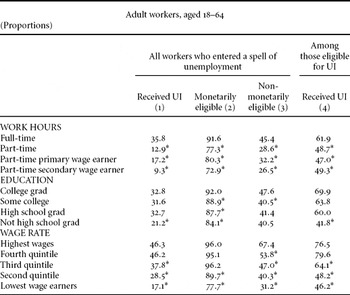
The first three columns of Table 2 report on the proportions of all workers who enter a spell of unemployment and who (1) receive UI, (2) are monetarily eligible and (3) meet non-monetary requirements related to their employment separation. The final column reports the proportion of workers who meet these eligibility criteria and who report UI receipt.
Descriptive proportions of receipt and eligibility for unemployment insurance by worker characteristics

Note:* statistically significantly different from means for reference group at p < 0.05 or above.
Source: Author's calculations from Center for Economic and Policy Research SIPP Uniform Extracts, Version 2.0.
Table 2 reports that about 36 per cent of full-time workers entering unemployment received UI. This is a low proportion, in and of itself. The US ranks at the bottom of the comparable G-8 nations in the recipiency rate among the unemployed (Vroman and Brusentsev, Reference Vroman and Brusentsev2005). Well below this proportion, however, are the 17 per cent of part-time primary earners who report UI receipt upon entering a spell of unemployment. Interestingly, part-time primary earners appeared almost twice as likely to access UI benefits as part-time secondary earners. Turning to the lowest wage earners (those in the lowest wage quintile), this group was also far less likely than workers in any of the other wage quintiles to access UI, with only 17 per cent receiving benefits, compared with 46 per cent in the two highest quintiles. There was even a sizeable difference between workers in the lowest wage group and the second wage quintile, in which close to 30 per cent of the unemployed received benefits. These results suggest that there are substantial and statistically significant descriptive differences in access to UI between advantaged and disadvantaged workers.
In terms of monetary eligibility, it is true that the disparities between advantaged and disadvantaged workers did not disappear. However, all groups of workers in Table 2 experienced high rates of monetary eligibility. Just over 90 per cent of full-time workers appeared to meet these minimum requirements, while among part-time primary earners, fully four in five met their state's requirements. Similarly, among all workers in the lowest wage quintile, about 78 per cent were monetarily eligible.
According to estimates in Table 2, a much lower proportion of workers in all groups met non-monetary eligibility requirements, as modelled here. Forty-five per cent of full-time workers entering a spell of unemployment (as defined in this article) met the requirements. This low percentage reflects the US's strict non-monetary eligibility rules. It also reflects the large proportion of workers who are job leavers rather than job losers. Only a third of part-time primary earners met these requirements. Differences by education were less stratified. While 48 per cent of college graduates appeared to meet non-monetary requirements, the other groups all had roughly the same proportion: 41 per cent. We see perhaps the greatest disparity when the workforce is divided into wage-rate quintiles. Roughly, 67 per cent of workers in the highest wage group met non-monetary requirements, while less than a third in the lowest wage group did.
The final column (4) of Table 2 reports on the proportion of workers entering a spell of unemployment who met both monetary and non-monetary eligibility requirements and who reported UI receipt. Even among eligible workers, disparities in rates of receipt between advantaged and disadvantaged workers did not disappear. While three in five eligible full-time workers accessed benefits, only 47 per cent of eligible part-time primary earners did the same. Fully three quarters of eligible workers in the highest wage quintile accessed UI, while the same was true of only 46 per cent of those in the lowest wage quintile. It appears that even among workers who met the main eligibility criteria for UI, there were statistically significant and substantial disparities in receipt of benefits between advantaged and disadvantaged workers. Less than half of workers in each of the disadvantaged worker categories considered in Table 2 reported receiving UI upon entering a spell of unemployment. This is compared to 62 per cent of full-time workers, and over 75 per cent of workers in the top two wage quintiles.
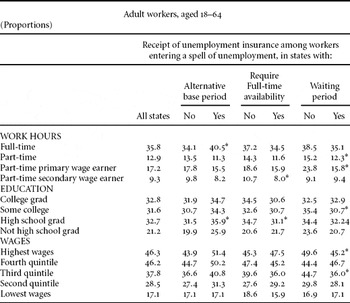
Table 3 reports on descriptive rates of receipt among states with three key UI policies described above. First, states with alternative base periods are compared to those without. States that require full-time availability are compared to those who do not, and states with a waiting period are compared to those without. In states with an ABP, disadvantaged workers entering a spell of unemployment appear descriptively no more likely to access UI than in states without. In fact, the only statistically significant difference is among full-time workers, who are descriptively more likely to access UI in states with an ABP than in states without. Another surprising finding in Table 3 is among states requiring full-time availability. As discussed above, this is one of the policies targeted in the UI eligibility provisions of the ARRA. There is no statistically significant difference between rates of UI receipt among part-time workers in these states, when compared to part-time workers in states that do not require full-time availability. The results may suggest a slight difference; however, these estimates are not statistically significant and are only a matter of a few percentage points. While other factors may be affecting this finding, Table 3 offers no statistically significant descriptive evidence that this policy reduces access to UI among part-time workers as a whole.
Receipt of unemployment insurance by state policies

Note: *statistically significantly different from the reference group at p < 0.05 or above.
Source: Author's calculations from Center for Economic and Policy Research SIPP Uniform Extracts, Version 2.0.
Finally, descriptively comparing states with a waiting period to those without, part-time workers who are primary wage earners do appear to be slightly less likely to report UI receipt upon entering a spell of unemployment in states with a waiting period, compared to those without (16 per cent compared to 24 per cent). However, there is no difference in receipt among workers in the lowest wage quintile in states with a waiting period relative to states without a waiting period. Thus, there is once again little descriptive evidence that this policy is a serious factor in explaining the disparities in UI receipt between advantaged and disadvantaged workers.
Probit analysis results
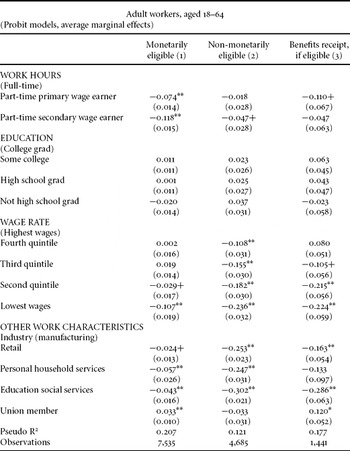
Table 4 reports on three probit models. Column (1) offers results on the probability of being monetarily eligible for all workers entering a spell of unemployment, and column (2) is for non-monetary eligibility. Column (3) restricts the sample to workers who met simulated monetary and non-monetary eligibility criteria, estimating the probability of accessing benefits conditional on eligibility. All models reported in Table 4 are significant at p < 0.001. Results for control variables all match with what the literature would predict. Union membership appears to be associated with an increased probability of accessing benefits, conditional of eligibility (column (3)). As existing research suggests, retail and other service industries were associated with large and statistically significant reductions in the probability of being non-monetarily eligible, relative to manufacturing jobs.
Eligibility for unemployment insurance

Notes: All models include age and age squared, race and ethnicity, sex, marital status, immigration status, student status, metropolitan residence, major industry variables, the state-year unemployment rate, and state and year fixed effects.
+ p < 0.10; *p < 0.05; ** p < 0.01.
Source: Author's calculations from Center for Economic and Policy Research SIPP Uniform Extracts, Version 2.0.
Interestingly, part-time primary earning work was not associated with a statistically significant reduction in the probability of non-monetary eligibility. Instead, wages and industry appear to be far more powerful predictors of stratification in non-monetary eligibility. When these other variables were omitted from the model, the parameter estimates associated with part-time primary earners for non-monetary eligibility became larger and statistically significant. Table 4 shows that the lowest wage quintile was associated with a statistically significant reduction in the probability of non-monetary eligibility, almost a 24 percentage point reduction relative to the highest wage quintile, far exceeding the disparities in rates of monetary eligibility.
Results in column (3) suggest that differences in eligibility were not the only factors driving differences in receipt of UI between advantaged and disadvantaged workers. As reported in column (3), even among those who met both monetary and non-monetary eligibility requirements – according to the estimation methods employed in this article – part-time primary earner work and low wages (as well as certain industries) were associated with statistically significant and substantial reductions in the probability of receipt of benefits. Eligible workers in the lowest wage group were 22 percentage points less likely to receive benefits than workers in the highest wage quintile. Thus, even among those who were eligible, disadvantaged workers were still less likely to access UI than were advantaged workers.
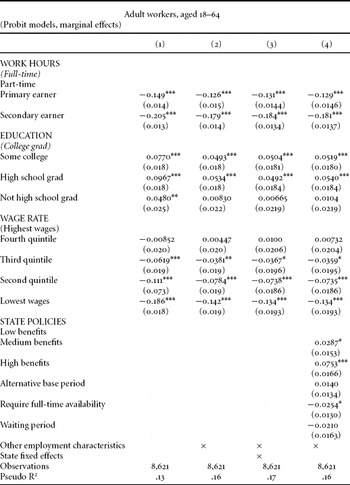
Table 5 offers a series of probit models with the dependent variable as receipt of unemployment insurance (1 = received UI after entering a spell of unemployment; 0 = did not receive UI after entering a spell of unemployment). These parameter estimates can be interpreted as the reduction in the probability of UI receipt for all workers entering a spell of unemployment. Model variation 1 includes worker characteristics discussed above and the key indicators of disadvantage (vectors Disadv and X in equation 1), along with the state unemployment rate, metro/rural status and year fixed effects. Variation 2 adds the other employment characteristics discussed above (vector L); variation 3 adds state fixed effects; and variation 4 replaces state fixed effects with key state UI programme characteristics (ST-prog). There is reason for concern that these state programme characteristics might introduce substantial multicollinearity into the model when paired with state fixed effects, resulting in biased parameter estimates and inflated standard errors. The variance inflation factor (VIF) test measures the level of multicollinearity in a model. The score is based on a set of bivariate regressions of independent variables run against each other. Researchers typically consider a VIF score of above 4.0 or 5.0 as a sign of multicollinearity problems. The state programme variables, as well as the variables used to identify disadvantaged workers, meet this criterion. However, state fixed effects and the state programme variables do prove to be multicollinear, and thus models are run separately with these variables. All models reported in Table 5 are significant at p < 0.001.
Effects of employment characteristics and state policies on receipt of unemployment insurance

Notes: All models include age and age squared, race and ethnicity, sex, marital status, immigration status, student status, metropolitan residence, the state-year unemployment rate, and year fixed effects. Other controls added as indicated.
*** p < 0.01, ** p < 0.05, * p < 0.1.
Source: Author's calculations from Center for Economic and Policy Research SIPP Uniform Extracts, Version 2.0.
The parameter estimate associated with part-time primary earners remains fairly stable throughout the four model variations. While these workers are descriptively 18.6 percentage points less likely to access UI upon entering a spell of unemployment than full-time workers, this disparity appears to remain steady at between 13 and 15 percentage points after controlling for other factors. Thus, including variables for industry, state and certain UI policies does not account for the reduced probability that part-time primary wage earners will access UI, relative to full-time workers. The parameter estimates associated with education are unclear. They suggest that, after controlling for other factors, those without a high school degree are no less likely to access UI than the college educated. Wage quintile, however, appears highly associated with a reduction in the probability of accessing UI. After adding controls for industry and union membership, the probability of UI receipt for workers in the lowest wage quintile remains at roughly 13 to 14 percentage points below workers in the highest quintile.
Turning to state policies, benefit generosity appears to be positively associated with UI receipt. The parameter estimate associated with the alternative base period is not statistically significant, nor is the coefficient on waiting periods. The parameter estimate associated with the requirement of full-time availability suggests a small effect, statistically significant at the p < 0.1 level. Adding these state policy variables into model variation 4 appears to have no real impact on the parameter estimates associated with the disadvantaged worker variables. Of course, there could be other state programme variables that are unaccounted for in the model that are biasing these results.
Discussion
Estimates presented in this article find that monetary eligibility requirements (based on past earnings) do not pose a major barrier to UI access for disadvantaged workers. The large majority of low-wage workers and part-time workers meet these requirements. Instead, non-monetary eligibility requirements appear far more important, as a much smaller proportion of all workers entering a spell of unemployment meet them. This suggests that while policies such as the alternative base period may help some workers, they will be insufficient for substantially raising the proportion of disadvantaged workers accessing UI.
Perhaps surprisingly, the analyses presented here offer no descriptive evidence that full-time availability requirements are associated with substantial reductions in initial UI receipt among part-time workers. If they have any impact, it appears to be small. It is possible that part-time workers get around these requirements by claiming full-time availability, whether they have it or not. These requirements may have more of an effect on duration of benefits, rather than initial receipt. Waiting periods also do not appear to be associated with lower rates of UI receipt for workers in the lowest wage quintile, although they may be associated with reduced access among part-time primary earners. If these findings are correct, it is unlikely that reforming these programme policies will seriously narrow the disparities in UI receipt between advantaged and disadvantaged workers. However, future research should more thoroughly examine this.
One key finding of importance in this article is that reforming eligibility requirements may not, in and of itself, significantly increase the proportion of disadvantaged workers receiving benefits. According to estimates presented here, less than half of the disadvantaged workers who are eligible for benefits ever receive them, while a far greater proportion of eligible advantaged workers receive UI. This may be due to a lack of knowledge about the programme, a lack of understanding of a complex bureaucratic process, a lack of need for benefits or a quick transition back to work. Future research should explore this issue. Wandner and Stettner's (Reference Wandner and Stettner2000) work suggests that the main reason that individuals fail to apply for UI is that they believe they are ineligible. If this is the case for eligible disadvantaged workers who fail to receive UI, then the most effective intervention may be to require states to better inform workers of their possible eligibility upon entering a spell of unemployment. Making this complicated programme clearer for disadvantaged workers may be the critical ingredient necessary for narrowing the disparities in UI receipt.
In terms of reforming non-monetary requirements, this will prove difficult at best. Issues of moral hazard complicate policy reforms. A policy that allows workers to receive UI after a voluntary quit would likely have the unintended consequence of incentivising workers to quit in order to receive UI benefits, which would be inefficient and expensive. In an effort to reform non-monetary requirements while avoiding such unintended consequences, some states have enacted provisions that allow workers who voluntarily quit for good causes (such as care for a family member, child care problems, trailing spouse provisions and domestic violence provisions) to maintain eligibility. However, these provisions address only a limited number of personal characteristics. Existing research suggests that firm and industry level characteristics may impact the low levels of non-monetary eligibility experienced by disadvantaged workers (General Accounting Office, 2000). Lambert's (Reference Lambert2008) work suggests that across a number of industries, firms tend to avoid lay-offs for their low-wage workers – probably in part to avoid higher UI taxes. They can cut their labour costs in other ways, such as reducing hours (sometimes to zero). Low-wage labour markets are dynamic and, as firms seek out ways to reduce costs, they change their employment policies and practices to minimise labour costs. While labour markets are constantly changing, the UI programme has remained structurally the same since in began in the 1930s.
One straightforward provision that would ease disparities caused by non-monetary eligibility would be to shorten the disqualification period due to voluntary quits to a few weeks instead of the duration of an unemployment spell, as Italy, Germany and Japan do (Storey and Neisner, Reference Storey, Neisner, O'Leary and Wandner1997). This would mean if workers were unemployed for four or perhaps 12 weeks following a voluntary quit – or if they met work search requirements (as is done in France) – they could become eligible to receive UI benefits. A more progressive measure might allow workers to ‘bank’ their UI months over time, to use when they need them most. Every year of work might translate into one month of UI benefits, up to a maximum of a few years. Workers could choose to take this when they need it most, and the limited total eligibility might reduce moral hazard concerns. However, such a policy reform is unlikely, as it would be unique among the comparable G-8 nations, and would represent a substantial policy departure for a programme that has largely remained static for three-quarters of a century.
UI could serve workers far better with some serious reforms. Policies such as alternative base periods that target monetary eligibility may indeed help some workers. However, they appear unlikely to lead to a significant change in the proportion of disadvantaged workers receiving benefits. The results from this article suggest that such reforms should instead focus on informing workers of their eligibility and on liberalising eligibility requirements as they relate to employment separations. While such reforms may be more difficult to achieve politically, they may be essential for the success of any effort to make UI more accessible to disadvantaged workers.
Acknowledgement
Research support for this article was provided by the Fahs-Beck Fund for Experimentation of the New York Community Trust. Thanks to Chris O'Leary, Julia Henly, Sheldon Danziger, Susan Lambert, Harold Pollack and two anonymous referees for helpful comments on earlier drafts of this work. Thanks to Mario Simonelli for research assistance.