‘It is just because I am in one sense in perfect solitude here that images of other scenes come trooping through my imagination and I like them so well that I feel like telling you of them.’Footnote 1 With these words, James Thomas Wilson – a ship’s surgeon on his first voyage east to China in 1884 – tried to explain to his parents back in Scotland the world he was inhabiting. During the slow days trekking across the broad expanse of the Indian Ocean, his mind ranged across the new people and places he was encountering, across the reading material he had brought with him, and out through memory and association, to create a space that extended along the routes of his own imagination. It is the contention of this article that historians of the nineteenth century need to think about notions of empire, nation, and race in the context of this social production of space. More specifically, the article posits that, in this period, the moving space of the steamship functioned as a particularly important and largely overlooked site in which travellers’ political and racial ideas were gradually and actively reworked as they moved along the routes of global and imperial trade. It suggests that the process of travel and the progressive way in which individuals consciously sought to order the world around them needs to be written back into the history of ideas and identities in the late nineteenth and early twentieth centuries.
Supporting this contention, the article also undertakes to demonstrate how such study might be undertaken. By paying attention to Wilson’s letters, written in the course of his travels to China and Australia in the mid 1880s, it shows that in the space of the ship, literally moving along the routes of global trade, Wilson forged a particular kind of British identity that collapsed the spaces of empire and extended the boundaries of the British nation. Deeply imbued with spatial and temporal concepts, Wilson’s notion of himself as a part of a diffuse British community that he saw as responsible for advancing modern civilization was his way of making sense of the immensity of a world he experienced as both liberating and unsettling. In the course of his journeys at sea, Wilson, the Scot, came to conceive of himself as part of an expansive British nation.
Space, empire, and the sea
The suggestion that encounters with new places and people were a fundamental part of nineteenth-century notions of European civilization, science, and race is not a new one. Since the 1990s, scholars such as Charles Withers, David Livingstone, and Felix Driver have pointed to the spatialization of European thought consequent to the European voyages of ‘discovery’.Footnote 2 They have shown that such encounters helped shape categories of ‘self’ and ‘other’ that came to be embedded within the scientific and moral discourses of the Enlightenment.Footnote 3 In the emerging disciplines of geology, natural science, philology, and even philosophy, difference was mapped onto space and time. The ‘Orient’ was rendered as exotic and effete; the peoples of Australia and South America as ‘primitive’ and ‘backward’; and everything that lay outside Hegel’s teleological progress of Reason as ‘prehistorical’. While on the one hand, following on from Edward Said’s Orientalism, scholars such as Mary Louise Pratt have seen travel writing as central to this process, helping to ‘produce’ the rest of the world for Europe, on the other, historians such as Christopher Bayly have argued that the creation of knowledge was always a ‘dialogic process’ of interaction and interconnection, in which most people of the world participated.Footnote 4 But for both modernity might, as Paul Gilroy has suggested, be considered to have begun ‘in the constitutive relationships with outsiders that both found and temper a self-conscious sense of Western civilisation’.Footnote 5
Christopher L. Hill has recently made similar arguments about the development of the nation-state. In Benedict Anderson’s formulation, print capitalism made it possible for readers who were separated by physical distance to imagine themselves sharing the same time and space in a common national community.Footnote 6 But, as Hill points out, at the end of the nineteenth century such imaginings were also conditioned by what he calls ‘the politics of knowledge of the age of imperialism’.Footnote 7 In ‘a period of accelerating integration of the international state system and the world market’, imagining the nation and writing its history became, argues Hill, a way of mediating ‘between the particular and the universal’; a way of making the process of change ‘representable and thereby comprehensible’.Footnote 8 Or, as Duncan Bell has written, the ‘history of modern political thought is partly the history of the attempt to confront increasing global interdependence and competition’.Footnote 9 For both Hill and Duncan, ideas about the nation in the late nineteenth century must be seen within the context of a rapidly globalizing world.
This, indeed, is the approach that has underwritten the sustained attempt of the last twenty years to integrate the history of British imperialism into the writing of British history. In the mid 1980s John Mackenzie’s pioneering study used a range of popular sources to identify the growth of an imperial culture in Britain. In doing so, he reignited a debate about the extent to which British culture was shaped by contact with the empire.Footnote 10 Cain and Hopkins’ research on ‘gentlemanly capitalism’ might be seen as part of this broad project, highlighting as it did the importance of empire to the City of London, while Andrew Thompson’s work in the late 1990s demonstrated the role empire played in British politics.Footnote 11 In various ways, these and other historians have argued that the empire was central to the cultural, economic, and political life of people in Britain.
Some of this work has overlapped with that of another group of historians who predominantly come from the former settlement colonies. They have argued that common sentiment, shared institutional values, and ‘a plethora of networks’ formed a ‘cultural glue’ that held together countries such as Australia and Canada ‘set going’ by mass migration from Britain. These real and imagined commonalities, they suggest, helped constitute a ‘trans-oceanic British world’.Footnote 12 Indeed, Andrew Thompson and Brian Magee’s new book on ‘imperial globalisation’ details in depth the networks and cultures that helped form ‘a British world economy’.Footnote 13 Pointing to the existence of a world in which distance was not mapped by miles but rather by the strength of cultural, commercial, and institutional ties, these ‘British world’ historians have made a claim not for the insertion of empire into Britain but for an expansive British nation – one constituted not by physical borders but rather by the relative space of networks and connections.Footnote 14
In contrast to both these groups, though sharing the agenda of the former, ‘new imperial’ historians such as Catherine Hall and Antoinette Burton have made a different sort of argument about the importance of empire to the history of Britain. Defining culture as a set of meaning-producing practices developed in contexts of power, they have argued that cultural constructions of race, class, and gender difference were fundamental to the simultaneous shaping of identities in both metropole and colony.Footnote 15 They contend that, as a consequence, British history ‘has to be transnational’, challenging the binary of imperial and national histories ‘and critically scrutinising the ways in which it has functioned as a way of normalising power relations and erasing our dependence on and exploitation of others’.Footnote 16 If imperial and ‘British world’ historians have in some senses seen ‘Britain’ as a materially constructed space – one contained by the physical boundaries of the British Isles or delineated by the relative movement of people and goods – these ‘new imperial’ historians have seen it as a culturally constructed entity – one created by ‘grammars of difference’ that instituted a logic of rule, replicated by representations and practices that worked to separate the colonizers from the colonized.Footnote 17
However, both ‘new’ and ‘old’ historians of empire, as Tony Ballantyne and Antoinette Burton have recently pointed out, have been slower to consider space in the way that geographers are increasingly encouraging them to do: not as ‘a surface across which people and things move or … the fixed site on which power and its capillaries are deployed and circumvented’, but rather as something, like knowledge, that is continually produced; space, ‘not as a smooth surface but as the sphere of the coexistence of a multiplicity of trajectories’.Footnote 18 As both material and cultural historians of empire implicitly and sometimes explicitly recognize, the modern period witnessed the emergence of new spatialities – and new ways of thinking about them – that were encountered and constructed in many ways: via cities, consumables, and popular and print cultures to name just a few. For the most part, however, two factors have been missing from their investigations.
First are the various imaginings and active re-workings that individuals undertook as they attempted to make sense of the different worlds they encountered; what Doreen Massey calls their attempts to tame ‘the challenge that the inherent spatiality of the world presents’.Footnote 19 While the history of political thought often concentrates on select thinkers, colonial discourse analysis has tended to see ‘regimes of difference’ as in some sense pre-packaged cultural constructions that saturated and structured the way in which individuals acted and interacted. Of course, these are powerful arguments. Yet, according to Middell and Naumann, if we are to historicize the globalized world, an actor-based approach is imperative nonetheless. If globalization is not only about flows across borders but also about attempts by various state and non-state actors to control such flows and make them meaningful, they argue that it is vital to understand ‘who was successful in putting the nation into the centre of spatial concepts at a certain time, and who managed best in the less hierarchical conditions that define the regimes of territorialization before and after the period of 1860 to 1970’.Footnote 20 Race, gender, and class conditioned and enabled this ability, but so too did the various ways in which individuals sought to make sense of the multiple trajectories and ideological fracturings they also encountered. Paying attention to people’s active engagements matters because some individuals and social groups – subaltern and elite – were able to navigate the globalizing processes of the late nineteenth century more successfully than others.
Second, in the nineteenth century some of the most significant of these globalizing processes were the new forms of personal mobility resulting from the power of steam. Although Ballantyne and Burton’s recent collection, Moving subjects, together with David Lambert and Alan Lester’s Colonial lives across the British empire, might be seen as attempts to integrate theories of spatiality into the writing of empire, the work they gather focuses less on the process of travel than on the sites – both human and material – constructed by the trajectories of people, products, and ideas.Footnote 21 However, as migration scholars well know, by the nineteenth century increasingly large numbers of people were, quite literally, feeling the ground move beneath their feet.Footnote 22 Indeed, James Belich has argued that the mass migration of people out of the British Isles in the nineteenth century constituted a ‘settler revolution’, while the systems of Indian indenture and Chinese labour moved large numbers of people as well.Footnote 23 In the age of sail such journeys could take between thirty days and six months and, although travel times were reduced following the introduction of steam and the opening of the Suez Canal, in the latter part of the century these voyages remained major undertakings. They involved not only farewells and anxious expectations but also new forms of onboard sociability, long days at sea, the dangers of illness and the environment, and regular stops at ports along the way. Such journeys cannot be abstracted from the ways in which the millions of people who made them understood themselves and the worlds around them. As Tim Cresswell has argued, ‘the movement of human bodies, whether self-propelled or transported, is never separate from consciousness and representation’.Footnote 24
The sea, and the ways in which people reworked their political and racial ideas in the course of their travels across it, needs to be put back into the study of British and imperial history. Though scholarship concerning Britain’s maritime history is vast, as Glen O’Hara has recently pointed out, ‘treatments of nation-making and the sea as a whole have for many years been brief and descriptive, rather than analytical … the idea has not been used consistently to uncover the relationships between the British peoples, their ideas, the British state, and the oceanic context’.Footnote 25 Work on sea journeys in other contexts shows how fruitful such an approach might be. Here, scholars of slavery and of the transportation of unfree labour in particular lead the way. Historians of the Atlantic slave trade have long pointed to the horrific ‘middle passage’ as central to the transformation of captive bodies into commodities and to the shaping of narratives following arrival in America.Footnote 26 The image of ‘ships in motion across the spaces between Europe, America, Africa, and the Caribbean’ was also central to Paul Gilroy’s study of the transnational cultural construction of the African diaspora in The Black Atlantic. He used it to argue for the modern and hybrid nature of black consciousness, pointing to the significance of the actual travels of many African American writers in shaping their ideas and identities.Footnote 27 Historians interested in other forms of bonded and captive labour have also examined the constitutive role of the sea passage in the shaping of subaltern lives and selves, and here attention to bodily markings has provided one way to access subjective experiences.Footnote 28 Hamish Maxwell-Stewart’s ‘Founders and survivors’ project, for example, is a longitudinal study that seeks to integrate the sea voyage into understanding of convict lives before and after transportation.Footnote 29 From another angle, Jonathan Hyslop’s recent work on Asian, African, and British sailors in the Indian Ocean world argues for the need to examine the active roles that these men played in shaping their futures.Footnote 30 He points to Isaiah Shembe, the founder of a syncretic religious movement based in Natal, and asks, ‘Could his experience of the Indian Ocean world not have been a factor in the evolution of his thought?’Footnote 31 Linking experiences at sea to experiences on land, such research views individuals as actors – albeit constrained and conditioned ones – making meaning of their worlds in the context of the experience of relocation, be it enforced or voluntary.
This methodology might profitably be applied to the way we seek to understand the construction of ideas in the late nineteenth century. In particular, it might tell us much about notions of Britain and British identities. How, for example, did journeys at sea, undertaken during this period in increasing numbers by ‘ordinary’ people from Britain and the settler colonies, affect the way in which these individuals consumed and processed ideas about the nation? Robin Haines has pointed out that, unlike their predecessors, steamships required constant refuelling. This meant that, from the 1880s on, emigrants also began to ‘[see] themselves as tourists’, stopping to sightsee at numerous ports in the Mediterranean and Indian Oceans on their way to Australasia, South Africa, India, or China.Footnote 32 How did this constant process of comparison and contrast help shape the ideas and consciousness of these passengers? What did they do onboard, and how did they integrate these practices and experiences into their prior understandings of themselves and the world? How did the sea journey enshrine, refashion, or disrupt previously constituted categories of class, race, and gender? Paying attention to voyages in this way might bring together the current historical interest in space, globality, and identity, in order to examine the emergence of ideas in exactly the sort of ‘uncharted spaces between empire and colony, nation and nation, and Western and non-Western worlds’ that Ian Tyrrell has suggested must be the focus for transnational historians.Footnote 33
Case study: J. T. Wilson’s journeys to China and Australia, 1884–87
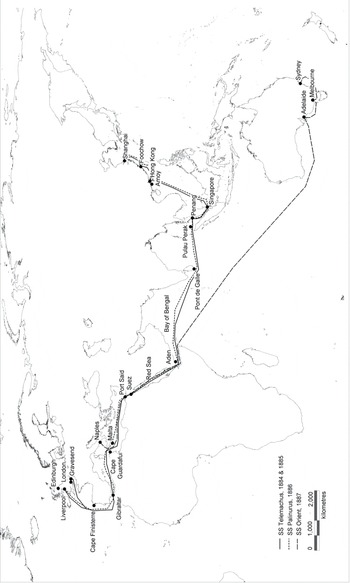
The journeys of James Thomas Wilson offer us an opportunity to consider just such questions. Over the course of his travels to China and Australia in the 1880s (see fig. 1 below), he wrote frequently to his parents, posting long and detailed, though sometimes sadly incomplete, letters – often written over the course of several days – from ports along the way.Footnote 34 This progressive correspondence affords a valuable insight into the ways in which his ideas changed and developed as he engaged with his reading, his shipmates, and the various ports in which he docked. By situating him in time, and accompanying him on his journeys, this section seeks to uncover the process by which one man came to understand himself and his environment. In so doing, it highlights the importance of the dynamic interplay between embodied individual mobility and ideational notions of space and time, and suggests that the development of what J. G. A. Pocock called ‘global Britishness’ was not merely a response to anxieties about decline or a cultural construction of difference, but also a way in which a real person made meaning of his experiences in the context of new forms of global connectivity.Footnote 35
Wilson's sea journeys in the 1880s.

Born in Dumfriesshire, Scotland, in 1861, Wilson was the child of devout parents, who – as first-generation schoolteachers from families of artisans – were invested in the opportunities brought by education and religion.Footnote 36 Their own parents had been beset by economic difficulty and, seeking better opportunities, two of his mother’s sisters had moved to America and another to Australia, where one of his father’s brothers – a coach-builder – also lived. But, remaining in Scotland, his parents had managed to qualify as teachers and they set up home in Moniaive, a small agricultural village where his father was the local schoolmaster. Teetotal and Sabbatarian, the Wilsons were a loving but disciplined family, deeply embedded in the strong networks of faith and kin that centred around their active membership of the Free Church. As a boy, the young Wilson was also inspired by the enthusiasm of a nearby doctor and eccentric naturalist, T. B. Grierson. However, his parents were also thinking people whose interests extended to botany and astronomy and an ardent support for Gladstone’s Liberal party. Encouraged by them, Wilson decided to follow in Grierson’s steps and work towards a medical career – something that would offer the rewards of a profession, as well as furthering his love of natural history.
However, Wilson was neither well off nor well connected and money for his university education had to be borrowed from an uncle and members of the Moniaive community.Footnote 37 Once in Edinburgh, he lived frugally but not desperately, lodging with a landlady whom he knew from Dumfriesshire. He volunteered with the University Company for Home Defence, regularly attended Church, and joined the Dumfries and Galloway Literary Association, where he made friends with James (Jim) Lorrian Smith, also a medical student. It was while visiting Jim’s family during the summer holidays in 1881 that Wilson met Jim’s sister, Jeanie, to whom he would later become engaged. He also became friends with another fellow student, John Haldane – brother of Richard Burton and member of an old landowning family – and through him encountered the work of Idealist philosophers such as T. H. Green and Edward Caird. Meanwhile, in his lectures, he encountered the mechanistic doctrines of German physiologists such as Hermann Helmholtz and Carl Ludwig, who held that all living phenomena could be reduced to the laws of physics and chemistry.
Wilson reeled from the death (from tuberculosis) of his beloved older sister in 1882, which left him as his parents’ only surviving child, but plugged away at his studies, graduating inauspiciously in 1883 with second-class honours. Plagued by ill-health, as well as the need to repay the debt to his uncle and take responsibility for his ageing parents, he worked for six months as a resident house surgeon at the Royal Edinburgh Infirmary but worried about what to do next. Although Haldane – by 1884 working in Oxford under his physiologist uncle, Burdon Sanderson – was asking him to collaborate on research, this was not something Wilson could afford to do. He needed money and was therefore relieved in the summer of 1884 to secure a position as a ship’s surgeon with the Blue Funnel Line.Footnote 38 He left at the beginning of August on the SS Telemachus for a round trip of four months to China, with only the names of a few Dumfriesshire connections and a medical degree in his pocket.Footnote 39 He had never been outside Scotland before, and his first trip was formative: in its shifting spaces, his sense of himself and the world was altered and challenged.
Wilson’s first journey to China: 1884
The ship was a new environment for Wilson, and it brought him into new sorts of intimate encounter. His handful of fellow saloon-class passengers were not the students and teachers with whom he was familiar, but rather merchants and engineers. As he left Britain he marked himself out in opposition to their company, which he thought ‘did not admit of thinking conversation’: ‘The way several of those here abuse their “h” is most lamentable’, he wrote disdainfully. But this new set of people also gave Wilson an opportunity to define his national identity: I have, he wrote, ‘realised the difference to me between a Scotchman & Englishman’; ‘Mr Moss the Chief Engineer is a “Fifer” & we can generally find something to talk about. The difference is not only that of subject but of the very mode of thought’.Footnote 40 This first articulation of his Scottish identity was in opposition to the English on board, but he also shared the trip with a Dutch passenger going to work on a tobacco plantation in Sumatra – the first of the several Europeans and Americans he would meet in his travels. And, if the English were strange, the members of the crew were even stranger: ‘There are some queer chaps among the fellows here’, he wrote of the men preparing to unload the cargo. Though Wilson never named them as such, following the introduction of steam, African and Indian labour was frequently used to work ships in the British merchant navy and it is possible that Wilson’s ‘queer chaps’ – ‘witty in their way and seem[ing] to enjoy themselves very well’ – were different from him in this respect as well.Footnote 41 It is difficult to believe that Wilson did not post a letter from the Mediterranean or Middle East, but the surviving letters contain no mention of stops in these ports. Instead we hear of the dull dinner conversation in the saloon during the long voyage across the Indian Ocean. Indeed, Wilson almost willed himself back to Scotland when he gave his parents instructions to pretend to be him and write to Maclachlan & Steward, booksellers in Edinburgh ‘in my name just as if it were I’.Footnote 42 Reaching out for the security of his Scottish home and identity was one of the ways in which Wilson negotiated the different people and places he met in the course of his travels.
Yet, despite his social anxieties and boredom, the excitement of the voyage was also something that captured him. Passing Point de Galle off Ceylon (Sri Lanka), he described catching a whiff of perfume and ‘an air of promise … that made [him] long to be there’.Footnote 43 Descriptions such as these show Wilson making sense of his environment by mobilizing a collection of preconceived understandings: the Orient was the place of adventure, empire was a liberating possibility, Ceylon with its tea plantations was exotic and perfumed. Arriving in Penang and seeing Chinese boats for the first time, he described the ‘whole scene’ as ‘just … like the realisation of many pictures which were quite familiar to me’: ‘the same rigging the same Chinamen with the same pigtails & parasol hats, & umbrellas & slippers & garb generally that I have long known in imagination & had now opportunity of recognising in reality & fact’.Footnote 44 Rendering them as ideal figures, timeless and undifferentiated, Wilson understood his first encounter with the Chinese through this lens of an already produced and static picture, one that he extended and replicated virtually identically across Southeast Asia.
Racial stereotypes were central to this picture. Disembarking in Penang (which he noted was ‘a motley town’ of Chinese, Malays, and Indians) Wilson described the Chinese as ‘miserably developed’; ‘It is very difficult at first to tell a man from a woman’; some ‘great stout lordly looking fellows but none appear especially well made’.Footnote 45 The ‘black fellows’, meanwhile, were ‘splendidly made, fine big muscular fellows, who are certainly not kept down by their tailor’s bills’. Later he would encounter Sikh policemen, ‘really fine looking fellows tall & stalwart’ who ‘curl their moustachios & whiskers in a very fierce manner’, escorting ‘about half a dozen lunatics from Penang to Singapore’.Footnote 46 Yet, despite their lack of trustworthiness – ‘Johnny is a great thief’ – it was the Chinese of whom he most approved. He praised their industry and their ‘splendid long pigtails’ and reported that he had been ‘told they [we]re the best kind of people out here … [and] very unlike some of the blacks in this’.Footnote 47 He ate food in a ‘Chinese shop kept by Yong Kee’ (‘a most respectable place’, in which all the customers ‘appeared well educated’); marvelled at the selection of fruits; wrote of the ‘exceedingly clever’ Chinese tradesmen; and admired the ‘betterclass houses’, some of which were ‘very fine’. He also noted the absence of women in public, and the proliferation of English merchants, expressing surprise at the relatively small contingent of Europeans. Hearing a Scottish accent on the street, he ran after a man who turned out to be a policeman from Perth and he attributed the admirable state of the roads and buildings to the positive influence of what he called ‘British rule’. In his first experience of a trading port, Wilson thus collapsed the Scottish and English presence into a composite ‘British’, at the same time as he explained its diverse character in terms of pre-established racial hierarchies. But, using Thomas Carlyle’s term for a man who prides himself on respectability and empathizing with the men pulling rickshaws, Wilson also castigated the ‘Chinese Aristocracy … which rides in its carriage & is quite as stuck up as any gigman at home could possible be’, and noted the ‘English amusements &c that seem to mix strangely in the Eastern Melee’. Though he freely employed it, his racial thinking was complicated by his Presbyterian appreciation of industriousness and moral, physical, and intellectual strength, and by his recognition of the multiple cultures coexisting in Penang.
His interest in the physique of the people whom he met is also striking. But this fascination also worked to disrupt – if only slightly – some of his pre-packaged ways of ordering his environment. For the bodies Wilson described were also ones with which he was coming into intimate contact. As the ship’s doctor, he engaged with not only the European passengers but also the numerous Chinese and Indian ones. 150 Chinese travellers were taken on at Penang and a further 202 at Singapore.Footnote 48 The ship also carried Malays going to Singapore. These passengers disturbed the ship’s space and its routine. ‘First thing they do when they come on board’, wrote Wilson after leaving Penang, ‘is to spread a mat somewhere on deck & thereafter that spot is respected … [t]he ships officers however have often to shift these’; ‘We can with difficulty get along the deck now for legs & arms sticking out’.Footnote 49
In practising Western medicine on these deck passengers, Wilson was bringing another set of notions about time and space to bear – notions caught up in ideas of progress attached to Western medical practice. But, as Tony Ballantyne and Antoinette Burton have pointed out, this sort of intimate doctor–patient encounter also created a space that shifted and moved as individuals – both Wilson and his patients – asserted their place within it.Footnote 50 It moved literally: the ship made its way to various ports of call, enabling patients to disembark or seek alternate care; and it moved corporally: bodies responded for good or bad to Wilson’s treatment, patients refused that treatment, supplemented it, presented changing accounts of their illnesses, and failed to assist each other. Wilson had to respond in turn, and in the shifting space of translation his ability to practise as he wished slipped as well:
it is very difficult to find out anything satisfactory for our comprador who is interpreter has himself but a meagre English vocabulary and it sometimes takes a long time to ascertain the simplest points. I ask a simple question to which the answer might be yes or no and after an extraordinary amount of chattering back & forth, get often, at best, a very round about answer. It is most aggravating. There more confusion arises if the patient belongs to Swatow [Shantou] or some other place. There are so many dialects and they cannot understand each other a hundred miles off. The comprador has often to call on the aid of another interpreter & the accuracy of a statement is not assured if it’s coming through the mouths of several media.Footnote 51
Like the pidgin English that Wilson also described – ‘a good deal of Chinese idiom in it and English words are often used in a very curious way’ – his practice of medicine had to adapt as he interacted with his patients.
Wilson’s sense of order was also disrupted by events outside the ship. Only a few weeks before, the French had attacked the Pagoda Anchorage at Foochow (Fuzhou), and on his arrival there Wilson found the river and harbour littered with the wrecks of the Chinese naval fleet. He reported that ‘feeling against foreigners was … very high’: ‘It felt rather unsafe’, he wrote, ‘to be in a foreign settlement of a few hundred in close proximity to an enraged native city of quarter to half a million.’Footnote 52 Disturbing his own happy trajectory and pre-packaged encounter with ‘the East’, these tensions were the context in which Wilson identified himself as ‘English’ and ‘British’, slipping between the two terms, while also reaching through memory and association to the security of his Scottish home. Arriving by night in Hong Kong, he had seen the tiers of lights on the hillside and had been reminded of the old town of Edinburgh. Sailing up the Min river into China had reminded him of Loch Lomond.Footnote 53 And he did so not only in imagination: in the middle of the destruction in Foochow, Wilson met up with one of his Dumfriesshire connections, a Dr Underwood who was in charge of the Seaman’s Hospital, and in the ruins of his looted house they sat together and reminisced about ‘Glenairn & its inhabitants & Edinh & its academic life’.Footnote 54 Amid an atmosphere of considerable hostility toward Europeans, Wilson thus extended his own sense of place into the unstable world around him, at the same time also finding security in a broader ‘British’ association.
In the midst of all of this, Wilson had changed. More accustomed with the ways of ship life, he found his journey home markedly different. The company he had originally felt to be unthinking, he now found congenial.Footnote 55 The world he had experienced as alien, he now found familiar. Though Wilson had only a few connections when he left, in the course of his trip he had befriended a number of the English and Scottish saloon passengers who had joined the boat along the way, and these new friends had toured the port cities with him, translated for him, and taken him to places where he might not otherwise have gone. And, while seeking out his fellow Scots, in the context of multiethnic port cities, he increasingly came to place himself as British as well. Although he was glad to arrive back in England in the first days of December, the trip had shifted his sense of his own home and its attractions: ‘shivering & cowering indoors in bleak Scotland … need[ed] all the attraction that homeliness & social life can give it to make it outbalance the soft climate of the south’.Footnote 56
Second journey to China: 1885
The unpleasantness of the Scottish winter was perhaps part of the reason why Wilson looked forward to the second of the two voyages for which he was contracted. He left Gravesend on Christmas Day 1884, under a month after his return from his first journey, again on the Telemachus. It was a ship that was now familiar, manned by the ‘same old crowd of officers & engineers’ – a company leavened by a few new saloon passengers in the form of a man in the sugar business and his wife.Footnote 57 Passing Cape Finisterre off the coast of Spain, Wilson looked with anticipation to the journey ahead. He revelled in his escape from the ‘murky climate and leaden skies’ of Scotland and gloried in the ‘loveliest of moonlight nights’. ‘What a queer thing life is’, he wrote to his parents, ‘and yet [it is] the most natural thing in the world!’Footnote 58
At the same time as it liberated him from the Scottish winter, the ship also gave Wilson intellectual space. He had set out for himself an ambitious schedule of reading and study – something he had also done on his first voyage – and looked forward to plunging in to ‘a lot of interesting work’. He allowed ‘an hour per morning for Greek’ and took with him P. G. Tait’s Recent advances in physical science (1876) and Heat (1884), a recent paper by his friend J. S. Haldane (probably ‘Life and mechanism’, published in 1884 in Mind), Adolphe Ganot’s introductions to physics, and T. H. Green’s Introduction to Hume’s treatise on human nature (1874), as well as some Berkeley, Milton, and Tennyson.Footnote 59 With this reading material, Wilson was trying to make sense of the vigorous contemporary scientific debate raging between the vitalists and the mechanists, a debate that drew heavily on both spatial and temporal ideas. Mechanists such as Charles Darwin and T. H. Huxley proposed a purely mechanical and materialist view of the universe; but this was a vision of life that to many, Wilson included, seemed empty of meaning. By contrast, vitalists believed that there existed a dynamic life force that was not wholly reducible to the laws of science. Puzzling over these debates, Wilson and Haldane were influenced by the metaphysics of Green, who postulated the existence of an eternal consciousness of which the individual mind only became aware as it grew and matured. ‘Of course’, wrote Wilson off Gibraltar, ‘the whole materialistic school is at war to the knife with such ideas’.Footnote 60 For Green, the world was a huge organic unity of interrelated parts, whereas for Darwin it was an endless random proliferation. In the early 1880s these were questions that rebounded around the philosophic and intellectual community with real force.
Moreover, they were questions that had troubled Wilson in Edinburgh for some time. He evidently saw the ship as a quiet and untroubled space in which to work them through. It was not, however, an isolated space, for Wilson’s reading took place in the context of strange, yet increasingly familiar, surroundings. His continuing struggle to make sense of this external world shaped the way in which he thought, in the same way that his internal world conditioned the way that he understood his environment. Indeed, the porosity of his inner and outer spaces is clearly evident in the letter that he wrote shortly after leaving Aden. With concepts borrowed from Green, Wilson reported to his parents that he was considering how to ‘best qualify myself for living my part in the life of the huge organism – the world’.Footnote 61 Green’s language had seeped into Wilson’s understanding of himself and his future, and his own movement along the routes of Britain’s global trade was the context in which he was absorbing Green’s notion of organic unity.
Moreover, these internal tussles were taking place in an external environment of turmoil. Shortly after passing Cape Guardafui, the ship was hit by the north-west monsoon. ‘[B]ig waves battered and thumped away at [his cabin] door’ and Wilson had to remain in bed with seasickness. He could not write, and he ‘could not even read’.Footnote 62 The outer world had disturbed all his well-laid plans for study and, when calm settled again and the ship resumed its ‘plodding across the Bay of Bengal’, he found it difficult to get his momentum back.Footnote 63 But entering the Straits, Wilson found his immediate external environment once again becoming highly excited. He reported continuing hostilities between the French and Chinese and strained relations between China and Japan. It was in the context of these antagonisms that Wilson learned of General Gordon’s death in the Sudan. To this news he responded with force, but his reaction conveyed the growing complexity of his political views: ‘shocked to hear of the fall of Khartoum’, he thought it a ‘sad end for poor Gordon after the manful stand he made’. But he did not sympathize with the general outcry against Gladstone, which he feared would ‘operate unduly against the [Liberal] Govt at home’. Though he believed it ‘futile to try & simply wash our hands of Egypt, as some people would have us do’, he wondered what sending out extra troops ‘[would] all come to’.Footnote 64 Caught himself in the midst of geopolitical tussles, he held his Liberalism alongside an increasing commitment to empire.
Similarly, Wilson struggled to reconcile what he saw as the threatening and debased elements of Chinese culture with those he found genuinely worthy.Footnote 65 One of his fellow saloon passengers between ports – a ‘Chinaman (young) & his wife & two children & three nurses & a mother in law’ – was anything but the ‘realisation of a picture quite familiar’.Footnote 66 Rather he was rich, spoke and read English, and was a British subject.Footnote 67 In Hong Kong, Wilson was delighted by the Chinese New Year celebrations, marvelling at the rich and gorgeous clothes: ‘But the colours! Brilliant & various they are’, he wrote in wonder.Footnote 68 In Shanghai, he procured a Chinese guide and ‘paid a visit to the Chinese city – Shanghai proper’. Although he condemned its system of justice, sanitation, religion, and burial, he also recognized that ‘Tho’ abounding in abominations it has withal a certain distinct civilisation.’ Admiration for Chinese industriousness and a sense of exoticism was often held alongside a commitment to racial hierarchy, but Wilson was sufficiently troubled by the apparent contradictions of what he saw to look consciously for some kind of explanatory framework. The one that he found read temporal notions of development onto spatial units such as East and West. ‘[W]hen our ancestors were savages’, he wrote from Shanghai, ‘this civilisation was in its heydey – it was real & a true thing and a vigorous and apparently healthy life was throbbing in the cities’.Footnote 69 China had ‘had a good start’, but ‘unlike the Western races they became isolated and missed the blending & welding of race with race … which has doubtless been such a potent factor in evolving our present western life’.Footnote 70 This invocation of evolutionary notions of development was in keeping with his scientific reading, yet Wilson believed that there was a still more important factor that influenced what he saw as Chinese ‘backwardness’:
The entire lack of moral principle and even of moral sense among the Chinese is one of the most deplorable features of the national character. This is the great obstacle to the way alike of rational self-government among them & of the progress of Christian faith … China lacked what was vouchsafed to the West in the same critical situation – the renovating & ennobling influence of the Gospel of Christ which alone perhaps has saved Europe from a degradation to the level of an effete civilisation such as we have in China.Footnote 71
It was not just environmental, racial, or demographic factors but also moral ones that Wilson saw as animating Western culture. And it was these moral aspects – in particular, ‘the lack of … any living faith’ – that was to him ‘by far the most important factor in the paralysis of Chinese advance’.Footnote 72 With these notions, Wilson seemed to find a way of containing the world he was seeing within a set of meanings that, for him, had explanatory force.
But this was not a system of thought that Wilson had generated entirely by himself. As Patricia Morison has written, his assessments had ‘less to do with China than with [his] own search for moral authority’.Footnote 73 For, in addition to his other reading, it seems clear that Wilson also took with him on his second voyage a copy of Edward Caird’s Hegel, published in 1883, and read this as he sailed up the Chinese coast.Footnote 74 As he reflected on the tumults of the external world, Wilson’s internal universe was occupied with Hegel’s elevation of Western civilization, progress, and Protestantism. Indeed, it was Caird’s particular presentation of Hegel’s dialectics as a way of reconciling conventional religion and materialistic science, by seeing them as ‘inseparable elements of a higher unity, which is … organic or vital’, that was gripping Wilson.Footnote 75 To a moral and religious Scot who was fascinated yet troubled by the materialist school, this synthetic approach was highly attractive. Yet from his comments about China it is evident, too, that the categories and conceptualizations that helped resolve his inner intellectual turmoil also seeped out into the equally uncertain external world of politics and empire. If Caird gave Wilson a way to think about Darwin, he also gave him a way to think about China.
For Wilson associated with Caird’s presentation of Hegel a critique not just of the habits of the Chinese but also of those of Europeans in East Asia. Referring to Hong Kong, he described ‘these trading places’ as only the ‘outworks of civilisation’, not representative of the ‘high type of that which is most essential in civilisation, religion – literature – science & art’.Footnote 76 If these representatives of Christianity did not display the moral qualities associated with Western culture, how was China to be brought out of the static past? On his way back through Shanghai he went with a Presbyterian friend, Mr Bamford, ‘to visit an out station of the London mission with Mr Stonehouse the present representative of that mission out here’. There he admired the school full of boys working diligently at the ‘New Testament & Confucius’, but lamented that, despite the best efforts of Protestant missionaries, ‘the Chinese don’t know how to reflect’: ‘They haven’t done it for many hundreds of years’. This, he thought, was why the Roman Catholics were more successful – with them it was ‘merely a transference of one system of religious custom & superstition to another’. However, he railed against the iniquities of Catholic missionaries, who he felt merely ‘extort an outward & unreflecting submission to an external traditional authority’.Footnote 77 By contrast, the Protestant missions promoted ‘the conscious & intelligent adoption of an entirely new principle of being, an internal motive power – a new birth’.Footnote 78 For above all, it was the moral force associated with rational Protestantism – and in particular Presbyterianism – that Wilson, from Hegel, saw as the engine of progress. And, as the only major Protestant global power – in 1885 Wilson gave no thought to the United States – it was the British who were doing most to advance true religion across the world. Though he relied on his Scottish connections, it was with the British that he now overtly aligned himself.
Wilson began to imagine himself occupying the landscape more permanently – as an agent in China of progress and civilization. In Shanghai he paid goodbye calls to his friends the Bamfords and the Matheisons and ‘felt just as if I were leaving a familiar place’.Footnote 79 Passing through Amoy (Xiamen), he thought it ‘almost … seemed like a dreamland’. Though Hong Kong, he admitted, was ‘a much more striking place at first’, he thought he ‘should tire of it sooner than of Amoy’: ‘I think it must be one of the finest places in China to live’.Footnote 80 No doubt the fact that in the European settlement of Kulangsu (Gulangyu) there were many fine houses belonging to ‘missionaries who were a very strong body’ also proved attractive. But, as the ship retraced its slow steps across the Indian Ocean and he found himself occupying the saloon class with nine small children who, ‘screaming & shouting & romping [had] an utter contempt of all privacy’, he longed to be back home.
Having left East Asia, however, Wilson also felt himself to be somehow rendered static: ‘The suspense of the problem of what next is very annoying’, he wrote from the Red Sea, ‘and I am beginning to feel that I must not spend more time in this, in one sense, idle life.’Footnote 81 It was in this restless frame of mind that, off Aden, Wilson saw a passing Orient Line steamer bound for Australia. This ship, with its invocation of a global British system that he now identified as the animating force in the world, gave him an idea. Since 1883, Wilson’s former Edinburgh classmate T. H. Anderson Stuart had been professor of medicine at the University of Sydney. Considering his career options, Wilson decided to write to Stuart to ask about the chance of finding work in Australia. He had seen first hand the opportunities available – especially to Scots – for social and material advancement in the professional services of Britain’s empire and, with his reading of Caird and Green, he had developed a way of making sense of his own potential place in its dynamic trajectories.
It was perhaps little wonder then that, working under a local doctor in Dunbar, East Lothian, a month after his return, Wilson felt unsettled. He was worrying about his career and his health and hoping that he would be accepted as the demonstrator for the professor of anatomy, Sir William Turner. ‘Of course you know’, he wrote to his parents, ‘that science is my special love & perhaps forte too & now that I have so far decided I am eager about it.’Footnote 82 Yet obtaining the appointment under Turner was by no means a certainty and Wilson worried about money. This was the state of mind he was in when an envelope arrived from Sydney: Anderson Stuart had made him a vague sort of proposal. Using a language that was sure to appeal to Wilson’s sense of time and space, Stuart was encouraging:
you should not lose sight of the place here either as Demonstrator or Professor … I am not bidding you leave your native shores for the Land of the Future: I am not even inviting you: But if you would like to come at any time let me know early as I may be able to put you on a good line.Footnote 83
In Stuart’s mind as well as Wilson’s, Australia, unlike China, was the land of the future. It was the extension of British progress, and its university in Sydney – the embodiment of civilized learning – was ‘a really big affair’.Footnote 84 In the context of his new-found sense of himself, such a possibility could not but have been attractive to Wilson.
Third journey to China: 1886
Though Wilson did secure the appointment as Turner’s demonstrator and worked under him during the winter session of 1885–86, his future continued to be fraught with uncertainty. Anderson Stuart’s offer was not a firm one, and Wilson had debts to pay as well as a career to choose. This was possibly a factor in his decision, despite having fulfilled his initial contract with the Blue Funnel Line, to undertake a third trip east to China, this time with the SS Palinurus of the Ocean Steamship Company, and he left England in mid April 1886. Once again the warm air and the open skies enthralled him. The Mediterranean climate was freeing and he found Malta so attractive that he did not want to leave.Footnote 85 The ‘mediaeval elements’ of the island fascinated him, and he wished he could linger longer in a place that seemed to him almost out of time. But instead he was drawn back to the ship and the networks of modern commerce and trade it embodied: ‘Time & tide & steamships wait for no man’, he wrote, once again mixing temporal with spatial language.Footnote 86
On this trip, however, Wilson was surer of himself. Though he again used the ship as an intellectual space, he could now read the authors whose ideas on his previous voyage he had found so challenging: ‘Darwin, Mill & Herbert Spencer & that school of which I stand in no fear nowadays when I can be sure of my standpoint. And from said standpoint the views of these writers are at best very imperfect & partial. In fact their science needs nothing short of rethinking on new lines. But Darwin’s scientific insight is marvellous!’Footnote 87
No longer wrestling with a set of Hegelian intellectual categories, in Shanghai, too, Wilson saw much more to admire. He visited the theatre and was impressed by the ‘gorgeous costumes’ of ‘magnificent silk and satin stiff with embroidery of gold & gorgeous colours’ and the drama of the music. He could not understand the words, but was aware that in this regard he was no different from the locals: ‘the majority of Chinese in the audience were as badly off for the dialect was Pekinese’.Footnote 88 He was less moralizing about the country, expressing greater hope in the advance of Christianity and the civilizing influences of railways and manufactures, though he still thought an alliance with Britain was China’s best hope.Footnote 89 More assured of his inner identity, Wilson could more consciously delight in the multiple characteristics of a China he now had a way of understanding.
He was, however, still uncertain about what his own role in life would be, and his mind turned to events at home where, much to Wilson’s chagrin, Gladstone’s Home Rule Bill was facing difficulties. In 1886, Wilson believed about Ireland what he would later hold for Australia: that providing for local independence was the way to strengthen imperial unity. He was not so clear on what should happen in Egypt or East Asia, but seemed to think that it was Christianity, aided by ‘all civilising influences … such as railways & manufactures’, that should penetrate the Chinese interior, not British troops.Footnote 90 Yet, for all the compatibilities of his versions of liberalism and imperialism, Wilson was also realizing that, among the European communities in the trading ports, his liberal view of empire was not widely shared: he ‘had some arguments over [Home Rule]’, meeting ‘no one who thoroughly approves it’ and had concluded that it ‘really [was] in advance of the average public opinion’.Footnote 91 If Wilson was considering an imperial career, it seemed increasingly unlikely that it would be in China.
Yet his journeys to China had directly shaped the way in which he understood himself and the world. In the shifting space of the ship he had encountered places and people against which he articulated his own identity, coming to see liberal Protestant Britain as the driving force of moral and material progress. Travelling the routes of global empire, he had translated his Scottish world into a British imperial one, and this had given him a way of thinking about himself that helped him negotiate its opportunities and expanses.Footnote 92 So when, back in Edinburgh, just as winter was beginning, Wilson received another letter from Anderson Stuart boasting in glowing terms of the climate in Australia, he took particular notice. ‘One hears at home’, read Stuart’s message, ‘accounts of the heat of Sydney: the 3 worst months are simply Neapolitan Summer weather and the remaining 9 are perfect! Query which is preferable 3 such hot mos. and the 9 perfect or as at home ie. in Britain, 9 beastly ones 2 middling and perhaps one good? I vote for Sydney!!!’ With this preamble, Stuart also made Wilson a definite offer: a position as demonstrator of anatomy at a salary of £350 a year, with the likelihood of professorship to follow. This in a medical school that Anderson Stuart described as one that would ‘worthily stand comparison with the Mother School [in Edinburgh]’: ‘you may with some confidence’, he wrote, ‘look for Light from the southern land’.Footnote 93
For a young graduate considering an academic career it was an attractive offer, with access to research material and superior pay and career prospects to those available to him in Scotland. And, unlike China, Australia was neither a land of the past nor a society divorced from the medical community to which Wilson belonged. Anderson Stuart had made this clear in his letter: ‘We are five of us here now’, he had written, envisaging the Medical Faculty in Sydney as an extension of that in Scotland, ‘all young Edinburgh fellows and … with our influence and help we could push you into anything’.Footnote 94 After three voyages to China, this prospect appealed directly to Wilson’s notion of himself as part of an expansive British community and it provided a solution to the problem of his own inertia. Though he demurred for a moment it was an opportunity that, despite the objections of his friend J. S. Haldane, who advocated by contrast the more traditional (and expensive) route of study in Germany, he could not resist.Footnote 95
Journey to Australia: 1887
Having accepted the post in Sydney, Wilson wasted no time getting there. Leaving behind his Jeanie, to whom he had become secretly engaged, he booked a passage aboard the passenger ship SS Orient and sailed from Naples in January 1887, after travelling overland through France and Italy. Though his place in the economy of the ship was this time very different – no longer the ship’s surgeon, he had more time but less privacy – once again the voyage was crucial in fashioning the way in which Wilson saw himself in the world. Particularly influential was a relationship that he formed with one of the other passengers, a fellow Scot, Mungo MacCallum, who was also bound for the University of Sydney, where he was to take up the Chair of English Language and Literature. Together with Dr Struthers – a doctor whom he had met on his previous travels – the three of them formed ‘quite a friendly corner immediately’.Footnote 96 It was a relief to Wilson, who did not have ‘a very high notion of the intelligence and the tastes of the average first-class passenger or the travelling colonial’, to find that in ‘the University circle at least one may meet a different sort’.Footnote 97 On the long journey across the Indian Ocean, MacCallum and Wilson became ‘great friends’, meeting for breakfast before having a smoke, and then reading together until lunch and reading together again in the afternoon. They arranged to carry on their study of philosophy together in Sydney.
Philosophy, indeed, was something that drew the two Scots together. Both, reported Wilson, ‘occupied the same platform’: MacCallum was also an Idealist and a disciple of Edward Caird.Footnote 98 When, fifty years later, MacCallum remembered his reasons for accepting the Sydney chair, he invoked aspects of this shared philosophy. Two things had influenced him: first, J. A. Froude’s 1886 work, Oceana, which had revealed to him ‘the brilliant promise of the Australian Colonies’, and second, the despatch from New South Wales of a contingent of troops in 1885 to join the Sudan campaign. Together, these events had convinced him that ‘coming to this far-off land [Australia] would not mean anything like exile, that I would still be among our own people, that the transfer would only be from Great to a portion of what Sir Charles Dilke had aptly called “Greater Britain”.’Footnote 99
Wilson was taken with this view of empire. On board he borrowed MacCallum’s copy of Oceana and was impressed by Froude’s notion of the British empire as an expansive nation and his insistence that the ‘life of a nation, like the life of a tree, is in its extremities’.Footnote 100 On the way to begin their new lives in Sydney, the two Scots talked at length about Caird and Froude and the idea of progressive advance that they saw as implicit in both.
This conception of Australia as an extension of the British nation, full of vitality and promise, was one that chimed well with the ideas that Wilson had developed on his own travels to China, accommodating his Scottish identity as well. Like many of the ways he found to describe his experiences on those trips, it was an idea that was inherently spatial, extending the British nation across the reaches of the globe. Moreover, the concept offered Wilson a way of holding together his liberalism and his imperialism. Echoing notions of organic unity evident in T. H. Green’s work, he could see Australia not as an outpost on the edge of empire but as part of an expansive nation; a community responsible for itself, but indelibly part – indeed, the most dynamic part – of the world from which he came. It was a community, too (at least according to the reports of Anderson Stuart), that had a special place for Scots. This was a perspective that can only have been further reinforced when, on his arrival in Sydney, Wilson was met by John Shewan, a laboratory assistant whom he already knew from Edinburgh, and was conducted around the university, where he met yet more Scots and found a hospital with ‘buildings & Equipment better than anything [he had] seen’ before.Footnote 101 Australia seemed very much to be a part of Britain; a Britain, moreover, in which Scots played a prominent role. It was something that must have been reassuring to someone who had just moved to the other side of the globe.
This way of seeing the world was reflected in the various activities that Wilson took up following his arrival in Australia. He continued his philosophic reading in regular sessions with MacCallum and, though he thought colonial politics ‘rather a one-horse affair’, supported Henry Parkes’ Free Trade party.Footnote 102 In 1888, he brought his parents out to live with him and, upon his appointment as professor of anatomy in 1890, the long-suffering Jeanie travelled out as well. But their life together was to be short-lived. She died after giving birth only nine months after her arrival, leaving a three-day old child. In his grief, Wilson threw himself into his work, hunting for specimens for his research, joining the NSW Royal Society and the Linnean Society, and promoting university extension lectures, the Student Christian Movement, and the Worker’s Educational Association – all activities that saw Australian society as an extension of that in Britain.Footnote 103 When the South African War broke out, he helped found the University Volunteer Rifle Corps and, in the first decade of the twentieth century, he became involved in a number of voluntary societies that sought to strengthen imperial ties. But Wilson did not believe that fostering such ties was in conflict with the assumption of various forms of local responsibility. Indeed, he saw responsible government as the best means of fostering imperial unity. In his scientific work, too, he pursued an analogous agenda. He dedicated his career to uncovering the morphology of the platypus, something he thought would identify evidence of evolution from a common ancestor. Indeed, Wilson saw both the natural world and the British empire as huge organisms of interrelated parts in which variation was evidence of superior development. As he would write in 1918, ‘real community does not hide differentiation. It is only the lowly organism which is undifferentiated. That is the higher organism in which there are “many members yet one body.”’Footnote 104
Wilson’s four voyages were crucial in helping shape this worldview. In his letters, we see him in the process of knitting together Caird, Green, and Froude to create a vision of Britain and its empire that allowed him not just to make sense of the foreign places and people he encountered en route to China but also to make choices about his own life that did not exile him from the political, cultural, and moral community of which he felt a part. Like many Scots – indeed like many members of his own family – he had found opportunity and advancement in the empire’s various networks and structures.Footnote 105 Consistent with his views about Home Rule, his idea of the British empire as an organism allowed for autonomy as well as ‘national’ unity, Scots as well as Australians. Slipping between articulations of ‘nation’ and ‘empire’, for him the notion of a British ‘organism’ became a way to make sense of the spatial dislocations in his own life; a way of integrating his Scottish networks into wider imperial ones; of containing the world so as to make choices about it.
Conclusion
A relatively unconnected, middle-class border Scot, Wilson navigated Britain’s global empire by moving along Scottish networks that were both religious and professional. In the course of these travels, however, he developed a way of seeing the British empire that allowed him to find a place for himself within it. If his sea had a Scottish accent, it styled itself as British. For, in the moving space of the ship, Wilson had encountered new worlds and new ways of being in the world that rubbed up against those he already knew. In the context of the shifting social space on board, the shifting world outside, and the shifting currents within himself, he had groped in various directions for explanation. In his letters, we see him developing what Doreen Massey calls ways of ‘incorporating spatiality into his way of being in the world’, employing modes of coping with the challenge presented not only by China but also by his own shifting intellectual worlds.Footnote 106 His decision to take up work in Australia and his understanding of it as part of an expansive British nation must be seen as a direct product of these experiences.Footnote 107
Though Wilson’s letters tell us little about the thoughts of those not fortunate enough to dine in the saloon – third-class and deck passengers, shipmen, or bonded labourers – they do, nonetheless, underscore the importance of the sea journey in shaping notions not only of self but also of nation in this period.Footnote 108 His letters draw attention to the need to understand such journeys as processes, often slow ones, in which passengers gradually understood their worlds as they moved through them; encountering new social relationships, new climates, foreign peoples, difficult ideas, and battling with the boredom of slow days without sight of land. On the way they translated the globalities that they encountered into languages and concepts that contained and channelled them.
Indeed, Wilson’s letters suggest that it is worth exploring more widely the extent to which global Britishness at the end of the nineteenth century was forged in the context of journeys that, after the opening of the Suez Canal, took ships from Britain via ports in the Mediterranean, Egypt, Aden, and Colombo. Here passengers disembarked, toured the cities and observed the customs of people who appeared very unlike themselves. They then returned to the moving space of the ship and sought to make sense of these places as they travelled towards a country that looked a lot more like ‘home’ than did any of the ports in which they had stopped. In this sense, it might be possible to talk about a ‘British sea’, in which passengers from the settler colonies and the various regions of the United Kingdom, travelled the routes not just of empire but also of global trade, forging as they did so an idea of the British nation and a ‘global British’ identity that allowed them both to make sense of their experiences and to make choices about their lives. As Jonathan Hyslop’s recent article about the journey of another global traveller suggests, this ‘British sea’ was merely one among many layered sea spaces in which racial, religious, and vocational identities were shaped in the routes of trade and empire.Footnote 109 Not all of these lasted into the twenty-first century. But if historians are to understand the ways in which various actors sought to capture and direct the forces of globalization in this period, then they need to think not just about arrivals and departures, not just about offshore and on, but about sea journeys themselves as shifting spaces in which people of all descriptions developed ideas that helped them navigate the contours of a rapidly changing world.