


Introduction
Oceanic island fauna usually includes a high proportion of endemic insects. Compared to other oceanic archipelagos, the Canary Islands are unusually close to the mainland (northwest Africa). They also possess great environmental diversity, due to variations in altitude and orientation, and proximity to the Sahara desert. The relative old age of the archipelago, its island fragmentation and ecological diversity have originated a rich local fauna with a total of 5260 insect species, 2220 of them endemic (Oromí & Báez, Reference Oromí, Báez, Izquierdo, Martín, Zurita and Arechavaleta2005). This interesting framework has promoted abundant phylogenetic and phylogeographic studies of some groups of insects and other arthropods (see Brunton & Hurst, Reference Brunton and Hurst1998; Juan et al., Reference Juan, Oromí and Hewitt1995, Reference Juan, Ibrahim, Oromí and Hewitt1998, Reference Juan, Emerson, Oromí and Hewitt2000; Arnedo et al., Reference Arnedo, Oromí and Ribera2001; Rees et al., Reference Rees, Emerson, Oromí and Hewitt2001; Contreras et al., Reference Contreras-Díaz, Moya, Oromí and Juan2003; Moya et al., Reference Moya, Contreras-Díaz, Oromí and Juan2004, Reference Moya, Contreras-Díaz, Oromí and Juan2006; Emerson & Oromí, Reference Emerson and Oromí2005; Emerson et al., Reference Emerson, Forgie, Goodacre and Oromí2006 and references therein; López et al., Reference López, Contreras-Díaz, Oromí and Juanin press), leading to one of the largest numbers of evolutionary studies to be carried out in an oceanic island archipelago. However, there is a paucity of ecological studies, despite the great interest of this particular fauna.
The proximity of the Canary Islands to the African continent probably accounts for colonization by unexpected animal groups such as large flightless insects like the pamphagid grasshopper. These species often have small populations, occupy fragile and limited environments, and have evolved to adapt closely to particular habitats. Such insular adaptations have mostly been described in vertebrates (see Gorman, Reference Gorman1979; Williamson, Reference Williamson1983; Whittaker, Reference Whittaker1998) while they remain relatively little known in invertebrates. The present study is focused on the grasshopper Acrostira euphorbiae García & Oromí endemic to La Palma and belonging to the Pamphagidae family (Orthoptera), represented in the Canaries by three other species of Acrostira Enderlein and by the also endemic genus Purpuraria Enderlein. The four species of Acrostira occur in the western and central Canaries, each one endemic to a single island: A. euphorbiae in La Palma, A. bellamyi (Uvarov) in La Gomera, A. tenerifae Pérez & López in Tenerife, and A. tamarani Báez in Gran Canaria. The genus Purpuraria is limited to the eastern islands and has a single species with two insular subspecies: Purpuraria erna erna Enderlein from Fuerteventura and P. erna lanzarotensis Bland from Lanzarote. Despite their large size (females up to 7.3 cm and males up to 3.4 cm in the case of A. euphorbiae) these species are difficult to observe and therefore considered scarce. Indeed, three of the species have been discovered recently (Báez, Reference Báez1984; García & Oromí, Reference García and Oromí1992; López et al., Reference López, Pérez, Oromí, Acevedo, Rodríguez and Hernández2005) and the males of A. tamarani were recorded and described 17 years after the females (Oromí et al., Reference Oromí, Martín and Galindo2001).
On the whole, studies of Pamphagidae dealing with aspects other than taxonomy are limited. Some have been performed on embryonic and post-embryonic development (Aiouaz & Boufersaoui, Reference Aiouaz and Boufersaoui1973; Llorente, Reference Llorente1990; Massa & Lo Verde, Reference Massa and Lo Verde1990; Foucart & Lecoq, Reference Foucart and Lecoq1996), behaviour (García & Presa, Reference García and Presa1985; Llorente, Reference Llorente1990; Llorente et al., Reference Llorente, García and Presa1995), feeding (Gangwere & Morales, Reference Gangwere and Morales Agacino1964), sound emission (Burtt, Reference Burtt1946; Johnsen, Reference Johnsen1972; García et al., Reference García, Clemente, Llorente and Presa1996) or genetics (Streiff et al., Reference Streiff, Mondor-Genson, Audiot and Rasplus2002, Reference Streiff, Audiot, Foucart, Lecoq and Rasplus2006; Zhang et al., Reference Zhang, Li, Wang, Yin, Yin and Yin2005; Contreras-Díaz et al., Reference Contreras-Díaz, López, Oromí and Juan2006; López et al., Reference López, Contreras-Díaz, Oromí and Juanin press). However, few studies have been carried out on basic ecology such as habitat use or phenology (Foucart & Lecoq, Reference Foucart and Lecoq1996) and most of these were made in continental environments.
Most of the studies carried out so far on the Canarian Pamphagidae are confined to taxonomical descriptions, and the geographic distribution and population estimates are well known only for A. euphorbiae (see López et al., Reference López, Contreras-Díaz, Morales, Báez and Oromí2004). This species is considered to be in danger of extinction by the Spanish National and the Canarian Regional Catalogues of Threatened Species (BOE, 1998; BOC, 2001) and another three are regarded as ‘vulnerable’ or in ‘danger of extinction’ in the regional catalogue. The sole exception is the recently discovered A. tenerifae, with an extremely reduced distribution but not yet included in such lists (López et al., Reference López, Pérez, Oromí, Acevedo, Rodríguez and Hernández2005). However, very little information is available on their biology and ecology, rendering it difficult to develop suitable conservation programmes for these endangered species.
In accord with our previous field experience, A. euphorbiae is found in dry scrub-land dominated by the endemic plant Euphorbia lamarckii, which seems to be the only abundant suitable wild food plant. Furthermore, its close relationship with this plant has probably resulted in insect phenology being related to host availability.
Thus, studies were conducted with two principal objectives: (i) to assess the main adaptation strategies of Acrostira euphorbiae to Euphorbia lamarckii, focusing primarily on its habitat use and movements; and (ii) to determine its population size and seasonal phenology over a complete year. Furthermore, the different strategy adaptations of this insular grasshopper were compared with related continental species.
Materials and methods
Study area
The study area is a small plot of about 1 ha located in El Remo (SW La Palma, UTM 28R021773/316178) included in a nature reserve. The area is bordered at the north by banana greenhouses and surrounded on the remaining sides by abrupt lava fields formed by the eruption of the Cumbre Vieja volcano in 1712 (Carracedo, Reference Carracedo, Fernández Palacios and Martín Esquivel2001). The landscape of this area is characterized by lavas and by sedimentary deposits originated by landslides from steep neighbouring cliffs. Since access to the main distribution area of this grasshopper is difficult, this flat area located at the base of the main cliff was selected. The soil is an entisol (J.A. Guerra and M. Rodríguez, personal communication) and the climate is typically arid Mediterranean, slightly influenced by the sea nearby; annual rainfall is 275.2 mm and the mean annual temperature is around 20°C. The vegetation is that of the leeward lowlands of the western Canaries, well-adapted to xeric conditions. This xerophytic scrub is rather open and the main plant species present are: Euphorbia lamarckii (from here on Euphorbia), Kleinia neriifolia, Retama rhodorhizoides, Ceballosia fruticosa, Echium brevirame and Lavandula canariensis (for further information on vegetation, see Santos, Reference Santos1983).
Methods
The study was performed from July 2001 to June 2002, spending five to six days per month to obtain the sampling data. Methods were organized to obtain precise information on habitat use, including spatial and temporal presence of every specimen of Acrostira on each individual Euphorbia plant, and floristic features of the closest surrounding area. For this purpose, a plot of 5500 m2 (110×50 m) which contained a good sample of vegetation from this area was established. The plot was divided into 55 squares or cells (n=11×5 units) of 100 m2 each. Every vertex was marked with a coded stake; this permitted making a quick identification on a local map of any particular square in which we were working. In each cell every plant species (except small herbs) was recorded with their cover and abundance. To study the plant cover the line-intercept method was used following the two diagonals of each square. All plant species intercepting or touching the tape previously set in the two diagonals were noted. A percentage-cover data per species was collected by measuring the length of line touching each plant or over line ground or rock (Kent & Coker, Reference Kent and Coker1992). Since practically all individuals of Acrostira are found on Euphorbia (see results), every Euphorbia shrub was marked and identified with a numbered label around its trunk.
To assess all the variables related to insects, observations were made during the day and night – the latter using a head torch. The efficiency was higher at night because individuals are more active and climb stems for feeding. All branches of each plant and the ground in each square were carefully examined in order to detect the presence of any grasshopper. Therefore, it can practically be affirmed that non-recaptured adults were outside the studied plot. Furthermore, it can be assumed that unmarked adults found in the following visits either came from somewhere outside the plot or originated after imaginal moulting of the local nymphs. Each grasshopper sighted was captured by hand, several measurements were taken (total body length, pronotum length and meta-femur height and width), and sex, developmental phase and code of the Euphorbia on which it was registered. In order to allow identification in further recaptures, every adult specimen was marked with a previously tested harmless paint, following a protocol which combined different colours and parts of the body (fig. 1). Identification of recaptured immature specimens was impossible due to the loss of marks after moulting of the old integument. Each recapture of marked individuals was also recorded along with the corresponding plant code and square of the plot. Finally, each individual was released on the same branch where it had been captured.
Marking method for identification of Acrostira euphorbiae. The individual of the figure corresponds to number 16, in which the black dot on a body segment indicates the ten values (10), and that on a leg segment indicates the units (6). A specific colour of paint was used for each hundred (1–100 yellow, 101–200 blue), and each sex had its own numeration.

Foliage density and the presence/abundance of flowers and fruits were estimated for each Euphorbia plant on which Acrostira specimens were observed, using an index with a scale ranging from one to five. Plant height and cover were also recorded.
Statistical analysis
To perform the seasonal statistical analyses, months were grouped as follows: December, January and February (winter); March, April and May (spring); June, July and August (summer); September, October and November (autumn). Spearman rank correlation tests were used to study the relationships between Acrostira and Euphorbia in the different grid cells. We applied categorical data analysis (likelihood ratio tests) to study the relationship between frequencies of sex, developmental stages and seasons in different ecological factors. Spearman rank correlation tests were also used to assess relationships between the abundance of Acrostira and different vegetation features. Mann-Whitney tests were applied to assess displacements among squares. The Jolly-Seber method (Jolly, Reference Jolly1982; Seber, Reference Seber1982) was used to estimate the population size of Acrostira in the studied plot of ‘El Remo’, since our study is based on a multiple mark–recapture in an open population. Due to the low effectiveness of marked nymphs, calculations are only referred to adults.
Results
Habitat use and movement
Acrostira euphorbiae was found far more frequently on Euphorbia (98.3% of cases) than on other plants (Kleinia neriifolia and Retama rhodorhizoides) (table 1). This selection pattern was observed in the remainder of its distribution area. Acrostira were observed feeding only on Euphorbia lamarckii, on leaves, stems, fruits or flowers. Plots including larger plants contained more adult grasshoppers (Rs=0.25; P=0.032). A positive correlation was observed between the density of living Euphorbia plants and the number of Acrostira adults and nymphs in the grid (Spearman correlation test: Rs=0.38, P=0.004 for adults; and Rs=0.33, P=0.005 for nymphs). These data clearly indicate the high dependence of this endemic grasshopper on Euphorbia lamarckii, a plant which also strongly influences its spatial distribution. The distribution pattern of nymphs and adults of Acrostira at El Remo is variable throughout the year, and is generally associated with the zones of greater Euphorbia cover (fig. 2). Adult males and females have a slightly overlapped distribution in spring and summer, in contrast with the other two seasons. The nymphs show the widest distribution and abundance in winter, clearly concentrating in the zones of the plot where the squares had higher Euphorbia cover.
Spatial distribution of Acrostira euphorbiae adults and nymphs and of Euphorbia cover (upper right) in the studied plot at El Remo, La Palma, Canary Islands. Darker tones correspond to higher densities, given by individuals/square for grasshoppers, and by percentage of plant cover for Euphorbia (see corresponding scales).

Plant cover of the main species present in the study area (El Remo, La Palma, Canary Islands).
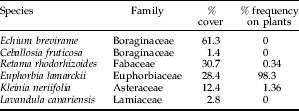
Plant cover exceeds 100% due to foliage overlapping. Percentage of frequency on plants corresponds to the presence of Acrostira on the different plant species.
A positive correlation was observed between the Euphorbia cover and the number of adult males (Rs=0.50; P<0.001), females (Rs=0.46; P<0.001) and nymphs (Rs=0.52; P<0.001). A seasonal analysis of these data shows that in all seasons adult males tended to be present in the squares where the percentage of Euphorbia cover was higher, whereas adult females were only present in these squares in spring and summer (table 2). Nymphs selected positively the squares with a higher percentage of Euphorbia cover, except in autumn. The daily timing of feeding activity was clearly nocturnal (96%; n=50 observations): by night most individuals were significantly located at the top of the stems with regard to the rest of the plant (G=100.6; df=1; P<0.001).
Seasonal oscillations in relationships between percentage of Euphorbia lamarckii cover and total number of adult males, adult females and nymphs of Acrostira euphorbiae in the different squares at El Remo, La Palma, Canary Islands.

Rs, Spearman rank correlation coefficient; P, significant value; and R 2, coefficient of determination. Significant values in boldface.
To evaluate the distances between the squares where individuals were captured and recaptured in subsequent months, the seasonal mean number of the distance covered by adult individuals was generally higher for males, although significant differences were only appreciated in winter (Mann-Whitney test: U=3.00; P=0.041) (table 3). The frequency with which all marked grasshoppers moved to other squares was analysed considering only the movements made in successive months, and no significant differences were found between sexes all year round (G=1.67; df=1; P=0.19). When records of null movement between grid cells were not included in the analysis, no statistical differences were found between sexes (Mann-Whitney test: Z=−1.0; P=0.31). In the two seasons for which there were sufficient samples, no significant differences were recorded (spring: U=68.5; P=0.37; summer: U=24.5; P=0.090). A total of 39.5% (males) and 67.9% (females) of marked grasshoppers were not recaptured, indicating that females definitively abandoned the squares in a higher proportion than males. Marked individuals disappeared at a higher rate in winter (51.3% females vs. 40% males); however, no significant differences were recorded between sexes among the different seasons (G=1.17; df=3; P=0.75). Analysing the sex of adult individuals returning to the squares within a period of three months (a time considered sufficient to avoid sampling bias), males performed these types of displacements more frequently than females (G=15.0; df=1; P<0.001).
Descriptive statistical results of the movements carried out by Acrostira euphorbiae adults (metres), according to sex and season in the studied plot at El Remo, La Palma, Canary Islands.
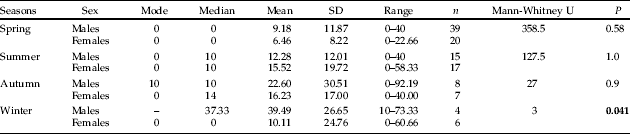
Significant values in boldface.
Population size estimation
The entire plot area (0.55 ha) was considered in order to estimate the density of values obtained by the Jolly-Seber method. Accordingly, in the El Remo plot densities oscillated between 73 and 193 individuals ha−1 (table 4). The lowest values were recorded in summer and autumn, being always under 100 individuals ha−1. However, in winter and spring (except in May) this value was always higher, reaching densities of almost 200 individuals ha−1.
Capture–recapture analysis of population parameters in the studied plot at El Remo, La Palma, Canary Islands according to the model of Jolly-Seber.
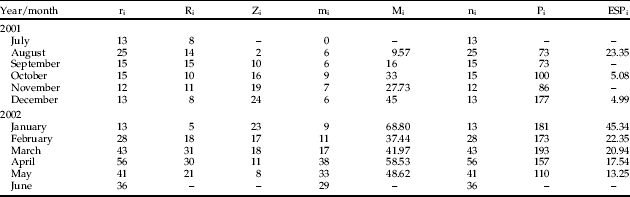
Pi is referred to 1 ha and not to 0.55 ha, as are the remaining parameters. Mi, number of marked animals in the population at the time ith sample is taken; Pi, total number of animals in the population at the time ith sample is taken; ni, total number of animals captured in the ith sample; ri, number of the ni which are released after ith sample; Ri, total of animals marked on day i and subsequently recaptured; mi, number of marked animals in the ith sample; Zi, total number of animals captured one day previous to i, not captured at day i, and captured again later; ESPi, standard error as the square root of the variance for population estimates at day i.
Phenology of Acrostira euphorbiae and Euphorbia lamarckii
A total of 306 individuals of A. euphorbiae were recorded, 188 (61.43%) of which were adults (112 females and 76 males) and 118 (38.56%) nymphs (86 females, 29 males and 3 indeterminate). Acrostira was found to be a univoltine species, with adults and nymphs present during most of the year (fig. 3). However, adults were more abundant than nymphs in spring, summer and autumn, whereas the number of nymphs was greater in winter (G=91.2; df=3; P<0.001) (fig. 3a). Concerning sex ratio, no significant differences were observed either in adults (G=1.05; df=3; P=0.78) or nymphs (G=5.3; df=3; P=0.14) in the different seasons. All matings were observed always in spring or at the beginning of summer. In the laboratory it has been recorded that egg laying occurs on average 39.6 days after the first mating (range: 10–70 days). The maximum abundance of male nymphs was reached in December, and that of female nymphs two months later in February (fig. 3b and c).
Phenology of Acrostira euphorbiae at El Remo, La Palma, Canary Islands, July 2001 to June 2002. a) total adults –●– and - -⋄- - nymphs; b) adult and nymph males; c) adult and nymph females.

With regard to the phenology of Euphorbia plants, foliage attained its maximum density in winter (fig. 4), which corresponded with the greatest abundance of Acrostira nymphs. The maximum production of flowers and fruits occurred twice in the year, in autumn and spring.
Phenology of Euphorbia lamarckii at El Remo, La Palma, Canary Islands, July 2001 to June 2002 (–●– foliage; - -⋄- - flowers; - -▲- - fruits).

Discussion
Habitat use
The preference of A. euphorbiae for the grid cells with higher density, cover and size of Euphorbia shrubs clearly demonstrates its high dependence on this plant. The occurrence of Euphorbia thus determines the spatial distribution of the grasshopper in the wild. This is a logical result if we consider the monophagy of this insect that lives on its own nutritious plant. However, the selection of squares with a greater abundance of food is probably more important for females, which have a higher feeding rate since they are almost twice as large as males and have to invest much more in reproduction (table 5). Under laboratory conditions we have observed that the feeding rate of males is much lower than that of females. The fact that females selected only in spring and summer the squares with the largest densities of Euphorbia (fig. 2 and table 2) is probably explained by the necessity of being in those squares with maximal leaf availability. It is important to point out that in these two seasons Euphorbia plants are beginning to shed their leaves, and in the squares with the highest densities of Euphorbia the females will have a higher probability of finding food. Furthermore, it is also in this period when mating, egg production and laying are carried out, requiring significant nutritional support. According to other studies with continental species, females of Orthoptera have to spend more time feeding than males (Hochkirch, Reference Hochkirch1999; Hochkirch & Papen, Reference Hochkirch and Papen2001). Moreover, vegetation biomass (foliage density and green food availability) is an important factor for the structure of grasshopper communities (Anderson, Reference Anderson1964; Joern, Reference Joern1982).
Morphometric comparison between adult males and females of Acrostira euphorbiae.
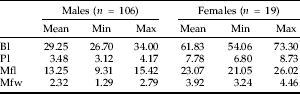
Bl, body length; Pl, pronotum length; Mfl, metafemur length; Mfw, metafemur width.
The other Canarian species of Pamphagidae have a wider food spectrum than A. euphorbiae (García & Oromí, Reference García and Oromí1992; Oromí et al., Reference Oromí, Martín and Galindo2001; López et al., Reference López, Contreras-Díaz, Morales, Báez and Oromí2004). The monophagy of A. euphorbiae is clearly marked, feeding on Euphorbia even in the driest seasons, when no leaves are present but other plant parts remain tender. In the laboratory, individuals have been observed feeding even on dry, dead stems. In winter, even though other plants are densely foliated, A. euphorbiae continues feeding only on Euphorbia. This permanent food availability results in a long lifespan for A. euphorbiae, with adults occurring throughout the year. In contrast, the populations of other grasshoppers closely tied to their main host plants, decline precipitously when these plants lose their foliage (Isley, Reference Isley1937). Although monophagy is uncommon among grasshoppers, in Schistocerca ceratiola Hubbell & Walker (Orthoptera: Acrididae) from Florida spatial distribution is closely linked to its host plant (Smith & Capinera, Reference Smith and Capinera2005), as occurs in the spatial pattern of A. euphorbiae.
Another reason for the selection of Euphorbia lamarckii could be the toxic latex synthesized by this plant (Marco et al., Reference Marco, Sanz-Cervera, Checa, Palomares and Fraga1999). Acrostira may incorporate its active principles as predator repellents, as occurs in Hyles tithymali Boisduval (Lepidoptera: Sphingidae) caterpillars in the Canary Islands (Hundsdoerfer et al., Reference Hundsdoerfer, Tshibangu, Wetterauer and Wink2005). Other similar cases are Danaus plexippus (Linnaeus) (Lepidoptera: Nymphalidae) caterpillars and Aphis nerii Boyer de Fonscolombe (Hemiptera: Aphididae) that feed on Asclepias curassavica with toxic latex (Malcom, Reference Malcom1989; Malcom & Brower, Reference Malcom and Brower1989), or in poisonous grasshoppers such as Zonocerus variegatus (Linnaeus) (Orthoptera: Acrididae), which defoliates Cassava plantations in Africa (Idowu, Reference Idowu1997).
Predation could also influence the spatial distribution, because a higher vegetative cover and the presence of larger plants provide better conditions to go unnoticed. Therefore, the general preference of males and nymphs for the squares with higher leaf cover may be related to the avoidance of predation. In winter, nymphs are mainly concentrated in those squares with greater Euphorbia cover (fig. 2), probably because this affords better camouflage. The smaller body size of males and nymphs with respect to females makes the former more suitable prey for reptiles and birds, and even for some spiders such as Neoscona crucifera (Lucas) (Araneidae) (H. López, personal observations). Furthermore, the large body size of females considerably reduces their potential predators and practically only feral cats and raptors can access them. However, such predators are not abundant in El Remo.
The potential effect of some predators was evaluated both in El Remo and in neighbouring localities by analysing their droppings and pellets. No remains of A. euphorbiae appeared either in the 72 sets of feral cat scats (F.M. Medina and R. García, personal communication) or in the 15 kestrel (Falco tinnunculus) pellets (H. López, personal observations). However, in Gran Canaria remains of the local vicariant species A. tamarani were found in feral cat stomachs (Oromí et al., Reference Oromí, Martín and Galindo2001) and in owl pellets (F. Rodríguez, personal communication). In other studies it has also been confirmed that shelter provided by foliage is an important factor for the establishment of grasshopper communities (Anderson, Reference Anderson1964; Joern, Reference Joern1982).
Under laboratory conditions, we observed that males and nymphs are more active and quicker than females. This is probably due to the larger and heavier abdomen of females with respect to the remainder of the body, limiting their capacity for movement. Higher male dispersal rates are known in many Orthoptera species (Uvarov, Reference Uvarov1977; Ingrisch & Köhler, Reference Ingrisch and Köhler1998; Hochkirch & Papen, Reference Hochkirch and Papen2001) and are possibly caused by sexual conflict: males profit more from multiple matings than females (Andersson, Reference Andersson1994).
Long-range displacement is restricted in the Canarian Pamphagidae due to their wingless condition and their limited jumping ability (males 25–60 cm, n=6 and females 15–20 cm, n=6) because their hind femora are poorly developed. For this reason the combination of homochromy, passive behaviour and very slow movements is important to avoid being sighted. Predation partly explains why these grasshoppers stay in subapical branches during the day and climb to the top for feeding at night, a common behaviour in rainforest grasshoppers, which undergo high predation pressure (Hochkirch, Reference Hochkirch1998). However, to metabolise efficiently, large females require longer periods of sunlight than males for thermoregulation, as occurs with continental grasshoppers (Hochkirch & Papen, Reference Hochkirch and Papen2001). Therefore, females are faced with an important trade-off: how to obtain adequate solar energy on exposed branches without being eaten. The importance of this biological process has been pointed out for ectothermic insects (Heinrich, Reference Heinrich1981, Reference Heinrich1993) and especially for Orthoptera (Chopard, Reference Chopard1938). Many contributions on Orthoptera mention the relevance of thermoregulation in different processes such as feeding (Lactin & Johnson, Reference Lactin and Johnson1995), locomotion (Whitman, Reference Whitman1988), reproduction (Begon, Reference Begon1983; Willott & Hassell, Reference Willott and Hassell1998), habitat selection (Anderson et al., Reference Anderson, Tracey and Abramsky1979; Gillis & Possai, Reference Gillis and Possai1983), development (Begon, Reference Begon1983; Whitman, Reference Whitman1988; Lactin & Johnson, Reference Lactin and Johnson1995) or to confer a certain degree of immunity against disease (Inglis et al., Reference Inglis, Johnson and Goettel1996; Blandford et al., Reference Blandford, Thomas and Langewald1998).
Our studies on post-embryonic development in the laboratory showed that males have four nymphal stages while females need a total of six (H. López, personal observations). Thus males mature much earlier than females, and most of them are adults at the onset of winter, while females often carry out the imaginal moulting as winter ends. This is the season when males move significantly more than females, probably because when reaching the adult stage they carry out longer and more frequent displacements to find females for mating purposes.
We have observed in the field how females mate with several males which move to the plants where females are present. While sedentary females can assure the genetic diversity of their offspring by being visited by several males, the latter have to move more to maximize their reproductive success. Male displacements of as far as 400 m have been recorded, but normally they oscillate between 10 and 90 m. However, summer was the only season when mean displacements of females were higher than in males, coinciding with the period when egg-laying is carried out. The search for a suitable substrate for laying eggs probably forces the females to make long displacements.
Males returned more frequently to the squares than females after leaving for three or more consecutive months, which could indicate that they are more faithful to their territories. Furthermore, the percentage of non-recaptured males was also lower. Each square has a limited load capacity that could explain why in winter, when a maximum concentration of males occurs, the percentage of abandon was higher than in other seasons. It is interesting to point out that a low flow of individuals occurred between the interior and the exterior of the studied plot, having found unmarked individuals inside and marked individuals outside the plot. In the pamphagid Prionotropis hystrix rhodanica Uvarov a higher mobility of males with respect to females has been observed (Foucart & Lecoq, Reference Foucart and Lecoq1996), but movements in both sexes are definitely more limited than in A. euphorbiae. The low mobility of this species could be due to its low requirement for feeding habits; small areas with relatively abundant Euphorbia plants can satisfy their needs.
In spite of living in a habitat characterized by well-preserved vegetation, and apparently capable of harbouring a high population of A. euphorbiae, the recorded densities are low, oscillating between 73 and 193 individuals ha−1. In France, maximum densities of P. hystrix rhodanica have been estimated a 200 individuals ha−1 in 1991 and 403 in 1992 (Foucart & Lecoq, Reference Foucart and Lecoq1996). Previous estimations for this species in the same localities gave even higher numbers (Vayssière, Reference Vayssière1921; Delmas & Rambier, Reference Delmas and Rambier1950), probably due to better habitat conservation (Foucart & Lecoq, Reference Foucart and Lecoq1998). In Herzegovina 600 individuals ha−1 have been calculated for P. hystrix (Miksic & Delic, 1974–Reference Miksic and Delic1975). These estimates support the general idea that most species of Pamphagidae have relatively small populations. However, in favourable conditions some species reach considerable numbers which could even evolve to small plagues (Foucart & Lecoq, Reference Foucart and Lecoq1996).
Phenology
Humidity activates embryonic development of most Acridoidea (Chopard, Reference Chopard1938) and once started it takes one to two months to accomplish (Korsakoff, Reference Korsakoff1941;Llorente, Reference Llorente1990). This agrees with our observations on A. euphorbiae, in which a significant increase in nymphs on plants was recorded in November, approximately one month after the arrival of the first rains (October; fig. 5). This explosion of nymph abundance coincided with the highest leaf density of Euphorbia plants, their only food source and protection against predators. Phenological data of Euphorbia plants are in agreement with rainfall and temperature patterns (fig. 5).
Rainfall (R) and temperatures (t) recorded during the study period (July 2001 to June 2002) at El Remo, La Palma, Canary Islands. Bars: rainfall; line: temperature.

The fact that males become adult before females explains why the number of nymphs reached two peaks in winter (fig. 3a); the first occurred immediately before male nymphs moulted to the adult stage (fig. 3b), and the second was observed a short time before the imaginal moulting of female nymphs (fig. 3c). After nymphs were transformed into adult males, the number of males increased considerably; this process is probably related to an increase in the number of individuals coming from outside the study plot, because they were unmarked. Sexual differences concerning the length of post-embryonic development could be a reproductive strategy, whereby males have sufficient time to attain sexual maturity and are ready to mate with females when they emerge. In many Orthoptera species in which females are larger than males, the latter become adult before the females (Chopard, Reference Chopard1938).
Both nymphs and adults of A. euphorbiae showed variations in population density, but were never completely absent, unlike other Pamphagidae species from nearby mainland areas (e.g. Morocco, Iberian Peninsula and France) from which at least adults disappear during unfavourable seasons (Massa & Lo Verde, Reference Massa and Lo Verde1990; Foucart & Lecoq, Reference Foucart and Lecoq1996; Llorente & Presa, Reference Llorente and Presa1997). A similar pattern occurs in Canarian and Moroccan populations of the acridid Sphingonotus rubescens Walker (A. Hochkirch, personal communication). According to Llorente & Presa (Reference Llorente and Presa1997) mainland Pamphaginae nymphs take between 4 and 12.5 months for post-embryonic development, depending on low temperatures which can induce a winter diapause in nymphs. In contrast, in the Canary lowlands where the Mediterranean climate is temperate (fig. 5), the post-embryonic diapause does not occur and therefore development is shorter, even when coinciding with the winter period.
From the present results we can conclude that A. euphorbiae has a high dependence on E. lamarckii and on well-preserved habitats in which this plant is dominant. This situation justifies its protection both at national and regional levels, since given its restricted distribution any alteration of its habitat could lead it to extinction. Moreover, recent studies show that Acrostira euphorbiae has the lowest genetic diversity among all Canarian Pamphagidae, and actually its populations are submitted to a severe bottleneck (López et al., Reference López, Contreras-Díaz, Oromí and Juanin press), two factors that usually precede the extinction of a species. Therefore A. euphorbiae should not be considered just as ‘sensitive to habitat alteration’ but as ‘in danger of extinction’, and conservation efforts should be oriented not only to preserve its habitat but also to the species itself.
Acknowledgements
The authors would like to thank Hermans Contreras, Bernardo Rodríguez, Antonio Pérez, Salvador de la Cruz and Nuria Macías for their help in the fieldwork, and Rafael García for providing important information on A. euphorbiae. Félix M. Medina afforded logistic support and helped in the field. Marcos Báez co-directed the first project and also helped during the fieldwork. Antonio de Los Santos helped on the calculation of densities, and Oscar Moya in the elaboration of some graphics. John L. Capinera, Axel Hochkirch, Vicenta Llorente, Felipe Pascual and Juan José Presa kindly revised the manuscript and answered many questions concerning Orthoptera. This study was financed by the Cabildo Insular de La Palma and by the Consejería de Política Territorial y Medio Ambiente of the Canarian Government. Heriberto López has a pre-doctoral grant awarded by the Canarian Government.


