INTRODUCTION
Mounting evidence suggests that persons with Multiple Sclerosis (pwMS) has deficits in social cognition, specifically in emotion recognition (Cotter et al., Reference Cotter, Firth, Enzinger, Kontopantelis, Yung, Elliott and Drake2016; Genova, Cagna, Chiaravalloti, DeLuca, & Lengenfelder, Reference Genova, Cagna, Chiaravalloti, DeLuca and Lengenfelder2016) and Theory of Mind (ToM) (Henry et al., Reference Henry, Phillips, Beatty, McDonald, Longley, Joscelyne and Rendell2009; Mike et al., Reference Mike, Strammer, Aradi, Orsi, Perlaki, Hajnal, Sandor, Banati, Illes, Zaitsev, Herold, Guttmann and Illes2013). Despite evidence of social cognition impairments in MS, there has been a significant lack of attention paid to individuals with progressive subtypes of MS with most research on social cognition focused on Relapsing–Remitting MS (RRMS) (Cotter et al., Reference Cotter, Firth, Enzinger, Kontopantelis, Yung, Elliott and Drake2016). There has been a recent focus on studying cognitive abilities in individuals with progressive MS, as accumulating neuronal pathology makes them likely candidates for advanced cognitive impairment (Brochet & Ruet, Reference Brochet and Ruet2019). The historic lack of attention paid to progressive MS represents a significant void in our knowledge of how cognitive abilities are affected in these subtypes. The current investigation addressed this void by examining social cognition in individuals with progressive MS.
Tasks of social cognition often involve “static” stimuli (i.e. photographs) (Cotter et al., Reference Cotter, Firth, Enzinger, Kontopantelis, Yung, Elliott and Drake2016), which have led some to question the ecological validity of these tasks. In real social interactions, social cognition requires processing of dynamic information (McDonald, Flanagan, Rollins, & Kinch, Reference McDonald, Flanagan, Rollins and Kinch2003). In MS, the majority of studies on social cognition have utilized “static” tasks, leaving an important gap in our understanding of social cognition in pwMS (Genova et al., Reference Genova, Cagna, Chiaravalloti, DeLuca and Lengenfelder2016). Currently, we examined the performance of individuals with progressive MS on The Awareness of Social Inference Test – Short Form (TASIT-S) (Honan, McDonald, Sufani, Hine, & Kumfor, Reference Honan, McDonald, Sufani, Hine and Kumfor2016; McDonald et al., Reference McDonald, Flanagan, Rollins and Kinch2003), a dynamic test of social cognition developed for individuals with traumatic brain injury (TBI). We have demonstrated TASIT is sensitive to social cognition impairments in pwMS, although mainly RRMS (Genova et al., Reference Genova, Cagna, Chiaravalloti, DeLuca and Lengenfelder2016). The identification of a sensitive measure of social cognition across MS subtypes could lead to the development of a test battery to examine these deficits in MS. This study is the first to use TASIT-S to examine social cognitive deficits in MS, specifically in a progressive sample.
It is not known whether social cognition deficits are independent of general cognitive impairments in pwMS, as studies investigating this issue have yielded inconsistent findings (Cotter et al., Reference Cotter, Firth, Enzinger, Kontopantelis, Yung, Elliott and Drake2016). Based on our previous investigation using TASIT in MS (Genova et al., Reference Genova, Cagna, Chiaravalloti, DeLuca and Lengenfelder2016), we hypothesized that worse performance on TASIT-S would be correlated with impaired cognitive abilities.
METHODS
This study included 32 participants: 15 healthy controls (HCs) and 17 individuals with progressive MS. Research was conducted in accordance with the Helsinki declaration, including informed consent. Progressive MS participants were diagnosed with clinically definite MS (Polman et al., Reference Polman, Reingold, Banwell, Clanet, Cohen, Filippi, Fujihara, Havrdova, Hutchinson, Kappos, Lublin, Montalban, O’Connor, Sandberg-Wollheim, Thompson, Waubant, Weinshenker and Wolinsky2011); nine were classified as primary-progressive (PP) MS, four as secondary-progressive (SP) MS, and two as progressive-relapsing MS. Diagnosis was confirmed by medical report; however, medical records were not available for two participants. Those two were screened by the research assistant regarding medical history, including date of diagnosis, diagnosis, and medications. Participants were excluded if they had a history of diagnosed psychological and psychiatric problems (including depression resulting in hospitalization), epilepsy, learning/developmental disability, diagnosis of substance abuse/dependence, or TBI. The average time since MS diagnosis was 13.8 years (±9.5 SD).
The two groups did not differ significantly on age (MHC = 45.6, SDHC = 11.7 years; MMS = 51.9, SDMS =9.2 years; t(30) = 1.72 p = .096, d = 0.6), education (MHC =15.9, SDHC = 2.3 years; MMS = 15.6, SDMS = 2.2 years; t(30) = −.434 p = .667, d = 0.13), or gender composition: 9/17 females in MS group and 11/15 females in HC group (X 2 = 1.414, p = .234).
Measures
Social cognition
TASIT-S
Readers are encouraged to review TASIT-S development work (Honan et al., Reference Honan, McDonald, Sufani, Hine and Kumfor2016), as well as the original version of TASIT (McDonald et al., Reference McDonald, Flanagan, Rollins and Kinch2003) for task description. TASIT-S is comprised of three subtests (Part 1: Emotion Evaluation Task; EET; Part 2: Social Inference-Minimal Test; SI-M; Part 3: Social Inference-Enriched; SI-E). Each subtest consists of a series of videotaped vignettes of social scenarios followed by either a choice of emotional labels (Part 1) or forced-choice questions about the thoughts, feelings, and/or intentions of a character (Parts 2 and 3). EET is composed of 10 video clips in which a character is portraying 1 of 6 basic emotions (happiness, sadness, anger, fear, revulsion, surprise or neutral). For the current study, the dependent variables for EET were accuracy for recognition of positive emotions (Pos-Emo), negative emotions (Neg-Emo), and all emotions (Total-Emo). SI-M is composed of nine videotaped social scenarios in which actors enact neutral scripts to be either sincere or sarcastic. Within the sarcastic scripts, half are paradoxical, that is, the exchange does not make literal sense unless it is interpreted as sarcastic. Participants are required to answer questions to assess ToM. For the current study, the dependent variables for SI-M were accuracy in understanding (1) sincere exchanges (Sincere), (2) paradoxical sarcasm (P-Sarcasm), (3) simple sarcasm (S-Sarcasm), and (4) a total SI-M score incorporating all of SI-M scores. The SI-E is composed of nine video clips depicting either sarcastic or deceptive (i.e. lies) exchanges. These differ from the SI-M because there is additional information (e.g. a visual edit or a prologue) that indicates what the speakers actually know or believe. Participants are required to answer questions to assess ToM. For the current study, the dependent variables were accuracy in understanding (1) deceptive exchanges (Lies), (2) sarcastic exchanges (Sarcasm), and (3) a total SI-E score.
Neuropsychological Measures
The following tests were administered to assess cognitive ability. All scores were standardized:
- spatial learning and memory assessed with the Brief Visual Memory Test – Revised, BVMT-R (Benedict, Reference Benedict1997). The total recall score served as the dependent variable.
- executive skills using Color-Word Interference subtest of the Delis Kaplan Executive Function System, Color-Word (Delis, Kaplan, & Kramer, Reference Delis, Kaplan and Kramer2001). The interference condition scaled score was used as the dependent variable.
- visuospatial judgement using Judgement of Line Orientation, JOLO (Benton, Sivan, Hamsher, Varney, & Spreen, Reference Benton, Sivan, Hamsher, Varney and Spreen1983). The total score served as the dependent variable.
- attention assessed with Paced Auditory Serial Addition Task, PASAT (Gronwall & Wrightson, Reference Gronwall and Wrightson1981). The dependent variable in the current study is the number of correct sums given (out of 60 possible) on the 3-second trial.
- processing speed assessed with Symbol Digit Modalities Test – oral, SDMT (Smith, Reference Smith1982). The sum of the correct responses was used in the current study.
Analysis
Determination of group differences on all variables was analyzed using t-tests. Due to small sample size, we considered not only p values, but also effect sizes (Cohen’s d). Correlations between TASIT-S variables and neuropsychological scores were analyzed using one-tailed Pearson correlation, to test our a priori hypothesis that better performance on TASIT-S variables would be associated with better neuropsychological performance. There were several cases of missing data points: two HCs were missing SDMT, one individual in the MS group was missing PASAT, and two in the MS group were missing DKEFS. The reasons for missing data points were either experimenter error or time constraints (tests could not be completed in allotted time).
Although there were no significant differences between groups on age, the MS group was marginally older than the HC group, representing a potential confounding factor. We examined the correlation between age and TASIT-S variables and found no significant correlations, although the relationship between age and TASIT-S Lies revealed a small to moderate correlation (r = −.223). On this variable only (TASIT-S Lies), we ran an ANCOVA to examine group differences including age as a covariate, and there were no group differences. Boxplots were used to detect outliers and only one extreme outlier was identified, which was a paradoxical sarcasm score by one participant. We removed the outlier and reran the analyses. Regarding t-tests, results remain unchanged when the data point was removed (significant differences were still detected). However, correlational results were significantly changed when the outlier was removed and therefore this data point was removed from correlational analyses only (see Table 2).
RESULTS
Group Differences on TASIT-S
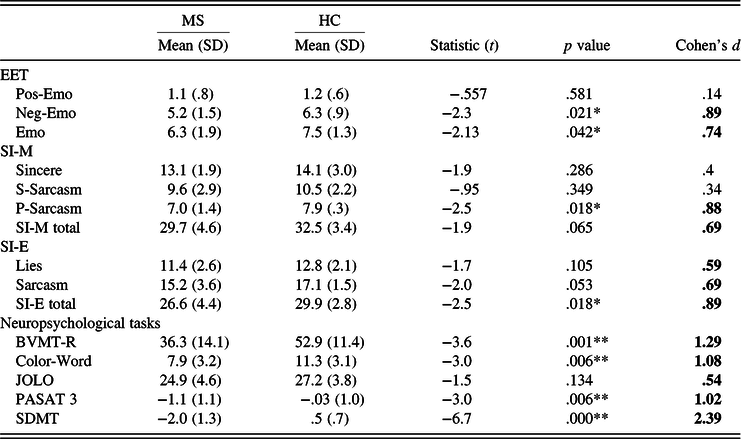
T-tests revealed group differences (MS performing worse than HC) on several variables of TASIT-S (Table 1). Moderate to large effect sizes indicating group differences are noted in Table 1.
Between groups differences on TASIT-S and cognitive variables

TASIT-S, The Awareness of Social Inference Test – Short Form; EET, the Emotion Evaluation Task; SI-M, Social Inference-Minimal Test; SI-E, Social Inference-Enriched; Pos-Emo, positive emotions; Neg-Emo, negative emotions; Total-Emo, all emotions; Sincere, sincere exchanges; P-Sarcasm, paradoxical sarcasm; S-Sarcasm, simple sarcasm; BVMT-R, Brief Visual Memory Test – Revised; Color-Word, Color-Word Interference subtest of the Delis Kaplan Executive Function System; JOLO, Judgement of Line Orientation; PASAT, Paced Auditory Serial Addition Task; SDMT, Symbol Digit Modalities Test.
*p < .05; **p < .01; bolded values in the effect size columns indicate moderate to large effect sizes.
Correlations between TASIT-S variables and neuropsychological test performance

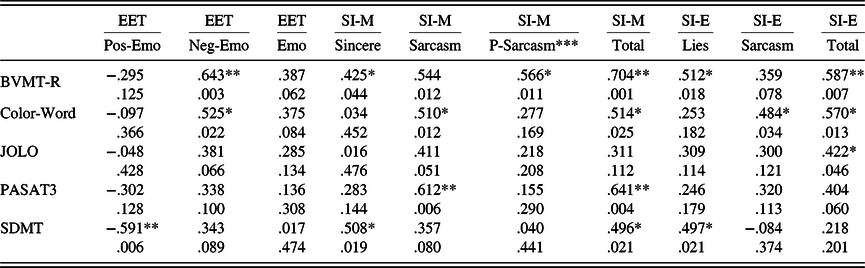
TASIT-S, The Awareness of Social Inference Test – Short Form; EET, the Emotion Evaluation Task; Pos-Emo, positive emotions; Neg-Emo, negative emotions; Emo, all emotions; SI-M, Social Inference-Minimal Test; P-Sarcasm, paradoxical sarcasm; SI-E, Social Inference-Enriched; BVMT-R, Brief Visual Memory Test – Revised; Color-Word, Color-Word Interference subtest of the Delis Kaplan Executive Function System; JOLO, Judgement of Line Orientation; PASAT, Paced Auditory Serial Addition Task; SDMT, Symbol Digit Modalities Test.
*p < .05; **p < .01; ***1 outlier removed from correlational analysis.
Group Differences on Neuropsychological Measures
The MS group was impaired in several cognitive tests, including BVMT-R, PASAT, and SDMT (see Table 1).
Correlations with Neuropsychological Measures
Correlations between TASIT-S and neuropsychological variables were run in the MS group only, as the purpose of this study was to explore the relationship between TASIT-S performance and cognition in pwMS (Table 2). Briefly, the TASIT-S variables correlated with multiple cognitive tests, in a consistent direction: better TASIT-S performance correlated with better neuropsychological test performance. One exception was a negative correlation between recognition of positive emotions and SDMT performance, in that worse performance on SDMT was associated with better positive emotion recognition.
DISCUSSION
The purpose of the current pilot study was to examine the performance of individuals with progressive MS on a task of social cognition: TASIT-S. The results indicate that the progressive MS group was significantly impaired on all subtests of TASIT-S and worse performance was correlated with cognitive abilities, including visuospatial memory, attention, and executive abilities. These findings extend our previous findings using TASIT in MS (Genova et al., Reference Genova, Cagna, Chiaravalloti, DeLuca and Lengenfelder2016). However, unlike our previous report where we examined primarily RRMS, the current study focused on progressive MS, and utilized all three subtests of TASIT-S to characterize facial affect recognition and ToM (our previous study examined primarily ToM). Furthermore, the current study utilized TASIT-S and is the first to our knowledge to utilize this test in pwMS.
Consistent with previous studies of social cognition, the MS group was impaired on the EET subtest of the TASIT-S, which assesses facial affect recognition. A closer analysis of the sub-scores indicates that the impairment was driven by the recognition of negative emotions, consistent with what others have reported (Cotter et al., Reference Cotter, Firth, Enzinger, Kontopantelis, Yung, Elliott and Drake2016; Henry et al., Reference Henry, Phillips, Beatty, McDonald, Longley, Joscelyne and Rendell2009). There are several explanations why recognition of positive emotions may be intact in MS. First, happiness has been noted to be an easier emotion to recognize compared to other emotions (i.e. anger) in multiple populations, including healthy adults (Goeleven, De Raedt, Leyman, & Verschuere, Reference Goeleven, De Raedt, Leyman and Verschuere2008). We found that positive emotion recognition was associated with worse processing speed ability. Although this finding was unexpected, it may indicate a speed-accuracy tradeoff (faster responders are less accurate) which should be evaluated in future studies. Second, neuroimaging research in MS is beginning to elucidate how neuropathology in specific brain regions is related to emotion-specific recognition. For example, Pitteri et al. (Reference Pitteri, Genova, Lengenfelder, DeLuca, Ziccardi, Rossi and Calabrese2019) reported that cortical lesion volume in the amygdala is related to recognition of fear and anger, but not other emotions. Larger scale studies are required to confirm whether neuropathology is related to recognition of specific emotions.
The results indicated that the MS group was impaired on several facets of ToM. Specifically, they had difficulty understanding sarcasm when the literal language content was conflicting (i.e. paradoxical sarcasm, Part 2: SI-M) or when provided with additional information about what speakers actually believed (Part 3 Sarcasm: SI-E). Difficulties with Part 2 could indicate high level difficulties resolving disparate meaning in social exchanges. Difficulties with Part 3 suggest that additional information about speakers’ beliefs, which should be facilitative, was, in this case, unhelpful. One interpretation of these findings is that the participants with MS were able to attribute ToM accurately when provided with simple straightforward social information but struggle to integrate extra social and linguistic cues in more complex scenarios. Sarcasm is used in conversation to relay a belief or emotion that is contrary to what one is literally saying. However, if not properly interpreted, the social interaction is unsuccessful, both for the speaker and for the listener who has failed to understand the speaker. The inability to comprehend complex social scenarios is a significant concern for pwMS as it may lead to misunderstandings, and difficulty navigating the social world (Genova et al., Reference Genova, Cagna, Chiaravalloti, DeLuca and Lengenfelder2016).
There is a growing body of research examining whether social cognition is independent of “traditional” cognitive impairment in MS (Ciampi et al., Reference Ciampi, Uribe-San-Martin, Vásquez, Ruiz-Tagle, Labbe, Cruz, Lillo, Slachevsky, Reyes, Reyes and Cárcamo-Rodríguez2018; Cotter et al., Reference Cotter, Firth, Enzinger, Kontopantelis, Yung, Elliott and Drake2016). Thus far, findings related to this issue are inconsistent, with some studies reporting associations between social cognitive deficits and other cognitive domains (e.g. Ciampi et al., Reference Ciampi, Uribe-San-Martin, Vásquez, Ruiz-Tagle, Labbe, Cruz, Lillo, Slachevsky, Reyes, Reyes and Cárcamo-Rodríguez2018), while others report that no relationship or that social cognition deficits exist in pwMS without cognitive impairment (e.g. Pitteri et al., Reference Pitteri, Genova, Lengenfelder, DeLuca, Ziccardi, Rossi and Calabrese2019). Our findings suggest that in progressive MS, these deficits are related; however, we cannot confirm whether social cognitive deficits predict or are predictive of general cognitive impairment. Furthermore, as the MS group was impaired across multiple cognitive domains, it is difficult to ascertain whether these variables are truly influencing one another, or whether there is a general non-specific cognitive impairment. Another possibility is that cognitive abilities may only partially mediate social cognition in MS, as is the case in other populations such as TBI (Honan, McDonald, Gowland, Fisher, & Randall, Reference Honan, McDonald, Gowland, Fisher and Randall2015). More highly powered studies will help determine the relationship between social cognition and general cognition in progressive MS.
The current study indicated that visuospatial memory was highly correlated with almost all of TASIT-S variables. This finding is not surprising given visual demands of TASIT-S (which may also explain the relationship between TASIT-S and JOLO). Utilizing tasks of social cognition which do not rely on visual processing (i.e. an affective prosody task) may be critical for those with impaired visual processing, for which administration of tests like TASIT-S may be invalid.
Executive abilities were related to TASIT-S variables, consistent with other studies in MS (Ciampi et al., Reference Ciampi, Uribe-San-Martin, Vásquez, Ruiz-Tagle, Labbe, Cruz, Lillo, Slachevsky, Reyes, Reyes and Cárcamo-Rodríguez2018; Henry et al., Reference Henry, Phillips, Beatty, McDonald, Longley, Joscelyne and Rendell2009), indicating that executive ability plays a role in social cognition. We also found correlations between some ToM abilities and processing speed, which extends what was found in our previous study using TASIT (Genova et al., Reference Genova, Cagna, Chiaravalloti, DeLuca and Lengenfelder2016). It has been hypothesized that processing speed underlies other cognitive abilities in MS (i.e. memory and attention) (Costa, Genova, Deluca, & Chiaravalloti, Reference Costa, Genova, Deluca and Chiaravalloti2017; Genova, Deluca, Chiaravalloti, & Wylie, Reference Genova, Deluca, Chiaravalloti and Wylie2013), and our findings suggest that this may be the case for social cognition as well.
We were limited by small sample size. Additionally, although individuals with progressive MS are often combined into one group, there is significant heterogeneity among individuals with progressive MS. SP-MS, for example, is characterized by axonal loss that accumulates over time after years of RRMS disease course, whereas in PP-MS neural pathology is present at disease onset. Thus, examining the influence of pathology on social cognition by examining different subtypes or by including neuroimaging is important. Furthermore, the current sample may not be generalizable to individuals with progressive MS. First, the majority of our sample had PP-MS subtype, and fewer with the SP-MS, which limits our ability to understand social cognitive abilities in SP-MS. Furthermore, for two participants medical records were not obtained, and therefore we could not definitely confirm diagnosis. However, despite these limitations, these preliminary results indicate significant social cognitive impairment in progressive forms of MS.
Expanding upon our previous work, this is the first to show that TASIT-S appeared to be sensitive to facial affect recognition deficits and ToM deficits in individuals with progressive MS. The current study may represent an initial step toward validating this measure in pwMS. As clinicians may begin to desire a battery of tests to comprehensively examine social cognition in MS, TASIT-S may represent an ecologically valid measure.
ACKNOWLEDGEMENTS
This research was supported by a pilot grant funded by the Consortium of Multiple Sclerosis Centers, entitled “Investigation of Social Cognition in Progressive MS.”
CONFLICT OF INTEREST
The authors have no financial interests to disclose.