Introduction
The potential role of companion animals as reservoirs for zoonotic disease has been recognized as a significant public health problem worldwide (Schantz, Reference Schantz1994). For example, the dog (Canis familiaris) is a domestic animal that maintains close contact with humans and other animals, such that missed diagnosis or treatments against certain diseases favours the transmission of zoonoses. The principal sources of these parasitic infections are faecal pollution of drinking water (Cifuentes et al., Reference Cifuentes, Blumentthal, Ruiz-Palacios, Bennett and Pesaey1994), soil (Wong et al., Reference Wong, Simeon, Powel and Grantham McGregor1994) and food (Garavelli & Scaglione, Reference Garavelli and Scaglione1989). The untold problems caused by parasites to humans and animals has a negative effect on the economy of affected nations, as much money, time and energy are spent in controlling such parasites and treating infected people (Ukoli, Reference Ukoli1992).
There are traditionally acknowledged zoonotic diseases, such as visceral larval migrans caused by Toxocara canis and cutaneous larval migrans caused by Ancylostoma braziliense (Schantz, Reference Schantz1991; Hendrix et al., Reference Hendrix, Bruce, Kellman, Harrelson and Bruhn1996; Malgor et al., Reference Malgor, Oku, Gallardo and Yarzabal1996; Castillo et al., Reference Castillo, Paredes, Zanartu, Castilo, Mercado, Munoz and Schenone2000; Morrison, Reference Morrison2001). Children are generally the most susceptible (Karrar & Rahim, Reference Karrar and Rahim1995) due to their pica habits and regular contact with soil contaminated with eggs of these parasites (Despommier, Reference Despommier2003; Fisher, Reference Fisher2003).
This situation prevails in Nigeria because of poor environmental sanitation and lack of pet restrictions. As a result, faeces from animals that roam the streets contaminate the soil and the environment at large (Mahdi & Ali, Reference Mahdi and Ali1993; Minvielle et al., Reference Minvielle, Pezzani and Basualdo Farjat1993). Hence, the objectives of the present study were to survey playgrounds in selected schools and homes in Kaduna metropolis for the presence of helminth eggs, and to determine the effects of environmental and socio-cultural factors on the prevalence of helminth eggs.
Materials and methods
Meteorological data of study area
Soil samples were examined between July and September 2005 and between December 2005 and February 2006 from 14 playgrounds that differ in socio-economic status in Mando and Kakuri areas of Kaduna metropolis (11°10′N, 7°38′E), Nigeria. The state covers an area of 46,053 km2 and, according to the 2006 census, has an estimated population of 6,066,562 people (http://en.wikipedia.org/wiki/Kaduna_state (accessed 25 August 2007)). The streets in both areas were mostly bare ground or partially covered with grass. Where dogs were present, up to 1–5 dogs were seen every 500 m to 1 km.
The two seasonal periods are the humid rainy season (April–October) and the dry harmattan season (November–March). Data of monthly changes in the average temperature, rainfall and relative humidity were collected from the Nigerian Meteorological Agency (NIMET), Federal Secretariat, Kawo, Kaduna. For 2005, the mean maximum temperature from April to October (rainy period) was 31.4°C, while the mean minimum temperature was 21.1°C. In November 2005 to March 2006 (harmattan period), the mean maximum temperature was 34.9°C, while the mean minimum temperature was 17.7°C. Average rainfall during the rainy period was 32.8 mm and 00.0 mm for the harmattan period, while mean relative humidity during the rainy period was 69.9%, and 27.4% during the harmattan period (NIMET, 2005, 2006).
The playgrounds were within schools and residential areas, and their estimated area ranged from 100 m2 to 800 m2, with an average of 284 m2. The number of samples per site varied according to the size of playgrounds.
Use of a questionnaire
Prior to the collection of soil samples, a structured questionnaire was used to study factors such as topography of site (gentle or irregular slope), presence of vegetation (grass), refuse and dogs in the playgrounds, depth of sample collections, fencing of the playgrounds and socio-economic status of people in the sites. A modification of the index for the measurement of socio-economic status as designed by Enesi (Reference Enesi2001) was applied. This defines socio-economic status (SES) as various indices of social class (low, middle or high), based on educational and socio-economic backgrounds, occupation, financial resources, home/school facilities, and so on. Thus, the SES was low if listed indices were poorly met; SES moderately rated if the indices were met on average; and SES highly rated if the indices were well met. The questionnaire was also used to determine the awareness of risk of parasitic zoonoses in Kaduna metropolis.
Sample processing
Up to 370 and 238 samples, during the rainy and dry periods, respectively, were collected from 14 sites by cluster random sampling (Motazedian et al., Reference Motazedian, Mehrabani, Tabatabaee, Pakniat and Tavalali2006). A trowel was used to scrape the soil from the uppermost 0–3 cm layer into labelled polythene bags, and the deeper 3–10 cm layer into different sets of labelled polythene bags (Matsuo & Nakashio, 2005). Up to 4 × 100 g soil samples were collected at specific points of sample collection.
All samples were immediately transported to the laboratory for analysis and those that were not analysed immediately were stored at 4°C, as recommended by Ruiz de Ybanez et al. (Reference Ruiz de Ybanez, Garijo and Alonso2001), for no more than 3 days pending examination. In the laboratory, egg recovery was carried out using a modified version of the sieving method devised by Laborde et al. (Reference Laborde, Bussieras and Chemette1980) and modified by Ruiz de Ybanez et al. (Reference Ruiz de Ybanez, Garijo, Goyena and Alonso2000). Up to 50 g of soil was weighed, mixed and washed with running tap water into a 250 ml beaker, using a set of three sieves with mesh widths of 100 μm, 850 μm and 400 μm. The filtrate was allowed to settle for 15 min and the liquid decanted after this sedimentation. The sediment was collected into 30 ml centrifuge tubes, shaken with 15 ml sucrose (specific gravity of 1.27) flotation solution and centrifuged at 1500 g for 5 min. The supernatant was poured into dropper bottles and these were used to fill two chambered McMaster slides. The McMaster slides were allowed to settle for 5 min and were examined under a light microscope ( × 10) for the presence of helminth eggs.
Morphological characteristics of the eggs, as described previously by Soulsby (Reference Soulsby and Geerts1987), were used for their identification.
Data analysis
Analysis of data was carried out using the Statistical Package for Social Science (SPSS Inc., Chicago, Illinois, USA). The chi-square test was used to test for association between the prevalence of helminth eggs and the different sites. P < 0.05 was defined as significant.
Using EPI INFO 2002 (Dean, Reference Dean1994), odds ratio (OR) and 95% confidence intervals (CI) were calculated for dichotomous variables. OR values greater than unity denote an association, and less than unity denotes that the factor may have a protective effect. Prevalence was estimated by dividing the number of positive samples by the total number of samples.
Results
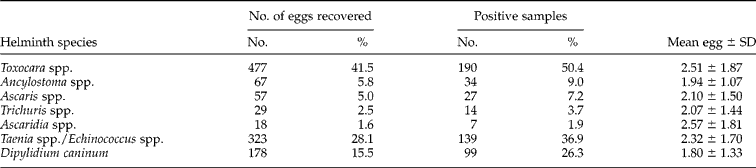
Of 608 soil samples examined, 377 (62.0%) were positive for helminth eggs and Toxocara eggs were the most prevalent (50.4%) (table 1).
Occurrence of helminth eggs in 608 soil samples in playgrounds in Kaduna metropolis, Nigeria.
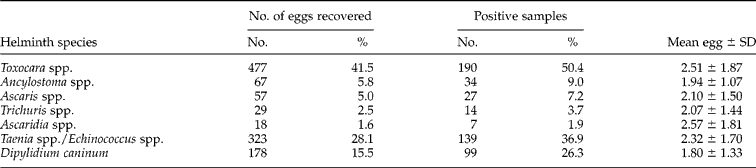
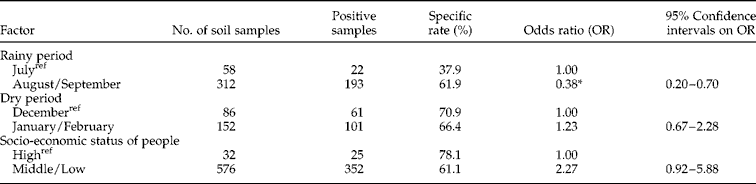
Table 2 shows the rainy/dry periods of sampling and socio-economic status. Twenty-two (37.9%) of 58 samples examined in July were positive for helminth eggs while 193 (61.9%) of 312 samples examined were positive in August/September. Sixty-one (70.9%) of 86 soil samples examined were positive in December while 101 (66.4%) of 152 samples examined in January/February were positive. There was a statistical significance between the prevalence of helminth eggs and the rainy period of sampling (OR = 0.38; 95% CI on OR: 0.20 < OR < 0.70) but no association between the prevalence of helminth eggs and the dry period of sampling (OR = 1.23; 95% CI on OR: 0.67 < OR < 2.28).
Odds ratio (OR) and 95% confidence intervals on the period of sampling and socio-economic status of people in relation to the prevalence of helminth eggs in 608 soil samples in Kaduna metropolis, Nigeria.
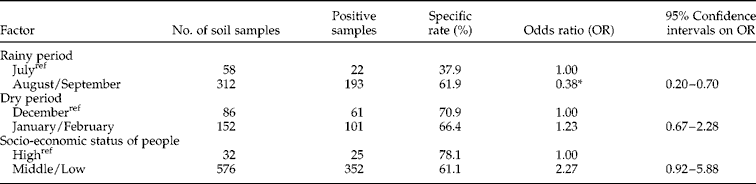
Analyses with respect to set standards, ref.
* P < 0.05.
Twenty-five (78.1%) of 32 soil samples were positive in playground sites of a high socio-economic status while 352 (61.1%) of 576 samples were positive in sites of low/middle socio-economic status. There was no statistical difference (OR = 2.27; 95% CI on OR: 0.92 < OR < 5.88) between the prevalence of helminth eggs and the socio-economic status of people in the playgrounds.
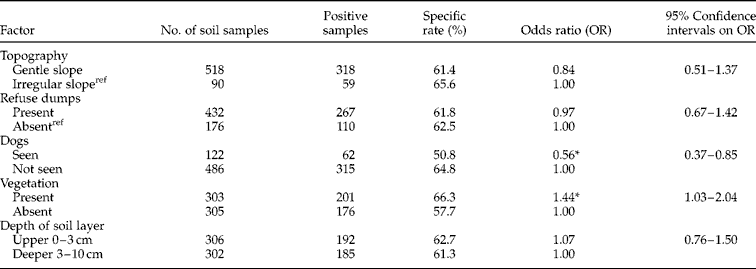
Table 3 shows the relationship between the prevalence of helminth eggs and topography of the sampled playgrounds and the presence of refuse dumps, dogs and vegetation and the depth at which the samples were collected. Up to 318 (61.4%) of 518 samples from gently sloping sites were positive for helminth eggs, while 59 (65.6%) of 90 samples from sites of irregular slope were positive. There was no statistical significance in the distribution of helminth eggs between the two sites (OR = 0.84, 95% CI on OR = 0.51 < OR < 1.37).
Odds ratio (OR) and 95% confidence intervals on factors influencing the prevalence of helminth eggs in 608 soil samples in Kaduna metropolis, Nigeria.
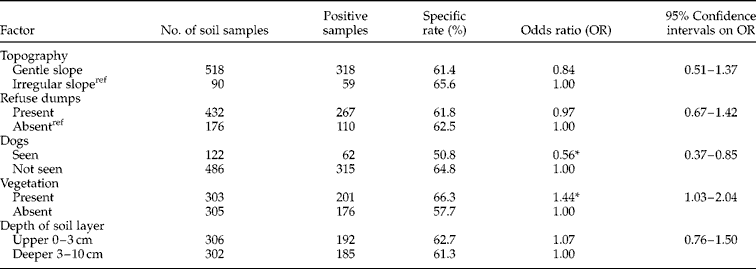
Analyses with respect to set standards, ref.
* P < 0.05.
In sites where refuse dumps were present, 267 (61.8%) of 432 samples were positive for helminth eggs, whereas 110 (62.5%) of 176 samples were positive in sites with no refuse dump. There was no association (OR = 0.97, 95% CI on OR = 0.67 < OR < 1.42) between the prevalence of helminth eggs and the presence of refuse in these sites.
In playgrounds where dogs were present, 62 (50.8%) of 122 soil samples were positive for helminth eggs, whereas 315 (64.8%) of 486 samples were positive in playground sites where dogs were not seen. There was a statistical association between the prevalence of helminth eggs and the presence of dogs in the sites (OR = 0.56, 95% CI on OR = 0.37 < OR < 0.85).
In playgrounds where vegetation was seen, 201 (66.3%) of 303 samples were positive for helminth eggs, whereas 176 (57.7%) of 305 samples from bare-ground sites were positive for eggs. There was a statistical significance (OR = 1.44, 95% CI on OR = 1.03 < OR < 2.04) between the distribution of helminth eggs in the two sites.
One hundred and ninety-two (62.7%) of 306 samples examined from the upper 0–3 cm layer of soil were positive for helminth eggs, compared with 185 (61.3%) of 302 samples from the deeper 3–10 cm layer. There was no statistical difference between the distributions of helminth eggs in the two layers (OR = 1.07, 95% CI on OR = 0.76 < OR < 1.50).
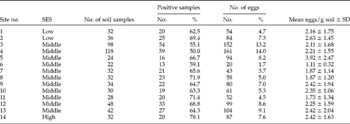
The rate of contamination of soil in all 14 sites sampled is shown in table 4. The highly SES rated site 14 in Kakuri had a greater number of contaminated samples (78.1%) than the remainder of the sites, but site 4 in Mando, which was moderately rated, showed the highest number of eggs (14.0%). Mean eggs/gram of soil ranged from 1.11 ± 0.32 in the moderately rated site 6 in Mando to 3.92 ± 2.47 in moderately rated site 5 in Kakuri. There was no significant association (χ 2 = 17.58, df = 13, P>0.05) between contamination rates in the sampled playgrounds.
Egg loads in 608 soil samples from playgrounds in Kaduna metropolis, Nigeria.

SES, socio-economic status of people.
The percentage awareness of risk of parasitic zoonoses was determined from a sample of 100 respondents, indicating that 70% knew little about transmissible parasitic zoonoses from dog faecal material contaminating the environment.
Discussion
The 62.0% contamination rate shown in this study is relatively high compared with the work of others (Etim & Akpan, Reference Etim and Akpan1999; Matsuo & Nakashio, 2005; Motazedian et al., Reference Motazedian, Mehrabani, Tabatabaee, Pakniat and Tavalali2006). This high rate is further justified by the recovery of eggs of seven different species of helminths from playgrounds, especially Toxocara spp. (50.4%) which was higher than that recovered in Japan (42%) and Norway (39%) but lower than the 87% positive samples recorded in Germany (Mizgajska, Reference Mizgajska2001) and 67% in Spain (Ruiz de Ybanez et al., Reference Ruiz de Ybanez, Garijo and Alonso2001). This high prevalence clearly shows the extent of contamination of playgrounds in the Kaduna metropolis.
The higher prevalence of helminth eggs in the dry harmattan compared with the wet rainy period is similar to the findings of Ruiz de Ybanez et al. (Reference Ruiz de Ybanez, Garijo and Alonso2001) but differs from those of Motazedian et al. (Reference Motazedian, Mehrabani, Tabatabaee, Pakniat and Tavalali2006) where there was no contamination of soil with helminth eggs during the dry season. The high rate during the dry period could be attributed to the lack of rainfall which has been implicated in washing of eggs away (Smith et al., Reference Smith, Hagstad and Beard1984). The prevalence was higher in the month of September, when there was lower rainfall, than in July and August.
It is a familiar sight to see dogs roam the streets of Kaduna metropolis irrespective of the socio-economic status of the people in the neighbourhood. This may have accounted for the insignificant relationship between the prevalence of helminth eggs and socio-economic status of the people in Kaduna metropolis.
The lack of association between the prevalence of helminth eggs and the topography of the playgrounds maybe linked with eggs being widely distributed in the soil due to the activities of earthworms and mammals (Despommier, Reference Despommier2003; Fisher, Reference Fisher2003). Although heaps of refuse may facilitate contamination of soil (Duniya, Reference Duniya2000), in the present study there was no association between helminth eggs and the presence of refuse. It is possible that dogs are unlikely to be attracted to refuse dumps due to the foul-smelling refuse, or unfavourable soil conditions may affect the optimal pH of soil, nitrogen levels and other exchangeable cations which may affect the survival of helminth eggs (Sam-Wobo & Mafiana, Reference Sam-Wobo and Mafiana2004).
Soil samples collected from playgrounds where dogs were present had lower numbers of eggs than when dogs were absent. Most playgrounds where dogs were seen were located within neighbourhoods with a higher degree of veterinary care for their pets and this may have been responsible for the low number of helminth eggs present in the site. Habluetzel et al. (Reference Habluetzel, Traldi, Ruggieri, Attili, Scuppa, Marchetti, Menghini and Esposito2003) reported that the administration of anthelminthics by veterinarians, or the education of pet owners, is effective in reducing parasitic infections.
In the present study, helminth eggs were evenly distributed throughout the soil layers, as in the survey of Matsuo & Nakashio (Reference Matsuo and Nakashio2005). It was demonstrated by Uga et al. (1996) that animal defaecations are distributed evenly, probably because of the activities of earthworms and small mammals (Despommier, Reference Despommier2003; Fisher, Reference Fisher2003).
The presence of vegetation and grass was significantly associated with helminth eggs, as in the survey of Ruiz de Ybanez et al. (Reference Ruiz de Ybanez, Garijo and Alonso2001). Vegetation is likely to play a role in preventing eggs from being washed away by rainwater or blown by wind. Vegetation also provides shade, and moisture is retained in soil covered with vegetation as compared to open areas and bare ground. Childs (Reference Childs1985) reported that ascarid eggs survive better in moist and shaded areas, where shade generally protects ascarid eggs from solar radiation which can cause egg degeneration (Katakura et al., Reference Katakura, Hamada and Kobayashi1986).
The high contamination rate of the SES highly rated playgrounds may be due to environmental contamination by faecal dropping from stray dogs. Information from the questionnaires revealed that dogs did gain entrance into fenced playgrounds through drainage outlets underneath gate doors, in search of food.
The fact that up to 70% of the human population knew little about canine parasitic zoonoses may be due to the poor educational status and the poor public enlightenment of people in the neighbourhood. The present study has shown that irrespective of how highly rated a playground is, the area may be contaminated with helminth eggs, especially Toxocara eggs, and therefore poses a public health risk.